
Global Industrial Sugar Market size and share Analysis 2026-2033
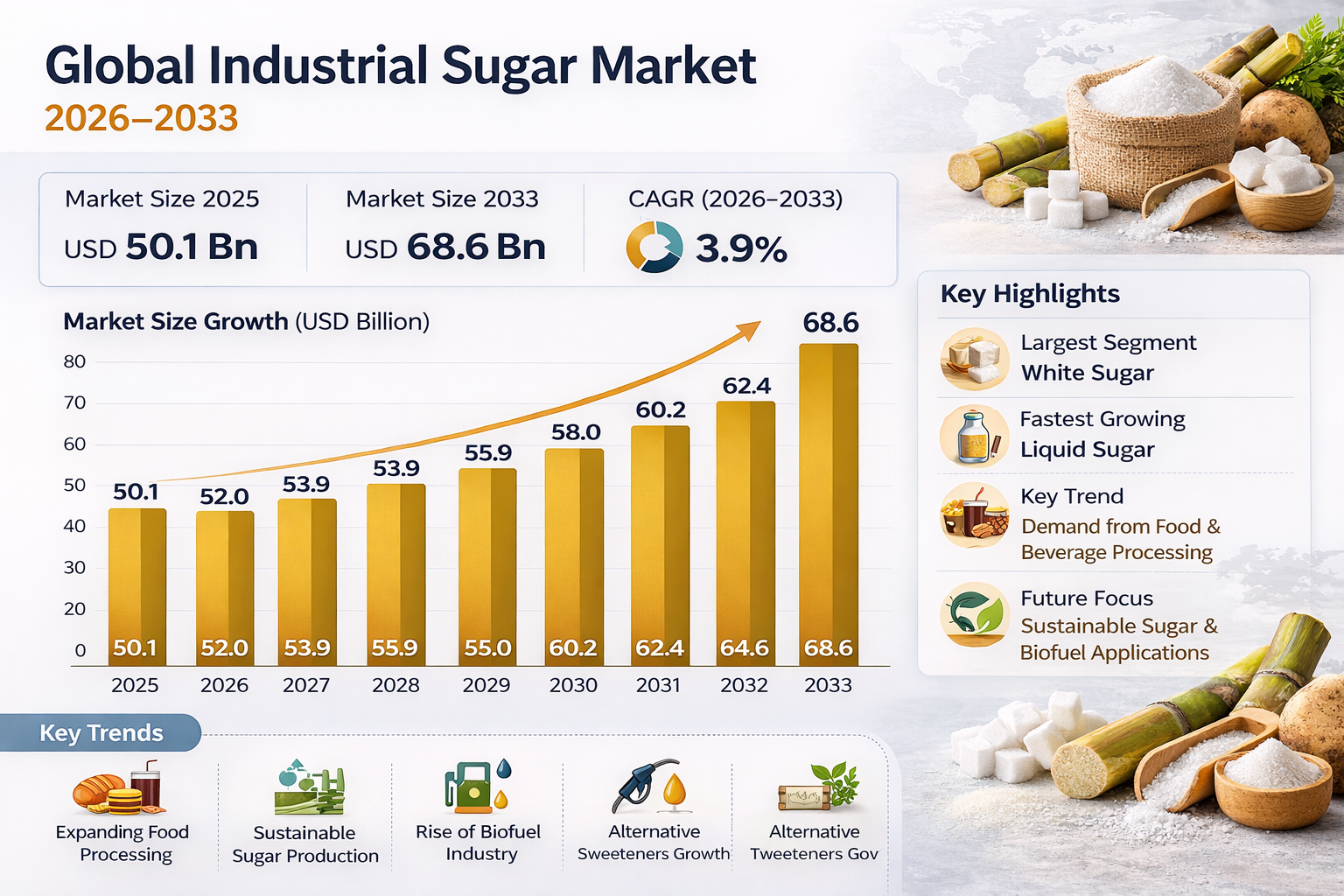
Table of Contents
Table of Contents
1. Executive Summary
1.1 Market Forecast Snapshot (2026???2033)
The Global Industrial Sugar Market is expected to witness steady growth during the 2026???2033 forecast period, supported by increasing demand from food processing, beverage manufacturing, pharmaceutical production, and industrial fermentation applications.
1.2 Global Market Size & CAGR Analysis
The market reflects stable expansion driven by rising consumption of processed foods, confectionery products, beverages, and pharmaceutical syrups. Industrial sugar continues to play a critical role in food manufacturing and ethanol production processes.
1.3 Largest & Fastest-Growing Segments
Largest Segment: White Sugar
Fastest-Growing Segment: Liquid Sugar
1.4 Region-Level Leadership & Growth Trends
Asia-Pacific currently leads the market due to large-scale sugarcane production and expanding food processing industries, while Latin America is expected to witness strong growth driven by ethanol production and sugar exports.
1.5 Key Market Drivers
Increasing global production of sugarcane
Growing demand from food and beverage processing industries
Expanding pharmaceutical and fermentation applications
Rising ethanol and biofuel production
Growth of global packaged food industries
1.6 Competitive Landscape Overview
Highly fragmented market with several regional sugar producers and multinational companies focusing on capacity expansion, supply chain optimization, and technological advancements in sugar refining.
1.7 Strategic Outlook Through 2033
Focus on sustainable sugar production, improved refining technologies, diversification into ethanol and biofuel production, and expansion of global food processing industries.
2. Introduction & Market Overview
2.1 Definition of the Global Industrial Sugar Market
Industrial sugar refers to refined sugar products derived primarily from sugarcane and sugar beet, used across food processing, beverage manufacturing, pharmaceutical formulations, and industrial fermentation applications.
2.2 Scope of the Study
Comprehensive analysis covering market trends, product segmentation, application sectors, regional demand patterns, and global market forecasts during 2026???2033.
2.3 Evolution from Traditional Sugar Consumption to Industrial Applications
The industry has evolved from household consumption toward large-scale industrial usage in food manufacturing, pharmaceuticals, ethanol production, and chemical processing.
2.4 Role of Agricultural Production & Supply Chain Infrastructure
Sugar production depends heavily on agricultural supply chains, large-scale sugarcane cultivation, and advanced sugar refining technologies.
2.5 Impact of Global Food Processing Trends
The growth of processed foods, confectionery products, and packaged beverages is significantly driving industrial sugar demand worldwide.
2.6 Integration of Sustainable Sugar Production Practices
Manufacturers are increasingly focusing on sustainable farming practices, efficient refining technologies, and environmental management systems.
2.7 Technological Advancements in Sugar Refining & Biofuel Production
Advanced processing technologies and fermentation-based ethanol production are creating new industrial applications for sugar.
3. Research Methodology
3.1 Primary Research
Interviews with sugar manufacturers, food processing companies, beverage producers, distributors, and industry experts.
3.2 Secondary Research
Industry publications, agricultural databases, government trade statistics, and corporate financial reports.
3.3 Market Size Estimation Model
Combination of bottom-up production analysis and top-down consumption modeling across major industries.
3.4 Forecast Assumptions (2026???2033)
Based on increasing demand from food processing, pharmaceutical production, and biofuel industries.
3.5 Data Validation & Triangulation
Cross-verification of market insights through supply chain analysis, industry benchmarks, and regional production data.
4. Market Dynamics
4.1 Drivers
4.1.1 Growing Production of Sugarcane
Expanding agricultural cultivation supporting global sugar production.
4.1.2 Increasing Demand from Food Processing Industries
Industrial sugar widely used in confectionery, bakery, and packaged foods.
4.1.3 Rising Beverage Industry Applications
Sugar used in soft drinks, fruit juices, and alcoholic beverages.
4.1.4 Expanding Pharmaceutical Applications
Sugar used in medicinal syrups and pharmaceutical formulations.
4.1.5 Growth in Ethanol and Biofuel Production
Industrial sugar used in fermentation processes for ethanol manufacturing.
4.2 Restraints
4.2.1 Rising demand for alternative sweeteners
4.2.2 Health concerns associated with excessive sugar consumption
4.2.3 Increasing production costs and agricultural risks
4.2.4 Environmental concerns related to monoculture sugar farming
4.3 Opportunities
4.3.1 Expansion of ethanol and biofuel industries
4.3.2 Growth of global food processing industries
4.3.3 Development of sustainable sugar farming technologies
4.3.4 Increasing industrial fermentation applications
4.4 Challenges
4.4.1 Competition from natural and artificial sweeteners
4.4.2 Regulatory pressures related to sugar consumption
4.4.3 Supply chain fluctuations in agricultural production
4.4.4 Climate change affecting sugarcane cultivation
5. Global Industrial Sugar Market Analysis (USD Billion), 2026???2033
5.1 Market Size Overview
5.2 CAGR Analysis
5.3 Region-Wise Revenue Distribution
5.4 Product Type Revenue Split
5.5 Application Industry Trends
5.6 Supply Chain Impact Analysis
6. Market Segmentation by Product Type (USD Billion), 2026???2033
6.1 White Sugar
6.1.1 Refined White Sugar
6.1.1.1 Confectionery Manufacturing
6.1.1.1.1 Bakery Applications
6.2 Brown Sugar
6.2.1 Natural Brown Sugar
6.2.1.1 Bakery Products
6.2.1.1.1 Gourmet Food Applications
6.3 Liquid Sugar
6.3.1 Industrial Liquid Sweeteners
6.3.1.1 Beverage Production
6.3.1.1.1 Soft Drink Manufacturing
7. Market Segmentation by Form Type (USD Billion), 2026???2033
7.1 Granulated Sugar
7.1.1 Food Processing Applications
7.1.1.1 Confectionery Production
7.1.1.1.1 Bakery Products
7.2 Powdered Sugar
7.2.1 Dessert and Confectionery Applications
7.2.1.1 Fine Powdered Sugar Products
7.2.1.1.1 Specialty Food Ingredients
7.3 Syrup Sugar
7.3.1 Beverage Manufacturing Applications
7.3.1.1 Liquid Sweetener Solutions
7.3.1.1.1 Industrial Food Processing
8. Market Segmentation by Source (USD Billion), 2026???2033
8.1 Cane Sugar
8.1.1 Sugarcane Processing
8.1.1.1 Industrial Production
8.1.1.1.1 Global Food Manufacturing
8.2 Beet Sugar
8.2.1 Sugar Beet Processing
8.2.1.1 Regional Sugar Production
8.2.1.1.1 Industrial Applications
9. Market Segmentation by Geography
9.1 Asia-Pacific ??? Largest Market
9.2 Latin America ??? Fastest Growing Market
9.3 North America
9.4 Europe
9.5 Middle East & Africa
10. Competitive Landscape ??? Global
10.1 Market Share Analysis
10.2 Product Portfolio Benchmarking
10.3 Global Production Capacity Mapping
10.4 Supply Chain & Distribution Partnerships
10.5 Competitive Intensity & Differentiation Strategies
11. Company Profiles
11.1 Nordzucker Group AG
11.2 I.D. Parry Limited
11.3 Tereos S.A
11.4 Archer Daniels Midland Company
11.5 Suedzucker AG
11.6 Illovo Sugar (Pty) Ltd
11.7 Mitr Phol Sugar Corp.
11.8 Cosan S.A
11.9 Wilmar International Ltd
12. Strategic Intelligence & Pheonix AI-Backed Insights
12.1 Pheonix Demand Forecast Engine
12.2 Supply Chain Infrastructure Analyzer
12.3 Industrial Sugar Production Innovation Tracker
12.4 Biofuel & Fermentation Industry Insights
12.5 Automated Porter???s Five Forces Analysis
13. Future Outlook & Strategic Recommendations
13.1 Sustainable sugar production initiatives
13.2 Technological advancements in sugar refining
13.3 Expansion of ethanol and biofuel production
13.4 Growth of global food processing industries
13.5 Long-Term Market Outlook (2033+)
14. Appendix
15. About Pheonix Research
16. Disclaimer
Competitive Landscape
Competitive Landscape of the Global Industrial Sugar Market
Executive Framing
The Global Industrial Sugar Market is characterized by a moderately consolidated structure dominated by large agribusiness corporations and regional sugar producers with strong supply chain integration. Key players such as S??dzucker AG, Tereos S.A., Wilmar International, ADM, Mitr Phol, and Nordzucker control significant production capacities and global distribution networks. Competition is largely driven by production efficiency, pricing strategies, raw material availability, and long-term supply agreements with food and beverage manufacturers.
Current Market Reality
The market is heavily volume-driven, with demand primarily coming from food processing, beverage manufacturing, and industrial fermentation industries. While traditional applications remain dominant, emerging use cases such as biofuel production and pharmaceutical formulations are gaining importance. Asia-Pacific and Latin America serve as key production hubs due to abundant sugarcane cultivation, whereas Europe leads in beet sugar processing. However, increasing health concerns related to sugar consumption and regulatory pressures are gradually reshaping demand dynamics.
Key Signals and Evidence
- Strong and consistent demand from global food and beverage processing industries.
- Expansion of ethanol and biofuel production using sugar-based feedstocks.
- Rising investments in large-scale sugar refining and processing facilities.
- Increasing regulatory scrutiny on sugar consumption in developed markets.
- Growing adoption of liquid sugar and industrial sweetener solutions in beverages.
Strategic Implications
- Cost Leadership Strategy: Focus on large-scale production efficiency and optimized supply chains to maintain competitive pricing.
- Diversification into Biofuels: Expanding ethanol production capabilities to reduce dependence on food industry demand.
- Product Innovation: Growth in liquid sugar and customized industrial sweetener solutions for beverage manufacturers.
- Sustainability Initiatives: Adoption of sustainable farming practices and low-carbon sugar production methods.
- Geographic Expansion: Strengthening presence in emerging markets with growing food processing industries.
Forward Outlook
By 2033, the Global Industrial Sugar Market is expected to remain a critical backbone of the global food and industrial manufacturing ecosystem, with steady but moderate growth. While traditional demand from food and beverages will continue to dominate, diversification into ethanol production and industrial applications will become increasingly important.
Asia-Pacific and Latin America will continue to lead in production, while demand growth will be driven by expanding food industries in emerging economies. Companies that invest in sustainable production, value-added sugar products, and diversified industrial applications will secure long-term competitive advantages in an evolving regulatory and health-conscious global market environment.
Value Chain
Global Industrial Sugar Market: Value Chain & Market Dynamics
Executive Framing
The Global Industrial Sugar Market operates within a high-volume commodity and food processing ecosystem, driven by strong demand from food, beverage, pharmaceutical, and biofuel industries. Sugar serves as a core industrial ingredient used for sweetening, preservation, and fermentation processes across multiple sectors.
The market follows an integrated operational model, encompassing sugarcane and sugar beet cultivation, refining, processing, and large-scale industrial distribution, ensuring consistent supply for global manufacturing industries.
Current Market Reality
The industry is characterized by a moderate-to-high supply chain complexity, influenced by agricultural dependency, seasonal production cycles, and global trade dynamics. Price volatility and regulatory policies further impact market stability.
Distribution is primarily bulk-oriented, with supply directed toward food processors, beverage manufacturers, pharmaceutical companies, and industrial users through long-term contracts and wholesale channels.
Key Signals and Evidence
- Market growth from USD 50.1 billion (2025) to USD 68.6 billion (2033) at a CAGR of 3.9%.
- Strong demand from food processing and beverage manufacturing industries.
- Rising use of industrial sugar in ethanol and biofuel production.
- Expansion of pharmaceutical and fermentation-based applications.
- Increasing focus on sustainable sugar production and refining technologies.
Strategic Implications
Market players are focusing on capacity expansion, supply chain optimization, and cost-efficient production to maintain competitiveness. Large companies leverage economies of scale and global trade networks, while regional players focus on localized supply and agricultural efficiency.
Sustainability initiatives, including water-efficient farming, renewable energy use, and carbon footprint reduction, are becoming critical for long-term market positioning.
Forward Outlook
The Global Industrial Sugar Market is expected to remain a stable and essential component of global industrial supply chains, while adapting to evolving consumption patterns and regulatory pressures.
- Growth in biofuel and ethanol production applications
- Increasing adoption of sustainable and eco-friendly sugar production
- Technological advancements in sugar refining and processing
- Gradual shift toward alternative sweeteners alongside traditional sugar
Companies that focus on efficiency, sustainability, and diversified industrial applications will sustain long-term growth in the global industrial sugar market.
Investment Activity
Investment & Funding Dynamics ??? Global Industrial Sugar Market
Executive Framing
Current Market Reality
Valued at USD 50.1 billion in 2025 and projected to reach USD 68.6 billion by 2033 (CAGR 3.9%), the market reflects steady but moderate investment growth. Asia-Pacific and Latin America remain key investment hubs due to large-scale sugarcane production and ethanol manufacturing, while Europe maintains strong beet sugar processing capabilities. Leading players such as Archer Daniels Midland Company, Tereos S.A., and Wilmar International Ltd are investing in production capacity expansion, refining technologies, and global distribution networks.
Key Signals and Evidence
- Food & Beverage Industry Demand: Continuous investments driven by large-scale consumption in processed foods and beverages.
- Expansion of Sugarcane Cultivation: Increasing capital allocation toward agricultural productivity and raw material supply stability.
- Biofuel and Ethanol Production: Rising investments in sugar-based ethanol production for energy and industrial applications.
- Industrial Processing Infrastructure: Growth in sugar refining, storage, and logistics capabilities.
- Pharmaceutical Applications: Steady demand for sugar in medicinal syrups and fermentation processes.
- Global Supply Chain Optimization: Investments in distribution networks and export capabilities.
- Shift Toward Sustainable Production: Emerging focus on eco-friendly sugar production and waste reduction technologies.
Strategic Implications
Companies that focus on cost efficiency, large-scale production, and vertical integration across farming, refining, and distribution will capture long-term value. Investors are prioritizing companies with strong supply chain control and diversified industrial applications, including ethanol and pharmaceuticals. Strategic collaborations with food and beverage manufacturers will further strengthen market positioning and demand stability.
Forward Outlook
From 2026 to 2033, investment in the Global Industrial Sugar Market is expected to remain steady, with increasing focus on sustainable sugar production, biofuel applications, and process optimization technologies. While demand from industrial applications will remain strong, evolving consumer preferences toward low-sugar diets may influence long-term investment strategies. M&A activity is expected to remain moderate, driven by consolidation in production and distribution capabilities.
Technology & Innovation
Global Industrial Sugar Market: Technology & Innovation
Executive Framing
Technology and innovation in the Global Industrial Sugar Market are centered on improving production efficiency, enhancing sustainability, and expanding industrial applications beyond traditional food and beverage usage. As demand from food processing, pharmaceuticals, and biofuel industries continues to rise, manufacturers are adopting advanced refining technologies, automation systems, and bio-based processing methods to optimize output quality and reduce environmental impact.
Current Market Reality
Valued at USD 50.1 billion in 2025 and projected to reach USD 68.6 billion by 2033 at a CAGR of 3.9%, the market reflects steady but moderate growth. White sugar remains the dominant segment, while liquid sugar is emerging as the fastest-growing category due to its ease of use in beverage and food processing applications. Asia-Pacific leads in production and consumption, supported by large-scale sugarcane cultivation and expanding industrial demand.
Key Signals and Evidence
- Advanced Sugar Refining Technologies: Adoption of energy-efficient refining processes and membrane filtration systems to improve sugar purity and production efficiency.
- Automation & Smart Manufacturing: Integration of IoT, AI, and robotics in sugar mills to enhance process control, reduce waste, and optimize operational performance.
- Biofuel & Ethanol Innovation: Increasing use of industrial sugar in ethanol production, supported by advancements in fermentation technologies and renewable energy initiatives.
- Sustainable Sugar Production: Implementation of water-efficient irrigation, waste recycling, and carbon reduction strategies in sugarcane and beet cultivation.
- Liquid Sugar Processing Growth: Rising demand for liquid sugar solutions in beverage manufacturing and industrial food processing.
- By-Product Utilization: Innovation in utilizing molasses and bagasse for bioenergy, animal feed, and biochemical production.
Strategic Implications
Companies investing in sustainable production technologies, automation, and diversified industrial applications such as biofuels and biochemicals will gain a competitive advantage. Expanding into liquid sugar and value-added by-products can enhance revenue streams and operational efficiency. Additionally, aligning production with environmental regulations and carbon reduction goals will be critical for long-term market positioning.
Forward Outlook
The market is expected to evolve toward a more sustainable and diversified industrial ecosystem, where sugar serves as a key input for food, energy, and biochemical industries. Future innovation will focus on low-carbon sugar production, advanced fermentation technologies, and integration with circular economy models. Industrial sugar will continue to play a vital role in global manufacturing, while adapting to changing health and regulatory landscapes.
Market Risk
Risk Factors and Disruption Threats in the Global Industrial Sugar Market
Executive Framing
The Global Industrial Sugar Market is evolving as a foundational component of the global food, beverage, and industrial ecosystem, driven by consistent demand across multiple end-use industries. Valued at USD 50.1 billion in 2025 and projected to reach USD 68.6 billion by 2033 at a CAGR of 3.9%, the market reflects stable growth supported by expanding food processing activities, beverage consumption, and industrial applications such as pharmaceuticals and biofuels.
Current Market Reality
Asia-Pacific dominates the global industrial sugar market due to large-scale sugarcane production, growing population, and expanding food processing industries. Latin America also plays a significant role, particularly in ethanol production and export-oriented sugar manufacturing. White sugar remains the leading segment owing to its widespread use in food and beverage applications, while liquid sugar is emerging as the fastest-growing segment due to its efficiency in large-scale beverage production and industrial processing.
Key Signals and Evidence
- Strong and consistent demand from food and beverage processing industries worldwide.
- Expansion of sugarcane cultivation supporting large-scale production capacity.
- Increasing use of industrial sugar in pharmaceutical and fermentation processes.
- Growing role of sugar in biofuel and ethanol production across key regions.
- Rising pressure from health trends encouraging reduced sugar consumption and reformulation.
Strategic Implications
- Invest in sustainable sugar production and efficient refining technologies.
- Expand into biofuel and ethanol production to diversify revenue streams.
- Optimize supply chains to manage agricultural and pricing volatility.
- Develop low-calorie and alternative sweetener blends to address health concerns.
- Strengthen partnerships with food processing and beverage manufacturing industries.
Forward Outlook
The industrial sugar market is expected to maintain steady and resilient growth, transitioning toward a more diversified and sustainability-driven ecosystem. While traditional demand from food and beverage sectors will remain strong, future growth will increasingly depend on biofuel applications, technological advancements in sugar processing, and adaptation to changing consumer preferences. Companies focusing on sustainability, efficiency, and product diversification will be better positioned to navigate evolving market dynamics and secure long-term competitive advantage.
Regulatory Landscape
Regulatory & Policy Landscape: Global Industrial Sugar Market
Executive Framing
The Global Industrial Sugar Market operates within a highly regulated framework influenced by agricultural policies, food safety standards, trade regulations, and environmental sustainability mandates. Key regulatory bodies such as the U.S. FDA, European Commission, Codex Alimentarius, and national agricultural authorities govern sugar production, processing, and distribution.
Industrial sugar is regulated across multiple sectors including food and beverages, pharmaceuticals, and biofuels, requiring compliance with diverse regulatory standards related to quality, purity, labeling, and industrial usage.
Current Market Reality
The market is heavily shaped by government intervention, including subsidies, price controls, and import-export tariffs, particularly in major sugar-producing countries. These policies significantly influence global pricing dynamics and supply stability.
At the same time, rising health concerns related to excessive sugar consumption are prompting stricter regulations on sugar usage, labeling, and marketing???especially in processed foods and beverages. Sugar taxes and reformulation mandates are becoming increasingly common in developed economies.
Key Signals and Evidence
- Government subsidies and price control mechanisms in major sugar-producing countries.
- Implementation of sugar taxes on beverages and processed foods in multiple regions.
- Strict quality and purity standards for industrial and food-grade sugar.
- Trade regulations affecting global sugar exports and imports.
- Increasing regulatory pressure on reducing sugar content in food and beverages.
- Growing sustainability regulations for water usage, emissions, and agricultural practices.
Strategic Implications
Companies must align with evolving regulatory frameworks by optimizing production efficiency, ensuring compliance with food safety standards, and adapting to sugar reduction policies. Diversification into alternative sweeteners and low-sugar formulations is becoming a strategic necessity.
Investments in sustainable sugar production, including water-efficient farming, renewable energy usage, and waste management, will be critical for long-term regulatory compliance and brand positioning.
Forward Outlook
Regulatory pressures on sugar consumption are expected to intensify, with more countries implementing sugar taxes and stricter labeling requirements. Policies promoting healthier diets and reduced sugar intake will reshape demand patterns across the food and beverage industry.
Additionally, sustainability regulations and climate-related policies will drive innovation in eco-friendly sugar production and biofuel applications. Technological advancements in refining processes and alternative sweetener development will further influence the regulatory landscape.