
Global Telecom Service Assurance Market Size, Share, Trends and Forecast 2026-2033
Telecom service assurance is a USD 11.84 billion market in 2025, growing at 9.2 per cent a year to USD 23.96 billion in 2033 — roughly three and a half times the growth rate of the operator revenue it is drawn from. That gap is the whole story: the market does not grow because telecom grows, it grows because the share of telecom revenue spent proving that services work is rising.
Five findings define this edition.
First, the buying centre has moved from engineering to the commercial side of the operator. When assurance monitored a voice network, an outage was a churn risk. When it monitors an enterprise 5G slice with a contractual service-level agreement attached, an outage is a rebate. The budget owner changed accordingly, and so did the willingness to pay for proof rather than for detection.
Second, the delivery model is shifting decisively toward managed and hosted service. Amdocs closed fiscal 2025 with revenue of USD 4.53 billion and record managed-services revenue of USD 2.996 billion, or 66 per cent of the total, with a twelve-month backlog of USD 4.19 billion. Mid-tier operators that will never build a twenty-four-hour assurance centre are buying the outcome instead, which raises revenue per account and lengthens contract duration.
Third, the specialist layer is consolidating into fewer, larger measurement platforms. Keysight completed its acquisition of Spirent on 15 October 2025 for approximately GBP 1.16 billion, around USD 1.46 billion, and, under a consent decree with the US Department of Justice and undertakings given to China's SAMR, divested Spirent's high-speed Ethernet, network security and channel emulation lines — which VIAVI absorbed. VIAVI's Network and Service Enablement segment grew 69.2 per cent year over year in its fourth fiscal quarter of 2026 on that consolidation.
Fourth, the growth is uneven inside the category. Pure-play assurance revenue is compounding in the mid single digits for incumbents while the market grows at 9.2 per cent, which means the delta is being captured by managed services, by cloud-native challengers in greenfield Open RAN builds, and by equipment vendors bundling assurance into multi-year network contracts rather than by the standalone licence line.
Fifth, AI has changed what the product is. NETSCOUT extended its Omnis AI Insights platform to communications service providers in February 2026 explicitly to give agentic AI a data foundation in customer experience and network operations. The durable asset in this market is no longer the dashboard or the algorithm; it is the normalised, low-latency, cross-domain data layer underneath both.
Strategic implications. Operators should expect assurance to be priced as a service with an outcome attached, not as a licence with a maintenance line. Vendors without a proprietary data-acquisition capability will compete on price against equipment vendors giving the function away to defend a network contract. Investors should treat the category's growth rate as real but concentrated: the 9.2 per cent accrues to the managed-service and data-layer positions, and a passive exposure to legacy OSS software will not capture it.
The global telecom service assurance market is valued at USD 11.84 billion in 2025 and is forecast to reach USD 23.96 billion by 2033, equivalent to a compound annual growth rate of 9.2 per cent.
Service assurance is the commercial mechanism by which a communications service provider proves that the network it sold is the network it delivered. It spans fault management, performance management, service-quality and customer-experience monitoring, and increasingly the closed-loop automation that corrects a degradation before a subscriber notices it. It is one of the few software categories inside a telecom operator where a buyer can attach a revenue figure to a failure: a dropped session on an enterprise 5G slice is a contractual breach, not an inconvenience.
Three structural changes sit behind the 9.2 per cent forecast, and none of them is subscriber growth. The first is disaggregation. The GSMA's Mobile Economy 2025 puts 5G at 25 per cent of connections in 2024, rising to 57 per cent by 2030; a standalone 5G core running across public and private cloud, fronted by multi-vendor Open RAN, carries several times the number of observable failure domains of the single-vendor 4G core it replaced. The second is the migration of operator spend from capex toward opex and outsourcing. The GSMA puts operator revenue at USD 1.08 trillion in 2024 rising to USD 1.25 trillion in 2030, on USD 1.3 trillion of capex across 2024-2030 — revenue that grows at roughly 2.5 per cent a year while the assurance bill inside it grows at 9.2. The third is AI: agentic operations need a curated, low-latency, normalised data layer, and that layer is service assurance's real product.
| Metric | Value |
|---|---|
| Market size, 2025 | USD 11.84 billion |
| Forecast, 2033 | USD 23.96 billion |
| CAGR, 2025-2033 | 9.2 per cent |
| Assurance spend as a share of operator revenue, 2025 | 1.07 per cent |
| Assurance spend as a share of operator revenue, 2033 | 1.81 per cent |
| Currency and scale | USD, billions |
| Fastest-growing layer | Managed and cloud-native assurance |
| Largest buying group | Mobile network operators |
What this report measures
The perimeter is software, subscription and managed-service revenue earned from fault, performance, service-quality and customer-experience assurance sold to communications service providers. Test, probe and capture hardware is counted only where it is bundled into an assurance contract rather than sold as capital equipment to a lab. Network planning, radio optimisation, inventory and billing are excluded, as is the internal cost of an operator's own assurance staff.
That perimeter matters, because published estimates of this market span a wide band — from roughly USD 9 billion to USD 13 billion for 2025 — depending on whether managed services, test and measurement, and the assurance line inside network equipment vendors' bundled contracts are counted. Pheonix's figure sits in the upper half of that band because it counts managed service revenue, which is where an increasing share of the function has migrated.
How the 2025 base was built
The base is built from the buyer side rather than by summing vendor revenues, because no vendor set in this category is close to complete. Operator revenue of USD 1.08 trillion in 2024 interpolates to approximately USD 1.11 trillion in 2025 on the GSMA's path to USD 1.25 trillion in 2030. Applying an assurance intensity of 1.07 per cent — the observed ratio across the disclosed pure-play revenue base and the assurance lines inside the large equipment vendors — gives USD 11.84 billion.
The 2033 endpoint applies a 1.81 per cent intensity to an operator revenue base of roughly USD 1.33 trillion, which extends the GSMA path three years at 2 per cent. The intensity rise, from 1.07 to 1.81 per cent, is the entire thesis: assurance takes a larger share of a slower-growing revenue pool because the network it supervises has become more complex, more virtualised and more contractually committed to enterprise service levels.
The forecast path
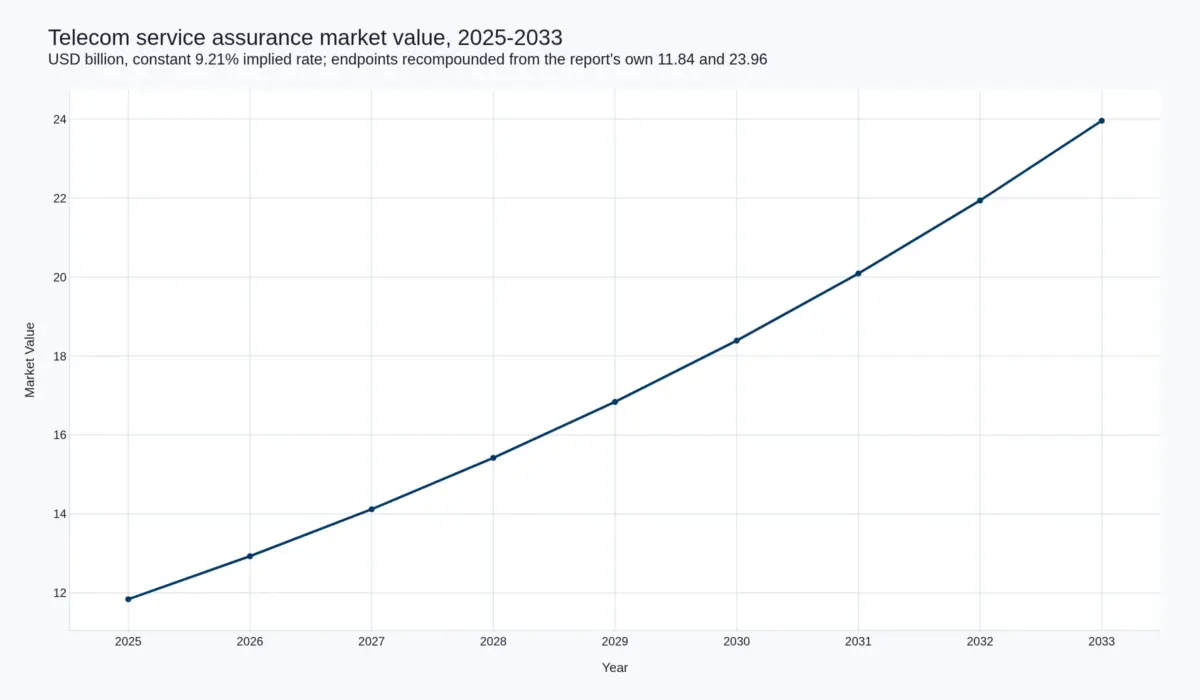
The annual series compounds the 9.21 per cent implied rate evenly across the window, producing USD 11.84, 12.93, 14.12, 15.42, 16.84, 18.39, 20.09, 21.94 and 23.96 billion from 2025 to 2033. A flat rate is the honest representation here, because the growth driver is a single ratio — assurance intensity against operator revenue — rather than a staged product rollout with dated milestones. That intensity rises from 1.07 per cent to 1.81 per cent across the eight years, and there is no year in which the model claims a discontinuity.
What the path cannot tell you is timing. If an operator consolidates its assurance vendors in one procurement cycle, or a large managed-services contract is re-scoped downward, the step lands in a single year and the total adjusts at once. The line is smooth because the model is smooth, not because the market is.
Why this edition replaces the 2021 series
This record previously carried a 2021-2028 series that placed the market above USD 10 billion by 2028 at 9.9 per cent. The direction was right and the magnitude is close, but the horizon, the base year and the composition were wrong: the 2021 base made no allowance for managed services, and the 2028 endpoint is now inside the historical window. This edition rebases to 2025 and extends to 2033 in line with the rest of the Pheonix telecom and enterprise software series.
Segmentation
By solution: software and services, with the software line itself split between fault and performance management, service-quality management, customer-experience analytics and orchestration. By deployment: on-premises, cloud-native and hybrid. By operator type: mobile network operators, fixed and cable operators, and the wholesale, MVNO and private-network operators that increasingly buy assurance as a hosted function. By organisation size: large enterprises and small and medium-sized operators. By geography: North America, Europe, Asia-Pacific, South America and the Middle East and Africa.
The chapters that follow work from the value chain outward: how assurance is built and sold, where the technology is heading, who holds share, what regulators require, where capital is moving, and what would break the forecast.
Table of Contents
1. Executive Summary
1.1. Market size and forecast at a glance
1.2. What changed in the 2026-2033 series
1.3. Key findings
1.4. Strategic implications
2. Market Definition and Scope
2.1. What service assurance covers
2.2. What is measured and what is excluded
2.3. The published range and why estimates differ
2.4. Research methodology
3. Market Size and Forecast, 2025-2033
3.1. Base year 2025 and the operator-revenue anchor
3.2. The intensity ratio: why assurance outgrows the network
3.3. Forecast path to 2033
3.4. Segment structure by solution, deployment and operator type
3.5. Regional profile
4. Value Chain and Delivery Model
4.1. Data acquisition: probes, telemetry and the economics of capture
4.2. Normalisation and the mediation layer
4.3. Analytics, correlation and closed-loop action
4.4. Direct sales, systems integrators and vendor bundling
4.5. The managed-service migration
5. Technology and Innovation
5.1. 5G standalone and assurance as revenue assurance
5.2. Open RAN, the RIC and near-real-time control
5.3. Cloud-native observability and the IT convergence
5.4. Agentic AI and the data-layer premium
5.5. Technology maturity and adoption barriers
6. Competitive Landscape
6.1. Market structure: two camps and a shrinking middle
6.2. The OSS and BSS incumbents
6.3. The assurance specialists
6.4. Test and measurement after the Keysight-Spirent consolidation
6.5. Hyperscalers and the bundled-assurance threat
6.6. Competitive intensity and share trajectory
7. Regulatory and Policy Environment
7.1. Network security regimes and vendor diversification
7.2. Lawful interception and data residency
7.3. Service-quality disclosure and net neutrality
7.4. Emergency calling and availability obligations
7.5. AI governance in automated network decisions
8. Investment Activity
8.1. Consolidation in test and measurement
8.2. Buybacks, backlog and the discipline of the incumbents
8.3. Private capital and carve-outs
8.4. Capital intensity and where the money goes
9. Market Risk Assessment
9.1. Buyer consolidation risk
9.2. Hyperscaler substitution risk
9.3. Geopolitical and supply-chain exposure
9.4. Pricing pressure in managed services
9.5. Demand risk from AI capex crowd-out
10. Outlook and Strategic Implications
10.1. Base, upside and downside paths to 2033
10.2. What to watch
10.3. Implications for operators, vendors and investors
10.4. Conclusion
Competitive Landscape
A market with two camps and a thinning middle
Telecom service assurance is not a single competitive arena. It is a set of adjacent ones that share a buyer. The first camp is the OSS and BSS incumbents — Amdocs, Ericsson, Nokia, Huawei, Netcracker, Oracle and CSG — which sell assurance as one module of a much larger operational and commercial stack, often attached to a network or billing contract. The second camp is the assurance specialists — NETSCOUT, VIAVI, MYCOM OSI, EXFO, Infovista, TEOCO and, until October 2025, Spirent — which sell the function as the product. Between them sits a thinning middle of regional OSS vendors and systems integrators with their own tooling.
Structure is moderately concentrated at the top and fragmented by layer. The legacy OSS and BSS incumbents still hold roughly half of the installed base, but almost all of that base is brownfield: networks built between 2005 and 2020 on element-level performance management. The specialists’ share is smaller and growing faster, and it is concentrated in two places — large operators that have deliberately chosen vendor-neutral assurance for a multi-vendor core, and greenfield builds where the assurance decision was made at the same time as the network architecture rather than five years later.
What the disclosed numbers actually show
The pure-play comparables are unusually informative in this cycle, because their reported growth diverges sharply from the market’s 9.2 per cent.
| Vendor | Period | Revenue | Growth |
|---|---|---|---|
| Amdocs | FY2025 (to 30 Sep 2025) | USD 4,533m, of which managed services USD 2,996m | -9.4% reported, +3.1% pro forma constant currency |
| NETSCOUT | FY2026 (to 31 Mar 2026) | USD 859.5m, of which service USD 489.3m | +4.5% |
| VIAVI, Network and Service Enablement | Q4 FY2026 (to 27 Jun 2026) | USD 353.9m in the quarter | +69.2% year over year |
| VIAVI, total | FY2026 | USD 1.5bn | +40.0% |
Read together, these three tell a coherent story. NETSCOUT’s 4.5 per cent — with fiscal 2027 guidance of USD 885-915 million, a 4.7 per cent midpoint — is what a mature pure-play grows at when it is selling into brownfield operators. Amdocs’ pro forma 3.1 per cent is what a large OSS and BSS incumbent grows at while deliberately shedding non-core business, with its assurance exposure wrapped inside a managed-services book that is now two thirds of revenue. VIAVI’s 40 per cent is not organic demand at all: it is the absorption of the business lines Spirent was required to divest, and it is the clearest single demonstration of how consolidation mechanically redistributes revenue in this category.
The gap between those figures and 9.2 per cent is not a contradiction. It is the measure of how much of this market’s growth is booked as managed service, as bundled equipment contract value, and by challengers too small to appear in a disclosed comparable set. Any vendor whose growth tracks its own licence line is not participating in the forecast.
Test and measurement after the Keysight-Spirent consolidation
Keysight completed its acquisition of Spirent Communications on 15 October 2025, for aggregate consideration of approximately GBP 1.16 billion, around USD 1.46 billion on a fully diluted basis, with Spirent shareholders receiving 202.5 pence per share. The deal cleared the US Department of Justice, the UK Competition and Markets Authority, the French Ministry for the Economy, the German Federal Ministry for Economic Affairs and Climate Action, and China’s State Administration for Market Regulation.
Those clearances came with conditions that reshaped the competitive landscape more than the merger itself. Under a consent decree with the Department of Justice and undertakings given to SAMR, Keysight and Spirent agreed to divest Spirent’s high-speed Ethernet, network security and channel emulation business lines, and that divestiture completed on 16 October 2025. VIAVI took the assets, which is why its Network and Service Enablement segment grew 69.2 per cent year over year in the quarter ended 27 June 2026 and why its total revenue rose 40 per cent to USD 1.5 billion.
The net effect is a measurement layer with fewer, larger participants and a clearer division of labour: Keysight holds design, emulation and satellite positioning; VIAVI holds the Ethernet, security and channel-emulation lines plus its historical test and assurance franchise. For operators, fewer bidders in test and measurement means less leverage on price, and it strengthens the hand of the remaining independents in assurance proper.
Hyperscalers and the bundled-assurance threat
The most credible long-run threat does not come from another assurance vendor. It comes from the cloud platforms on which the 5G core now runs. A hyperscaler that already hosts the core, sells the observability stack for the workloads on it, and bundles basic network and service monitoring into the consumption bill can make the entry-level assurance decision close to free. That is tolerable while operators buy assurance for forensic depth and cross-domain correlation, and dangerous the moment operators conclude that cloud-native observability is good enough for everything except the most severe faults.
The countervailing force is regulatory and commercial rather than technical: an operator reporting service quality to a regulator, or defending a service credit claim to an enterprise customer, needs evidence that is neutral between the cloud provider and the network vendor. A hyperscaler’s own telemetry is not that evidence, and operators know it.
Where share is going
Three movements are visible. Greenfield Open RAN and standalone-core builds are going disproportionately to API-first challengers and to the specialists, because the architecture makes vendor-neutral correlation a requirement rather than a preference. Brownfield estates are sticky and continue to renew with the incumbent, which is why the installed base remains concentrated. And the mid-tier operator segment — the hundreds of operators below the global top twenty — is moving to managed service faster than either, because those operators increasingly cannot staff a twenty-four-hour assurance function at all.
Competitive intensity is high, and rising at the low end. The pricing pressure is not in the enterprise-grade assurance deals, where the buyer is solving a regulatory problem; it is in the tier-two and tier-three market, where the buyer is solving a headcount problem and will take an adequate hosted product at a third of the price.
Value Chain
The four stages that decide who gets paid
Service assurance is conventionally drawn as a single box in an OSS diagram. Commercially it is four separable businesses with very different margins: data acquisition, normalisation, analytics and action. Almost every strategic question in this market resolves to which of those four a vendor actually owns.
Data acquisition. The assurance function is only as good as the traffic it can see. There are two ways to see it. Probes and packet brokers capture at line rate from taps on the physical network, which gives complete fidelity and forensic depth at a hardware cost that scales with bandwidth. Streaming telemetry — gNMI and OpenConfig pushed from the network elements themselves — gives far broader coverage at almost no marginal cost, but at whatever granularity and sampling interval the equipment vendor chose to expose. The industry has spent a decade migrating from the first to the second, and the migration has compressed the hardware line inside this market while expanding its software line. It has also created a dependency: an assurance platform fed only by vendor telemetry inherits the vendor’s view of what constitutes a fault.
Normalisation. This is the least glamorous stage and the most defensible. A tier-one operator runs thousands of element types across several generations of technology, and each reports performance in its own schema, its own counters and its own time base. The mediation layer that maps all of it onto a common information model — service, subscriber, slice, flow — is what makes cross-domain correlation possible at all. NETSCOUT’s positioning of its platform as an AI-ready data foundation, extended to communications service providers in February 2026, is a direct claim on this layer. It is also the layer that is hardest to displace once installed, because it is where the operator’s institutional knowledge of its own network accumulates.
Analytics and action. Correlation, root-cause analysis, anomaly detection and the closed-loop automation that either raises a ticket or reconfigures the network. This is where the category’s pricing power is weakest and its visibility highest: a good dashboard is easy to demonstrate and easy to replicate, which is why so much of the differentiation has migrated down into acquisition and normalisation.
How it is sold
Three routes reach the buyer, and the mix between them is shifting. Direct sale to the operator’s network or IT organisation remains the norm for the large incumbents, typically as a multi-year licence with maintenance. A systems-integrator overlay — Accenture, Tata Consultancy Services, Capgemini, HCL and the operator-focused practices of the Indian and European service firms — is increasingly common where the operator wants the assurance function run rather than installed, and where the integrator already holds the managed-services contract for the surrounding estate. Equipment-vendor bundling remains the largest channel by volume, because Nokia, Ericsson, Huawei and Cisco can attach an assurance capability to a radio or core contract at marginal cost and price it as part of the network.
That third route is the structural problem for independents. An assurance module given away to protect a multi-billion-dollar radio contract does not need to be the best product in the category; it needs to be adequate and already integrated. The independents’ counter-argument is vendor-neutrality: an operator running a multi-vendor core cannot accept an assurance system that only sees one vendor’s domain, and the more disaggregated the network becomes, the stronger that argument gets.
Supply-chain complexity is high, and it is not only silicon. Probe platforms depend on high-speed Ethernet capture silicon, field-programmable gate arrays and, increasingly, merchant switch silicon — a supply chain that ran into lead-time problems through 2022 and 2023 and has since normalised. Above the hardware, the constraint is people: engineers who understand both telecom protocols and cloud-native operations are scarce, and managed-service providers are competing for exactly the same cohort as their customers.
The managed-service migration is the commercial story of the decade
The clearest disclosed evidence of where this market is going is in Amdocs’ fiscal 2025 results. Total revenue was USD 4.53 billion, down 9.4 per cent as reported because of the deliberate phase-out of certain business activities, but up 3.1 per cent on a pro forma constant-currency basis — and within that, managed-services revenue reached a record USD 2.996 billion, or about 66 per cent of the total, with a twelve-month backlog of USD 4.19 billion, up 3.2 per cent.
That mix is the template. The operator keeps the policy, the service models and the vendor relationships; the vendor keeps the network operations centre, the tooling and the staff. For the vendor, the economics change shape: lower gross margin per unit of work, but recurring revenue, multi-year duration, and a data position that deepens every year the contract runs. For the market, it means a growing share of the 9.2 per cent is being booked as service revenue rather than as software, which is precisely why estimates that count only software licences understate the category.
The limit to the migration is the operator’s own risk appetite. Outsourcing assurance means outsourcing the evidence used in regulatory service-quality reporting and in enterprise SLA disputes, and a small number of large operators — particularly in North America and Japan — have concluded that the data layer is too close to the customer relationship to hand over. Those accounts remain the independent vendors’ strongest territory.
Investment Activity
The capital is moving through consolidation, not through new entrants
Investment in telecom service assurance in 2025 and 2026 has been dominated by one large transaction and a series of smaller, quieter capital returns. That pattern is characteristic of a market whose technology is mature, whose buyers are consolidating, and whose participants are generating more cash than they can reinvest at attractive returns.
Keysight buys Spirent, and VIAVI ends up with part of it
The defining transaction was Keysight’s acquisition of Spirent Communications, completed on 15 October 2025 at approximately GBP 1.16 billion, around USD 1.46 billion on a fully diluted basis. The antitrust conditions attached to clearance mattered as much as the price. To satisfy a consent decree with the US Department of Justice and undertakings given to China’s SAMR, Keysight and Spirent agreed to divest Spirent’s high-speed Ethernet, network security and channel emulation business lines, with that divestiture completing on 16 October 2025.
VIAVI was the beneficiary. Its fiscal 2026 revenue rose 40 per cent to USD 1.5 billion, and its Network and Service Enablement segment delivered USD 353.9 million in the quarter ended 27 June 2026, up 69.2 per cent year over year, with segment growth driven largely by the acquired lines rather than by underlying demand. The strategic logic on both sides is the same: in a market where assurance and test are converging on the same packet data, scale in measurement is the cheapest route to a defensible position.
Two consequences follow. First, the number of independent bidders in carrier test and assurance fell by one at the top of the market. Second, the assets were redistributed in a way that no commercial negotiation would have produced — a regulator decided which vendor got which capability — and the resulting portfolios will take several years to integrate.
Capital returns at the incumbents
Amdocs repurchased USD 551 million of its own shares in fiscal 2025 and, alongside its fourth-quarter results, its board approved an 8 per cent increase in the quarterly dividend from USD 0.527 to USD 0.569 per share. NETSCOUT repurchased approximately 2.5 million shares for USD 60.8 million during fiscal 2026, ended the year with USD 705.1 million in cash and marketable securities and no debt outstanding under its USD 600 million revolving facility, and in May 2026 closed the acquisition of DigiCert’s DDoS protection business, which it expects to contribute approximately USD 20 million of annualised revenue.
Those numbers describe a category that is not capital-hungry. Assurance software is not a fab business: the marginal cost of a licence is close to zero, research and development runs in the mid teens as a percentage of revenue, and the hardware content inside a modern deployment is smaller than it was a decade ago because streaming telemetry has replaced probes in many roles. The capital intensity of the category is moderate and falling, which is why so much of the cash flow goes back to shareholders rather than into capacity.
The NETSCOUT acquisition is worth noting for what it signals: adjacency buying into security, where the same packet data supports DDoS detection. That is the most plausible consolidation vector left in the category — not assurance vendors merging with each other, but assurance data platforms extending into security, experience analytics and fraud.
What is not happening
There has been no wave of sponsor-led take-privates in this category, despite the cash generation and the strategic value of the installed base. The reason is structural rather than cyclical: the buyers of assurance assets are strategic, the assets are deeply embedded in operator workflows, and a financial owner would inherit long renewal cycles and heavy integration obligations without the cross-sell that makes a strategic deal work. The consolidation is strategic, and it is likely to stay that way.
Where capital is going inside the operator
The buyer-side capital picture is more complicated than the vendor-side one. The GSMA’s forecast of USD 1.3 trillion of operator capex across 2024-2030 is large, but the composition is shifting toward data-centre and AI infrastructure and away from radio, and assurance is an opex line that sits beside that capex rather than inside it. In practice this helps the market: an operator cutting radio capital expenditure to protect its balance sheet still needs to prove the network it already owns is working, and the cheapest way to protect service quality without new capex is to instrument what exists.
Technology & Innovation
The category is old; its cloud-native form is not
Assurance has existed since networks became too large to supervise by hand, and it has been a software category for a quarter of a century. That history matters for how innovation should be read here: the concepts are mature, the deployment model and the data architecture underneath them are not. Almost all of the meaningful change in this market since 2020 sits in three places — what the network exposes, how the assurance function is packaged, and what does the deciding.
5G standalone turns assurance into revenue assurance
The GSMA expects 5G to move from 25 per cent of connections in 2024 to 57 per cent by 2030, and the commercial significance of that shift is not speed. A non-standalone 5G network is a faster radio bolted onto a 4G core, and its assurance problem is the one operators already knew how to solve. A standalone core is different: it is cloud-native, it is sliced, and each slice is a separately sold product with its own committed latency, throughput and availability. That converts a technical monitoring function into the system of record for a commercial commitment. A slice that underperforms does not produce a customer complaint; it produces a service credit, an enterprise escalation and, in regulated markets, a reportable quality-of-service shortfall.
This is why the assurance budget is surviving a period in which most telecom software budgets are flat. The buyer is no longer only the head of network operations; it is whoever owns the enterprise P&L and needs evidence that the slice sold is the slice delivered.
Open RAN disaggregation and the RAN Intelligent Controller
Open RAN decomposes a base station into separately sourced radio units, distributed units and centralised units, with interfaces defined by standards and control exercised through a RAN Intelligent Controller that hosts applications — xApps for near-real-time control, rApps for non-real-time optimisation. Assurance data is the input to both. In a single-vendor radio estate, the vendor’s own performance management is sufficient; in a disaggregated one, somebody neutral has to correlate across the boundaries, and the near-real-time loop means the correlation has to happen in seconds rather than in a fifteen-minute performance counter interval.
This is the strongest structural argument for independent assurance in a decade, and it is why greenfield Open RAN builds have been disproportionately won by API-first challengers rather than by the incumbents whose products were designed around a proprietary element model. It is also the point at which the equipment vendors fight hardest to keep the function bundled, because the RIC is the control point for the radio.
The convergence with IT observability
Once the core runs on Kubernetes in a public cloud, the assurance problem starts to look like the observability problem that every enterprise already has: distributed tracing, service meshes, eBPF instrumentation, log aggregation, synthetic transactions. The disciplines are converging from both directions. Enterprise observability vendors are moving into carrier networks, and carrier assurance vendors are finding that their packet-level capability has a market inside large enterprises — which is exactly the dual positioning NETSCOUT has built, describing itself as a provider of enterprise network observability and carrier service assurance against a fiscal 2026 revenue base of USD 859.5 million, up from USD 822.7 million.
The convergence also imports an uncomfortable comparison. Cloud-native observability is priced and consumed like cloud infrastructure, per host and per gigabyte, and operators who have bought it for their IT estates arrive at the assurance negotiation with that price anchor in mind. Incumbent per-subscriber and per-element licence models look expensive against it unless the vendor can demonstrate that carrier-grade fidelity costs more to produce. It does — but the burden of proof has shifted to the seller.
Agentic AI and the data-layer premium
The 2025 and 2026 wave of AI in this category is not primarily about better anomaly detection. Detection was already good; what limited automation was the confidence required to act without a human. Large-model agents change the interface — an operator can ask why a slice is degrading and get an answer assembled across domains — but they do not change the underlying requirement, which is that the model must be reasoning over data that has already been normalised, deduplicated and mapped to a service model. NETSCOUT’s February 2026 extension of its Omnis AI Insights platform to communications service providers made precisely that argument: agentic AI needs smart data before it needs a model.
The strategic consequence is that value accrues to whoever owns the curated data layer, not to whoever ships the most impressive natural-language front end. Front ends commoditise quickly. A cross-domain service model with ten years of an operator’s fault history inside it does not.
Where innovation is thin
Two areas remain stubbornly under-automated. Energy assurance — proving that a network is hitting efficiency targets without degrading service — is now a board-level metric for European operators and is still largely done with spreadsheet reconciliation against vendor claims. And assurance for private 5G and edge deployments, where the operator may not own the radio or the application, has no settled commercial model at all.
Patent activity in the category is moderate rather than high. Innovation here is mostly systems engineering — data plumbing, correlation logic, integration breadth — which is difficult to protect and easy to reimplement. That is one reason the market consolidates around distribution and installed base rather than around technology leadership.
Market Risk
The forecast rests on one assumption that could fail
The 9.2 per cent CAGR is not a bet on telecom growth. It is a bet that the share of operator revenue spent on assurance rises from 1.07 per cent in 2025 to 1.81 per cent in 2033. Five risks could prevent that, and they are not equally probable.
Buyer consolidation
Every in-market merger between operators removes a buying centre, a procurement team and a competitive tension. The direction of travel in Europe and North America is toward fewer, larger operators with more purchasing power and a mandate to take cost out of exactly the kind of vendor line that assurance represents. A merged operator routinely consolidates two assurance estates into one, and the surviving contract is won on price as often as on capability.
This is a real drag on the forecast, and it is partly offset by the fact that the merged entity’s assurance requirement goes up rather than down: a network spanning two countries, three generations of technology and two vendor estates is harder to assure than either predecessor. The net effect on revenue is usually negative in year one and neutral by year three.
Hyperscaler substitution
As the 5G core moves onto AWS, Azure and Google Cloud, the observability stack that comes with it moves in alongside. Cloud provider tooling is cheap, integrated and improving, and for a small or mid-sized operator it is credible for everything except the most demanding fault analysis. The risk is not that hyperscalers take the top of the market; it is that they compress the entry-level price point so far that the specialist’s volume business disappears while its enterprise business stays intact but small.
The mitigant is neutrality and evidence quality, discussed in the regulatory chapter. That is a strong argument to a tier-one operator and a weak one to a tier-three operator buying on price.
Geopolitical exposure
This category has unusually high geopolitical exposure because the assurance platform is inside the network it supervises. Huawei and ZTE are structurally locked out of the North American and much of the European market; US, European, Japanese and Korean vendors are effectively locked out of China. The consequence is two largely separate competitive arenas, each with its own price level, and a global market size that is really the sum of two markets that do not trade with each other.
Secondary exposure runs through the supply chain. Probe and capture platforms depend on high-speed networking silicon and programmable logic, and export controls on advanced semiconductors have already changed which components are available to which vendors and at what price. A further tightening would raise the cost of the hardware end of the category and accelerate the shift to telemetry-only architectures — a substitution that hurts incumbent probe vendors and helps challengers.
Pricing pressure in managed services
The migration to managed service is the forecast’s main growth engine and its main margin risk. Managed assurance contracts are typically priced on a per-element or per-subscriber basis with productivity commitments built in, meaning the vendor is contractually obliged to deliver the same outcome for less each year. If cost reduction cannot keep pace with the productivity commitment, the revenue growth in this market is being bought at the expense of the participants’ returns.
Amdocs’ managed-services revenue reaching USD 2.996 billion, or 66 per cent of a USD 4.53 billion total, while group revenue fell 9.4 per cent as reported, illustrates both sides of this. The recurring base is real and the backlog of USD 4.19 billion is real; the price at which it is renewed is under continuous pressure.
AI capex crowd-out and the monetisation risk beneath it
The largest strategic risk is that operators conclude they cannot afford both the AI and data-centre investment their boards are committed to and the software estate that supervises the network. Assurance is protected by the fact that it is largely opex and largely tied to service obligations, but it is not immune. In a severe scenario, operators defer transformation programmes, extend the life of existing assurance tooling, and buy only what regulation or an enterprise contract compels.
Underneath that sits the older question the whole telecom software market has never fully answered: if 5G enterprise monetisation disappoints, the services that depend on it — including the slicing assurance sold on the back of it — lose their budget. The GSMA’s 2030 expectation of 57 per cent 5G connections is a connections forecast, not a revenue forecast. Assurance is the rare category that earns more when the network is more complex regardless of whether that complexity is monetised, which is the strongest reason to think the 1.81 per cent intensity is achievable.
Overall assessment
Overall market risk is moderate. Geopolitical exposure is high and structural. Substitution risk is moderate and rising, concentrated at the low end of the market. The single most likely cause of a downside outcome is not any of these individually but the combination of operator consolidation and hyperscaler price anchoring arriving in the same procurement cycle.
Regulatory Landscape
Assurance sits on the fault line between security policy and network operations
Regulation reaches this market from four directions, and only one of them is telecom-specific. The first is network security, which since 2020 has been the single largest driver of architecture change in operator networks. The second is data protection and sovereignty, which determines where assurance data can be processed. The third is service-quality and availability obligation, which is what makes assurance evidence legally useful. The fourth is emerging AI governance, which attaches to the automation layer rather than to the monitoring layer.
Network security regimes are creating demand for vendor-neutral assurance
The UK’s Telecommunications (Security) Act 2021, and the designated vendor direction that followed it, required operators to remove Huawei equipment from 5G networks on a published timetable and imposed security duties across the estate. The United States ran a parallel programme through the Secure and Trusted Communications Networks Act, funding the removal and replacement of covered equipment from smaller carriers. The EU’s 5G toolbox and the NIS2 directive push in the same direction: diversify suppliers, harden the management plane, and be able to demonstrate that you have done so.
Each of those requirements increases the number of vendors inside a single network, and vendor diversification and vendor-neutral assurance are the same requirement viewed from two sides. An operator compelled to run radio from one supplier, core from another and transport from a third cannot demonstrate end-to-end service quality using any one of their element managers. It needs a correlation layer it controls. This is the most reliable structural tailwind in the market and it is not priced as such by most forecasters.
The same regimes cut the other way for the equipment vendors. An assurance module shipped inside a radio contract from a designated or restricted supplier is itself part of the management plane, and management-plane access is precisely what security reviews scrutinise most closely.
Data residency, lawful interception and the cloud problem
Assurance data is among the most sensitive material an operator holds. It describes who connected to what, from where, with what quality, and it is retained long enough to be forensically useful. Under the GDPR and its national implementations, and under an expanding set of sectoral and sovereign-cloud rules, that data frequently cannot leave the jurisdiction in which it was generated. For cloud-native assurance this is an architectural constraint rather than a compliance checkbox: the platform has to be deployable in-country, with the data plane resident and only aggregated telemetry crossing the border.
Lawful interception adds a second layer. An assurance platform with packet-level visibility sits close enough to the traffic that interception-grade controls — authenticated access, audit trails, dual authorisation, tamper-evident logging — become expected by regulators even where they are not formally mandated. Operators in Europe and North America now write those controls into assurance procurement requirements, which raises the cost of entry for smaller vendors and favours those with a carrier-grade security posture.
Service-quality disclosure: the reason the evidence matters
The EU Open Internet Regulation requires operators to publish and maintain advertised speeds and to be accountable for them; national regulators including Ofcom and the FCC run their own measurement and reporting regimes; enterprise service-level agreements convert the same numbers into money. Assurance is the system that generates the figure reported to the regulator and the figure disputed with the customer, and it is the same figure in both cases. That dual use is why operators are reluctant to outsource the data layer entirely.
Emergency calling obligations complete the picture. Voice over new radio and voice over Wi-Fi mean that call availability depends on a chain of network functions no single element manager sees, and regulators measure it as a public-safety obligation rather than as a commercial one. Operators in several markets now run continuous assurance of emergency-call completion as a distinct reporting line.
AI governance reaches the automation layer
The EU AI Act classifies AI systems used as safety components in the management and operation of critical digital infrastructure within its high-risk category. Most network assurance today sits below that threshold, because a recommendation to a human engineer is not a safety component. The classification becomes live as closed-loop automation takes the human out of the path — when an AI system is authorised to reconfigure capacity, reroute traffic or isolate a fault without review, and an error could degrade availability of a public network. Vendors selling autonomous operations should expect to document risk management, data governance and human-oversight provisions to a standard that assurance software has never previously had to meet.
Approval pathways, in practice, are procurement-led rather than regulatory-led. There is no certification an assurance platform must obtain to be sold. The gating steps are the operator’s own security review, its architecture board, and in some markets a national security assessment of the supplier — which is why sales cycles in this category run to nine and twelve months at tier-one accounts and why installed-base advantage is worth so much.
Frequently Asked Questions
How large is the global telecom service assurance market in 2025?
The market is valued at USD 11.84 billion in 2025 and is forecast to reach USD 23.96 billion by 2033, a compound annual growth rate of 9.2 per cent. The figure covers software, subscription and managed-service revenue for fault, performance, service-quality and customer-experience assurance sold to communications service providers, and includes the assurance content of managed-service contracts, which is where a growing share of the spend sits.
Why does service assurance grow at 9.2 per cent when operator revenue grows at about 2.5 per cent?
Because the market is driven by the intensity of assurance spend rather than by the size of the revenue pool it is drawn from. Assurance represented 1.07 per cent of global operator revenue in 2025 and is forecast at 1.81 per cent in 2033. The increase comes from disaggregation — standalone 5G cores, multi-vendor Open RAN and cloud-native deployments multiply the failure domains that must be observed — and from the fact that each new enterprise service, particularly a network slice, carries a contractual service level that has to be evidenced.
Who are the leading vendors in telecom service assurance?
The category splits into OSS and BSS incumbents that sell assurance as one module of a larger stack — Amdocs, Ericsson, Nokia, Huawei, Netcracker and Oracle — and specialists that sell the function as the product, including NETSCOUT, VIAVI, MYCOM OSI, EXFO, Infovista and TEOCO. Amdocs reported fiscal 2025 revenue of USD 4.53 billion with managed services at USD 2.996 billion, NETSCOUT reported fiscal 2026 revenue of USD 859.5 million, and VIAVI reported fiscal 2026 revenue of USD 1.5 billion after absorbing the business lines Spirent was required to divest when Keysight acquired it.
Is AI replacing service assurance software?
Not yet, and the direction of travel favours the data layer rather than the model. Agentic AI can assemble a diagnosis across network domains and act on it faster than a human engineer, but it needs data that has already been normalised and mapped to a service model before it can reason over it. That is why vendors with a proprietary acquisition and mediation layer are positioning it as the foundation for AI rather than selling the AI capability itself. The functions most exposed to automation are tier-one triage and ticket creation, not the platforms that generate and correlate the data.