
Global Electric Bike (E-Bike) Market Report, Size and Forecast 2026-2033
Global Electric Bike (E-Bike) Market Forecast Snapshot (2026???2033)
| Metric | Value |
|---|---|
| Market Size (2025) | USD 52.80 Billion |
| Market Size (2033) | USD 118.45 Billion |
| CAGR (2026???2033) | 10.63% |
| Largest Regional Market | Asia-Pacific |
| Fastest Growing Region | Europe |
| Leading Segment | Pedal-Assisted E-Bikes |
| Key Trend | Smart Connected E-Mobility Platforms |
| Regulatory Influence | Global Carbon Neutrality & Green Mobility Policies |
| Future Outlook | Expansion of Intelligent Urban Mobility Ecosystems |
Market Size & Forecast
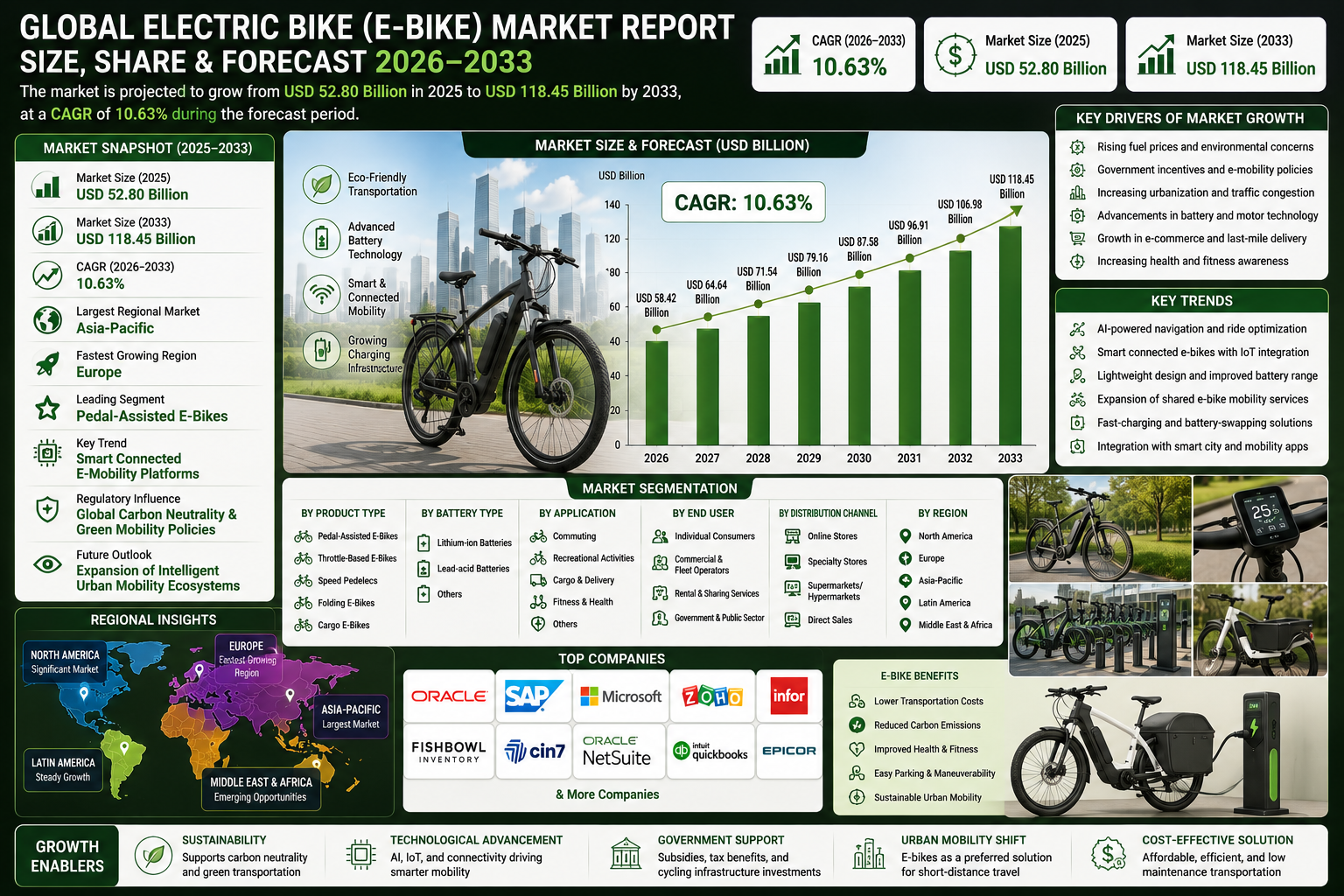
The Global Electric Bike (E-Bike) Market is projected to witness strong growth during the forecast period from 2026 to 2033. The market was valued at USD 52.80 billion in 2025 and is anticipated to reach approximately USD 118.45 billion by 2033, registering a CAGR of 10.63% during the forecast timeline. The market expansion is primarily driven by increasing urbanization, growing fuel prices, rising environmental concerns, and the global transition toward sustainable transportation systems. E-bikes are increasingly being adopted as efficient, eco-friendly, and economical transportation alternatives for commuting, logistics, recreational activities, and fitness applications. The market is also benefiting from technological advancements in lithium-ion battery systems, smart mobility integration, lightweight materials, and AI-powered navigation technologies. Governments worldwide are introducing subsidies, tax incentives, cycling infrastructure investments, and low-emission transportation initiatives that continue accelerating global e-bike adoption. Additionally, growing consumer preference for healthy lifestyles, urban traffic reduction, and cost-effective transportation solutions is contributing significantly to long-term market growth.Global Electric Bike (E-Bike) Market Overview
Electric bikes are bicycles equipped with electric motors and rechargeable battery systems that assist riders through pedal-assist or throttle-based propulsion technologies. The market includes commuter e-bikes, cargo e-bikes, mountain e-bikes, folding e-bikes, speed pedelecs, and shared mobility e-bike systems. The industry is undergoing rapid transformation due to the convergence of electrification, digital mobility ecosystems, and connected transportation technologies. E-bikes are becoming essential components of smart city mobility infrastructure and sustainable transportation strategies globally. Manufacturers are increasingly integrating advanced technologies such as IoT connectivity, GPS tracking, AI-assisted navigation, anti-theft systems, mobile applications, and predictive maintenance capabilities into modern e-bike platforms. Governments and municipalities worldwide are also investing heavily in cycling infrastructure, battery charging ecosystems, and urban mobility programs to encourage electric bicycle adoption and reduce transportation-related carbon emissions.Structural Drivers of Market Growth
1. Innovation and Commercialization Acceleration
Technological innovation in battery efficiency, lightweight materials, connected mobility systems, and intelligent motor technologies is significantly accelerating market growth. Advances in lithium-ion batteries and fast-charging systems are extending riding range and improving overall user convenience. Smart e-bikes equipped with app connectivity, digital dashboards, remote diagnostics, and GPS-based navigation systems are gaining substantial traction across urban consumer segments.Market Implications
Manufacturers investing in connected mobility ecosystems, battery innovation, and AI-powered transportation technologies are expected to strengthen long-term competitive positioning.2. Compliance and Risk Repricing
Stringent environmental regulations and carbon neutrality initiatives are accelerating the shift toward electric mobility worldwide. Governments are implementing low-emission transportation policies, urban congestion controls, and green mobility incentives to reduce fossil fuel dependency. Regulatory support for sustainable transportation infrastructure is increasing adoption across both consumer and commercial applications.Market Implications
Companies aligned with global sustainability goals and emission reduction initiatives are expected to benefit from favorable long-term regulatory environments.3. Competitive and Value-Chain Reconfiguration
The market is witnessing significant competitive transformation driven by battery supply chain localization, strategic manufacturing partnerships, and mobility platform integration. Global manufacturers are increasingly investing in regional assembly plants, battery production facilities, and digital mobility ecosystems. The rapid growth of e-commerce logistics and last-mile delivery services is also creating strong demand for commercial cargo e-bikes.Market Implications
Manufacturers focusing on vertically integrated battery production, logistics partnerships, and urban mobility solutions are likely to gain stronger market advantages.4. Capital and Capacity Scaling
Large-scale investments in battery manufacturing facilities, charging infrastructure, and smart mobility networks are accelerating global market expansion. Governments and private investors are allocating significant funding toward cycling infrastructure modernization and sustainable transportation systems. The rapid expansion of shared mobility services and commercial delivery fleets is further supporting high-volume e-bike adoption.Market Implications
Companies investing in production scalability, battery innovation, and global distribution networks are expected to capture substantial growth opportunities.Market Segmentation Analysis
By Product Type
1. Pedal-Assisted E-Bikes
Pedal-assisted e-bikes dominate the market due to regulatory acceptance, energy efficiency, and widespread urban commuting applications.2. Throttle-Controlled E-Bikes
Throttle-based e-bikes are gaining popularity in recreational and commercial mobility applications.3. Speed Pedelecs
High-speed electric bicycles are increasingly utilized for long-distance commuting and professional mobility needs.4. Cargo E-Bikes
Cargo e-bikes are experiencing rapid growth due to rising urban delivery and logistics operations.5. Folding E-Bikes
Folding e-bikes are gaining traction among urban commuters due to portability and space-saving benefits.6. Electric Mountain Bikes
Electric mountain bikes continue expanding due to increasing outdoor sports and adventure tourism activities.By Battery Type
1. Lithium-Ion Batteries
Lithium-ion batteries dominate the market due to lightweight structure, high energy density, and long operational lifespan.2. Lead-Acid Batteries
Lead-acid batteries maintain limited usage in low-cost e-bike applications.3. Solid-State Batteries
Emerging solid-state battery technologies are attracting investments for future high-performance mobility applications.By Motor Type
1. Mid-Drive Motors
Mid-drive systems are increasingly preferred for better torque distribution and superior riding efficiency.2. Hub Motors
Hub motors remain widely utilized due to affordability and simplified design structures.By Application
1. Urban Commuting
Urban transportation remains the largest application segment due to increasing traffic congestion and sustainability initiatives.2. Cargo & Logistics
Commercial delivery and logistics applications are rapidly accelerating demand for cargo e-bikes globally.3. Leisure & Recreation
Recreational cycling and fitness applications continue supporting market growth.4. Sports & Adventure
Electric mountain biking and adventure tourism are driving growth within sports-oriented segments.By Distribution Channel
1. Specialty Bicycle Stores
Physical retail stores remain major distribution channels due to customer preference for in-person testing and servicing.2. Online Retail
E-commerce platforms are rapidly expanding due to increasing digital purchasing behavior.3. Direct-to-Consumer Sales
Manufacturers are increasingly utilizing direct-to-consumer business models to improve profitability and customer engagement.Regional Market Dynamics
Asia-Pacific
Asia-Pacific dominates the global e-bike market due to high production capacity, large consumer base, urban population density, and government support for electric mobility. Countries such as China, Japan, and South Korea are major contributors to market growth.Europe
Europe represents one of the fastest-growing markets due to extensive cycling infrastructure, environmental awareness, and strong regulatory support for green transportation.North America
North America is witnessing increasing adoption driven by urban mobility transformation, fitness trends, and growing investments in sustainable transportation infrastructure.Latin America
Latin America is gradually expanding due to increasing urban congestion and growing demand for affordable transportation solutions.Middle East & Africa
The Middle East & Africa region is experiencing emerging growth supported by tourism mobility solutions and smart city development projects.Competitive Landscape
The Global Electric Bike Market is highly competitive with manufacturers focusing on battery innovation, smart mobility integration, lightweight materials, and connected transportation technologies. Key companies operating in the market include:- Accell Group
- Giant Manufacturing Co.
- Trek Bicycle Corporation
- Specialized Bicycle Components
- Yamaha Motor Company
- Bosch
- Shimano
- VanMoof
- Cowboy
- Pedego Electric Bikes
Strategic Outlook
The future of the global e-bike market will be strongly influenced by battery innovation, AI-powered mobility systems, urban sustainability initiatives, and connected transportation ecosystems. Governments globally are expected to continue prioritizing cycling infrastructure investments and low-emission transportation programs. The convergence of AI, IoT, GPS navigation, cloud connectivity, and predictive maintenance technologies will significantly enhance user experience and operational efficiency. Shared mobility ecosystems, subscription-based transportation models, and commercial fleet electrification are expected to generate substantial future opportunities. Additionally, developments in solid-state batteries, autonomous mobility technologies, and lightweight composite materials may reshape the future competitive landscape.Final Market Perspective
The Global Electric Bike Market is entering a transformative growth phase driven by sustainable transportation adoption, smart urban mobility development, and rapid technological advancement. E-bikes are increasingly becoming central components of modern transportation infrastructure due to their affordability, environmental benefits, and operational efficiency. Manufacturers capable of delivering connected, lightweight, energy-efficient, and technologically advanced e-bike solutions will be best positioned to capitalize on substantial long-term growth opportunities. The ongoing convergence of electrification, digital mobility ecosystems, sustainability, and intelligent transportation technologies is expected to redefine the future of personal and commercial mobility worldwide.Table of Contents
Executive Summary
1.1 Market Forecast Snapshot (2026???2033)
1.2 Global Electric Bike (E-Bike) Market Size & CAGR Analysis
1.3 Largest & Fastest-Growing Segments
1.4 Region-Level Leadership & Growth Trends
1.5 Key Market Drivers
1.6 Competitive Landscape Overview
1.7 Regulatory Influence & Green Mobility Policy Trends
1.8 Strategic Outlook Through 2033
Introduction & Market Overview
2.1 Definition of the Electric Bike (E-Bike) Market
2.2 Market Size & Forecast (2026???2033)
2.3 Industry Evolution & Market Development
2.4 Supply Chain & Distribution Infrastructure
2.5 Impact of Sustainable Transportation & Urban Mobility Trends
2.6 Regulatory & Compliance Landscape (Carbon Neutrality & E-Mobility Standards)
2.7 Technology & Innovation Landscape (AI Mobility, IoT Connectivity & Battery Systems)
Research Methodology
3.1 Primary Research
3.2 Secondary Research
3.3 Market Size Estimation Model
3.4 Forecast Assumptions (2026???2033)
3.5 Data Validation & Triangulation
Market Dynamics
4.1 Drivers
4.1.1 Rising Urbanization & Traffic Congestion
4.1.2 Increasing Demand for Sustainable Transportation
4.1.3 Advancements in Battery & Smart Mobility Technologies
4.1.4 Government Subsidies & Cycling Infrastructure Investments
4.1.5 Growing Adoption of E-Commerce Delivery & Cargo Mobility Solutions
4.2 Restraints
4.2.1 High Initial Cost of Advanced E-Bikes
4.2.2 Battery Supply Chain & Raw Material Constraints
4.2.3 Charging Infrastructure Limitations
4.2.4 Regulatory Variability Across Regions
4.3 Opportunities
4.3.1 Expansion of Smart Connected Mobility Ecosystems
4.3.2 Growth of Shared E-Bike Mobility Services
4.3.3 Emerging Market Penetration Across Asia-Pacific & Latin America
4.3.4 Development of Solid-State Battery Technologies
4.4 Challenges
4.4.1 Battery Recycling & Sustainability Concerns
4.4.2 Cybersecurity Risks in Connected Mobility Platforms
4.4.3 Supply Chain Volatility & Component Shortages
4.4.4 Intense Market Competition & Pricing Pressure
Electric Bike (E-Bike) Market Analysis (USD Billion), 2026???2033
5.1 Market Size Overview
5.2 CAGR Analysis
5.3 Regional Revenue Distribution
5.4 Segment Revenue Analysis
5.5 Distribution Channel Analysis
5.6 Consumer Mobility & Sustainability Impact Analysis
Market Segmentation (USD Billion), 2026???2033
6.1 By Product Type
6.1.1 Pedal-Assisted E-Bikes
6.1.1.1 Urban Commuter Pedal-Assist Systems
6.1.1.1.1 Smart Connected Commuter E-Bikes
6.1.1.1.1.1 AI-Enabled Urban Mobility Platforms
6.1.2 Throttle-Controlled E-Bikes
6.1.2.1 Recreational Electric Bikes
6.1.2.1.1 Commercial Utility E-Bikes
6.1.2.1.1.1 Integrated Smart Control E-Bike Systems
6.1.3 Speed Pedelecs
6.1.3.1 High-Speed Commuter E-Bikes
6.1.3.1.1 Long-Distance Electric Mobility Platforms
6.1.3.1.1.1 Premium High-Performance E-Bike Systems
6.1.4 Cargo E-Bikes
6.1.4.1 Commercial Delivery E-Bikes
6.1.4.1.1 Urban Logistics Cargo Platforms
6.1.4.1.1.1 Fleet-Integrated Cargo Mobility Systems
6.1.5 Folding E-Bikes
6.1.5.1 Portable Urban Mobility E-Bikes
6.1.5.1.1 Compact Folding Electric Commuters
6.1.5.1.1.1 Lightweight Smart Folding E-Bike Platforms
6.1.6 Electric Mountain Bikes
6.1.6.1 Off-Road Adventure E-Bikes
6.1.6.1.1 Performance Mountain Mobility Systems
6.1.6.1.1.1 AI-Assisted Terrain Adaptive E-Bikes
6.2 By Battery Type
6.2.1 Lithium-Ion Batteries
6.2.1.1 High-Energy Density Battery Systems
6.2.1.1.1 Fast-Charging E-Bike Battery Platforms
6.2.1.1.1.1 Smart Battery Management Systems
6.2.2 Lead-Acid Batteries
6.2.2.1 Low-Cost Electric Mobility Batteries
6.2.2.1.1 Entry-Level E-Bike Battery Platforms
6.2.2.1.1.1 Budget Urban Mobility Systems
6.2.3 Solid-State Batteries
6.2.3.1 Next-Generation E-Bike Energy Systems
6.2.3.1.1 Ultra-High Efficiency Battery Platforms
6.2.3.1.1.1 Advanced Long-Range E-Bike Batteries
6.3 By Motor Type
6.3.1 Mid-Drive Motors
6.3.1.1 Torque-Optimized Drive Systems
6.3.1.1.1 Performance Mid-Motor Platforms
6.3.1.1.1.1 Intelligent Power Distribution Systems
6.3.2 Hub Motors
6.3.2.1 Rear Hub Drive Systems
6.3.2.1.1 Front Hub Electric Mobility Systems
6.3.2.1.1.1 Cost-Efficient Urban Motor Platforms
6.4 By Application
6.4.1 Urban Commuting
6.4.1.1 Smart City Mobility Solutions
6.4.1.1.1 Daily Commuter Transportation Systems
6.4.1.1.1.1 AI-Based Urban Route Optimization Platforms
6.4.2 Cargo & Logistics
6.4.2.1 Last-Mile Delivery Mobility Systems
6.4.2.1.1 Commercial Cargo Fleet Platforms
6.4.2.1.1.1 Smart Logistics E-Bike Ecosystems
6.4.3 Leisure & Recreation
6.4.3.1 Recreational Electric Cycling Systems
6.4.3.1.1 Lifestyle & Wellness Mobility Platforms
6.4.3.1.1.1 Smart Recreational E-Bike Networks
6.4.4 Sports & Adventure
6.4.4.1 Adventure Tourism E-Bikes
6.4.4.1.1 Sports Performance Electric Bicycles
6.4.4.1.1.1 Off-Road Connected Mobility Systems
52.806.5 By Distribution Channel
6.5.1 Specialty Bicycle Stores
6.5.1.1 Premium E-Bike Retail Networks
6.5.1.1.1 Service & Maintenance Support Centers
6.5.1.1.1.1 Experience-Based E-Mobility Retail Platforms
6.5.2 Online Retail
6.5.2.1 E-Commerce E-Bike Platforms
6.5.2.1.1 Digital Direct Purchase Systems
6.5.2.1.1.1 AI-Based Consumer Recommendation Platforms
6.5.3 Direct-to-Consumer Sales
6.5.3.1 Manufacturer-Owned Mobility Platforms
6.5.3.1.1 Subscription-Based E-Bike Services
6.5.3.1.1.1 Connected Consumer Mobility Ecosystems
Market Segmentation by Geography
7.1 North America
7.2 Europe
7.3 Asia-Pacific
7.4 Latin America
7.5 Middle East & Africa
Competitive Landscape
8.1 Market Share Analysis
8.2 Product Portfolio Benchmarking
8.3 Product Positioning Mapping
8.4 Strategic Partnerships & Mobility Ecosystem Integration
8.5 Competitive Intensity & Innovation Benchmarking
Company Profiles
9.1 Accell Group
9.2 Giant Manufacturing Co.
9.3 Trek Bicycle Corporation
9.4 Specialized Bicycle Components
9.5 Yamaha Motor Company
9.6 Bosch
9.7 Shimano
9.8 VanMoof
9.9 Cowboy
9.10 Pedego Electric Bikes
Strategic Intelligence & Pheonix AI Insights
10.1 Pheonix Demand Forecast Engine
10.2 Supply Chain & Infrastructure Analyzer
10.3 Technology & Innovation Tracker
10.4 Product Development Insights
10.5 Automated Porter???s Five Forces Analysis
Future Outlook & Strategic Recommendations
11.1 Expansion of Smart Connected Urban Mobility Ecosystems
11.2 AI-Driven Predictive Mobility & Fleet Management Strategies
11.3 Battery Innovation & Charging Infrastructure Development
11.4 Commercial Cargo & Shared Mobility Expansion Strategies
11.5 Long-Term Market Outlook (2033+)
Appendix
About Pheonix Research
Disclaimer
Competitive Landscape
Global Electric Bike (E-Bike) Market Competitive Intensity & Market Structure Overview
The Global Electric Bike (E-Bike) Market is characterized by a moderately fragmented structure with high competitive intensity, driven by rapid technological innovation, expanding urban mobility ecosystems, and increasing global adoption of sustainable transportation solutions. The market includes established bicycle manufacturers, electric mobility companies, component suppliers, and emerging smart mobility startups competing across commuter, cargo, recreational, and commercial mobility segments.
Leading companies such as Accell Group, Giant Manufacturing Co., Trek Bicycle Corporation, Specialized Bicycle Components, and Yamaha Motor Company are shaping market dynamics through battery innovation, connected mobility platforms, lightweight frame technologies, and AI-integrated smart transportation systems.
Competitive intensity is primarily driven by battery performance, smart connectivity integration, urban mobility partnerships, lightweight material innovation, range optimization, pricing strategies, and digital mobility ecosystem development. The increasing transition toward carbon-neutral transportation and smart city infrastructure is further intensifying market competition globally.
Global Electric Bike (E-Bike) Market Competitive Intensity & Market Structure Current Scenario
Leading Company Profiles
- Accell Group: Major global e-bike manufacturer focused on urban mobility, connected cycling ecosystems, and sustainable transportation solutions.
- Giant Manufacturing Co.: Leading bicycle manufacturer with strong expertise in lightweight e-bike engineering and battery-integrated mobility systems.
- Trek Bicycle Corporation: Premium mobility brand specializing in high-performance electric bicycles and smart cycling technologies.
- Specialized Bicycle Components: Innovation-driven company focusing on connected e-bike platforms and premium electric cycling experiences.
- Yamaha Motor Company: Global mobility company providing advanced e-bike motor systems and electric drivetrain technologies.
- Bosch: Key supplier of connected e-bike drive systems, smart mobility software, and battery technologies.
- Shimano: Major supplier of e-bike drivetrain systems, intelligent shifting technologies, and mobility components.
- VanMoof: Smart mobility startup focused on connected urban transportation and integrated anti-theft technologies.
- Cowboy: Urban e-bike company specializing in minimalist smart mobility ecosystems and app-connected bicycles.
- Pedego Electric Bikes: Provider of commuter and leisure-oriented electric bicycles with strong retail distribution networks.
Key Competitive Intensity & Market Structure Signals in Global Electric Bike (E-Bike) Market
Several signals define the competitive dynamics of the market:
- Rapid advancements in lithium-ion battery technology, fast charging systems, and lightweight composite materials are accelerating product innovation across the industry.
- Increasing integration of IoT connectivity, GPS tracking, AI-assisted navigation, predictive maintenance, and smartphone applications is intensifying smart mobility competition.
- Government incentives, carbon neutrality policies, and sustainable transportation regulations are strengthening market growth and attracting new market entrants globally.
- Competitive differentiation is increasingly based on battery range, motor efficiency, digital connectivity, rider experience, and integrated mobility ecosystems.
- Expansion of urban delivery networks and last-mile logistics services is driving rapid growth in cargo e-bike adoption.
- Strategic partnerships between mobility companies, battery manufacturers, software providers, and smart city infrastructure developers are reshaping value-chain dynamics.
- Direct-to-consumer sales models and online retail expansion are intensifying pricing competition and improving global market accessibility.
Strategic Implications of Competitive Intensity & Market Structure in Global Electric Bike (E-Bike) Market
The competitive structure creates several strategic implications:
- Continuous investment in battery innovation, lightweight materials, AI-powered mobility systems, and smart connectivity platforms is essential for maintaining competitive leadership.
- Companies capable of building integrated digital mobility ecosystems combining navigation, diagnostics, theft protection, and predictive maintenance will gain stronger competitive advantages.
- Vertical integration across battery manufacturing, drivetrain systems, and software ecosystems is becoming increasingly important for supply chain stability and cost optimization.
- Strategic collaborations with municipalities, logistics operators, and smart city infrastructure providers are critical for expanding urban mobility market penetration.
- Subscription-based mobility services, shared e-bike platforms, and fleet management ecosystems are emerging as major long-term business opportunities.
- Sustainability positioning, regulatory alignment, and carbon-neutral manufacturing capabilities are becoming increasingly important competitive differentiators.
- Companies focusing on commercial cargo mobility, urban commuting solutions, and premium connected cycling experiences are expected to strengthen long-term market positioning.
Global Electric Bike (E-Bike) Market Competitive Intensity & Market Structure Forward Outlook
Looking ahead, the Global Electric Bike (E-Bike) Market is expected to maintain its moderately fragmented structure with sustained high competitive intensity, driven by global electrification trends and expanding smart urban mobility ecosystems.
- AI-powered mobility systems and cloud-connected e-bike ecosystems will increasingly become mainstream across urban transportation networks.
- Advancements in solid-state batteries, lightweight composites, and high-efficiency drive systems will intensify technology competition.
- Smart city infrastructure investments and government sustainability initiatives will continue accelerating global e-bike adoption.
- Shared mobility services and subscription-based transportation platforms are expected to expand significantly across urban markets.
- Cargo e-bikes and commercial fleet electrification will emerge as major high-growth segments within the market.
- Strategic acquisitions, mobility platform partnerships, and battery supply chain consolidation are likely to reshape competitive dynamics globally.
- Integration of autonomous mobility technologies, advanced navigation systems, and predictive maintenance platforms will further transform the future e-bike ecosystem.
In conclusion, the Global Electric Bike (E-Bike) Market represents a high-growth, innovation-driven, and digitally transforming competitive landscape, where battery technology, smart mobility integration, connected ecosystems, and sustainability alignment will determine long-term market leadership.
Value Chain
Global Electric Bike (E-Bike) Market Value Chain & Supply Chain Evolution Overview
The Global Electric Bike (E-Bike) Market is undergoing significant transformation driven by electrification, smart mobility integration, battery innovation, and expanding sustainable transportation ecosystems. The market???s value chain is characterized by a hybrid operational model supported by a hybrid distribution structure integrating OEM manufacturing, specialty retail networks, direct-to-consumer channels, online platforms, and shared mobility ecosystems. This interconnected framework is reshaping urban transportation, commercial logistics mobility, and intelligent cycling infrastructure globally.
A defining feature of this value chain is the convergence of electric mobility technologies, lithium-ion battery systems, IoT connectivity, AI-powered navigation, and digital transportation platforms. Modern e-bikes increasingly integrate smart sensors, GPS tracking, cloud connectivity, predictive maintenance systems, mobile applications, and energy-efficient propulsion technologies to improve user experience, operational efficiency, and sustainability.
Supply chain complexity remains high due to dependence on lithium-ion battery sourcing, semiconductor components, electric motor systems, lightweight composite materials, and global electronics manufacturing ecosystems. Manufacturers must coordinate battery procurement, motor assembly, software integration, electronic component sourcing, logistics operations, and regulatory compliance while maintaining scalability, product quality, and cost competitiveness.
E-bike manufacturers and mobility technology providers are increasingly investing in vertically integrated battery production, regional assembly facilities, AI-enabled mobility systems, and cloud-connected transportation ecosystems to improve operational resilience and accelerate market expansion. The value chain is evolving into a digitally integrated, sustainability-focused, and intelligent mobility ecosystem designed to support long-term urban transportation transformation.
Global Electric Bike (E-Bike) Market Value Chain & Supply Chain Evolution Current Scenario
Market-Specific Value Chain
- Raw Material & Component Sourcing: Lithium-ion battery cells, electric motors, semiconductors, aluminum frames, carbon fiber materials, sensors, and electronic control systems
- Manufacturing & Assembly: E-bike frame manufacturing, battery pack assembly, motor integration, software installation, and product testing
- Technology Integration: IoT connectivity, AI-assisted navigation, GPS systems, mobile applications, predictive maintenance platforms, and cloud-connected mobility software
- Regulatory & Sustainability Compliance: Emission compliance, battery safety standards, transportation regulations, recycling frameworks, and green mobility certifications
- Distribution & Mobility Networks: Specialty bicycle retailers, online platforms, direct-to-consumer channels, distributors, fleet operators, and shared mobility platforms
- End User Utilization: Urban commuters, logistics operators, recreational cyclists, delivery fleets, tourism mobility providers, and fitness consumers
Company-to-Stage Mapping
- Raw Material & Component Sourcing: Battery suppliers, semiconductor manufacturers, lightweight material providers, electric motor manufacturers
- Manufacturing & Assembly: Accell Group, Giant Manufacturing Co., Trek Bicycle Corporation
- Technology Integration: Bosch, Shimano, VanMoof
- Regulatory & Sustainability Compliance: Transportation regulators, battery safety certification bodies, urban mobility authorities
- Distribution & Mobility Networks: Specialty bicycle retailers, e-commerce platforms, fleet distributors, shared mobility operators
- End User Utilization: Consumers, urban commuters, delivery service providers, tourism operators, corporate mobility fleets
Key Value Chain & Supply Chain Evolution Signals in Global Electric Bike (E-Bike) Market
- Expansion of Lithium-Ion & Advanced Battery Technologies
Improvements in battery efficiency, charging speed, and energy density are enhancing e-bike range and operational performance. - Growth of Smart Connected Mobility Ecosystems
IoT-enabled e-bikes with AI navigation, GPS tracking, cloud connectivity, and predictive diagnostics are reshaping user experiences. - Localization of Battery & Assembly Supply Chains
Manufacturers are investing in regional battery production and localized assembly facilities to reduce supply chain risks and improve scalability. - Increasing Regulatory Support for Green Mobility
Government subsidies, carbon neutrality initiatives, and cycling infrastructure investments are accelerating e-bike adoption globally. - Expansion of Cargo & Commercial E-Bike Applications
Growth in last-mile delivery and urban logistics is significantly increasing demand for cargo e-bikes and fleet electrification solutions. - Integration of AI & Predictive Maintenance Systems
AI-powered diagnostics and connected maintenance platforms are improving operational reliability and lifecycle management.
Strategic Implications of Value Chain & Supply Chain Evolution
- Investment in Battery Innovation & Energy Efficiency
Companies investing in advanced battery systems and lightweight materials will strengthen long-term market competitiveness. - Expansion of Connected Mobility & Digital Ecosystems
Smart mobility integration and cloud-connected transportation services are becoming key competitive differentiators. - Strengthening Regional Manufacturing & Supply Chain Resilience
Localized assembly plants and battery production facilities improve operational stability and reduce geopolitical risks. - Optimization of Commercial Fleet & Logistics Solutions
E-bike manufacturers targeting logistics and shared mobility sectors can capture expanding urban transportation opportunities. - Development of Sustainable & Circular Mobility Models
Battery recycling, sustainable materials, and green manufacturing initiatives are becoming increasingly important for compliance and brand positioning. - Expansion of Omnichannel Distribution & Direct-to-Consumer Models
Integrated retail, online sales, and subscription-based mobility platforms are reshaping customer engagement strategies.
Global Electric Bike (E-Bike) Market Value Chain & Supply Chain Evolution Forward Outlook
Looking ahead, the value chain is expected to evolve into a highly connected, AI-enabled, and sustainability-driven transportation ecosystem.
Key Future Developments Include:
- Expansion of solid-state battery technologies and ultra-fast charging systems
- Increased integration of AI-powered navigation and predictive mobility analytics
- Growth of connected shared mobility and subscription-based e-bike ecosystems
- Integration of smart city infrastructure with cloud-connected e-bike platforms
- Expansion of autonomous diagnostics, anti-theft systems, and fleet management technologies
As the market evolves, competitive advantage will increasingly depend on the ability to combine battery innovation, connected mobility systems, regulatory compliance, and scalable manufacturing capabilities.
Companies that effectively integrate intelligent transportation technologies, sustainable manufacturing, digital mobility ecosystems, and resilient supply chain infrastructure will achieve superior operational performance, consumer engagement, and long-term competitive positioning in the Global Electric Bike (E-Bike) Market.
Investment Activity
Global Electric Bike (E-Bike) Market Investment & Funding Dynamics Overview
The investment and funding landscape within the Global Electric Bike (E-Bike) Market is characterized by rapidly rising investment activity and high capital intensity, driven by accelerating global electrification trends, sustainable transportation initiatives, and expanding smart urban mobility ecosystems. Structural drivers such as increasing urbanization, rising fuel costs, carbon neutrality goals, and growing adoption of low-emission transportation systems are attracting substantial long-term capital inflows into the market. Investments are primarily focused on battery innovation, smart mobility integration, lightweight materials engineering, AI-enabled connected mobility systems, and large-scale manufacturing expansion.
A major factor shaping investment dynamics is the increasing technological sophistication of electric bikes and connected transportation ecosystems. Modern e-bikes increasingly integrate IoT connectivity, AI-assisted navigation, GPS tracking, predictive maintenance platforms, mobile applications, and cloud-connected fleet management systems. These advancements require significant investments in battery technologies, embedded software systems, digital mobility infrastructure, and intelligent transportation platforms.
Additionally, governments and municipalities worldwide are heavily investing in cycling infrastructure, charging ecosystems, green transportation programs, and smart city mobility initiatives to accelerate e-bike adoption and reduce transportation-related carbon emissions. This supportive regulatory environment continues strengthening long-term investment confidence across the industry.
Global Electric Bike (E-Bike) Market Investment & Funding Dynamics Current Scenario
In the current scenario, the Global Electric Bike (E-Bike) Market is witnessing strong and strategically driven investment activity supported by increasing demand for sustainable mobility solutions and intelligent transportation systems. The market???s high capital intensity reflects substantial financial commitments toward battery manufacturing facilities, smart mobility software development, lightweight frame production, and connected mobility ecosystem integration.
Investment activity is particularly concentrated in lithium-ion battery technologies, AI-powered navigation systems, cargo e-bike platforms, urban fleet electrification, cloud-connected mobility systems, and predictive maintenance technologies. Manufacturers are allocating significant capital toward extending riding range, improving charging efficiency, reducing vehicle weight, and enhancing digital rider experiences.
The market is also experiencing active merger and acquisition (M&A) activity as bicycle manufacturers, mobility startups, battery suppliers, and connected transportation companies seek to strengthen technological capabilities, expand mobility ecosystems, and improve global market reach. Strategic partnerships between e-bike manufacturers, battery technology firms, logistics providers, and smart city developers are increasingly reshaping industry value chains.
Furthermore, venture capital investments, government mobility funding programs, and sustainability-focused infrastructure investments continue supporting rapid commercialization and scalability of intelligent e-bike ecosystems globally.
Key Investment & Funding Dynamics Signals in Global Electric Bike (E-Bike) Market
The investment and funding dynamics in the Global Electric Bike (E-Bike) Market are shaped by several key signals reflecting transformation in urban mobility systems. One of the primary signals is the rapid adoption of sustainable transportation solutions and carbon-neutral mobility initiatives globally.
Another major signal is the accelerating advancement of battery technologies and smart mobility platforms. Companies are heavily investing in lithium-ion battery efficiency improvements, fast-charging systems, lightweight composites, AI-driven rider analytics, and cloud-connected transportation ecosystems.
The rapid expansion of e-commerce logistics and last-mile delivery services is also driving substantial investment into cargo e-bikes and commercial fleet electrification platforms. Urban logistics operators are increasingly adopting electric cargo mobility solutions to reduce transportation costs and improve operational sustainability.
Additionally, increasing government subsidies, green transportation incentives, and cycling infrastructure investments are creating highly favorable investment conditions across major urban markets. Smart city programs and low-emission transportation regulations continue accelerating adoption globally.
The emergence of subscription-based mobility services, shared e-bike platforms, and fleet management ecosystems is further driving investment into digital mobility infrastructure and connected transportation technologies.
Strategic Implications of Investment & Funding Dynamics in Global Electric Bike (E-Bike) Market
The current investment dynamics have significant strategic implications for companies operating within the Global Electric Bike (E-Bike) Market. One of the primary implications is the increasing necessity for continuous innovation in battery systems, connected mobility technologies, AI integration, and lightweight engineering to maintain competitive differentiation.
High capital intensity requires manufacturers to strategically allocate investments toward battery production infrastructure, digital mobility software, cloud-connected fleet systems, and smart transportation ecosystems. Companies capable of delivering integrated, intelligent, and energy-efficient mobility platforms will strengthen long-term market positioning.
The increasing role of M&A activity highlights the importance of technological consolidation and ecosystem expansion. Companies are leveraging acquisitions and strategic collaborations to strengthen battery supply chains, accelerate software integration, improve urban mobility capabilities, and expand international distribution networks.
Furthermore, the convergence of electrification, smart city infrastructure, AI-driven transportation analytics, and mobility-as-a-service platforms is reshaping strategic priorities across the industry. Investments in connected transportation ecosystems and intelligent mobility services are becoming increasingly critical for long-term competitiveness.
Global Electric Bike (E-Bike) Market Investment & Funding Dynamics Forward Outlook
Looking ahead, the investment and funding dynamics in the Global Electric Bike (E-Bike) Market are expected to remain highly positive, driven by continued urban mobility transformation, sustainability-focused transportation policies, and rapid advancements in intelligent mobility technologies.
Future investment activity will increasingly focus on solid-state battery development, AI-powered mobility ecosystems, autonomous navigation systems, predictive maintenance platforms, and integrated smart transportation infrastructure. These technologies are expected to improve rider safety, operational efficiency, battery performance, and urban mobility optimization.
The continued expansion of cargo e-bikes, shared mobility services, and commercial fleet electrification is expected to attract substantial long-term investments into scalable manufacturing infrastructure and connected mobility platforms globally.
Additionally, increasing government support for green transportation, urban congestion reduction, and low-emission mobility systems will continue strengthening market expansion opportunities across both developed and emerging economies.
In summary, the Global Electric Bike (E-Bike) Market is positioned for sustained long-term investment growth supported by electrification trends, smart mobility integration, battery innovation, and expanding sustainable transportation ecosystems. Companies that strategically invest in intelligent mobility platforms, battery technologies, digital transportation infrastructure, and scalable production ecosystems will be best positioned to capture future market opportunities.
Technology & Innovation
Global Electric Bike (E-Bike) Market Technology & Innovation Landscape Overview
The Global Electric Bike (E-Bike) Market is undergoing rapid technological transformation driven by advancements in battery technologies, smart mobility ecosystems, AI-powered connectivity, lightweight materials, and intelligent transportation infrastructure. The market is characterized by a high innovation intensity level, supported by accelerating electrification trends and growing investments in sustainable urban mobility systems.
At the center of this transformation are lithium-ion battery innovations that are significantly improving riding range, charging speed, energy density, and operational lifespan. Manufacturers are increasingly investing in next-generation battery architectures, fast-charging systems, and emerging solid-state battery technologies to enhance performance and user convenience.
Smart connected mobility platforms are becoming core differentiators across the market. Modern e-bikes increasingly integrate IoT connectivity, GPS tracking, mobile applications, AI-powered navigation, predictive maintenance systems, anti-theft technologies, and cloud-based fleet management solutions. These technologies are transforming e-bikes from standalone transportation products into fully connected intelligent mobility devices.
The market is also witnessing rapid advancements in lightweight composite materials, carbon fiber frames, and aerodynamic engineering, improving vehicle efficiency, durability, and riding comfort. Simultaneously, motor technologies such as mid-drive systems and torque-sensitive pedal-assist systems are enhancing power efficiency, torque distribution, and rider experience.
AI-powered mobility analytics and cloud-connected diagnostics are further reshaping the innovation landscape. Manufacturers and fleet operators are increasingly deploying predictive maintenance platforms, remote diagnostics, and intelligent route optimization systems to improve operational efficiency and user engagement.
In parallel, the integration of smart city infrastructure, battery charging ecosystems, and shared mobility platforms is accelerating commercialization of intelligent urban transportation networks globally.
Global Electric Bike (E-Bike) Market Technology & Innovation Landscape Current Scenario
Currently, the Global Electric Bike Market demonstrates high patent activity and accelerating commercialization of smart mobility technologies, advanced battery systems, AI-driven navigation platforms, and connected transportation ecosystems.
1. Lithium-Ion Battery Innovation
Battery manufacturers are improving energy density, charging efficiency, riding range, and battery lifecycle performance through advanced lithium-ion technologies.
2. Smart Connected E-Bike Platforms
IoT-enabled connectivity, GPS systems, smartphone integration, cloud diagnostics, and anti-theft technologies are increasingly becoming standard features.
3. AI-Powered Navigation & Predictive Maintenance
AI-driven mobility systems are enabling route optimization, riding analytics, remote diagnostics, and predictive maintenance capabilities.
4. Lightweight Material Engineering
Manufacturers are increasingly adopting lightweight aluminum alloys, carbon fiber materials, and aerodynamic frame designs to improve efficiency and performance.
5. Mid-Drive & Intelligent Motor Systems
Advanced motor technologies are improving torque distribution, energy efficiency, hill-climbing capability, and overall ride quality.
6. Smart Fleet & Shared Mobility Integration
Commercial e-bike fleets and urban mobility platforms are integrating cloud-connected fleet management systems and intelligent mobility analytics.
Key Technology & Innovation Landscape Signals in Global Electric Bike (E-Bike) Market
The market is evolving through several major innovation signals:
1. Rapid Expansion of Smart Urban Mobility Ecosystems
Cities and mobility providers are increasingly integrating e-bikes into intelligent transportation infrastructure.
2. Increasing Adoption of Connected Mobility Technologies
Consumers are demanding app-connected, GPS-enabled, and AI-assisted e-bike systems.
3. Acceleration of Battery Technology Development
Manufacturers are investing heavily in next-generation batteries, fast charging, and energy optimization technologies.
4. Growth of Commercial Cargo E-Bikes
E-commerce logistics and last-mile delivery services are driving innovation in cargo e-bike technologies.
5. Emergence of Predictive Maintenance Platforms
Cloud-based analytics and AI diagnostics are improving fleet efficiency and reducing operational downtime.
6. Expansion of Sustainable Transportation Technologies
Governments and manufacturers are prioritizing environmentally sustainable materials and low-emission mobility systems.
Strategic Implications of Technology & Innovation Landscape in Global Electric Bike (E-Bike) Market
The evolving technology landscape is fundamentally reshaping competition across the global e-bike industry. Companies are increasingly competing on battery innovation, connected mobility ecosystems, AI integration, motor efficiency, lightweight engineering, and smart transportation capabilities rather than traditional bicycle manufacturing alone.
The integration of AI, IoT, cloud connectivity, GPS systems, and predictive analytics is enabling manufacturers to deliver highly personalized and intelligent mobility experiences. Smart mobility ecosystems are also supporting subscription-based transportation models, shared mobility services, and fleet management solutions.
Battery supply chain localization, manufacturing automation, and strategic technology partnerships are becoming increasingly important for ensuring scalability and cost competitiveness. Manufacturers are also prioritizing sustainability-focused product development aligned with carbon neutrality and green transportation initiatives.
The convergence of urban mobility infrastructure, digital transportation platforms, and connected fleet ecosystems is creating long-term opportunities for integrated smart transportation networks globally.
Global Electric Bike (E-Bike) Market Technology & Innovation Landscape Forward Outlook
Looking ahead to 2026???2033, the Global Electric Bike Market is expected to evolve toward highly intelligent, connected, and autonomous mobility ecosystems.
Future technological developments are likely to include:
1. Solid-State Battery Commercialization
Next-generation solid-state batteries may significantly improve range, safety, charging speed, and battery lifespan.
2. AI-Integrated Smart Mobility Platforms
Advanced AI systems will enable adaptive riding assistance, predictive route optimization, and intelligent mobility analytics.
3. Fully Connected Urban Transportation Ecosystems
E-bikes will increasingly integrate with smart city infrastructure, public transportation networks, and cloud-based mobility platforms.
4. Autonomous & Semi-Autonomous Mobility Features
Emerging autonomous technologies may support self-balancing systems, collision avoidance, and intelligent rider assistance functions.
5. Advanced Lightweight Composite Engineering
New materials and frame technologies will continue improving efficiency, durability, and portability.
6. Intelligent Commercial Fleet Management
Commercial cargo e-bike fleets will increasingly utilize cloud-connected analytics, remote diagnostics, and AI-powered logistics optimization.
Overall, companies capable of combining battery innovation, AI integration, cloud connectivity, lightweight engineering, IoT ecosystems, sustainability alignment, and scalable manufacturing capabilities will be best positioned to lead the next phase of growth within the Global Electric Bike Market.
Market Risk
Global Electric Bike (E-Bike) Market Risk Factors & Disruption Threats Overview
The Global Electric Bike (E-Bike) Market is undergoing rapid expansion driven by electrification trends, sustainable transportation policies, urban mobility transformation, and technological advancements in connected transportation ecosystems. Despite strong growth momentum, the market is exposed to multiple structural, operational, regulatory, and supply chain risks that may significantly influence profitability, scalability, and long-term market stability.
The overall market risk level is moderate-to-high, primarily due to battery supply chain dependency, regulatory fragmentation, pricing volatility, infrastructure limitations, and rapid technological disruption. The market is highly sensitive to fluctuations in lithium-ion battery costs, semiconductor availability, raw material sourcing, and evolving electric mobility regulations across different regions.
Geopolitical exposure is high, as the e-bike ecosystem relies heavily on globally interconnected supply chains involving lithium, cobalt, nickel, rare earth materials, semiconductors, electronic components, and battery manufacturing infrastructure concentrated in Asia-Pacific regions. Trade restrictions, geopolitical conflicts, export controls, and raw material shortages could significantly disrupt manufacturing operations and increase production costs globally.
Substitution risk is moderate, because consumers may alternatively choose electric scooters, electric motorcycles, public transportation systems, ride-sharing platforms, traditional bicycles, or compact electric vehicles depending on infrastructure availability, pricing, convenience, and regional transportation policies.
Global Electric Bike (E-Bike) Market Risk Factors & Disruption Threats Current Scenario
Currently, the e-bike market is experiencing accelerated commercialization alongside increasing operational and regulatory complexity. One of the most significant risks involves the global dependency on lithium-ion battery supply chains. Battery costs remain highly vulnerable to fluctuations in lithium, cobalt, and nickel prices, while geopolitical tensions continue affecting battery material sourcing and manufacturing capacity.
The market is also facing increasing pressure from rapid technological obsolescence. Continuous advancements in battery efficiency, smart mobility systems, AI-assisted navigation, connected software platforms, and lightweight materials are shortening product innovation cycles and increasing R&D expenditure requirements for manufacturers.
Another major challenge is the fragmented global regulatory environment. Different regions maintain varying classifications, speed limits, safety standards, licensing requirements, and subsidy policies for e-bikes. Regulatory inconsistencies complicate product standardization and international market expansion strategies.
Infrastructure limitations continue to create operational barriers in many developing markets. Insufficient cycling lanes, limited charging infrastructure, theft concerns, and inadequate urban mobility integration may slow consumer adoption rates.
In addition, rising competition from low-cost manufacturers, particularly across Asia-Pacific, is intensifying pricing pressure and margin compression across the global market.
Key Risk Factors & Disruption Threats Signals in Global Electric Bike (E-Bike) Market
Several major signals illustrate the evolving risk environment within the market:
- Battery Supply Chain Dependency ??? Reliance on lithium-ion batteries and critical minerals creates exposure to raw material shortages and pricing volatility.
- Geopolitical Trade Risks ??? Tariffs, export controls, and geopolitical tensions affecting battery manufacturing and semiconductor supply chains may disrupt production.
- Rapid Technological Obsolescence ??? Continuous innovation in battery systems, smart mobility technologies, and AI platforms increases R&D pressure.
- Regulatory Fragmentation ??? Diverse regional regulations regarding speed limits, licensing, safety standards, and subsidy eligibility complicate global scalability.
- Infrastructure Constraints ??? Limited charging infrastructure, cycling lanes, and urban mobility integration may restrict adoption in certain markets.
- Cybersecurity & Connectivity Risks ??? IoT-enabled e-bikes and connected mobility platforms face increasing cybersecurity and software vulnerability concerns.
- Intense Competitive Pricing Pressure ??? Entry of low-cost manufacturers and direct-to-consumer brands is increasing market competition and margin compression.
- Product Safety & Battery Fire Risks ??? Battery overheating, thermal runaway incidents, and product recalls remain critical operational concerns.
- Economic Sensitivity & Consumer Spending Risks ??? Premium e-bike demand may weaken during economic slowdowns and inflationary periods.
- Substitution from Alternative Mobility Solutions ??? Electric scooters, micro-mobility platforms, and public transit systems continue competing for urban transportation demand.
Strategic Implications of Risk Factors & Disruption Threats
These risks are reshaping strategic priorities across the e-bike ecosystem. Manufacturers are increasingly focusing on battery localization, vertical integration, software ecosystems, and connected mobility services to improve operational resilience and reduce dependency on volatile global supply chains.
Companies are also investing heavily in solid-state batteries, lightweight composite materials, predictive maintenance platforms, and AI-enabled mobility intelligence to strengthen product differentiation and long-term competitiveness.
Strategic partnerships between battery manufacturers, mobility platform providers, semiconductor companies, logistics operators, and smart city infrastructure developers are becoming increasingly important to support scalable ecosystem expansion.
In addition, manufacturers are prioritizing regional manufacturing hubs and diversified sourcing strategies to mitigate geopolitical risks and improve supply chain flexibility.
Cybersecurity protection, battery safety certification, and compliance with evolving urban mobility regulations are also becoming critical competitive requirements within the market.
Global Electric Bike (E-Bike) Market Risk Factors & Disruption Threats Forward Outlook
Looking ahead to 2026???2033, the market is expected to remain highly innovation-driven while facing intensifying geopolitical, regulatory, and technological disruption risks. The convergence of electrification, connected transportation ecosystems, AI mobility analytics, and sustainability initiatives will continue reshaping market dynamics.
Future disruption risks are expected to include:
- Increasing volatility in lithium, cobalt, and rare earth material supply chains
- Stricter global battery safety and sustainability regulations
- Growing cybersecurity threats targeting connected mobility ecosystems
- Rapid technology replacement cycles reducing product lifespan competitiveness
- Escalating trade restrictions and geopolitical tensions affecting battery manufacturing
- Urban infrastructure limitations slowing adoption in emerging economies
- Rising competition from autonomous and shared micro-mobility solutions
- Economic slowdowns impacting premium e-bike purchasing behavior
- Pressure for localized battery recycling and circular economy compliance
- Expansion of low-cost competitors intensifying global pricing pressure
At the same time, advancements in solid-state batteries, AI-assisted mobility systems, autonomous fleet integration, predictive maintenance technologies, and smart city infrastructure are expected to create substantial long-term growth opportunities.
Overall, the Global Electric Bike (E-Bike) Market represents a rapidly evolving and strategically important segment within the broader sustainable mobility ecosystem. Companies that successfully balance battery innovation, regulatory compliance, connected mobility integration, operational scalability, affordability, and supply chain resilience will be best positioned to capture long-term market leadership.
Regulatory Landscape
Global Electric Bike (E-Bike) Market Regulatory & Policy Environment Overview
The regulatory and policy environment plays a pivotal role in shaping the Global Electric Bike (E-Bike) Market as governments worldwide increasingly prioritize sustainable transportation, carbon emission reduction, and intelligent urban mobility development. Regulatory frameworks governing e-bike classification, battery safety, vehicle speed limits, road access permissions, charging infrastructure, and environmental compliance are significantly influencing market expansion and competitive dynamics globally.
Governments and transportation authorities across North America, Europe, and Asia-Pacific are implementing green mobility policies, urban emission reduction programs, and cycling infrastructure investments to accelerate e-bike adoption. These policy initiatives are designed to reduce fossil fuel dependency, improve urban transportation efficiency, and support long-term climate neutrality goals.
Regulatory agencies are also strengthening standards surrounding lithium-ion battery safety, electric motor performance, charging systems, electromagnetic compatibility, and connected mobility technologies. As e-bikes become increasingly integrated with IoT platforms, GPS systems, AI-powered navigation, and cloud-connected mobility ecosystems, regulators are expanding oversight into areas including cybersecurity, digital connectivity, and rider safety compliance.
In parallel, municipal governments are introducing dedicated cycling lanes, low-emission zones, urban congestion restrictions, and public charging infrastructure investments to support the expansion of electric bicycle ecosystems. Regulatory harmonization efforts across international markets are also helping manufacturers streamline product commercialization and improve cross-border market accessibility.
Global Electric Bike (E-Bike) Market Regulatory & Policy Environment Current Scenario
Currently, the Global Electric Bike Market operates within a rapidly evolving regulatory environment characterized by strong sustainability-driven policy support, transportation electrification initiatives, and growing standardization of e-bike safety regulations.
One of the most significant regulatory trends influencing the market is the increasing implementation of carbon neutrality and low-emission transportation policies. Governments worldwide are encouraging e-bike adoption through tax incentives, purchase subsidies, registration exemptions, and urban mobility grants to accelerate sustainable transportation transitions.
Battery safety and product certification standards are also becoming increasingly stringent due to rising adoption of lithium-ion battery technologies. Regulatory authorities are emphasizing compliance related to thermal safety, battery lifecycle management, charging infrastructure compatibility, and transportation safety standards.
Another major regulatory development involves classification frameworks for pedal-assisted e-bikes, throttle-controlled systems, and speed pedelecs. Regional governments continue refining speed limitations, licensing requirements, helmet mandates, and roadway access regulations to ensure rider safety and transportation consistency.
The market is also witnessing increasing regulation of connected mobility technologies and digital transportation platforms. Smart e-bikes integrated with GPS tracking, mobile applications, cloud connectivity, and AI-powered diagnostics must increasingly comply with cybersecurity standards and digital privacy regulations.
Additionally, sustainability reporting requirements and circular economy initiatives are encouraging manufacturers to invest in recyclable materials, battery recycling systems, and environmentally sustainable production processes.
Key Regulatory & Policy Environment Signals in Global Electric Bike (E-Bike) Market
1. Expansion of Carbon Neutrality & Green Mobility Policies
Governments globally are strengthening sustainability initiatives, low-emission transportation policies, and urban mobility regulations to accelerate electric bicycle adoption.
2. Increasing Battery Safety & Certification Standards
Regulators are emphasizing lithium-ion battery compliance, charging infrastructure safety, thermal management, and transportation certification standards.
3. Harmonization of E-Bike Classification Frameworks
Authorities are standardizing regulations related to speed limits, pedal assistance systems, throttle controls, and rider safety requirements across international markets.
4. Growth of Smart Mobility & Connected Transportation Regulations
IoT-enabled e-bikes and cloud-connected mobility platforms are increasingly subject to cybersecurity, digital privacy, and connected transportation governance standards.
5. Rising Sustainability & Circular Economy Requirements
Manufacturers are facing increasing pressure to adopt recyclable materials, battery recovery systems, and environmentally sustainable manufacturing processes.
Strategic Implications of Regulatory & Policy Environment in Global Electric Bike (E-Bike) Market
The evolving regulatory environment creates significant strategic opportunities for e-bike manufacturers, battery suppliers, mobility technology providers, and smart transportation companies. One of the most important implications is the increasing need for alignment with sustainability-focused transportation policies and global carbon reduction initiatives.
Manufacturers must invest heavily in battery safety certifications, regulatory testing, cybersecurity compliance, sustainable manufacturing practices, and regional vehicle classification compliance to maintain market competitiveness and regulatory approval across multiple jurisdictions.
The growing convergence between electrification, AI-powered mobility systems, IoT connectivity, and smart transportation infrastructure is also reshaping competitive dynamics within the market. Companies capable of delivering connected, regulation-compliant, and environmentally sustainable mobility solutions are expected to achieve substantial long-term advantages.
Government incentives and infrastructure investments are further accelerating competitive transformation by encouraging rapid commercialization of advanced e-bike technologies and urban mobility ecosystems.
Additionally, regulatory support for cargo e-bikes, shared mobility services, and urban delivery electrification is creating new opportunities for commercial fleet expansion and logistics-focused mobility solutions.
Global Electric Bike (E-Bike) Market Regulatory & Policy Environment Forward Outlook
Looking ahead to 2026???2033, the regulatory environment for electric bikes is expected to become increasingly sophisticated, sustainability-focused, and digitally integrated as governments continue accelerating transportation electrification initiatives worldwide.
Future regulatory frameworks are likely to place stronger emphasis on connected mobility governance, AI-assisted transportation systems, battery lifecycle sustainability, cybersecurity resilience, and integrated smart city mobility infrastructure. Authorities may also introduce stricter standards surrounding battery recycling, energy efficiency, autonomous mobility integration, and urban transportation interoperability.
The expansion of intelligent transportation ecosystems and shared mobility networks is expected to encourage broader harmonization of e-bike regulations across international markets, improving product standardization and cross-border commercialization opportunities.
Governments are also expected to continue expanding cycling infrastructure investments, green transportation subsidies, and low-emission urban mobility initiatives to reduce traffic congestion and support environmental sustainability objectives.
Additionally, advancements in solid-state batteries, lightweight composite materials, and AI-driven transportation systems may introduce new regulatory considerations surrounding performance certification, rider safety validation, and digital mobility governance.
Overall, the regulatory and policy environment will remain a foundational force shaping innovation, commercialization, infrastructure development, and competitive positioning within the Global Electric Bike Market. Companies capable of balancing sustainability alignment, connected mobility innovation, regulatory adaptability, and scalable manufacturing capabilities will be best positioned to capture long-term market growth opportunities.