
Global Vending Machine Market Size and Share Analysis 2026-2033
Global Vending Machine Market Forecast Snapshot (2026???2033)
| Metric | Value |
|---|---|
| Market Size (2025) | USD 24.8 Billion |
| Market Size (2033) | USD 41.6 Billion |
| CAGR (2026???2033) | 6.7% |
| Largest Segment | Beverage Vending Machines |
| Fastest-Growing Segment | Smart & Cashless Vending Machines |
| Largest Product Offering | Food & Beverages |
| Fastest-Growing Product Offering | Healthy Snacks & Fresh Food Products |
| Dominant Payment Mode | Cash-Based Vending Machines |
| Fastest-Growing Payment Mode | Cashless Vending Machines |
| Dominant Region | North America |
| Fastest-Growing Region | Asia-Pacific |
| Key Growth Driver | Rising Adoption of Automated Retail Solutions and Cashless Payment Technologies |
Global Vending Machine Market and forecast
The global vending machine market is projected to witness significant growth during the forecast period from 2026 to 2033. The market was valued at approximately USD 24.8 billion in 2025 and is expected to reach nearly USD 41.6 billion by 2033, expanding at a CAGR of around 6.7%. The market???s growth is driven by increasing demand for automated retail solutions, rising adoption of cashless payment technologies, growing urbanization, and expanding consumer preference for convenient self-service purchasing experiences. Vending machines are automated retail systems that dispense products such as snacks, beverages, packaged foods, personal care items, electronics, medicines, and other consumer goods without requiring direct human assistance. These machines are increasingly deployed across transportation hubs, offices, educational institutions, healthcare facilities, retail centers, hotels, and public spaces. The market is experiencing rapid transformation through integration of smart technologies such as touchless payments, AI-driven inventory management, IoT-enabled monitoring systems, and interactive digital displays. The rise of contactless retail and automated commerce models is further accelerating global vending machine adoption. Additionally, changing consumer lifestyles, increasing demand for on-the-go food and beverage consumption, and advancements in machine customization are creating new opportunities for vending machine operators and manufacturers worldwide.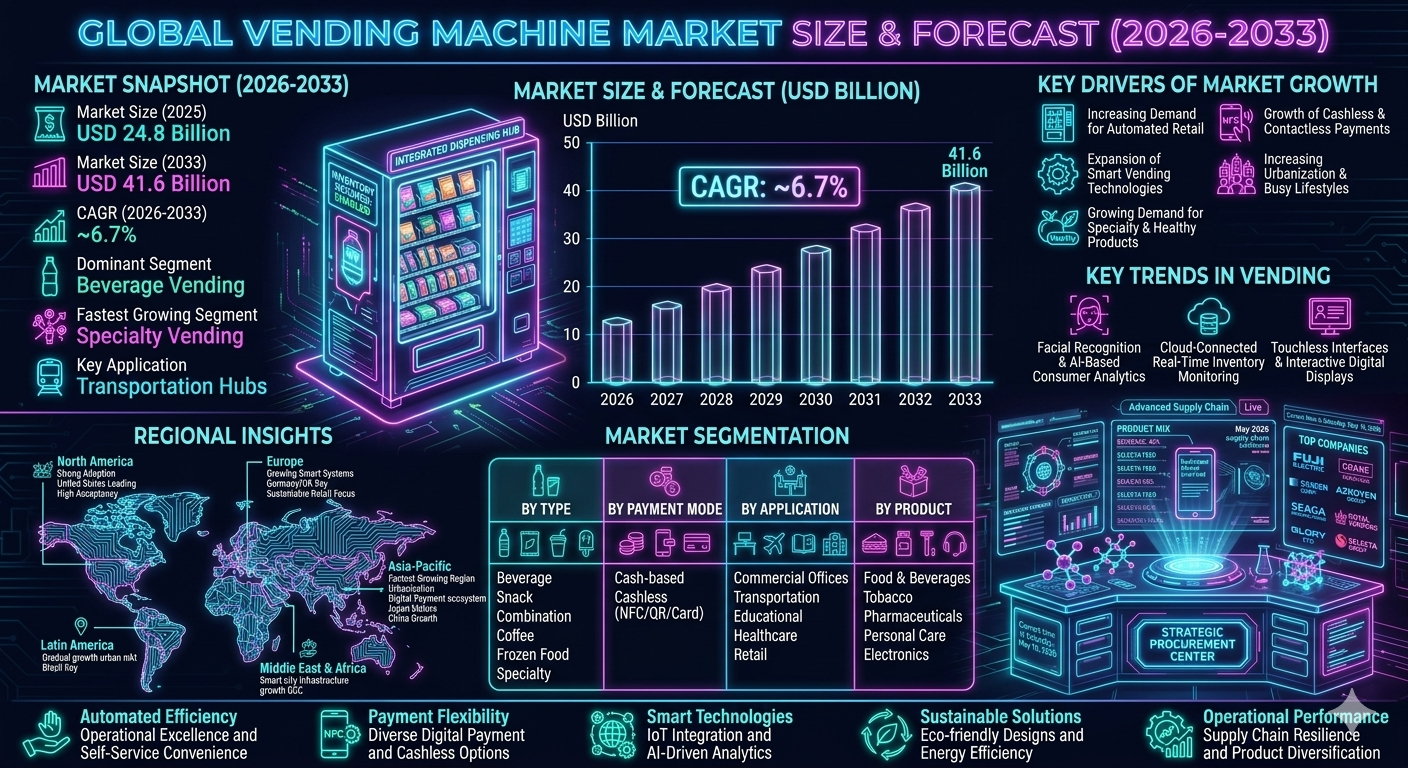
Global Vending Machine Market Overview
The vending machine market forms an important segment of the global automated retail and self-service technology industry. Vending machines provide fast, convenient, and accessible retail experiences while reducing operational costs associated with traditional staffed retail environments. The market includes beverage vending machines, snack vending machines, combination vending machines, coffee vending machines, frozen food vending systems, pharmaceutical vending machines, and specialty product vending solutions. Technological innovation is significantly reshaping the industry through adoption of AI-based consumer analytics, cloud-connected monitoring systems, facial recognition technology, and personalized advertising interfaces. Smart vending machines equipped with remote diagnostics, real-time inventory tracking, and predictive maintenance systems are improving operational efficiency and enhancing customer experience. Major industry participants include Fuji Electric Co., Ltd., Crane Holdings, Sanden Corporation, Azkoyen Group, Seaga Manufacturing, Royal Vendors, Selecta Group, Westomatic Vending Services, and Glory Ltd.Key Drivers of Global Vending Machine Market Growth
Rising Demand for Automated Retail Solutions
Consumers are increasingly preferring fast and convenient self-service purchasing experiences, particularly in urban environments and high-traffic public locations. Businesses are adopting vending machines to improve operational efficiency, reduce labor dependency, and provide 24/7 product accessibility.Growth of Cashless and Contactless Payments
The rapid adoption of digital wallets, QR-code payments, NFC technologies, and contactless card systems is significantly improving vending machine usability and transaction efficiency. Cashless payment integration is helping operators increase sales while enhancing customer convenience and reducing cash handling complexities.Expansion of Smart Vending Technologies
IoT-enabled vending machines, AI-driven inventory systems, and cloud-based analytics are enabling operators to optimize machine performance and consumer engagement. Advanced vending systems can now offer personalized recommendations, digital advertising, and automated stock replenishment capabilities.Increasing Urbanization and Busy Lifestyles
Rapid urbanization and changing consumer lifestyles are increasing demand for quick-access food, beverages, and convenience products. Vending machines are becoming essential retail solutions in airports, train stations, offices, educational campuses, hospitals, and commercial complexes.Growing Demand for Specialty and Healthy Products
Consumers are increasingly seeking healthier snacks, fresh food, organic beverages, and specialty products through vending channels. Operators are diversifying product portfolios to include premium coffee, salads, protein snacks, pharmaceuticals, and electronics.Global Vending Machine Market Segmentation
By Machine Type
The market is segmented into beverage vending machines, snack vending machines, combination vending machines, coffee vending machines, frozen food vending machines, and specialty vending systems. Beverage and snack vending machines account for a major market share due to widespread deployment across commercial and public spaces.By Payment Mode
The market includes cash-based vending machines and cashless vending machines. Cashless vending systems are witnessing rapid growth due to increasing adoption of digital payment technologies and mobile wallet applications.By Application
Applications include commercial offices, transportation hubs, educational institutions, healthcare facilities, retail centers, hotels, industrial facilities, and public infrastructure locations. Transportation and office environments represent major deployment segments due to high foot traffic and demand for convenience retail services.By Product Offering
The market includes food & beverages, tobacco products, pharmaceuticals, personal care products, electronics, and specialty merchandise. Food and beverage products dominate the market due to high-frequency consumer purchases and strong demand for convenience snacks and drinks.Regional Market Dynamics
North America
North America represents a major market for vending machines due to strong adoption of automated retail technologies, high consumer acceptance of self-service systems, and widespread deployment across commercial locations. The United States remains a leading contributor supported by technological innovation, cashless payment adoption, and large-scale vending infrastructure.Europe
Europe holds a significant share of the market driven by growing demand for smart vending systems, sustainable retail solutions, and healthy food vending options. Countries such as Germany, the United Kingdom, France, Italy, and Spain are key regional markets. European operators are increasingly focusing on eco-friendly vending technologies and energy-efficient machine designs.Asia-Pacific
Asia-Pacific is the fastest-growing region in the vending machine market due to rapid urbanization, expanding middle-class populations, and increasing adoption of smart retail technologies. Japan remains one of the most mature vending machine markets globally, while China, South Korea, and India are witnessing strong growth in automated retail deployment. The region also benefits from advanced digital payment ecosystems and high consumer engagement with technology-driven retail experiences.Latin America
Latin America is witnessing gradual growth supported by expanding urban infrastructure, increasing retail automation, and rising demand for convenience retail formats. Brazil and Mexico represent key emerging markets within the region.Middle East & Africa
The Middle East & Africa region is gradually expanding due to rising investments in smart city infrastructure, tourism development, and modern retail technologies. Countries within the Gulf Cooperation Council (GCC) are increasingly adopting advanced vending systems in airports, malls, and hospitality environments.Competitive Landscape
The global vending machine market is highly competitive and technology-driven, with participation from established vending manufacturers, retail automation companies, and smart technology providers. Key players include Fuji Electric Co., Ltd., Crane Holdings, Sanden Corporation, Azkoyen Group, Seaga Manufacturing, Royal Vendors, Glory Ltd., and Selecta Group. Companies are increasingly investing in AI-powered vending systems, touchless interfaces, smart refrigeration technologies, and cloud-connected inventory management platforms. Strategic collaborations between vending machine operators, payment technology companies, and food & beverage brands are becoming increasingly common. Competition is driven by machine reliability, payment flexibility, energy efficiency, digital capabilities, product variety, and consumer experience quality.Strategic Outlook
The strategic outlook for the global vending machine market remains highly positive due to increasing automation trends and growing consumer demand for convenient self-service retail experiences. Future growth opportunities include robotic vending systems, AI-powered consumer analytics, personalized digital advertising, autonomous micro-retail stores, and sustainable vending technologies. Healthy vending solutions, fresh food dispensing systems, and connected smart vending ecosystems are expected to become major focus areas for industry participants. Manufacturers and operators investing in digital transformation, energy-efficient systems, and omnichannel retail integration are likely to strengthen their competitive positioning.Final Market Perspective
The global vending machine market is evolving rapidly as automation, digital payments, and smart retail technologies reshape consumer purchasing behavior and retail operations worldwide. Growing urbanization, changing lifestyles, and rising preference for fast, convenient purchasing experiences will continue driving demand for advanced vending solutions across commercial and public environments. As smart vending systems become more connected, personalized, and data-driven, companies that successfully combine technology innovation, operational efficiency, and customer-centric retail experiences will remain strongly positioned in the evolving global vending machine market.Table of Contents
Table of Contents
- 1. Executive Summary
- 1.1 Global Vending Machine Market Snapshot (2026-2033)
- 1.2 Market Size & CAGR Analysis
- 1.3 Largest & Fastest-Growing Segments
- 1.4 Key Regional Insights
- 1.5 Major Market Growth Drivers
- 1.6 Competitive Landscape Overview
- 1.7 Strategic Outlook Through 2033
- 2. Introduction & Market Overview
- 2.1 Definition of Vending Machines
- 2.2 Scope of the Study
- 2.3 Evolution of Automated Retail Systems
- 2.4 Vending Machine Value Chain Analysis
- 2.5 Product Categories & Deployment Landscape
- 2.6 Regulatory & Payment Infrastructure Framework
- 2.7 Technology Innovations in Smart Vending
- 3. Research Methodology
- 3.1 Primary Research
- 3.2 Secondary Research
- 3.3 Market Size Estimation Model
- 3.4 Forecast Assumptions (2026-2033)
- 3.5 Data Validation & Market Triangulation
- 4. Market Dynamics
- 4.1 Drivers
- 4.1.1 Rising Demand for Automated Retail Solutions
- 4.1.2 Growth of Cashless & Contactless Payments
- 4.1.3 Expansion of Smart Vending Technologies
- 4.1.4 Increasing Urbanization & Busy Lifestyles
- 4.1.5 Growing Demand for Specialty & Healthy Products
- 4.2 Restraints
- 4.2.1 High Initial Installation Costs
- 4.2.2 Maintenance & Operational Challenges
- 4.2.3 Security & Vandalism Risks
- 4.2.4 Regulatory Compliance for Food & Beverage Safety
- 4.3 Opportunities
- 4.3.1 Expansion of AI-Powered Smart Vending Machines
- 4.3.2 Growth of Healthy Food & Fresh Product Vending
- 4.3.3 Integration with Smart City Infrastructure
- 4.3.4 Personalized Consumer Engagement & Digital Advertising
- 4.4 Challenges
- 4.4.1 Supply Chain & Inventory Management Complexity
- 4.4.2 Intense Market Competition
- 4.4.3 Technology Integration & Cybersecurity Concerns
- 4.4.4 Consumer Preference Variability Across Regions
- 4.1 Drivers
- 5. Global Vending Machine Market Analysis (USD Billion), 2026-2033
- 5.1 Market Size Overview
- 5.2 CAGR Analysis
- 5.3 Regional Revenue Distribution
- 5.4 Segment Revenue Analysis
- 5.5 Smart Technology Adoption Analysis
- 5.6 Consumer Demand & Usage Trends
- 6. Market Segmentation (USD Billion), 2026-2033
- 6.1 By Machine Type
- 6.1.1 Beverage Vending Machines
- 6.1.1.1 Cold Beverage Machines
- 6.1.1.1.1 Soft Drink Vending
- 6.1.1.1.1.1 High-Traffic Commercial Applications
- 6.1.1.1.1 Soft Drink Vending
- 6.1.1.1 Cold Beverage Machines
- 6.1.2 Snack Vending Machines
- 6.1.2.1 Packaged Food Dispensing
- 6.1.2.1.1 Healthy Snack Solutions
- 6.1.2.1.1.1 Wellness-Oriented Consumer Demand
- 6.1.2.1.1 Healthy Snack Solutions
- 6.1.2.1 Packaged Food Dispensing
- 6.1.3 Combination Vending Machines
- 6.1.3.1 Multi-Product Dispensing
- 6.1.3.1.1 Smart Inventory Integration
- 6.1.3.1.1.1 AI-Based Retail Automation
- 6.1.3.1.1 Smart Inventory Integration
- 6.1.3.1 Multi-Product Dispensing
- 6.1.4 Coffee Vending Machines
- 6.1.4.1 Premium Beverage Solutions
- 6.1.4.2 Office & Hospitality Applications
- 6.1.5 Frozen Food Vending Machines
- 6.1.6 Specialty Vending Machines
- 6.1.1 Beverage Vending Machines
- 6.2 By Payment Mode
- 6.2.1 Cash-Based Vending Machines
- 6.2.2 Cashless Vending Machines
- 6.3 By Application
- 6.3.1 Commercial Offices
- 6.3.2 Transportation Hubs
- 6.3.3 Educational Institutions
- 6.3.4 Healthcare Facilities
- 6.3.5 Retail Centers
- 6.3.6 Hotels & Hospitality
- 6.3.7 Industrial Facilities
- 6.3.8 Public Infrastructure Locations
- 6.4 By Product Offering
- 6.4.1 Food & Beverages
- 6.4.2 Tobacco Products
- 6.4.3 Pharmaceuticals
- 6.4.4 Personal Care Products
- 6.4.5 Electronics
- 6.4.6 Specialty Merchandise
- 6.5 By Technology
- 6.5.1 IoT-Enabled Vending Machines
- 6.5.2 AI-Powered Smart Vending Systems
- 6.5.3 Interactive Touchscreen Machines
- 6.5.4 Cloud-Connected Monitoring Systems
- 6.1 By Machine Type
- 7. Market Segmentation by Geography
- 7.1 North America
- 7.2 Europe
- 7.3 Asia-Pacific
- 7.4 Latin America
- 7.5 Middle East & Africa
- 8. Competitive Landscape
- 8.1 Market Share Analysis
- 8.2 Technology & Innovation Benchmarking
- 8.3 Smart Payment & Connectivity Analysis
- 8.4 Strategic Partnerships & Retail Collaborations
- 8.5 Sustainability & Energy Efficiency Strategies
- 9. Company Profiles
- 9.1 Fuji Electric Co., Ltd.
- 9.2 Crane Holdings
- 9.3 Sanden Corporation
- 9.4 Azkoyen Group
- 9.5 Seaga Manufacturing
- 9.6 Royal Vendors
- 9.7 Selecta Group
- 9.8 Westomatic Vending Services
- 9.9 Glory Ltd.
- 9.10 Bianchi Industry
- 10. Strategic Intelligence & Pheonix AI Insights
- 10.1 Pheonix Automated Retail Forecast Engine
- 10.2 Smart Vending Analytics Dashboard
- 10.3 Consumer Behavior Tracking System
- 10.4 Payment Technology Integration Monitor
- 10.5 Automated Porter???s Five Forces Analysis
- 11. Future Outlook & Strategic Recommendations
- 11.1 Expansion of Smart & Connected Vending Ecosystems
- 11.2 Investment in AI & Personalized Retail Technologies
- 11.3 Development of Sustainable & Energy-Efficient Machines
- 11.4 Growth of Healthy Food & Fresh Product Vending
- 11.5 Long-Term Market Outlook (2033+)
- 12. Appendix
- 13. About Pheonix Research
- 14. Disclaimer
Competitive Landscape
Global Vending Machine Market Competitive Intensity & Market Structure Overview
The Global Vending Machine Market is becoming increasingly competitive and technology-driven as automated retail solutions gain widespread adoption across commercial, transportation, healthcare, educational, and public infrastructure environments. The market consists of vending machine manufacturers, automated retail operators, payment technology providers, software developers, and smart retail solution companies competing to deliver advanced self-service consumer experiences.
Competition in the market is primarily driven by machine reliability, digital payment integration, smart technology capabilities, energy efficiency, product customization, and operational scalability. As consumer demand for convenient and contactless purchasing experiences continues to rise, companies are aggressively investing in intelligent vending technologies and connected retail ecosystems.
The market structure includes a combination of large multinational vending machine manufacturers, regional vending operators, specialty automated retail providers, and emerging smart vending startups. While traditional snack and beverage vending remains dominant, specialty vending segments such as fresh food, pharmaceuticals, electronics, and personal care products are rapidly expanding.
Technological innovation is significantly reshaping competitive dynamics as operators increasingly adopt IoT-enabled monitoring systems, AI-powered inventory management, cloud-based analytics, and touchless payment technologies to improve efficiency and customer engagement.
Global Vending Machine Market Competitive Intensity & Market Structure Current Scenario
Leading Vending Machine Manufacturers & Automated Retail Companies
Fuji Electric Co., Ltd.: Major global vending machine manufacturer known for advanced beverage vending systems, energy-efficient technologies, and strong market presence across Asia-Pacific.
Crane Holdings: Leading vending technology company specializing in payment systems, automated retail platforms, and connected vending machine infrastructure.
Sanden Corporation: Global vending and refrigeration technology provider focusing on beverage vending systems and energy-efficient cooling technologies.
Azkoyen Group: European vending technology company offering smart payment integration, coffee vending systems, and connected retail solutions.
Seaga Manufacturing: Key vending equipment manufacturer specializing in snack, beverage, and specialty vending machine solutions across commercial environments.
Royal Vendors: Established beverage vending system provider recognized for durable vending infrastructure and customized dispensing technologies.
Selecta Group: Major European automated retail operator focusing on workplace vending solutions, smart coffee systems, and food service automation.
Glory Ltd.: Technology-driven provider specializing in cash handling systems, payment technologies, and intelligent vending infrastructure.
Westomatic Vending Services: Specialized vending technology company focusing on connected vending systems and self-service retail innovations.
Regional Smart Vending Startups: Emerging companies across Asia-Pacific, North America, and Europe developing AI-powered vending systems, autonomous micro-retail solutions, and personalized vending experiences.
Key Competitive Intensity & Market Structure Signals in Global Vending Machine Market
A major competitive signal within the market is the rapid transition toward cashless and contactless vending systems. Operators are increasingly integrating mobile wallets, QR-code payments, NFC technologies, and digital payment applications to improve convenience and transaction efficiency.
Another important trend is the growing adoption of smart vending technologies. IoT-enabled systems with remote monitoring, predictive maintenance, AI-driven inventory tracking, and cloud analytics are becoming key differentiators for vending machine operators and manufacturers.
Consumer demand for healthier food and beverage options is reshaping vending product strategies. Operators are increasingly offering fresh meals, organic beverages, protein snacks, salads, and wellness-oriented products to align with evolving consumer preferences.
Digital advertising and personalized consumer engagement are becoming increasingly important competitive factors. Advanced vending machines equipped with interactive displays, facial recognition capabilities, and AI-based recommendation engines are improving customer interaction and sales conversion rates.
Sustainability and energy efficiency are also emerging as critical market drivers. Companies are increasingly investing in eco-friendly refrigeration systems, recyclable machine materials, energy-saving technologies, and low-power vending infrastructure to meet environmental standards and operational efficiency goals.
The expansion of autonomous retail ecosystems is intensifying competition as vending machines evolve beyond traditional snack dispensers into intelligent micro-retail platforms capable of offering broad product assortments and frictionless shopping experiences.
Strategic Implications of Competitive Intensity & Market Structure in Global Vending Machine Market
Companies are increasingly pursuing digital transformation strategies focused on AI-powered analytics, cloud-connected operations, and real-time machine management systems to improve operational performance and reduce downtime.
Strategic partnerships between vending operators, food & beverage companies, payment technology providers, and retail software developers are becoming increasingly common as businesses seek to strengthen ecosystem integration and enhance customer experience.
Manufacturers are heavily investing in modular vending architectures, customizable machine configurations, and scalable software platforms that support rapid deployment across diverse retail environments.
Location optimization and data-driven placement strategies are becoming critical competitive advantages as operators use consumer analytics and traffic pattern insights to maximize machine profitability and product sales.
The rise of smart cities and connected infrastructure projects is creating new deployment opportunities for intelligent vending systems in airports, metro stations, hospitals, educational campuses, and commercial office complexes.
Regional operators are increasingly focusing on niche vending segments such as pharmaceutical dispensing, electronics vending, beauty products, and premium coffee systems to differentiate themselves within highly competitive urban retail markets.
Global Vending Machine Market Competitive Intensity & Market Structure Forward Outlook
The Global Vending Machine Market is expected to become increasingly intelligent, connected, and automation-focused throughout the forecast period. Smart vending systems integrated with AI, machine learning, and predictive analytics are expected to dominate future market development.
Autonomous micro-retail concepts and cashier-less vending ecosystems are likely to significantly reshape urban retail infrastructure, enabling faster and more personalized self-service shopping experiences.
AI-driven consumer analytics and personalized advertising systems are expected to become major revenue optimization tools, allowing operators to customize product recommendations and promotional campaigns based on consumer behavior patterns.
Sustainability will remain a central strategic priority as operators adopt low-energy vending technologies, environmentally friendly refrigeration systems, and recyclable packaging solutions to align with global environmental regulations and consumer expectations.
Fresh food vending, smart refrigeration systems, and robotic dispensing technologies are expected to witness substantial growth as consumers increasingly demand high-quality, convenient, and hygienic food retail solutions.
Overall, the vending machine market will remain highly competitive and innovation-intensive, supported by rising automation trends, growing urbanization, and increasing consumer preference for fast and contactless purchasing experiences. Companies that successfully combine intelligent retail technologies, operational efficiency, digital payment integration, and customer-centric innovation will remain strongly positioned in the evolving Global Vending Machine Market through 2033.
Value Chain
Global Vending Machine Market Value Chain & Supply Chain Evolution Overview
The global vending machine market value chain is rapidly evolving from traditional coin-operated automated dispensers into highly connected, AI-enabled, cashless, and data-driven smart retail ecosystems. The industry transformation is being fueled by increasing demand for automated retail infrastructure, rising adoption of digital payment technologies, expansion of smart city projects, growing urban consumer convenience preferences, and advancements in IoT-enabled machine intelligence.
Modern vending machine ecosystems now extend far beyond simple product dispensing functions. The industry increasingly integrates cloud-connected monitoring systems, AI-powered inventory analytics, predictive maintenance software, touchless payment infrastructure, interactive digital advertising displays, consumer behavior analytics, and automated supply chain optimization platforms. Vending operators are transforming into intelligent retail service providers capable of delivering personalized and seamless purchasing experiences across high-traffic commercial and public environments.
The market value chain encompasses raw material suppliers, refrigeration system manufacturers, display technology providers, payment solution vendors, embedded software developers, IoT connectivity providers, machine assemblers, logistics operators, product suppliers, vending operators, and after-sales maintenance service providers. Large vending ecosystem participants including Fuji Electric Co., Ltd., Crane Holdings, Sanden Corporation, Azkoyen Group, Glory Ltd., and Selecta Group are continuously expanding digital capabilities and smart retail infrastructure investments.
The upstream supply chain heavily depends on steel fabrication, electronic component manufacturing, refrigeration technologies, semiconductor systems, touch-screen interfaces, wireless communication modules, sensors, motors, compressors, cloud software infrastructure, and digital payment hardware suppliers. Increasing semiconductor integration and smart connectivity requirements are making the supply chain more technologically sophisticated and globally interconnected.
Midstream operations increasingly focus on vending machine assembly, software integration, payment enablement, product stocking optimization, machine deployment, remote monitoring, and route management systems. Operators are utilizing AI-driven analytics and cloud-connected platforms to improve machine uptime, reduce operational costs, optimize product assortment, and enhance customer engagement.
Downstream activities involve machine placement partnerships, product merchandising, consumer transaction processing, real-time inventory replenishment, digital advertising monetization, customer experience management, and predictive servicing. Retail automation providers are increasingly collaborating with food brands, payment technology companies, telecom operators, transportation authorities, and smart building developers to strengthen ecosystem integration.
Supply chain evolution is also being influenced by increasing demand for sustainable vending systems, energy-efficient refrigeration units, eco-friendly materials, low-power digital displays, recyclable packaging integration, and reduced operational waste. Environmental sustainability is becoming an important competitive differentiator across advanced vending infrastructure deployment strategies.
However, the industry faces several supply chain and operational challenges including semiconductor shortages, electronic component cost volatility, cybersecurity concerns, machine vandalism risks, supply chain disruptions, fluctuating commodity prices, refrigeration maintenance complexities, and increasing compliance requirements for digital payment security and food safety standards.
Global Vending Machine Market Value Chain & Supply Chain Evolution Current Scenario
The current vending machine ecosystem is being shaped by rapid digital transformation, increasing cashless consumer behavior, rising automation adoption, and growing demand for unattended retail solutions across urban infrastructure environments. Smart vending technologies are increasingly replacing conventional mechanical systems as operators seek to improve profitability, operational efficiency, and consumer engagement.
Manufacturers are aggressively investing in intelligent vending technologies that combine IoT-enabled monitoring, AI-based demand forecasting, touchless user interfaces, and cloud-connected operational platforms. These systems allow operators to remotely manage inventory levels, machine diagnostics, energy consumption, and customer purchasing patterns in real time.
Cashless payment integration has become a central component of the modern vending value chain. Digital wallets, QR-code payments, NFC systems, biometric authentication, and mobile payment applications are significantly enhancing transaction speed, convenience, and accessibility while reducing dependency on physical cash infrastructure.
Vending operators are increasingly deploying machines in transportation hubs, airports, railway stations, office campuses, universities, hospitals, shopping malls, hotels, industrial facilities, and smart city projects where demand for 24/7 automated retail services continues to rise. The market is also witnessing expansion into non-traditional categories such as electronics vending, pharmaceutical dispensing, healthy food vending, beauty product vending, and fresh meal automation systems.
AI-driven analytics platforms are becoming highly important across vending operations. Machine learning systems are helping operators optimize stock allocation, personalize promotions, forecast demand fluctuations, reduce product wastage, and improve route planning efficiency for replenishment teams.
Cloud-based infrastructure management systems are enabling centralized operational control across large vending networks. These platforms support predictive maintenance, digital inventory tracking, automated service scheduling, remote troubleshooting, and real-time machine performance analysis.
In addition, sustainability initiatives are increasingly influencing procurement strategies and machine design. Manufacturers are focusing on low-energy refrigeration systems, environmentally friendly cooling technologies, recyclable materials, and intelligent power management systems to comply with evolving environmental regulations and corporate sustainability goals.
Key Value Chain & Supply Chain Evolution Signals in Global Vending Machine Market
Several transformative trends are actively reshaping the global vending machine market value chain and operational ecosystem.
First, the rapid adoption of cashless and contactless payment systems is fundamentally changing transaction infrastructure across vending operations. Consumers increasingly expect frictionless purchasing experiences supported by mobile wallets, tap-to-pay systems, and app-based payment integration.
Second, IoT-enabled smart vending technologies are improving operational intelligence and enabling real-time visibility into machine performance, inventory conditions, maintenance requirements, and consumer behavior analytics.
Third, AI-powered demand forecasting and inventory optimization systems are allowing operators to improve product availability, reduce spoilage, minimize stockouts, and increase operational profitability across large vending networks.
Fourth, consumer preferences are shifting toward healthier snacks, premium beverages, fresh food products, and personalized retail experiences. This trend is encouraging operators to diversify product offerings and deploy more sophisticated vending infrastructure capable of handling temperature-sensitive and premium merchandise categories.
Fifth, integration between vending operators, payment technology firms, food & beverage suppliers, logistics providers, and cloud software companies is creating increasingly interconnected automated retail ecosystems focused on operational scalability and consumer convenience.
Sixth, sustainability and energy efficiency initiatives are driving demand for environmentally optimized vending systems equipped with low-energy compressors, intelligent lighting controls, eco-friendly refrigerants, and recyclable material integration.
Seventh, advancements in digital advertising and interactive display technologies are transforming vending machines into media-enabled retail engagement platforms capable of delivering targeted promotions and consumer analytics.
Strategic Implications of Value Chain & Supply Chain Evolution in Global Vending Machine Market
Leading vending machine manufacturers and operators are increasingly prioritizing digital transformation, operational automation, and AI-enabled retail intelligence to strengthen long-term competitive positioning within the global automated retail industry.
Competitive advantage is no longer based solely on machine deployment scale. Success increasingly depends on intelligent software integration, cloud-based fleet management capabilities, payment flexibility, machine uptime optimization, consumer personalization features, energy efficiency performance, and advanced inventory analytics.
Companies capable of combining smart vending hardware with AI-powered software ecosystems and seamless digital payment infrastructure are expected to capture stronger growth opportunities across transportation, hospitality, healthcare, education, and corporate office environments.
Strategic partnerships between vending operators, fintech providers, telecom companies, logistics firms, food manufacturers, and cloud software developers are becoming increasingly important for enabling scalable automated retail ecosystems and improving customer engagement.
Operators are also increasingly investing in predictive maintenance systems and remote diagnostics technologies to reduce machine downtime, improve servicing efficiency, and lower operational maintenance costs across geographically distributed vending networks.
The growing emphasis on consumer data analytics is encouraging companies to deploy advanced monitoring platforms capable of tracking purchasing behavior, product demand trends, demographic engagement patterns, and digital advertising performance metrics.
In addition, expansion into specialty vending categories such as pharmaceutical dispensing, electronics retail automation, fresh food vending, and smart micro-market ecosystems is creating opportunities for product differentiation and higher-margin retail automation services.
Long-term strategic success will increasingly depend on balancing operational efficiency, machine reliability, cybersecurity protection, sustainability compliance, digital integration capabilities, and personalized consumer engagement strategies across highly competitive automated retail environments.
Global Vending Machine Market Value Chain & Supply Chain Evolution Forward Outlook
Between 2026 and 2033, the vending machine market value chain is expected to become increasingly AI-driven, cloud-connected, autonomous, and digitally personalized as automated retail ecosystems continue evolving worldwide.
Future vending systems will increasingly incorporate advanced technologies such as computer vision, facial recognition, AI-powered recommendation engines, robotic dispensing systems, biometric authentication, and autonomous inventory replenishment capabilities.
Cloud-connected vending infrastructure will enable real-time synchronization between operators, suppliers, logistics providers, payment systems, and consumer engagement platforms. This interconnected ecosystem will significantly improve operational visibility and retail responsiveness.
AI-powered consumer analytics will increasingly enable dynamic product pricing, personalized promotions, predictive product placement, and highly customized purchasing experiences based on consumer preferences, time-of-day demand patterns, and location-specific purchasing behaviors.
Autonomous retail expansion is expected to accelerate through integration of vending technologies with smart stores, cashier-less retail environments, digital kiosks, and robotic micro-retail concepts. Vending machines will increasingly function as decentralized retail fulfillment nodes within broader omnichannel commerce ecosystems.
Sustainability initiatives will continue reshaping equipment design and supply chain strategies. Manufacturers are expected to prioritize low-energy systems, recyclable machine components, carbon-efficient logistics operations, sustainable refrigeration technologies, and environmentally optimized manufacturing processes.
Healthy vending solutions, pharmaceutical dispensing systems, fresh meal vending, and specialty retail automation are expected to become major growth categories as consumer expectations evolve toward convenience, personalization, and premium self-service experiences.
Advanced cybersecurity systems and blockchain-enabled transaction security may also become increasingly important as vending infrastructure becomes more digitally connected and data-intensive.
Ultimately, the future vending machine value chain will evolve from standalone automated dispensers into highly intelligent, digitally integrated, AI-powered retail ecosystems capable of delivering personalized, scalable, and seamless consumer commerce experiences across global urban environments.
Market-Specific Value Chain
- Raw Material & Component Supply: Steel fabrication, refrigeration systems, semiconductors, touch-screen displays, payment hardware, motors, sensors, lighting systems, communication modules, compressors, and electronic component suppliers supporting vending machine manufacturing.
- Machine Manufacturing & System Integration: Vending machine assembly, embedded software integration, IoT connectivity installation, AI analytics integration, payment enablement systems, refrigeration engineering, and smart interface development.
- Software, Connectivity & Digital Infrastructure: Cloud monitoring platforms, AI-powered inventory management, remote diagnostics software, cybersecurity systems, digital payment gateways, consumer analytics platforms, and predictive maintenance systems.
- Distribution, Deployment & Logistics: Equipment transportation, machine installation, route planning, warehouse management, machine placement partnerships, product stocking operations, and replenishment logistics management.
- Retail Operations & Consumer Engagement: Product merchandising, digital advertising, cashless transaction processing, customer interaction systems, personalized promotions, automated inventory optimization, and vending network operations.
- After-Sales Services & Lifecycle Management: Machine servicing, predictive maintenance, software upgrades, component replacement, technical support, operational analytics, energy optimization, and refurbishment services.
Company-to-Stage Mapping
- Raw Material & Component Supply: Semiconductor suppliers, refrigeration component manufacturers, electronic hardware providers, display technology companies, payment hardware manufacturers.
- Machine Manufacturing & System Integration: Fuji Electric Co., Ltd., Sanden Corporation, Azkoyen Group, Crane Holdings, Seaga Manufacturing, Glory Ltd.
- Software, Connectivity & Digital Infrastructure: IoT platform providers, AI analytics firms, cloud software companies, digital payment technology providers, remote monitoring solution developers.
- Distribution, Deployment & Logistics: Vending operators, logistics companies, retail deployment service providers, warehouse operators, regional machine distributors.
- Retail Operations & Consumer Engagement: Selecta Group, vending service operators, food & beverage partners, payment solution companies, digital advertising platform providers.
- After-Sales Services & Lifecycle Management: Maintenance contractors, predictive servicing providers, technical support firms, software upgrade vendors, equipment refurbishment specialists.
Investment Activity
Global Vending Machine Market Investment & Funding Dynamics Overview
Investment and funding dynamics in the Global Vending Machine Market are being increasingly driven by rapid expansion of automated retail ecosystems, rising consumer demand for contactless purchasing experiences, and growing integration of intelligent retail technologies. Between 2026 and 2033, capital investments are expected to focus heavily on AI-powered vending infrastructure, IoT-enabled machine management systems, digital payment integration, and smart self-service retail platforms designed to improve operational efficiency and customer engagement.
The vending machine industry is evolving from traditional product dispensing systems into connected, data-driven retail environments capable of supporting personalized shopping experiences, predictive inventory management, and real-time analytics. Major companies including Fuji Electric Co., Ltd., Crane Holdings, Sanden Corporation, Azkoyen Group, Royal Vendors, Seaga Manufacturing, Glory Ltd., and Selecta Group are significantly increasing investments in machine modernization, cloud-based monitoring technologies, touchless interfaces, and intelligent vending ecosystems.
A major structural transformation shaping investment activity is the increasing adoption of cashless transactions, AI-enabled consumer analytics, remote diagnostics, and automated inventory replenishment technologies. These advancements are encouraging funding into next-generation vending systems capable of delivering higher operational reliability, reduced maintenance costs, and improved retail performance across high-traffic commercial environments.
The market is also benefiting from rising investments in urban infrastructure modernization, smart transportation networks, commercial real estate automation, and digitally connected retail environments. Expansion of airports, railway stations, educational institutions, healthcare facilities, offices, and smart city developments is creating substantial deployment opportunities for advanced vending solutions globally.
Global Vending Machine Market Investment & Funding Dynamics Current Scenario
Current investment activity in the vending machine market is strongly supported by increasing demand for automated retail solutions, rapid adoption of digital payment technologies, and growing consumer preference for fast and convenient self-service purchasing experiences. Companies are actively investing in intelligent vending systems, smart refrigeration technologies, energy-efficient machines, and AI-powered consumer engagement platforms to improve competitiveness and operational scalability.
- Asia-Pacific: Dominates global vending machine investment activity due to advanced automated retail adoption, strong digital payment ecosystems, high urban population density, and significant technological innovation across Japan, China, South Korea, and Southeast Asia.
- North America: Continues attracting major investments driven by rapid expansion of cashless retail infrastructure, increasing deployment of smart vending systems, and strong demand for unattended commerce solutions across the United States and Canada.
- Europe: Witnessing strong investment growth supported by increasing focus on energy-efficient vending technologies, healthy food dispensing systems, and sustainable automated retail infrastructure across Germany, France, Italy, Spain, and the United Kingdom.
- Middle East & Latin America: Emerging as developing investment regions supported by smart city projects, tourism infrastructure expansion, retail automation initiatives, and growing adoption of self-service commerce technologies.
Key Investment & Funding Dynamics Signals in Global Vending Machine Market
- Rapid growth in cashless and contactless payments is driving investments into NFC-enabled systems, QR-code transactions, biometric authentication technologies, and mobile wallet integration.
- AI-powered vending technologies are attracting significant funding due to their ability to provide personalized recommendations, dynamic pricing capabilities, and advanced consumer analytics.
- Expansion of IoT-enabled vending infrastructure is supporting investments in cloud-based machine monitoring, predictive maintenance systems, automated stock replenishment, and remote operational management.
- Growing demand for healthier snacks, fresh foods, organic beverages, and specialty products is encouraging investments in refrigerated vending systems and premium product dispensing technologies.
- Increasing labor costs and workforce shortages in retail environments are accelerating investments in unattended retail solutions and autonomous vending ecosystems.
- Smart city development initiatives and transportation infrastructure expansion are increasing deployment opportunities for vending systems across airports, metro stations, public transit networks, and commercial complexes.
- Sustainability initiatives are encouraging funding into low-energy vending systems, environmentally friendly refrigeration technologies, recyclable machine components, and energy-efficient operating systems.
Strategic Implications of Investment & Funding Dynamics in Global Vending Machine Market
- The investment landscape increasingly favors companies capable of integrating AI, cloud connectivity, advanced payment systems, and real-time analytics into scalable vending machine ecosystems.
- Technological innovation is becoming a major competitive differentiator, particularly in touchless interaction systems, intelligent inventory management, facial recognition capabilities, and consumer personalization technologies.
- Strategic partnerships between vending machine manufacturers, digital payment providers, retail automation companies, and food & beverage brands are becoming increasingly important for market expansion and service diversification.
- Regional diversification strategies remain critical, with Asia-Pacific leading deployment growth, North America driving digital retail innovation, and Europe focusing on sustainable vending technologies.
- Operators investing in AI-driven analytics and connected vending ecosystems are expected to achieve stronger revenue optimization, operational efficiency, and customer retention.
- Healthy vending solutions and premium specialty products are emerging as key investment areas as consumer purchasing preferences increasingly shift toward wellness-focused and convenience-oriented retail experiences.
- Companies with strong omnichannel integration capabilities and digital retail infrastructure are expected to maintain stronger competitive positioning in the evolving automated retail market.
Global Vending Machine Market Investment & Funding Dynamics Forward Outlook
Looking ahead, the Global Vending Machine Market is expected to attract strong long-term investment supported by increasing automation trends, growing adoption of smart retail technologies, and rising consumer demand for fast, convenient, and personalized purchasing experiences.
Future capital allocation will prioritize AI-powered vending systems, robotic retail technologies, connected micro-store environments, advanced digital advertising platforms, energy-efficient refrigeration systems, and cloud-based vending management infrastructure.
- Asia-Pacific: Will remain the leading investment region due to strong consumer acceptance of automated retail technologies, expanding smart city infrastructure, and rapid urbanization.
- North America: Will continue strengthening its position through investments in intelligent unattended commerce systems, AI-driven retail analytics, and advanced digital payment integration.
- Europe: Will increasingly focus on eco-friendly vending infrastructure, healthy food dispensing systems, and sustainable retail automation technologies.
Future funding activity is also expected to accelerate across biometric payment technologies, autonomous retail platforms, advanced refrigeration systems, smart merchandising technologies, and digitally personalized consumer engagement solutions.
Digital transformation, sustainability initiatives, and AI-driven operational optimization will remain central investment priorities across the vending machine industry. The increasing integration of predictive analytics, IoT connectivity, and real-time consumer intelligence will continue reshaping competitive strategies and operational models globally.
Overall, the market is expected to maintain strong long-term investment momentum due to its expanding role in automated retail infrastructure, smart commerce ecosystems, and consumer convenience services. Companies that successfully combine intelligent automation, energy efficiency, digital connectivity, and customer-centric innovation will remain strongly positioned to lead the Global Vending Machine Market through 2033.
Technology & Innovation
Global Vending Machine Market Technology & Innovation Landscape Overview
The technology and innovation landscape of the Global Vending Machine Market is evolving rapidly as manufacturers, retail automation providers, and vending operators increasingly integrate smart technologies to improve operational efficiency, customer engagement, payment flexibility, and inventory optimization. Innovation across the market is centered around AI-powered vending systems, IoT-enabled monitoring platforms, touchless payment technologies, cloud-connected inventory management, interactive digital displays, and automated retail ecosystems designed to enhance self-service purchasing experiences globally.
The growing digital transformation of retail infrastructure is significantly reshaping the vending machine industry. Operators are increasingly utilizing cloud-based vending management systems, real-time inventory tracking platforms, predictive maintenance technologies, and remote diagnostics to improve machine uptime and operational performance. These digital technologies are helping reduce maintenance costs, optimize product availability, and improve overall customer satisfaction across vending networks.
Artificial intelligence and machine learning are also becoming critical innovation areas within the vending machine market. AI-driven systems are being deployed to analyze consumer purchasing behavior, optimize product assortment, forecast demand patterns, and deliver personalized product recommendations through interactive vending interfaces. These technologies allow operators to improve sales performance while creating more intelligent and customized retail experiences.
In addition, advancements in cashless payment infrastructure, biometric authentication systems, smart refrigeration technologies, and automated dispensing mechanisms are significantly improving vending machine functionality and reliability. Leading vending machine manufacturers are increasingly investing in energy-efficient hardware, high-resolution touchscreen interfaces, and connected retail platforms to strengthen competitiveness within the automated retail ecosystem.
The innovation landscape is also expanding toward healthier and specialty vending solutions. Smart vending systems are increasingly being designed to support fresh food dispensing, temperature-controlled inventory management, nutritional product tracking, and personalized wellness recommendations. These technologies are enabling operators to diversify product offerings and target evolving consumer preferences for healthier and premium convenience products.
Global Vending Machine Market Technology & Innovation Landscape Current Scenario
Currently, the global vending machine market is experiencing accelerated modernization as businesses increasingly adopt automated retail solutions and contactless consumer engagement technologies. Major markets such as Japan, the United States, China, South Korea, and Europe are heavily investing in smart vending infrastructure, AI-driven retail analytics, and digital payment ecosystems to improve customer convenience and operational scalability.
Cashless and contactless payment technologies have become one of the most widely adopted innovations within the vending machine market. Vending systems increasingly support mobile wallets, QR-code payments, near-field communication (NFC), digital banking applications, and contactless credit card transactions, significantly improving transaction speed and customer accessibility.
IoT-enabled vending machines are increasingly being deployed to support real-time inventory monitoring, automated restocking alerts, remote machine diagnostics, and predictive maintenance systems. These technologies are helping operators reduce operational downtime while improving supply chain efficiency and inventory accuracy.
Artificial intelligence is increasingly being integrated into vending machine analytics platforms to optimize product placement, dynamic pricing, consumer targeting, and purchasing recommendations. AI-supported systems can analyze transaction histories, foot traffic patterns, and consumer preferences to improve machine profitability and customer engagement.
Smart refrigeration systems and energy-efficient vending technologies are also becoming major innovation priorities within the market. Advanced vending machines equipped with intelligent cooling systems, low-energy compressors, and environmental monitoring technologies are helping operators reduce electricity consumption and support sustainability initiatives.
Digital advertising integration is expanding rapidly across premium vending systems. Interactive touchscreens, personalized promotional content, and AI-enabled advertising platforms are allowing vending machines to function as intelligent retail engagement channels in high-traffic environments such as airports, malls, hotels, and transportation hubs.
Key Technology & Innovation Trends in Global Vending Machine Market
- AI-Powered Consumer Analytics: Intelligent vending platforms analyzing customer behavior, purchasing patterns, and personalized product recommendations.
- IoT-Enabled Monitoring Systems: Connected vending technologies supporting real-time inventory tracking, remote diagnostics, and predictive maintenance.
- Cashless & Contactless Payments: Digital payment integration through mobile wallets, NFC systems, QR-code payments, and contactless banking technologies.
- Cloud-Based Vending Management: Centralized digital platforms improving inventory optimization, sales analytics, and machine performance management.
- Interactive Digital Displays: Smart touchscreen interfaces enabling advertising, product customization, and enhanced customer interaction.
- Smart Refrigeration Technologies: Energy-efficient cooling systems improving product preservation while reducing operational energy consumption.
- Predictive Maintenance Systems: AI-driven diagnostics technologies identifying maintenance issues before operational failures occur.
- Biometric Authentication Systems: Facial recognition and biometric payment technologies enhancing secure and personalized vending experiences.
- Healthy & Fresh Food Vending Solutions: Advanced dispensing systems supporting fresh meals, organic snacks, and wellness-focused products.
- Autonomous Micro-Retail Ecosystems: Integrated smart retail environments combining vending automation, AI analytics, and self-service purchasing technologies.
Strategic Implications of Technology & Innovation
Technological innovation is fundamentally reshaping the vending machine market by improving retail automation, operational efficiency, consumer engagement, and payment flexibility across self-service retail ecosystems. Digital transformation is enabling vending operators to create seamless and data-driven customer experiences that integrate smart inventory management, cashless transactions, personalized marketing, and real-time operational monitoring into unified automated retail platforms.
For vending machine manufacturers and operators, investment in AI-driven analytics, IoT-enabled infrastructure, smart payment systems, and cloud-connected vending platforms has become a major strategic differentiator. Companies leveraging intelligent vending ecosystems are improving operational scalability, reducing maintenance costs, and strengthening competitive positioning within the rapidly evolving automated retail industry.
The growing adoption of data analytics and consumer behavior tracking technologies is also helping operators optimize product selection, improve sales forecasting, and enhance customer retention strategies. This shift toward intelligent vending operations is strengthening profitability while enabling more personalized and responsive retail experiences.
At the same time, innovation in sustainable vending technologies is helping operators reduce environmental impact and improve energy efficiency. Smart refrigeration systems, eco-friendly machine components, and energy management technologies are becoming increasingly important as businesses prioritize sustainability and compliance with environmental regulations.
However, cybersecurity risks, high technology integration costs, data privacy concerns, infrastructure maintenance challenges, and evolving consumer expectations remain major barriers affecting technology adoption within the vending machine market. Operators must continue investing in secure digital infrastructure, payment security systems, and software upgrades to maintain operational reliability and consumer trust.
Global Vending Machine Market Technology & Innovation Forward Outlook
Looking ahead, the global vending machine market is expected to evolve toward highly intelligent, fully connected, and AI-enabled automated retail ecosystems powered by cloud computing, predictive analytics, advanced robotics, and smart payment technologies. Vending operators will increasingly utilize autonomous retail platforms capable of delivering personalized shopping experiences, automated inventory replenishment, and real-time consumer engagement across diverse commercial environments.
Artificial intelligence is expected to play a much larger role in predictive sales analytics, customer personalization, inventory forecasting, and automated retail optimization. AI-driven vending systems will increasingly support dynamic pricing models, targeted digital advertising, and adaptive product recommendations based on consumer behavior patterns.
The convergence of IoT technologies, biometric authentication systems, digital wallets, and cloud-based retail management platforms will significantly enhance operational efficiency and customer convenience within the vending machine industry. Connected vending ecosystems will increasingly support real-time inventory synchronization, automated supply chain coordination, and intelligent maintenance scheduling.
Robotic vending systems and autonomous micro-retail environments are also expected to emerge as major innovation areas within the market. Advanced vending platforms equipped with robotic dispensing technologies, AI-supported customer interaction systems, and cashier-less retail capabilities are likely to transform future convenience retail experiences.
Sustainability and energy efficiency will remain central priorities in next-generation vending technologies. Manufacturers are expected to increasingly develop low-energy vending systems, recyclable machine materials, and environmentally friendly refrigeration technologies to align with global sustainability initiatives and energy regulations.
In conclusion, the Global Vending Machine Market is undergoing a major technological transformation driven by retail automation, AI integration, IoT connectivity, and smart payment innovations. Companies that successfully combine intelligent vending technologies, operational efficiency, personalized customer engagement, and sustainable retail infrastructure will lead the future evolution of the global vending machine industry.
Market Risk
Global Vending Machine Market Risk Factors & Disruption Threats Overview
The global vending machine market is experiencing strong growth driven by rising adoption of automated retail solutions, increasing demand for contactless purchasing experiences, expanding urbanization, and advancements in smart vending technologies. Despite positive long-term growth prospects, the market remains exposed to several operational, technological, regulatory, and economic risks that could affect profitability, deployment expansion, and long-term sustainability. As vending machines increasingly integrate AI, IoT, cashless payment systems, and cloud-based monitoring platforms, the industry is becoming more technologically dependent and operationally complex.
One of the major risk factors affecting the vending machine market is the high upfront investment and maintenance costs associated with advanced smart vending systems. Modern vending machines equipped with touchless payments, refrigeration systems, digital displays, inventory sensors, and AI-enabled analytics require significant capital expenditure. Smaller operators may face financial limitations in upgrading infrastructure or deploying technologically advanced vending networks.
Cybersecurity and digital payment vulnerabilities are also becoming increasingly significant within the industry. Smart vending machines connected to cloud networks and digital payment ecosystems are exposed to risks such as payment fraud, hacking, data breaches, malware attacks, and unauthorized system access. Any disruption in payment processing systems or compromise of customer transaction data may negatively impact consumer trust and operational continuity.
Supply chain disruptions represent another major challenge for vending machine manufacturers and operators. Shortages of semiconductors, electronic components, refrigeration equipment, and payment processing hardware can delay machine production and deployment timelines. Global logistics disruptions, trade restrictions, and rising transportation costs may further impact machine availability and operating expenses.
Changing consumer preferences and shifting purchasing behavior also create uncertainty for vending machine operators. Consumers increasingly demand healthier food options, fresh products, sustainable packaging, and personalized retail experiences. Operators failing to adapt product offerings and machine capabilities to evolving consumer expectations may experience declining sales performance and reduced machine utilization rates.
Global Vending Machine Market Risk Factors & Disruption Threats Current Scenario
The current vending machine market environment reflects strong momentum in automation and self-service retail adoption alongside growing operational and technological challenges. Increasing labor shortages and rising wage pressures are encouraging businesses to adopt automated vending solutions to reduce staffing dependency and improve retail accessibility.
At the same time, inflationary pressures, rising energy prices, and increasing raw material costs are significantly affecting vending machine manufacturing and operational profitability. Refrigerated vending systems in particular face higher electricity consumption costs, creating pressure on operators to adopt energy-efficient technologies.
The rapid expansion of cashless and contactless payment ecosystems is transforming consumer interactions with vending machines. However, operators are becoming increasingly dependent on third-party payment providers, network connectivity, and digital infrastructure reliability. Any system outages or payment processing failures may disrupt transactions and negatively affect customer satisfaction.
Smart vending technologies such as facial recognition, AI-based recommendation systems, and real-time inventory tracking are improving operational efficiency and customer engagement. However, these technologies also raise concerns related to data privacy regulations, surveillance compliance, and ethical use of consumer information across different global markets.
Additionally, competition from quick-commerce platforms, convenience stores, automated micro-markets, and food delivery services is intensifying across urban environments. Vending machine operators must continuously innovate to maintain competitiveness and consumer relevance within increasingly digital retail ecosystems.
Global Vending Machine Market Key Risk Factors & Disruption Threat Signals
One of the most important disruption signals in the vending machine market is the accelerating shift toward AI-powered autonomous retail systems and cashier-less micro-store concepts. These next-generation retail technologies may reduce reliance on traditional vending machine models while reshaping consumer expectations regarding automated shopping experiences.
Another major disruption trend involves growing sustainability regulations and environmental concerns related to vending machine energy consumption, plastic packaging waste, and refrigeration emissions. Governments and corporate customers are increasingly demanding eco-friendly vending systems with low-energy operation, recyclable packaging integration, and sustainable product sourcing.
Technological disruption through IoT integration and predictive analytics is rapidly transforming machine management capabilities. Operators adopting connected vending ecosystems gain advantages in inventory optimization, predictive maintenance, and consumer behavior analysis. Companies failing to modernize their machine fleets may struggle to compete with digitally advanced operators.
Cybersecurity threats continue to escalate as vending systems become increasingly connected to cloud-based infrastructure and digital payment networks. Data theft, ransomware attacks, payment fraud, and unauthorized remote access may create operational disruptions and financial liabilities for operators and manufacturers.
Economic uncertainty and fluctuations in consumer spending patterns may also affect vending machine transaction volumes, particularly in discretionary product categories such as snacks, beverages, and specialty consumer goods. Economic slowdowns may reduce foot traffic across transportation hubs, offices, and commercial locations where vending machines are commonly deployed.
Global Vending Machine Market Strategic Implications of Risk Factors
Vending machine operators and manufacturers must prioritize digital security investments, payment system protection, and cybersecurity infrastructure to reduce exposure to fraud, hacking, and operational disruptions. Multi-layer authentication systems, encrypted payment platforms, and continuous network monitoring will become increasingly essential.
Companies should also invest in energy-efficient machine designs, sustainable refrigeration technologies, and environmentally responsible product packaging solutions to align with evolving regulatory standards and consumer sustainability expectations.
Supply chain diversification strategies will remain critical for reducing dependency on single-source component suppliers and minimizing disruption risks related to electronic parts shortages or logistics instability. Regional manufacturing capabilities and strategic supplier partnerships may improve operational resilience.
Operators must continue enhancing customer engagement through AI-driven personalization, digital advertising integration, mobile app connectivity, and flexible payment options. Consumer convenience and user experience will remain major competitive differentiators in the evolving automated retail landscape.
Strategic expansion into healthy vending, fresh food dispensing, pharmaceutical vending, and smart micro-retail solutions may help operators diversify revenue streams and strengthen long-term market positioning.
Global Vending Machine Market Forward Risk Outlook
Looking ahead to 2026???2033, the global vending machine market is expected to maintain steady growth driven by expanding retail automation, increasing adoption of contactless technologies, and growing demand for self-service retail convenience. However, market participants will continue facing challenges related to cybersecurity, sustainability compliance, rising operational costs, and intensifying retail competition.
Future market dynamics will increasingly be influenced by AI-enabled automation, autonomous retail ecosystems, personalized consumer engagement technologies, and integration of advanced analytics within vending operations. Companies that successfully modernize machine infrastructure and optimize digital capabilities are likely to strengthen competitive advantage.
Environmental sustainability and energy efficiency will become increasingly important investment priorities as governments introduce stricter emissions standards and corporate customers prioritize green retail infrastructure solutions.
Overall, while the global vending machine market presents substantial long-term growth opportunities, sustainable success will depend on balancing technology innovation, operational efficiency, cybersecurity protection, consumer convenience, and environmental responsibility within rapidly evolving automated retail ecosystems.
Regulatory Landscape
Global Vending Machine Market Regulatory & Policy Environment Overview
The regulatory and policy environment governing the global vending machine market is evolving in response to increasing automation in retail, rising digital payment adoption, food safety concerns, and the expansion of unmanned commercial systems in public and semi-public spaces. Vending machines, which dispense food, beverages, pharmaceuticals, and consumer goods without direct human supervision, are subject to a combination of retail regulations, food safety laws, electronic payment compliance standards, and public health policies across different jurisdictions.
Regulatory frameworks vary significantly across regions, but generally focus on ensuring consumer safety, product quality, hygiene standards, transaction transparency, and operational accountability. As vending machines become more technologically advanced and widely deployed, governments are strengthening oversight related to product traceability, cashless payment security, and automated retail governance.
In addition, increasing deployment of smart vending machines equipped with IoT, AI, and cloud-based monitoring systems is introducing new regulatory considerations around data privacy, cybersecurity, and digital transaction compliance. These evolving requirements are reshaping how operators design, deploy, and manage vending infrastructure globally.
Global Vending Machine Market Regulatory & Policy Environment Current Scenario
The current regulatory environment for the vending machine market is characterized by a mix of food safety compliance rules, commercial licensing requirements, electrical safety standards, and digital payment regulations. Authorities in major economies are increasingly focusing on ensuring that vending machines comply with hygiene, labeling, and product quality standards, especially for food and beverage dispensing systems.
In North America, vending machine operations are governed by food safety regulations enforced by agencies such as the FDA and local health departments, alongside electrical safety certifications and accessibility requirements. Cashless vending systems must also comply with financial transaction security standards and payment card industry (PCI DSS) protocols.
In Europe, vending machines are regulated under EU food safety directives, machinery safety standards, and strict consumer protection laws. Operators must ensure compliance with hygiene standards, allergen labeling requirements, and eco-design regulations aimed at reducing energy consumption and environmental impact.
Asia-Pacific markets such as Japan, China, South Korea, and India are witnessing rapid regulatory modernization to support the expansion of automated retail. Japan maintains highly structured vending regulations focusing on product safety and urban deployment standards, while China and India are strengthening food safety enforcement, digital payment governance, and retail licensing frameworks.
Middle Eastern countries are increasingly regulating vending machine deployment in public spaces such as airports, malls, and transportation hubs, with emphasis on hygiene compliance, product approval systems, and digital transaction monitoring. Africa is gradually adopting structured retail automation policies aligned with urban development and tourism growth.
Key Regulatory & Policy Environment Signals in Global Vending Machine Market
- Food Safety & Hygiene Compliance: Vending machines dispensing food and beverages must comply with strict hygiene, temperature control, and product safety regulations to prevent contamination and ensure consumer protection.
- Electrical & Machinery Safety Standards: Machines must meet safety certifications related to electrical systems, mechanical operations, fire safety, and installation standards in public environments.
- Digital Payment & Financial Compliance: Cashless vending systems must adhere to payment security standards such as PCI DSS, anti-fraud regulations, and digital transaction authentication protocols.
- Consumer Protection & Labeling Regulations: Governments require transparent product labeling, pricing accuracy, refund mechanisms, and allergen disclosure for vending machine products.
- Data Privacy & Cybersecurity Regulations: Smart vending machines using IoT and AI systems must comply with data protection laws governing consumer data collection, storage, and usage.
- Environmental & Energy Efficiency Policies: Regulations are increasingly promoting energy-efficient vending machines, refrigerant controls, and sustainable packaging requirements.
Strategic Implications of Regulatory & Policy Environment
The evolving regulatory landscape is significantly influencing vending machine design, deployment strategies, and operational models. Manufacturers are increasingly integrating compliance-ready technologies such as smart monitoring systems, automated hygiene controls, and secure digital payment platforms to meet regulatory expectations.
Operators are also adapting to stricter food safety and labeling requirements by improving supply chain traceability, real-time inventory tracking, and temperature-controlled dispensing systems. This is particularly important for fresh food, dairy, and pharmaceutical vending applications.
The rise of cashless transactions has made payment compliance and cybersecurity a critical focus area. Companies are investing in encrypted payment systems, fraud detection mechanisms, and secure cloud-based vending platforms to ensure regulatory adherence and consumer trust.
Environmental regulations are driving the adoption of energy-efficient vending machines, LED lighting systems, eco-friendly refrigerants, and recyclable packaging materials. Sustainability compliance is becoming a key differentiator in competitive vending markets.
In parallel, urban governance policies are shaping vending machine placement, particularly in transportation hubs, educational institutions, and public spaces where licensing, zoning approvals, and accessibility standards must be met.
Global Vending Machine Market Regulatory & Policy Environment Forward Outlook
Between 2026 and 2033, the regulatory environment for the global vending machine market is expected to become more digitized, sustainability-driven, and security-focused. Governments are likely to introduce stricter frameworks for automated retail systems, particularly in relation to food safety monitoring, digital payment security, and consumer data protection.
The expansion of smart vending technologies will drive the development of new regulations governing AI-based retail analytics, facial recognition payment systems, and IoT-enabled machine networks. Regulatory agencies are expected to focus on ensuring transparency, ethical data usage, and cybersecurity resilience.
Environmental regulations will continue to tighten, encouraging energy-efficient vending systems, low-carbon refrigeration technologies, and reduced plastic packaging usage. Sustainability compliance will become increasingly important for large-scale vending operators and retail chains.
Global harmonization of retail automation standards may gradually emerge as international trade and multinational vending operators expand. Standardized frameworks for machine safety, payment integration, and food hygiene compliance are expected to improve cross-border deployment efficiency.
Overall, the regulatory and policy environment will play a critical role in shaping the future of the vending machine market. Companies that proactively integrate compliance, cybersecurity, sustainability, and smart retail governance into their operations will be better positioned to succeed in the evolving global automated retail landscape.