
Global Snow Sports Market Size and Share Analysis 2026-2033
Global Snow Sports Market Size & Forecast
The global snow sports market is projected to witness steady growth during the forecast period from 2026 to 2033. The market was valued at approximately USD 18.2 billion in 2025 and is expected to reach nearly USD 29.6 billion by 2033, expanding at a CAGR of around 6.3%. The market growth is driven by rising participation in winter tourism activities, increasing popularity of skiing and snowboarding, expanding adventure sports culture, and growing investments in winter sports infrastructure across developed and emerging regions. Snow sports include recreational and competitive activities performed on snow or ice, such as skiing, snowboarding, ice skating, sledding, and snowmobiling. These activities require specialized equipment including skis, snowboards, boots, helmets, protective gear, and winter apparel designed for extreme cold conditions. The market is experiencing strong momentum due to increasing disposable incomes, growing interest in experiential travel, and rising government support for winter tourism development and international sporting events. Additionally, technological advancements in lightweight materials, performance-enhancing gear, and smart wearable sports devices are further contributing to market expansion.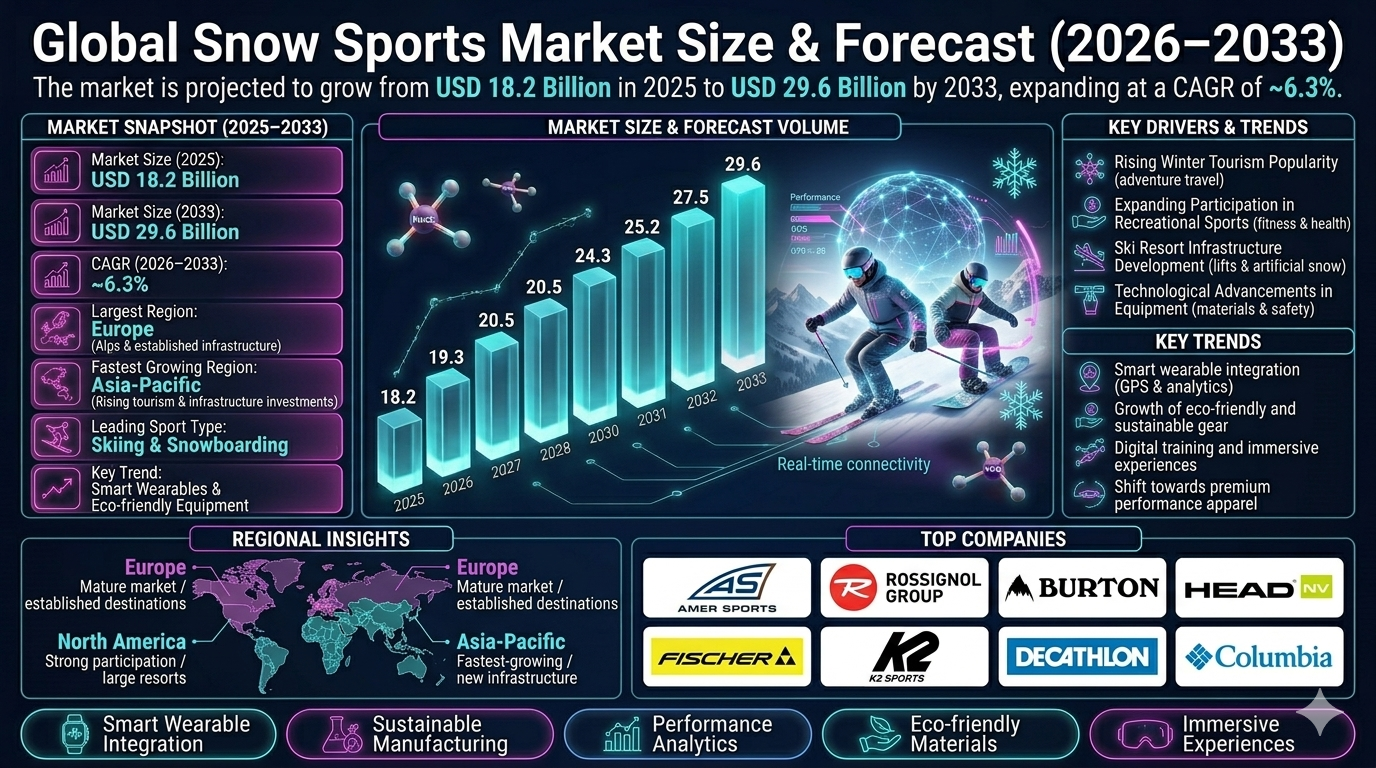
Global Snow Sports Market Overview
The snow sports market is a key segment of the global sports, outdoor recreation, and tourism industry. It encompasses both professional competitive sports and recreational winter activities enjoyed by individuals across ski resorts, mountain destinations, and indoor snow facilities. The market includes skiing equipment, snowboarding gear, ice skating equipment, protective apparel, snowmobiles, and supporting accessories such as goggles, gloves, and thermal clothing. Major ski resorts and winter sports destinations continue to expand infrastructure, including ski lifts, artificial snow systems, training facilities, and hospitality services, to attract domestic and international tourists. The integration of digital technologies such as GPS-enabled tracking devices, smart helmets, and performance analytics tools is enhancing user safety and experience in snow sports activities. Key market participants include Amer Sports (Salomon, Atomic, Arc'teryx), Rossignol Group, Burton Snowboards, Head NV, Fischer Sports GmbH, K2 Sports, Tecnica Group, Decathlon S.A., Columbia Sportswear Company, and Patagonia Inc.Key Drivers of Global Snow Sports Market Growth
Rising Popularity of Winter Tourism
Increasing global interest in adventure and experiential travel is driving demand for snow sports activities in ski resorts and winter destinations. Tourists are increasingly seeking unique outdoor recreational experiences, boosting participation in skiing and snowboarding.Expanding Participation in Recreational Sports
Growing awareness of health, fitness, and outdoor recreational activities is encouraging more individuals to participate in snow sports. Snow sports are increasingly viewed as both leisure and fitness-enhancing activities.Infrastructure Development in Ski Resorts
Investments in ski resorts, winter tourism infrastructure, and artificial snow-making systems are expanding access to snow sports. Improved facilities are attracting both beginners and professional athletes.Technological Advancements in Equipment
Innovations in lightweight materials, aerodynamic designs, and smart wearable sports gear are enhancing performance and safety. Modern equipment offers improved durability, control, and comfort in extreme weather conditions.Government Support and International Events
Government initiatives promoting winter tourism and hosting of international sporting events such as the Winter Olympics are boosting market visibility and participation. These events drive long-term investments in sports infrastructure and athlete development programs.Global Snow Sports Market Segmentation
By Sport Type
The market is segmented into skiing, snowboarding, ice skating, snowmobiling, and sledding. Skiing and snowboarding dominate the market due to high global participation and strong tourism integration.By Equipment Type
The market includes skis, snowboards, boots, protective gear, apparel, and accessories. Protective gear and apparel represent a major share due to mandatory safety requirements and harsh environmental conditions.By End User
End users include recreational users, professional athletes, and training institutions. Recreational users account for the largest market share due to rising tourism participation.By Distribution Channel
Distribution channels include specialty sports stores, online retail, brand outlets, and rental services. Rental services are growing rapidly in ski resorts due to convenience for tourists and occasional users.Regional Market Dynamics
Europe
Europe dominates the global snow sports market due to well-established ski destinations in the Alps and strong winter tourism infrastructure. Countries such as Switzerland, Austria, France, Italy, and Germany are key contributors to market growth.North America
North America holds a significant market share driven by strong participation in skiing and snowboarding activities. The United States and Canada benefit from extensive ski resorts and growing adventure tourism demand.Asia-Pacific
Asia-Pacific is the fastest-growing region due to increasing disposable incomes, rising tourism, and expanding winter sports infrastructure. Japan, China, and South Korea are major markets supported by government investments in winter sports development.Latin America
Latin America shows moderate growth, with countries like Chile and Argentina developing ski tourism destinations in mountainous regions.Middle East & Africa
The region is gradually emerging, supported by indoor snow parks and tourism diversification initiatives, particularly in GCC countries.Competitive Landscape
The global snow sports market is highly competitive, with strong presence of international sports equipment brands and outdoor lifestyle companies. Key players include Amer Sports, Rossignol Group, Burton Snowboards, Head NV, Fischer Sports GmbH, K2 Sports, Tecnica Group, Decathlon S.A., Columbia Sportswear Company, and Patagonia Inc. Companies are focusing on product innovation, lightweight materials, sustainability in manufacturing, and smart sports technology integration. Strategic collaborations with ski resorts, sports events, and professional athletes are strengthening brand positioning.Strategic Outlook
The strategic outlook for the global snow sports market remains positive due to increasing demand for adventure tourism and outdoor recreational activities. Future growth opportunities include smart wearable sports gear, eco-friendly equipment, indoor snow experience facilities, and AI-based performance tracking systems. Expansion of ski tourism infrastructure in emerging markets and rising youth participation will further support long-term growth. Manufacturers investing in sustainable materials, digital sports innovation, and premium performance gear are expected to strengthen their market position.Final Market Perspective
The global snow sports market continues to evolve as consumers increasingly prioritize experiential travel, outdoor recreation, and active lifestyles. Rising participation in winter sports, infrastructure expansion, and technological innovation will continue driving market growth throughout the forecast period. Companies that successfully combine performance innovation, sustainability, and immersive sports experiences will remain strongly positioned in the evolving snow sports market.Table of Contents
Table of Contents
- 1. Executive Summary
- 1.1 Global Snow Sports Market Snapshot (2026???2033)
- 1.2 Market Size & CAGR Analysis
- 1.3 Key Market Highlights
- 1.4 Growth Drivers Overview
- 1.5 Segment Performance Summary
- 1.6 Competitive Landscape Overview
- 1.7 Strategic Market Outlook
- 2. Introduction & Market Overview
- 2.1 Definition of Snow Sports
- 2.2 Market Scope & Coverage
- 2.3 Evolution of Winter Sports Industry
- 2.4 Value Chain Analysis
- 2.5 Ski Resorts & Tourism Ecosystem
- 2.6 Technological Advancements in Equipment
- 2.7 Industry Innovation Trends
- 3. Research Methodology
- 3.1 Primary Research Approach
- 3.2 Secondary Research Sources
- 3.3 Market Estimation Model
- 3.4 Forecasting Assumptions (2026???2033)
- 3.5 Data Validation & Triangulation
- 4. Market Dynamics
- 4.1 Drivers
- 4.1.1 Rising Popularity of Winter Tourism
- 4.1.2 Expanding Participation in Recreational Sports
- 4.1.3 Infrastructure Development in Ski Resorts
- 4.1.4 Technological Advancements in Equipment
- 4.1.5 Government Support & International Events
- 4.2 Restraints
- 4.2.1 High Cost of Equipment & Travel
- 4.2.2 Seasonal Dependence of Demand
- 4.2.3 Climate Change Impact on Snow Availability
- 4.2.4 Safety Risks & Injury Concerns
- 4.3 Opportunities
- 4.3.1 Growth of Indoor Snow Parks
- 4.3.2 Smart Wearable Sports Technology
- 4.3.3 Eco-Friendly & Sustainable Equipment
- 4.3.4 Expansion in Emerging Tourism Destinations
- 4.4 Challenges
- 4.4.1 Environmental Sustainability Concerns
- 4.4.2 High Infrastructure Investment Requirements
- 4.4.3 Competition from Alternative Leisure Activities
- 4.4.4 Weather Variability & Unpredictability
- 4.1 Drivers
- 5. Global Snow Sports Market Analysis (USD Billion), 2026???2033
- 5.1 Market Size Overview
- 5.2 CAGR Analysis
- 5.3 Revenue Growth Trends
- 5.4 Demand-Supply Analysis
- 5.5 Tourism & Participation Trends
- 5.6 Future Growth Projections
- 6. Market Segmentation (USD Billion), 2026???2033
- 6.1 By Sport Type
- 6.1.1 Skiing
- 6.1.2 Snowboarding
- 6.1.3 Ice Skating
- 6.1.4 Snowmobiling
- 6.1.5 Sledding
- 6.2 By Equipment Type
- 6.2.1 Skis
- 6.2.2 Snowboards
- 6.2.3 Boots
- 6.2.4 Protective Gear
- 6.2.5 Apparel
- 6.2.6 Accessories
- 6.3 By End User
- 6.3.1 Recreational Users
- 6.3.2 Professional Athletes
- 6.3.3 Training Institutions
- 6.4 By Distribution Channel
- 6.4.1 Specialty Sports Stores
- 6.4.2 Online Retail
- 6.4.3 Brand Outlets
- 6.4.4 Rental Services
- 6.1 By Sport Type
- 7. Regional Market Analysis
- 7.1 Europe
- 7.2 North America
- 7.3 Asia-Pacific
- 7.4 Latin America
- 7.5 Middle East & Africa
- 8. Competitive Landscape
- 8.1 Market Share Analysis
- 8.2 Key Player Benchmarking
- 8.3 Product Portfolio Analysis
- 8.4 Strategic Developments
- 8.5 Innovation & Sustainability Trends
- 9. Company Profiles
- 9.1 Amer Sports
- 9.2 Rossignol Group
- 9.3 Burton Snowboards
- 9.4 Head NV
- 9.5 Fischer Sports GmbH
- 9.6 K2 Sports
- 9.7 Tecnica Group
- 9.8 Decathlon S.A.
- 9.9 Columbia Sportswear Company
- 9.10 Patagonia Inc.
- 10. Strategic Insights & Market Outlook
- 10.1 Smart Sports Technology Integration
- 10.2 Sustainability in Snow Sports Equipment
- 10.3 Expansion of Indoor Snow Facilities
- 10.4 Digital Performance Tracking Systems
- 10.5 Long-Term Market Outlook (2033+)
- 11. Future Outlook & Strategic Recommendations
- 11.1 Growth of Experiential Winter Tourism
- 11.2 Investment in Smart & Wearable Gear
- 11.3 Expansion in Emerging Ski Destinations
- 11.4 Adoption of Eco-Friendly Equipment
- 11.5 Youth Participation & Sports Development Programs
- 12. Appendix
- 13. About Pheonix Research
- 14. Disclaimer
Competitive Landscape
Global Snow Sports Market Competitive Intensity & Market Structure Overview
The global snow sports market is moderately consolidated and brand-driven, with strong competition among international sports equipment manufacturers, outdoor apparel companies, and specialized winter sports brands. Competitive intensity is shaped by product innovation, brand reputation, performance quality, distribution reach, and strategic partnerships with ski resorts and tourism operators.
The market structure is characterized by a mix of large multinational sportswear conglomerates and niche snow sports specialists. While established global brands dominate premium equipment and apparel segments, regional players and rental service providers play a significant role in supporting recreational participation at ski destinations.
Rising participation in winter tourism, increasing demand for high-performance gear, and growing interest in experiential sports activities are intensifying competition across skiing, snowboarding, and related snow-based recreational segments.
Global Snow Sports Market Competitive Intensity & Market Structure Current Scenario
Leading Snow Sports Equipment & Outdoor Apparel Companies
Amer Sports (Salomon, Atomic, Arc’teryx): A major global player offering high-performance skiing, snowboarding, and outdoor apparel products with strong innovation and premium positioning.
Rossignol Group: One of the most established snow sports brands specializing in skis, snowboards, boots, and winter sports equipment with deep heritage in alpine sports.
Burton Snowboards: Leading snowboard-focused brand known for innovation, youth-driven marketing, and strong global presence in snowboarding culture.
Head NV: Major manufacturer of skiing and snowboarding equipment with a strong presence in competitive and recreational winter sports markets.
Fischer Sports GmbH: Well-known for skiing equipment and cross-country skiing products with strong European market penetration.
K2 Sports: Key player offering skis, snowboards, and winter sports gear with a focus on performance and recreational users.
Tecnica Group: Specialized in ski boots and performance footwear for winter sports athletes and recreational users.
Decathlon S.A.: Mass-market sports retailer offering affordable snow sports equipment and apparel, strengthening accessibility for entry-level users.
Columbia Sportswear Company: Major outdoor apparel brand providing thermal wear, jackets, and protective winter clothing for snow sports participants.
Patagonia Inc.: Premium outdoor apparel company emphasizing sustainability, environmental responsibility, and high-performance winter sports clothing.
Key Competitive Intensity & Market Structure Drivers
Product innovation in lightweight materials, thermal insulation, aerodynamic design, and safety-enhancing features is a key competitive differentiator in the snow sports market.
Strong brand identity and lifestyle positioning play a crucial role, particularly among younger consumers who associate snow sports with adventure, fashion, and experiential travel.
Seasonality of demand intensifies competition during peak winter tourism periods, pushing companies to strengthen distribution, marketing campaigns, and resort partnerships.
Expansion of rental services and ski resort retail channels is influencing competitive dynamics by increasing access for occasional and first-time participants.
Sustainability trends are gaining importance, with companies investing in eco-friendly materials, recyclable equipment, and responsible manufacturing practices to attract environmentally conscious consumers.
Strategic Implications of Competitive Intensity & Market Structure
Manufacturers are increasingly focusing on premium product differentiation, advanced performance technologies, and athlete endorsements to strengthen brand positioning in competitive segments.
Strategic collaborations with ski resorts, tourism operators, and winter sports events are enhancing visibility and driving equipment adoption across key destinations.
Growth of online retail channels and direct-to-consumer sales models is reshaping distribution strategies and increasing competitive pressure on traditional retail outlets.
Companies are also investing in smart sports technologies, including wearable performance trackers, GPS-enabled safety devices, and connected equipment ecosystems.
Emerging markets in Asia-Pacific are becoming strategic growth areas, encouraging global brands to expand distribution networks and localized product offerings.
Global Snow Sports Market Competitive Intensity & Market Structure Forward Outlook
The snow sports market is expected to remain highly brand-competitive as consumer expectations shift toward high-performance, sustainable, and experience-enhancing winter sports products.
Future competition will increasingly focus on smart equipment integration, AI-driven performance analytics, and personalized sports gear tailored to individual user profiles.
Sustainability will become a key differentiator, with growing emphasis on recyclable materials, low-carbon manufacturing, and eco-conscious product lines.
Expansion of indoor snow facilities and artificial winter environments is expected to create new commercial opportunities and broaden the consumer base beyond traditional geographies.
Overall, companies that successfully combine performance innovation, strong brand identity, sustainability, and immersive user experiences will remain strongly positioned in the evolving global snow sports market.
Value Chain
Global Snow Sports Market Value Chain & Supply Chain Evolution Overview
The global snow sports market value chain is evolving steadily as rising participation in winter tourism, increasing demand for adventure-based recreation, and continuous innovation in high-performance outdoor equipment reshape the global sports and leisure ecosystem. Snow sports???including skiing, snowboarding, ice skating, sledding, and snowmobiling???have transitioned from niche recreational activities into a mainstream segment of global experiential tourism and outdoor lifestyle industries.
The value chain spans raw material sourcing, advanced material engineering, equipment manufacturing, winter apparel production, distribution networks, ski resort infrastructure development, rental ecosystems, and end-user recreational and professional engagement. This ecosystem integrates sports equipment manufacturers, technical textile producers, outdoor apparel brands, ski resort operators, tourism boards, logistics providers, and digital sports technology companies.
Leading companies such as Amer Sports (Salomon, Atomic, Arc’teryx), Rossignol Group, Burton Snowboards, Head NV, Fischer Sports GmbH, K2 Sports, Tecnica Group, Decathlon S.A., Columbia Sportswear Company, and Patagonia Inc. are continuously investing in lightweight materials, aerodynamic designs, eco-friendly manufacturing processes, and smart sports technology integration to enhance performance, safety, and user experience.
Upstream supply chain activities include advanced composite material production, carbon fiber and polymer engineering, insulation textile manufacturing, metal alloy processing for skis and bindings, and protective gear material innovation. Midstream operations focus on product design, performance testing, safety certification, manufacturing, and seasonal production planning. Downstream distribution is heavily influenced by seasonal demand cycles, ski resort retail ecosystems, rental service networks, online retail platforms, and international tourism flows.
Operational priorities across the snow sports value chain increasingly emphasize product durability, performance optimization, environmental sustainability, cost efficiency, and user safety. However, the market continues to face challenges such as seasonality dependence, climate variability affecting snowfall patterns, high equipment costs, supply chain seasonality constraints, and increasing pressure for sustainable manufacturing practices.
Global Snow Sports Market Value Chain & Supply Chain Evolution Current Scenario
The current snow sports market is being shaped by strong growth in winter tourism, rising disposable incomes, expanding adventure travel culture, and increasing government investments in winter sports infrastructure. Ski resorts across Europe, North America, and Asia-Pacific are actively expanding facilities, including ski lifts, artificial snow systems, training centers, and hospitality services to attract global tourists.
Europe continues to dominate the global snow sports ecosystem due to its well-established Alpine destinations and mature winter tourism infrastructure. North America also holds a significant market position supported by strong recreational participation and extensive ski resort networks across the United States and Canada. Meanwhile, Asia-Pacific is emerging as the fastest-growing region due to rising middle-class incomes, increasing tourism activity, and government-led winter sports development initiatives.
Equipment manufacturers are increasingly focusing on lightweight composite materials, enhanced safety features, ergonomic designs, and performance-enhancing technologies to meet the evolving expectations of both recreational users and professional athletes. Rental-based consumption models are also gaining strong traction, particularly in ski resort destinations where tourists prefer short-term equipment access over ownership.
The integration of digital technologies such as GPS-enabled tracking systems, smart helmets, wearable performance sensors, and AI-based coaching tools is enhancing safety, performance monitoring, and user experience in snow sports activities. Additionally, sustainability initiatives are becoming increasingly important as manufacturers adopt recyclable materials, eco-friendly production processes, and low-carbon manufacturing strategies.
Key Value Chain & Supply Chain Evolution Signals in Global Snow Sports Market
One of the most important transformation signals is the growing shift toward experiential tourism and adventure-based recreation. Consumers are increasingly prioritizing immersive outdoor experiences over traditional leisure activities, driving sustained demand for skiing, snowboarding, and other snow sports activities across global destinations.
Another key signal is the rapid expansion of ski resort infrastructure and winter tourism ecosystems. Governments and private investors are heavily investing in ski lifts, artificial snow-making systems, indoor snow parks, and integrated hospitality facilities to extend seasonal tourism and improve accessibility.
Technological innovation in sports equipment is also reshaping the value chain. Advancements in carbon fiber materials, lightweight alloys, thermal insulation fabrics, and aerodynamic designs are significantly improving performance, safety, and comfort for users in extreme weather conditions.
The rise of smart sports technology is another important trend. Wearable devices, GPS tracking systems, performance analytics platforms, and connected helmets are increasingly being integrated into snow sports equipment to enhance safety and training efficiency.
Rental-based consumption models are becoming more prominent, particularly in high-tourism regions. Ski resorts are expanding rental fleets to cater to occasional users and international tourists, reducing ownership barriers and increasing overall participation rates.
Climate variability and changing snowfall patterns are also influencing market dynamics, pushing resorts and manufacturers to invest in artificial snow systems and all-season recreational infrastructure such as indoor ski facilities.
Strategic Implications of Value Chain & Supply Chain Evolution in Global Snow Sports Market
Leading snow sports equipment manufacturers are increasingly focusing on product innovation, sustainability, and digital integration to maintain competitiveness in a highly seasonal and experience-driven market. Competitive advantage is increasingly determined by performance quality, material innovation, brand positioning, and integration with tourism ecosystems.
Companies capable of delivering high-performance, lightweight, and eco-friendly equipment are expected to capture stronger growth opportunities as environmental awareness and sustainability expectations continue to rise among consumers and regulators.
Strategic partnerships between equipment manufacturers, ski resorts, tourism boards, and sports event organizers are becoming increasingly important for strengthening brand visibility and expanding consumer engagement. Professional athlete endorsements and event sponsorships also play a critical role in shaping market perception and demand.
Digital transformation is emerging as a key strategic factor. Companies integrating smart wearables, performance tracking systems, and AI-based training tools are enhancing product differentiation and improving user engagement across both recreational and professional segments.
Rental ecosystem expansion is also reshaping business models. Equipment manufacturers and resort operators are increasingly collaborating to provide integrated rental services, subscription-based equipment access, and bundled tourism packages.
Sustainability is becoming a defining competitive factor, with manufacturers investing in recyclable materials, energy-efficient production processes, and environmentally responsible supply chains to align with global ESG expectations and climate-conscious consumer behavior.
Global Snow Sports Market Value Chain & Supply Chain Evolution Forward Outlook
Between 2026 and 2033, the snow sports value chain is expected to become more technologically advanced, environmentally sustainable, and deeply integrated with global tourism ecosystems. Rising participation in winter sports, expansion of ski tourism infrastructure, and increasing adoption of smart sports technologies will continue driving long-term market growth.
Advanced materials such as ultra-light composites, thermally adaptive fabrics, and high-performance alloys are expected to further enhance equipment efficiency, safety, and durability. Manufacturers will continue investing in innovation to improve performance while reducing environmental impact.
The integration of digital ecosystems???including AI-based coaching systems, wearable performance analytics, and connected sports devices???will redefine how users interact with snow sports activities, improving safety, training efficiency, and personalized experiences.
Ski resort infrastructure is expected to expand further, particularly in emerging markets across Asia-Pacific and select regions in Latin America. Indoor snow facilities and artificial snow technologies will also gain traction as climate variability affects traditional winter tourism seasons.
Sustainability will remain a key long-term driver, with manufacturers and resorts increasingly adopting low-carbon operations, recyclable materials, and eco-friendly tourism practices to meet evolving consumer expectations and regulatory requirements.
Ultimately, the future snow sports value chain will evolve into a highly integrated ecosystem combining sports technology, tourism infrastructure, digital engagement platforms, and sustainable manufacturing practices to deliver immersive and high-performance winter sports experiences globally.
Market-Specific Value Chain
- Raw Material & Advanced Material Production: Carbon fiber, composite materials, metal alloys, technical textiles, insulation materials, and polymer engineering.
- Equipment & Apparel Manufacturing: Skis, snowboards, boots, protective gear, winter apparel, helmets, goggles, and performance accessories.
- Product Design & Performance Engineering: Aerodynamic design, safety testing, durability optimization, material innovation, and product certification.
- Distribution & Retail Ecosystem: Specialty sports stores, online retail platforms, brand outlets, and seasonal rental networks.
- Tourism & Ski Resort Operations: Ski lifts, resort infrastructure, artificial snow systems, hospitality services, and winter sports training facilities.
- Digital Sports Technology & Experience Enhancement: Wearable performance tracking, GPS systems, smart helmets, AI coaching platforms, and connected sports ecosystems.
Company-to-Stage Mapping
- Raw Material & Advanced Material Production: Composite material suppliers, carbon fiber manufacturers, textile engineering companies.
- Equipment & Apparel Manufacturing: Amer Sports, Rossignol Group, Burton Snowboards, Head NV, Fischer Sports GmbH, K2 Sports, Tecnica Group.
- Product Design & Performance Engineering: Decathlon R&D, Columbia Sportswear innovation units, Patagonia sustainability labs, sports engineering teams.
- Distribution & Retail Ecosystem: Decathlon, online sports retailers, specialty ski shops, rental service operators.
- Tourism & Ski Resort Operations: European Alpine resorts, North American ski resorts, Asian winter sports destinations, hospitality operators.
- Digital Sports Technology & Experience Enhancement: Wearable tech companies, GPS tracking solution providers, sports analytics platforms, smart gear innovators.
Investment Activity
Global Snow Sports Market Investment & Funding Dynamics Overview
Investment activity in the global snow sports market is gradually strengthening due to rising winter tourism demand, expanding ski resort infrastructure, increasing participation in recreational outdoor sports, and growing consumer spending on premium sports equipment and apparel. Between 2026 and 2033, capital allocation is expected to focus on ski resort modernization, artificial snow systems, smart sports equipment, sustainable gear manufacturing, and integrated winter tourism ecosystems.
The snow sports industry sits at the intersection of tourism, sports equipment manufacturing, and outdoor recreation. Investors, resort operators, sports brands, and tourism development authorities are increasingly allocating funds toward enhancing visitor experience, improving safety infrastructure, and expanding access to winter sports activities across established and emerging destinations.
A key structural shift shaping investment flows is the transformation of ski resorts into year-round, experience-driven tourism destinations. This is driving investments in diversified recreational infrastructure, digital booking ecosystems, AI-based crowd and slope management systems, and premium hospitality integration alongside traditional snow sports facilities.
The market is also benefiting from rising funding in sustainable tourism infrastructure, energy-efficient snowmaking technologies, eco-friendly sports equipment production, and smart wearable sports technologies that enhance performance tracking and safety monitoring in extreme conditions.
Current Investment & Funding Landscape
Current funding activity in the snow sports market is strongly supported by ski resort expansion projects, winter tourism promotion initiatives, rising outdoor recreation demand, and increasing collaboration between sports brands and tourism operators. Companies are actively investing in infrastructure upgrades, digital resort management systems, rental ecosystem expansion, and premium gear innovation.
- Europe: Leads global investment activity due to mature ski infrastructure in the Alps, strong tourism flows, and continuous reinvestment in resort modernization across Switzerland, France, Austria, and Italy.
- North America: Witnessing steady investment growth driven by resort expansion, adventure tourism demand, and increasing consumer participation in skiing and snowboarding activities.
- Asia-Pacific: Emerging as a high-growth investment region supported by government-backed winter sports development programs, rising disposable incomes, and expansion of ski resorts in China, Japan, and South Korea.
- Latin America & Middle East: Attracting niche investments in emerging ski destinations, indoor snow parks, and tourism diversification projects.
Key Investment & Funding Drivers
- Rising global winter tourism is increasing investment in ski resort infrastructure and hospitality expansion.
- Growing participation in recreational snow sports is driving demand for rental ecosystems and retail equipment expansion.
- Infrastructure modernization, including ski lifts and artificial snow systems, is attracting large-scale capital expenditure.
- Technological innovation in smart sports gear is supporting investments in wearable tracking devices and performance analytics systems.
- Increasing focus on sustainability is driving funding for eco-friendly materials and energy-efficient resort operations.
- Government initiatives promoting winter sports events are stimulating long-term infrastructure investments.
- Expansion of digital booking and resort management platforms is improving operational efficiency and investment attractiveness.
Strategic Investment Implications
- The investment landscape increasingly favors integrated winter tourism ecosystems combining sports, hospitality, and digital services.
- Resort operators investing in automation, snow reliability systems, and visitor experience optimization are gaining competitive advantage.
- Sports brands focusing on sustainable materials and performance innovation are attracting stronger long-term capital support.
- Strategic partnerships between tourism boards, private investors, and sports equipment manufacturers are shaping large-scale development projects.
- Digital transformation, including AI-based resort operations and smart safety systems, is becoming a key investment differentiator.
- Rental-based equipment ecosystems are emerging as an important revenue and investment segment in mature tourism markets.
- Companies integrating eco-tourism principles with high-performance sports infrastructure are expected to gain stronger investor confidence.
Forward Investment Outlook
The global snow sports market is expected to maintain steady long-term investment momentum driven by growing experiential tourism demand, expanding infrastructure development, and rising interest in outdoor recreational lifestyles.
Future funding activity is expected to prioritize smart ski resorts, AI-driven slope management systems, eco-friendly snowmaking technologies, digital tourism platforms, indoor snow experience facilities, and advanced performance tracking wearables.
- Europe: Will remain the dominant investment hub due to mature ski infrastructure and continuous modernization of alpine tourism ecosystems.
- Asia-Pacific: Will experience the fastest growth in investment due to expanding winter sports participation and government-supported tourism development.
- North America: Will continue stable investment growth driven by strong consumer demand and resort expansion initiatives.
Future innovation investments are also expected in climate-resilient snowmaking systems, sustainable mountain tourism development, AI-powered safety monitoring, and immersive digital ski experiences.
Overall, the convergence of tourism expansion, sports technology innovation, and sustainability-driven infrastructure development will continue shaping investment strategies across the snow sports market.
Technology & Innovation
Snow Sports Market Technology & Innovation Landscape Overview
The snow sports industry is experiencing continuous technological advancement driven by innovations in smart equipment design, wearable electronics, performance analytics, and digital resort infrastructure. The evolution of winter sports technology is increasingly focused on improving athlete safety, enhancing real-time performance tracking, and delivering more immersive and connected user experiences across skiing, snowboarding, and other snow-based activities.
Modern snow sports technologies are integrating advanced sensor systems, lightweight composite materials, and wireless connectivity to capture real-time movement, speed, balance, and terrain interaction data. These enhancements are significantly improving training precision, reducing injury risk, and optimizing overall performance outcomes for both recreational users and professional athletes.
The market is also witnessing strong adoption of smart wearables, GPS-enabled devices, and AI-powered analytics platforms that enable continuous monitoring of athlete performance and environmental conditions in extreme winter environments.
Snow Sports Technology & Innovation Current Scenario
Currently, snow sports innovation is centered around smart gear integration and data-driven performance optimization. Connected skis and snowboards equipped with embedded sensors provide real-time feedback on edge control, weight distribution, speed, and turning efficiency, enabling users to refine their technique instantly.
Wearable technologies such as smart helmets, GPS trackers, and biometric monitoring devices are widely used to enhance safety and performance tracking. These systems provide critical data including heart rate, altitude, crash detection, and location monitoring in real time.
Ski resorts are increasingly deploying IoT-enabled infrastructure, including automated lift systems, smart ticketing solutions, slope monitoring sensors, and avalanche prediction systems. These technologies improve operational efficiency while significantly enhancing visitor safety and experience.
Artificial intelligence and machine learning applications are being used for motion analysis and performance coaching, offering personalized feedback based on biomechanical data and environmental conditions.
Virtual reality and augmented reality training systems are also gaining traction, enabling users to simulate slope conditions, practice techniques, and build confidence in controlled environments before real-world execution.
Key Technology & Innovation Trends in Snow Sports Market
- Smart Wearable Devices: GPS-enabled trackers, biometric sensors, and crash-detection helmets for real-time monitoring.
- Sensor-Embedded Equipment: Skis and snowboards with motion and pressure sensors for performance optimization.
- AI-Based Performance Analytics: Machine learning systems for technique improvement and injury risk prediction.
- IoT-Enabled Ski Infrastructure: Connected resort systems for lift management, slope monitoring, and crowd control.
- Advanced Safety Systems: Avalanche detection technologies, emergency beacons, and real-time hazard alerts.
- VR/AR Training Platforms: Immersive simulation environments for skill development and training optimization.
- Smart Thermal Apparel: Adaptive clothing systems with temperature regulation and heating technologies.
- Drone-Based Monitoring: Aerial surveillance systems for terrain mapping and emergency response support.
- Performance Tracking Platforms: Cloud-based analytics for speed, motion, and endurance measurement.
- Connected Safety Ecosystems: Integrated communication between wearables, resorts, and rescue services.
Strategic Implications of Technology & Innovation
Technological advancements are reshaping the snow sports industry by transforming traditional recreational activities into highly data-driven and safety-enhanced experiences. The integration of smart devices and AI-based analytics is enabling athletes to achieve higher precision, improved consistency, and better injury prevention.
Ski resorts adopting digital infrastructure and IoT-based systems are gaining competitive advantages through improved operational efficiency, enhanced safety management, and superior customer experience delivery. This is also supporting the expansion of premium winter tourism ecosystems.
The growing adoption of wearable technology and connected sports ecosystems is increasing user engagement and enabling continuous performance tracking across recreational and professional segments.
However, challenges such as high equipment costs, extreme weather durability requirements, and limited connectivity in remote mountain regions continue to impact widespread adoption of advanced snow sports technologies.
Snow Sports Market Technology & Innovation Forward Outlook
The future of snow sports technology is expected to evolve toward fully connected, AI-enabled ecosystems that integrate real-time biometric intelligence, predictive safety systems, and autonomous monitoring solutions.
Emerging innovations include AI-powered smart goggles with real-time terrain mapping, autonomous rescue drones for avalanche zones, and fully integrated digital coaching systems tailored to individual athlete performance profiles.
Sustainability will also play a key role, with increased focus on eco-friendly materials, energy-efficient resort systems, and low-impact manufacturing processes for snow sports equipment.
Overall, snow sports technology is moving toward a highly intelligent and interconnected ecosystem that enhances safety, performance, and user experience across all levels of participation.
Market Risk
Global Snow Sports Market Risk Factors & Disruption Threats Overview
The global snow sports market is experiencing steady expansion supported by rising adventure tourism, increasing recreational participation, and infrastructure development in winter destinations. However, the industry remains highly exposed to environmental, climatic, economic, and operational risks that can significantly impact demand patterns and revenue stability.
One of the most critical disruption threats is climate variability and inconsistent snowfall patterns. Snow sports activities are heavily dependent on reliable winter conditions, and rising global temperatures are reducing natural snowfall in several traditional ski regions. This is increasing reliance on artificial snow-making systems, which raises operational costs and environmental concerns.
High seasonality is another structural risk factor. Demand for snow sports is concentrated in winter months, leading to fluctuating revenue streams for equipment manufacturers, ski resorts, and tourism operators. Off-season dependency limits cash flow stability and increases financial pressure on smaller operators.
Economic volatility and discretionary spending sensitivity also pose significant risks. Snow sports are often considered premium recreational activities requiring high travel and equipment expenditure. During economic slowdowns or inflationary periods, consumer participation in winter tourism and equipment purchases tends to decline.
Safety risks and injury concerns represent another challenge for market growth. Activities such as skiing and snowboarding involve high injury rates, which can deter new participants and increase insurance and liability costs for resorts and service providers.
Environmental regulations and sustainability pressures are also increasing across ski destinations. Restrictions on artificial snow production, land development in mountainous regions, and carbon emissions from tourism infrastructure may limit expansion opportunities for resorts and operators.
Global Snow Sports Market Risk Factors & Disruption Threats Current Scenario
The current market environment is characterized by strong demand recovery in post-pandemic tourism, with increasing participation from younger demographics and international travelers. Ski resorts in Europe, North America, and Asia-Pacific are witnessing improved occupancy rates and rising equipment rental demand.
However, rising operational costs associated with energy consumption, snow-making systems, and resort maintenance are impacting profitability. Inflation in transportation, hospitality, and equipment manufacturing is further increasing overall participation costs for consumers.
The industry is also witnessing a shift toward indoor snow facilities and artificial ski environments, particularly in regions with limited natural snowfall. While this expands accessibility, it also increases capital intensity and operational complexity for developers.
Digital transformation is influencing consumer behavior, with growing use of online booking platforms, experience-based tourism apps, and smart wearable devices. However, over-reliance on digital platforms also increases exposure to cybersecurity risks and competitive pricing pressure.
Additionally, environmental awareness among consumers is influencing travel decisions, with increasing preference for sustainable tourism destinations. Ski resorts that fail to adopt eco-friendly practices may face reputational and regulatory challenges.
Global Snow Sports Market Key Risk Factors & Disruption Threat Signals
- Climate Change & Snowfall Variability: Reduced natural snowfall and rising temperatures impacting ski season reliability.
- High Seasonality: Revenue concentration in winter months creating cash flow instability.
- Economic Sensitivity: Decline in discretionary spending affecting travel and equipment purchases.
- High Injury Rates: Safety concerns limiting participation and increasing insurance costs.
- Rising Operational Costs: Increasing expenses for energy, snow-making, and resort maintenance.
- Environmental Regulations: Restrictions on land use, emissions, and artificial snow production.
- Infrastructure Capital Intensity: High investment requirements for ski resorts and indoor snow facilities.
- Tourism Dependency: Heavy reliance on international travel and seasonal tourism flows.
- Supply Chain Risks: Dependence on specialized winter sports equipment manufacturing and logistics.
- Digital Platform Competition: Pricing pressure from online booking and experience marketplaces.
Strategic Implications of Risk Factors
Snow sports operators and equipment manufacturers must prioritize diversification strategies to reduce dependence on natural snowfall and seasonal demand cycles. Expansion of indoor snow facilities, year-round training centers, and multi-season adventure tourism offerings can help stabilize revenue streams.
Investment in sustainable resort operations, including renewable energy adoption, efficient snow-making systems, and eco-friendly infrastructure, will become increasingly important to meet regulatory requirements and consumer expectations.
Companies in the equipment segment will need to focus on lightweight materials, durable performance gear, and rental-friendly product models to align with changing consumer behavior and cost-sensitive tourism trends.
Digital transformation, including smart booking systems, AI-based tourism forecasting, and connected wearable devices, will play a growing role in improving operational efficiency and customer experience.
Global Snow Sports Market Forward Risk Outlook
Looking ahead to 2026???2033, the snow sports market is expected to remain growth-oriented but increasingly shaped by environmental constraints and climate uncertainty. Regions with stable winter conditions will continue to dominate, while artificial snow and indoor facilities will expand in non-traditional markets.
The long-term trajectory of the industry will depend heavily on climate adaptation strategies, sustainable tourism development, and infrastructure innovation. Markets that fail to address environmental risks may face declining season reliability and reduced participation levels.
Overall, while demand for adventure tourism and winter recreation remains strong, the industry will need to balance growth with sustainability, operational efficiency, and climate resilience to ensure long-term stability.
Regulatory Landscape
Global Snow Sports Market Regulatory & Policy Environment Overview
The regulatory and policy environment governing the global snow sports market is primarily shaped by tourism development regulations, environmental protection laws, mountain safety standards, and government-led sports promotion initiatives. Unlike heavily industrial sectors, snow sports are influenced more by public safety frameworks, land-use regulations, environmental conservation rules, and infrastructure development policies governing ski resorts and winter tourism destinations.
Regulations in this market focus on ensuring participant safety, maintaining ski resort operational standards, managing environmental impact in fragile alpine ecosystems, and regulating equipment quality and protective gear compliance. In addition, government policies promoting winter tourism, international sporting events, and recreational infrastructure development play a significant role in shaping market growth.
In recent years, climate change policies and sustainability regulations have increasingly influenced ski resort operations, snow-making practices, and energy consumption standards. This has led to stronger emphasis on eco-friendly resort management, artificial snow efficiency, and carbon reduction initiatives across major winter tourism destinations.
Global Snow Sports Market Regulatory & Policy Environment Current Scenario
The current regulatory landscape for snow sports is characterized by a combination of safety compliance requirements, environmental protection mandates, and tourism development incentives. Ski resorts and winter sports facilities are required to adhere to strict operational safety standards covering lift systems, slope maintenance, avalanche control measures, and emergency response preparedness.
In Europe, particularly in alpine countries such as Switzerland, Austria, France, and Italy, ski resort operations are governed by stringent environmental regulations aimed at protecting mountain ecosystems. These include restrictions on land development, water usage for artificial snow production, and biodiversity conservation requirements.
In North America, regulatory oversight is managed through a combination of federal, state, and local safety standards, with strong emphasis on liability management, resort safety protocols, and occupational safety for instructors and operators. Organizations such as the U.S. Consumer Product Safety Commission (CPSC) also play a role in regulating protective sports equipment standards.
In Asia-Pacific, countries such as Japan, China, and South Korea are actively expanding winter sports infrastructure under government-backed tourism and sports development programs. These initiatives include subsidies for ski resort development, hosting of international winter sports events, and investments in athlete training ecosystems.
Emerging markets in Latin America and the Middle East are gradually developing regulatory frameworks focused on tourism diversification, indoor snow facilities, and controlled winter recreation environments, often supported through public-private partnerships.
Key Regulatory & Policy Environment Signals in Global Snow Sports Market
- Tourism Development Policies: Government initiatives promoting winter tourism, ski resort expansion, and international sporting events are major growth enablers.
- Environmental Protection Regulations: Strict controls on mountain ecosystem preservation, water usage for snow-making, and carbon emissions from resort operations are increasingly important.
- Safety and Risk Management Standards: Mandatory safety protocols for ski lifts, slope operations, avalanche monitoring, and emergency response systems ensure participant protection.
- Sports Equipment Compliance: Standards for helmets, bindings, protective gear, and apparel ensure product safety and performance reliability.
- Sustainability and Climate Policies: Growing emphasis on low-carbon resort operations, renewable energy adoption, and eco-friendly infrastructure development.
- International Sporting Event Regulations: Hosting requirements for events such as the Winter Olympics drive infrastructure upgrades and long-term policy investments.
Strategic Implications of Regulatory & Policy Environment
The evolving regulatory environment is increasingly influencing investment decisions in ski infrastructure, equipment manufacturing, and tourism development. Environmental restrictions are pushing ski resorts to adopt energy-efficient snow-making systems, sustainable construction practices, and carbon-neutral operational models.
Safety regulations are driving continuous innovation in protective gear, smart wearables, and real-time monitoring systems that enhance skier safety and reduce accident risks. Equipment manufacturers are increasingly aligning product design with international safety certifications and performance standards.
Government-backed tourism promotion policies are creating strong opportunities for market expansion, particularly in Asia-Pacific, where large-scale investments in winter sports infrastructure are accelerating participation rates and international tourism inflows.
At the same time, climate variability and environmental constraints are pushing stakeholders to diversify offerings through indoor snow parks, artificial skiing facilities, and year-round recreational experiences, reducing dependency on natural snowfall conditions.
Global Snow Sports Market Regulatory & Policy Environment Forward Outlook
Between 2026 and 2033, the regulatory and policy landscape for the snow sports market is expected to become increasingly sustainability-focused and infrastructure-driven. Governments are likely to intensify investments in winter tourism while enforcing stricter environmental compliance measures to protect fragile alpine ecosystems.
Climate adaptation policies will play a more prominent role, encouraging innovation in artificial snow technologies, energy-efficient resort operations, and year-round indoor snow recreation facilities. This will help stabilize market growth despite changing snowfall patterns in several regions.
International sports events and tourism promotion programs are expected to remain key policy drivers, supporting long-term infrastructure development and increasing global participation in snow sports activities.
Overall, regulatory and policy frameworks will continue to balance safety, sustainability, and tourism growth objectives, with stakeholders investing in eco-friendly infrastructure, advanced safety systems, and diversified winter sports experiences expected to gain a competitive advantage.