
India Baby Care Products Market Report, Size & Forecast 2026-2033
India Baby Care Products Market Forecast Snapshot (2026???2033)
| Metric | Value |
|---|---|
| Market Size (2025) | ?? ?? ?? ?? ?? ?? ?? ?? ?? ?? ?? ?? ?? ?? ?? ?? ?? ?? ?? ?? ?? ?? ?? ?? ?? ?? ?? ?? ?? ?? ?? ?? ?? ?? ?? ?? ?? ?? ?? ?? ?? ?? ?? ?? ??USD 4.85 Billion |
| Market Size (2033) | ?? ?? ?? ?? ?? ?? ?? ?? ?? ?? ?? ?? ?? ?? ?? ?? ?? ?? ?? ?? ?? ?? ?? ?? ?? ?? ?? ?? ?? ?? ?? ?? ?? ?? ?? ?? ?? ?? ?? ?? ?? ?? ?? ?? ??USD 9.45 Billion |
| CAGR (2026???2033) | ?? ?? ?? ?? ?? ?? ?? ?? ?? ?? ?? ?? ?? ?? ?? ?? ?? ?? ?? ?? ?? ?? ?? ?? ?? ?? ?? ?? ?? ?? ?? ?? ?? ?? ?? ?? ?? ?? ?? ?? ?? ?? ?? ?? ?? ?? ?? ?? ?? ??8.70% |
| Largest Segment | ?? ?? ?? ?? ?? ?? ?? ?? ?? ?? ?? ?? ?? ?? ?? ?? ?? ?? ?? ?? ?? ?? ?? ?? ?? ?? ?? ?? ?? ?? ?? ?? ?? ?? ?? ?? ?? ?? ?? ?? ?? ??Baby Skincare Products |
| Fastest Growing Segment | ?? ?? ?? ?? ?? ?? ?? ?? ?? ?? ?? ?? ?? ?? ?? ?? ?? ?? ?? ?? ?? ?? ?? ?? ?? ?? ?? ?? ?? ?? ?? ?? ??Organic & Natural Baby Care Products |
| Leading End-Use Segment | ?? ?? ?? ?? ?? ?? ?? ?? ?? ?? ?? ?? ?? ?? ?? ?? ?? ?? ?? ?? ?? ?? ?? ?? ?? ?? ?? ?? ?? ?? ?? ?? ?? ?? ?? ?? ?? ?? ?? ?? ?? ?? ?? ?? ?? ?? Households |
| Key Trend | ?? ?? ?? ?? ?? ?? ?? ?? ?? ?? ?? ?? ?? ?? ?? ?? Premiumization, Organic Formulations & Growth of E-Commerce-Based Baby Care Retail |
| Regulatory Influence | ?? ?? ?? ?? ?? ?? ?? ?? ?? ?? ?? ?? ?? ?? ?? ?? BIS Standards, Cosmetic Safety Regulations & Infant Product Quality Guidelines |
| Future Outlook | Growth Driven by Rising Disposable Income, Increasing Parental Awareness & Demand for Safe Baby Care Solutions |
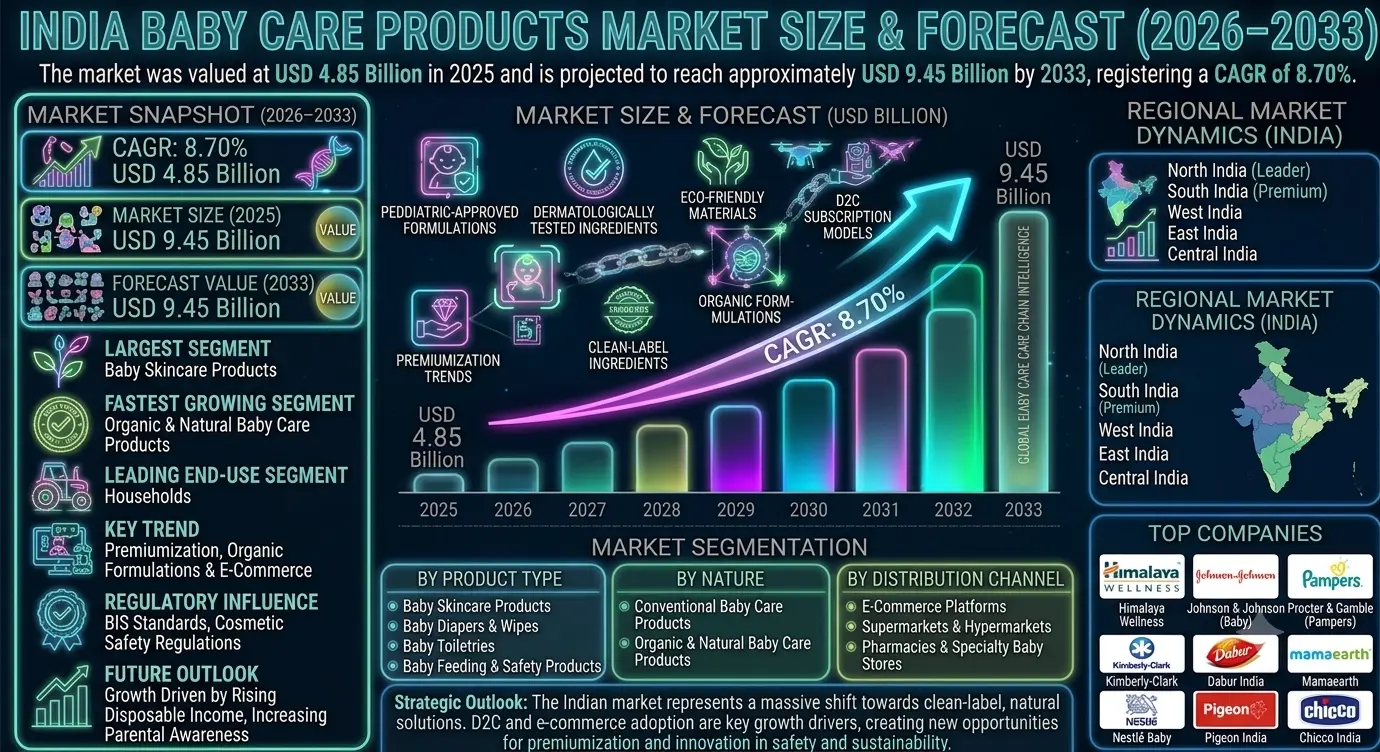
India Baby Care Products Market Size & Forecast
The India Baby Care Products Market is expected to witness strong growth during the forecast period from 2026 to 2033. The market was valued at USD 4.85 billion in 2025 and is projected to reach approximately USD 9.45 billion by 2033, registering a CAGR of 8.70%. Market growth is primarily driven by increasing birth rates, rising disposable income, growing awareness regarding infant hygiene and health, and expanding availability of premium baby care products. The rapid growth of organized retail and e-commerce channels is further supporting market expansion across urban and semi-urban regions.India Baby Care Products Market Overview
The baby care products market includes a wide range of products such as baby skincare products, diapers, wipes, shampoos, lotions, powders, baby toiletries, feeding accessories, and baby safety products. Growing parental focus on child health, increasing preference for dermatologically tested formulations, and rising demand for organic and chemical-free products are shaping the market landscape. Manufacturers are focusing on product innovation, premiumization, and sustainable packaging to meet evolving consumer expectations.Structural Drivers of Market Growth
1. Rising Awareness of Infant Health and Hygiene
Parents are increasingly prioritizing infant hygiene, skincare, and wellness, driving demand for specialized baby care products. Market Implications: Brands offering safe, clinically tested, and pediatrician-recommended products are gaining consumer trust and market share.2. Increasing Disposable Income and Premiumization
Growing household incomes are encouraging consumers to spend more on premium and branded baby care products. Market Implications: Premium product manufacturers are expanding their portfolios to address evolving consumer preferences.3. Growth of Organic and Natural Baby Care Products
Parents are increasingly seeking products free from harmful chemicals, parabens, and synthetic additives. Market Implications: Demand for natural, herbal, and organic baby care solutions is accelerating across India.4. Expansion of E-Commerce and Organized Retail
Online platforms and modern retail outlets are improving product accessibility and offering a wider range of baby care brands. Market Implications: Digital sales channels are becoming important growth drivers for baby care product manufacturers.Market Segmentation Analysis
By Product Type
- Baby Skincare Products Largest segment including lotions, creams, oils, powders, and rash protection products.
- Baby Diapers & Wipes High-demand category driven by convenience, hygiene awareness, and increasing disposable diaper adoption.
- Baby Toiletries Includes shampoos, soaps, body washes, and grooming products designed for infants.
- Baby Feeding & Safety Products Includes feeding accessories, sterilizers, monitors, and baby safety solutions.
By Nature
- Conventional Baby Care Products Largest segment supported by widespread availability and affordability.
- Organic & Natural Baby Care Products Fastest-growing segment due to rising consumer preference for safe and chemical-free formulations.
By Distribution Channel
- Supermarkets & Hypermarkets Major sales channel offering a wide range of baby care products.
- Pharmacies & Drug Stores Trusted channel for healthcare-oriented baby care purchases.
- E-Commerce Platforms Fastest-growing segment driven by convenience, discounts, and product variety.
- Specialty Baby Stores Provide premium and niche baby care product selections.
Regional Market Dynamics
North India
Leading regional market supported by large population base, growing urbanization, and increasing disposable income.South India
Strong demand driven by high literacy levels, healthcare awareness, and premium product adoption.West India
Significant market growth supported by organized retail expansion and strong purchasing power.East India
Growing market due to improving economic conditions and increasing awareness of infant care products.Central India
Emerging market driven by retail penetration and rising demand for affordable baby care solutions.Competitive Landscape
The India Baby Care Products Market is highly competitive with multinational consumer goods companies, domestic manufacturers, and emerging organic baby care brands competing through innovation, product safety, brand trust, and distribution reach. Key Companies Operating in the Market Include:- Johnson & Johnson Consumer Health
- Himalaya Wellness Company
- Procter & Gamble Co.
- Kimberly-Clark Corporation
- Dabur India Ltd.
- Unilever PLC
- Nestl?? S.A.
- Pigeon Corporation
- Mamaearth (Honasa Consumer Ltd.)
- Chicco (Artsana Group)
Strategic Outlook
The future of the India Baby Care Products Market will be shaped by increasing consumer preference for natural products, product innovation, and digital retail expansion. Manufacturers are expected to invest in organic formulations, sustainable packaging, and premium product lines to address changing parental expectations. Growing awareness regarding infant health and wellness will continue to support demand across both urban and rural markets. The rapid expansion of e-commerce platforms, coupled with personalized marketing strategies and direct-to-consumer business models, will create new growth opportunities. Companies focusing on safety, transparency, and product quality are expected to strengthen their market positions over the coming years.Final Market Perspective
The India Baby Care Products Market represents a significant growth opportunity within the Personal Care, Beauty & Hygiene industry. Rising parental awareness, increasing spending on infant wellness, and growing demand for premium and organic baby care products are expected to drive sustained market expansion. As product innovation and retail accessibility continue to improve, companies investing in safe, high-quality, and consumer-centric baby care solutions will be well-positioned to capture long-term growth opportunities in the Indian market.Table of Contents
Table of Contents
- Executive Summary
- India Baby Care Products Market Snapshot (2026???2033)
- Market Size & Growth Overview
- Key Market Highlights
- Largest & Fastest-Growing Segments
- Leading End-Use Segment Overview
- Key Market Trends in Premium, Organic & Digital Baby Care Retail
- Strategic Outlook Through 2033
- Market Introduction & Overview
- Definition of Baby Care Products
- Scope of the India Baby Care Products Market
- Evolution of Infant Care and Baby Hygiene Products in India
- Role of Baby Care Products in Infant Health, Hygiene & Wellness
- Value Chain Analysis of the Baby Care Products Ecosystem
- Regulatory Influence (BIS Standards, Cosmetic Safety Regulations & Infant Product Quality Guidelines)
- Transition Toward Organic Formulations, Premium Products & E-Commerce-Based Retailing
- Research Methodology
- Primary Research Approach
- Secondary Research Sources
- Market Size Estimation Methodology
- Forecasting Assumptions (2026???2033)
- Data Validation & Triangulation Process
- Market Dynamics
- Structural Drivers of Market Growth
- Rising Awareness of Infant Health and Hygiene
- Increasing Disposable Income and Premiumization
- Growth of Organic and Natural Baby Care Products
- Expansion of E-Commerce and Organized Retail
- Market Restraints
- Price Sensitivity in Rural and Semi-Urban Markets
- Availability of Counterfeit and Unorganized Products
- Regulatory Compliance and Product Safety Challenges
- Market Opportunities
- Expansion of Organic and Chemical-Free Baby Care Products
- Growth of Premium and Specialized Infant Care Solutions
- Increasing Penetration in Tier-II and Tier-III Cities
- Rising Adoption of Direct-to-Consumer (D2C) Sales Models
- Market Challenges
- Maintaining Product Safety and Consumer Trust
- Intense Competition Among Domestic and International Brands
- Supply Chain and Distribution Management Across Diverse Regions
- Structural Drivers of Market Growth
- India Baby Care Products Market Size & Forecast (2026???2033)
- Market Revenue Analysis
- CAGR Analysis
- Consumer Spending and Premiumization Trends
- Organic Baby Care Product Adoption Analysis
- Retail and E-Commerce Growth Trends
- Future Market Outlook
- Market Segmentation Analysis (2026???2033)
- By Product Type
- Baby Skincare Products (Largest Segment)
- Baby Diapers & Wipes
- Baby Toiletries
- Baby Feeding & Safety Products
- By Nature
- Conventional Baby Care Products (Largest Segment)
- Organic & Natural Baby Care Products (Fastest-Growing Segment)
- By Distribution Channel
- Supermarkets & Hypermarkets
- Pharmacies & Drug Stores
- E-Commerce Platforms (Fastest-Growing Segment)
- Specialty Baby Stores
- By Product Type
- Regional Market Analysis
- North India (Largest Regional Market)
- South India
- West India
- East India
- Central India
- Competitive Landscape
- Market Structure & Competitive Analysis
- Key Player Benchmarking
- Strategic Developments
- Product Innovation, Safety & Brand Positioning Strategies
- Partnerships, Acquisitions & Distribution Network Expansion
- Company Profiles
- Johnson & Johnson Consumer Health
- Himalaya Wellness Company
- Procter & Gamble Co.
- Kimberly-Clark Corporation
- Dabur India Ltd.
- Unilever PLC
- Nestl?? S.A.
- Pigeon Corporation
- Mamaearth (Honasa Consumer Ltd.)
- Chicco (Artsana Group)
- Strategic Outlook
- Future of Organic and Sustainable Baby Care Products
- Expansion of Premium Infant Care Product Categories
- Growth of E-Commerce and Direct-to-Consumer Distribution Models
- Innovation in Safe, Dermatologically Tested & Pediatrician-Recommended Products
- Long-Term Market Outlook (2033+)
- Final Market Perspective
- Appendix
- About Pheonix Market Research
- Disclaimer
Competitive Landscape
India Baby Care Products Market Competitive Intensity & Market Structure Overview
The India Baby Care Products Market is highly competitive and moderately fragmented, with multinational consumer goods companies, domestic manufacturers, healthcare brands, and emerging organic baby care companies competing across multiple product categories. Competitive intensity is primarily driven by product safety, brand trust, dermatological testing, ingredient quality, distribution reach, and innovation in infant care formulations.
Companies compete across baby skincare products, diapers, wipes, baby toiletries, feeding accessories, and baby safety products. Rising parental awareness regarding infant health and hygiene, coupled with growing demand for premium and natural formulations, is intensifying competition across the Indian baby care ecosystem.
The market structure is evolving from traditional mass-market baby care products toward premium, organic, and clinically tested solutions. Strategic partnerships between manufacturers, healthcare professionals, retail chains, and e-commerce platforms are reshaping competitive dynamics throughout the industry.
India Baby Care Products Market Competitive Intensity & Market Structure Current Scenario
Leading India Baby Care Products Companies
- Johnson & Johnson Consumer Health: One of the most recognized baby care brands in India, offering a comprehensive portfolio of baby skincare, toiletries, and hygiene products supported by strong consumer trust and nationwide distribution.
- Himalaya Wellness Company: A leading herbal and wellness brand providing baby care products formulated with natural ingredients and Ayurvedic expertise, catering to growing demand for gentle infant care solutions.
- Procter & Gamble Co.: A major consumer goods company with a strong presence in the baby care segment through diaper and infant hygiene product offerings.
- Kimberly-Clark Corporation: A global hygiene products manufacturer known for baby diapers and infant care solutions designed to enhance comfort, hygiene, and convenience.
- Dabur India Ltd.: A leading Indian FMCG company offering baby care products based on natural and Ayurvedic formulations, supported by strong brand recognition and extensive retail penetration.
- Unilever PLC: A diversified consumer goods company with a broad personal care portfolio and growing participation in infant hygiene and baby wellness categories.
- Nestl?? S.A.: A global nutrition company with a strong presence in infant and child wellness products, supporting broader baby care market growth through trusted consumer brands.
- Pigeon Corporation: A prominent provider of baby feeding accessories, nursing products, and infant care solutions focused on safety, convenience, and product innovation.
- Mamaearth (Honasa Consumer Ltd.): A rapidly growing Indian brand specializing in toxin-free, natural, and dermatologically tested baby care products, benefiting from strong digital and direct-to-consumer channels.
- Chicco (Artsana Group): An international baby care brand offering premium baby skincare, feeding products, safety solutions, and infant wellness products across India.
Key Competitive Intensity & Market Structure Drivers
Growing parental awareness regarding infant hygiene, skincare, and overall wellness is intensifying competition as companies focus on product safety, quality assurance, and pediatrician-recommended formulations.
The rising demand for organic, natural, and chemical-free baby care products is encouraging manufacturers to invest in clean-label ingredients, herbal formulations, and sustainable product development.
Expansion of e-commerce platforms and digital retail channels is increasing market accessibility while enabling brands to strengthen direct-to-consumer engagement and personalized marketing strategies.
Stringent product safety standards, cosmetic regulations, BIS compliance requirements, and quality certifications are influencing purchasing decisions and shaping competitive positioning.
Premiumization trends are creating opportunities for companies offering advanced skincare solutions, specialized infant products, and premium baby wellness portfolios.
Strategic Implications of Competitive Intensity & Market Structure
Companies with strong brand equity, proven product safety records, extensive distribution networks, and trusted healthcare positioning are expected to maintain significant competitive advantages.
Investment in organic formulations, dermatologically tested products, and eco-friendly packaging solutions is becoming increasingly important for long-term market differentiation.
Manufacturers focusing on innovation, transparency, ingredient safety, and digital consumer engagement are likely to strengthen customer loyalty and market share.
Strategic expansion through e-commerce partnerships, pharmacy networks, specialty baby stores, and direct-to-consumer channels is enabling companies to broaden their market presence across India.
Organizations capable of combining safety, affordability, innovation, premium quality, and strong consumer trust will be best positioned to compete effectively in the evolving India baby care products market.
India Baby Care Products Market Competitive Intensity & Market Structure Forward Outlook
The competitive landscape of the India baby care products market is expected to become increasingly innovation-driven as parents continue to prioritize infant health, wellness, and product safety.
Future competition will be shaped by advancements in natural formulations, sustainable packaging technologies, personalized baby care solutions, and digitally enabled consumer engagement platforms.
Baby care manufacturers are expected to increase investments in organic product development, premium infant wellness solutions, omnichannel retail strategies, and product safety certifications to strengthen market positioning.
Over the forecast period, companies that successfully balance product quality, affordability, innovation, regulatory compliance, sustainability, and consumer trust will be best positioned to lead the evolving India Baby Care Products Market.
Value Chain
India Baby Care Products Market Value Chain & Supply Chain Evolution Overview
The India Baby Care Products Market operates through a comprehensive value chain that includes raw material sourcing, ingredient formulation, product manufacturing, packaging, distribution, retailing, and end-user consumption. The industry serves growing demand for baby skincare products, diapers, wipes, toiletries, feeding accessories, and baby safety products across urban and rural markets.
The market is increasingly influenced by parental awareness regarding infant health, product safety, organic formulations, and premium baby care solutions. Manufacturers are focusing on dermatologically tested ingredients, chemical-free formulations, and sustainable packaging to meet evolving consumer preferences.
Digital commerce expansion, organized retail growth, and direct-to-consumer business models are reshaping supply chain dynamics. Companies are investing in omnichannel distribution networks and localized manufacturing facilities to improve product accessibility and operational efficiency.
Technological advancements in product formulation, quality testing, packaging innovation, and supply chain management are enabling manufacturers to enhance product quality, regulatory compliance, and customer engagement throughout the value chain.
India Baby Care Products Market Value Chain & Supply Chain Evolution Current Scenario
Market-Specific Value Chain
- Raw Material & Ingredient Sourcing: Procurement of botanical extracts, skincare ingredients, absorbent materials, polymers, fragrances, packaging materials, and natural additives used in baby care products.
- Formulation & Product Development: Development of baby-safe formulations, dermatological testing, product innovation, and quality assurance processes.
- Manufacturing & Processing: Production of baby lotions, creams, shampoos, diapers, wipes, powders, feeding accessories, and hygiene products.
- Packaging & Labeling: Product packaging, safety labeling, regulatory compliance, and sustainable packaging implementation.
- Distribution & Logistics: Warehousing, transportation, inventory management, and supply chain coordination across regional markets.
- Retail & Sales Channels: Distribution through supermarkets, hypermarkets, pharmacies, specialty baby stores, and e-commerce platforms.
- End User Consumption: Households, parents, caregivers, hospitals, maternity centers, and childcare facilities utilizing baby care products.
Company-to-Stage Mapping
- Raw Material & Ingredient Sourcing: BASF SE, Croda International Plc, Evonik Industries AG, specialty ingredient suppliers, and packaging material providers.
- Formulation & Product Development: Johnson & Johnson Consumer Health, Himalaya Wellness Company, Mamaearth, and product development laboratories.
- Manufacturing & Processing: Procter & Gamble Co., Kimberly-Clark Corporation, Dabur India Ltd., Unilever PLC, and contract manufacturing organizations.
- Packaging & Labeling: Packaging solution providers, labeling companies, and compliance service providers.
- Distribution & Logistics: Third-party logistics companies, regional distributors, warehousing operators, and supply chain service providers.
- Retail & Sales Channels: Reliance Retail, DMart, Apollo Pharmacy, FirstCry, Amazon India, Flipkart, and specialty baby care retailers.
- End User Consumption: Households, parents, caregivers, healthcare facilities, and childcare institutions across India.
Key Value Chain & Supply Chain Evolution Signals in India Baby Care Products Market
Expansion of Organic and Natural Baby Care Products
Demand for chemical-free, plant-based, and organic baby care products is increasing as parents prioritize product safety and infant wellness.
Growth of E-Commerce-Led Distribution
Online marketplaces and direct-to-consumer channels are strengthening product accessibility and expanding brand reach across India.
Premiumization of Baby Care Offerings
Manufacturers are introducing premium skincare, hygiene, and wellness products with advanced formulations and enhanced safety features.
Adoption of Sustainable Packaging Solutions
Companies are increasingly utilizing recyclable, biodegradable, and eco-friendly packaging materials to align with sustainability objectives.
Strengthening of Domestic Manufacturing Capabilities
Local production facilities are expanding to improve supply chain resilience, reduce costs, and support growing market demand.
Digital Consumer Engagement and Brand Building
Brands are leveraging social media, influencer marketing, and personalized digital campaigns to strengthen consumer trust and loyalty.
Strategic Implications of Value Chain & Supply Chain Evolution
Investment in Product Safety and Quality Assurance
Companies focusing on clinical testing, safety certifications, and transparent ingredient disclosure can strengthen brand credibility.
Expansion of Organic Product Portfolios
Manufacturers developing natural and organic baby care solutions can capitalize on rapidly evolving consumer preferences.
Enhancement of Omnichannel Distribution Networks
Integrating offline retail, pharmacies, and e-commerce channels can improve market penetration and customer accessibility.
Localization of Manufacturing Operations
Domestic production expansion can improve supply chain efficiency, reduce dependency on imports, and enhance profitability.
Implementation of Sustainable Packaging Initiatives
Eco-friendly packaging adoption can support environmental goals and improve brand differentiation among conscious consumers.
Utilization of Data-Driven Consumer Insights
Advanced analytics and consumer behavior monitoring can help companies optimize product development and marketing strategies.
India Baby Care Products Market Value Chain & Supply Chain Evolution Forward Outlook
Looking ahead, the India Baby Care Products Market is expected to become increasingly innovation-driven, digitally connected, and sustainability-focused. Growing demand for premium products, organic formulations, and convenient purchasing experiences will continue reshaping industry value chains.
Key Future Developments Include:
- Expansion of organic and plant-based baby care product portfolios.
- Increased adoption of sustainable and biodegradable packaging materials.
- Growth of e-commerce and direct-to-consumer retail models.
- Strengthening of domestic manufacturing and sourcing ecosystems.
- Integration of digital marketing and personalized consumer engagement strategies.
- Enhanced focus on product safety, quality certifications, and regulatory compliance.
As the market evolves, competitive advantage will increasingly depend on product quality, ingredient transparency, sustainability initiatives, digital retail capabilities, and strong distribution networks.
Companies that successfully integrate innovation, safety, sustainability, and consumer-centric product development across the value chain will be well-positioned to achieve long-term growth in the India Baby Care Products Market.
Investment Activity
India Baby Care Products Market Investment & Funding Dynamics Overview (2026???2033)
The India Baby Care Products Market is witnessing increasing investment activity driven by rising parental awareness regarding infant health and hygiene, growing demand for premium baby care products, expanding disposable incomes, and increasing adoption of organic and natural formulations. Consumer goods companies, baby care brands, private equity firms, venture capital investors, healthcare-focused organizations, and retail companies are actively investing in organic baby skincare products, premium infant hygiene solutions, digital retail channels, sustainable packaging technologies, and product innovation initiatives.
Investment momentum is accelerating as manufacturers focus on meeting evolving consumer preferences for safe, dermatologically tested, and chemical-free baby care products. Capital allocation is increasingly directed toward natural ingredient formulations, research and development, brand expansion, omnichannel distribution networks, and direct-to-consumer business models.
Additionally, growing investments in e-commerce platforms, premium baby wellness products, eco-friendly packaging solutions, and infant healthcare-focused product portfolios are creating substantial long-term opportunities across the Indian baby care ecosystem.
Current Investment & Funding Landscape
The current market environment reflects strong investor interest in baby wellness, organic product development, and digital retail expansion. Industry participants are investing heavily in baby skincare innovation, diaper manufacturing capacity, product safety testing, and premium baby care product launches.
Significant funding is being directed toward organic and natural baby care brands, e-commerce-led distribution strategies, sustainable product development, and consumer engagement platforms to strengthen market reach and brand loyalty.
Strategic collaborations among consumer goods manufacturers, healthcare companies, retail chains, e-commerce platforms, and baby care startups are reshaping investment flows and accelerating innovation across the baby care value chain.
Key Investment & Funding Dynamics Signals
Growing demand for premium baby skincare and hygiene products is driving capital investment across product categories.
Expansion of organic and natural baby care solutions is attracting significant funding from wellness-focused investors.
Increasing penetration of e-commerce and direct-to-consumer sales channels is accelerating digital retail investments.
Rising consumer preference for safe, pediatrician-recommended, and dermatologically tested products is strengthening innovation-focused funding.
Strategic investments in sustainable packaging, eco-friendly materials, and responsible manufacturing practices are supporting long-term growth initiatives.
Growing awareness of infant health, hygiene, and wellness is encouraging expansion of premium product portfolios.
Increasing retail penetration into semi-urban and rural markets is creating new investment opportunities for manufacturers and distributors.
Strategic Implications of Investment & Funding Dynamics
- Continuous investment in product safety, organic formulations, and innovation-driven product development is essential for maintaining market competitiveness.
- Capital allocation toward digital commerce platforms, consumer education initiatives, and brand-building strategies will strengthen market positioning.
- Companies developing chemical-free, hypoallergenic, and environmentally responsible baby care products are expected to secure stronger long-term growth opportunities.
- Strategic partnerships between manufacturers, healthcare providers, retailers, and online marketplaces will accelerate product accessibility and market expansion.
- Investments in localized manufacturing capabilities and supply chain optimization will improve operational efficiency and market reach.
- Compliance with BIS standards, cosmetic safety regulations, infant product quality guidelines, and labeling requirements will continue influencing investment decisions.
- Organizations building integrated capabilities across product innovation, retail distribution, digital engagement, and sustainable manufacturing are expected to capture substantial future value.
Forward Outlook
Looking ahead, the India Baby Care Products Market is expected to maintain strong investment momentum driven by rising consumer spending on infant wellness, growing demand for premium products, increasing adoption of organic formulations, and continued expansion of digital retail ecosystems.
Future capital deployment will increasingly focus on natural baby care products, advanced skincare formulations, sustainable packaging technologies, omnichannel retail strategies, and personalized consumer engagement platforms.
As parents continue prioritizing infant safety, health, and hygiene, investment activity is expected to expand across baby skincare, hygiene products, digital commerce infrastructure, wellness-focused innovations, and sustainable product development initiatives.
In conclusion, the India Baby Care Products Market represents an attractive consumer goods investment landscape where premiumization, organic formulations, product safety, digital retail expansion, and infant wellness innovation will define future funding priorities, competitive differentiation, and long-term market growth.
Technology & Innovation
India Baby Care Products Market Technology & Innovation Landscape Overview
The India baby care products market is witnessing significant innovation as manufacturers focus on developing safer, gentler, and more effective products for infant care. Technological advancements in dermatological testing, natural ingredient formulation, product safety assessment, and sustainable packaging solutions are transforming the industry landscape. Companies are increasingly investing in research and development to create products that meet the growing demand for chemical-free, hypoallergenic, and pediatrician-recommended baby care solutions. As parental awareness regarding infant health and wellness continues to increase, innovation is becoming a key differentiating factor across the market.
The market is also benefiting from advancements in digital retail technologies, consumer analytics platforms, smart manufacturing systems, and product traceability solutions. These innovations are enabling brands to improve product quality, enhance customer engagement, optimize supply chains, and respond more effectively to evolving consumer preferences. The growing popularity of organic and premium baby care products is further accelerating investment in formulation technologies and sustainable product development initiatives.
India Baby Care Products Market Technology & Innovation Current Scenario
Current innovation within the India baby care products market is primarily focused on natural ingredient formulations, skin-friendly product development, sustainable packaging, and digital commerce integration. Manufacturers are increasingly incorporating plant-based ingredients, organic extracts, and clinically tested formulations to address consumer concerns regarding product safety and infant skin sensitivity. Advances in dermatological research and quality testing procedures are helping companies develop products that offer improved efficacy while minimizing the risk of irritation and allergic reactions.
Digital transformation is also reshaping how baby care products are marketed and distributed. Artificial intelligence-based consumer insights, personalized product recommendations, and e-commerce technologies are helping brands strengthen customer engagement and improve purchasing experiences. In addition, smart manufacturing technologies and automated quality control systems are supporting greater production efficiency, consistency, and compliance with regulatory standards across the industry.
Key Technology & Innovation Trends in India Baby Care Products Market
- Natural & Organic Formulation Technologies: Development of chemical-free, plant-based, and skin-friendly baby care products.
- Advanced Dermatological Testing: Enhancing product safety, skin compatibility, and pediatric approval standards.
- Hypoallergenic Product Innovation: Supporting sensitive skin care through clinically tested formulations.
- Sustainable Packaging Solutions: Increasing adoption of recyclable, biodegradable, and eco-friendly packaging materials.
- Smart Manufacturing Systems: Improving production efficiency, quality consistency, and operational performance.
- AI-Based Consumer Analytics: Enabling personalized product recommendations and market trend analysis.
- Digital Commerce Technologies: Enhancing online shopping experiences and direct-to-consumer engagement.
- Product Traceability Platforms: Improving transparency regarding ingredient sourcing and product authenticity.
- Advanced Quality Assurance Technologies: Strengthening compliance with safety regulations and product quality standards.
- Premium Baby Care Product Development: Supporting innovation in specialized skincare, hygiene, and wellness products.
Strategic Implications of Technology & Innovation
Technological advancements are enabling baby care product manufacturers to improve product quality, strengthen consumer trust, and address the growing demand for safe and natural infant care solutions. Companies investing in advanced formulation technologies, digital retail capabilities, and sustainable product development are enhancing their competitive positioning within the rapidly expanding market. Innovation is helping brands differentiate themselves through superior product performance, transparency, and customer-centric offerings.
As parental expectations continue to evolve, manufacturers are increasingly focusing on product safety, ingredient transparency, and personalized customer engagement strategies. Digital technologies are improving market responsiveness and expanding access to premium baby care products across urban and emerging markets. However, regulatory compliance requirements, product safety standards, and changing consumer preferences remain important considerations for industry participants seeking long-term growth.
India Baby Care Products Market Technology & Innovation Forward Outlook
The future of the India baby care products market is expected to be shaped by continued advancements in natural formulations, sustainable packaging technologies, digital commerce ecosystems, and intelligent manufacturing processes. Emerging innovations such as AI-driven product development, personalized baby care recommendations, advanced skin microbiome research, and environmentally responsible packaging solutions are expected to further enhance product effectiveness and consumer engagement. Manufacturers are likely to increase investments in research and innovation to address growing demand for premium and organic baby care products.
As consumer awareness regarding infant health, hygiene, and wellness continues to rise, technology will play an increasingly important role in supporting product innovation and market expansion. The combination of scientific formulation expertise, digital retail transformation, sustainable manufacturing practices, and advanced quality assurance systems is expected to create new growth opportunities while strengthening the long-term development of the India baby care products market.
Market Risk
India Baby Care Products Market Risk Factors & Disruption Threats Overview
The India Baby Care Products Market operates within the broader personal care, beauty, hygiene, and consumer health ecosystem, benefiting from rising parental awareness, increasing disposable incomes, and growing demand for infant wellness products. Despite strong growth prospects, the market faces significant risks related to product safety concerns, regulatory compliance requirements, changing consumer preferences, and supply chain disruptions.
A major structural risk is the increasing scrutiny surrounding infant product safety, ingredient transparency, and quality standards. Parents are becoming more cautious regarding chemicals, allergens, preservatives, fragrances, and synthetic ingredients used in baby care products, increasing pressure on manufacturers to maintain strict safety standards.
Another significant disruption factor is the dependence on raw materials, packaging inputs, and specialized ingredients used in skincare formulations, diapers, wipes, and baby toiletries. Volatility in commodity prices, supply chain disruptions, and sourcing challenges can impact production costs and profitability.
The market is also exposed to regulatory risks as authorities continue strengthening standards related to cosmetic safety, infant care product labeling, quality certifications, and manufacturing compliance. Regulatory changes may require reformulation, testing, and additional documentation.
Additionally, counterfeit products, unorganized market participants, and misleading product claims can undermine consumer confidence and create reputational challenges for established brands.
India Baby Care Products Market Risk Factors & Disruption Threats Current Scenario
The current market is characterized by increasing demand for baby skincare products, diapers, wipes, feeding accessories, and wellness-focused infant care solutions across urban and semi-urban regions.
Consumers are increasingly favoring dermatologically tested, pediatrician-recommended, hypoallergenic, and chemical-free products that offer enhanced safety and quality assurance.
Manufacturers are investing in organic formulations, sustainable packaging solutions, and premium product lines to address evolving consumer expectations and differentiate their offerings.
At the same time, regulatory agencies are increasing oversight of product ingredients, manufacturing practices, advertising claims, and quality standards to strengthen consumer protection.
Competition continues to intensify as multinational corporations, domestic brands, and emerging direct-to-consumer companies expand their product portfolios and digital retail presence.
Key Risk Factors & Disruption Threats Signals in India Baby Care Products Market
A major disruption signal is the growing consumer shift toward organic, natural, plant-based, and toxin-free baby care products, influencing purchasing decisions across both premium and mass-market segments.
Another important signal is the increasing demand for ingredient transparency, with parents actively evaluating product labels, certifications, and safety claims before making purchasing decisions.
The rapid growth of e-commerce platforms and direct-to-consumer brands is reshaping traditional retail channels and intensifying competition across the market.
Growing sustainability awareness is encouraging manufacturers to develop eco-friendly packaging, biodegradable baby care products, and environmentally responsible sourcing strategies.
Rising influence of social media, parenting communities, healthcare professionals, and online product reviews is significantly affecting brand perception and consumer trust.
Strategic Implications of Risk Factors & Disruption Threats in India Baby Care Products Market
Manufacturers must prioritize product safety, clinical testing, quality assurance, and transparent ingredient disclosure to strengthen consumer confidence and maintain regulatory compliance.
Investment in research and development will be essential for creating innovative, organic, dermatologically tested, and pediatrician-approved formulations that meet evolving consumer expectations.
Companies should diversify supplier networks and strengthen supply chain resilience to reduce exposure to raw material shortages, logistics disruptions, and input cost volatility.
Compliance with BIS standards, cosmetic regulations, infant product quality guidelines, and labeling requirements will remain critical for long-term market access and brand credibility.
Strategic partnerships with healthcare professionals, maternity hospitals, pharmacies, specialty retailers, and e-commerce platforms will support market expansion and customer acquisition efforts.
India Baby Care Products Market Risk Factors & Disruption Threats Forward Outlook
Looking ahead to 2026???2033, the India Baby Care Products Market is expected to evolve toward safer, more sustainable, and increasingly premium infant care solutions.
Regulatory oversight is likely to become more stringent, encouraging higher standards for product testing, ingredient transparency, safety certifications, and manufacturing practices.
Organic and natural baby care products are expected to gain further traction as consumers increasingly prioritize chemical-free, eco-friendly, and wellness-focused solutions.
Digital commerce, personalized product recommendations, and direct-to-consumer business models will continue transforming purchasing behavior and market accessibility across India.
Overall, the market will remain strongly growth-oriented but increasingly shaped by product safety requirements, regulatory compliance, sustainability expectations, and consumer trust. Long-term market leaders will be defined by their ability to deliver safe, high-quality, transparent, and innovative baby care solutions that align with the evolving needs of Indian parents and caregivers.
Regulatory Landscape
India Baby Care Products Market Regulatory & Policy Environment Overview
The regulatory and policy environment governing the India Baby Care Products Market is becoming increasingly stringent as regulatory authorities focus on ensuring infant safety, product quality, ingredient transparency, and consumer protection. Government agencies, standards organizations, and health authorities are strengthening oversight of baby skincare products, diapers, wipes, toiletries, feeding accessories, and other infant care products to ensure compliance with established safety standards.
Manufacturers, importers, distributors, and retailers operating in the baby care sector must comply with regulations related to product safety, ingredient usage, labeling requirements, packaging standards, quality testing, and advertising practices. As parents become more conscious of product safety and quality, regulatory compliance has emerged as a critical factor influencing consumer trust and brand reputation.
The growing demand for organic, natural, and chemical-free baby care products is encouraging regulators to enhance monitoring of product claims, ingredient disclosures, and certification standards while promoting higher levels of transparency across the industry.
India Baby Care Products Market Regulatory & Policy Environment Current Scenario
The current regulatory landscape is primarily driven by product safety requirements and quality standards designed to protect infant health and well-being. Regulatory authorities are increasing oversight of ingredients used in baby care formulations, particularly substances that may cause skin irritation, allergic reactions, or other health concerns.
Bureau of Indian Standards (BIS) guidelines continue to play an important role in establishing quality benchmarks for various baby care products. Manufacturers are required to comply with applicable standards related to product safety, performance, packaging, and quality assurance.
Cosmetic safety regulations are becoming increasingly significant for baby lotions, creams, shampoos, powders, and skincare products. Companies must ensure compliance with ingredient restrictions, labeling requirements, and safety assessment procedures before products are introduced to the market.
Labeling and consumer information regulations are also receiving greater attention as authorities emphasize accurate product descriptions, ingredient disclosure, usage instructions, manufacturing information, and safety warnings.
At the same time, advertising and marketing regulations are helping ensure that product claims related to infant health, safety, and performance are supported by appropriate evidence and do not mislead consumers.
Key Regulatory & Policy Environment Signals in India Baby Care Products Market
- BIS Standards for Baby Care Products:
Quality and safety standards governing the manufacturing, testing, packaging, and performance of infant care products. - Cosmetic Safety Regulations:
Requirements governing ingredient safety, product formulation, labeling compliance, and market authorization for baby skincare and toiletry products. - Infant Product Quality Guidelines:
Frameworks designed to ensure product safety, hygiene standards, and suitability for infant use. - Labeling & Consumer Information Requirements:
Regulations requiring transparent ingredient disclosure, usage instructions, safety information, and product traceability. - Advertising & Consumer Protection Policies:
Rules governing marketing claims, promotional activities, and protection against misleading product representations. - Packaging & Sustainability Compliance Standards:
Guidelines encouraging safe packaging materials, environmental responsibility, and waste reduction initiatives.
Strategic Implications of Regulatory & Policy Environment
The evolving regulatory environment is encouraging baby care product manufacturers to invest in product testing, dermatological evaluations, quality assurance systems, and regulatory compliance programs. Strong compliance practices are becoming increasingly important for maintaining consumer confidence and market competitiveness.
Ingredient safety regulations are driving manufacturers to develop gentler formulations, reduce the use of potentially harmful substances, and introduce clinically tested products specifically designed for infant care.
Growing scrutiny of labeling and marketing practices is encouraging brands to provide transparent product information and substantiate product claims through scientific validation and safety testing.
The increasing popularity of organic and natural baby care products is prompting companies to adopt certification programs, strengthen ingredient traceability, and improve sourcing transparency throughout their supply chains.
Sustainability-related regulations are encouraging investments in environmentally responsible packaging solutions and sustainable manufacturing practices that align with changing consumer expectations.
India Baby Care Products Market Regulatory & Policy Environment Forward Outlook
Between 2026 and 2033, the regulatory environment for the India Baby Care Products Market is expected to become more comprehensive as authorities continue strengthening consumer safety frameworks and product quality standards for infant care products.
Product safety regulations are likely to place greater emphasis on ingredient transparency, dermatological testing, toxicological assessments, and scientific validation of baby care formulations.
Regulatory oversight of organic, natural, and chemical-free product claims is expected to increase, supporting greater accountability and transparency across the industry.
Packaging regulations are anticipated to encourage wider adoption of sustainable materials, recyclable packaging solutions, and environmentally responsible production practices.
Overall, the future regulatory landscape will be shaped by the convergence of BIS standards, cosmetic safety regulations, infant product quality guidelines, labeling requirements, and consumer protection policies. Companies capable of delivering safe, compliant, transparent, and high-quality baby care products will be best positioned to capitalize on long-term growth opportunities within the expanding Indian baby care market.