
Global Matcha Market Report Analysis, Size and Forecast 2026-2033
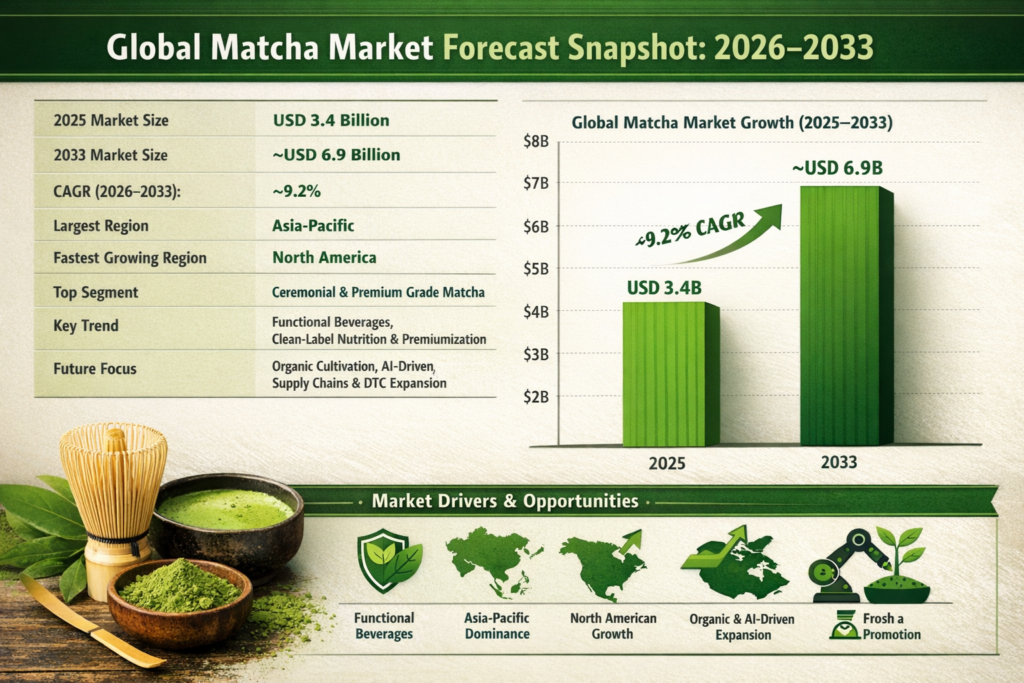
Global Matcha Market Forecast Snapshot: 2026–2033
| Metric | Value |
|---|---|
| 2025 Market Size | USD 3.4 Billion |
| 2033 Market Size | ~USD 6.9 Billion |
| CAGR (2026–2033) | ~9.2% |
| Largest Region | Asia-Pacific |
| Fastest Growing Region | North America |
| Top Segment | Ceremonial & Premium Grade Matcha |
| Key Trend | Functional Beverages, Clean-Label Nutrition & Premiumization |
| Future Focus | Organic Cultivation, AI-Driven Supply Chains & DTC Expansion |
Global Matcha Market Overview
The Global Matcha Market is undergoing accelerated structural expansion, supported by rising global health awareness, premium tea consumption trends, and the integration of matcha into functional food, beverage, nutraceutical, and cosmetic applications. Matcha categories—including ceremonial, culinary, ingredient-grade, and functional blends—are evolving into premium-driven, wellness-oriented ecosystems aligned with modern clean-label and plant-based consumption patterns.
According to Pheonix Research, the Global Matcha Market is valued at USD 3.4 billion in 2025 and is projected to reach approximately USD 6.9 billion by 2033, registering a CAGR of ~9.2% (2026–2033). This revenue forecast reflects strong global demand for antioxidant-rich beverages, expansion of specialty café culture, rapid e-commerce penetration, and increasing adoption of matcha-based functional formulations.
Asia-Pacific holds the largest market share, led by Japan and China’s established production ecosystems and export capabilities. North America is emerging as the fastest-growing region, driven by premium café adoption, health-conscious millennials, plant-based beverage innovation, and expanding DTC subscription models.
The Post-2025 outlook for the Matcha Market highlights continued premiumization, sustainable shade-grown cultivation practices, AI-powered agricultural monitoring, global café innovation, and functional product diversification as key long-term growth drivers.
Key Drivers of Global Matcha Market Growth
1. Rising Demand for Functional & Antioxidant-Rich Beverages
Consumers increasingly prefer beverages that offer natural energy, metabolism support, and immunity benefits, positioning matcha as a premium superfood ingredient.
2. Expansion of Café Culture & RTD Innovation
Specialty coffee chains and beverage startups are expanding matcha lattes, iced matcha drinks, and ready-to-drink (RTD) matcha formulations globally.
3. Clean-Label & Plant-Based Lifestyle Trends
Growing vegan and plant-based adoption strengthens matcha’s appeal as a natural, minimally processed ingredient.
4. Growth in Nutraceutical & Cosmetic Applications
Matcha is gaining traction in supplements, protein blends, skincare, and anti-aging products due to its high antioxidant profile.
5. E-Commerce & Direct-to-Consumer Expansion
Digital-first tea brands are leveraging subscription models, personalized product bundles, and global shipping capabilities.
Global Matcha Market Segmentation
1. By Grade
1.1 Ceremonial Grade
1.1.1 Premium First Harvest
1.1.1.1 Hand-Picked Tencha Leaves
1.1.1.2 Stone-Ground Traditional Matcha
1.1.1.3 Organic Certified Ceremonial
1.1.1.4 Single-Origin Limited Harvest
1.1.2 Standard Ceremonial
1.1.2.1 Daily Ritual Grade
1.1.2.2 Café Ceremonial Grade
1.1.2.3 Blended Ceremonial
1.1.2.4 Export Quality Ceremonial
1.2 Culinary Grade
1.2.1 Beverage Grade
1.2.1.1 Matcha Latte Blends
1.2.1.2 RTD Matcha Drinks
1.2.1.3 Smoothie & Protein Mixes
1.2.1.4 Functional Beverage Formulations
1.2.2 Food & Bakery Grade
1.2.2.1 Desserts & Confectionery
1.2.2.2 Ice Cream & Dairy Applications
1.2.2.3 Snack & Cereal Infusions
1.2.2.4 Chocolate & Sweet Blends
1.3 Ingredient & Extract Grade
1.3.1 Nutraceutical Grade
1.3.1.1 Capsule & Tablet Supplements
1.3.1.2 Powdered Antioxidant Blends
1.3.1.3 Energy & Focus Supplements
1.3.1.4 Metabolism Support Formulations
1.3.2 Cosmetic Grade
1.3.2.1 Anti-Aging Skincare
1.3.2.2 Facial Masks
1.3.2.3 Clean Beauty Products
1.3.2.4 Herbal & Botanical Blends
2. By Distribution Channel
2.1 On-Trade / Café & Hospitality
2.1.1 Specialty Coffee Chains
2.1.1.1 Matcha Latte Menus
2.1.1.2 Seasonal Innovations
2.1.1.3 Premium Add-On Options
2.1.1.4 Functional Beverage Lines
2.1.2 Boutique Tea Houses
2.1.2.1 Traditional Ceremonial Services
2.1.2.2 Premium Tasting Experiences
2.1.2.3 Educational Workshops
2.1.2.4 Cultural Tea Ceremonies
2.2 Off-Trade / Retail
2.2.1 Supermarkets & Hypermarkets
2.2.1.1 Organic Matcha Shelves
2.2.1.2 Imported Japanese Brands
2.2.1.3 Functional Wellness Variants
2.2.1.4 Promotional & Combo Packs
2.2.2 Specialty Stores
2.2.2.1 Artisanal Tea Boutiques
2.2.2.2 Organic Retailers
2.2.2.3 Health-Focused Stores
2.2.2.4 Gourmet Food Shops
2.3 Direct-to-Consumer (DTC)
2.3.1 Subscription Programs
2.3.1.1 Monthly Ceremonial Deliveries
2.3.1.2 Functional Wellness Boxes
2.3.1.3 Limited Harvest Releases
2.3.1.4 Personalized Blends
2.3.2 Brand-Owned E-Stores
2.3.2.1 Global Direct Shipping
2.3.2.2 Limited Online Exclusives
2.3.2.3 AI-Recommended Products
2.3.2.4 Digital Loyalty Programs
3. By End-User
3.1 Household Consumers
3.1.1 Health-Conscious Individuals
3.1.1.1 Daily Wellness Users
3.1.1.2 Organic & Clean-Label Buyers
3.1.1.3 Vegan & Plant-Based Consumers
3.1.1.4 Fitness-Oriented Users
3.2 Corporate & Institutional
3.2.1 Cafés & Beverage Chains
3.2.1.1 Premium Café Chains
3.2.1.2 Boutique Outlets
3.2.1.3 International Franchises
3.2.1.4 Seasonal Beverage Innovators
3.2.2 Food & Nutraceutical Manufacturers
3.2.2.1 Supplement Companies
3.2.2.2 Functional Food Brands
3.2.2.3 Cosmetic Manufacturers
3.2.2.4 Private Label Producers
4. By Region
4.1 Asia-Pacific
4.2 North America
4.3 Europe
4.4 Latin America
4.5 Middle East & Africa
Regional Insights of the Global Matcha Market
Asia-Pacific – Largest Global Matcha Market
Asia-Pacific leads the global matcha market in both production and consumption, anchored by Japan’s long-established ceremonial-grade heritage and China’s expanding large-scale cultivation and export capabilities. Japan remains the benchmark for premium, stone-ground ceremonial matcha, while China plays a critical role in scaling culinary-grade and ingredient-grade supply. Strong domestic consumption, cultural integration, and export-driven growth reinforce the region’s dominant market position.
North America – Fastest Growing Market
North America represents the fastest-growing regional market, fueled by rising health consciousness, expanding plant-based lifestyles, and strong specialty café penetration. The popularity of matcha lattes, RTD functional beverages, and wellness supplements continues to accelerate adoption. Additionally, digital-first DTC brands, subscription models, and influencer-driven marketing are significantly boosting consumer awareness and premium product demand.
Europe
Europe is experiencing steady market expansion, supported by increasing preference for organic, clean-label, and functional beverages. Countries such as the UK, Germany, and France are witnessing growing adoption of matcha across cafés, health food retailers, and nutraceutical brands. Sustainability-focused consumers and premium tea culture are further strengthening regional demand.
Latin America
Latin America is emerging as a developing opportunity market, driven by rising urban health awareness, café culture growth, and expanding middle-class consumption patterns. Specialty beverage chains and gourmet retailers are gradually introducing matcha-based drinks and products, creating long-term expansion potential in major metropolitan centers.
Middle East & Africa
Growth in the Middle East & Africa is concentrated in high-income urban hubs and luxury hospitality destinations. Premium cafés, wellness-focused retail outlets, and upscale hotel chains are driving demand for ceremonial and specialty matcha products. Increasing tourism and expatriate populations are also contributing to gradual market penetration.
Leading Companies in the Global Matcha Market
Aiya Co., Ltd.
Ito En Ltd.
Ippodo Tea Co.
Marukyu Koyamaen
Encha
Jade Leaf Matcha
DoMatcha
Matchaeologist
Aiya Co., Ltd. remains one of the largest global producers with strong export capabilities and vertical integration across cultivation and processing.
Strategic Intelligence & AI-Driven Insights
Pheonix Demand Forecast Engine – Projects high-growth momentum driven by functional beverage demand and premium ceremonial adoption.
Consumer Behavior Analyzer – Detects accelerating preference for organic, single-origin, and functional wellness matcha blends among Millennials and Gen Z.
Innovation Tracker – Highlights AI-enabled shade-growing optimization, climate-resilient farming, smart grading systems, and biodegradable packaging investments.
Porter’s Five Forces Analysis – Reflects moderate competitive intensity, high entry barriers in premium ceremonial production, and strong differentiation through origin authenticity and sustainability credentials.
Why the Global Matcha Market Remains Critical
Accelerating Growth in the Functional Beverage Sector
Matcha’s natural antioxidant profile, sustained energy benefits, and metabolism support position it as a core ingredient within the rapidly expanding global functional beverage ecosystem.
Strong Alignment with Plant-Based & Clean-Label Movements
As consumers increasingly demand minimally processed, transparent, and plant-derived ingredients, matcha stands out as a clean-label superfood with strong cross-category versatility.
High-Margin Premium Ceremonial Segment
The ceremonial-grade category offers attractive margins, strong brand loyalty, and premium pricing power, particularly in developed markets and specialty retail channels.
Sustainability-Driven Brand Differentiation
Organic cultivation, shade-growing techniques, and eco-friendly packaging initiatives enhance ESG positioning and long-term brand equity.
AI-Enabled Agricultural & Supply Chain Optimization
Advanced analytics, precision farming, and AI-powered demand forecasting are improving yield consistency, reducing waste, and strengthening global supply chain resilience.
Final Takeaway of the Global Matcha Market
The Global Matcha Market is evolving into a premium-focused, wellness-driven, and digitally integrated ecosystem. The projected CAGR of ~9.2% (2026–2033) highlights strong and sustained growth momentum, supported by functional beverage innovation, expanding café culture, organic cultivation practices, and DTC expansion.
Future market leadership will be defined by companies that successfully leverage AI-powered agricultural analytics, strengthen sustainable sourcing, expand omnichannel distribution, and innovate across nutraceutical and cosmetic applications.
At Pheonix Research, our advanced forecasting frameworks deliver comprehensive Matcha Market revenue projections, competitive intelligence, and AI-backed strategic insights — empowering stakeholders to capitalize on the Post-2025 matcha landscape with data-driven precision, scalability, and long-term value creation.
📢 Social Mentions & Publication Channels
Explore deeper insights and follow our cross-platform updates on LinkedIn, and X for continuous intelligence and market coverage.
LinkedIn : https://www.linkedin.com/feed/update/urn:li:activity:7430637200871964673
X : https://x.com/Pheonix_Insight/status/2024876643056308575?s=20
Table of Contents
1. Executive Summary
1.1 Market Snapshot (2026–2033)
1.2 Key Growth Highlights
1.3 Premium & Functional Opportunity Landscape
1.4 Regional Growth Summary
1.5 Strategic Recommendations
2. Global Matcha Market Introduction
2.1 Definition & Scope
2.2 Evolution of the Global Matcha Industry
2.3 Product Classification Overview
2.4 Industry Value Chain Analysis
2.5 Regulatory Framework & Certification Standards
3. Global Matcha Market Forecast Snapshot (USD Billion), 2025–2033
3.1 Market Size & Revenue Forecast
3.2 CAGR Analysis
3.3 Volume Trend Analysis
3.4 Price Trend Analysis
3.5 Margin Outlook
4. Market Dynamics
4.1 Growth Drivers
4.2 Market Restraints
4.3 Emerging Opportunities
4.4 Industry Challenges
4.5 Post-2025 Strategic Outlook
5. Market Segmentation by Grade (USD Billion), 2026–2033
5.1 Ceremonial Grade
5.1.1 Premium First Harvest
5.1.1.1 Hand-Picked Tencha Leaves
5.1.1.2 Stone-Ground Traditional Matcha
5.1.1.3 Organic Certified Ceremonial
5.1.1.4 Single-Origin Limited Harvest
5.1.2 Standard Ceremonial
5.1.2.1 Daily Ritual Grade
5.1.2.2 Café Ceremonial Grade
5.1.2.3 Blended Ceremonial
5.1.2.4 Export Quality Ceremonial
5.2 Culinary Grade
5.2.1 Beverage Grade
5.2.1.1 Matcha Latte Blends
5.2.1.2 RTD Matcha Drinks
5.2.1.3 Smoothie & Protein Mixes
5.2.1.4 Functional Beverage Formulations
5.2.2 Food & Bakery Grade
5.2.2.1 Desserts & Confectionery
5.2.2.2 Ice Cream & Dairy Applications
5.2.2.3 Snack & Cereal Infusions
5.2.2.4 Chocolate & Sweet Blends
5.3 Ingredient & Extract Grade
5.3.1 Nutraceutical Grade
5.3.1.1 Capsule & Tablet Supplements
5.3.1.2 Powdered Antioxidant Blends
5.3.1.3 Energy & Focus Supplements
5.3.1.4 Metabolism Support Formulations
5.3.2 Cosmetic Grade
5.3.2.1 Anti-Aging Skincare
5.3.2.2 Facial Masks
5.3.2.3 Clean Beauty Products
5.3.2.4 Herbal & Botanical Blends
6. Market Segmentation by Distribution Channel (USD Billion), 2026–2033
6.1 On-Trade / Café & Hospitality
6.1.1 Specialty Coffee Chains
6.1.1.1 Matcha Latte Menus
6.1.1.2 Seasonal Innovations
6.1.1.3 Premium Add-On Options
6.1.1.4 Functional Beverage Lines
6.1.2 Boutique Tea Houses
6.1.2.1 Traditional Ceremonial Services
6.1.2.2 Premium Tasting Experiences
6.1.2.3 Educational Workshops
6.1.2.4 Cultural Tea Ceremonies
6.2 Off-Trade / Retail
6.2.1 Supermarkets & Hypermarkets
6.2.1.1 Organic Matcha Shelves
6.2.1.2 Imported Japanese Brands
6.2.1.3 Functional Wellness Variants
6.2.1.4 Promotional & Combo Packs
6.2.2 Specialty Stores
6.2.2.1 Artisanal Tea Boutiques
6.2.2.2 Organic Retailers
6.2.2.3 Health-Focused Stores
6.2.2.4 Gourmet Food Shops
6.3 Direct-to-Consumer (DTC)
6.3.1 Subscription Programs
6.3.1.1 Monthly Ceremonial Deliveries
6.3.1.2 Functional Wellness Boxes
6.3.1.3 Limited Harvest Releases
6.3.1.4 Personalized Blends
6.3.2 Brand-Owned E-Stores
6.3.2.1 Global Direct Shipping
6.3.2.2 Limited Online Exclusives
6.3.2.3 AI-Recommended Products
6.3.2.4 Digital Loyalty Programs
7. Market Segmentation by End User (USD Billion), 2026–2033
7.1 Household Consumers
7.1.1 Health-Conscious Individuals
7.1.1.1 Daily Wellness Users
7.1.1.2 Organic & Clean-Label Buyers
7.1.1.3 Vegan & Plant-Based Consumers
7.1.1.4 Fitness-Oriented Users
7.2 Corporate & Institutional
7.2.1 Cafés & Beverage Chains
7.2.1.1 Premium Café Chains
7.2.1.2 Boutique Outlets
7.2.1.3 International Franchises
7.2.1.4 Seasonal Beverage Innovators
7.2.2 Food & Nutraceutical Manufacturers
7.2.2.1 Supplement Companies
7.2.2.2 Functional Food Brands
7.2.2.3 Cosmetic Manufacturers
7.2.2.4 Private Label Producers
8. Market Segmentation by Region (USD Billion), 2026–2033
8.1 Asia-Pacific
8.2 North America
8.3 Europe
8.4 Latin America
8.5 Middle East & Africa
9. Regional Insights & Country-Level Analysis
9.1 Asia-Pacific Deep Dive
9.2 North America Deep Dive
9.3 Europe Deep Dive
9.4 Emerging Markets Outlook
10. Competitive Landscape
10.1 Market Share Analysis
10.2 Company Benchmarking
10.3 Strategic Initiatives
10.4 Mergers & Acquisitions
11. Leading Company Profiles
11.1 Aiya Co., Ltd.
11.2 Ito En Ltd.
11.3 Ippodo Tea Co.
11.4 Marukyu Koyamaen
11.5 Encha
11.6 Jade Leaf Matcha
11.7 DoMatcha
11.8 Matchaeologist
12. Strategic Intelligence & AI-Driven Insights
12.1 Pheonix Demand Forecast Engine
12.2 Consumer Behavior Analyzer
12.3 Innovation Tracker
12.4 Porter’s Five Forces Analysis
13. Investment & Growth Opportunity Analysis
13.1 Premium Segment Opportunity
13.2 DTC & Subscription Growth
13.3 Organic Cultivation Expansion
13.4 Global Export Potential
14. Sustainability & ESG Landscape
14.1 Organic Certification Trends
14.2 Shade-Grown Cultivation Practices
14.3 Sustainable Packaging Innovations
14.4 Carbon Footprint Optimization
15. Future Outlook (2026–2033)
15.1 Technology Integration in Farming
15.2 Functional Product Diversification
15.3 AI-Driven Supply Chain Optimization
15.4 Long-Term Market Transformation
16. Appendix
17. About Pheonix Research
18. Disclaimer
Competitive Landscape
Competitive Landscape of the Global Matcha Market
Executive Framing
The Global Matcha Market is characterized by moderate competitive intensity with a fragmented market structure, where heritage Japanese producers, international beverage companies, and specialty boutique brands coexist. Differentiation is highly influenced by origin authenticity, ceremonial vs. culinary grade quality, and sustainable cultivation practices. As consumer preferences shift toward functional wellness, clean-label nutrition, and premium beverage experiences, competitive dynamics are increasingly shaped by AI-driven supply chain innovation, direct-to-consumer models, and digital brand engagement.
Current Market Reality
The matcha market remains moderately fragmented, with leading players such as Aiya Co., Ltd., Ito En Ltd., Ippodo Tea Co., and Marukyu Koyamaen operating alongside emerging specialty brands like Encha, Jade Leaf Matcha, and Matchaeologist. Asia-Pacific dominates production and consumption, led by Japan and China, while North America is the fastest-growing region due to expanding café culture, premium functional beverages, and DTC subscription adoption.
Specialty cafés, e-commerce platforms, and wellness-focused retail are increasingly critical channels. Sustainability practices—including organic, shade-grown, and eco-friendly packaging—serve as key differentiators for premium brands, while AI-enabled agricultural monitoring and grading systems enhance consistency and quality.
Key Signals and Evidence
Several key signals highlight evolving competitive dynamics in the global matcha market:
- Growing consumer demand for functional, antioxidant-rich, and clean-label beverages.
- Expansion of specialty café offerings, RTD matcha drinks, and subscription-based DTC channels.
- Increased investment in AI-enabled cultivation, grading, and supply chain optimization.
- Rising adoption of organic, shade-grown, and ethically sourced matcha as a premium differentiator.
- Emerging opportunities in nutraceuticals, cosmetics, and functional food applications.
Strategic Implications
Market participants must implement integrated strategies combining heritage, innovation, and consumer engagement:
- Premium Differentiation: Emphasize ceremonial authenticity, single-origin quality, and limited harvest releases.
- DTC & Omnichannel Expansion: Strengthen subscriptions, e-commerce platforms, and global direct shipping.
- Sustainability Leadership: Adopt organic, shade-grown, and eco-friendly cultivation practices.
- Functional Innovation: Develop nutraceutical, cosmetic, and functional beverage applications leveraging matcha’s antioxidant profile.
- Technology Integration: Use AI for precision agriculture, demand forecasting, grading, and personalized consumer recommendations.
Forward Outlook
By 2033, the Global Matcha Market is projected to reach approximately USD 6.9 billion, growing at a CAGR of ~9.2%. Asia-Pacific will remain the largest market, driven by established production in Japan and China, while North America will continue as the fastest-growing region due to premium café adoption, health-conscious consumers, and DTC expansion.
The market is expected to evolve through a dual growth model: high-margin ceremonial and premium-grade matcha for specialty retail and cafés, alongside scalable DTC and functional beverage applications. Companies integrating sustainability, digital transformation, AI-driven supply chains, and innovative functional product offerings will be best positioned to capture long-term growth in this dynamic and wellness-driven landscape.
Value Chain
Global Matcha Market: Value Chain & Market Dynamics
Executive Framing
The Global Matcha Market is undergoing accelerated expansion, fueled by rising health awareness, premium tea consumption trends, and integration into functional foods, beverages, nutraceuticals, and cosmetics. Matcha categories—including ceremonial, culinary, ingredient-grade, and functional blends—are evolving into premium, wellness-oriented ecosystems aligned with modern clean-label and plant-based lifestyles.
The market operates through a hybrid value chain combining traditional cultivation and processing in Asia-Pacific with innovation-led specialty brands in North America and Europe. Established producers leverage heritage cultivation, large-scale processing, and export networks, while emerging brands focus on DTC models, functional formulations, and AI-powered supply chain optimization.
Key challenges include traceability in organic cultivation, consistent quality across grades, and regulatory compliance for functional and cosmetic applications. Expansion of specialty cafés, RTD beverages, and e-commerce channels further increases operational complexity across the value chain.
Current Market Reality
The Global Matcha Market exhibits moderate-to-high complexity due to the mix of traditional production, premium differentiation, and multi-channel distribution. Leading companies such as Aiya Co., Ltd., Ito En Ltd., and Ippodo Tea Co. dominate upstream cultivation and downstream distribution, while smaller, agile brands leverage DTC and e-commerce to reach niche consumers.
Upstream, sourcing varies between ceremonial-grade Tencha leaves and culinary-grade bulk matcha, affecting quality, pricing, and supply reliability. Midstream operations include grinding, blending, packaging, and formulation into beverages, functional powders, supplements, and cosmetic products. Increasing demand for organic, plant-based, and functional blends drives R&D and advanced processing technologies.
Downstream, distribution channels include on-trade cafés, boutique tea houses, retail supermarkets and specialty stores, and direct-to-consumer platforms. Subscription programs, brand-owned e-stores, and digital marketplaces are reshaping traditional retail, enabling smaller brands to compete in global markets.
Key Signals and Evidence
- Projected growth from USD 3.4 billion (2025) to ~USD 6.9 billion (2033) at a CAGR of ~9.2% indicates strong market expansion driven by wellness, premiumization, and functional beverage demand.
- Rising preference for ceremonial-grade and premium functional blends is reshaping upstream sourcing and midstream production strategies.
- Rapid adoption of RTD matcha drinks and subscription-based DTC models is accelerating downstream channel evolution.
- Asia-Pacific continues to dominate in production and consumption, while North America leads in growth due to café culture and health-conscious consumer adoption.
- Organic cultivation, shade-grown practices, and sustainable packaging are becoming key differentiators in premium and eco-conscious segments.
Supplier power is moderate in specialized ceremonial-grade sourcing, while buyer power is high in commoditized culinary and functional matcha products where price and brand recognition are critical.
Strategic Implications
Companies must strategically balance scale efficiency and premium differentiation. Established producers leverage cultivation scale, heritage, and export networks, while investing in functional formulations, DTC channels, and sustainable practices to maintain market leadership.
Smaller and emerging brands gain competitive advantage through value chain agility, including niche sourcing, AI-assisted production, and digital-first marketing. Technology integration—such as precision farming, AI-based demand forecasting, and blockchain-enabled traceability—enhances operational efficiency, quality, and regulatory compliance.
Sustainable cultivation, biodegradable packaging, and circular supply chain models are increasingly critical, meeting consumer expectations and regulatory standards in premium and wellness-oriented segments.
Forward Outlook
The Global Matcha Market is set to evolve into a premium-focused, wellness-driven, and digitally integrated ecosystem. Key near-to-medium-term trends include:
- Expansion of DTC channels, subscription programs, and global e-commerce distribution
- Increasing adoption of organic, shade-grown, and functional matcha variants
- Growth of café culture, specialty beverages, and wellness-oriented retail experiences
- Investment in AI-driven agricultural monitoring and supply chain optimization
- Focus on sustainable cultivation and eco-friendly packaging to strengthen ESG positioning
Companies that integrate premium production, digital engagement, sustainable sourcing, and functional innovation will be best positioned to capture long-term value in the evolving matcha market.
Investment Activity
Global Matcha Market: Investment & Market Insights
Executive Framing
Current Market Reality
Valued at USD 3.4 billion in 2025 and projected to reach ~USD 6.9 billion by 2033 (CAGR ~9.2%), the Global Matcha Market is witnessing strong investment momentum. Asia-Pacific holds the largest market share, anchored by Japan’s ceremonial-grade heritage and China’s scalable culinary-grade supply. North America is the fastest-growing region due to specialty café adoption, health-conscious consumers, and DTC subscription growth. Premium ceremonial, functional wellness, and organic matcha products remain key investment targets.
Key Signals and Evidence
- Functional Beverage Demand: Growing consumer preference for antioxidant-rich, metabolism-supporting, and immunity-enhancing beverages.
- Premium Ceremonial Adoption: Rising interest in traditional stone-ground matcha for rituals, gifting, and specialty consumption.
- Café Culture & RTD Expansion: Specialty chains and ready-to-drink products are accelerating market penetration.
- Organic & Clean-Label Focus: Consumer awareness is driving investment into minimally processed, plant-based, and certified organic products.
- Digital & DTC Channels: Subscription models, personalized bundles, and e-commerce sales are creating scalable revenue streams.
- AI & Agricultural Tech: AI-powered shade-growing, precision farming, and climate-resilient practices are optimizing yields and quality.
- Nutraceutical & Cosmetic Applications: Matcha integration into supplements, skincare, and protein blends expands growth opportunities.
Strategic Implications
Companies prioritizing premium ceremonial products, sustainable cultivation, AI-enabled supply chains, and digital DTC engagement are well-positioned to capture market share. Strategic partnerships, subscription services, and innovation in functional beverage and cosmetic applications drive differentiation, premiumization, and investor interest.
Forward Outlook
From 2026 to 2033, the Global Matcha Market is expected to maintain strong growth momentum. Investments will focus on sustainable cultivation, premium product innovation, and digital-first sales channels. M&A activity and strategic collaborations will continue, particularly in high-margin ceremonial, functional wellness, and cosmetic applications. Companies leveraging AI-driven agricultural and supply chain optimization will unlock long-term value and global scalability.
Technology & Innovation
Global Matcha Market: Technology & Innovation
Executive Framing
Technology and innovation are increasingly shaping the global matcha market, blending centuries-old cultivation practices with modern AI-driven agricultural techniques and digital consumer engagement. Innovations focus on optimizing cultivation, improving yield and quality, ensuring sustainability, and enhancing distribution efficiency, while supporting premiumization and functional product development.
Current Market Reality
The matcha market currently combines traditional production methods—such as hand-picked tencha leaves and stone-ground milling—with advanced innovations. AI-powered shade-growing monitoring, climate-resilient farming strategies, and automated quality grading systems are being deployed to maintain consistent ceremonial-grade quality. Digital-first platforms, DTC subscriptions, and e-commerce channels are driving direct engagement with health-conscious and premium consumers. Sustainability initiatives, including biodegradable packaging and organic certification, further strengthen brand credibility.
Key Signals and Evidence
- AI-Driven Cultivation: Sensors and predictive analytics optimize shade coverage, irrigation, and harvesting timing.
- Sustainable Farming: Organic and shade-grown techniques reduce environmental impact and enhance leaf quality.
- Digital & DTC Integration: Subscription boxes, personalized e-commerce, and influencer marketing increase global reach.
- Functional Product Innovation: Expansion into nutraceuticals, ready-to-drink beverages, and cosmetic applications leveraging matcha’s antioxidant properties.
- Smart Grading & Packaging: Automated sorting and eco-friendly packaging support premium positioning and operational efficiency.
Strategic Implications
Companies adopting technology and innovation gain multiple advantages, including improved yield consistency, enhanced product differentiation, operational efficiency, and stronger brand positioning. Integration of AI and digital platforms enables data-driven consumer targeting, optimized supply chains, and scalable DTC growth. Sustainability-focused innovations reinforce ESG positioning and premium appeal.
Forward Outlook
The global matcha market will continue to experience innovation-driven growth, emphasizing AI-powered agricultural analytics, climate-resilient cultivation, expanded functional product applications, and digital-first distribution strategies. Companies that successfully integrate tradition, technology, sustainability, and consumer engagement will be best positioned to lead the post-2025 matcha ecosystem.
Market Risk
Risk Factors and Disruption Threats in the Global Matcha Market
Executive Framing
The Global Matcha Market is a high-growth, premium beverage segment driven by health-conscious consumers, plant-based trends, and functional beverage adoption. With a projected CAGR of ~9.2% from 2026–2033, the market offers significant upside but faces structural risks including climate dependency, supply chain fragility, high production costs for ceremonial-grade matcha, and evolving regulatory requirements for nutraceutical and food applications.
Current Market Reality
Asia-Pacific dominates production and consumption, anchored by Japan and China, while North America emerges as the fastest-growing market. However, dependency on optimal shade-grown cultivation, limited premium-grade harvests, and climate variability pose yield and quality risks. Regulatory scrutiny on health claims, organic certification, and cross-border exports adds operational complexity. Market penetration in Latin America, Europe, and the Middle East is gradually expanding but remains limited compared to mature regions.
Key Signals and Evidence
Strong consumer demand for functional, antioxidant-rich beverages and clean-label, plant-based products is driving growth. Subscription DTC models, café culture adoption, and influencer-led marketing accelerate awareness. Conversely, price sensitivity in emerging markets, competition from green tea extracts, matcha blends, and alternative superfood beverages signals substitution risks. Climate-related cultivation disruptions and sustainability pressures are increasingly evident in key producing regions.
Strategic Implications
Producers should invest in climate-resilient farming, AI-powered agricultural monitoring, and sustainable shade-growing practices. Strengthening DTC channels, expanding premium café collaborations, and innovating across nutraceutical and cosmetic applications will be key. Companies must also navigate certification standards, supply chain traceability, and global regulatory frameworks to maintain quality, brand trust, and operational efficiency.
Forward Outlook
The Global Matcha Market is poised for sustained growth, driven by premiumization, functional beverage trends, and DTC expansion. Long-term market leadership will depend on effectively managing cultivation risks, operational scalability, regulatory compliance, and competitive differentiation through quality, sustainability, and innovation.
Regulatory Landscape
Regulatory & Policy Landscape: Global Matcha Market
Executive Framing
The Global Matcha Market operates under a multifaceted regulatory environment that spans food safety, organic certification, import/export standards, labeling transparency, and sustainable agricultural practices. Compliance requirements vary by region and product application, including beverages, nutraceuticals, and cosmetic uses.
Key regulatory bodies include Japan’s Ministry of Agriculture, Forestry and Fisheries (MAFF), U.S. Food and Drug Administration (FDA), European Food Safety Authority (EFSA), and other national health authorities. These agencies oversee permissible production methods, quality testing, additive restrictions, health claims, and traceability of matcha products across the supply chain.
Current Market Reality
Asia-Pacific, led by Japan, has established stringent quality and grading standards for ceremonial and premium-grade matcha, including cultivation practices, shading protocols, and stone-grinding methods. China’s regulatory framework focuses on food safety, pesticide control, and export compliance for bulk and culinary-grade matcha.
In North America and Europe, organic certifications (USDA Organic, EU Organic) and clean-label compliance are critical for market entry. Labeling regulations enforce ingredient disclosure, origin declaration, allergen statements, and functional claims, while import/export duties influence pricing and cross-border trade strategies.
Globally, sustainability certifications—including shade-grown practices, fair labor standards, and biodegradable packaging—are increasingly being adopted as regulatory or industry-backed requirements, reinforcing brand credibility.
Key Signals and Evidence
- Mandatory quality and purity testing for ceremonial and functional matcha products.
- Strict labeling requirements for organic, single-origin, and functional claims.
- Import/export tariffs, phytosanitary regulations, and customs documentation compliance.
- Guidelines on permissible additives, sweeteners, and botanical blends.
- Adoption of sustainability and ESG standards in cultivation and packaging.
- Enforcement of health and wellness claims for nutraceutical and cosmetic applications.
Strategic Implications
Regulatory frameworks influence product positioning, operational costs, and market access. Premium ceremonial producers benefit from strict quality and origin certifications, which reinforce brand equity and pricing power. Conversely, complex compliance requirements may limit entry for smaller or new players, particularly in international markets.
Companies expanding DTC, e-commerce, or global exports must navigate region-specific labeling, certification, and shipping regulations. Sustainability compliance is becoming a key differentiator, enhancing consumer trust and supporting long-term market growth.
Forward Outlook
Regulations are expected to evolve alongside consumer demand for clean-label, organic, and functional products. Countries are likely to introduce stricter certification requirements, traceability standards, and sustainability mandates for matcha production. Digital commerce will also introduce new compliance needs related to cross-border shipping, age verification (for functional beverages with caffeine), and accurate product claims.
Companies that proactively adopt AI-enabled agricultural monitoring, sustainable cultivation practices, and international certification compliance will be best positioned to capture global growth opportunities, ensure brand credibility, and maintain competitive differentiation in a rapidly expanding matcha market.