
Global Spirits Market Report, Size & Forecast 2026–2033
Basis of valuation: this is consumer spending, not supplier revenue. The USD 493.7 billion is what the world pays at retail — off-trade shelf price plus on-trade menu price. It is stated here because the figure is routinely read as a revenue pool to divide between producers, and it is not one.
The test is concentration at the top of the chain. Diageo's net sales for the year to 30 June 2026 were USD 19,643 million, and Pernod Ricard's for the year to the same date were EUR 9,404 million — together USD 29.5 billion to 30.9 billion depending on where the euro sits, or 6.0 to 6.3 per cent of this market. Diageo alone is 3.98 per cent. For USD 493.7 billion to be revenue at producer prices, the world's two largest distillers would have to be under 6.3 per cent of world spirits revenue while every local distiller in Asia, Latin America and Africa — most of them unlisted, several of them state monopolies — shared the remaining USD 463 billion at ex-works prices. At consumer prices the same arithmetic is ordinary: producer revenue is a fraction of what the shopper pays once excise, freight, distributor and retailer margins are added.
What follows. A share table, a revenue pool or a comparison with a company's reported net sales has to be made on the producer side of the chain, not against this number. The forecast itself is unaffected — a change of basis scales the series, it does not bend it — and with the same basis now stated on the wine and premium wine reports in this segment, the 2031 crossover argued in Spirits Passes Wine in 2031 compares like with like.
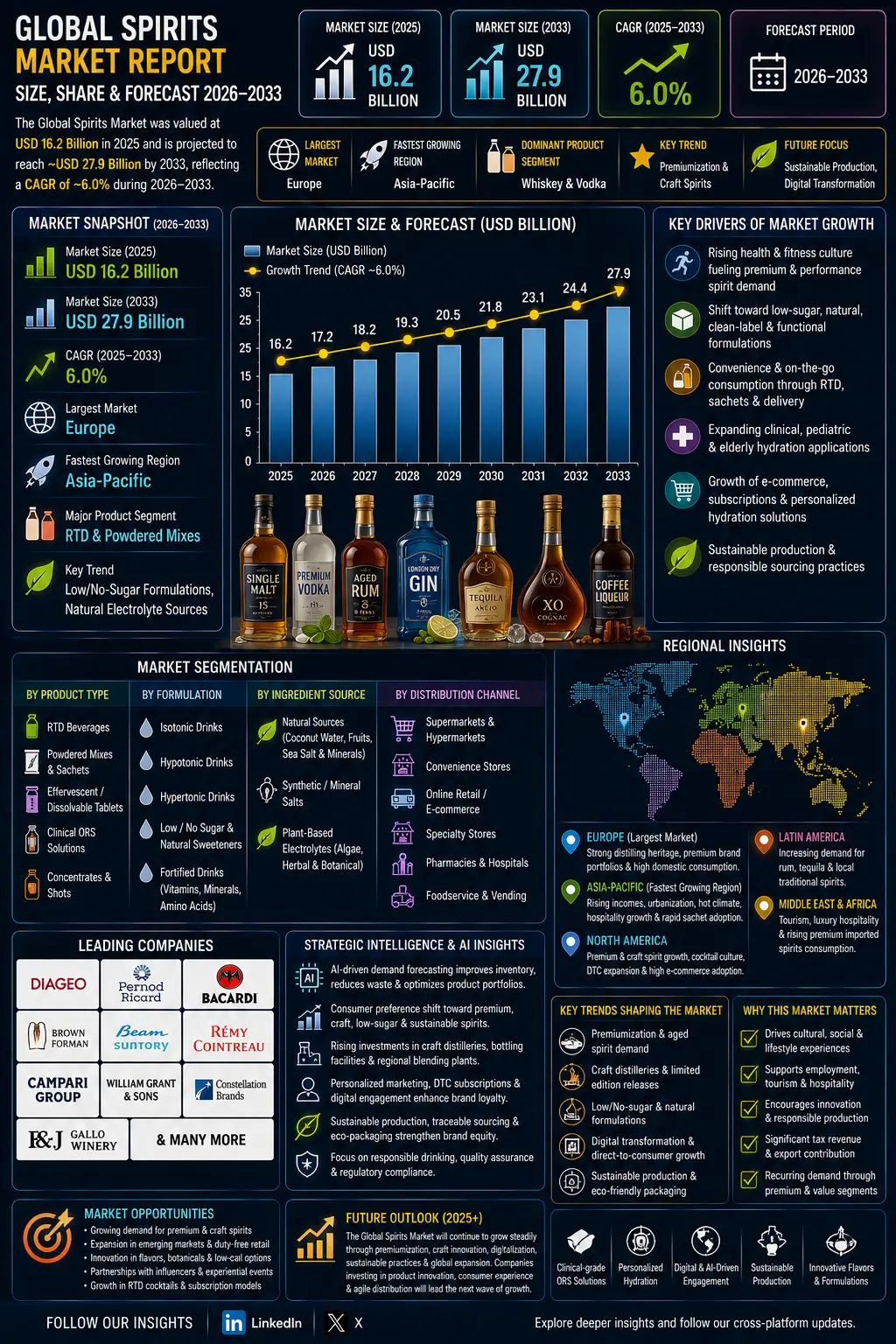
Global Spirits Market Forecast Snapshot (2026--2033)
| Metric | Value |
|---|---|
| 2025 Market Size | USD 493.7 Billion |
| 2033 Market Size | ~USD 732.5 Billion |
| CAGR (2025-2033) | 5.0% |
| Largest Market | Europe |
| Fastest Growing Region | Asia-Pacific |
| Dominant Product Segment | Whiskey & Vodka |
| Key Trend | Premiumization & Craft Spirits |
| Future Focus | Sustainable Production, Digital Transformation |
Global Spirits Market Overview
The Global Spirits Market is booming, driven by rising disposable incomes, urban lifestyles, and premiumization trends. Consumers are craving authentic, high-quality, and innovative spirit experiences, with a focus on whiskey, vodka, rum, gin, tequila, brandy, liqueurs, and other premium or craft spirit offerings. Interestingly, the market is also being shaped by the rising demand for performance-focused hydration and functional beverages, with consumers seeking products that combine functionality with premium appeal
Consumers are increasingly seeking craft and flavored variants, boutique distillery products, and premium aged spirits, reflecting a shift toward experimentation, heritage, and taste sophistication. Digital distribution, e-commerce platforms, and online alcohol delivery services further enhance accessibility and visibility for both established and emerging brands.
According to Pheonix Demand Forecast Engine, the Global Spirits Market is valued at USD 493.7 billion in 2025 and is projected to reach approximately USD 732.5 billion by 2033, reflecting a CAGR of ~5.0% during 2026-2033. Europe currently holds the largest market share, supported by historic distilling traditions, premium brand portfolios, and strong domestic consumption, while Asia-Pacific represents the fastest-growing region, fueled by rising disposable incomes, urban nightlife culture, and hospitality expansion.
Post-2025, growth is expected to be shaped by rising craft and premium consumption, digital marketing and e-commerce adoption, sustainable and ethical production practices, and innovation in flavored, low-calorie, and experiential spirit offerings. The expanding adoption of functional and wellness-oriented beverages is intersecting with trends in this space, driving interest in antioxidant-rich, low-caffeine alternatives with clean-label credentials.
Key Drivers of Global Spirits Market Growth
1. Premiumization & Product Innovation
Premiumization and consumer interest in high-quality, aged, and craft beverages are increasingly overlapping with the premium wine segment, encouraging manufacturers to introduce small-batch releases, limited editions, and specialty craft variants that command higher margins, boosting profitability in this space. Increasing consumer inclination toward high-quality, aged, and artisanal spirits is further fueling this trend.
2. Rising Popularity of Craft & Flavored Spirits
Demand for locally produced, distinctive, and flavored offerings such as botanical-infused gins, fruit-forward vodkas, and experimental blends is attracting younger and experience-driven consumers.
3. Urbanization & Evolving Lifestyle Patterns
Growth in urban populations, expanding social culture, nightlife expansion, and rising disposable incomes are fueling consumption of premium and experimental spirit categories.
4. Expansion of Distribution & Digital Commerce
The rapid development of e-commerce platforms, alcohol delivery applications, and global duty-free retail networks is improving product accessibility and strengthening international brand visibility.
5. Brand Heritage, Storytelling & Influencer Marketing
Strategic brand positioning through heritage narratives, celebrity partnerships, experiential campaigns, and digital engagement is enhancing brand loyalty among millennials and Gen Z consumers.
6. Sustainability & Responsible Production Practices
Growing emphasis on renewable energy usage, organic raw materials, carbon footprint reduction, and recyclable packaging aligns with environmentally conscious consumer expectations and strengthens long-term brand equity.
Global Spirits Market Segmentation
1. By Product Type
1.1 Whiskey
1.1.1 Single Malt Whiskey
1.1.1.1 Aged 12-15 Years
1.1.1.2 Aged 16-20 Years
1.1.1.3 Aged 20+ Years
1.1.2 Blended Whiskey
1.1.2.1 Standard Blends
1.1.2.2 Premium Blends
1.1.3 Bourbon / Rye
1.1.3.1 Bourbon
1.1.3.2 Rye Whiskey
1.2 Vodka
1.2.1 Flavored Vodka
1.2.1.1 Fruit-Flavored Vodka
1.2.1.2 Botanical / Herb-Infused Vodka
1.2.2 Premium Vodka
1.2.2.1 Ultra-Premium / Small-Batch Vodka
1.2.2.2 Organic / Clean-Label Vodka
1.3 Rum
1.3.1 Light / White Rum
1.3.1.1 Standard Light Rum
1.3.1.2 Flavored Light Rum
1.3.2 Dark / Aged Rum
1.3.2.1 Aged 37 Years
1.3.2.2 Aged 8-12 Years
1.3.3 Spiced Rum
1.3.3.1 Standard Spiced Rum
1.3.3.2 Premium / Craft Spiced Rum
1.4 Gin
1.4.1 London Dry Gin
1.4.1.1 Standard London Dry
1.4.1.2 Premium London Dry
1.4.2 Premium / Craft Gin
1.4.2.1 Small-Batch Craft Gin
1.4.2.2 Botanical / Flavored Craft Gin
1.5 Tequila
1.5.1 Blanco / Silver
1.5.1.1 Standard Blanco
1.5.1.2 Premium Blanco
1.5.2 Reposado
1.5.2.1 Standard Reposado
1.5.2.2 Premium Reposado
1.5.3 Añejo / Extra Añejo
1.5.3.1 Añejo (1–3 Years)
1.5.3.2 Extra Añejo (3+ Years)
1.6 Brandy
1.6.1 Cognac
1.6.1.1 VS / VSOP
1.6.1.2 XO / Premium Cognac
1.6.2 Other Brandy Variants
1.6.2.1 Fruit Brandies (Apple, Pear, etc.)
1.6.2.2 Regional Brandy Variants
1.7 Liqueurs
1.7.1 Herbal / Botanical Liqueurs
1.7.1.1 Digestive & Aperitif Liqueurs
1.7.1.2 Specialty Herbal Blends
1.7.2 Cream / Dessert Liqueurs
1.7.2.1 Chocolate / Coffee Cream Liqueurs
1.7.2.2 Vanilla / Nut-Flavored Cream Liqueurs
1.8 Others
1.8.1 Ready-to-Drink (RTD) Spirits
1.8.1.1 RTD Cocktail Mixes
1.8.1.2 RTD Highball & Spritz
1.8.2 Specialty / Regional Spirits
1.8.2.1 Local / Indigenous Spirits
1.8.2.2 Limited Edition / Seasonal Spirits
2. By Category
2.1 Premium Spirits
2.1.1 Ultra-Premium / Aged Spirits
2.1.2 Craft / Small-Batch Spirits
2.2 Standard Spirits
2.2.1 Mass-Market Bottled Spirits
2.2.2 Flavored / Value Variants
2.3 Economy Spirits
2.3.1 Budget Bottled Spirits
2.3.2 Local / Regional Economy Brands
3. By Distribution Channel
3.1 On-Trade (Bars, Restaurants, Hotels)
3.1.1 Premium & Boutique Bars
3.1.1.1 Cocktail Bars
3.1.1.2 Hotel Lounges
3.1.2 Hotel & Resort Beverage Services
3.1.2.1 Luxury Resorts
3.1.2.2 Mid-Tier Hotels
3.2 Off-Trade (Supermarkets, Retail Stores)
3.2.1 Large Retail Chains
3.2.1.1 Global Chains (e.g., Walmart, Tesco)
3.2.1.2 Regional / National Chains
3.2.2 Specialty Liquor Stores
3.2.2.1 Premium / Craft Stores
3.2.2.2 Standard Retail Liquor Stores
3.3 Online Channels
3.3.1 E-Commerce Marketplaces
3.3.1.1 Global Platforms (Amazon, Alibaba)
3.3.1.2 Regional / Local Online Retailers
3.3.2 Direct-to-Consumer Subscription / Delivery
3.3.2.1 Subscription-Based Spirit Boxes
3.3.2.2 Personalized Spirit Bundles
4. By End User
4.1 Individual Consumers
4.1.1 Daily / Casual Drinkers
4.1.1.1 Standard Spirits for Everyday Use
4.1.1.2 Flavored & Light Spirits
4.1.2 Social & Leisure Drinkers
4.1.2.1 Party & Event Consumption
4.1.2.2 Premium Spirits for Occasions
4.1.3 Premium / Collectors
4.1.3.1 Limited Edition / Rare Bottles
4.1.3.2 Vintage & Aged Collections
4.2 Commercial (Hospitality & Entertainment)
4.2.1 Hotels & Resorts
4.2.1.1 Luxury / Premium Hotels
4.2.1.2 Mid-Tier Hotels
4.2.2 Restaurants & Bars
4.2.2.1 Fine Dining Restaurants
4.2.2.2 Casual Dining / Bar Chains
4.2.3 Clubs, Lounges & Event Venues
4.2.3.1 Nightclubs / High-End Lounges
4.2.3.2 Event Catering & Banquet Services
5. By Region
5.1 North America
5.2 Europe
5.3 Asia-Pacific
5.4 Latin America
5.5 Middle East & Africa
Regional Insights of the Global Spirits Market:
Europe
Europe maintains the largest market share, driven by its established distilling heritage, presence of iconic premium brands, and strong domestic consumption. The region shows sustained growth in craft, small-batch, and aged spirits, with consumers increasingly seeking authenticity, heritage, and innovative flavor profiles. Regulatory frameworks supporting quality labeling and responsible drinking further reinforce market stability.North America
North America is experiencing rapid expansion in flavored, craft, and premium spirits, fueled by a vibrant cocktail culture, growing number of local micro-distilleries, and urban lifestyle trends. Consumer interest in low-calorie, organic, and sustainably produced products is shaping product innovation. E-commerce platforms and direct-to-consumer subscriptions are accelerating market reach and brand engagement. The growing popularity of convenient, ready-to-drink formats and on-the-go consumption is also driving growth, appealing to busy consumers seeking quality in convenience.Asia-Pacific
Asia-Pacific is the fastest-growing region, led by China, India, and Japan, driven by rapid urbanization, rising disposable incomes, and the expansion of modern retail and hospitality sectors. Westernization of consumption habits, growing nightlife culture, and rising interest in premium and imported spirits are further fueling market adoption. Localized flavors and limited-edition releases are increasingly popular among urban consumers.Latin America
Growth in Latin America is supported by both traditional and emerging spirit categories. Regional beverages like cacha??a, mezcal, and rum are gaining international recognition, while exports and cross-border collaborations with global brands are boosting market expansion. Increasing tourism, rising disposable incomes, and growing social occasions also contribute to higher per-capita consumption.Middle East & Africa
While cultural norms and strict regulations limit alcohol consumption, markets in the UAE, South Africa, and select tourism hubs are witnessing moderate but steady growth. Tourism-driven hospitality, international events, and luxury hotels are key drivers. Additionally, interest in premium and imported spirits among affluent urban populations is gradually expanding the overall market footprint.Leading Companies in the Global Spirits Market
-
Bacardi Limited
-
Brown-Forman Corporation
-
Beam Suntory Inc.
-
R??my Cointreau SA
-
Campari Group
-
William Grant & Sons Ltd.
-
Constellation Brands, Inc.
-
E. & J. Gallo Winery
Competition Focus: Premium product portfolios, heritage-based marketing, flavor innovation, craft spirits, sustainable production, and digital distribution. Diageo plc is the largest company in the Global spirits Market market.
Strategic Intelligence & AI-Backed Insights
Market modeling: Pheonix Demand Forecast Engine analyzed consumer preferences, premium vs. standard adoption, regional consumption patterns, and seasonal/occasion-driven demand.Why the Global Spirits Market Remains Critical
-
Reflects cultural, social, and lifestyle evolution worldwide.
-
Drives employment and tourism in hospitality sectors.
-
Encourages sustainable innovation and ethical production.
-
Contributes significantly to government revenue via taxation and exports.
-
Represents a major segment of the global alcoholic beverage industry with recurring revenue potential.
Final Takeaway of Global Spirits Market
The Global Spirits Market continues to evolve as consumer preferences shift toward premium, authentic, and responsibly produced beverages. The projected CAGR of ~5.0% during 2025-2033 reflects steady growth, fueled by increasing disposable incomes, urban lifestyle adoption, and rising demand for craft, flavored, and aged spirits. Future growth will follow a dual-structure model, with high-margin premium and craft spirits targeting affluent urban consumers, alongside scalable standard and economy spirits addressing mass-market demand. Innovation in flavor, packaging, and digital distribution, coupled with sustainable and ethical production practices, will define market leadership. Consumer preference for natural and clean-label beverages is influencing trends, driving interest in spirits with fewer additives and transparent sourcing, mirroring shifts in the broader beverage landscape. Companies investing in brand storytelling, AI-driven marketing insights, e-commerce expansion, experiential distillery tours, and sustainable production are positioned to gain long-term competitive advantage. At Pheonix Research, our AI-driven market intelligence and forecasting frameworks provide detailed revenue projections, consumer trend analysis, and strategic insights, enabling manufacturers, investors, and stakeholders to capitalize on the evolving Post-2025 global spirits landscape with data-backed, scalable strategies.Social Mentions & Publication Channels
Explore deeper insights and follow our cross-platform updates on LinkedIn, and X for continuous intelligence and market coverage.
LinkedIn: https://www.linkedin.com/feed/update/urn:li:activity:7430144829751214081
X : https://x.com/Pheonix_Insight/status/2024380158447407382?s=20Companion analysis
Spirits Passes Wine in 2031 — this report's 5.0 per cent against the wine market's 3.81 closes a USD 34.7 billion gap in six years and leaves spirits USD 19.9 billion ahead by 2033. The crossover rests on two published rates and on one unresolved question: whether both markets are measured at retail.
The Sale That Made a Consolidator Out of a Debt Stack — the largest spirits-and-wine group in Europe sold its entire international wine portfolio on 30 April 2025 and kept the spirits. Read as a rate judgement: a business growing at wine's 3.81 per cent cannot sit inside a portfolio growing at spirits' 5.0 without the blended multiple going down.
Table of Contents
1. Market Forecast Snapshot (2026-2033)
1.1 2025 Market Size: USD 493.70 Billion
1.2 2033 Market Size: USD 732.50 Billion
1.3 CAGR (2025–2033): 5.00%
1.4 Largest Market: Europe
1.5 Fastest Growing Region: Asia-Pacific
1.6 Dominant Product Segment: Whiskey & Vodka
1.7 Key Trend: Premiumization & Craft Spirits
1.8 Future Focus: Sustainable Production & Digital Transformation
2. Global Spirits Market Overview
2.1 Market Definition & Scope
2.2 Evolution of the Global Spirits Industry
2.3 Premiumization & Craft Movement
2.4 Digital Transformation & E-Commerce Expansion
2.5 Regulatory & Taxation Landscape
2.6 Post-2025 Market Outlook
3. Key Drivers of Global Spirits Market Growth
3.1 Premiumization & Product Innovation
3.2 Popularity of Craft & Flavored Spirits
3.3 Urbanization & Lifestyle Changes
3.4 Expansion of Distribution & E-Commerce
3.5 Brand Heritage & Experiential Marketing
3.6 Sustainability & Ethical Production Practices
4. Market Segmentation by Product Type
4.1 Whiskey
4.1.1 Single Malt Whiskey
4.1.1.1 Aged 12-15 Years
4.1.1.2 Aged 16-20 Years
4.1.1.3 Aged 20+ Years
4.1.2 Blended Whiskey
4.1.2.1 Standard Blends
4.1.2.2 Premium Blends
4.1.3 Bourbon / Rye
4.1.3.1 Bourbon
4.1.3.2 Rye Whiskey
4.2 Vodka
4.2.1 Flavored Vodka
4.2.1.1 Fruit-Flavored Vodka
4.2.1.2 Botanical / Herb-Infused Vodka
4.2.2 Premium Vodka
4.2.2.1 Ultra-Premium / Small-Batch Vodka
4.2.2.2 Organic / Clean-Label Vodka
4.3 Rum
4.3.1 Light / White Rum
4.3.1.1 Standard Light Rum
4.3.1.2 Flavored Light Rum
4.3.2 Dark / Aged Rum
4.3.2.1 Aged 37 Years
4.3.2.2 Aged 8-12 Years
4.3.3 Spiced Rum
4.3.3.1 Standard Spiced Rum
4.3.3.2 Premium / Craft Spiced Rum
4.4 Gin
4.4.1 London Dry Gin
4.4.1.1 Standard London Dry
4.4.1.2 Premium London Dry
4.4.2 Premium / Craft Gin
4.4.2.1 Small-Batch Craft Gin
4.4.2.2 Botanical / Flavored Craft Gin
4.5 Tequila
4.5.1 Blanco / Silver
4.5.1.1 Standard Blanco
4.5.1.2 Premium Blanco
4.5.2 Reposado
4.5.2.1 Standard Reposado
4.5.2.2 Premium Reposado
4.5.3 A??ejo / Extra Aejo
4.5.3.1 A??ejo (13 Years)
4.5.3.2 Extra A??ejo (3+ Years)
4.6 Brandy
4.6.1 Cognac
4.6.1.1 VS / VSOP
4.6.1.2 XO / Premium Cognac
4.6.2 Other Brandy Variants
4.6.2.1 Fruit Brandies
4.6.2.2 Regional Brandy Variants
4.7 Liqueurs
4.7.1 Herbal / Botanical Liqueurs
4.7.1.1 Digestive & Aperitif Liqueurs
4.7.1.2 Specialty Herbal Blends
4.7.2 Cream / Dessert Liqueurs
4.7.2.1 Chocolate / Coffee Cream Liqueurs
4.7.2.2 Vanilla / Nut-Flavored Cream Liqueurs
4.8 Others
4.8.1 Ready-to-Drink (RTD) Spirits
4.8.1.1 RTD Cocktail Mixes
4.8.1.2 RTD Highball & Spritz
4.8.2 Specialty / Regional Spirits
4.8.2.1 Local / Indigenous Spirits
4.8.2.2 Limited Edition / Seasonal Spirits
5. Market Segmentation by Category
5.1 Premium Spirits
5.1.1 Ultra-Premium / Aged Spirits
5.1.2 Craft / Small-Batch Spirits
5.2 Standard Spirits
5.2.1 Mass-Market Bottled Spirits
5.2.2 Flavored / Value Variants
5.3 Economy Spirits
5.3.1 Budget Bottled Spirits
5.3.2 Local / Regional Economy Brands
6. Market Segmentation by Distribution Channel
6.1 On-Trade (Bars, Restaurants, Hotels)
6.1.1 Premium & Boutique Bars
6.1.1.1 Cocktail Bars
6.1.1.2 Hotel Lounges
6.1.2 Hotel & Resort Beverage Services
6.1.2.1 Luxury Resorts
6.1.2.2 Mid-Tier Hotels
6.2 Off-Trade (Supermarkets, Retail Stores)
6.2.1 Large Retail Chains
6.2.1.1 Global Chains (Walmart, Tesco)
6.2.1.2 Regional / National Chains
6.2.2 Specialty Liquor Stores
6.2.2.1 Premium / Craft Stores
6.2.2.2 Standard Retail Liquor Stores
6.3 Online Channels
6.3.1 E-Commerce Marketplaces
6.3.1.1 Global Platforms (Amazon, Alibaba)
6.3.1.2 Regional / Local Online Retailers
6.3.2 Direct-to-Consumer Subscription / Delivery
6.3.2.1 Subscription-Based Spirit Boxes
6.3.2.2 Personalized Spirit Bundles
7. Market Segmentation by End User
7.1 Individual Consumers
7.1.1 Daily / Casual Drinkers
7.1.1.1 Standard Spirits for Everyday Use
7.1.1.2 Flavored & Light Spirits
7.1.2 Social & Leisure Drinkers
7.1.2.1 Party & Event Consumption
7.1.2.2 Premium Spirits for Occasions
7.1.3 Premium / Collectors
7.1.3.1 Limited Edition / Rare Bottles
7.1.3.2 Vintage & Aged Collections
7.2 Commercial (Hospitality & Entertainment)
7.2.1 Hotels & Resorts
7.2.1.1 Luxury / Premium Hotels
7.2.1.2 Mid-Tier Hotels
7.2.2 Restaurants & Bars
7.2.2.1 Fine Dining Restaurants
7.2.2.2 Casual Dining / Bar Chains
7.2.3 Clubs, Lounges & Event Venues
7.2.3.1 Nightclubs / High-End Lounges
7.2.3.2 Event Catering & Banquet Services
8. Market Segmentation by Region
8.1 North America
8.2 Europe
8.3 Asia-Pacific
8.4 Latin America
8.5 Middle East & Africa
9. Regional Insights
9.1 Europe Market Leader
9.2 North America Premium & Craft Expansion
9.3 Asia-Pacific Fastest Growing Region
9.4 Latin America Export & Heritage Growth
9.5 Middle East & Africa Tourism-Driven Expansion
10. Competitive Landscape
10.1 Market Share Analysis
10.2 Competitive Positioning Matrix
10.3 Mergers & Acquisitions
10.4 Craft Distillery Expansion Trends
10.5 Pricing & Premiumization Strategies
11. Leading Companies
11.1 Diageo plc (Largest Player)
11.2 Pernod Ricard SA
11.3 Bacardi Limited
11.4 Brown-Forman Corporation
11.5 Beam Suntory Inc.
11.6 R??my Cointreau SA
11.7 Campari Group
11.8 William Grant & Sons Ltd.
11.9 Constellation Brands, Inc.
11.10 E. & J. Gallo Winery
12. Strategic Intelligence & AI-Backed Insights
12.1 Pheonix Demand Forecast Modeling
12.2 Production & Distillery Investment Mapping
12.3 Consumer Sentiment & Trend Analytics
12.4 Porters Five Forces Analysis
13. Sustainability & Regulatory Landscape
13.1 Environmental & Ethical Production
13.2 Packaging & Carbon Footprint Reduction
13.3 Alcohol Regulations & Taxation Policies
13.4 Responsible Drinking Initiatives
14. Market Significance
14.1 Cultural & Lifestyle Influence
14.2 Contribution to Tourism & Hospitality
14.3 Government Revenue & Taxation Impact
14.4 Employment & Supply Chain Ecosystem
14.5 Recurring Revenue & Brand Loyalty
15. Final Takeaway
15.1 Growth Outlook (2026-2033)
15.2 Dual-Structure Growth Model
15.3 Premium vs. Mass-Market Strategy
15.4 Digital & Experiential Expansion
15.5 Strategic Recommendations
16. Appendix
17. About Us
18. Disclaimer
t
Competitive Landscape
Competitive Landscape of the Global Spirits Market
Executive Framing
The Global Spirits Market is a mature yet dynamic segment characterized by high competitive intensity and a semi-consolidated market structure. Dominated by Tier 1 players such as Diageo plc, Pernod Ricard SA, Bacardi Limited, Brown-Forman Corporation, and Beam Suntory Inc., the market is also witnessing the rise of craft and premium brands that are reshaping consumer preferences. Strategic positioning, product innovation, and sustainable practices have become critical levers for market players to secure growth and competitive advantage. Understanding the interplay of heritage branding, digital distribution, and premiumization trends is essential for stakeholders aiming to navigate this competitive landscape effectively.
Current Market Reality
The market is dominated by a handful of global beverage conglomerates, yet it is highly competitive due to the growing influence of craft, flavored, and premium spirits. Companies are focusing on limited-edition releases, small-batch production, and heritage storytelling to differentiate themselves. For example, Diageo plc has leveraged celebrity endorsements and experiential campaigns to strengthen its premium brand presence, while smaller craft brands are gaining traction through digital channels and local consumer engagement.
Rapid adoption of e-commerce, online alcohol delivery, and subscription-based services has intensified competition, making accessibility and direct-to-consumer engagement key strategic priorities. Sustainability initiatives, such as carbon footprint reduction, renewable energy usage, and recyclable packaging, are increasingly influencing competitive positioning. Companies that fail to adapt risk losing relevance in a market that values both authenticity and innovation.
Key Signals and Evidence
Several signals underscore the strategic imperatives in this market:
- Heritage-based marketing and storytelling are central to maintaining consumer loyalty, particularly among millennials and Gen Z.
- Investments in craft distilleries, limited-edition spirits, and flavored variants indicate a strong focus on product differentiation and premiumization.
- Expansion into emerging markets, especially Asia-Pacific, reflects an emphasis on geographic diversification and capturing high-growth regions.
- Integration of digital marketing, e-commerce platforms, and subscription services demonstrates the growing importance of direct-to-consumer strategies.
- Sustainability-focused practices, including eco-friendly packaging and responsible production, are increasingly influencing competitive positioning.
Strategic Implications
Market players must navigate a dual-structure environment where Tier 1 global brands coexist with agile craft and premium players. Key strategic implications include:
- Brand Differentiation: Leveraging heritage, quality, and storytelling to sustain consumer loyalty.
- Innovation & Product Development: Launching premium, craft, and flavored variants to meet evolving tastes.
- Digital & E-Commerce Expansion: Strengthening direct-to-consumer channels to enhance accessibility and engagement.
- Sustainability Initiatives: Adopting eco-friendly production and packaging practices to align with consumer and regulatory expectations.
- Geographic Expansion: Targeting high-growth regions, particularly in Asia-Pacific, through strategic partnerships and local flavor innovations.
Forward Outlook
By 2033, the Global Spirits Market is expected to continue its steady growth trajectory with a projected CAGR of ~5.0%, driven by premiumization, craft innovation, digital commerce, and sustainability initiatives. While Europe will remain the largest market due to its historic distilling heritage, Asia-Pacific will emerge as the fastest-growing region, fueled by urbanization, rising disposable incomes, and growing nightlife culture. Companies that effectively combine brand heritage, innovation, sustainability, and digital engagement will secure competitive advantages and long-term growth in this evolving market.
What this market is actually made of
Global spirits is not one market competing with one other market; it is four categories with different price elasticities sharing a shelf. The premium tier is carried by whisky, which is where the aged-stock argument and the tariff exposure both live; gin is the botanical-led premium case with a lower capital intensity and a faster product cycle; agave spirits is the category whose supply, not its demand, is the binding constraint; and ready-to-drink is spirits’ own forward channel, growing from a small base by taking the serving decision away from the consumer.
The substitution this report projects runs against still and sparkling wine. That edge is deliberately one-way: the overtake is a claim about wine’s volume trajectory, and reading it from this side is the only place the argument closes.
Value Chain
Global Spirits Market: Value Chain & Market Dynamics
Executive Framing
The Global Spirits Market operates through a complex value chain that integrates production, aging, bottling, distribution, and marketing. Premiumization, craft innovation, and digital commerce are reshaping this ecosystem, requiring agility in ingredient sourcing, production methods, and distribution strategies. The market balances large-scale industrial operations with boutique craft distilleries to cater to both mass-market consumers and niche premium segments.
The supply chain must manage diverse product types including whiskey, vodka, rum, gin, tequila, brandy, liqueurs, and ready-to-drink spirits while ensuring quality, consistency, and compliance with local and international alcohol regulations. Innovation in flavor, sustainability in production, and e-commerce distribution adds layers of complexity and differentiation to the value chain.
Current Market Reality
The spirits market value chain is of moderate-to-high complexity, influenced by premiumization trends, craft innovation, and expanding digital and hospitality channels. Major players like Diageo, Pernod Ricard, and Bacardi leverage vertically integrated production and distribution networks to maintain scale and quality, while smaller craft brands rely on contract manufacturing and direct-to-consumer (DTC) platforms to reach targeted consumers.
Upstream, ingredient sourcing spans grains, botanicals, sugar, and aging casks, with high emphasis on quality, provenance, and sustainability. Midstream, production involves distillation, aging, blending, flavoring, and bottling processes that vary in duration and complexity depending on the spirit type. Downstream, the distribution structure combines on-trade channels (bars, restaurants, hotels), off-trade retail (supermarkets, specialty stores), and online/DTC channels to maximize reach and margin optimization.
Sustainability considerations, traceability of premium ingredients, regulatory compliance, and quality assurance play significant roles in operational decision-making and supply chain management.
Key Signals and Evidence
- The market is projected to grow from USD 493.7 billion (2025) to ~USD 732.5 billion (2033), at a CAGR of ~5.0%.
- Premiumization and craft spirits are increasingly defining upstream sourcing, production, and branding strategies.
- Digital commerce and e-commerce adoption are reshaping downstream distribution and consumer engagement.
- Asia-Pacific is the fastest-growing region, highlighting the need for localized production, flavors, and packaging strategies.
- Sustainability initiatives in raw material sourcing, energy usage, and packaging are becoming central to supply chain operations.
- Consumer demand for flavored, small-batch, and limited-edition spirits drives innovation and complexity in midstream blending and production.
Strategic Implications
Firms must manage the trade-off between scale efficiency and product differentiation. Large distillers focus on integrated production, expansive distribution, and brand heritage marketing to secure mass-market dominance. Craft and niche brands emphasize flexible production, direct-to-consumer engagement, and innovation to capture premium consumers.
Technology adoption, including AI-driven production analytics, digital marketing insights, and e-commerce platforms, enhances operational efficiency, demand forecasting, and consumer personalization. Simultaneously, sustainability, traceability, and regulatory compliance remain critical for long-term brand equity.
Overall, competitive advantage is driven by the ability to optimize multi-format production, streamline ingredient sourcing, innovate in flavors and experiences, and leverage omnichannel distribution while maintaining consistent quality and compliance.
Forward Outlook
The spirits market value chain will continue evolving with dual growth pathways:
- Premium & Craft Segment: High-margin, experiential, and limited-edition spirits targeting affluent, urban consumers, emphasizing quality, heritage, and sustainability.
- Standard & Economy Segment: Mass-market, accessible spirits addressing high-volume demand through scalable production, efficient distribution, and cost-effective packaging.
Post-2025, we expect:
- Expansion of digital distribution channels and subscription-based DTC offerings.
- Increased focus on sustainable production, ethical sourcing, and eco-friendly packaging.
- Innovation in flavor profiles, limited editions, and experiential marketing to engage premium consumers.
- Regional production optimization, particularly in Asia-Pacific, to address rising demand and local preferences.
Companies that successfully integrate technology, sustainability, product innovation, and omnichannel distribution into their value chain will be best positioned to lead in the competitive and rapidly evolving global spirits market.
Investment Activity
Global Spirits Market : Investment & Funding Dynamics
Executive Framing
The Global Spirits Market, encompassing whiskey, vodka, rum, gin, tequila, brandy, liqueurs, and other premium or craft spirit offerings, is experiencing transformative growth. Rising disposable incomes, urban lifestyles, premiumization trends, and a growing preference for authentic, high-quality experiences are driving investment and strategic interest in this sector.
Consumer demand for craft, flavored, and boutique spirits, alongside digital distribution, e-commerce, and online alcohol delivery, is shaping market accessibility and visibility. Post-2025, the market is expected to expand in premium, craft, and digitally distributed segments, while embracing sustainable and ethically produced spirits. Investment dynamics now reflect the alignment of strategic imperatives with evolving consumer tastes, regulatory expectations, and technological innovations.
Current Market Reality
As of 2025, the Global Spirits Market is valued at USD 493.7 billion and projected to reach ~USD 732.5 billion by 2033, growing at a CAGR of ~5.0%. Europe leads in market share, supported by historic distilling heritage and strong domestic consumption, whereas Asia-Pacific is the fastest-growing region, driven by rising incomes, urban nightlife, and hospitality sector expansion.
Key trends include premiumization, craft and flavored spirit growth, digital marketing and e-commerce adoption, and a focus on sustainability and responsible production. Leading investment and market participants include Diageo plc, Pernod Ricard, Bacardi, and Brown-Forman, who are leveraging heritage, innovation, and digital distribution to secure competitive advantage.
Key Signals and Evidence
Multiple drivers are shaping investment decisions in the Global Spirits Market:
- Premiumization & Product Innovation: Small-batch releases, limited editions, and artisanal offerings are capturing consumer interest and higher margins.
- Rising Popularity of Craft & Flavored Spirits: Botanical-infused gins, fruit-forward vodkas, and experimental blends are attracting younger, experience-driven consumers.
- Urbanization & Lifestyle Trends: Expanding social culture, nightlife, and disposable income growth fuel premium and experimental spirit consumption.
- Digital Commerce & Distribution Expansion: E-commerce, alcohol delivery apps, and duty-free networks strengthen product accessibility and international brand visibility.
- Brand Heritage & Storytelling: Heritage narratives, celebrity partnerships, and digital campaigns enhance loyalty among millennials and Gen Z.
- Sustainability & Responsible Production: Renewable energy, organic raw materials, recyclable packaging, and ethical practices align with environmentally conscious consumers.
Strategic Implications
Companies and investors must integrate sustainability, innovation, and digital capabilities to maintain competitive advantage. Premium and craft spirits targeting affluent urban consumers offer high-margin growth, whereas scalable standard and economy spirits address mass-market demand.
Investment strategies are increasingly focused on brand storytelling, AI-driven marketing insights, e-commerce expansion, and experiential initiatives such as distillery tours. Companies able to combine regulatory compliance, sustainability, and consumer experience innovation are positioned for long-term leadership.
Forward Outlook
From 2026 to 2033, the Global Spirits Market is projected to continue steady growth, fueled by rising premium and craft consumption, digital marketing, and sustainable production. Companies pursuing strategic partnerships, regional blending facilities, and innovative flavor and packaging solutions are likely to capture market share. Regulatory trends, consumer preference for ethical products, and technological adoption in distribution will shape competitive dynamics.
Investors and stakeholders that leverage AI-driven insights, sustainability initiatives, and premium brand positioning will be best placed to capitalize on long-term growth opportunities in this evolving global market.
Technology & Innovation
Global Spirits Market: Technology & Innovation
Executive Framing
In the evolving landscape of the global spirits industry, technology and innovation are key levers shaping growth and competitive advantage. As consumer demand shifts toward premium, craft, and flavored spirits, producers are increasingly leveraging advanced production techniques, digital marketing, and sustainable practices to differentiate their offerings. This is not only a response to changing consumer preferences but also a strategic initiative to optimize efficiency, reduce environmental impact, and enhance brand value. Technology and innovation in the spirits market encompass sustainable production methods, AI-driven consumer insights, digital distribution, and experimentation in flavors, aging processes, and packaging. These dimensions matter now because they directly influence market expansion, profitability, and consumer engagement in a highly competitive global environment.
Current Market Reality
The current global spirits market is characterized by a strong push toward premiumization, craft production, and digital integration. Traditional distilling processes are being complemented by innovative techniques such as small-batch production, botanical infusions, and experimental aging methods to create unique flavor profiles. E-commerce platforms, direct-to-consumer subscription services, and AI-driven marketing analytics are expanding market reach and enabling hyper-personalized consumer experiences. Additionally, sustainability initiatives, including renewable energy usage, organic ingredient sourcing, and recyclable packaging, are becoming critical for brand credibility and regulatory compliance.
Leading companies such as Diageo plc, Pernod Ricard SA, and Bacardi Limited are investing heavily in innovation, from state-of-the-art distilleries and R&D in flavor development to digital consumer engagement platforms. Emerging craft and boutique brands are leveraging technology for limited-edition releases, interactive online experiences, and production efficiency, highlighting a competitive landscape driven by both heritage and innovation.
Key Signals and Evidence
- Premiumization Trends: Rising consumer preference for ultra-premium, aged, and small-batch spirits drives innovation in production techniques and aging processes.
- Digital Transformation: AI-powered analytics, e-commerce platforms, and online subscriptions enable personalized offerings and enhanced consumer engagement.
- Sustainable Production Practices: Increasing adoption of renewable energy, organic raw materials, and eco-friendly packaging reflects both regulatory compliance and consumer expectations.
- Flavor Innovation: Experimentation with botanical infusions, limited editions, and localized flavor profiles signals ongoing product differentiation and market expansion.
- Consumer-Driven R&D: Data-backed insights inform new product launches, packaging designs, and marketing strategies aligned with evolving preferences.
Strategic Implications
For producers, the integration of technology and innovation translates into higher brand differentiation, operational efficiency, and market agility. Craft and premium brands benefit from digital consumer insights, enabling targeted marketing and personalized experiences, while large conglomerates leverage technology to scale production and maintain consistent quality. Sustainability-focused innovation helps firms meet regulatory requirements, enhance corporate reputation, and reduce environmental impact. For investors and stakeholders, understanding technological trends, flavor innovation, and digital adoption is crucial for identifying high-growth opportunities and mitigating competitive risks.
Forward Outlook
Looking ahead, the global spirits market will continue to evolve along a dual-structure growth path, with premium, craft, and experiential offerings commanding high margins, while scalable standard and economy spirits maintain mass-market accessibility. Innovation will focus on sustainable production, flavor diversification, AI-driven marketing, and immersive digital consumer experiences. Companies that successfully integrate heritage, technology, and sustainability into their value propositions will achieve stronger competitive advantage, brand loyalty, and long-term profitability. As the market matures, technology and innovation will remain pivotal in shaping production efficiency, consumer engagement, and global expansion, ensuring the industry adapts to Post-2025 consumer and regulatory expectations.
Market Risk
Global Spirits Market : Structural Constraints & Market Impacts
Executive Framing
The Global Spirits Market is a mature and evolving segment of the alcoholic beverage industry, characterized by rising premiumization, craft spirit trends, and digital transformation. Despite steady growth projections (~5% CAGR from 2025-2033), the market is exposed to certain risks including regulatory constraints, taxation policies, cultural restrictions, and supply chain vulnerabilities. The interplay between consumer preference shifts and geopolitical/regulatory influences underscores the need for strategic foresight and resilience among stakeholders.
Current Market Reality
Europe leads the market in size, while Asia-Pacific is the fastest-growing region. Premiumization and craft offerings dominate consumer demand, but market stability is challenged by strict regulations in certain regions, fluctuating raw material costs, and global supply chain disruptions. Additionally, online and e-commerce distribution channels create opportunities but also increase exposure to cybersecurity and digital compliance risks. Alcohol taxation, import/export duties, and local cultural restrictions further contribute to market sensitivity.
Key Signals and Evidence
Key risk indicators include government regulations limiting alcohol content or advertising, shifting consumer preferences toward low-alcohol or alcohol-free alternatives, and potential volatility in raw material supply (grains, botanicals). Emerging craft distilleries and digital sales channels indicate both growth opportunities and operational exposure, particularly regarding cybersecurity and compliance with multi-jurisdictional regulations. The premium segment is resilient but sensitive to economic downturns affecting discretionary spending.
Strategic Implications
Companies must navigate regulatory compliance, supply chain optimization, and brand reputation risks while capitalizing on premiumization and digital distribution. Investments in sustainable and ethical production practices can mitigate environmental and reputational risks. Additionally, diversification across product types (premium, craft, standard) and regions (Europe, APAC, North America) reduces dependency on single markets and enhances resilience against taxation, regulation, and cultural volatility.
Forward Outlook
The Global Spirits Market is expected to continue growing steadily, but stakeholders should remain vigilant about regulatory changes, supply chain dependencies, and evolving consumer behaviors. By strategically leveraging premiumization trends, digital channels, and sustainable practices, companies can navigate risks and secure long-term competitive advantage.
Regulatory Landscape
Regulatory & Policy Landscape: Global Spirits Market
Executive Framing
The Global Spirits Market operates within a complex regulatory environment encompassing production standards, labeling requirements, advertising restrictions, and trade policies. Alcoholic beverages are highly regulated due to health, safety, and social concerns, and regulations vary significantly across regions. Compliance with these frameworks is critical for market entry, brand reputation, and sustainable growth.
Key regulatory bodies include the U.S. Alcohol and Tobacco Tax and Trade Bureau (TTB), European Union regulations and national alcohol authorities, the Food Safety and Standards Authority of India (FSSAI), the China National Alcohol Regulatory Administration (CNARA), and similar authorities in Latin America, Middle East, and Africa. Regulations cover product composition, labeling, advertising, taxation, and responsible consumption initiatives.
Current Market Reality
Europe maintains robust regulatory oversight with stringent standards on labeling, health warnings, production traceability, and quality certifications. Premium and craft producers often leverage these regulations to validate authenticity and reinforce consumer trust. Similarly, North America emphasizes responsible marketing, age verification, and adherence to taxation frameworks, while e-commerce and DTC alcohol sales are tightly regulated for licensing and delivery compliance.
Asia-Pacific exhibits a fragmented regulatory landscape, with each country defining import duties, production standards, and consumption guidelines differently. China and India are tightening controls on labeling, advertising, and ingredient transparency. Latin America imposes region-specific duties and promotional regulations, and the Middle East & Africa enforce strict alcohol licensing, with some countries maintaining near-total prohibition.
Key Signals and Evidence
- Mandatory alcohol content labeling and health warnings across multiple markets.
- Age restrictions and strict verification protocols for on-trade, off-trade, and online sales.
- Taxes, excise duties, and import/export regulations impacting pricing and distribution.
- Advertising limitations, including restrictions on marketing to youth and claims around health benefits.
- Compliance requirements for craft, small-batch, and flavored spirits regarding quality control and authenticity.
- Environmental and sustainability directives affecting production, packaging, and carbon footprint reporting.
Strategic Implications
Regulatory frameworks act as both barriers and opportunities. Compliance is essential to avoid fines, reputational risk, and restricted market access. Premium and craft brands benefit from certifications and quality standards to enhance consumer trust and command higher pricing. E-commerce and DTC channels require careful navigation of digital sales laws, age verification, and shipment regulations.
Emerging players must balance innovation with adherence to local regulations, while global conglomerates leverage scale and expertise to streamline compliance across multiple jurisdictions. Sustainability and responsible production practices are becoming strategic differentiators aligned with regulatory trends and consumer expectations.
Forward Outlook
The regulatory landscape is expected to become more harmonized in certain regions but stricter overall, particularly regarding advertising, sugar content in liqueurs, health-related claims, and sustainability reporting. Governments will increasingly promote responsible drinking initiatives, and e-commerce alcohol delivery will be closely monitored to prevent underage access.
Compliance with environmental regulations in production, energy usage, and packaging will be essential for maintaining market competitiveness. Brands that proactively adapt to evolving legal frameworks, invest in transparency, and implement responsible marketing practices will be better positioned for growth in both mature and emerging markets.