
Global Dairy Market Report 2026-2033
Global Dairy Market Forecast Snapshot: 2026–2033
| Metric | Value |
| 2025 Market Size | USD 645.2 Billion |
| 2033 Market Size | ~USD 860.7 Billion |
| CAGR (2026–2033) | ~3.7% |
| Largest Region | North America |
| Fastest Growing Region | Asia-Pacific |
| Top Segment | Milk & Milk-Based Beverages |
| Key Trend | Functional Dairy Products & Plant-Based Hybrid Innovations |
| Future Focus | Sustainable Production, Digital Supply Chain Integration, and Premiumization |
Global Dairy Market Overview
The Global Dairy Market is huge. It's got all sorts of products like milk, cream, butter, cheese, yogurt, ice cream, and ingredients used in other foods. People are buying more dairy products because they're looking for protein-rich foods, becoming more health-conscious, want convenient options, and companies are innovating with new products like probiotic yogurt or lactose-free milk.
This is driving growth in the market. Major trends include increased demand for functional dairy products, growing popularity of dairy in emerging markets, and focus on sustainability and animal welfare. The market is expected to keep growing as people seek nutritious and tasty dairy options.
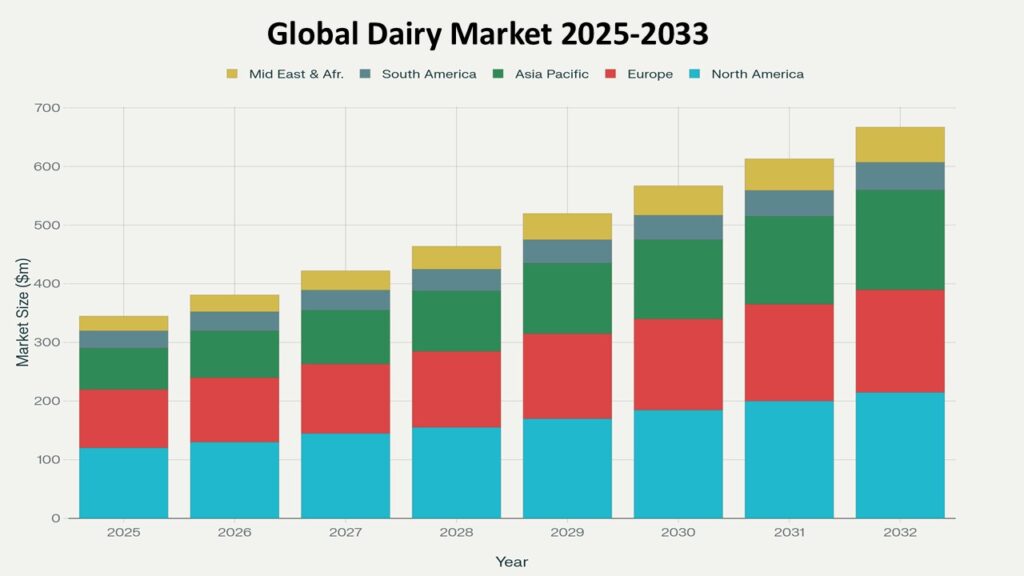
According to Phoenix Research, the Global Dairy Market is valued at USD 645.2 Billion in 2025 and is projected to reach USD 860.7 Billion by 2033, reflecting a CAGR of ~3.7% during (2026–2033).
North America holds the largest market share due to mature dairy consumption, advanced supply chains, and strong retail penetration. Asia-Pacific is the fastest-growing region, driven by rising disposable incomes, urbanization, and increased adoption of value-added and premium dairy products.
Post-2025 trends indicate accelerated premiumization, functional and fortified product expansion, plant-based dairy alternatives, and digitally optimized distribution networks.
Key Drivers of Global Dairy Market Growth
1. Rising Health & Nutrition Awareness
Growing consumer focus on protein intake, calcium, probiotics, and immunity-enhancing dairy products is driving widespread adoption across age groups.
2. Premiumization & Functional Product Innovation
High-income and health-conscious consumers are increasingly seeking premium cheeses, specialty yogurts, A2 milk, and fortified dairy products that deliver enhanced nutritional benefits and unique taste experiences.
3. Plant-Based & Hybrid Dairy Alternatives
The rise of vegan, flexitarian, and health-conscious lifestyles is fueling demand for oat, almond, soy, and hybrid dairy alternatives, expanding the market beyond traditional dairy offerings.
4. Technological Advancements & Supply Chain Digitization
Automation, cold-chain logistics, AI-driven demand forecasting, and smart packaging solutions are improving operational efficiency, reducing product waste, and ensuring safety and quality across the supply chain.
5. Expansion of Modern Retail & E-Commerce
The growth of supermarkets, hypermarkets, convenience stores, and online retail platforms is increasing dairy product accessibility, broadening consumer reach, and accelerating regional market penetration.
Global Dairy Market Segmentation
1. By Product Type
1.1 Milk & Milk-Based Beverages
1.1.1 Fresh Milk
1.1.1.1 Whole Milk
1.1.1.2 Low-Fat Milk
1.1.1.3 Skimmed Milk
1.1.2 Flavored & Sweetened Milk
1.1.2.1 Chocolate & Cocoa Milk
1.1.2.2 Fruit-Flavored Milk
1.1.2.3 Specialty Blends
1.1.3 Functional & Fortified Milk
1.1.3.1 Protein-Enriched Milk
1.1.3.2 Vitamin & Mineral Fortified Milk
1.1.3.3 Lactose-Free / A2 Milk
1.2 Yogurt & Fermented Dairy Products
1.2.1 Regular Yogurt
1.2.1.1 Plain Yogurt
1.2.1.2 Flavored Yogurt
1.2.2 Greek & Skyr Yogurt
1.2.2.1 High-Protein Greek Yogurt
1.2.2.2 Low-Fat Skyr Variants
1.2.3 Probiotic & Functional Yogurt
1.2.3.1 Digestive Health Yogurt
1.2.3.2 Immunity-Boosting Yogurt
1.3 Cheese & Dairy Spreads
1.3.1 Hard Cheese
1.3.1.1 Cheddar
1.3.1.2 Gouda
1.3.1.3 Parmesan & Aged Varieties
1.3.2 Soft Cheese
1.3.2.1 Cream Cheese
1.3.2.2 Ricotta & Cottage Cheese
1.3.3 Processed Cheese & Cheese Spreads
1.4 Butter & Cream
1.4.1 Unsalted Butter
1.4.2 Salted Butter
1.4.3 Cream Products
1.4.3.1 Heavy / Whipping Cream
1.4.3.2 Sour Cream & Cooking Cream
1.5 Ice Cream & Frozen Dairy Desserts
1.5.1 Traditional Ice Cream
1.5.2 Gelato & Sorbet
1.5.3 Dairy-Based Frozen Yogurt
1.6 Dairy-Based Ingredients
1.6.1 Milk Powder (Whole & Skimmed)
1.6.2 Whey & Protein Powders
1.6.3 Condensed & Cream-Based Ingredients
2. By Distribution Channel
2.1 Supermarkets & Hypermarkets
2.1.1 Large Format Chains
2.1.2 Regional / Local Supermarkets
2.1.3 Discount Retailers
2.2 Convenience Stores
2.2.1 Urban Convenience Outlets
2.2.2 Fuel Station-Based Stores
2.2.3 Mini-Market Formats
2.3 Online Retail / E-Commerce
2.3.1 Brand-Owned Online Platforms
2.3.2 Third-Party Marketplaces
2.3.3 Subscription & Meal Kits
2.4 Specialty & Health Stores
2.4.1 Organic / Natural Food Stores
2.4.2 Vegan / Plant-Based Retailers
2.4.3 Pharmacy-Based Retail
2.5 Foodservice & HoReCa Channels
2.5.1 Hotels & Resorts
2.5.2 Restaurants & Cafés
2.5.3 Institutional Catering (Schools, Hospitals, Offices)
3. By End-User
3.1 Individual Consumers
3.1.1 Millennials & Gen Z
3.1.1.1 Urban Health-Conscious Youth
3.1.1.2 College / University Students
3.1.2 Health-Conscious Adults
3.1.2.1 Fitness Enthusiasts
3.1.2.2 Nutritionally Aware Professionals
3.1.3 Families & Children
3.1.3.1 Young Families
3.1.3.2 Parents Focusing on Child Nutrition
3.2 Corporate & Institutional Clients
3.2.1 Hotels & Restaurants
3.2.1.1 Luxury Hotels & Resorts
3.2.1.2 Quick-Service & Casual Dining Restaurants
3.2.2 Cafés & Coffee Chains
3.2.2.1 Barista-Led Chains
3.2.2.2 Independent Coffee Shops
3.2.3 Hospitals & Healthcare Institutions
3.2.3.1 Public Hospitals
3.2.3.2 Private Healthcare Facilities
3.2.4 Educational Institutions
3.2.4.1 Schools
3.2.4.2 Colleges & Universities
4. By region
4.1 North America – Largest Market
4.2 Asia-Pacific – Fastest Growing Market
4.3 Europe
4.4 Middle East & Africa
4.5 South America
Regional Insights of Global Dairy Market
North America – Largest Market
High dairy consumption, mature supply chains, and strong retail penetration drive market leadership. Functional dairy, flavored milk, and premium cheese are key growth segments.
Asia-Pacific – Fastest Growing Market
Rising disposable income, urbanization, and health awareness are driving growth. Functional milk, yogurt, and dairy-based beverages are rapidly expanding.
Europe
Premiumization, clean-label products, and plant-based dairy alternatives are key trends, with Germany, France, and the UK leading adoption.
Middle East & Africa
Emerging markets, rising urban populations, and international dairy brand expansion are supporting growth, particularly in UAE, Saudi Arabia, and South Africa.
South America
Growing middle-class population, urbanization, and adoption of dairy-based beverages and convenience products drive steady growth, led by Brazil and Argentina.
Leading Companies in the Global Dairy Market
-
Lactalis Group
-
Fonterra Co-operative Group
-
Arla Foods
-
FrieslandCampina
-
Dean Foods Company
-
Saputo Inc.
-
Amul / Gujarat Cooperative Milk Marketing Federation (GCMMF)
-
Meiji Holdings Co., Ltd.
Nestlé S.A. remains a leading global player, leveraging integrated sourcing, product innovation, functional dairy development, and global distribution networks.
Strategic Intelligence and Technological Insights
Phoenix Demand Forecast Engine highlights steady growth driven by rising health-conscious consumption, premium and functional dairy product adoption, plant-based and hybrid dairy alternatives, and expansion across modern retail and e-commerce channels.
The Consumer Behavior Analyzer identifies increasing preference for protein-enriched, vitamin-fortified, probiotic, and immunity-boosting dairy products, alongside demand for clean-label, organic, and plant-based alternatives. Consumers are also gravitating toward convenient formats, online subscriptions, and digital loyalty programs.
The Innovation Tracker emphasizes technological integration in production and supply chain, including automation in dairy processing, cold-chain logistics, AI-based demand forecasting, smart packaging, and collaborations with cafés, restaurants, and HoReCa channels to promote premium products and culinary experimentation.
Porter’s Five Forces Analysis indicates high competitive rivalry among global dairy brands, moderate supplier power in raw milk and ingredient sourcing, and significant opportunities for differentiation through product fortification, sustainability initiatives, premiumization, and digital retail optimization.
Why the Global Dairy Market is Critical
Essential Nutritional Source: Dairy products provide key nutrients such as protein, calcium, vitamins, and probiotics, supporting daily dietary needs across all age groups.
Rising Health & Wellness Focus: Increasing consumer awareness of immunity, digestive health, and functional nutrition has amplified demand for fortified, probiotic, and high-protein dairy products.
Premiumization & Consumer Experience: Growing preference for artisanal cheeses, organic milk, specialty yogurts, and plant-based hybrid products is fueling innovation and value creation in the market.
Technological Integration & Supply Chain Efficiency: Advanced cold-chain logistics, AI-based demand forecasting, and smart packaging are enhancing operational efficiency, reducing wastage, and ensuring food safety — critical in meeting global supply demands.
Final Takeaway of Global Dairy Market
The Global Dairy Market is steadily evolving into a functional, premium, and digitally integrated ecosystem. The projected CAGR of approximately 3.7% during 2026–2033 reflects consistent and stable growth, driven by several interrelated factors: rising consumer health consciousness, increasing demand for fortified and functional dairy products, growing adoption of plant-based and hybrid dairy alternatives, and the expansion of modern retail and digital channels.
Premiumization continues to reshape consumer expectations, with high-income populations seeking specialty cheeses, yogurts, A2 milk, and other differentiated products, while convenience and personalization remain critical for everyday consumption.
Companies that strategically integrate product innovation, supply chain digitization, sustainable practices, and global expansion will be well positioned for long-term value creation.
At Phoenix Research, our advanced forecasting models, competitive benchmarking, and strategic intelligence provide stakeholders with actionable insights, enabling informed decision-making and maximizing opportunities in the post-2025 dairy landscape. With our comprehensive analysis of emerging trends, regional dynamics, and consumer behavior, businesses can navigate market complexities with confidence and build resilient, future-ready dairy portfolios.
📢 Social Mentions & Publication Channels
Explore deeper insights and follow our cross-platform updates on LinkedIn, and X for continuous intelligence and market coverage.
LinkedIn : https://www.linkedin.com/feed/update/urn:li:activity:7432339728621981712
X : https://x.com/Pheonix_Insight/status/2026576318062887096?s=20
Table of Contents
1. Executive Summary
1.1 Market Forecast Snapshot (2026–2033)
1.2 2025 Market Size & CAGR Analysis
1.3 Largest & Fastest-Growing Segments
1.4 Regional Leadership & Market Trends
1.5 Key Market Drivers
1.6 Competitive Landscape Overview
1.7 Strategic Outlook Through 2033
2. Introduction & Market Overview
2.1 Definition of the Global Dairy Market
2.2 Scope of the Study
2.3 Role of Dairy in Nutrition & Foodservice Industry
2.4 Evolution of Global Dairy Industry
2.5 Functional, Premium, and Plant-Based Dairy Trends
2.6 Digital Supply Chain & E-Commerce Integration
2.7 Sustainability, Animal Welfare & Ethical Sourcing Trends
3. Research Methodology
3.1 Primary Research
3.2 Secondary Research
3.3 Market Size Estimation Model
3.4 Forecast Assumptions (2026–2033)
3.5 Data Validation & Triangulation
4. Market Dynamics
4.1 Drivers
4.1.1 Rising Health & Nutrition Awareness
4.1.2 Premiumization & Functional Product Innovation
4.1.3 Plant-Based & Hybrid Dairy Alternatives
4.1.4 Technological Advancements & Supply Chain Digitization
4.1.5 Expansion of Modern Retail & E-Commerce
4.2 Restraints
4.2.1 Raw Milk Price Volatility
4.2.2 Regulatory & Labeling Compliance Costs
4.2.3 Cold-Chain Infrastructure Limitations
4.3 Opportunities
4.3.1 Growth in Emerging Markets
4.3.2 Fortified, Functional & Plant-Based Innovations
4.3.3 E-Commerce & Direct-to-Consumer Channels
4.3.4 Premiumization & Experiential Consumption
4.4 Challenges
4.4.1 Climate Change & Sustainability Pressures
4.4.2 Competition from Non-Dairy Beverages
4.4.3 Price Sensitivity in Developing Regions
5. Global Dairy Market Segmentation by Product Type (USD Billion)
5.1 Milk & Milk-Based Beverages
5.1.1 Fresh Milk
5.1.1.1 Whole Milk
5.1.1.2 Low-Fat Milk
5.1.1.3 Skimmed Milk
5.1.2 Flavored & Sweetened Milk
5.1.2.1 Chocolate & Cocoa Milk
5.1.2.2 Fruit-Flavored Milk
5.1.2.3 Specialty Blends
5.1.3 Functional & Fortified Milk
5.1.3.1 Protein-Enriched Milk
5.1.3.2 Vitamin & Mineral Fortified Milk
5.1.3.3 Lactose-Free / A2 Milk
5.2 Yogurt & Fermented Dairy Products
5.2.1 Regular Yogurt
5.2.1.1 Plain Yogurt
5.2.1.2 Flavored Yogurt
5.2.2 Greek & Skyr Yogurt
5.2.2.1 High-Protein Greek Yogurt
5.2.2.2 Low-Fat Skyr Variants
5.2.3 Probiotic & Functional Yogurt
5.2.3.1 Digestive Health Yogurt
5.2.3.2 Immunity-Boosting Yogurt
5.3 Cheese & Dairy Spreads
5.3.1 Hard Cheese
5.3.1.1 Cheddar
5.3.1.2 Gouda
5.3.1.3 Parmesan & Aged Varieties
5.3.2 Soft Cheese
5.3.2.1 Cream Cheese
5.3.2.2 Ricotta & Cottage Cheese
5.3.3 Processed Cheese & Cheese Spreads
5.4 Butter & Cream
5.4.1 Unsalted Butter
5.4.2 Salted Butter
5.4.3 Cream Products
5.4.3.1 Heavy / Whipping Cream
5.4.3.2 Sour Cream & Cooking Cream
5.5 Ice Cream & Frozen Dairy Desserts
5.5.1 Traditional Ice Cream
5.5.2 Gelato & Sorbet
5.5.3 Dairy-Based Frozen Yogurt
5.6 Dairy-Based Ingredients
5.6.1 Milk Powder (Whole & Skimmed)
5.6.2 Whey & Protein Powders
5.6.3 Condensed & Cream-Based Ingredients
6. Market Segmentation by Distribution Channel
6.1 Supermarkets & Hypermarkets
6.1.1 Large Format Chains
6.1.2 Regional / Local Supermarkets
6.1.3 Discount Retailers
6.2 Convenience Stores
6.2.1 Urban Convenience Outlets
6.2.2 Fuel Station-Based Stores
6.2.3 Mini-Market Formats
6.3 Online Retail / E-Commerce
6.3.1 Brand-Owned Online Platforms
6.3.2 Third-Party Marketplaces
6.3.3 Subscription & Meal Kits
6.4 Specialty & Health Stores
6.4.1 Organic / Natural Food Stores
6.4.2 Vegan / Plant-Based Retailers
6.4.3 Pharmacy-Based Retail
6.5 Foodservice & HoReCa Channels
6.5.1 Hotels & Resorts
6.5.2 Restaurants & Cafés
6.5.3 Institutional Catering (Schools, Hospitals, Offices)
7. Market Segmentation by End-User
7.1 Individual Consumers
7.1.1 Millennials & Gen Z
7.1.1.1 Urban Health-Conscious Youth
7.1.1.2 College / University Students
7.1.2 Health-Conscious Adults
7.1.2.1 Fitness Enthusiasts
7.1.2.2 Nutritionally Aware Professionals
7.1.3 Families & Children
7.1.3.1 Young Families
7.1.3.2 Parents Focusing on Child Nutrition
7.2 Corporate & Institutional Clients
7.2.1 Hotels & Restaurants
7.2.1.1 Luxury Hotels & Resorts
7.2.1.2 Quick-Service & Casual Dining Restaurants
7.2.2 Cafés & Coffee Chains
7.2.2.1 Barista-Led Chains
7.2.2.2 Independent Coffee Shops
7.2.3 Hospitals & Healthcare Institutions
7.2.3.1 Public Hospitals
7.2.3.2 Private Healthcare Facilities
7.2.4 Educational Institutions
7.2.4.1 Schools
7.2.4.2 Colleges & Universities
8. Market Segmentation by Region
8.1 North America – Largest Market
8.2 Asia-Pacific – Fastest Growing Market
8.3 Europe
8.4 Middle East & Africa
8.5 South America
9. Regional Insights
9.1 North America – Functional Dairy & Premium Cheese Leadership
9.2 Asia-Pacific – Urbanization & Health-Driven Growth
9.3 Europe – Premiumization & Plant-Based Adoption
9.4 Middle East & Africa – Emerging Market Expansion
9.5 South America – Urbanization & Convenience Product Growth
10. Competitive Landscape
10.1 Market Share Analysis
10.2 Competitive Positioning Matrix
10.3 Product Innovation & Functional Differentiation
10.4 Global vs Regional Brand Presence
10.5 M&A & Strategic Collaborations
10.6 Premiumization & Plant-Based Portfolio Strategies
11. Leading Companies
11.1 Nestlé S.A.
11.2 Danone S.A.
11.3 Lactalis Group
11.4 Fonterra Co-operative Group
11.5 Arla Foods
11.6 FrieslandCampina
11.7 Dean Foods Company
11.8 Saputo Inc.
11.9 Amul / GCMMF
11.10 Meiji Holdings Co., Ltd.
12. Strategic Intelligence & AI-Backed Insights
12.1 Phoenix Demand Forecast Engine
12.2 Consumer Behavior Analyzer
12.3 Innovation Tracker
12.4 Digital Supply Chain Optimization
12.5 Automated Porter’s Five Forces Analysis
13. Sustainability & Regulatory Landscape
13.1 Environmental & Ethical Production
13.2 Animal Welfare & Dairy Farm Practices
13.3 Packaging & Carbon Footprint Reduction
13.4 Dairy Regulations & Labeling Compliance
13.5 Responsible Consumption & Food Safety Initiatives
14. Market Significance
14.1 Nutritional & Health Contribution
14.2 Economic Impact & Employment Generation
14.3 Premiumization & Consumer Experience
14.4 Supply Chain & Retail Ecosystem Role
14.5 Recurring Revenue & Brand Loyalty
15. Future Outlook & Strategic Recommendations
15.1 Premiumization & Functional Product Expansion
15.2 Plant-Based & Hybrid Dairy Integration
15.3 E-Commerce & Direct-to-Consumer Growth
15.4 Regional Market Penetration Strategy
15.5 Long-Term Global Dairy Market Outlook (2033+)