
Global Adaptogen Market report 2026-2033
Global Adaptogen Market Forecast Snapshot: 2026–2033
| Metric | Value |
| 2025 Market Size | USD 11.8 Billion |
| 2033 Market Size | USD 19.6 Billion |
| CAGR (2026–2033) | 6.5% |
| Largest Region | North America |
| Fastest Growing Region | Asia-Pacific |
| Top Segment | Adaptogenic Herbal Supplements |
| Key Trend | Stress-Relief and Functional Wellness Products |
| Future Focus | Functional Beverages, Nutraceuticals, and Herbal Formulations |
Global Adaptogen Market Overview
Global Adaptogen Market is buzzing.People are turning to nature's remedies to beat stress, boost immunity, and feel better. Adaptogens – herbs, roots, and mushrooms – help body cope with life's pressures and keep you balanced. As wellness gets natural, the market's growing fast.
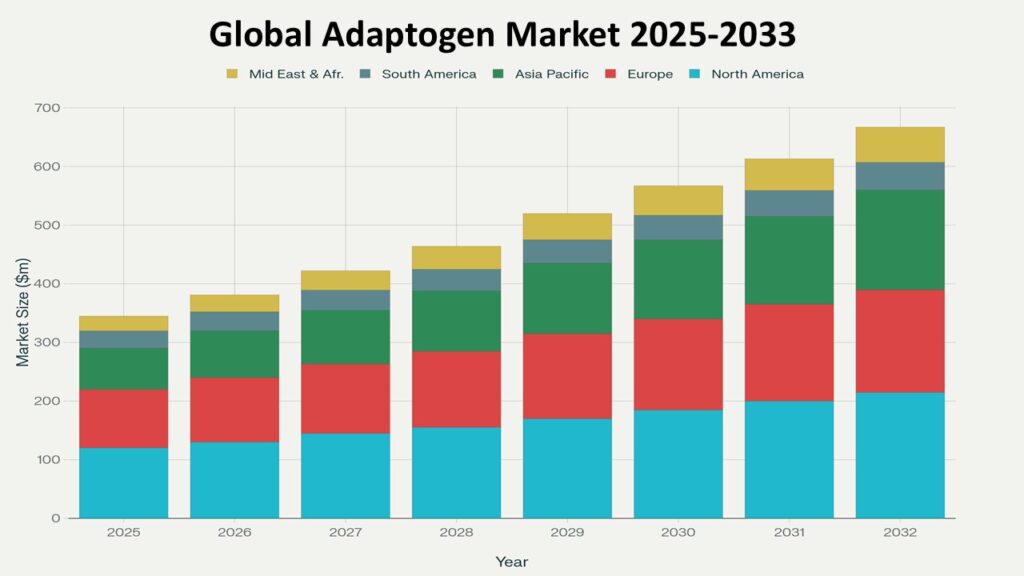
According to Pheonix Research, the Global Adaptogen Market is valued at USD 11.8 billion in 2025 and is projected to reach USD 19.6 billion by 2033, registering a CAGR of 6.5% during 2026–2033. Market growth is supported by rising awareness of holistic health practices, expanding demand for plant-based nutraceuticals, and increasing incorporation of adaptogenic ingredients into functional foods and beverages.
Adaptogens such as ashwagandha, ginseng, rhodiola, maca root, holy basil, and cordyceps mushrooms are increasingly used in dietary supplements, herbal medicines, functional beverages, and skincare formulations. Their stress-reducing, energy-boosting, and immunity-supporting properties are driving widespread consumer adoption across both traditional and modern wellness markets.
The post-2025 outlook indicates strong innovation in adaptogenic beverages, wellness supplements, and clean-label functional foods, positioning adaptogens as a key category within the broader natural health and nutraceutical industry.
Key Drivers of Global Adaptogen Market Growth
1. Rising Stress and Mental Health Awareness
Increasing levels of stress, anxiety, and lifestyle-related health issues are driving demand for natural stress-management supplements.
2. Growing Popularity of Herbal and Natural Remedies
Consumers are increasingly shifting toward plant-based and herbal products for long-term health benefits.
3. Expansion of Functional Food and Beverage Products
Adaptogens are increasingly incorporated into teas, coffee blends, energy drinks, and wellness beverages.
4. Increasing Demand for Nutraceuticals and Dietary Supplements
Adaptogenic herbs are widely used in supplements aimed at boosting immunity, energy, and cognitive performance.
5. Growth of Holistic and Preventive Healthcare Trends
Consumers are adopting wellness-focused lifestyles, encouraging the use of natural functional ingredients such as adaptogens.
Global Adaptogen Market Segmentation
1. By Product Type
1.1 Adaptogenic Herbs
1.1.1 Ashwagandha
1.1.1.1 Root Extracts
1.1.1.1.1 Stress Relief Supplements
1.1.1.1.2 Immunity Boosting Formulations
1.1.2 Ginseng
1.1.2.1 Asian Ginseng
1.1.2.1.1 Energy Supplements
1.1.2.1.2 Cognitive Health Products
1.1.3 Rhodiola Rosea
1.1.3.1 Standardized Herbal Extracts
1.1.3.1.1 Fatigue Reduction Supplements
1.1.3.1.2 Performance Enhancement Products
1.2 Adaptogenic Mushrooms
1.2.1 Reishi Mushroom
1.2.1.1 Immune Support Supplements
1.2.1.1.1 Herbal Capsules
1.2.1.1.2 Functional Beverage Ingredients
1.2.2 Cordyceps Mushroom
1.2.2.1 Energy and Endurance Products
1.2.2.1.1 Sports Nutrition Supplements
1.2.2.1.2 Functional Wellness Drinks
1.3 Adaptogenic Roots and Botanicals
1.3.1 Maca Root
1.3.1.1 Powdered Supplements
1.3.1.1.1 Energy Boosting Products
1.3.1.1.2 Hormonal Balance Supplements
1.3.2 Holy Basil (Tulsi)
1.3.2.1 Herbal Extracts
1.3.2.1.1 Stress Relief Teas
1.3.2.1.2 Immune Support Products
2. By Application
2.1 Dietary Supplements
2.1.1 Capsules and Tablets
2.1.1.1 Herbal Supplement Formulations
2.1.1.1.1 Stress Relief Supplements
2.1.1.1.2 Energy and Immunity Supplements
2.1.2 Powdered Supplements
2.1.2.1 Functional Wellness Powders
2.1.2.1.1 Adaptogenic Smoothie Mixes
2.1.2.1.2 Fitness Nutrition Products
2.2 Functional Foods and Beverages
2.2.1 Adaptogenic Beverages
2.2.1.1 Herbal Teas
2.2.1.1.1 Stress Relief Tea Blends
2.2.1.1.2 Wellness Herbal Infusions
2.2.2 Functional Food Products
2.2.2.1 Nutritional Snack Products
2.2.2.1.1 Adaptogenic Snack Bars
2.2.2.1.2 Wellness Energy Foods
2.3 Personal Care and Cosmetics
2.3.1 Herbal Skincare Products
2.3.1.1 Anti-Aging Skincare
2.3.1.1.1 Adaptogen-Based Creams
2.3.1.1.2 Herbal Serums
2.3.2 Wellness Beauty Products
2.3.2.1 Natural Beauty Formulations
2.3.2.1.1 Botanical Beauty Products
2.3.2.1.2 Herbal Skin Protection Products
3. By Distribution Channel
3.1 Health & Wellness Stores
3.1.1 Herbal Product Retailers
3.1.1.1 Natural Supplement Stores
3.1.1.1.1 Adaptogen Capsule Products
3.1.1.1.2 Herbal Wellness Supplements
3.2 Supermarkets & Hypermarkets
3.2.1 Health Food Sections
3.2.1.1 Functional Food Products
3.2.1.1.1 Adaptogenic Beverage Products
3.2.1.1.2 Wellness Snack Products
3.3 Online Retail
3.3.1 E-commerce Platforms
3.3.1.1 Online Nutraceutical Stores
3.3.1.1.1 Herbal Supplement Marketplaces
3.3.1.1.2 Direct-to-Consumer Wellness Brands
4. By End User
4.1 Health-Conscious Consumers
4.1.1 Fitness Enthusiasts
4.1.1.1 Sports Nutrition Consumers
4.1.1.1.1 Energy Supplements
4.1.1.1.2 Performance Boosting Products
4.2 Wellness Lifestyle Consumers
4.2.1 Stress Management Consumers
4.2.1.1 Mental Wellness Products
4.2.1.1.1 Relaxation Supplements
4.2.1.1.2 Adaptogenic Herbal Products
Regional Insights of Global Adaptogen Market
North America – Largest Market
North America dominates the global adaptogen market due to strong consumer awareness of herbal supplements, rising stress-management product demand, and widespread adoption of functional wellness beverages.
Asia-Pacific – Fastest Growing Market
Asia-Pacific is experiencing rapid growth driven by the traditional use of herbal medicine in countries such as China, India, and South Korea, along with rising demand for natural health products.
Europe
European markets are expanding due to growing demand for organic herbal supplements, clean-label nutraceuticals, and wellness-oriented functional foods.
Middle East & Africa
Increasing interest in herbal remedies and rising health awareness are supporting the adoption of adaptogenic supplements.
South America
Growing popularity of plant-based health products ahttps://himalayawellness.in/nd natural herbal supplements is driving gradual market expansion.
Leading Companies in Global Adaptogen Market
Prominent players include:
-
Organic India
-
Nature’s Way
-
NOW Foods
-
NutraHerb Inc.
-
Terrasoul Superfoods
-
Moon Juice
Among these, Himalaya Wellness Company and Gaia Herbs are recognized as leading players due to their strong global herbal product portfolios and extensive distribution networks.
Strategic Intelligence & AI-Backed Insights
Pheonix Demand Forecast Engine identifies increasing demand for natural stress management products and herbal supplements as major long-term growth drivers.
Consumer Behavior Analyzer highlights growing preference for clean-label, plant-based, and natural wellness products.
Innovation Tracker emphasizes adaptogenic beverages, herbal supplements, and functional snack products as key competitive differentiators.
Porter’s Five Forces Analysis reveals moderate supplier power, strong competition among herbal supplement brands, and growing opportunities for premium natural wellness products.
Why the Global Adaptogen Market is Critical
-
Supports natural stress management and mental wellness.
-
Expands the global nutraceutical and herbal supplement industry.
-
Drives innovation in functional foods and beverages.
-
Encourages the use of plant-based and natural health ingredients.
-
Supports preventive healthcare and holistic wellness trends.
Final Takeaway of Global Adaptogen Market
The Global Adaptogen Market is steadily evolving as consumers increasingly adopt natural wellness solutions to manage stress, improve immunity, and support overall health. The Adaptogen Market CAGR 2026–2033 of 6.5% reflects consistent growth driven by expanding demand for herbal supplements, functional foods, and plant-based health products.
Companies that focus on clean-label formulations, functional beverage innovation, and premium herbal supplement portfolios will be well positioned to capture long-term growth opportunities in the evolving wellness ecosystem.
At Pheonix Research, our advanced market intelligence frameworks deliver comprehensive revenue forecasts, consumer insights, and competitive benchmarking, enabling stakeholders to capitalize on emerging opportunities in the global adaptogen market with confidence.
📢 Social Mentions & Publication Channels
Explore deeper insights and follow our cross-platform updates on LinkedIn and X for continuous intelligence and market coverage.
LinkedIn : https://www.linkedin.com/feed/update/urn:li:activity:7437387554016063488
X : https://x.com/Pheonix_Insight/status/2031625401659994207?s=20
Table of Contents
1. Executive Summary
1.1 Global Adaptogen Market Forecast Snapshot (2026–2033)
1.2 Market Size & CAGR Analysis
1.3 Key Market Trends in Natural Wellness
1.4 Largest and Fastest-Growing Regions
1.5 Leading Segment Analysis
1.6 Competitive Landscape Overview
1.7 Strategic Outlook Through 2033
2. Introduction & Market Overview
2.1 Definition of the Global Adaptogen Market
2.2 Scope of the Study
2.3 Evolution of Herbal and Adaptogenic Products
2.4 Role of Adaptogens in Stress Management and Holistic Health
2.5 Growing Popularity of Plant-Based Nutraceuticals
2.6 Expansion of Functional Foods and Beverages with Adaptogenic Ingredients
2.7 Integration of Adaptogens in Personal Care and Wellness Products
3. Research Methodology
3.1 Primary Research
3.2 Secondary Research
3.3 Market Size Estimation Model
3.4 Forecast Assumptions (2026–2033)
3.5 Data Validation and Triangulation
4. Market Dynamics
4.1 Market Drivers
4.1.1 Rising Stress and Mental Health Awareness
4.1.2 Growing Popularity of Herbal and Natural Remedies
4.1.3 Expansion of Functional Food and Beverage Products
4.1.4 Increasing Demand for Nutraceuticals and Dietary Supplements
4.1.5 Growth of Holistic and Preventive Healthcare Trends
4.2 Market Restraints
4.2.1 Limited Clinical Evidence for Certain Adaptogenic Ingredients
4.2.2 Regulatory Challenges in Herbal Supplements
4.2.3 High Cost of Premium Herbal Extracts
4.2.4 Quality and Standardization Concerns
4.3 Market Opportunities
4.3.1 Expansion of Functional Beverage Innovations
4.3.2 Growth of Plant-Based Nutraceutical Products
4.3.3 Increasing Demand for Clean-Label Wellness Products
4.3.4 Rising Popularity of Herbal Beauty and Skincare Products
4.4 Market Challenges
4.4.1 Ensuring Consistent Raw Material Supply
4.4.2 Maintaining Product Authenticity and Quality
4.4.3 Competition Among Herbal Supplement Brands
4.4.4 Consumer Awareness and Education Challenges
5. Global Adaptogen Market Analysis (USD Billion), 2026–2033
5.1 Market Size Overview
5.2 CAGR Growth Analysis
5.3 Regional Revenue Distribution
5.4 Product Category Market Share Analysis
5.5 Application-Level Demand Trends
5.6 Distribution Channel Revenue Trends
6. Market Segmentation by Product Type (USD Billion), 2026–2033
6.1 Adaptogenic Herbs
6.1.1 Ashwagandha
6.1.2 Ginseng
6.1.3 Rhodiola Rosea
6.2 Adaptogenic Mushrooms
6.2.1 Reishi Mushroom
6.2.2 Cordyceps Mushroom
6.3 Adaptogenic Roots and Botanicals
6.3.1 Maca Root
6.3.2 Holy Basil (Tulsi)
7. Market Segmentation by Application (USD Billion), 2026–2033
7.1 Dietary Supplements
7.1.1 Capsules and Tablets
7.1.2 Powdered Supplements
7.2 Functional Foods and Beverages
7.2.1 Adaptogenic Beverages
7.2.2 Functional Food Products
7.3 Personal Care and Cosmetics
7.3.1 Herbal Skincare Products
7.3.2 Wellness Beauty Products
8. Market Segmentation by Distribution Channel (USD Billion), 2026–2033
8.1 Health & Wellness Stores
8.2 Supermarkets and Hypermarkets
8.3 Online Retail and E-Commerce
9. Market Segmentation by End User (USD Billion), 2026–2033
9.1 Health-Conscious Consumers
9.1.1 Fitness Enthusiasts
9.1.2 Sports Nutrition Consumers
9.2 Wellness Lifestyle Consumers
9.2.1 Stress Management Consumers
9.2.2 Mental Wellness Product Consumers
10. Market Segmentation by Geography
10.1 North America – Largest Market
10.2 Asia-Pacific – Fastest Growing Market
10.3 Europe
10.4 Middle East & Africa
10.5 South America
11. Competitive Landscape
11.1 Global Market Share Analysis
11.2 Product Portfolio Benchmarking
11.3 Herbal Ingredient Sourcing Strategies
11.4 Brand Positioning and Innovation Strategies
11.5 Competitive Differentiation Analysis
12. Company Profiles
12.1 Gaia Herbs
12.2 Himalaya Wellness Company
12.3 Organic India
12.4 Nature’s Way
12.5 NOW Foods
12.6 NutraHerb Inc.
12.7 Terrasoul Superfoods
12.8 Moon Juice
13. Strategic Intelligence & Phoenix AI Insights
13.1 Pheonix Demand Forecast Engine
13.2 Consumer Behavior Analyzer
13.3 Herbal Wellness Innovation Tracker
13.4 Functional Food Market Intelligence
13.5 Automated Porter’s Five Forces Analysis
14. Future Outlook & Strategic Recommendations
14.1 Expansion of Adaptogenic Functional Beverages
14.2 Growth of Herbal Nutraceutical Products
14.3 Development of Clean-Label Wellness Formulations
14.4 Increasing Integration of Adaptogens in Beauty Products
14.5 Long-Term Market Outlook (2033+)