
Global Protein Powder Market Report 2026-2033
Global Protein Powder Market Forecast Snapshot: 2026–2033
| Metric | Value |
|---|---|
| 2025 Market Size | USD 12.6 Billion |
| 2033 Market Size | USD 28.7 Billion |
| CAGR (2026–2033) | 10.8% |
| Largest Region | North America |
| Fastest Growing Region | Asia-Pacific |
| Top Segment | Whey Protein |
| Fastest Growing Segment | Plant-Based Proteins |
| Key Trend | Plant-Based Blends, RTD Expansion, Collagen Demand |
| Future Focus | Clinical Validation, Sustainable Sourcing, and Product Innovation |
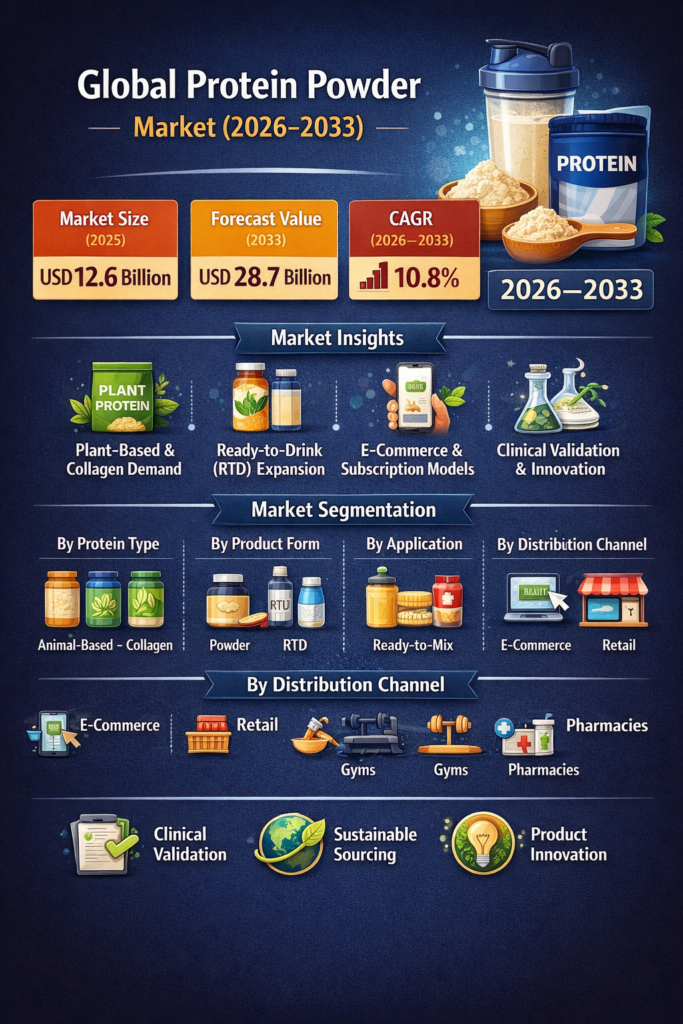
Global Protein Powder Market Overview (2026–2033)
The Global Protein Powder Market is experiencing strong growth during the 2026–2033 forecast period, driven by the increasing adoption of protein supplementation across diverse consumer groups.
Protein powders are no longer limited to athletes; they are now widely used for daily nutrition, weight management, clinical recovery, and beauty applications, expanding their role in the global health ecosystem.
According to Pheonix Research, rising awareness of protein deficiency, aging-related muscle loss, and active lifestyle trends is significantly contributing to market expansion.
Manufacturers are focusing on product innovation, including plant-based blends, enzyme-enhanced formulations, and low-sugar variants, while also expanding into ready-to-drink beverages and meal replacement products.
North America remains the largest market, supported by high consumption and mature retail infrastructure, while Asia-Pacific is the fastest-growing region, driven by rising incomes, fitness awareness, and e-commerce expansion.
Key Drivers of Global Protein Powder Market Growth
Mainstreaming of Protein Consumption
Protein is increasingly consumed for general health, satiety, and weight management.
Growth of Plant-Based & Alternative Proteins
Pea, soy, rice, and blended proteins are gaining popularity among vegan and lactose-intolerant consumers.
Collagen & Beauty-from-Within Trends
Collagen-based products are expanding demand among women and aging populations.
Expansion of RTD & Convenience Formats
Ready-to-drink shakes and single-serve sachets are increasing consumption occasions.
Growth of E-Commerce & DTC Channels
Online platforms and subscription models are accelerating product accessibility.
Product Innovation & Functional Nutrition
Advanced formulations with probiotics, enzymes, and low-calorie content are enhancing product appeal.
Global Protein Powder Market Segmentation
1. By Protein Type
1.1 Animal-Based Proteins
1.1.1 Whey Protein
1.1.1.1 Whey Concentrate
1.1.1.1.1 Whey Isolate & Hydrolyzed
1.1.2 Casein Protein
1.1.2.1 Micellar Casein
1.1.2.1.1 Calcium Caseinate
1.1.3 Egg & Collagen Proteins
1.1.3.1 Egg White Protein
1.1.3.1.1 Collagen Peptides
1.2 Plant-Based Proteins
1.2.1 Single Source Proteins
1.2.1.1 Pea Protein
1.2.1.1.1 Soy & Rice Protein
1.2.2 Blended Plant Proteins
1.2.2.1 Multi-Plant Blends
1.2.2.1.1 Functional Formulations
1.3 Specialty & Functional Proteins
1.3.1 Protein + Probiotics
1.3.1.1 Protein + Fiber
1.3.1.1.1 Rapid Absorption Formulas
2. By Product Form
2.1 Powder
2.1.1 Bulk Packaging
2.1.1.1 Single-Serve Sachets
2.1.1.1.1 Retail Packs
2.2 Ready-to-Drink (RTD)
2.2.1 Bottled Shakes
2.2.1.1 Canned Beverages
2.2.1.1.1 Functional Drinks
2.3 Ready-to-Mix
2.3.1 Pre-Mixed Products
2.3.1.1 Instant Beverages
2.3.1.1.1 Convenience Formats
2.4 Fortified Foods & Bars
2.4.1 Protein Snacks
2.4.1.1 Bakery Products
2.4.1.1.1 Functional Foods
3. By Application
3.1 Sports & Performance Nutrition
3.1.1 Athlete Nutrition
3.1.1.1 Gym Consumption
3.1.1.1.1 Performance Products
3.2 Weight Management
3.2.1 Meal Replacement
3.2.1.1 Diet Products
3.2.1.1.1 Low-Calorie Nutrition
3.3 Clinical Nutrition
3.3.1 Elderly Care
3.3.1.1 Recovery Nutrition
3.3.1.1.1 Medical Use
3.4 General Health & Wellness
3.4.1 Daily Nutrition
3.4.1.1 Lifestyle Consumption
3.4.1.1.1 Preventive Health
3.5 Beauty & Functional
3.5.1 Collagen Products
3.5.1.1 Skin & Joint Health
3.5.1.1.1 Wellness Segment
4. By Distribution Channel
4.1 E-Commerce & DTC
4.1.1 Brand Websites
4.1.1.1 Subscription Models
4.1.1.1.1 Online Marketplaces
4.2 Modern Retail
4.2.1 Supermarkets
4.2.1.1 Health Stores
4.2.1.1.1 Specialty Retail
4.3 Sports & Specialty Stores
4.3.1 Gym Stores
4.3.1.1 Nutrition Retail
4.3.1.1.1 Fitness Channels
4.4 Foodservice & HoReCa
4.4.1 Protein-Based Menu Items
4.4.1.1 Functional Beverages
4.4.1.1.1 Institutional Use
4.5 Pharmacies & Clinical Channels
4.5.1 Medical Nutrition
4.5.1.1 Healthcare Products
4.5.1.1.1 Clinical Distribution
Global Protein Powder Market Regional Insights
North America – Largest Market
High consumption, strong supplement culture, and premium product demand.
Europe
Growing demand for plant-based proteins and regulatory focus on health claims.
Asia-Pacific – Fastest Growing Region
Rapid growth driven by rising incomes, fitness awareness, and e-commerce expansion.
Latin America
Increasing fitness culture and demand for premium nutrition products.
Middle East & Africa
Growing demand in clinical nutrition and niche wellness segments.
Leading Companies in the Global Protein Powder Market
Glanbia plc
Abbott Laboratories
Herbalife Nutrition
Iovate Health Sciences
Nestlé S.A.
PepsiCo
NOW Foods
MusclePharm
Dymatize
These companies focus on product innovation, global expansion, and brand positioning to maintain competitive advantage.
Strategic Intelligence & Market Insights
Pheonix Demand Forecast Engine identifies health awareness and fitness trends as key drivers.
Channel Optimization Model highlights growth in DTC and e-commerce channels.
Product-Market Fit Analyzer recommends formulation strategies based on demographics.
Porter’s Five Forces Analysis indicates high competition with strong innovation-driven differentiation.
Why the Global Protein Powder Market Remains Critical
Supports aging population and muscle health
Provides convenient nutrition solutions
Expands functional food ecosystem
Creates high-margin opportunities for brands
Promotes sustainable plant-based protein consumption
Final Takeaway of Global Protein Powder Market
The Global Protein Powder Market is expected to witness strong growth through 2033, driven by increasing demand for functional nutrition, plant-based proteins, and convenient health solutions.
Companies that focus on clinical validation, product innovation, sustainable sourcing, and omnichannel distribution strategies will be best positioned to capture long-term market opportunities.
At Pheonix Research, our advanced forecasting tools and AI-driven insights help stakeholders identify emerging trends, optimize strategies, and build competitive advantage in the global protein powder market.
Table of Contents
Table of Contents
1. Executive Summary
1.1 Market Forecast Snapshot (2026–2033)
The Global Protein Powder Market is projected to grow from USD 12.6 Billion in 2025 to USD 28.7 Billion by 2033, registering a CAGR of 10.8% during 2026–2033.
1.2 Global Market Size & CAGR Analysis
The market reflects strong expansion driven by the mainstream adoption of protein consumption, rising health awareness, and increasing demand for functional and convenient nutrition products.
1.3 Largest & Fastest-Growing Segments
Largest Segment: Whey Protein
Fastest-Growing Segment: Plant-Based Proteins
1.4 Region-Level Leadership & Growth Trends
North America leads the market due to high consumption and mature supplement infrastructure, while Asia-Pacific is projected to be the fastest-growing region through 2033.
1.5 Key Market Drivers
Mainstream adoption of protein consumption across demographics
Growing demand for plant-based and alternative protein sources
Expansion of ready-to-drink (RTD) and convenience formats
Rising popularity of collagen and beauty-from-within products
Growth of e-commerce and direct-to-consumer (DTC) channels
Continuous product innovation in functional nutrition
1.6 Competitive Landscape Overview
Highly competitive market with global brands focusing on product innovation, clinical validation, sustainable sourcing, and omnichannel distribution strategies.
1.7 Strategic Outlook Through 2033
Focus on plant-based protein innovation, RTD expansion, clinical validation, sustainable sourcing, and digital retail growth.
2. Introduction & Market Overview
2.1 Definition of the Global Protein Powder Market
Covers protein supplements including whey, plant-based, collagen, and functional protein products used across sports nutrition, wellness, and clinical applications.
2.2 Scope of the Study
Comprehensive analysis of market size, segmentation, product innovation, distribution channels, and global forecasts for 2026–2033.
2.3 Evolution from Sports Nutrition to Mainstream Consumption
The market has transitioned from athlete-focused products to widespread adoption across general health, wellness, and aging populations.
2.4 Role of Retail, E-Commerce & DTC Channels
Expansion of online platforms, subscription models, and retail distribution is driving product accessibility.
2.5 Impact of Health & Wellness Trends
Rising awareness of protein intake for muscle health, weight management, and overall wellness is fueling demand.
2.6 Integration of Sustainable & Plant-Based Nutrition
Growing focus on plant-based proteins and environmentally sustainable sourcing practices.
2.7 Innovation in Functional & Clinical Nutrition
Advancements in protein formulations including probiotics, enzymes, and low-calorie blends.
3. Research Methodology
3.1 Primary Research
Interviews with manufacturers, nutrition experts, distributors, and industry stakeholders.
3.2 Secondary Research
Industry reports, health data, market studies, and corporate filings.
3.3 Market Size Estimation Model
Combination of consumption-based and revenue-based modeling.
3.4 Forecast Assumptions (2026–2033)
Based on health awareness, fitness trends, aging population, and retail expansion.
3.5 Data Validation & Triangulation
Cross-verification using supply chain insights and regional consumption patterns.
4. Market Dynamics
4.1 Drivers
4.1.1 Mainstreaming of Protein Consumption
Increasing adoption beyond athletes into everyday health and wellness routines.
4.1.2 Growth of Plant-Based & Alternative Proteins
Rising demand for vegan, lactose-free, and sustainable protein options.
4.1.3 Expansion of RTD & Convenience Products
Ready-to-drink and meal-replacement formats are increasing consumption frequency.
4.1.4 Rise of Collagen & Functional Nutrition Trends
Growing demand for beauty, joint health, and wellness supplements.
4.1.5 Growth of E-Commerce & DTC Channels
Online sales channels are expanding market reach globally.
4.2 Restraints
4.2.1 High pricing of premium protein products
4.2.2 Regulatory challenges and labeling requirements
4.2.3 Competition from whole food protein sources
4.2.4 Product quality and adulteration concerns
4.3 Opportunities
4.3.1 Expansion of plant-based protein innovations
4.3.2 Growth in emerging markets
4.3.3 Development of clinical nutrition products
4.3.4 Integration with functional foods and beverages
4.4 Challenges
4.4.1 Maintaining product quality and consistency
4.4.2 Supply chain challenges for raw materials
4.4.3 Intense competition among global brands
4.4.4 Consumer skepticism around claims and effectiveness
5. Global Protein Powder Market Analysis (USD Billion), 2026–2033
5.1 Market Size Overview
5.2 CAGR Analysis
5.3 Region-Wise Revenue Distribution
5.4 Product Type Revenue Split
5.5 Distribution Channel Trends
5.6 Application-Based Analysis
6. Market Segmentation by Protein Type (USD Billion), 2026–2033
6.1 Whey Protein
6.1.1 Whey Concentrate
6.1.1.1 Whey Isolate
6.1.1.1.1 Hydrolyzed Whey
6.2 Casein Protein
6.2.1 Micellar Casein
6.2.1.1 Calcium Caseinate
6.2.1.1.1 Functional Use
6.3 Plant-Based Proteins
6.3.1 Pea Protein
6.3.1.1 Soy & Rice Protein
6.3.1.1.1 Blended Proteins
6.4 Collagen & Specialty Proteins
6.4.1 Collagen Peptides
6.4.1.1 Functional Blends
6.4.1.1.1 Beauty & Wellness Products
7. Market Segmentation by Product Form (USD Billion), 2026–2033
7.1 Powder
7.1.1 Bulk Packaging
7.1.1.1 Single-Serve Packs
7.1.1.1.1 Retail Segment
7.2 Ready-to-Drink (RTD)
7.2.1 Bottled Beverages
7.2.1.1 Canned Drinks
7.2.1.1.1 Functional Drinks
7.3 Ready-to-Mix
7.3.1 Instant Products
7.3.1.1 Pre-Mixed Beverages
7.3.1.1.1 Convenience Formats
7.4 Fortified Foods & Bars
7.4.1 Protein Snacks
7.4.1.1 Bakery Products
7.4.1.1.1 Functional Foods
8. Market Segmentation by Application (USD Billion), 2026–2033
8.1 Sports & Performance Nutrition
8.1.1 Athlete Products
8.1.1.1 Gym Use
8.1.1.1.1 Performance Nutrition
8.2 Weight Management
8.2.1 Meal Replacement
8.2.1.1 Diet Products
8.2.1.1.1 Low-Calorie Nutrition
8.3 Clinical Nutrition
8.3.1 Elderly Care
8.3.1.1 Recovery Nutrition
8.3.1.1.1 Medical Use
8.4 General Health & Wellness
8.4.1 Daily Nutrition
8.4.1.1 Lifestyle Use
8.4.1.1.1 Preventive Health
8.5 Beauty & Functional Nutrition
8.5.1 Collagen Products
8.5.1.1 Skin & Joint Health
8.5.1.1.1 Wellness Segment
9. Market Segmentation by Distribution Channel (USD Billion), 2026–2033
9.1 E-Commerce & DTC – Fastest Growing Channel
9.1.1 Brand Websites
9.1.1.1 Subscription Models
9.1.1.1.1 Online Marketplaces
9.2 Modern Retail
9.2.1 Supermarkets
9.2.1.1 Health Stores
9.2.1.1.1 Specialty Retail
9.3 Sports & Specialty Stores
9.3.1 Gym Stores
9.3.1.1 Nutrition Retail
9.3.1.1.1 Fitness Channels
9.4 Foodservice & HoReCa
9.4.1 Protein-Based Menu Items
9.4.1.1 Functional Beverages
9.4.1.1.1 Institutional Use
9.5 Pharmacies & Clinical Channels
9.5.1 Medical Nutrition
9.5.1.1 Healthcare Products
9.5.1.1.1 Clinical Distribution
10. Market Segmentation by Geography
10.1 North America – Largest Market
10.2 Europe
10.3 Asia-Pacific – Fastest Growing Region
10.4 Latin America
10.5 Middle East & Africa
11. Competitive Landscape – Global
11.1 Market Share Analysis
11.2 Product Portfolio Benchmarking
11.3 Pricing Strategy Analysis
11.4 Distribution Network Mapping
11.5 Competitive Differentiation Strategies
12. Company Profiles
12.1 Glanbia plc
12.2 Abbott Laboratories
12.3 Herbalife Nutrition
12.4 Iovate Health Sciences
12.5 Nestlé S.A.
12.6 PepsiCo
12.7 NOW Foods
12.8 MusclePharm
12.9 Dymatize
13. Strategic Intelligence & Pheonix AI-Backed Insights
13.1 Pheonix Demand Forecast Engine
13.2 Channel Optimization Model
13.3 Product-Market Fit Analyzer
13.4 Consumer Sentiment Analyzer
13.5 Porter’s Five Forces Analysis
14. Future Outlook & Strategic Recommendations
14.1 Expansion of plant-based protein products
14.2 Growth of RTD and convenience formats
14.3 Clinical validation and product transparency
14.4 Sustainable sourcing and eco-friendly production
14.5 Long-Term Market Outlook (2033+)
15. Appendix
16. About Pheonix Research
17. Disclaimer