
Global Sports Nutrition Market Report 2026-2033
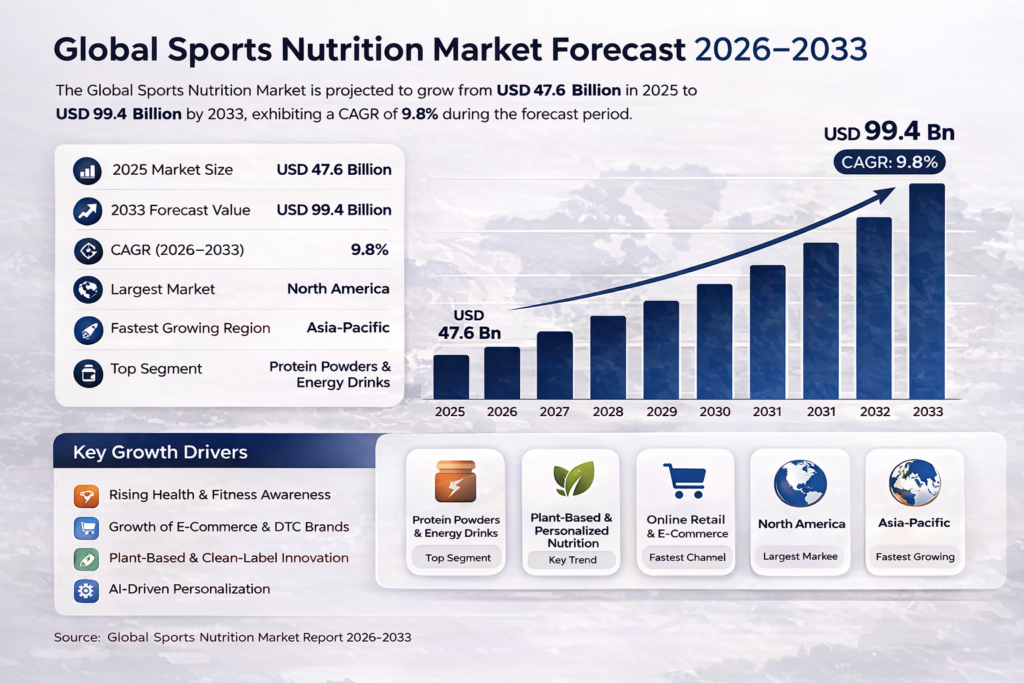
Global Sports Nutrition Market Forecast Snapshot: 2026–2033
| Metric | Value |
|---|---|
| 2025 Market Size | USD 47.6 Billion |
| 2033 Market Size | USD 99.4 Billion |
| CAGR (2026–2033) | 9.8% |
| Largest Market | North America |
| Fastest Growing Region | Asia-Pacific |
| Top Segment | Protein Powders & Energy Drinks |
| Key Trend | Plant-Based & Personalized Nutrition |
| Future Focus | AI-Driven Customization & Clean-Label Innovation |
Global Sports Nutrition Market Overview (2026–2033)
The Global Sports Nutrition Market is entering a high-growth phase during the 2026–2033 forecast period, driven by increasing health consciousness, expanding fitness participation, and rising demand for performance-enhancing nutrition products. The market is evolving from a niche athletic segment into a mainstream wellness category, catering to athletes, fitness enthusiasts, and lifestyle consumers.
According to Pheonix Research, the market is projected to grow from USD 47.6 billion in 2025 to USD 99.4 billion by 2033, supported by strong demand for protein supplements, energy drinks, recovery products, and functional nutrition solutions.
Consumers are increasingly adopting sports nutrition products to improve endurance, muscle recovery, strength, and overall well-being. The expansion of fitness centers, digital workout platforms, and personalized nutrition programs is further accelerating product adoption across global markets.
Additionally, the growing demand for plant-based formulations, clean-label ingredients, and sustainable nutrition products is reshaping product innovation. Manufacturers are focusing on transparency, ingredient quality, and functional benefits to meet evolving consumer expectations.
Regionally, North America remains the largest market due to strong fitness culture, advanced product innovation, and high consumer awareness. Meanwhile, Asia-Pacific is the fastest-growing region, driven by urbanization, rising disposable income, and increasing participation in fitness and sports activities.
Key Drivers of Global Sports Nutrition Market Growth
Rising Health Awareness and Fitness Participation
Increasing consumer focus on health, fitness, and active lifestyles is driving demand for sports nutrition products across multiple demographics.
Expansion of E-Commerce and Direct-to-Consumer Channels
Online platforms and brand-owned digital channels are improving accessibility, enabling consumers to conveniently purchase sports nutrition products.
Innovation in Functional Ingredients and Formulations
The introduction of BCAAs, plant proteins, probiotics, and functional blends is enhancing product effectiveness and consumer appeal.
Growing Adoption of Plant-Based and Clean-Label Products
Consumers are increasingly choosing plant-based, non-GMO, and allergen-free products, driving demand for clean-label sports nutrition solutions.
Influence of Digital Fitness and Social Media
Fitness influencers, mobile apps, and online training programs are increasing product awareness and accelerating adoption globally.
Expansion of Female and Lifestyle Consumer Segments
Sports nutrition is expanding beyond athletes to include women and general wellness consumers seeking daily nutrition support.
Global Sports Nutrition Market Segmentation
-
By Product Type
1.1 Protein Powders
1.1.1 Whey Protein
1.1.1.1 Concentrate
1.1.1.1.1 Isolate & Hydrolyzed
1.1.2 Plant-Based Protein
1.1.2.1 Pea & Soy Protein
1.1.2.1.1 Multi-Plant Blends
1.2 Energy Drinks
1.2.1 Performance Drinks
1.2.1.1 Caffeinated Beverages
1.2.1.1.1 Functional Energy Drinks
1.3 Nutrition Bars
1.3.1 Protein Bars
1.3.1.1 Meal Replacement Bars
1.3.1.1.1 Functional Snack Bars
1.4 Amino Acids & BCAAs
1.4.1 Recovery Supplements
1.4.1.1 Muscle Repair Formulations
1.4.1.1.1 Performance Boosters
1.5 Pre-Workout & Post-Workout Supplements
1.5.1 Energy Boosters
1.5.1.1 Recovery Formulas
1.5.1.1.1 Hydration & Endurance Products
1.6 Electrolyte & Hydration Products
1.6.1 Hydration Mixes
1.6.1.1 Electrolyte Drinks
1.6.1.1.1 Sports Hydration Solutions
-
By Distribution Channel
2.1 Online Retail
2.1.1 E-Commerce Platforms
2.1.1.1 Brand Websites
2.1.1.1.1 Subscription-Based Models
2.2 Supermarkets & Hypermarkets
2.2.1 Health Nutrition Sections
2.2.1.1 Packaged Sports Nutrition Products
2.2.1.1.1 Premium Product Lines
2.3 Specialty Stores
2.3.1 Fitness & Nutrition Stores
2.3.1.1 Sports Supplement Retailers
2.3.1.1.1 Gym-Based Retail
2.4 Pharmacies & Drugstores
2.4.1 Clinical Nutrition Products
2.4.1.1 Functional Supplements
2.4.1.1.1 Medical Nutrition
-
By End User
3.1 Athletes & Bodybuilders
3.1.1 Professional Athletes
3.1.1.1 Competitive Sports Nutrition
3.1.1.1.1 Performance Enhancement Products
3.2 Fitness Enthusiasts
3.2.1 Gym Users
3.2.1.1 Daily Nutrition Products
3.2.1.1.1 Lifestyle Fitness Consumers
3.3 Recreational Users
3.3.1 Casual Fitness Participants
3.3.1.1 Wellness Consumers
3.3.1.1.1 Preventive Nutrition Users
3.4 Lifestyle Consumers
3.4.1 Health-Conscious Individuals
3.4.1.1 Weight Management Users
3.4.1.1.1 General Wellness Consumers
Global Sports Nutrition Market Regional Insights
North America – Largest Market
North America dominates the market due to high fitness awareness, strong supplement consumption, and advanced retail and e-commerce infrastructure.
Asia-Pacific – Fastest Growing Region
Asia-Pacific is witnessing rapid growth driven by increasing urbanization, expanding fitness culture, and rising disposable incomes across China, India, and Southeast Asia.
Europe
Europe is experiencing steady growth with rising demand for clean-label, plant-based, and functional sports nutrition products.
Latin America
Growing fitness awareness and increasing participation in sports activities are supporting market expansion in Brazil and Mexico.
Middle East & Africa
Rising gym culture and health awareness are creating new growth opportunities across GCC countries and South Africa.
Leading Companies in the Global Sports Nutrition Market
The Coca-Cola Company
Clif Bar & Company
MusclePharm Corporation
Iovate Health Sciences International Inc.
Quest Nutrition LLC
Post Holdings, Inc.
Ultimate Nutrition Inc.
These companies focus on product innovation, plant-based formulations, digital marketing strategies, and global expansion to strengthen their market position. Glanbia plc is the leading company in the Global Sports Nutrition Market.
Strategic Intelligence & Market Insights
Pheonix Demand Forecast Engine
Identifies rising fitness participation, plant-based nutrition demand, and personalized health solutions as key growth drivers.
Consumer Behavior Analyzer
Highlights increasing preference for clean-label, functional, and performance-enhancing products.
Innovation Tracker
Tracks advancements in AI-driven nutrition personalization, functional ingredients, and product diversification.
Porter’s Five Forces Analysis
Indicates high competition, moderate supplier power, and strong opportunities for product differentiation through innovation.
Why the Global Sports Nutrition Market Remains Critical
Supports global health and fitness trends
Enhances athletic performance and recovery
Expands preventive healthcare through nutrition
Drives innovation in functional and clean-label products
Integrates technology with personalized nutrition solutions
Final Takeaway of Global Sports Nutrition Market
The Global Sports Nutrition Market is rapidly evolving into a mainstream health and wellness ecosystem, driven by fitness awareness, product innovation, and digital transformation.
The Global Sports Nutrition Market CAGR 2026–2033 of 9.8% reflects strong growth supported by plant-based nutrition trends, personalized health solutions, and expanding consumer adoption across multiple demographics.
Companies that focus on clean-label transparency, functional ingredient innovation, digital engagement, and personalized nutrition platforms will be well positioned to capture long-term growth opportunities.
At Pheonix Research, our advanced forecasting models and AI-driven market intelligence tools provide actionable insights into consumer behavior, product innovation, and regional demand dynamics—enabling stakeholders to stay ahead in the rapidly evolving global sports nutrition market.
📢 Social Mentions & Publication Channels
Explore deeper insights and follow our cross-platform updates on LinkedIn and X for continuous intelligence and market coverage.
LinkedIn : https://www.linkedin.com/in/pheonix-research-media/
X : https://x.com/Pheonix_Insight
Table of Contents
Table of Contents
1. Executive Summary
1.1 Market Forecast Snapshot (2026–2033)
The Global Sports Nutrition Market is projected to grow from USD 47.6 Billion in 2025 to USD 99.4 Billion by 2033, registering a CAGR of 9.8% during 2026–2033.
1.2 Global Market Size & CAGR Analysis
The market reflects strong expansion driven by rising fitness awareness, increasing adoption of performance nutrition products, and growing demand for plant-based and functional supplements.
1.3 Largest & Fastest-Growing Segments
Largest Segment: Protein Powders & Energy Drinks
Fastest-Growing Segment: Plant-Based Sports Nutrition Products
1.4 Region-Level Leadership & Growth Trends
North America currently leads the market due to strong fitness culture and supplement consumption, while Asia-Pacific is projected to be the fastest-growing region through 2033.
1.5 Key Market Drivers
Rising health awareness and increasing participation in fitness activities
Expansion of e-commerce and direct-to-consumer nutrition brands
Growing demand for plant-based and clean-label products
Innovation in functional ingredients and performance supplements
Influence of digital fitness platforms and social media
1.6 Competitive Landscape Overview
Highly competitive market with global and regional players focusing on product innovation, plant-based formulations, and digital marketing strategies.
1.7 Strategic Outlook Through 2033
Focus on personalized nutrition, AI-driven product development, plant-based expansion, and omnichannel distribution strategies.
2. Introduction & Market Overview
2.1 Definition of the Global Sports Nutrition Market
Covers protein powders, energy drinks, nutrition bars, amino acids, hydration products, and performance supplements used for fitness, recovery, and overall wellness.
2.2 Scope of the Study
Comprehensive analysis of market size, product segments, distribution channels, consumer groups, and global forecasts for 2026–2033.
2.3 Evolution from Athlete-Focused to Mainstream Nutrition
The market has evolved from serving professional athletes to catering to fitness enthusiasts and general wellness consumers.
2.4 Role of Retail Expansion & Supply Chain Optimization
Growth of supermarkets, specialty stores, and online platforms is improving accessibility of sports nutrition products.
2.5 Impact of Health & Wellness Trends
Increasing awareness of fitness, muscle recovery, and preventive healthcare is driving product adoption.
2.6 Integration of Sustainable & Clean-Label Practices
Manufacturers are adopting natural ingredients, transparent labeling, and sustainable sourcing methods.
2.7 AI-Driven Personalized Nutrition & Product Innovation
AI and data analytics are enabling customized nutrition solutions and advanced product formulations.
3. Research Methodology
3.1 Primary Research
Interviews with nutrition brands, fitness experts, distributors, and healthcare professionals.
3.2 Secondary Research
Industry reports, company filings, trade data, and health & fitness databases.
3.3 Market Size Estimation Model
Combination of top-down revenue analysis and bottom-up consumption modeling.
3.4 Forecast Assumptions (2026–2033)
Based on fitness participation trends, product innovation, and digital retail expansion.
3.5 Data Validation & Triangulation
Cross-verification using industry benchmarks, regional consumption data, and supply chain analysis.
4. Market Dynamics
4.1 Drivers
4.1.1 Rising Health Awareness and Fitness Participation
Growing consumer focus on fitness and wellness is boosting demand.
4.1.2 Expansion of E-Commerce and Direct-to-Consumer Channels
Online platforms are increasing product accessibility and sales.
4.1.3 Innovation in Functional Ingredients and Formulations
Advanced ingredients such as plant proteins and amino acids are enhancing product value.
4.1.4 Growing Demand for Plant-Based and Clean-Label Products
Consumers prefer natural and allergen-free products.
4.1.5 Influence of Digital Fitness and Social Media
Fitness influencers and apps are increasing product awareness.
4.2 Restraints
4.2.1 High cost of premium nutrition products
4.2.2 Regulatory challenges in supplement labeling
4.2.3 Consumer skepticism regarding product claims
4.2.4 Supply chain challenges for raw materials
4.3 Opportunities
4.3.1 Expansion of plant-based nutrition products
4.3.2 Growth in personalized nutrition solutions
4.3.3 Development of functional beverages and RTD products
4.3.4 Increasing demand in emerging markets
4.4 Challenges
4.4.1 Maintaining product quality and authenticity
4.4.2 High competition among global and local brands
4.4.3 Price sensitivity in developing markets
4.4.4 Managing complex distribution networks
5. Global Sports Nutrition Market Analysis (USD Billion), 2026–2033
5.1 Market Size Overview
5.2 CAGR Analysis
5.3 Region-Wise Revenue Distribution
5.4 Product Type Revenue Split
5.5 Distribution Channel Trends
5.6 Consumer Segment Impact Analysis
6. Market Segmentation by Product Type (USD Billion), 2026–2033
6.1 Protein Powders
6.1.1 Whey Protein
6.1.1.1 Concentrate
6.1.1.1.1 Isolate & Hydrolyzed
6.1.2 Plant-Based Protein
6.1.2.1 Pea & Soy Protein
6.1.2.1.1 Multi-Plant Blends
6.2 Energy Drinks
6.2.1 Performance Drinks
6.2.1.1 Functional Beverages
6.2.1.1.1 Fortified Energy Drinks
6.3 Nutrition Bars
6.3.1 Protein Bars
6.3.1.1 Meal Replacement Bars
6.3.1.1.1 Functional Snack Bars
6.4 Amino Acids & BCAAs
6.4.1 Recovery Supplements
6.4.1.1 Muscle Repair Products
6.4.1.1.1 Performance Boosters
7. Market Segmentation by Distribution Channel (USD Billion), 2026–2033
7.1 Supermarkets & Hypermarkets
7.1.1 Health Nutrition Sections
7.1.1.1 Functional Food Shelves
7.1.1.1.1 Premium Products
7.2 Online Retail
7.2.1 E-commerce Platforms
7.2.1.1 Brand Websites
7.2.1.1.1 Subscription Models
7.3 Specialty Stores
7.3.1 Fitness & Nutrition Stores
7.3.1.1 Sports Supplement Retailers
7.3.1.1.1 Gym-Based Retail
7.4 Pharmacies
7.4.1 Clinical Nutrition Products
7.4.1.1 Functional Supplements
7.4.1.1.1 Medical Nutrition
8. Market Segmentation by End User (USD Billion), 2026–2033
8.1 Athletes & Bodybuilders
8.1.1 Professional Athletes
8.1.1.1 Competitive Nutrition
8.1.1.1.1 Performance Products
8.2 Fitness Enthusiasts
8.2.1 Gym Users
8.2.1.1 Daily Nutrition
8.2.1.1.1 Lifestyle Consumers
8.3 Recreational Users
8.3.1 Casual Fitness Consumers
8.3.1.1 Wellness Products
8.3.1.1.1 Preventive Nutrition
8.4 Lifestyle Consumers
8.4.1 Health-Conscious Individuals
8.4.1.1 Weight Management
8.4.1.1.1 General Wellness
9. Market Segmentation by Geography
9.1 North America – Largest Market
9.2 Asia-Pacific – Fastest Growing Region
9.3 Europe
9.4 Latin America
9.5 Middle East & Africa
10. Competitive Landscape – Global
10.1 Market Share Analysis
10.2 Product Portfolio Benchmarking
10.3 Plant-Based vs Animal-Based Product Mapping
10.4 Distribution & Retail Partnerships
10.5 Competitive Intensity & Differentiation Strategies
11. Company Profiles
11.1 Glanbia plc
11.2 Abbott Laboratories
11.3 PepsiCo, Inc.
11.4 The Coca-Cola Company
11.5 Clif Bar & Company
11.6 MusclePharm Corporation
11.7 Iovate Health Sciences
11.8 Quest Nutrition LLC
11.9 Post Holdings, Inc.
11.10 Ultimate Nutrition Inc.
12. Strategic Intelligence & Pheonix AI-Backed Insights
12.1 Pheonix Demand Forecast Engine
12.2 Consumer Behavior Analyzer
12.3 AI-Driven Nutrition Innovation Tracker
12.4 Product Innovation Insights
12.5 Automated Porter’s Five Forces Analysis
13. Future Outlook & Strategic Recommendations
13.1 Expansion of plant-based nutrition
13.2 Growth of personalized nutrition solutions
13.3 Development of functional beverages
13.4 Expansion of e-commerce distribution
13.5 Long-Term Market Outlook (2033+)
14. Appendix
15. About Pheonix Research
16. Disclaimer