
Global Generic Drug Market Report, Size & Forecast 2026-2033
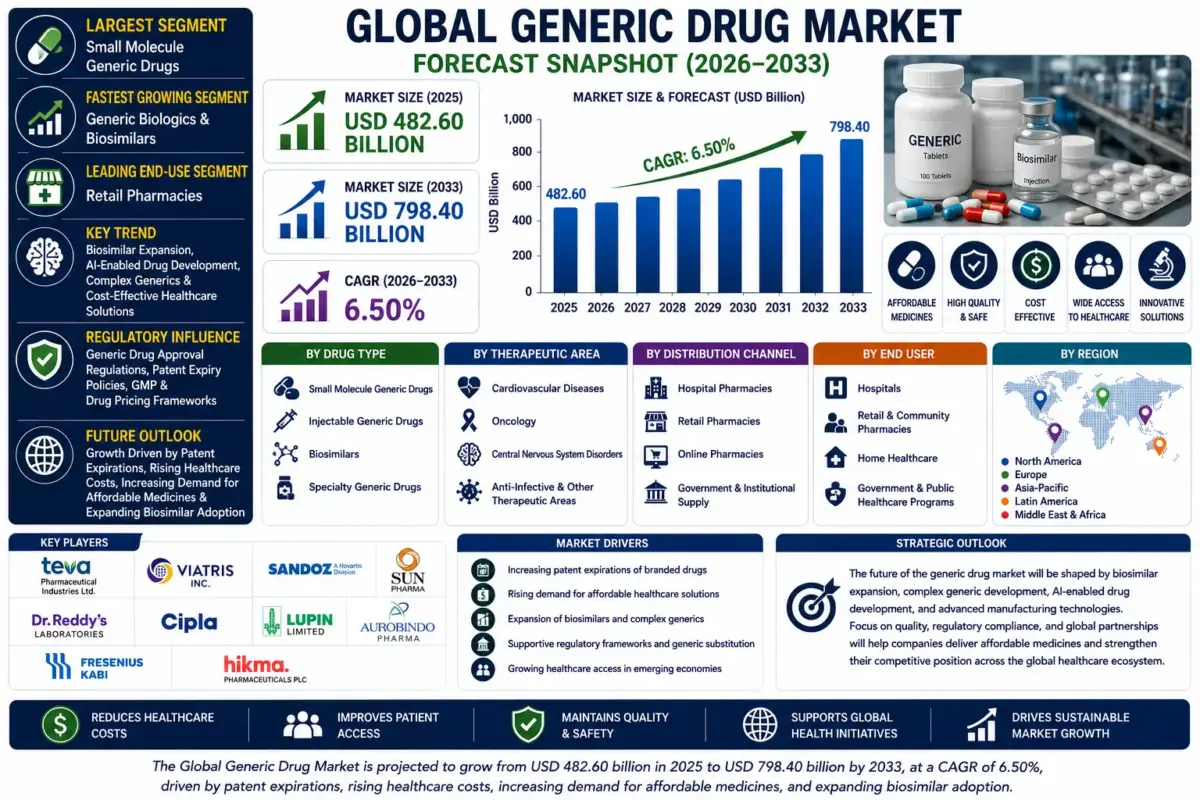
Global Generic Drug Market Forecast Snapshot (2026???2033)
| Metric | Value |
|---|---|
| Market Size (2025) | ?? ?? ?? ?? ?? ?? ?? ?? ?? ?? ?? ?? ?? ?? ?? ?? ?? ?? ?? ?? ?? ?? ?? ?? ?? ?? ?? ?? ?? ?? ?? ?? ?? ?? ?? ?? ?? ?? ?? ?? ?? ?? ?? ?? ?? ?? ?? ?? ?? ?? ?? ?? ??USD 482.60 Billion |
| Market Size (2033) | ?? ?? ?? ?? ?? ?? ?? ?? ?? ?? ?? ?? ?? ?? ?? ?? ?? ?? ?? ?? ?? ?? ?? ?? ?? ?? ?? ?? ?? ?? ?? ?? ?? ?? ?? ?? ?? ?? ?? ?? ?? ?? ?? ?? ?? ?? ?? ?? ?? ?? ?? ?? USD 798.40 Billion |
| CAGR (2026???2033) | ?? ?? ?? ?? ?? ?? ?? ?? ?? ?? ?? ?? ?? ?? ?? ?? ?? ?? ?? ?? ?? ?? ?? ?? ?? ?? ?? ?? ?? ?? ?? ?? ?? ?? ?? ?? ?? ?? ?? ?? ?? ?? ?? ?? ?? ?? ?? ?? ?? ?? ?? ?? ?? ?? ?? ?? ?? ?? ?? 6.50% |
| Largest Segment | ?? ?? ?? ?? ?? ?? ?? ?? ?? ?? ?? ?? ?? ?? ?? ?? ?? ?? ?? ?? ?? ?? ?? ?? ?? ?? ?? ?? ?? ?? ?? ?? ?? ?? ?? ?? ?? ?? ?? ?? ?? ?? ?? ?? ?? ?? ?? Small Molecule Generic Drugs |
| Fastest Growing Segment | ?? ?? ?? ?? ?? ?? ?? ?? ?? ?? ?? ?? ?? ?? ?? ?? ?? ?? ?? ?? ?? ?? ?? ?? ?? ?? ?? ?? ?? ?? ?? ?? ?? ?? ?? ?? ?? ?? ?? ?? ?? ?? ?? ?? ?? ?? Generic Biologics & Biosimilars |
| Leading End-Use Segment | ?? ?? ?? ?? ?? ?? ?? ?? ?? ?? ?? ?? ?? ?? ?? ?? ?? ?? ?? ?? ?? ?? ?? ?? ?? ?? ?? ?? ?? ?? ?? ?? ?? ?? ?? ?? ?? ?? ?? ?? ?? ?? ?? ?? ?? ?? ?? ?? ?? ?? ?? Retail Pharmacies |
| Key Trend | ?? ?? ?? ?? ?? ?? ?? ?? ?? ?? ?? Biosimilar Expansion, AI-Enabled Drug Development, Complex Generics & Cost-Effective Healthcare Solutions |
| Regulatory Influence | ?? ?? ?? ?? ?? Generic Drug Approval Regulations, Patent Expiry Policies, Good Manufacturing Practices (GMP) & Drug Pricing Frameworks |
| Future Outlook | Growth Driven by Patent Expirations, Rising Healthcare Costs, Increasing Demand for Affordable Medicines & Expanding Biosimilar Adoption |
Global Generic Drug Market Size & Forecast
The Global Generic Drug Market is expected to witness steady growth during the forecast period from 2026 to 2033. The market was valued at USD 482.60 billion in 2025 and is projected to reach approximately USD 798.40 billion by 2033, registering a CAGR of 6.50%. Market growth is primarily driven by increasing patent expirations of branded drugs, rising healthcare expenditure, growing demand for affordable treatment options, supportive regulatory frameworks promoting generic substitution, and expanding access to healthcare across emerging economies.Global Generic Drug Market Overview
Generic drugs are pharmaceutical products that contain the same active ingredients, dosage form, strength, route of administration, quality, safety, and efficacy as branded reference medicines after patent expiration. The market includes small molecule generics, biosimilars, complex generics, and value-added generic formulations. Generic medicines are widely utilized across hospitals, retail pharmacies, online pharmacies, and healthcare institutions to improve treatment accessibility while reducing overall healthcare costs.Structural Drivers of Market Growth
1. Increasing Patent Expirations of Branded Drugs
A growing number of blockbuster pharmaceutical products are losing patent protection, creating significant opportunities for generic manufacturers. Market Implications: Pharmaceutical companies are expanding generic product portfolios to capitalize on patent expiry opportunities.2. Rising Demand for Affordable Healthcare
Governments, healthcare providers, and patients are increasingly adopting generic medicines to reduce healthcare expenditures without compromising therapeutic outcomes. Market Implications: Generic drug utilization continues to increase across both developed and emerging healthcare systems.3. Expansion of Biosimilars and Complex Generics
Technological advancements and regulatory support are accelerating the commercialization of biosimilars and complex generic formulations. Market Implications: High-value biologic alternatives are creating new revenue opportunities for manufacturers.4. Supportive Regulatory Frameworks
Governments and regulatory authorities are promoting generic drug approvals, substitution policies, and healthcare cost containment initiatives. Market Implications: Faster approval pathways and favorable reimbursement policies are supporting market expansion.Global Generic Drug Market Segmentation
??????????????1. By Drug Type
1.1 Small Molecule Generic Drugs
1.1.1 Oral Solid Dosage Forms 1.1.1.1 Tablets 1.1.1.1.1 Immediate Release Tablets 1.1.1.1.2 Extended Release Tablets 1.1.1.1.3 Chewable Tablets 1.1.1.1.4 Dispersible Tablets 1.1.2 Capsules 1.1.3 Oral Liquids 1.1.4 Topical Formulations1.2 Injectable Generic Drugs
1.2.1 Intravenous Injections 1.2.2 Intramuscular Injections 1.2.3 Subcutaneous Injections 1.2.4 Prefilled Syringes1.3 Biosimilars
1.3.1 Monoclonal Antibodies 1.3.2 Recombinant Proteins 1.3.3 Growth Factors 1.3.4 Insulin Biosimilars1.4 Specialty Generic Drugs
1.4.1 Oncology Generics 1.4.2 Hormonal Therapies 1.4.3 Controlled Substances 1.4.4 Complex Generic Formulations??????????????2. By Therapeutic Area
2.1 Cardiovascular Diseases
2.1.1 Hypertension Drugs 2.1.1.1 Antihypertensive Agents 2.1.1.1.1 ACE Inhibitors 2.1.1.1.2 Beta Blockers 2.1.1.1.3 Calcium Channel Blockers 2.1.1.1.4 Diuretics 2.1.2 Lipid-Lowering Drugs 2.1.3 Anticoagulants 2.1.4 Antiarrhythmic Drugs2.2 Oncology
2.2.1 Chemotherapy Drugs 2.2.2 Hormonal Therapies 2.2.3 Targeted Therapy Generics 2.2.4 Supportive Care Drugs2.3 Central Nervous System Disorders
2.3.1 Antidepressants 2.3.2 Antiepileptic Drugs 2.3.3 Antipsychotic Drugs 2.3.4 Analgesics2.4 Anti-Infective & Other Therapeutic Areas
2.4.1 Antibiotics 2.4.2 Antiviral Drugs 2.4.3 Antidiabetic Drugs 2.4.4 Respiratory Drugs??????????????3. By Distribution Channel
3.1 Hospital Pharmacies
3.1.1 Public Hospitals 3.1.1.1 Inpatient Pharmacy Services 3.1.1.1.1 Emergency Drug Supply 3.1.1.1.2 Critical Care Medicines 3.1.1.1.3 Surgical Care Medicines 3.1.1.1.4 Oncology Pharmacy Services 3.1.2 Private Hospitals 3.1.3 Specialty Hospitals 3.1.4 Teaching Hospitals3.2 Retail Pharmacies
3.2.1 Chain Pharmacies 3.2.2 Independent Pharmacies 3.2.3 Discount Pharmacies 3.2.4 Community Pharmacies3.3 Online Pharmacies
3.3.1 E-Pharmacy Platforms 3.3.2 Direct-to-Consumer Websites 3.3.3 Mobile Pharmacy Applications 3.3.4 Subscription-Based Medicine Services3.4 Government & Institutional Supply
3.4.1 Public Health Programs 3.4.2 Government Procurement Agencies 3.4.3 Military Healthcare Facilities 3.4.4 Non-Governmental Organizations (NGOs)??????????????4. By End User
4.1 Hospitals
4.1.1 General Hospitals 4.1.1.1 Acute Care Hospitals 4.1.1.1.1 Public Healthcare Facilities 4.1.1.1.2 Private Healthcare Facilities 4.1.1.1.3 Specialty Care Centers 4.1.1.1.4 Multi-Specialty Hospitals 4.1.2 Specialty Clinics 4.1.3 Ambulatory Surgical Centers 4.1.4 Emergency Care Centers4.2 Retail & Community Pharmacies
4.2.1 Urban Pharmacies 4.2.2 Rural Pharmacies 4.2.3 Franchise Pharmacy Chains 4.2.4 Independent Drug Stores4.3 Home Healthcare
4.3.1 Chronic Disease Management 4.3.2 Elderly Care 4.3.3 Home Infusion Therapy 4.3.4 Long-Term Medication Management4.4 Government & Public Healthcare Programs
4.4.1 National Healthcare Systems 4.4.2 Public Insurance Programs 4.4.3 Humanitarian Healthcare Initiatives 4.4.4 Disease Control Programs??????????????5. By Region
5.1 North America 5.2 Europe 5.3 Asia-Pacific 5.4 Latin America 5.5 Middle East & AfricaRegional Market Dynamics
North America
Leading region supported by extensive generic drug utilization, strong regulatory pathways, increasing biosimilar approvals, and healthcare cost optimization initiatives.Europe
Driven by universal healthcare systems, favorable generic substitution policies, expanding biosimilar adoption, and strong pharmaceutical manufacturing capabilities.Asia-Pacific
Fastest-growing region supported by expanding pharmaceutical production, rising healthcare access, increasing chronic disease burden, and strong government support for affordable medicines.Latin America
Growing market driven by increasing healthcare investments, generic medicine adoption, and expanding pharmaceutical distribution networks.Middle East & Africa
Emerging market supported by improving healthcare infrastructure, government procurement programs, and increasing demand for cost-effective pharmaceutical products.Competitive Landscape
The Global Generic Drug Market is highly competitive with multinational pharmaceutical companies, generic drug manufacturers, biosimilar developers, and contract manufacturing organizations focusing on product portfolio expansion, regulatory approvals, biosimilar development, and manufacturing efficiency. Key Companies Operating in the Market Include:- Teva Pharmaceutical Industries Ltd.
- Viatris Inc.
- Sandoz Group AG
- Sun Pharmaceutical Industries Ltd.
- Dr. Reddy's Laboratories Ltd.
- Cipla Limited
- Lupin Limited
- Aurobindo Pharma Limited
- Fresenius Kabi AG
- Hikma Pharmaceuticals PLC
Strategic Outlook
The future of the generic drug market will be driven by biosimilar expansion, complex generic development, digital manufacturing technologies, artificial intelligence-assisted drug development, and advanced pharmaceutical production capabilities. Pharmaceutical companies are increasingly investing in biosimilar pipelines, high-value specialty generics, continuous manufacturing technologies, and global regulatory compliance to strengthen market competitiveness. Growing emphasis on affordable healthcare, pharmaceutical supply chain resilience, personalized medicine support, and expanded access to essential medicines will continue creating significant growth opportunities. Companies focusing on manufacturing excellence, regulatory expertise, innovation in complex generics, and strategic global expansion will strengthen their competitive position across the global pharmaceutical industry.Final Market Perspective
The Global Generic Drug Market remains a cornerstone of affordable healthcare delivery worldwide. Rising demand for cost-effective medicines, increasing patent expirations, supportive government initiatives, expanding biosimilar adoption, and continuous pharmaceutical innovation are expected to sustain market growth throughout the forecast period. Organizations delivering high-quality, compliant, and affordable generic pharmaceutical products will be well-positioned to capitalize on long-term opportunities across the global healthcare ecosystem.Table of Contents
1. Executive Summary
1.1 Market Snapshot (2026???2033)
1.2 Key Growth Highlights
1.3 Demand-Supply Overview
1.4 Key Strategic Insights
1.5 Analyst Viewpoint
2. Market Overview
2.1 Introduction to Global Generic Drug Market
2.2 Industry Value Chain Analysis
2.3 Market Evolution & Historical Trends
2.4 Macro-Economic Impact Analysis
2.5 Affordable Healthcare & Generic Pharmaceutical Industry Transformation
2.6 Biosimilar Expansion, AI-Enabled Drug Development, Complex Generics & Cost-Effective Healthcare Solutions
3. Global Generic Drug Market Forecast Snapshot (USD Billion), 2026???2033
3.1 2025 Market Size
3.2 2033 Market Size
3.3 CAGR (2026???2033)
3.4 Largest Region
3.5 Fastest Growing Region
3.6 Largest Segment
3.7 Key Trend
3.8 Future Outlook
4. Key Drivers of Market Growth
4.1 Increasing Patent Expirations of Branded Drugs
4.2 Rising Demand for Affordable Healthcare
4.3 Expansion of Biosimilars and Complex Generics
4.4 Supportive Regulatory Frameworks
4.5 Increasing Adoption of AI-Enabled Drug Development & Advanced Pharmaceutical Manufacturing
5. Market Challenges
5.1 Pricing Pressure & Intense Market Competition
5.2 Stringent Regulatory Compliance & Approval Requirements
5.3 Supply Chain Disruptions & API Availability
5.4 Manufacturing Quality & Good Manufacturing Practices (GMP) Compliance
6. Market Segmentation by Drug Type (USD Billion), 2026???2033
6.1 Small Molecule Generic Drugs
6.1.1 Oral Solid Dosage Forms
6.1.1.1 Tablets
6.1.1.1.1 Immediate Release Tablets
6.1.1.1.2 Extended Release Tablets
6.1.1.1.3 Chewable Tablets
6.1.1.1.4 Dispersible Tablets
6.1.2 Capsules
6.1.3 Oral Liquids
6.1.4 Topical Formulations
6.2 Injectable Generic Drugs
6.2.1 Intravenous Injections
6.2.2 Intramuscular Injections
6.2.3 Subcutaneous Injections
6.2.4 Prefilled Syringes
6.3 Biosimilars
6.3.1 Monoclonal Antibodies
6.3.2 Recombinant Proteins
6.3.3 Growth Factors
6.3.4 Insulin Biosimilars
6.4 Specialty Generic Drugs
6.4.1 Oncology Generics
6.4.2 Hormonal Therapies
6.4.3 Controlled Substances
6.4.4 Complex Generic Formulations
7. Market Segmentation by Therapeutic Area (USD Billion), 2026???2033
7.1 Cardiovascular Diseases
7.1.1 Hypertension Drugs
7.1.1.1 Antihypertensive Agents
7.1.1.1.1 ACE Inhibitors
7.1.1.1.2 Beta Blockers
7.1.1.1.3 Calcium Channel Blockers
7.1.1.1.4 Diuretics
7.1.2 Lipid-Lowering Drugs
7.1.3 Anticoagulants
7.1.4 Antiarrhythmic Drugs
7.2 Oncology
7.2.1 Chemotherapy Drugs
7.2.2 Hormonal Therapies
7.2.3 Targeted Therapy Generics
7.2.4 Supportive Care Drugs
7.3 Central Nervous System Disorders
7.3.1 Antidepressants
7.3.2 Antiepileptic Drugs
7.3.3 Antipsychotic Drugs
7.3.4 Analgesics
7.4 Anti-Infective & Other Therapeutic Areas
7.4.1 Antibiotics
7.4.2 Antiviral Drugs
7.4.3 Antidiabetic Drugs
7.4.4 Respiratory Drugs
8. Market Segmentation by Distribution Channel (USD Billion), 2026???2033
8.1 Hospital Pharmacies
8.1.1 Public Hospitals
8.1.1.1 Inpatient Pharmacy Services
8.1.1.1.1 Emergency Drug Supply
8.1.1.1.2 Critical Care Medicines
8.1.1.1.3 Surgical Care Medicines
8.1.1.1.4 Oncology Pharmacy Services
8.1.2 Private Hospitals
8.1.3 Specialty Hospitals
8.1.4 Teaching Hospitals
8.2 Retail Pharmacies
8.2.1 Chain Pharmacies
8.2.2 Independent Pharmacies
8.2.3 Discount Pharmacies
8.2.4 Community Pharmacies
8.3 Online Pharmacies
8.3.1 E-Pharmacy Platforms
8.3.2 Direct-to-Consumer Websites
8.3.3 Mobile Pharmacy Applications
8.3.4 Subscription-Based Medicine Services
8.4 Government & Institutional Supply
8.4.1 Public Health Programs
8.4.2 Government Procurement Agencies
8.4.3 Military Healthcare Facilities
8.4.4 Non-Governmental Organizations (NGOs)
9. Market Segmentation by End User (USD Billion), 2026???2033
9.1 Hospitals
9.1.1 General Hospitals
9.1.1.1 Acute Care Hospitals
9.1.1.1.1 Public Healthcare Facilities
9.1.1.1.2 Private Healthcare Facilities
9.1.1.1.3 Specialty Care Centers
9.1.1.1.4 Multi-Specialty Hospitals
9.1.2 Specialty Clinics
9.1.3 Ambulatory Surgical Centers
9.1.4 Emergency Care Centers
9.2 Retail & Community Pharmacies
9.2.1 Urban Pharmacies
9.2.2 Rural Pharmacies
9.2.3 Franchise Pharmacy Chains
9.2.4 Independent Drug Stores
9.3 Home Healthcare
9.3.1 Chronic Disease Management
9.3.2 Elderly Care
9.3.3 Home Infusion Therapy
9.3.4 Long-Term Medication Management
9.4 Government & Public Healthcare Programs
9.4.1 National Healthcare Systems
9.4.2 Public Insurance Programs
9.4.3 Humanitarian Healthcare Initiatives
9.4.4 Disease Control Programs
10. Market Segmentation by Region (USD Billion), 2026???2033
10.1 North America
10.2 Europe
10.3 Asia-Pacific
10.4 Latin America
10.5 Middle East & Africa
11. Regional Market Analysis
11.1 North America ??? Market Leader
11.2 Asia-Pacific ??? Fastest Growing Region
11.3 Europe ??? Biosimilar Adoption & Generic Substitution Market
11.4 Latin America ??? Expanding Affordable Healthcare & Pharmaceutical Distribution
11.5 Middle East & Africa ??? Emerging Generic Medicines Market
12. Competitive Landscape
12.1 Market Share Analysis
12.2 Competitive Positioning Matrix
12.3 Strategic Developments (M&A, Product Launches, Partnerships)
12.4 Innovation Benchmarking
12.5 Biosimilars, AI-Enabled Drug Development & Pharmaceutical Manufacturing Assessment
13. Company Profiles
13.1 Teva Pharmaceutical Industries Ltd.
13.2 Viatris Inc.
13.3 Sandoz Group AG
13.4 Sun Pharmaceutical Industries Ltd.
13.5 Dr. Reddy’s Laboratories Ltd.
13.6 Cipla Limited
13.7 Lupin Limited
13.8 Aurobindo Pharma Limited
13.9 Fresenius Kabi AG
13.10 Hikma Pharmaceuticals PLC
14. Strategic Intelligence & AI-Driven Insights
14.1 Pheonix Demand Forecast Engine
14.2 Generic Drug Market Analytics Dashboard
14.3 AI-Powered Drug Development & Biosimilar Intelligence
14.4 Pharmaceutical Manufacturing Optimization Engine
14.5 Generic Drug Supply Chain & Regulatory Intelligence
15. Investment & Growth Opportunities
15.1 Biosimilars & Complex Generic Drug Development
15.2 AI-Enabled Drug Discovery & Manufacturing Technologies
15.3 Continuous Pharmaceutical Manufacturing
15.4 Affordable Healthcare & Emerging Market Expansion
15.5 Global Generic Drug Manufacturing & Regulatory Compliance
16. Why the Global Generic Drug Market Remains Critical
16.1 Increasing Patent Expirations of Branded Drugs
16.2 Rising Demand for Affordable Healthcare
16.3 Expansion of Biosimilars & Complex Generic Medicines
16.4 Supportive Regulatory Frameworks & Generic Drug Adoption
16.5 Long-Term Growth Across Global Pharmaceutical & Healthcare Markets
17. Appendix
18. About Pheonix Research
19. Disclaimer
Competitive Landscape
Global Generic Drug Market Competitive Intensity & Market Structure Overview
The Global Generic Drug Market is highly competitive and characterized by the presence of multinational pharmaceutical companies, generic drug manufacturers, biosimilar developers, contract development and manufacturing organizations (CDMOs), and specialty pharmaceutical companies. Competitive intensity is driven by product portfolio expansion, regulatory approvals, manufacturing efficiency, pricing strategies, biosimilar innovation, supply chain resilience, and global market expansion.
Companies compete across multiple generic drug segments including small molecule generic drugs, injectable generics, biosimilars, specialty generics, complex generic formulations, and value-added pharmaceutical products. Rising patent expirations of branded medicines, increasing demand for affordable healthcare, expanding biosimilar adoption, and supportive government initiatives are intensifying competition while encouraging continuous investment in pharmaceutical innovation and manufacturing capabilities.
The market structure is evolving toward biosimilar expansion, AI-enabled drug development, continuous pharmaceutical manufacturing, digital quality management systems, advanced formulation technologies, and global regulatory harmonization. Market participants are investing heavily in research and development, manufacturing modernization, strategic acquisitions, and international partnerships to strengthen market positioning and improve access to affordable medicines.
Global Generic Drug Market Competitive Intensity & Market Structure Current Scenario
Leading Global Generic Drug Companies
- Teva Pharmaceutical Industries Ltd.: A leading global generic pharmaceutical company offering a broad portfolio of generic medicines, biosimilars, specialty pharmaceuticals, and active pharmaceutical ingredients (APIs).
- Viatris Inc.: A global healthcare company providing generic medicines, biosimilars, complex injectables, branded generics, and specialty pharmaceutical products across international markets.
- Sandoz Group AG: A leading generic and biosimilar manufacturer specializing in high-quality generic pharmaceuticals, biosimilars, injectable medicines, and complex formulations.
- Sun Pharmaceutical Industries Ltd.: A global pharmaceutical company offering generic medicines, specialty pharmaceuticals, dermatology products, oncology therapies, and complex generic formulations.
- Dr. Reddy’s Laboratories Ltd.: A multinational pharmaceutical company providing generic drugs, biosimilars, active pharmaceutical ingredients, and innovative healthcare solutions worldwide.
- Cipla Limited: A global pharmaceutical company specializing in respiratory therapies, anti-infectives, oncology medicines, chronic disease treatments, and affordable generic pharmaceuticals.
- Lupin Limited: A pharmaceutical company focused on generic medicines, biosimilars, specialty pharmaceuticals, respiratory products, and cardiovascular therapies.
- Aurobindo Pharma Limited: A leading generic pharmaceutical manufacturer offering oral solids, injectables, APIs, antibiotics, and specialty pharmaceutical products.
- Fresenius Kabi AG: A global healthcare company delivering injectable generic drugs, biosimilars, infusion therapies, clinical nutrition products, and hospital pharmaceuticals.
- Hikma Pharmaceuticals PLC: A multinational pharmaceutical company providing branded and generic medicines, injectable pharmaceuticals, and specialty healthcare products across global markets.
Key Competitive Intensity & Market Structure Drivers
Increasing patent expirations, rising demand for affordable medicines, and expanding healthcare access are intensifying competition among generic pharmaceutical manufacturers worldwide.
Advancements in biosimilar development, complex generic formulations, artificial intelligence-assisted drug development, and continuous manufacturing technologies are becoming major competitive differentiators across the market.
Growing demand for specialty generics, biologic alternatives, high-quality pharmaceutical manufacturing, and cost-effective treatment solutions is strengthening market competitiveness while improving healthcare accessibility.
Strategic collaborations among pharmaceutical companies, contract manufacturers, research organizations, healthcare providers, and regulatory agencies are accelerating product development, expanding manufacturing capabilities, and strengthening global market access.
Continuous investment in advanced manufacturing technologies, regulatory compliance, digital quality management systems, supply chain optimization, and pharmaceutical innovation is enabling companies to improve operational efficiency and long-term competitiveness.
Strategic Implications of Competitive Intensity & Market Structure
Companies with diversified generic drug portfolios, strong regulatory expertise, advanced manufacturing capabilities, and extensive global distribution networks are expected to maintain significant competitive advantages.
Investment in biosimilars, complex generics, artificial intelligence, digital manufacturing technologies, and continuous process optimization is becoming increasingly important for long-term market leadership.
Organizations focusing on expanding specialty pharmaceutical portfolios, strengthening biosimilar capabilities, improving manufacturing efficiency, and enhancing regulatory compliance are likely to increase revenue growth and market share.
Strategic partnerships with healthcare providers, contract manufacturing organizations, research institutions, government agencies, and pharmaceutical distributors are supporting innovation, operational efficiency, and international market expansion.
Businesses capable of combining pharmaceutical innovation, manufacturing excellence, regulatory compliance, operational scalability, and comprehensive generic drug portfolios will be best positioned to compete effectively in the evolving global generic drug market.
Global Generic Drug Market Competitive Intensity & Market Structure Forward Outlook
The competitive landscape of the global generic drug market is expected to become increasingly technology-driven, biosimilar-focused, and globally integrated as demand for affordable pharmaceutical products continues to expand worldwide.
Future competition will be shaped by AI-assisted drug development, biosimilar innovation, complex generic formulations, digital pharmaceutical manufacturing, advanced quality management systems, and next-generation production technologies.
Market participants are expected to increase investments in pharmaceutical manufacturing infrastructure, biosimilar pipelines, advanced formulation technologies, regulatory compliance systems, and integrated global supply chains to strengthen competitive positioning.
Over the forecast period, companies that successfully combine technological innovation, pharmaceutical expertise, regulatory excellence, operational scalability, and comprehensive generic medicine portfolios will be best positioned to lead the evolving global generic drug market.
Value Chain
Global Generic Drug Market Value Chain & Supply Chain Evolution Overview
The Global Generic Drug Market operates through a highly integrated pharmaceutical value chain comprising active pharmaceutical ingredient (API) sourcing, formulation development, contract manufacturing, quality assurance, regulatory approvals, packaging, distribution, retail pharmacy networks, hospital procurement, and patient access. The ecosystem includes API manufacturers, generic drug manufacturers, biosimilar developers, contract development and manufacturing organizations (CDMOs), regulatory authorities, wholesalers, distributors, healthcare providers, pharmacies, and government procurement agencies collaborating to deliver affordable, high-quality medicines across global healthcare systems.
The industry is being driven by increasing patent expirations of branded medicines, rising demand for affordable healthcare, supportive generic substitution policies, expanding biosimilar adoption, and growing pharmaceutical manufacturing capacity across emerging markets. Pharmaceutical companies are increasingly investing in advanced manufacturing technologies, regulatory compliance, AI-assisted drug development, biosimilar pipelines, and supply chain resilience to improve product availability and operational efficiency.
The integration of artificial intelligence, continuous pharmaceutical manufacturing, digital quality management systems, cloud-based supply chain platforms, automation, predictive analytics, serialization technologies, and real-time inventory monitoring has significantly optimized the generic drug value chain. Organizations are strengthening collaboration between API suppliers, manufacturers, distributors, healthcare providers, and regulatory agencies while expanding resilient pharmaceutical supply networks.
Advancements in biosimilar development, complex generic formulations, continuous manufacturing, AI-driven formulation optimization, digital quality assurance, pharmaceutical serialization, and intelligent supply chain management are transforming industry operations while improving manufacturing efficiency, regulatory compliance, product quality, and medicine accessibility across the global generic pharmaceutical ecosystem.
Global Generic Drug Market Value Chain & Supply Chain Evolution Current Scenario
Market-Specific Value Chain
- API Sourcing & Raw Material Procurement: Procurement of active pharmaceutical ingredients (APIs), excipients, packaging materials, biologic raw materials, specialty chemicals, and pharmaceutical intermediates from qualified global suppliers.
- Drug Development, Manufacturing & Formulation: Generic drug formulation, biosimilar development, process optimization, pharmaceutical manufacturing, sterile production, continuous manufacturing, packaging, labeling, serialization, and product release.
- Quality Assurance & Regulatory Compliance: Good Manufacturing Practices (GMP), product validation, analytical testing, bioequivalence studies, pharmacovigilance, batch certification, regulatory documentation, and compliance with generic drug approval regulations, patent expiry policies, GMP requirements, and drug pricing frameworks.
- Distribution & Pharmaceutical Supply Chain: Pharmaceutical wholesalers, cold chain logistics for biologics, inventory management, warehouse operations, transportation, government procurement, retail distribution, and healthcare supply chain coordination.
- Digital Supply Chain & Commercial Operations: AI-powered demand forecasting, ERP integration, supply chain visibility, inventory optimization, serialization tracking, digital procurement, and pharmaceutical data analytics.
- Sales, Medical Support & Customer Services: Hospital procurement support, retail pharmacy partnerships, government tenders, healthcare provider engagement, medical information services, technical support, and post-market surveillance.
- End User Applications: Supply of generic medicines across hospitals, retail pharmacies, online pharmacies, government healthcare programs, specialty clinics, ambulatory care centers, and home healthcare services.
Company-to-Stage Mapping
- API Sourcing & Raw Material Procurement: API manufacturers, excipient suppliers, specialty chemical companies, biologic raw material suppliers, packaging manufacturers, and pharmaceutical ingredient providers.
- Drug Development, Manufacturing & Formulation: Teva Pharmaceutical Industries Ltd., Viatris Inc., Sandoz Group AG, Sun Pharmaceutical Industries Ltd., Dr. Reddy’s Laboratories Ltd., Cipla Limited, Lupin Limited, Aurobindo Pharma Limited, Fresenius Kabi AG, and Hikma Pharmaceuticals PLC.
- Digital Supply Chain & Commercial Operations: Pharmaceutical ERP providers, AI-based pharmaceutical analytics companies, supply chain software providers, serialization technology companies, warehouse automation providers, and inventory management solution providers.
- Distribution & Pharmaceutical Supply Chain: Pharmaceutical wholesalers, logistics providers, cold chain operators, government procurement agencies, healthcare distributors, retail pharmacy networks, and pharmaceutical supply chain companies.
- Sales, Medical Support & Customer Services: Teva Pharmaceutical Industries Ltd., Viatris Inc., Sandoz Group AG, Sun Pharmaceutical Industries Ltd., Dr. Reddy’s Laboratories Ltd., Cipla Limited, retail pharmacy partners, hospital procurement organizations, and pharmaceutical service providers.
- Quality Assurance & Regulatory Compliance: Regulatory authorities, GMP certification agencies, pharmaceutical testing laboratories, quality assurance organizations, pharmacovigilance service providers, and healthcare regulatory bodies.
- End User Applications: Hospitals, retail pharmacies, online pharmacies, government healthcare programs, specialty clinics, ambulatory surgical centers, home healthcare providers, and public health organizations.
Key Value Chain & Supply Chain Evolution Signals in Global Generic Drug Market
Expansion of Biosimilar Manufacturing
Pharmaceutical companies are increasingly investing in biosimilar development, biologics manufacturing capabilities, and advanced production technologies to expand affordable treatment options and strengthen market competitiveness.
Growing Adoption of AI-Enabled Pharmaceutical Manufacturing
Artificial intelligence is improving formulation development, production planning, quality assurance, predictive maintenance, and manufacturing optimization while enhancing operational efficiency.
Rapid Digitalization of Pharmaceutical Supply Chains
Cloud-based supply chain platforms, serialization technologies, ERP integration, and AI-powered inventory management are improving pharmaceutical traceability, visibility, and regulatory compliance.
Increasing Investment in Continuous Manufacturing Technologies
Manufacturers are adopting continuous pharmaceutical manufacturing, process automation, and digital production monitoring to improve scalability, reduce production costs, and enhance product consistency.
Strengthening Global Pharmaceutical Supply Chain Resilience
Organizations are diversifying API sourcing, expanding regional manufacturing facilities, improving inventory planning, and strengthening supplier partnerships to reduce supply chain disruptions.
Expansion of Affordable Healthcare Access Programs
Governments, healthcare providers, and pharmaceutical companies are increasing investments in generic medicine accessibility, public procurement initiatives, and cost-effective treatment programs to improve global healthcare outcomes.
Strategic Implications of Value Chain & Supply Chain Evolution
Investment in Advanced Pharmaceutical Manufacturing
Automation, continuous manufacturing, AI-driven process optimization, and digital quality management improve manufacturing efficiency, product quality, and regulatory compliance.
Expansion of Biosimilar and Complex Generic Capabilities
Advanced biologics manufacturing, complex formulation expertise, and specialized production technologies strengthen competitive positioning while supporting high-value product portfolios.
Strengthening Digital Pharmaceutical Supply Chains
AI-powered forecasting, serialization, ERP integration, cloud-based logistics, and inventory optimization improve pharmaceutical distribution efficiency and supply chain resilience.
Optimization of Regulatory and Quality Management
Digital quality systems, automated documentation, pharmacovigilance platforms, laboratory analytics, and compliance management improve product safety while accelerating regulatory approvals.
Enhancement of Global Distribution Networks
Efficient pharmaceutical logistics, cold chain infrastructure, government procurement, retail pharmacy partnerships, and digital distribution systems improve medicine accessibility and market reach.
Leveraging Affordable Healthcare Strategies
Generic drug expansion, biosimilar commercialization, cost optimization, strategic manufacturing investments, and patient access initiatives enable sustainable growth while strengthening long-term healthcare affordability.
Global Generic Drug Market Value Chain & Supply Chain Evolution Forward Outlook
Looking ahead, the generic drug value chain is expected to become increasingly digital, resilient, and innovation-driven. Continued advancements in biosimilars, AI-assisted drug development, continuous manufacturing, intelligent pharmaceutical supply chains, automation, and digital quality management will further improve manufacturing efficiency, regulatory compliance, medicine accessibility, and healthcare affordability.
Key Future Developments Include:
- Expansion of biosimilar manufacturing and complex generic drug development capabilities.
- Increasing adoption of AI-powered pharmaceutical manufacturing and digital quality management platforms.
- Greater integration of serialization technologies, cloud-based supply chain management, ERP systems, and predictive analytics.
- Broader deployment of continuous manufacturing, automated production systems, and intelligent inventory optimization.
- Growing investment in resilient API supply chains, regional manufacturing facilities, and pharmaceutical distribution infrastructure.
- Strengthening collaborations between pharmaceutical manufacturers, API suppliers, healthcare providers, distributors, regulatory authorities, and government procurement agencies.
As the market evolves, competitive advantage will increasingly depend on manufacturing excellence, biosimilar innovation, regulatory expertise, intelligent supply chain management, digital transformation, quality assurance, and global pharmaceutical distribution capabilities.
Companies that successfully integrate artificial intelligence, advanced pharmaceutical manufacturing, biosimilar development, digital quality systems, resilient supply chains, and efficient global distribution networks will be well-positioned to achieve long-term growth in the Global Generic Drug Market.
Investment Activity
Global Generic Drug Market Investment & Funding Dynamics Overview (2026???2033)
The Global Generic Drug Market is witnessing strong investment momentum driven by increasing patent expirations of branded drugs, expanding biosimilar development, rising demand for affordable healthcare, and supportive regulatory pathways promoting generic drug adoption. Pharmaceutical manufacturers, biosimilar developers, contract development and manufacturing organizations (CDMOs), venture capital firms, private equity investors, healthcare institutions, and government healthcare agencies are actively investing in biosimilar development, complex generic drug manufacturing, AI-enabled drug development, continuous pharmaceutical manufacturing, advanced formulation technologies, and regulatory compliance capabilities.
Investment activity is accelerating as pharmaceutical companies focus on expanding product portfolios, improving manufacturing efficiency, strengthening global supply chains, and increasing access to affordable medicines. Capital allocation is increasingly directed toward biosimilar production facilities, complex generic formulations, sterile injectable manufacturing, digital pharmaceutical manufacturing platforms, AI-assisted drug discovery, quality management systems, and advanced pharmaceutical research infrastructure.
Additionally, growing investments in pharmaceutical manufacturing automation, smart production facilities, regulatory digitalization, supply chain resilience, sustainable pharmaceutical production, and advanced biologics manufacturing technologies are creating substantial long-term opportunities across the global generic pharmaceutical ecosystem.
Current Investment & Funding Landscape
The current investment landscape reflects active participation from multinational pharmaceutical companies, generic drug manufacturers, biosimilar developers, CDMOs, healthcare investors, institutional investors, government healthcare agencies, and technology-focused venture capital firms. Industry participants are investing heavily in generic drug manufacturing capacity, biosimilar development programs, AI-enabled pharmaceutical research, advanced quality control systems, pharmaceutical automation, and global regulatory compliance capabilities.
Significant funding is being directed toward continuous manufacturing technologies, biologics production facilities, complex generic formulation development, pharmaceutical process automation, digital manufacturing platforms, and resilient pharmaceutical supply chains to improve production efficiency and strengthen long-term competitive positioning.
Strategic collaborations among generic pharmaceutical manufacturers, biosimilar developers, research organizations, healthcare institutions, contract manufacturing companies, regulatory authorities, and technology solution providers are accelerating innovation, improving manufacturing efficiency, and expanding global access to affordable medicines.
Key Investment & Funding Dynamics Signals
- Growing investment in biosimilar development programs and complex generic drug manufacturing technologies is expanding affordable treatment options across multiple therapeutic areas.
- Expansion of AI-enabled drug development, digital pharmaceutical manufacturing, and advanced formulation technologies is attracting substantial funding across the pharmaceutical industry.
- Increasing capital allocation toward continuous manufacturing systems, sterile injectable production, biologics manufacturing, and automated quality control platforms is improving manufacturing efficiency and product quality.
- Rising investment in pharmaceutical supply chain resilience, digital quality management, regulatory compliance systems, and global manufacturing expansion is strengthening operational performance and business continuity.
- Strategic funding for advanced biosimilar production facilities, smart pharmaceutical factories, sustainable manufacturing technologies, and pharmaceutical R&D infrastructure is supporting long-term industry growth.
- Growing collaboration between generic drug manufacturers, biosimilar developers, contract manufacturing organizations, healthcare providers, research institutions, and technology companies is accelerating innovation and expanding market opportunities.
- Expansion of pharmaceutical manufacturing capabilities across developed and emerging markets is creating attractive long-term investment opportunities globally.
Strategic Implications of Investment & Funding Dynamics
- Continuous investment in biosimilar development, complex generic drug manufacturing, and AI-enabled pharmaceutical innovation will be essential for sustaining long-term competitive advantage.
- Capital allocation toward continuous manufacturing, biologics production, pharmaceutical automation, and digital quality management will strengthen operational efficiency and global manufacturing capabilities.
- Companies developing integrated pharmaceutical manufacturing ecosystems, advanced formulation technologies, and scalable biosimilar production platforms are expected to secure stronger competitive positions.
- Strategic partnerships among pharmaceutical manufacturers, CDMOs, research organizations, healthcare providers, regulatory authorities, and technology companies will accelerate innovation and global pharmaceutical expansion.
- Investments in artificial intelligence, advanced manufacturing technologies, automation, biologics production, digital quality systems, and pharmaceutical supply chain optimization will enhance manufacturing performance and patient access.
- Compliance with generic drug approval regulations, patent expiry policies, Good Manufacturing Practices (GMP), and drug pricing frameworks will continue influencing investment decisions.
- Organizations building integrated capabilities across generic pharmaceuticals, biosimilars, manufacturing technologies, regulatory compliance, digital quality management, and global pharmaceutical supply chains are expected to capture significant long-term value.
Forward Outlook
Looking ahead, the Global Generic Drug Market is expected to maintain strong investment momentum driven by increasing biosimilar adoption, expanding generic drug demand, accelerating pharmaceutical digitalization, and rising healthcare affordability initiatives.
Future capital deployment will increasingly focus on AI-enabled drug development, biosimilar manufacturing, continuous pharmaceutical production, advanced formulation technologies, digital manufacturing platforms, and resilient pharmaceutical supply chains.
As pharmaceutical companies continue investing in manufacturing modernization and expanding global healthcare access, investment activity is expected to expand across biosimilar production facilities, pharmaceutical automation infrastructure, smart manufacturing technologies, regulatory compliance systems, advanced R&D platforms, and integrated pharmaceutical ecosystems.
In conclusion, the Global Generic Drug Market represents a highly attractive investment landscape where biosimilar innovation, AI-enabled pharmaceutical development, complex generic manufacturing, continuous production technologies, and affordable healthcare solutions will define future funding priorities, competitive differentiation, and long-term market growth.
Technology & Innovation
Global Generic Drug Market Technology & Innovation Landscape Overview
The Global Generic Drug Market is undergoing significant technological advancement as innovations in biosimilars, artificial intelligence (AI), continuous pharmaceutical manufacturing, advanced drug formulation, and digital quality management transform generic drug development and production. Generic pharmaceutical manufacturers, contract development and manufacturing organizations (CDMOs), research institutions, and healthcare companies are investing heavily in advanced technologies to accelerate product development, improve manufacturing efficiency, strengthen regulatory compliance, and expand access to affordable medicines. These innovations are enabling the commercialization of complex generics, high-value biosimilars, and next-generation pharmaceutical formulations while maintaining quality, safety, and therapeutic equivalence.
The market is also benefiting from breakthroughs in pharmaceutical automation, process analytical technologies (PAT), continuous manufacturing systems, bioinformatics, data analytics, and digital manufacturing platforms. These advancements are improving production scalability, reducing manufacturing costs, accelerating regulatory approvals, and enhancing product consistency. As global demand for affordable healthcare and high-quality generic medicines continues to increase, technology is becoming a critical driver of operational excellence, competitive differentiation, and long-term market growth.
Global Generic Drug Market Technology & Innovation Current Scenario
Current innovation within the generic drug market is primarily focused on biosimilar expansion, AI-enabled drug development, complex generic formulations, continuous manufacturing technologies, and digital quality management systems. Pharmaceutical companies are increasingly utilizing artificial intelligence to optimize formulation development, identify manufacturing efficiencies, support regulatory documentation, and accelerate product commercialization. Advanced manufacturing technologies are improving production flexibility while ensuring compliance with stringent global pharmaceutical quality standards.
Automation platforms, smart manufacturing systems, electronic batch records, predictive quality analytics, and cloud-based pharmaceutical data management solutions are enhancing manufacturing productivity and regulatory readiness. In addition, advancements in biologics manufacturing, high-potency active pharmaceutical ingredient (API) production, advanced drug delivery systems, and serialization technologies are strengthening supply chain transparency and improving global pharmaceutical distribution. These innovations are enhancing the industry’s ability to deliver safe, effective, and affordable generic medicines across diverse therapeutic areas.
Key Technology & Innovation Trends in Global Generic Drug Market
- Biosimilar Expansion: Advancing the development and commercialization of biologic alternatives to improve treatment accessibility and reduce healthcare costs.
- AI-Enabled Drug Development: Utilizing artificial intelligence to optimize formulation design, manufacturing processes, and regulatory documentation.
- Complex Generic Formulations: Developing advanced formulations including controlled-release products, inhalation therapies, injectables, and specialty generics.
- Continuous Manufacturing Technologies: Improving pharmaceutical production efficiency, product consistency, and manufacturing flexibility through continuous processing.
- Digital Manufacturing Platforms: Integrating automation, real-time monitoring, and intelligent process control to optimize pharmaceutical manufacturing operations.
- Process Analytical Technologies (PAT): Enhancing product quality and manufacturing precision through continuous process monitoring and analytical controls.
- Advanced Drug Delivery Systems: Supporting improved therapeutic performance through innovative delivery technologies and patient-centric formulations.
- Electronic Quality Management Systems: Strengthening GMP compliance, quality assurance, documentation, and audit readiness through digital platforms.
- Serialization & Track-and-Trace Technologies: Improving pharmaceutical supply chain transparency, product authentication, and anti-counterfeiting capabilities.
- Predictive Analytics & Smart Manufacturing: Leveraging advanced analytics to optimize production planning, equipment maintenance, and operational performance.
Strategic Implications of Technology & Innovation
Technological advancements are enabling generic pharmaceutical manufacturers to improve production efficiency, accelerate product development, and strengthen competitive positioning. Organizations investing in artificial intelligence, biosimilar technologies, digital manufacturing, automation, and advanced formulation platforms are enhancing manufacturing productivity, regulatory compliance, and product quality. Innovation is helping companies differentiate through faster development timelines, improved operational efficiency, and expanded pharmaceutical portfolios.
As demand for affordable medicines continues to increase worldwide, companies are increasingly focusing on intelligent manufacturing ecosystems, digital quality management, and advanced pharmaceutical production technologies. Businesses that successfully integrate automation, predictive analytics, continuous manufacturing, and advanced biosimilar capabilities are expected to gain significant competitive advantages. However, generic drug approval regulations, patent expiry policies, Good Manufacturing Practices (GMP), and drug pricing frameworks remain critical factors influencing technology adoption and commercialization.
Global Generic Drug Market Technology & Innovation Forward Outlook
The future of the Global Generic Drug Market is expected to be shaped by continued advancements in biosimilar technologies, artificial intelligence, digital pharmaceutical manufacturing, advanced formulation science, continuous processing, and intelligent quality management systems. Emerging innovations such as AI-assisted pharmaceutical design, digital twins for manufacturing, robotic production systems, personalized generic medicines, and next-generation biologics manufacturing are expected to redefine generic pharmaceutical production. Companies are likely to increase investments in platform technologies that accelerate product development, improve scalability, and strengthen global regulatory compliance.
As demand for affordable healthcare, pharmaceutical supply chain resilience, and high-quality generic medicines continues to grow, technology will play an increasingly important role in driving market development. The combination of artificial intelligence, biosimilar innovation, continuous manufacturing technologies, advanced pharmaceutical analytics, and digital quality management systems is expected to create substantial growth opportunities while strengthening the long-term evolution of the global generic drug market.
Market Risk
Global Generic Drug Market Risk Factors & Disruption Threats Overview
The global generic drug market is experiencing steady growth as patent expirations, rising demand for affordable medicines, biosimilar expansion, and supportive healthcare policies continue to drive adoption worldwide. Despite favorable market conditions, generic drug manufacturers, biosimilar developers, and pharmaceutical distributors face multiple regulatory, operational, technological, and supply chain risks that may influence product development, manufacturing efficiency, and long-term market growth. Increasing regulatory scrutiny, pricing pressures, supply chain disruptions, evolving intellectual property challenges, and stringent quality compliance requirements continue to reshape the competitive landscape. Companies are investing in advanced manufacturing technologies, AI-assisted drug development, biosimilar innovation, supply chain resilience, and global regulatory compliance frameworks to strengthen operational resilience and sustain long-term market growth.
Global Generic Drug Market Risk Factors & Disruption Threats Current Scenario
The current market environment is characterized by growing demand for small molecule generic drugs, biosimilars, complex generics, and cost-effective pharmaceutical solutions across hospitals, retail pharmacies, online pharmacies, and public healthcare programs. However, manufacturers continue to face challenges related to stringent regulatory approvals, manufacturing quality requirements, pricing competition, raw material supply constraints, and increasing development costs for complex generics and biosimilars. Compliance with generic drug approval regulations, Good Manufacturing Practices (GMP), patent expiry policies, drug pricing frameworks, and international pharmaceutical standards has become increasingly important, requiring continuous investment in quality assurance, regulatory expertise, and secure pharmaceutical manufacturing infrastructure.
Key Risk Factors & Disruption Threat Signals in Global Generic Drug Market
Major risk factors include supply chain disruptions affecting active pharmaceutical ingredients (APIs), manufacturing facilities, and global pharmaceutical logistics, potentially resulting in medicine shortages and production delays. Regulatory inspections, product recalls, quality control failures, patent litigation, and evolving drug approval requirements may increase compliance costs and delay product commercialization. Intense pricing competition, reimbursement pressure, counterfeit medicines, and fluctuations in raw material availability may impact profitability and market expansion. Furthermore, rapid advancements in biosimilars, AI-enabled drug development, continuous manufacturing technologies, personalized medicine, and increasing competition from global pharmaceutical manufacturers represent significant disruption signals capable of reshaping market dynamics.
Strategic Implications of Risk Factors & Disruption Threats in Global Generic Drug Market
Generic drug manufacturers are strengthening business resilience by investing in advanced pharmaceutical manufacturing technologies, AI-powered research and development, biosimilar innovation, and comprehensive quality management systems to improve operational efficiency and regulatory compliance. Organizations are expanding global manufacturing capabilities, diversifying API sourcing strategies, and strengthening integration across research, production, distribution, and regulatory operations to improve supply chain resilience. Strategic investments in complex generic development, continuous manufacturing, digital quality monitoring, regulatory intelligence, and biosimilar commercialization are enabling pharmaceutical companies to improve competitiveness and accelerate product approvals. Partnerships with contract manufacturing organizations, healthcare providers, research institutions, and regulatory agencies are further supporting innovation, scalability, and global market expansion.
Global Generic Drug Market Risk Factors & Disruption Threats Forward Outlook
Looking ahead, the global generic drug market is expected to maintain steady growth despite evolving regulatory, technological, supply chain, and competitive challenges. Continued innovation in biosimilars, complex generic formulations, artificial intelligence-assisted drug development, advanced pharmaceutical manufacturing, and digital quality management will create significant opportunities for affordable healthcare expansion. However, market participants must continuously monitor changing regulatory requirements, intellectual property developments, pricing policies, cybersecurity risks, and global pharmaceutical supply chain conditions to minimize operational risks. Organizations that prioritize manufacturing excellence, regulatory compliance, secure supply chains, technological innovation, and high-quality affordable medicines will be well positioned to navigate future disruptions and capitalize on long-term opportunities across the global pharmaceutical industry.
Regulatory Landscape
Global Generic Drug Market Regulatory Landscape Overview
The Global Generic Drug Market operates within a comprehensive regulatory framework shaped by generic drug approval regulations, patent expiry policies, Good Manufacturing Practices (GMP), and drug pricing frameworks. As demand for affordable medicines continues to increase, regulatory compliance plays a critical role in ensuring product quality, safety, efficacy, manufacturing consistency, and timely market access. Regulatory authorities worldwide are strengthening approval pathways while maintaining rigorous standards for bioequivalence, pharmacovigilance, and manufacturing quality.
Governments and healthcare regulators are implementing policies that promote generic medicine adoption, biosimilar development, cost-effective healthcare delivery, pharmaceutical quality assurance, and expanded patient access to essential medicines. These regulatory frameworks encourage competition within the pharmaceutical industry while supporting healthcare affordability, innovation in complex generics, and sustainable pharmaceutical supply chains.
Key Regulatory Areas Influencing the Market
- Generic Drug Approval Regulations: Regulatory pathways governing the approval of generic medicines through bioequivalence studies, quality assessments, manufacturing inspections, and safety evaluations before commercialization.
- Patent Expiry Policies: Intellectual property regulations that determine the timing of generic drug market entry following the expiration of branded pharmaceutical patents and exclusivity periods.
- Good Manufacturing Practices (GMP): Manufacturing quality standards ensuring consistent production, quality control, facility compliance, product safety, and regulatory inspection readiness.
- Drug Pricing Frameworks: Government pricing regulations, reimbursement policies, and procurement programs designed to improve affordability and accessibility of generic medicines.
- Biosimilar Approval Guidelines: Regulatory requirements governing the development, clinical evaluation, comparability studies, and approval of biosimilars to ensure safety and therapeutic equivalence.
- Pharmacovigilance & Drug Safety Standards: Regulations requiring continuous monitoring, adverse event reporting, product traceability, and post-market surveillance to maintain patient safety.
- Serialization & Supply Chain Security Regulations: Compliance requirements supporting pharmaceutical traceability, anti-counterfeiting measures, secure distribution, and transparent supply chain management.
Regional Regulatory Landscape
North America maintains well-established regulatory frameworks supporting generic drug approvals, biosimilar commercialization, GMP compliance, pharmaceutical quality assurance, and healthcare cost optimization initiatives.
Europe emphasizes harmonized pharmaceutical regulations, generic substitution policies, biosimilar adoption, stringent manufacturing standards, and comprehensive pharmacovigilance systems.
Asia-Pacific is strengthening pharmaceutical regulations through accelerated generic approval pathways, expanding GMP enforcement, government healthcare initiatives, and increasing support for affordable medicines.
Latin America continues enhancing regulatory systems through healthcare modernization, expanded access to generic medicines, pharmaceutical quality standards, and improvements in drug approval processes.
Middle East & Africa is advancing pharmaceutical regulatory frameworks through healthcare infrastructure development, government procurement programs, quality assurance initiatives, and increasing adoption of generic medicines.
Regulatory Impact on Market Growth
- Generic drug approval regulations are accelerating market access while maintaining high standards of quality, safety, and therapeutic efficacy.
- Patent expiry policies are creating significant opportunities for manufacturers to expand generic product portfolios and increase market competition.
- Good Manufacturing Practices (GMP) are strengthening manufacturing quality, operational efficiency, and global regulatory compliance.
- Drug pricing frameworks are improving patient access to affordable medicines while supporting healthcare cost containment initiatives.
- Biosimilar approval guidelines are encouraging investment in advanced biologic alternatives and expanding treatment accessibility.
- Pharmacovigilance requirements are enhancing post-market monitoring, patient safety, and confidence in generic pharmaceutical products.
- Serialization and supply chain security regulations are improving pharmaceutical traceability, reducing counterfeit risks, and strengthening global distribution networks.
Future Regulatory Outlook
The regulatory environment for the Global Generic Drug Market is expected to increasingly focus on biosimilar approvals, streamlined regulatory pathways, digital manufacturing compliance, pharmaceutical supply chain security, and enhanced pharmacovigilance. Regulatory authorities will continue modernizing approval processes while maintaining rigorous standards for product quality, manufacturing excellence, and patient safety.
Future regulatory developments are expected to expand support for complex generics, biosimilar innovation, AI-enabled pharmaceutical development, advanced manufacturing technologies, global regulatory harmonization, and affordable healthcare initiatives. Companies delivering compliant, high-quality, and cost-effective generic pharmaceutical products will be well positioned to meet evolving regulatory requirements and capitalize on long-term growth opportunities across the global healthcare ecosystem.