
Global Industrial Cybersecurity Market Report, Size & Forecast 2026 - 2033
Global Industrial Cybersecurity Market Forecast Snapshot: 2026–2033
| Metric | Value |
|---|---|
| 2025 Market Size | USD 25.40 Billion |
| 2033 Market Size | ~USD 58.70 Billion |
| CAGR (2026–2033) | ~11.03% |
| Largest Region | North America |
| Fastest Growing Region | Asia-Pacific |
| Top Segment | Network Security Solutions |
| Key Trend | AI-Powered Threat Detection & Zero Trust Security for OT Networks |
| Future Focus | Zero Trust Architecture, AI-Driven Threat Intelligence, Industrial IoT Security & Cloud-Based OT Protection |
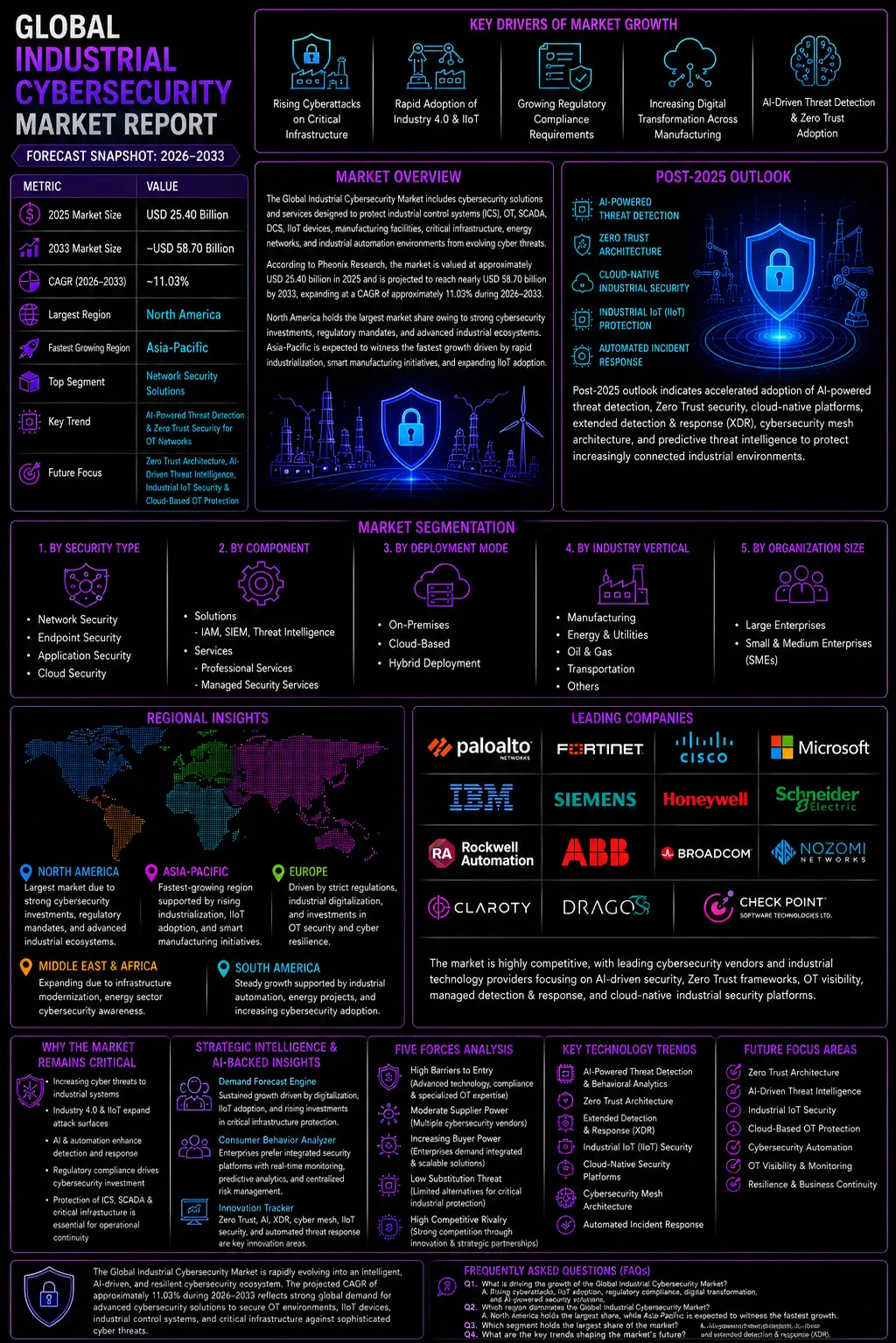
Global Industrial Cybersecurity Market Overview
The Global Industrial Cybersecurity Market comprises cybersecurity solutions and services designed to protect industrial control systems (ICS), operational technology (OT), supervisory control and data acquisition (SCADA) systems, distributed control systems (DCS), Industrial Internet of Things (IIoT) devices, manufacturing facilities, critical infrastructure, energy networks, transportation systems, and industrial automation environments from cyber threats. The market includes network security, endpoint protection, application security, cloud security, identity and access management, threat intelligence, and managed |cybersecurity services. Industrial cybersecurity has become a strategic priority as manufacturing facilities, utilities, oil & gas operations, transportation networks, and smart factories continue to digitize their operations. Increasing cyberattacks targeting critical infrastructure, rapid adoption of Industry 4.0 technologies, cloud-connected industrial assets, and IIoT deployment are driving demand for advanced cybersecurity solutions capable of protecting mission-critical industrial environments. According to Pheonix Research, the Global Industrial Cybersecurity Market is valued at approximately USD 25.40 billion in 2025 and is projected to reach nearly USD 58.70 billion by 2033, expanding at a CAGR of approximately 11.03% during 2026–2033. North America accounts for the largest market share owing to strong cybersecurity investments, extensive deployment of industrial automation, stringent regulatory compliance, and the presence of leading cybersecurity solution providers. Asia-Pacific is expected to witness the fastest growth, supported by rapid industrialization, smart manufacturing initiatives, expanding IIoT adoption, and increasing investments in critical infrastructure protection across China, India, Japan, South Korea, and Southeast Asia. The Post-2025 outlook indicates accelerating adoption of AI-powered threat detection, Zero Trust security architecture, cloud-native industrial security platforms, extended detection and response (XDR), cybersecurity mesh architecture, predictive threat intelligence, and automated incident response capabilities to protect increasingly connected industrial environments.Global Industrial Cybersecurity Market
Key Drivers of Global Industrial Cybersecurity Market Growth
1. Rising Cyberattacks on Critical Infrastructure
Critical infrastructure sectors including energy, utilities, manufacturing, transportation, water treatment, and oil & gas are experiencing increasingly sophisticated cyberattacks. This has significantly increased investments in industrial cybersecurity solutions.2. Rapid Adoption of Industry 4.0 & IIoT
The widespread deployment of Industrial Internet of Things (IIoT), connected sensors, robotics, industrial automation, and smart manufacturing systems is expanding the industrial attack surface, driving demand for advanced cybersecurity platforms.3. Growing Regulatory Compliance Requirements
Governments and regulatory agencies worldwide are strengthening cybersecurity standards for critical infrastructure, encouraging industries to deploy robust cybersecurity frameworks, continuous monitoring, and risk management solutions.4. Increasing Digital Transformation Across Manufacturing
Manufacturers are integrating cloud computing, AI, digital twins, industrial analytics, and remote operations into production environments, creating new cybersecurity requirements for operational technology networks.5. AI-Driven Threat Detection & Zero Trust Adoption
Artificial intelligence, machine learning, behavioral analytics, and Zero Trust security architectures are enabling organizations to detect sophisticated cyber threats faster while minimizing operational disruption across industrial environments.Global Industrial Cybersecurity Market Segmentation
1. By Security Type
1.1 Network Security 1.1.1 Firewall Solutions 1.1.1.1 Next-Generation Firewalls 1.1.1.2 Industrial Firewalls 1.1.1.3 Network Segmentation 1.1.2 Intrusion Detection & Prevention 1.1.2.1 IDS 1.1.2.2 IPS 1.1.2.3 Network Monitoring 1.2 Endpoint Security 1.2.1 Industrial Endpoints 1.2.1.1 PLC Protection 1.2.1.2 HMI Protection 1.2.1.3 Engineering Workstations 1.2.2 Server Protection 1.2.2.1 Industrial Servers 1.2.2.2 Control Servers 1.2.2.3 Virtual Machines 1.3 Application Security 1.3.1 Industrial Software 1.3.1.1 SCADA Security 1.3.1.2 MES Security 1.3.1.3 ERP Integration Security 1.4 Cloud Security 1.4.1 Industrial Cloud Platforms 1.4.1.1 Private Cloud 1.4.1.2 Public Cloud 1.4.1.3 Hybrid Cloud2. By Component
2.1 Solutions 2.1.1 Identity & Access Management 2.1.1.1 Multi-Factor Authentication 2.1.1.2 Privileged Access Management 2.1.2 Security Information & Event Management (SIEM) 2.1.2.1 Log Management 2.1.2.2 Threat Analytics 2.1.3 Threat Intelligence 2.1.3.1 Risk Assessment 2.1.3.2 Vulnerability Management 2.2 Services 2.2.1 Professional Services 2.2.1.1 Consulting 2.2.1.2 System Integration 2.2.1.3 Security Assessment 2.2.2 Managed Security Services 2.2.2.1 Security Monitoring 2.2.2.2 Incident Response 2.2.2.3 SOC-as-a-Service3. By Deployment Mode
3.1 On-Premises 3.1.1 Enterprise Deployment 3.1.1.1 Manufacturing Facilities 3.1.1.2 Energy Infrastructure 3.2 Cloud-Based 3.2.1 SaaS Platforms 3.2.1.1 Security Analytics 3.2.1.2 Threat Intelligence 3.2.2 Hybrid Deployment 3.2.2.1 Multi-Site Operations 3.2.2.2 Distributed Industrial Networks4. By Industry Vertical
4.1 Manufacturing 4.1.1 Automotive Manufacturing 4.1.1.1 Smart Factories 4.1.1.2 Robotics Production 4.1.2 Electronics Manufacturing 4.1.2.1 Semiconductor Plants 4.1.2.2 Consumer Electronics 4.2 Energy & Utilities 4.2.1 Power Generation 4.2.1.1 Conventional Power Plants 4.2.1.2 Renewable Energy Facilities 4.2.2 Transmission & Distribution 4.2.2.1 Smart Grid 4.2.2.2 Utility Networks 4.3 Oil & Gas 4.3.1 Upstream Operations 4.3.1.1 Exploration 4.3.1.2 Drilling 4.3.2 Midstream & Downstream 4.3.2.1 Pipelines 4.3.2.2 Refineries 4.4 Transportation 4.4.1 Rail Infrastructure 4.4.1.1 Signaling Systems 4.4.1.2 Railway Networks 4.4.2 Airports & Ports 4.4.2.1 Airport Operations 4.4.2.2 Maritime Infrastructure5. By Organization Size
5.1 Large Enterprises 5.1.1 Critical Infrastructure Operators 5.1.1.1 Multi-National Manufacturers 5.1.1.2 Utility Companies 5.2 Small & Medium Enterprises (SMEs) 5.2.1 Industrial SMEs 5.2.1.1 Component Manufacturers 5.2.1.2 Industrial Service ProvidersRegional Insights of Global Industrial Cybersecurity Market
North America – Largest Market
North America dominates the Global Industrial Cybersecurity Market owing to its highly developed industrial automation ecosystem, widespread deployment of Industrial Internet of Things (IIoT) technologies, strong cybersecurity regulations, and significant investments in protecting critical infrastructure. The United States leads the regional market through extensive adoption of Operational Technology (OT) security solutions across manufacturing, utilities, oil & gas, defense, transportation, and energy sectors. Continuous investments in Zero Trust architecture, AI-powered threat detection, and cloud security further strengthen regional market leadership.Asia-Pacific
Asia-Pacific represents the fastest-growing regional market, supported by rapid industrialization, expanding smart manufacturing initiatives, increasing adoption of Industry 4.0 technologies, and rising cybersecurity awareness across China, India, Japan, South Korea, Singapore, and Southeast Asia. Government investments in digital infrastructure, critical infrastructure protection, and industrial automation continue to accelerate demand for advanced industrial cybersecurity solutions throughout the region.Europe
Europe remains a significant market driven by stringent cybersecurity regulations, increasing digital transformation across manufacturing industries, and growing investments in securing critical infrastructure. Countries including Germany, France, the United Kingdom, Italy, and the Nordic region are actively deploying OT security, industrial network monitoring, and cyber resilience platforms to strengthen operational continuity and regulatory compliance.Middle East & Africa
The Middle East & Africa market is expanding steadily due to increasing investments in oil & gas infrastructure, smart utilities, industrial diversification programs, and critical infrastructure modernization. Rising cyber threats targeting energy facilities, refineries, water treatment plants, and transportation networks continue to drive cybersecurity adoption across the region.South America
South America is witnessing gradual market growth supported by increasing industrial automation, modernization of manufacturing facilities, expansion of renewable energy projects, and rising awareness of cybersecurity risks. Governments and industrial enterprises are strengthening cybersecurity capabilities to protect operational technology systems from evolving cyber threats.Leading Companies in the Global Industrial Cybersecurity Market
- Palo Alto Networks
- Fortinet Inc.
- Cisco Systems, Inc.
- Microsoft Corporation
- IBM Corporation
- Siemens AG
- Honeywell International Inc.
- Schneider Electric SE
- Rockwell Automation, Inc.
- ABB Ltd.
- Broadcom Inc. (Symantec Enterprise)
- Nozomi Networks
- Claroty
- Dragos, Inc.
- Check Point Software Technologies Ltd.
Why the Global Industrial Cybersecurity Market Remains Critical
- Increasing cyberattacks targeting critical infrastructure continue to accelerate industrial cybersecurity investments worldwide.
- Industry 4.0, IIoT, cloud computing, and smart manufacturing significantly expand cybersecurity requirements across operational technology environments.
- AI-powered threat detection and automated incident response improve cyber resilience while minimizing operational downtime.
- Regulatory compliance requirements encourage organizations to strengthen cybersecurity governance and risk management capabilities.
- Protecting industrial control systems, SCADA networks, and critical operational assets has become essential for ensuring business continuity and national security.
Strategic Intelligence and AI-Backed Insights – Global Industrial Cybersecurity Market
Pheonix Demand Forecast Engine identifies sustained market growth driven by rapid industrial digitalization, increasing investments in critical infrastructure protection, rising adoption of cloud-connected industrial systems, and growing deployment of AI-enabled cybersecurity platforms across manufacturing and energy sectors. The Consumer Behavior Analyzer highlights increasing enterprise preference for integrated cybersecurity platforms capable of delivering continuous threat monitoring, real-time incident response, operational technology visibility, predictive threat intelligence, and centralized security management across industrial environments. The Innovation Tracker emphasizes Zero Trust architecture, AI-powered behavioral analytics, Extended Detection and Response (XDR), Security Information and Event Management (SIEM), cybersecurity mesh architecture, Industrial IoT security, cloud-native security platforms, and autonomous threat response as the primary technologies transforming the industrial cybersecurity landscape. Five Forces Analysis indicates high barriers to entry due to advanced technological expertise, regulatory compliance requirements, and specialized OT security capabilities. Supplier power remains moderate owing to the availability of multiple cybersecurity technology vendors, while buyer power continues to increase as enterprises demand integrated, scalable, and AI-enabled cybersecurity solutions. Competitive rivalry remains high as global technology providers compete through continuous innovation, acquisitions, cloud security capabilities, and industry-specific cybersecurity offerings.Final Takeaway of Global Industrial Cybersecurity Market
The Global Industrial Cybersecurity Market is rapidly evolving into an intelligent, AI-driven, and resilient cybersecurity ecosystem designed to protect increasingly connected industrial operations. The projected CAGR of approximately 11.03% during 2026–2033 reflects strong global demand for advanced cybersecurity solutions capable of securing operational technology environments, Industrial Internet of Things (IIoT) devices, industrial control systems, and critical infrastructure against increasingly sophisticated cyber threats. Future market growth will be driven by Zero Trust security architecture, AI-powered threat detection, cybersecurity automation, cloud-native industrial security platforms, predictive threat intelligence, extended detection and response (XDR), and integrated IT-OT security management. As digital transformation accelerates across manufacturing, utilities, transportation, energy, and critical infrastructure sectors, industrial organizations will continue prioritizing cybersecurity investments to ensure operational resilience and regulatory compliance. Organizations that successfully integrate artificial intelligence, automated threat response, industrial network visibility, identity and access management, and cyber resilience strategies will be well positioned to strengthen security posture while supporting long-term digital transformation initiatives. At Pheonix Research, our advanced forecasting models deliver comprehensive Global Industrial Cybersecurity Market revenue forecasts, competitive benchmarking, regional opportunity analysis, and strategic intelligence—enabling cybersecurity vendors, industrial enterprises, investors, and technology providers to capitalize on the Post-2025 outlook with confidence and data-driven decision-making.Table of Contents
1. Executive Summary
1.1 Market Snapshot
1.2 Key Market Highlights
1.3 Market Size & Forecast (2026–2033)
1.4 Largest Regional Market Analysis
1.5 Fastest Growing Regional Market Analysis
1.6 Largest Segment Analysis
1.7 Competitive Landscape Snapshot
1.8 Future Market Outlook
2. Global Industrial Cybersecurity Market Introduction
2.1 Market Definition
2.2 Scope of Study
2.3 Research Assumptions
2.4 Research Methodology
2.5 Forecast Parameters
3. Global Industrial Cybersecurity Market Overview
3.1 Market Evolution
3.2 Industry Ecosystem Analysis
3.3 Value Chain Analysis
3.4 Pricing & Service Model Analysis
3.5 Industrial OT & Critical Infrastructure Security Landscape
3.6 Cybersecurity Solution Landscape
3.6.1 Network Security
3.6.1.1 Firewall Solutions
3.6.1.1.1 Next-Generation Firewalls
3.6.1.1.1.1 Industrial Firewalls
3.6.1.1.1.2 Network Segmentation
3.6.2 Endpoint Security
3.6.2.1 Industrial Endpoint Protection
3.6.2.1.1 Server Protection
3.6.2.1.1.1 PLC & HMI Security
3.6.2.1.1.2 Engineering Workstations
3.6.3 Application Security
3.6.3.1 Industrial Software Security
3.6.3.1.1 SCADA Security
3.6.3.1.1.1 MES Security
3.6.3.1.1.2 ERP Integration Security
3.6.4 Cloud Security
3.6.4.1 Industrial Cloud Platforms
3.6.4.1.1 Private Cloud
3.6.4.1.1.1 Public Cloud
3.6.4.1.1.2 Hybrid Cloud
4. Regulatory Landscape
4.1 Critical Infrastructure Cybersecurity Regulations
4.2 Industrial Control System (ICS) Security Standards
4.3 Operational Technology (OT) Compliance Frameworks
4.4 Data Protection & Privacy Regulations
4.5 Industrial Cyber Risk Governance & Resilience Standards
5. Market Trends & Innovation Outlook
5.1 AI-Powered Threat Detection
5.2 Zero Trust Security Architecture
5.3 Extended Detection & Response (XDR)
5.4 Industrial IoT (IIoT) Security
5.5 Cloud-Based OT Protection
5.6 Cybersecurity Mesh Architecture
5.7 Predictive Threat Intelligence
5.8 Automated Incident Response & SOC Automation
6. Global Industrial Cybersecurity Market Dynamics
6.1 Market Drivers
6.1.1 Rising Cyberattacks on Critical Infrastructure
6.1.2 Rapid Adoption of Industry 4.0 & IIoT
6.1.3 Growing Regulatory Compliance Requirements
6.1.4 Increasing Digital Transformation Across Manufacturing
6.1.5 AI-Driven Threat Detection & Zero Trust Adoption
6.2 Market Restraints
6.2.1 High Deployment & Implementation Costs
6.2.2 Complexity of Legacy OT Environments
6.2.3 Shortage of Skilled Cybersecurity Professionals
6.2.4 Integration Challenges Between IT & OT Systems
6.3 Market Opportunities
6.3.1 AI-Based Threat Intelligence Platforms
6.3.2 Managed Detection & Response (MDR) Services
6.3.3 Industrial Cloud Security Solutions
6.3.4 Industrial IoT Security Expansion
6.3.5 Cybersecurity for Smart Manufacturing
6.4 Market Challenges
6.4.1 Advanced Persistent Threats (APTs)
6.4.2 Ransomware Targeting Critical Infrastructure
6.4.3 Regulatory Complexity Across Global Markets
6.4.4 Securing Distributed Industrial Networks
7. Global Industrial Cybersecurity Market Size Analysis (USD Billion), 2026–2033
7.1 Revenue Forecast Analysis
7.2 CAGR Analysis
7.3 Demand Analysis by Industry
7.4 Pricing & Spending Trends
7.5 Investment Trend Analysis
8. Global Industrial Cybersecurity Market Segmentation Analysis
8.1 By Security Type
8.1.1 Network Security
8.1.2 Endpoint Security
8.1.3 Application Security
8.1.4 Cloud Security
8.2 By Component
8.2.1 Solutions
8.2.2 Services
8.3 By Deployment Mode
8.3.1 On-Premises
8.3.2 Cloud-Based
8.3.3 Hybrid Deployment
8.4 By Industry Vertical
8.4.1 Manufacturing
8.4.2 Energy & Utilities
8.4.3 Oil & Gas
8.4.4 Transportation
8.5 By Organization Size
8.5.1 Large Enterprises
8.5.2 Small & Medium Enterprises (SMEs)
9. Regional Market Analysis
9.1 North America
9.1.1 U.S.
9.1.2 Canada
9.1.3 Mexico
9.2 Asia-Pacific
9.2.1 China
9.2.2 India
9.2.3 Japan
9.2.4 South Korea
9.2.5 Singapore
9.2.6 Rest of Asia-Pacific
9.3 Europe
9.3.1 Germany
9.3.2 U.K.
9.3.3 France
9.3.4 Italy
9.3.5 Nordic Countries
9.3.6 Rest of Europe
9.4 Middle East & Africa
9.4.1 GCC Countries
9.4.2 South Africa
9.4.3 Rest of Middle East & Africa
9.5 South America
9.5.1 Brazil
9.5.2 Argentina
9.5.3 Rest of South America
10. Competitive Landscape
10.1 Market Share Analysis
10.2 Competitive Intensity Overview
10.3 Strategic Developments
10.4 Product Innovation & AI Security Platforms
10.5 Partnerships, Acquisitions & Collaborations
10.6 Vendor Positioning Analysis
11. Company Profiles
11.1 Palo Alto Networks
11.2 Fortinet Inc.
11.3 Cisco Systems, Inc.
11.4 Microsoft Corporation
11.5 IBM Corporation
11.6 Siemens AG
11.7 Honeywell International Inc.
11.8 Schneider Electric SE
11.9 Rockwell Automation, Inc.
11.10 ABB Ltd.
11.11 Broadcom Inc. (Symantec Enterprise)
11.12 Nozomi Networks
11.13 Claroty
11.14 Dragos, Inc.
11.15 Check Point Software Technologies Ltd.
12. Strategic Intelligence & Pheonix AI Insights
12.1 Pheonix Demand Forecast Engine
12.2 Consumer Behavior Analyzer
12.3 Innovation Tracker
12.4 Cyber Risk Intelligence Dashboard
12.5 Automated Porter’s Five Forces Analysis
13. Future Outlook & Strategic Recommendations
13.1 Zero Trust Adoption Roadmap
13.2 AI-Driven Cybersecurity Strategy
13.3 Industrial IoT Security Framework
13.4 Cloud-Based OT Protection Strategy
13.5 Long-Term Market Outlook (2033+)
14. About Pheonix Market Research
15. Disclaimer
Competitive Landscape
Global Industrial Automation Market Competitive Intensity & Market Structure Overview
The Global Industrial Automation Market is highly competitive and characterized by the presence of industrial automation providers, robotics manufacturers, industrial software developers, control system suppliers, sensor manufacturers, industrial communication technology companies, and digital transformation solution providers. Competitive intensity is driven by the rapid adoption of Industry 4.0, Industrial Internet of Things (IIoT), artificial intelligence (AI), machine learning, digital twins, cloud manufacturing, edge computing, and advanced robotics across manufacturing industries.
Companies compete across multiple automation segments including industrial control systems (ICS), programmable logic controllers (PLCs), distributed control systems (DCS), supervisory control and data acquisition (SCADA), manufacturing execution systems (MES), industrial robotics, collaborative robots (cobots), industrial AI platforms, machine vision systems, industrial cybersecurity, and predictive maintenance solutions. Increasing demand for smart factories, autonomous manufacturing, operational efficiency, workforce optimization, and sustainable industrial operations is intensifying competition while accelerating technological innovation throughout the automation ecosystem.
The market structure is evolving toward integrated automation ecosystems combining industrial hardware, intelligent software, AI-powered analytics, cloud connectivity, industrial edge computing, digital twins, and cybersecurity into unified manufacturing platforms. Market participants are investing heavily in AI-enabled automation, industrial IoT infrastructure, robotics software, industrial cloud platforms, advanced sensing technologies, and strategic partnerships to strengthen market positioning while enabling manufacturers to achieve greater productivity, flexibility, and resilience.
Global Industrial Automation Market Competitive Intensity & Market Structure Current Scenario
Leading Global Industrial Automation Companies
Siemens AG: A global industrial technology leader providing industrial automation systems, digital factory solutions, PLCs, SCADA, digital twin platforms, industrial software, AI-powered manufacturing, and smart infrastructure technologies.
ABB Ltd.: A leading provider of industrial robotics, electrification, motion control, distributed control systems, AI-enabled automation platforms, collaborative robots, and intelligent manufacturing solutions.
Schneider Electric SE: A global automation and energy management company offering industrial control systems, EcoStruxure digital platforms, industrial software, smart manufacturing technologies, and industrial IoT solutions.
Rockwell Automation, Inc.: An industrial automation specialist delivering PLCs, industrial control systems, manufacturing execution systems, industrial AI, digital transformation solutions, and factory automation platforms.
Mitsubishi Electric Corporation: A global automation company providing factory automation equipment, PLCs, motion control systems, robotics, industrial software, and intelligent manufacturing technologies.
Emerson Electric Co.: A leading automation provider offering process automation systems, distributed control systems, industrial software, predictive maintenance, measurement technologies, and digital transformation solutions.
Honeywell International Inc.: A technology company delivering industrial automation, process control systems, industrial cybersecurity, smart manufacturing software, and connected industrial operations.
FANUC Corporation: A global robotics manufacturer specializing in industrial robots, CNC systems, factory automation, AI-enabled robotic solutions, and precision manufacturing technologies.
Yaskawa Electric Corporation: A leading supplier of industrial robots, servo systems, motion control technologies, intelligent automation platforms, and advanced manufacturing solutions.
Omron Corporation: An industrial automation company providing sensors, machine vision systems, PLCs, industrial safety systems, autonomous mobile robots, and smart factory automation technologies.
Key Competitive Intensity & Market Structure Drivers
Increasing adoption of Industry 4.0, smart factories, and digital manufacturing initiatives is intensifying competition among industrial automation providers across global manufacturing industries.
Growing deployment of industrial AI, Industrial Internet of Things (IIoT), machine vision, collaborative robots, digital twins, and predictive maintenance solutions is creating significant technological differentiation among market participants.
Rising demand for manufacturing efficiency, labor optimization, quality improvement, real-time production monitoring, and autonomous factory operations is strengthening competitive intensity while accelerating innovation in automation platforms.
Strategic collaborations among automation companies, robotics manufacturers, cloud service providers, semiconductor companies, AI software developers, industrial cybersecurity firms, and manufacturing enterprises are accelerating product innovation, expanding digital capabilities, and improving operational performance.
Continuous investment in industrial AI, cloud manufacturing platforms, industrial edge computing, robotics, industrial cybersecurity, machine vision, and integrated automation ecosystems is enabling companies to improve operational efficiency, customer value, and long-term competitiveness.
Strategic Implications of Competitive Intensity & Market Structure
Companies offering comprehensive industrial automation platforms, integrated hardware-software ecosystems, and AI-enabled manufacturing technologies are expected to maintain significant competitive advantages.
Investment in industrial AI, predictive analytics, digital twins, industrial IoT connectivity, collaborative robotics, and industrial cybersecurity is becoming increasingly important for sustaining long-term market leadership.
Organizations focusing on expanding intelligent automation capabilities, improving software interoperability, strengthening cloud-based manufacturing solutions, and enhancing production flexibility are likely to increase revenue growth and market share.
Strategic partnerships with manufacturing companies, cloud technology providers, semiconductor manufacturers, system integrators, industrial software developers, and research institutions are supporting innovation, global expansion, and next-generation automation development.
Businesses capable of combining technological innovation, industrial engineering expertise, software intelligence, operational scalability, cybersecurity, and integrated automation ecosystems will be best positioned to compete effectively in the evolving global industrial automation market.
Global Industrial Automation Market Competitive Intensity & Market Structure Forward Outlook
The competitive landscape of the global industrial automation market is expected to become increasingly AI-driven, software-defined, and Industry 4.0-oriented as manufacturers accelerate investments in intelligent production systems and digital transformation.
Future competition will be shaped by industrial artificial intelligence, collaborative robotics (cobots), autonomous manufacturing, Industrial IoT, digital twins, cloud manufacturing, edge computing, machine vision, industrial cybersecurity, and predictive maintenance technologies.
Market participants are expected to increase investments in intelligent automation software, robotics platforms, AI-powered production optimization, industrial cloud infrastructure, advanced sensing technologies, and connected manufacturing ecosystems to strengthen competitive positioning.
Over the forecast period, companies that successfully combine artificial intelligence, industrial automation expertise, robotics engineering, software innovation, digital manufacturing platforms, and scalable end-to-end automation solutions will be best positioned to lead the evolving global industrial automation market.
Value Chain
Global Industrial Cybersecurity Market Value Chain & Supply Chain Evolution Overview
The Global Industrial Cybersecurity Market operates through a highly integrated cybersecurity value chain comprising cybersecurity research, security hardware manufacturing, cybersecurity software development, system integration, compliance validation, distribution, deployment & implementation, security operations, and managed cybersecurity services. The ecosystem includes cybersecurity vendors, industrial automation companies, OT security specialists, cloud security providers, managed security service providers (MSSPs), system integrators, industrial enterprises, regulatory bodies, and critical infrastructure operators collaborating to secure industrial environments against evolving cyber threats.
The market is being driven by rapid Industry 4.0 adoption, increasing convergence of operational technology (OT) and information technology (IT), expanding Industrial Internet of Things (IIoT) deployments, cloud-based manufacturing, and the growing sophistication of cyberattacks targeting critical infrastructure. Organizations are investing in AI-powered threat detection, Zero Trust architectures, industrial Security Operations Centers (SOCs), industrial firewalls, endpoint protection, and advanced threat intelligence platforms to strengthen operational resilience.
The integration of artificial intelligence, behavioral analytics, industrial threat intelligence, cloud security, industrial IoT security, identity and access management, network segmentation, and automated incident response has significantly strengthened the cybersecurity value chain. Companies are expanding strategic collaborations among cybersecurity vendors, industrial automation providers, cloud service companies, telecommunications providers, semiconductor manufacturers, and system integrators to build resilient industrial security ecosystems.
Advancements in Zero Trust security, AI-driven cyber defense, industrial cloud protection, predictive threat analytics, industrial edge security, secure remote access, and OT-specific cybersecurity platforms continue transforming the supply chain while improving cyber resilience, regulatory compliance, operational continuity, and protection of critical industrial assets across global industries.
Global Industrial Cybersecurity Market Value Chain & Supply Chain Evolution Current Scenario
Market-Specific Value Chain
Cybersecurity Research & Threat Intelligence:
Cyber threat research, vulnerability assessment, AI security algorithm development, industrial threat intelligence, malware analysis, security analytics, and cybersecurity innovation.
Security Hardware & Software Development:
Industrial firewalls, intrusion detection systems (IDS/IPS), endpoint protection, SIEM, SOAR, identity & access management (IAM), privileged access management (PAM), Zero Trust platforms, cloud security solutions, and OT security software development.
System Integration & Solution Engineering:
Industrial network architecture, OT-IT security integration, industrial cloud security, cybersecurity consulting, secure remote access implementation, industrial SOC deployment, and cybersecurity engineering.
Quality Assurance & Regulatory Compliance:
Security testing, penetration testing, vulnerability assessment, IEC 62443 compliance, NIST Cybersecurity Framework implementation, ISO/IEC 27001 certification, risk assessment, and cybersecurity audits.
Supply Chain, Distribution & Deployment:
Cybersecurity software licensing, hardware distribution, cloud security deployment, channel partner networks, industrial solution providers, managed service delivery, and cybersecurity implementation.
Security Operations & Incident Response:
Threat monitoring, industrial SOC operations, managed detection and response (MDR), incident response, vulnerability management, security orchestration, continuous monitoring, and cyber risk management.
Lifecycle Services & Managed Security:
Managed security services (MSS), security updates, compliance management, employee cybersecurity training, technical support, cybersecurity consulting, and continuous security optimization.
End User Applications:
Deployment across manufacturing, energy & utilities, oil & gas, chemicals, pharmaceuticals, food & beverage, transportation & logistics, water & wastewater, mining & metals, and critical infrastructure sectors.
Company-to-Stage Mapping
Cybersecurity Research & Threat Intelligence:
Cisco Systems, Palo Alto Networks, Fortinet, Microsoft Corporation, IBM Corporation, Nozomi Networks, Claroty, Dragos, CrowdStrike, Trend Micro, and cybersecurity research organizations.
Security Hardware & Software Development:
Cisco Systems, Palo Alto Networks, Fortinet, Microsoft, IBM, Honeywell International, Siemens AG, Schneider Electric, Rockwell Automation, ABB Ltd., Check Point Software Technologies, Broadcom (Symantec Enterprise), Kaspersky, and TXOne Networks.
System Integration & Solution Engineering:
Siemens AG, Schneider Electric, Honeywell International, Rockwell Automation, IBM Corporation, Cisco Systems, industrial system integrators, OT security consultants, and cloud service providers.
Supply Chain, Distribution & Deployment:
Cybersecurity distributors, managed security providers, cloud platform providers, industrial automation partners, value-added resellers, channel partners, and industrial solution integrators.
Security Operations & Incident Response:
Managed Security Service Providers (MSSPs), Security Operations Centers (SOCs), Cisco Systems, IBM Corporation, Microsoft, CrowdStrike, Dragos, Nozomi Networks, Claroty, and industrial cyber response specialists.
Lifecycle Services & Managed Security:
Cisco Systems, IBM Corporation, Microsoft Corporation, Honeywell International, Siemens AG, Schneider Electric, Fortinet, Palo Alto Networks, cybersecurity consulting firms, and compliance service providers.
Quality Assurance & Regulatory Compliance:
Industrial cybersecurity certification bodies, IEC 62443 compliance specialists, ISO/IEC 27001 auditors, NIST implementation consultants, regulatory advisory firms, and cybersecurity testing laboratories.
End User Applications:
Manufacturing companies, energy & utility operators, oil & gas companies, pharmaceutical manufacturers, transportation infrastructure operators, mining companies, water utilities, logistics providers, and critical infrastructure organizations.
Key Value Chain & Supply Chain Evolution Signals in Global Industrial Cybersecurity Market
Expansion of Zero Trust Security Architecture
Industrial organizations are rapidly adopting Zero Trust frameworks with identity-centric security, least-privilege access, continuous authentication, and network micro-segmentation.
Growing Adoption of AI-Powered Threat Detection
Artificial intelligence and machine learning are improving anomaly detection, predictive cyber risk analysis, automated incident response, and behavioral threat intelligence.
Increasing Convergence of OT & IT Security
Integrated cybersecurity platforms are securing both operational technology and enterprise IT environments through centralized visibility and unified risk management.
Advancement of Industrial Cloud & Edge Security
Cloud-native cybersecurity, industrial edge protection, secure remote access, and hybrid cloud security solutions are strengthening connected manufacturing environments.
Strengthening Industrial Security Operations Centers (SOCs)
Organizations are expanding industrial SOC capabilities to provide continuous monitoring, threat intelligence, rapid incident response, and operational resilience.
Expansion of Regulatory Compliance & Critical Infrastructure Protection
Growing implementation of IEC 62443, NIST Cybersecurity Framework, NIS2 Directive, ISO/IEC 27001, and national cyber resilience regulations is accelerating industrial cybersecurity investments.
Strategic Implications of Value Chain & Supply Chain Evolution
Investment in Advanced Cyber Defense Technologies
AI-powered security platforms, industrial threat intelligence, Zero Trust architectures, and predictive cyber analytics strengthen protection against evolving cyber threats.
Expansion of Secure Digital Manufacturing Infrastructure
Integrated OT-IT security, industrial cloud protection, secure industrial networking, and cybersecurity automation improve resilience across smart manufacturing environments.
Strengthening Supply Chain Cybersecurity
Organizations are improving supplier security, software integrity, third-party risk management, and secure industrial communications to minimize cyber vulnerabilities.
Optimization of Operational Resilience
Continuous monitoring, automated incident response, industrial SOC services, and proactive vulnerability management reduce operational disruption and improve business continuity.
Enhancement of Regulatory Compliance & Governance
Comprehensive compliance management, cybersecurity audits, industrial risk assessment, and governance frameworks strengthen regulatory readiness and enterprise security.
Leveraging AI-Driven Security Innovation
Artificial intelligence, machine learning, behavioral analytics, and security automation improve cyber defense capabilities while reducing response time and operational risk.
Global Industrial Cybersecurity Market Value Chain & Supply Chain Evolution Forward Outlook
The industrial cybersecurity value chain is expected to become increasingly intelligent, automated, identity-centric, and resilient as industrial organizations accelerate digital transformation. Continued advancements in AI-powered threat detection, Zero Trust security, industrial cloud protection, industrial IoT security, edge computing security, and predictive cyber analytics will strengthen the protection of connected industrial ecosystems.
Key Future Developments Include:
- Expansion of AI-driven industrial threat detection and autonomous cyber defense platforms.
- Greater adoption of Zero Trust architectures across OT, IT, cloud, and industrial edge environments.
- Increasing deployment of industrial SOCs, managed detection & response (MDR), and real-time threat intelligence platforms.
- Broader integration of industrial IoT security, cloud-native cybersecurity, secure remote access, and identity management solutions.
- Growing investment in supply chain cybersecurity, regulatory compliance, industrial risk governance, and critical infrastructure protection.
- Strengthening collaborations among cybersecurity vendors, industrial automation providers, cloud service companies, semiconductor manufacturers, system integrators, and industrial enterprises.
As the market evolves, competitive advantage will increasingly depend on AI-enabled cybersecurity, unified OT-IT protection, Zero Trust implementation, industrial threat intelligence, regulatory compliance expertise, and scalable security platforms capable of protecting increasingly connected industrial environments. Organizations that successfully integrate intelligent cybersecurity technologies with digital manufacturing ecosystems will be best positioned to achieve long-term leadership in the Global Industrial Cybersecurity Market.
Investment Activity
Investment Activity in the Global Industrial Cybersecurity Market
Investment activity in the Global Industrial Cybersecurity Market is accelerating rapidly as cybersecurity vendors, industrial automation companies, cloud service providers, governments, and critical infrastructure operators increase capital allocation toward securing industrial environments against evolving cyber threats. Growing adoption of Industry 4.0, Industrial Internet of Things (IIoT), smart factories, operational technology (OT) modernization, and cloud-connected industrial systems is driving substantial investment across the cybersecurity ecosystem.
Leading technology providers are investing heavily in AI-powered threat detection, Zero Trust security frameworks, industrial Security Operations Centers (SOCs), Security Information and Event Management (SIEM) platforms, Security Orchestration, Automation and Response (SOAR) solutions, and real-time industrial network monitoring. These investments are enabling organizations to improve cyber resilience, strengthen operational continuity, and reduce the risk of attacks targeting industrial control systems.
The convergence of IT and OT environments has encouraged major investments in unified cybersecurity platforms capable of protecting programmable logic controllers (PLCs), supervisory control and data acquisition (SCADA) systems, distributed control systems (DCS), industrial robots, edge devices, and cloud-based manufacturing applications. Organizations are also increasing spending on identity and access management (IAM), privileged access management (PAM), industrial firewalls, endpoint protection, and secure remote access solutions.
Governments worldwide are strengthening investment in critical infrastructure protection programs, national cybersecurity initiatives, and regulatory compliance frameworks aligned with standards such as IEC 62443, the NIST Cybersecurity Framework, ISO/IEC 27001, and the NIS2 Directive. Public-private partnerships are expanding investments in industrial cyber resilience, incident response capabilities, and cyber risk assessment to protect manufacturing, energy, utilities, transportation, and other critical sectors.
Strategic mergers, acquisitions, venture capital funding, and partnerships between cybersecurity firms, industrial automation providers, cloud vendors, semiconductor companies, and managed security service providers (MSSPs) continue to reshape the competitive landscape. Investment is also increasing in industrial AI, behavioral analytics, threat intelligence platforms, digital twins, private 5G security, and cloud-native industrial cybersecurity solutions to support next-generation smart manufacturing ecosystems.
Key Investment Trends
- Rising investment in AI-powered threat detection, industrial SOCs, SIEM, and SOAR platforms to strengthen cyber resilience.
- Increasing funding for Zero Trust Architecture, OT security, industrial network segmentation, and secure remote access.
- Expansion of investment in Industrial IoT (IIoT) security, edge computing protection, private 5G security, and cloud-native cybersecurity platforms.
- Growing capital allocation toward critical infrastructure protection, ransomware defense, threat intelligence, and predictive cyber risk analytics.
- Increasing strategic partnerships between cybersecurity vendors, industrial automation companies, cloud providers, semiconductor manufacturers, and MSSPs.
- Higher investment in identity and access management (IAM), privileged access management (PAM), endpoint protection, and industrial firewalls.
- Continued funding for regulatory compliance solutions, industrial cyber training, incident response services, and cybersecurity consulting.
Strategic Investment Outlook
Investment activity is expected to remain robust throughout the forecast period as industrial organizations continue expanding digital manufacturing, cloud-connected operations, AI-enabled production systems, and intelligent industrial infrastructure. Future capital deployment will increasingly focus on autonomous cybersecurity, AI-assisted threat intelligence, industrial Zero Trust frameworks, cloud security, supply chain cyber resilience, and advanced protection for connected OT environments.
Organizations investing in scalable cybersecurity platforms, industrial AI, compliance-driven security solutions, managed detection and response (MDR), and integrated IT-OT protection strategies are expected to strengthen their competitive position and capitalize on the long-term growth opportunities emerging across the Global Industrial Cybersecurity Market.
Technology & Innovation
Global Industrial Cybersecurity Market Technology & Innovation Landscape Overview
The Global Industrial Cybersecurity Market is undergoing rapid technological transformation driven by the convergence of Operational Technology (OT), Information Technology (IT), Artificial Intelligence (AI), Industrial Internet of Things (IIoT), cloud computing, edge security, and Zero Trust architectures. As industrial organizations accelerate digital transformation through Industry 4.0 initiatives, cybersecurity has evolved from a standalone IT function into a strategic pillar supporting resilient, connected, and autonomous industrial operations.
Innovation is reshaping industrial security through AI-powered threat detection, behavioral analytics, industrial Security Operations Centers (SOCs), identity-centric access management, industrial digital twins, and real-time cyber risk intelligence. These technologies enable organizations to detect sophisticated cyber threats, secure critical infrastructure, and maintain operational continuity across manufacturing plants, utilities, energy facilities, transportation networks, and other industrial environments.
The continued expansion of connected industrial ecosystems, private 5G networks, cloud-native manufacturing, and remote operations is further accelerating investment in advanced industrial cybersecurity technologies.
Global Industrial Cybersecurity Market Technology & Innovation Landscape Current Scenario
The current industrial cybersecurity landscape is characterized by widespread deployment of AI-driven security analytics, Zero Trust security frameworks, OT-specific monitoring platforms, industrial intrusion detection systems (IDS), Security Information and Event Management (SIEM), Security Orchestration, Automation and Response (SOAR), and cloud-based security solutions. Organizations are increasingly implementing unified IT-OT security architectures that provide centralized visibility across industrial assets while minimizing operational disruption.
Industrial enterprises are integrating machine learning, endpoint detection and response (EDR), industrial firewalls, privileged access management (PAM), secure remote access, and continuous vulnerability assessment into cybersecurity strategies. At the same time, edge computing, industrial AI, digital twins, and IIoT security platforms are strengthening real-time threat detection, predictive risk analysis, and automated incident response across connected manufacturing environments.
Key Technology & Innovation Landscape Trends in the Global Industrial Cybersecurity Market
- AI-powered threat detection and behavioral analytics are enabling real-time identification of cyber anomalies, ransomware attacks, and advanced persistent threats (APTs).
- Zero Trust Architecture is becoming the preferred cybersecurity model through continuous authentication, least-privilege access, micro-segmentation, and identity-centric security.
- Industrial OT security platforms are improving protection for PLCs, SCADA systems, DCS environments, industrial robots, and connected production equipment.
- Security Information and Event Management (SIEM) and Security Orchestration, Automation and Response (SOAR) platforms are enhancing automated incident detection, investigation, and response.
- Industrial IoT (IIoT) security solutions are securing connected sensors, smart devices, industrial gateways, and machine-to-machine communications.
- Cloud-native industrial cybersecurity platforms are strengthening security for hybrid cloud, private cloud, and multi-cloud manufacturing environments.
- Industrial edge security is enabling localized threat analytics, low-latency monitoring, and secure edge computing for distributed industrial operations.
- AI-driven vulnerability management and predictive cyber risk analytics are helping organizations proactively identify weaknesses before exploitation.
- Industrial Security Operations Centers (SOCs) and Managed Detection and Response (MDR) services are expanding continuous monitoring and rapid incident response capabilities.
- Industrial digital twins and cyber-physical system security technologies are supporting secure simulation, operational resilience, and risk assessment for smart factories.
Strategic Implications of Technology & Innovation in the Global Industrial Cybersecurity Market
Continued investment in AI-powered cybersecurity, Zero Trust frameworks, OT security platforms, industrial cloud security, and intelligent threat intelligence has become essential for protecting increasingly connected industrial environments.
The convergence of AI, IIoT, cloud computing, edge security, and operational technology is enabling organizations to establish resilient cybersecurity ecosystems capable of securing critical infrastructure while maintaining production efficiency and regulatory compliance.
Industrial cybersecurity providers investing in integrated IT-OT security platforms, AI-assisted threat detection, industrial SOC capabilities, and automated incident response are expected to strengthen their competitive positioning as smart manufacturing adoption accelerates globally.
Strategic collaboration among cybersecurity vendors, industrial automation companies, cloud providers, telecommunications firms, and industrial software developers is accelerating innovation while enabling comprehensive end-to-end industrial security solutions.
Growing investment in industrial AI, predictive cyber analytics, secure remote operations, supply chain cybersecurity, and cloud-native protection will continue creating significant opportunities across manufacturing, energy, utilities, pharmaceuticals, transportation, mining, and critical infrastructure sectors.
Organizations capable of integrating AI, Zero Trust security, industrial threat intelligence, OT visibility, cloud protection, and regulatory compliance into unified cybersecurity platforms will be well positioned to address future industrial cyber risks.
Global Industrial Cybersecurity Market Technology & Innovation Landscape Forward Outlook
Future innovation within the Global Industrial Cybersecurity Market will increasingly focus on autonomous cyber defense, AI-driven Security Operations Centers (SOCs), quantum-resistant cryptography, industrial digital identity management, secure industrial 5G networks, and self-healing cyber-physical systems. The continued expansion of smart factories, connected infrastructure, edge computing, and autonomous industrial operations will further increase demand for intelligent, adaptive, and predictive cybersecurity solutions.
Emerging technologies such as generative AI-assisted threat intelligence, automated vulnerability remediation, confidential computing, industrial cyber digital twins, and predictive cyber resilience platforms are expected to redefine industrial security strategies over the coming decade. As industries prioritize operational resilience, digital transformation, and critical infrastructure protection, technology-driven cybersecurity innovation will remain a key enabler of secure industrial modernization.
Market Risk
Global Industrial Cybersecurity Market Risk & Disruption Analysis
The Global Industrial Cybersecurity Market operates within a high-risk, rapidly evolving environment shaped by increasingly sophisticated cyber threats, accelerating industrial digitalization, regulatory tightening, and the convergence of operational technology (OT) with information technology (IT). As industries embrace Industry 4.0, Industrial Internet of Things (IIoT), cloud manufacturing, artificial intelligence (AI), and connected critical infrastructure, cybersecurity has become a strategic necessity rather than an operational support function.
Industrial organizations are transitioning from traditional perimeter-based security toward Zero Trust architectures, AI-powered threat detection, industrial Security Operations Centers (SOCs), identity-centric security, behavioral analytics, and real-time cyber resilience frameworks. While these innovations strengthen protection, they also introduce greater system complexity, interoperability challenges, and evolving attack surfaces.
Additionally, increasing ransomware attacks targeting manufacturing facilities, utilities, transportation networks, pharmaceutical production, oil & gas infrastructure, and smart factories continue reshaping cybersecurity investment priorities worldwide. Supply-chain attacks, insider threats, cloud vulnerabilities, regulatory compliance requirements, and the shortage of skilled cybersecurity professionals remain major challenges influencing market development.
Global Industrial Cybersecurity Market Current Risk Environment
The industrial cybersecurity market currently operates in one of the most dynamic and risk-intensive technology environments as industrial systems become increasingly interconnected.
One of the most significant risks is the rapid escalation of ransomware and advanced persistent threats (APTs) targeting industrial control systems (ICS), SCADA environments, manufacturing execution systems (MES), and critical infrastructure. Cybercriminals and nation-state actors continue exploiting vulnerabilities in operational technology environments to disrupt production and critical services.
Another major challenge is the expanding attack surface created by OT-IT convergence. The growing integration of cloud platforms, IIoT devices, remote monitoring, edge computing, industrial AI, and connected manufacturing ecosystems has significantly increased cybersecurity complexity.
The market also faces regulatory and compliance risks, as organizations must comply with evolving industrial cybersecurity standards such as IEC 62443, NIST Cybersecurity Framework, ISO/IEC 27001, NIS2 Directive, and national critical infrastructure protection requirements.
Furthermore, industrial supply-chain vulnerabilities continue increasing as manufacturers rely on complex ecosystems of automation vendors, software providers, cloud platforms, equipment suppliers, and third-party service providers.
A persistent shortage of skilled cybersecurity professionals, combined with increasing investment requirements for AI-driven defense platforms and continuous monitoring, continues influencing enterprise cybersecurity strategies.
Key Market Risk & Disruption Signals in Global Industrial Cybersecurity Market
1. Escalating Cyberattacks on Critical Infrastructure
Manufacturing plants, energy utilities, transportation systems, pharmaceutical facilities, and water infrastructure are experiencing increasing ransomware attacks, industrial malware, and sophisticated cyber intrusions.
2. OT-IT Convergence Expanding Attack Surface
The integration of operational technology with enterprise IT, cloud platforms, IIoT devices, and remote operations is creating new cybersecurity vulnerabilities requiring unified security strategies.
3. Rapid Adoption of Zero Trust Security
Organizations are increasingly replacing perimeter-based security models with Zero Trust architectures featuring continuous authentication, least-privilege access, and identity-based protection.
4. AI-Powered Cyber Threat Evolution
Artificial intelligence is transforming both cyber defense and cyberattacks, requiring organizations to adopt AI-assisted threat detection, behavioral analytics, and automated incident response.
5. Regulatory & Compliance Intensification
Industrial organizations face expanding cybersecurity obligations under global standards governing operational resilience, incident reporting, critical infrastructure protection, and cyber governance.
6. Supply Chain Cybersecurity Risks
Growing reliance on interconnected suppliers, industrial software vendors, cloud providers, and automation partners is increasing third-party cybersecurity exposure.
7. Cloud Manufacturing & Edge Security Challenges
Migration toward cloud-native manufacturing platforms and industrial edge computing introduces additional requirements for secure connectivity, encryption, identity management, and workload protection.
8. Cybersecurity Talent Shortages
The global shortage of OT security specialists, industrial cybersecurity engineers, and threat analysts continues limiting cybersecurity implementation and operational resilience.
Strategic Implications of Market Risk & Disruption in Global Industrial Cybersecurity Market
The rapidly evolving cyber threat landscape requires industrial organizations to adopt comprehensive, intelligence-driven cybersecurity strategies focused on operational resilience, regulatory compliance, and business continuity.
One of the most important strategic priorities is investment in AI-powered cybersecurity platforms, Zero Trust security architectures, industrial SOCs, industrial intrusion detection systems (IDS), identity and access management (IAM), privileged access management (PAM), and industrial threat intelligence to strengthen cyber defense across connected industrial environments.
Industrial organizations must also enhance OT security governance, supply-chain cybersecurity, cloud security, endpoint protection, industrial network segmentation, and continuous vulnerability management to reduce cyber risk.
Strategic collaboration among industrial automation vendors, cybersecurity companies, cloud providers, telecommunications firms, semiconductor manufacturers, and system integrators is becoming increasingly critical for delivering secure, interoperable industrial ecosystems.
The convergence of AI, IIoT, cloud manufacturing, industrial edge computing, private 5G, digital twins, and autonomous production systems is fundamentally reshaping cybersecurity requirements. Vendors capable of delivering integrated IT-OT security platforms with real-time analytics and automated response capabilities are expected to strengthen long-term competitive positioning.
Future market leadership will increasingly depend on cyber resilience, compliance readiness, AI-enabled security automation, industrial risk analytics, Zero Trust implementation, and secure digital transformation capabilities.
Global Industrial Cybersecurity Market Risk & Disruption Forward Outlook
Looking ahead to 2026-2033, the Global Industrial Cybersecurity Market is expected to experience continuous disruption as industrial environments become increasingly autonomous, cloud-connected, and AI-driven.
1. AI-Driven Cyber Defense Will Become Standard
Artificial intelligence will increasingly support automated threat detection, anomaly identification, predictive cyber analytics, and autonomous incident response.
2. Zero Trust Architecture Will Dominate Industrial Security
Continuous authentication, identity verification, micro-segmentation, and least-privilege access models will become core security principles across industrial operations.
3. Expansion of Industrial Security Operations Centers (SOCs)
Organizations will increasingly deploy dedicated industrial SOCs integrating OT monitoring, AI-powered threat intelligence, and centralized incident management.
4. Stronger Supply Chain Security Requirements
Industrial companies will strengthen cybersecurity governance across suppliers, software vendors, automation partners, and cloud ecosystems to reduce third-party risk.
5. Growth of Cloud & Edge Security Platforms
Cloud-native industrial security, secure edge computing, confidential computing, encrypted industrial communications, and hybrid security architectures will expand rapidly.
6. Increasing Regulatory Oversight
Governments will continue strengthening industrial cybersecurity legislation, mandatory reporting requirements, critical infrastructure protection frameworks, and cyber resilience regulations.
7. Industrial AI Security Will Become Critical
The rapid deployment of AI-driven manufacturing systems will require dedicated protection for AI models, autonomous decision-making systems, industrial algorithms, and machine-learning workflows.
8. Cyber Resilience Will Become a Core Competitive Advantage
Organizations capable of maintaining secure, resilient, and continuously monitored industrial operations will achieve stronger operational continuity, regulatory compliance, and customer trust.
Overall, the Global Industrial Cybersecurity Market will remain one of the most strategically important segments of industrial digital transformation, where AI-powered cyber defense, Zero Trust security, OT protection, regulatory compliance, and operational resilience will define future market leadership.
Regulatory Landscape
Global Industrial Cybersecurity Market Regulatory & Policy Environment Overview
The regulatory and policy environment plays a pivotal role in shaping the Global Industrial Cybersecurity Market by ensuring the protection of critical infrastructure, industrial control systems (ICS), operational technology (OT), and connected manufacturing environments against evolving cyber threats. Organizations operating across manufacturing, energy, utilities, transportation, oil & gas, and other critical industries must comply with a growing framework of international cybersecurity standards, critical infrastructure protection regulations, industrial safety requirements, and data security policies. The market is primarily influenced by globally recognized frameworks such as IEC 62443, the NIST Cybersecurity Framework, ISO/IEC 27001, the NIS2 Directive, Critical Infrastructure Protection (CIP) regulations, and national cyber resilience strategies. These frameworks promote risk-based security management, secure OT-IT convergence, incident response, vulnerability management, and continuous monitoring across industrial environments.
Global Industrial Cybersecurity Market Regulatory & Policy Environment Current Scenario
The current regulatory landscape emphasizes industrial cyber resilience, secure digital transformation, critical infrastructure protection, regulatory compliance, and operational continuity. As Industry 4.0, Industrial IoT (IIoT), cloud manufacturing, and smart factory deployments expand, governments and regulatory agencies are strengthening cybersecurity requirements to reduce operational risks and improve national cyber resilience. Organizations are increasingly required to implement Zero Trust security architectures, industrial network segmentation, identity and access management, incident reporting mechanisms, and continuous threat monitoring to comply with evolving regulatory frameworks. Cybersecurity governance has become a strategic priority, particularly for operators of essential services and critical industrial infrastructure.
Key Regulatory & Policy Environment Signals in the Global Industrial Cybersecurity Market
1. Industrial Cybersecurity Standards
Compliance with IEC 62443, ISO/IEC 27001, and the NIST Cybersecurity Framework remains central to securing industrial control systems and operational technology environments.
2. Critical Infrastructure Protection Regulations
Governments continue strengthening cybersecurity requirements for critical sectors including manufacturing, energy, utilities, transportation, and water infrastructure.
3. Zero Trust & OT Security Frameworks
Regulatory focus is increasing on Zero Trust architecture, secure remote access, identity governance, and protection of converged IT-OT environments.
4. Incident Reporting & Cyber Resilience Requirements
Organizations are required to strengthen cyber governance through vulnerability management, security monitoring, incident response planning, and mandatory reporting obligations.
5. Cloud Security & Data Protection Policies
Expanding adoption of industrial cloud platforms is driving greater emphasis on cloud security controls, secure data management, and compliance with data protection regulations.
Strategic Implications of Regulatory & Policy Environment
The evolving regulatory environment is encouraging cybersecurity vendors to develop standards-compliant, AI-enabled, and industrial-grade security solutions that support operational resilience, secure digital transformation, and critical infrastructure protection. Vendors are expanding investments in industrial SOCs, AI-powered threat detection, Zero Trust security, industrial risk analytics, and OT-specific cybersecurity platforms to meet increasingly stringent compliance requirements. Organizations capable of delivering secure, scalable, interoperable, and compliance-ready industrial cybersecurity solutions are expected to strengthen their competitive position as industrial cyber governance becomes a strategic business priority.
Global Industrial Cybersecurity Market Regulatory & Policy Environment Forward Outlook
Between 2026 and 2033, regulatory frameworks are expected to place greater emphasis on industrial cyber resilience, AI governance, software supply chain security, cloud-native industrial security, and protection of increasingly autonomous manufacturing ecosystems. Governments are likely to expand critical infrastructure cybersecurity regulations, strengthen mandatory incident reporting requirements, and accelerate adoption of international industrial cybersecurity standards. Future policy developments are also expected to promote greater harmonization of global cybersecurity frameworks, stronger protection for connected industrial assets, and wider deployment of Zero Trust architectures, enabling a more secure, resilient, and digitally connected industrial ecosystem. Regulatory Complexity Level – High Approval Pathway Structure – compliance_driven