
India Business Process Outsourcing Market size and Share Analysis 2026-2033
India Business Process Outsourcing (BPO) Market Size & Forecast
The India Business Process Outsourcing (BPO) market is projected to witness strong and sustained growth during the forecast period from 2026 to 2033. The market was valued at approximately USD 48.6 billion in 2025 and is expected to reach nearly USD 92.4 billion by 2033, expanding at a CAGR of around 8.4%. The market???s growth is driven by increasing global demand for cost-efficient outsourcing solutions, rapid digital transformation across industries, expanding IT infrastructure, and India???s strong position as a global outsourcing hub. Business Process Outsourcing (BPO) refers to the delegation of business operations and support functions to third-party service providers. India has emerged as one of the world???s leading BPO destinations due to its large skilled workforce, English language proficiency, advanced technology ecosystem, and competitive operational costs. The market includes customer support services, finance & accounting outsourcing, human resource outsourcing, technical support, healthcare BPO, legal process outsourcing (LPO), knowledge process outsourcing (KPO), and IT-enabled services (ITES). The growing adoption of cloud computing, artificial intelligence (AI), robotic process automation (RPA), analytics, and digital customer engagement platforms is significantly reshaping the Indian BPO industry.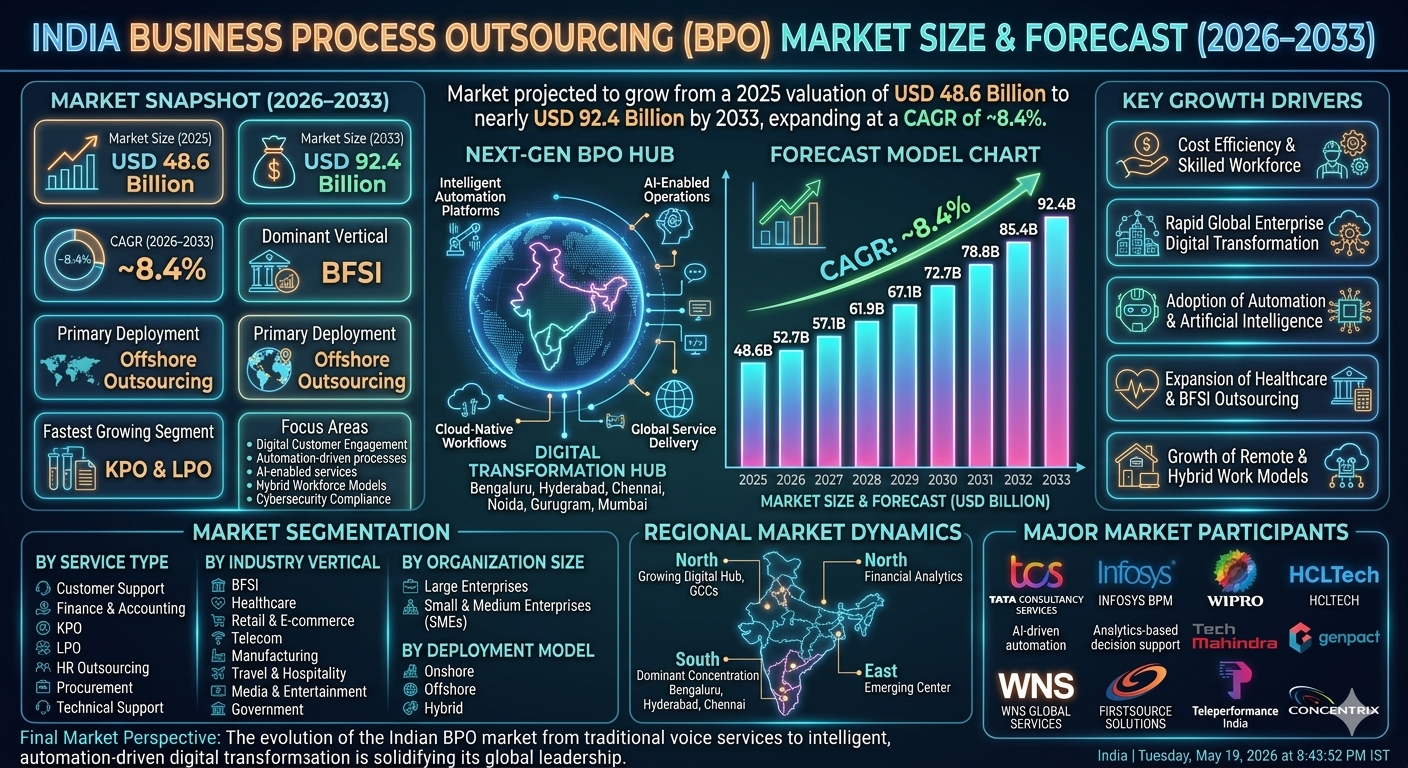
India BPO Market Overview
The India BPO market forms a major segment of the country???s IT and business services industry. India continues to dominate the global outsourcing landscape due to its mature technology infrastructure, highly qualified workforce, and ability to deliver scalable and cost-effective business solutions. The industry serves clients across banking, financial services, insurance (BFSI), healthcare, telecommunications, retail, manufacturing, travel, e-commerce, and government sectors. Traditional voice-based outsourcing services are gradually evolving toward high-value digital transformation services, analytics, automation-driven processes, and AI-enabled customer experience management. The increasing focus on multilingual support services, cybersecurity compliance, and hybrid workforce models is also shaping the future of India???s outsourcing ecosystem. Major industry participants include Tata Consultancy Services (TCS), Infosys BPM, Wipro, HCLTech, Tech Mahindra, Genpact, Teleperformance India, Concentrix, Firstsource Solutions, and WNS Global Services.Key Drivers of India BPO Market Growth
Cost Efficiency and Skilled Workforce
India offers significant operational cost advantages compared to developed economies while maintaining high service quality standards. The country???s large pool of English-speaking professionals and technically skilled workforce continues to attract global outsourcing contracts.Rapid Digital Transformation Across Industries
Enterprises worldwide are increasingly outsourcing digital operations, cloud services, analytics, and customer engagement processes. This shift is expanding demand for advanced BPO and IT-enabled services in India.Adoption of Automation and Artificial Intelligence
Indian BPO companies are integrating AI, robotic process automation (RPA), machine learning, and predictive analytics to improve operational efficiency and reduce turnaround times. Automation is enabling service providers to transition from low-value repetitive tasks to higher-value strategic services.Expansion of Healthcare and BFSI Outsourcing
The healthcare and financial services industries are increasingly outsourcing claims processing, revenue cycle management, fraud detection, compliance management, and customer support functions. India???s strong domain expertise and scalable operations are supporting growth in these verticals.Growth of Remote and Hybrid Work Models
The adoption of remote work infrastructure and cloud collaboration tools is enabling Indian BPO providers to expand geographically distributed service delivery models. This flexibility is improving business continuity and operational scalability.India BPO Market Segmentation
By Service Type
The market is segmented into customer support services, finance & accounting outsourcing, HR outsourcing, procurement outsourcing, technical support, legal process outsourcing (LPO), and knowledge process outsourcing (KPO). Customer support and finance & accounting outsourcing account for a major share of the market.By Organization Size
The market includes large enterprises and small & medium enterprises (SMEs). Large enterprises dominate the market due to high outsourcing volumes and long-term global contracts.By Deployment Model
The market includes onshore outsourcing, offshore outsourcing, and hybrid delivery models. Offshore outsourcing remains the dominant model due to cost optimization benefits.By Industry Vertical
Industry verticals include BFSI, healthcare, retail & e-commerce, telecommunications, manufacturing, travel & hospitality, media & entertainment, and government services. BFSI remains the largest industry segment due to extensive outsourcing of financial operations and customer service functions.Regional Market Dynamics
South India
South India represents the largest concentration of BPO and IT-enabled service operations, particularly in Bengaluru, Hyderabad, Chennai, and Kochi. The region benefits from strong IT infrastructure, technology parks, and access to skilled talent pools.North India
North India, led by cities such as Gurugram, Noida, and Chandigarh, is a major hub for multinational outsourcing firms and customer support centers. The region is witnessing strong investment in digital operations and global capability centers (GCCs).West India
West India, including Mumbai and Pune, plays an important role in financial outsourcing, analytics services, and banking support operations. The region benefits from proximity to major financial institutions and multinational corporations.East India
East India is gradually emerging as a cost-effective outsourcing destination, with Kolkata becoming a growing center for customer service and back-office operations.Competitive Landscape
The India BPO market is highly competitive and characterized by the presence of large IT service providers, multinational outsourcing firms, and specialized niche operators. Key companies include Tata Consultancy Services (TCS), Infosys BPM, Wipro, HCLTech, Tech Mahindra, Genpact, WNS Global Services, Firstsource Solutions, Teleperformance India, and Concentrix. Companies are increasingly focusing on AI-driven automation, analytics-based decision support, omnichannel customer engagement, cybersecurity compliance, and cloud-based outsourcing solutions. Strategic partnerships, acquisitions, and expansion of digital transformation capabilities remain key competitive strategies within the industry.Strategic Outlook
The strategic outlook for the India BPO market remains highly positive due to increasing global outsourcing demand and rapid enterprise digitalization. Future opportunities include AI-enabled customer service, multilingual digital support, cloud-native business process management, cybersecurity outsourcing, and industry-specific digital transformation solutions. The rise of Global Capability Centers (GCCs), remote workforce management, and intelligent automation platforms is expected to reshape India???s outsourcing landscape. Companies investing in digital innovation, workforce upskilling, automation technologies, and value-added consulting services are likely to strengthen their competitive positioning.Final Market Perspective
The India Business Process Outsourcing market continues to play a central role in the global services economy, supported by strong technological capabilities, operational scalability, and cost advantages. Rising demand for intelligent automation, digital customer engagement, and specialized outsourcing services will continue driving market expansion throughout the forecast period. Organizations that successfully combine advanced technology integration, skilled talent management, and customer-centric service delivery will remain strongly positioned in the evolving India BPO market.Table of Contents
Table of Contents
- 1. Executive Summary
- 1.1 India BPO Market Snapshot (2026-2033)
- 1.2 Market Size & CAGR Analysis
- 1.3 Largest & Fastest-Growing Segments
- 1.4 Key Regional Insights
- 1.5 Market Growth Drivers
- 1.6 Competitive Landscape Overview
- 1.7 Future Industry Outlook
- 2. Introduction & Market Overview
- 2.1 Definition of Business Process Outsourcing (BPO)
- 2.2 Scope of the Study
- 2.3 Evolution of India???s Outsourcing Industry
- 2.4 India BPO Industry Ecosystem
- 2.5 Value Chain Analysis
- 2.6 Digital Transformation Trends in Outsourcing
- 2.7 Regulatory & Data Protection Framework
- 3. Research Methodology
- 3.1 Primary Research
- 3.2 Secondary Research
- 3.3 Market Estimation Methodology
- 3.4 Forecast Assumptions (2026-2033)
- 3.5 Data Validation & Market Triangulation
- 4. Market Dynamics
- 4.1 Drivers
- 4.1.1 Cost Efficiency & Skilled Workforce Availability
- 4.1.2 Rapid Digital Transformation Across Industries
- 4.1.3 Adoption of Automation & Artificial Intelligence
- 4.1.4 Expansion of Healthcare & BFSI Outsourcing
- 4.1.5 Growth of Remote & Hybrid Work Models
- 4.2 Restraints
- 4.2.1 Data Privacy & Cybersecurity Concerns
- 4.2.2 High Employee Attrition Rates
- 4.2.3 Wage Inflation & Rising Operational Costs
- 4.2.4 Infrastructure Challenges in Tier-II Cities
- 4.3 Opportunities
- 4.3.1 AI-Driven Intelligent Process Automation
- 4.3.2 Expansion of Global Capability Centers (GCCs)
- 4.3.3 Growth of Industry-Specific BPO Services
- 4.3.4 Increasing Demand for Cloud-Based Outsourcing Solutions
- 4.4 Challenges
- 4.4.1 Intense Global Outsourcing Competition
- 4.4.2 Managing Complex Regulatory Compliance
- 4.4.3 Workforce Skill Gap in Emerging Technologies
- 4.4.4 Business Continuity & Operational Risks
- 4.1 Drivers
- 5. India BPO Market Analysis (USD Billion), 2026-2033
- 5.1 Market Size Overview
- 5.2 CAGR Analysis
- 5.3 Revenue Distribution by Region
- 5.4 Segment-Wise Revenue Analysis
- 5.5 Outsourcing Demand Trends
- 5.6 Technology Innovation Trends
- 6. Market Segmentation (USD Billion), 2026-2033
- 6.1 By Service Type
- 6.1.1 Customer Support Services
- 6.1.2 Finance & Accounting Outsourcing
- 6.1.3 HR Outsourcing
- 6.1.4 Procurement Outsourcing
- 6.1.5 Technical Support
- 6.1.6 Legal Process Outsourcing (LPO)
- 6.1.7 Knowledge Process Outsourcing (KPO)
- 6.2 By Organization Size
- 6.2.1 Large Enterprises
- 6.2.2 Small & Medium Enterprises (SMEs)
- 6.3 By Deployment Model
- 6.3.1 Onshore Outsourcing
- 6.3.2 Offshore Outsourcing
- 6.3.3 Hybrid Delivery Models
- 6.4 By Industry Vertical
- 6.4.1 BFSI
- 6.4.2 Healthcare
- 6.4.3 Retail & E-Commerce
- 6.4.4 Telecommunications
- 6.4.5 Manufacturing
- 6.4.6 Travel & Hospitality
- 6.4.7 Media & Entertainment
- 6.4.8 Government Services
- 6.1 By Service Type
- 7. Market Segmentation by Geography
- 7.1 South India
- 7.2 North India
- 7.3 West India
- 7.4 East India
- 8. Competitive Landscape
- 8.1 Market Share Analysis
- 8.2 Digital Transformation Capability Benchmarking
- 8.3 AI & Automation Integration Analysis
- 8.4 Strategic Partnerships & Acquisitions
- 8.5 Workforce & Service Delivery Strategies
- 9. Company Profiles
- 9.1 Tata Consultancy Services (TCS)
- 9.2 Infosys BPM
- 9.3 Wipro
- 9.4 HCLTech
- 9.5 Tech Mahindra
- 9.6 Genpact
- 9.7 WNS Global Services
- 9.8 Firstsource Solutions
- 9.9 Teleperformance India
- 9.10 Concentrix
- 10. Strategic Intelligence & Pheonix AI Insights
- 10.1 AI-Based Customer Experience Analytics
- 10.2 Intelligent Process Automation Tracker
- 10.3 Workforce Productivity Optimization System
- 10.4 Outsourcing Demand Forecast Analytics
- 10.5 Automated Competitive Benchmarking System
- 11. Future Outlook & Strategic Recommendations
- 11.1 Expansion of AI-Enabled Outsourcing Services
- 11.2 Growth of Cloud-Native BPO Platforms
- 11.3 Development of Tier-II & Tier-III Delivery Centers
- 11.4 Industry-Specific Digital Transformation Solutions
- 11.5 Long-Term Market Outlook (2033+)
- 12. Appendix
- 13. About Pheonix Research
- 14. Disclaimer
Competitive Landscape
India Business Process Outsourcing (BPO) Market Competitive Intensity & Market Structure Overview
The India Business Process Outsourcing (BPO) market is highly competitive, technology-driven, and structurally mature, characterized by the presence of large IT service providers, multinational outsourcing firms, digital transformation specialists, and niche process management companies. Competition is primarily driven by service quality, operational scalability, pricing efficiency, digital transformation capabilities, automation expertise, and global delivery infrastructure.
The market structure includes both integrated IT-BPO enterprises offering end-to-end digital transformation services and specialized outsourcing providers focused on customer support, finance & accounting, healthcare outsourcing, legal process outsourcing (LPO), analytics, and knowledge process outsourcing (KPO). India continues to maintain a dominant position within the global outsourcing ecosystem due to its large skilled workforce, mature IT infrastructure, and cost advantages.
The competitive environment is evolving rapidly as enterprises increasingly demand AI-enabled automation, cloud-native business process management, cybersecurity compliance, multilingual support, and omnichannel customer engagement services. Companies are shifting from traditional labor-intensive outsourcing models toward high-value digital and analytics-driven service offerings.
India BPO Market Competitive Intensity & Market Structure Current Scenario
Leading BPO & IT-Enabled Service Providers in India
Tata Consultancy Services (TCS): One of the largest global IT and business process service providers with strong capabilities in digital transformation, analytics, finance outsourcing, and enterprise support services.
Infosys BPM: Major player offering integrated outsourcing solutions across finance, procurement, customer service, human resources, and digital operations management.
Wipro: Leading outsourcing and technology services company focused on automation, cloud transformation, AI-driven business operations, and enterprise process optimization.
HCLTech: Significant participant in digital operations, engineering services, customer experience management, and IT-enabled outsourcing solutions.
Tech Mahindra: Strong outsourcing provider specializing in telecommunications, customer experience services, AI-enabled automation, and digital business operations.
Genpact: Global leader in business process management and analytics-driven outsourcing services with strong presence in BFSI, healthcare, and supply chain operations.
WNS Global Services: Specialized provider of analytics, finance outsourcing, travel support, and industry-specific digital business process solutions.
Firstsource Solutions: Prominent player in healthcare BPO, customer lifecycle management, and financial services outsourcing.
Teleperformance India: Major customer experience management company with strong capabilities in multilingual support, digital customer engagement, and omnichannel communication services.
Concentrix: Leading global customer experience and business process outsourcing company with expanding digital transformation and AI-enabled support operations in India.
Key Competitive Intensity & Market Structure Drivers
One of the strongest competitive drivers in the market is the rapid adoption of AI, robotic process automation (RPA), machine learning, and analytics platforms. Service providers capable of delivering intelligent automation and data-driven process optimization are gaining stronger competitive advantages.
Cost efficiency remains a major competitive factor, particularly for global enterprises seeking scalable outsourcing solutions while maintaining operational quality and business continuity.
The shift from traditional voice-based services toward high-value knowledge-based outsourcing, digital consulting, and platform-enabled services is reshaping market competition.
Cybersecurity compliance, regulatory adherence, and data privacy management are becoming increasingly important as outsourcing operations handle sensitive customer and enterprise data across multiple global jurisdictions.
Workforce quality, multilingual capabilities, employee retention, and continuous upskilling initiatives are also critical differentiators within the highly talent-intensive outsourcing industry.
Strategic Implications of Competitive Intensity & Market Structure
Companies are increasingly investing in AI-driven automation platforms, cloud-native outsourcing infrastructure, and advanced analytics capabilities to improve operational efficiency and move toward outcome-based service models.
Strategic expansion into healthcare BPO, financial compliance outsourcing, cybersecurity operations, and industry-specific digital transformation services is creating new revenue opportunities.
Partnerships with global cloud providers, enterprise software companies, and AI technology firms are becoming increasingly important for expanding digital service capabilities.
The rise of Global Capability Centers (GCCs) in India is intensifying competition, as multinational corporations increasingly establish in-house shared service and digital innovation centers within the country.
Tier-2 and Tier-3 Indian cities are emerging as important growth hubs due to lower operating costs, improving digital infrastructure, and expanding talent availability.
India BPO Market Competitive Intensity & Market Structure Forward Outlook
The India BPO market is expected to become increasingly automation-driven, analytics-focused, and digitally integrated through 2033 as enterprises accelerate global digital transformation initiatives.
Future competition will increasingly center around AI-enabled customer experience management, predictive analytics, cloud-based business process platforms, and intelligent workflow automation.
Hybrid workforce models, remote service delivery infrastructure, and decentralized operations are expected to permanently reshape operational structures within the outsourcing industry.
Market consolidation is likely to increase as large IT and outsourcing firms acquire niche automation, analytics, cybersecurity, and digital consulting companies to strengthen service portfolios and global competitiveness.
Overall, the India BPO market will remain one of the world???s most strategically important outsourcing ecosystems, supported by strong technological infrastructure, skilled talent availability, and expanding digital service capabilities. Companies that successfully combine automation expertise, domain specialization, operational scalability, and customer-centric innovation will remain strongly positioned in the evolving India BPO market.
Value Chain
India Business Process Outsourcing (BPO) Market Value Chain & Supply Chain Evolution Overview
The India Business Process Outsourcing (BPO) market value chain is evolving from a traditional labor-intensive outsourcing ecosystem into a highly digitalized, automation-driven, globally integrated, and knowledge-centric business services network. This transformation is being driven by rising global demand for cost-efficient outsourcing solutions, rapid enterprise digital transformation, increasing adoption of AI and automation technologies, and India???s strong position as a leading global outsourcing destination.
The BPO value chain begins with upstream infrastructure development, talent acquisition, digital technology integration, and enterprise software enablement. This stage includes IT infrastructure providers, cloud service companies, telecom operators, cybersecurity vendors, workforce training institutions, and enterprise software developers that support outsourcing operations. India???s large pool of English-speaking professionals, engineering graduates, and digitally skilled workforce remains a critical foundation for the country???s outsourcing ecosystem.
The operational service delivery layer forms the core of the BPO market value chain and includes customer support operations, finance & accounting outsourcing, technical support services, HR outsourcing, legal process outsourcing (LPO), healthcare BPO, analytics services, and knowledge process outsourcing (KPO). BPO firms are increasingly integrating AI-driven automation, robotic process automation (RPA), machine learning, predictive analytics, and omnichannel customer engagement technologies to improve efficiency, reduce turnaround times, and deliver higher-value services.
Digital transformation is reshaping traditional outsourcing models, with service providers shifting from voice-based support services toward intelligent automation, cloud-native business process management, AI-enabled customer experience management, and data-driven decision support solutions. Companies are increasingly investing in hybrid workforce infrastructure, remote collaboration platforms, cybersecurity systems, and digital workflow optimization technologies.
Global Capability Centers (GCCs), multinational outsourcing hubs, and offshore delivery centers are becoming increasingly important components of the India BPO ecosystem. International enterprises are expanding captive centers and strategic outsourcing partnerships within India to optimize operational efficiency, improve scalability, and strengthen global service continuity.
The distribution structure of the India BPO market involves multinational corporations, enterprise clients, cloud-based service delivery networks, digital communication platforms, managed service providers, and outsourced operational support ecosystems. Service delivery models include offshore outsourcing, hybrid outsourcing, remote operations management, and cloud-integrated customer engagement systems.
Regulatory compliance, cybersecurity governance, and data protection standards represent central pillars within the BPO value chain. Service providers must comply with data privacy regulations, financial compliance standards, cybersecurity frameworks, and international outsourcing governance requirements established by authorities such as GDPR, ISO, HIPAA, PCI DSS, and India???s digital governance regulations. Increasing emphasis on secure digital infrastructure and compliance management is driving investment in AI-powered cybersecurity monitoring and automated risk management systems.
Overall, the India BPO market value chain is evolving into a highly scalable, digitally connected, AI-driven, and globally diversified business services ecosystem focused on operational efficiency, customer experience optimization, intelligent automation, and long-term enterprise transformation.
India BPO Market Value Chain & Supply Chain Evolution Current Scenario
The current India BPO market supply chain is characterized by strong global outsourcing demand, rapid digitalization, and increasing adoption of AI-enabled service delivery models. India continues to dominate the global outsourcing landscape due to its large skilled workforce, cost competitiveness, advanced IT ecosystem, and mature outsourcing infrastructure.
South India remains the leading operational hub for BPO and IT-enabled services, particularly Bengaluru, Hyderabad, Chennai, and Kochi, supported by advanced technology parks, IT infrastructure, and skilled workforce availability. North India, led by Gurugram and Noida, also plays a major role in customer support operations, global capability centers, and multinational outsourcing services.
Automation and AI integration are increasingly reshaping operational workflows. BPO companies are adopting AI-powered chatbots, intelligent virtual assistants, automated claims processing systems, predictive customer analytics, and robotic process automation to improve productivity and reduce operational dependency on repetitive manual tasks.
Cloud computing and hybrid work infrastructure are becoming standard operational components across the industry. Remote workforce management systems, secure cloud collaboration platforms, and virtual service delivery models are enabling greater scalability and operational continuity.
Sustainability and workforce optimization are also becoming increasingly important operational priorities. Companies are investing in energy-efficient office infrastructure, remote work enablement, digital workforce training, employee wellness programs, and ESG-focused operational practices to strengthen long-term business resilience.
Key Value Chain & Supply Chain Evolution Signals in India BPO Market
One of the strongest transformation signals within the India BPO market is the rapid shift from traditional voice-based outsourcing toward high-value digital transformation services. Enterprises are increasingly outsourcing analytics, AI-enabled customer engagement, cloud operations, cybersecurity support, and intelligent process automation functions.
Another major evolution signal is the growing integration of AI and robotic process automation technologies throughout outsourcing operations. Intelligent automation platforms are significantly improving operational efficiency, reducing processing time, and enabling service providers to focus on higher-value consulting and strategic support services.
The expansion of Global Capability Centers (GCCs) in India is also reshaping the outsourcing ecosystem. Multinational companies are increasingly establishing dedicated operational hubs in India for finance, analytics, engineering, cybersecurity, customer support, and digital transformation functions.
Cybersecurity and data privacy management are becoming defining priorities across the value chain due to increasing digitalization and growing cross-border data processing requirements. Investment in secure cloud infrastructure, AI-based fraud detection systems, and regulatory compliance technologies is accelerating rapidly.
Additionally, multilingual customer support services, industry-specific outsourcing solutions, and vertical-focused digital transformation capabilities are becoming increasingly important competitive differentiators within the global outsourcing market.
Strategic Implications of Value Chain & Supply Chain Evolution in India BPO Market
The evolving India BPO value chain presents significant strategic implications for outsourcing companies, IT service providers, enterprise clients, cloud technology vendors, and workforce management organizations. Companies that successfully combine automation technologies, skilled workforce capabilities, cybersecurity infrastructure, and customer-centric digital service delivery are expected to strengthen long-term competitive positioning.
Investment in AI-driven automation platforms, predictive analytics systems, omnichannel communication technologies, and cloud-native outsourcing infrastructure is creating operational efficiency advantages by improving scalability, reducing service costs, and enhancing customer experience quality.
Supply chain resilience and workforce diversification are becoming strategic priorities as BPO providers increasingly adopt hybrid workforce models, distributed operational networks, and remote service delivery infrastructure to improve business continuity and operational flexibility.
Expansion into industry-specific outsourcing solutions such as healthcare BPO, legal process outsourcing, fintech support services, and cybersecurity outsourcing is creating new revenue diversification opportunities for service providers.
Long-term competitive success will increasingly depend on balancing cost efficiency, automation adoption, digital innovation, regulatory compliance, workforce upskilling, and customer experience excellence while maintaining scalable global service delivery capabilities.
India BPO Market Value Chain & Supply Chain Evolution Forward Outlook
Between 2026 and 2033, the India BPO value chain is expected to become increasingly AI-driven, cloud-integrated, digitally automated, and knowledge-focused. Service providers are expected to continue investing in intelligent automation platforms, AI-powered customer engagement systems, cloud-native business process management technologies, and predictive analytics infrastructure.
Digital transformation outsourcing, cybersecurity services, multilingual customer support, healthcare process outsourcing, and AI-enabled enterprise support solutions are expected to become major growth areas across the market.
Remote workforce management technologies, virtual collaboration systems, AI-assisted quality monitoring, and real-time operational analytics are expected to further strengthen operational scalability and global outsourcing efficiency.
Sustainability initiatives will continue gaining importance within the outsourcing ecosystem, with increasing investment in green IT infrastructure, energy-efficient data centers, remote work enablement, paperless digital workflows, and ESG-focused operational strategies.
Ultimately, the future India BPO value chain will evolve into a highly intelligent, globally interconnected, digitally optimized, and customer-centric outsourcing ecosystem where automation, workforce expertise, cybersecurity resilience, operational scalability, and innovation-driven service delivery collectively define long-term market competitiveness.
Market-Specific Value Chain
- Infrastructure & Technology Enablement: Cloud infrastructure providers, telecom operators, cybersecurity vendors, enterprise software companies, AI and automation technology providers
- Talent Acquisition & Workforce Development: Recruitment agencies, workforce training institutes, skill development organizations, language training providers, HR technology firms
- BPO Service Operations: Customer support centers, finance & accounting outsourcing firms, technical support providers, healthcare BPO companies, legal process outsourcing operators
- Digital Transformation & Automation Integration: AI solution providers, robotic process automation vendors, analytics firms, cloud-native business process management companies
- Global Delivery & Enterprise Service Management: Offshore delivery centers, Global Capability Centers (GCCs), managed service providers, hybrid workforce management systems
- Compliance & Cybersecurity Management: Data privacy compliance firms, cybersecurity solution providers, regulatory governance systems, risk management service providers
- Enterprise Clients & End-Use Industries: BFSI companies, healthcare organizations, telecom providers, retail & e-commerce firms, manufacturing enterprises, government agencies
Investment Activity
Global India Business Process Outsourcing (BPO) Market Investment & Funding Dynamics Overview
Investment and funding dynamics in the India Business Process Outsourcing (BPO) Market are accelerating significantly due to increasing global enterprise digitalization, rising demand for AI-enabled outsourcing services, expansion of cloud-based business operations, and growing adoption of intelligent automation technologies. Between 2026 and 2033, investments are expected to increasingly target digital transformation platforms, artificial intelligence integration, cybersecurity infrastructure, multilingual support services, analytics-driven process management, and hybrid workforce enablement solutions designed to improve operational efficiency and customer experience.
The India BPO industry is evolving from a traditional cost-arbitrage outsourcing destination into a strategic global digital services ecosystem supporting finance, healthcare, telecommunications, retail, e-commerce, travel, insurance, and technology sectors. Major companies including Tata Consultancy Services (TCS), Infosys BPM, Wipro, HCLTech, Tech Mahindra, Genpact, WNS Global Services, Concentrix, Teleperformance India, and Firstsource Solutions are significantly increasing investments in AI-driven automation, cloud-native service delivery, cybersecurity compliance, and next-generation customer engagement technologies.
A major structural transformation shaping investment activity is the increasing global shift toward intelligent automation, omnichannel customer experience management, and digitally integrated business operations. Enterprises worldwide are increasingly funding outsourcing partnerships capable of delivering scalable, technology-enabled, and data-driven operational solutions.
The market is also benefiting from rising investments in robotic process automation (RPA), generative AI platforms, analytics-driven decision support systems, remote workforce infrastructure, and industry-specific digital transformation services. Expansion of healthcare BPO, fintech outsourcing, legal process outsourcing (LPO), and knowledge process outsourcing (KPO) activities is creating strong commercial opportunities across India???s outsourcing ecosystem.
India BPO Market Investment & Funding Dynamics Current Scenario
Current investment activity in the India BPO market is strongly supported by rising enterprise demand for cost-efficient digital operations, increasing cloud adoption, and growing integration of AI and automation technologies across outsourcing workflows. Companies are actively investing in intelligent process automation, multilingual customer support infrastructure, cybersecurity frameworks, advanced analytics platforms, and employee upskilling initiatives to improve service quality and scalability.
- South India: Dominates investment activity due to strong IT infrastructure, large technology talent pools, expanding Global Capability Centers (GCCs), and major outsourcing hubs across Bengaluru, Hyderabad, Chennai, and Kochi.
- North India: Continues attracting major investments driven by multinational outsourcing operations, customer engagement platforms, fintech services, and digital support centers across Gurugram, Noida, and Chandigarh.
- West India: Witnessing strong funding growth supported by financial outsourcing services, analytics platforms, BFSI-focused operations, and expanding enterprise technology ecosystems in Mumbai and Pune.
- East India: Emerging as a developing outsourcing investment region supported by cost-effective operations, rising talent availability, and expansion of customer support and back-office service centers in Kolkata and surrounding cities.
Key Investment & Funding Dynamics Signals in India BPO Market
- Growing enterprise demand for AI-enabled customer support and workflow automation is driving investments into intelligent process management platforms and digital customer experience technologies.
- Expansion of cloud computing and remote work ecosystems is attracting funding into virtual delivery infrastructure, collaboration tools, and cloud-native outsourcing solutions.
- Healthcare and BFSI outsourcing growth is increasing investments in compliance management, fraud detection systems, revenue cycle management, and secure data processing platforms.
- Cybersecurity and data privacy regulations are encouraging investments into secure outsourcing environments, risk management frameworks, and regulatory compliance technologies.
- Generative AI, machine learning, and predictive analytics technologies are becoming major innovation areas attracting both domestic and international technology investments.
- Global Capability Centers (GCCs) are increasingly investing in India-based innovation hubs focused on analytics, digital engineering, automation, and enterprise support functions.
- Workforce upskilling programs focused on AI, data analytics, cybersecurity, and multilingual communication are becoming critical investment priorities across the outsourcing industry.
Strategic Implications of Investment & Funding Dynamics in India BPO Market
- The investment landscape increasingly favors companies capable of combining digital transformation expertise, scalable outsourcing operations, and advanced automation capabilities.
- Technology innovation is becoming a major competitive differentiator, particularly in AI integration, predictive analytics, omnichannel engagement, and cloud-based process management.
- Strategic collaborations between outsourcing firms, cloud service providers, AI companies, and enterprise software vendors are becoming increasingly important for market expansion and service diversification.
- Regional diversification strategies remain critical, with South India leading digital infrastructure growth, North India driving multinational outsourcing expansion, and West India strengthening BFSI-focused operations.
- Companies investing in high-value services such as KPO, analytics, digital consulting, and AI-driven customer engagement are expected to achieve stronger profitability and long-term competitive positioning.
- Cybersecurity resilience, regulatory compliance, and secure digital infrastructure are emerging as key investment priorities due to increasing enterprise data protection requirements.
- Organizations with strong automation capabilities, advanced analytics expertise, skilled workforce development programs, and global delivery networks are expected to maintain stronger market leadership.
India BPO Market Investment & Funding Dynamics Forward Outlook
Looking ahead, the India Business Process Outsourcing (BPO) Market is expected to attract strong long-term investment supported by increasing global outsourcing demand, enterprise digital transformation initiatives, and rapid adoption of intelligent automation technologies.
Future capital allocation will prioritize AI-powered customer engagement platforms, robotic process automation systems, cloud-native outsourcing infrastructure, multilingual support services, cybersecurity enhancement technologies, and analytics-driven business process management solutions.
- South India: Will remain the leading investment region due to expanding technology ecosystems, strong engineering talent availability, and continued growth of Global Capability Centers and digital innovation hubs.
- North India: Will continue strengthening its market position through investments in customer experience management, fintech outsourcing, and multinational enterprise service operations.
- West India: Will increasingly focus on financial outsourcing technologies, AI-driven analytics services, and enterprise digital transformation solutions.
Future funding activity is also expected to accelerate across generative AI-enabled customer service, intelligent workflow orchestration, healthcare process outsourcing, cloud security services, multilingual digital support platforms, and industry-specific automation solutions.
Digital transformation initiatives, workforce modernization, and enterprise automation strategies will remain central investment priorities across the India BPO industry. The increasing integration of AI, analytics, and cloud technologies into outsourcing operations will continue reshaping competitive dynamics globally.
Overall, the market is expected to maintain strong long-term investment momentum due to its expanding role in global digital operations, enterprise transformation, and intelligent service delivery. Companies that successfully combine advanced technology integration, scalable delivery capabilities, workforce expertise, and customer-centric innovation will remain strongly positioned to lead the India Business Process Outsourcing (BPO) Market through 2033.
Technology & Innovation
India Business Process Outsourcing (BPO) Market Technology & Innovation Landscape Overview
The technology and innovation landscape of the India Business Process Outsourcing (BPO) Market is evolving rapidly as outsourcing providers increasingly integrate artificial intelligence (AI), robotic process automation (RPA), cloud computing, advanced analytics, and digital customer engagement platforms into business operations. Innovation across the market is focused on intelligent process automation, AI-driven customer support, cloud-native service delivery, cybersecurity integration, predictive analytics, and omnichannel communication systems designed to improve operational efficiency, scalability, and customer experience.
India???s BPO industry is undergoing a major transformation from traditional voice-based outsourcing services toward high-value digital transformation and knowledge-based services. Companies are increasingly deploying automation platforms, conversational AI systems, virtual assistants, and workflow optimization technologies to improve service quality and reduce operational costs.
Artificial intelligence and machine learning are becoming central innovation drivers within the Indian outsourcing ecosystem. AI-powered systems are being used for customer sentiment analysis, intelligent ticket routing, fraud detection, predictive customer engagement, automated claims processing, and personalized customer support services.
Cloud computing technologies are also significantly reshaping the market by enabling remote workforce management, scalable service delivery infrastructure, real-time collaboration, and secure data access across distributed operational environments. Hybrid cloud environments and SaaS-based outsourcing platforms are improving business continuity and operational flexibility.
The innovation landscape is further expanding toward industry-specific digital outsourcing solutions, including healthcare process automation, fintech outsourcing platforms, legal analytics systems, and AI-enabled HR management services. These technologies are helping Indian BPO providers deliver more specialized and value-driven business solutions globally.
India BPO Market Technology & Innovation Landscape Current Scenario
Currently, the India BPO market is experiencing accelerated digital modernization as enterprises increasingly demand intelligent automation, cloud-enabled operations, and AI-driven customer experience management. Major outsourcing hubs such as Bengaluru, Hyderabad, Pune, Chennai, Gurugram, and Noida are witnessing strong investments in digital infrastructure, cybersecurity systems, and advanced analytics capabilities.
Robotic process automation has become one of the most widely adopted technologies within the Indian BPO sector. Service providers are increasingly using RPA platforms to automate repetitive back-office tasks such as invoice processing, payroll management, claims handling, compliance reporting, and customer onboarding workflows.
AI-powered customer engagement technologies are rapidly transforming call center operations. Conversational AI chatbots, voice assistants, and natural language processing (NLP) systems are improving response times, customer personalization, and multilingual support capabilities across customer service operations.
Cloud-based outsourcing infrastructure is increasingly supporting remote and hybrid workforce models across the industry. Companies are deploying virtual desktop environments, cloud collaboration tools, unified communication platforms, and secure remote access systems to maintain operational continuity and workforce scalability.
Cybersecurity innovation is becoming a major priority within the market due to rising concerns regarding data privacy, regulatory compliance, and cyber threats. BPO firms are investing heavily in zero-trust security frameworks, AI-driven threat detection systems, endpoint security technologies, and secure cloud architectures.
Advanced analytics and business intelligence platforms are also gaining strong traction within the industry. Data analytics tools are enabling BPO providers to deliver predictive insights, customer behavior analysis, operational optimization, and strategic decision-support services to enterprise clients.
Key Technology & Innovation Trends in India BPO Market
- Artificial Intelligence & Machine Learning: AI-powered automation systems supporting customer service, fraud detection, predictive analytics, and workflow optimization.
- Robotic Process Automation (RPA): Intelligent automation platforms streamlining repetitive business operations and improving operational efficiency.
- Cloud-Native Outsourcing Platforms: Scalable cloud infrastructure enabling remote operations, digital collaboration, and flexible service delivery.
- Conversational AI & Chatbots: NLP-driven virtual assistants enhancing omnichannel customer engagement and multilingual support.
- Advanced Data Analytics: Business intelligence and predictive analytics platforms improving decision-making and customer insights.
- Cybersecurity & Compliance Technologies: AI-driven threat detection, zero-trust security models, and secure cloud systems protecting sensitive enterprise data.
- Hybrid Workforce Technologies: Digital collaboration platforms and remote workforce management systems enabling flexible operational models.
- Industry-Specific Digital Solutions: Specialized outsourcing technologies for healthcare, BFSI, legal services, HR management, and retail operations.
- Omnichannel Customer Experience Platforms: Integrated communication systems supporting voice, email, chat, social media, and mobile engagement.
- Intelligent Workflow Management: AI-driven process orchestration systems improving operational agility and service delivery efficiency.
Strategic Implications of Technology & Innovation
Technological innovation is fundamentally reshaping the India BPO market by shifting the industry from labor-intensive outsourcing toward intelligent, automated, and value-driven business services. Digital transformation is enabling Indian BPO providers to improve service quality, operational scalability, customer engagement, and strategic consulting capabilities.
For outsourcing companies, investment in AI platforms, automation infrastructure, cloud ecosystems, and advanced analytics technologies has become a major competitive differentiator. Organizations leveraging intelligent automation and digital transformation capabilities are improving profitability while expanding into higher-value service offerings.
The increasing integration of AI-driven customer experience management and predictive analytics is also helping companies strengthen client retention and operational efficiency. Intelligent outsourcing systems are enabling real-time customer engagement, automated issue resolution, and data-driven decision-making across enterprise operations.
At the same time, innovation in cybersecurity and regulatory compliance infrastructure is becoming increasingly important as global enterprises prioritize data protection and secure outsourcing partnerships. Companies capable of delivering secure and compliant digital services are likely to gain stronger competitive advantages within the global outsourcing market.
However, rising automation adoption may also create workforce transition challenges, requiring large-scale employee upskilling and reskilling initiatives. Data privacy regulations, infrastructure modernization costs, and increasing global competition also remain important challenges affecting long-term market evolution.
India BPO Market Technology & Innovation Forward Outlook
Looking ahead, the India BPO market is expected to evolve toward highly intelligent, AI-driven, cloud-native, and automation-enabled service ecosystems powered by advanced analytics, conversational AI, predictive automation, and secure digital infrastructure. The industry will increasingly focus on delivering end-to-end digital business transformation services rather than traditional outsourcing alone.
Artificial intelligence is expected to play a significantly larger role in intelligent customer support, workflow orchestration, business analytics, fraud prevention, and automated decision-making systems. AI-enabled outsourcing platforms will increasingly support hyper-personalized customer engagement and real-time operational optimization.
The convergence of cloud computing, edge technologies, cybersecurity platforms, and automation systems will significantly improve remote workforce scalability, operational resilience, and global service delivery capabilities within the Indian outsourcing industry.
Industry-specific outsourcing innovation is also expected to accelerate. Healthcare BPO, fintech process outsourcing, legal analytics services, insurance automation, and e-commerce customer engagement solutions are likely to emerge as major growth areas within the market.
Workforce transformation and digital skill development will remain critical strategic priorities. Companies are expected to increasingly invest in AI training, digital upskilling programs, and human-machine collaboration models to support future outsourcing operations.
In conclusion, the India Business Process Outsourcing Market is undergoing a major technological transformation driven by artificial intelligence, automation, cloud computing, advanced analytics, and digital customer engagement technologies. Companies that successfully combine intelligent automation, cybersecurity resilience, workforce innovation, and scalable digital service delivery will lead the future evolution of the Indian BPO industry.
Market Risk
India Business Process Outsourcing (BPO) Market Risk Factors & Disruption Threats Overview
The India Business Process Outsourcing (BPO) market is experiencing strong growth driven by increasing global outsourcing demand, rapid digital transformation, cost efficiency advantages, and expansion of IT-enabled services. However, despite its dominant global position, the industry faces several structural risk factors including automation-led disruption, geopolitical dependency, cybersecurity threats, rising operational costs, regulatory changes, and increasing global competition from emerging outsourcing destinations.
One of the primary risk factors affecting the India BPO market is the accelerating shift toward automation and artificial intelligence. AI-driven chatbots, generative AI systems, robotic process automation (RPA), and self-service platforms are significantly reducing demand for traditional voice-based and repetitive backend processes. This structural shift is forcing Indian BPO providers to rapidly transition toward high-value digital services, creating short-term revenue pressure for legacy operations.
Another key challenge is rising global competition from alternative outsourcing destinations such as the Philippines, Vietnam, Eastern Europe, and Latin America. These regions are increasingly offering competitive labor costs, language capabilities, and specialized service delivery, which is intensifying pricing pressure on Indian service providers and reducing margin flexibility in commoditized segments.
Cybersecurity and data privacy risks represent a major operational concern for the India BPO industry. Since BPO firms handle sensitive financial, healthcare, and customer data for global clients, any breach, ransomware attack, or data leakage incident can result in severe financial penalties, contract losses, and reputational damage. Increasing regulatory frameworks such as GDPR, HIPAA, and India???s evolving data protection laws further increase compliance complexity.
The industry is also exposed to high client concentration and global demand dependency risks. A large portion of BPO revenue is driven by clients in the United States and Europe. Economic slowdowns, outsourcing restrictions, geopolitical tensions, or policy shifts in these regions can directly impact contract renewals and outsourcing volumes.
Talent attrition and skill transition challenges also remain significant. High employee turnover, wage inflation in Tier-1 cities, and increasing demand for AI, analytics, and domain-specific skills are creating workforce management pressures. Companies that fail to reskill employees risk losing competitiveness in high-value outsourcing segments.
Additionally, regulatory and compliance risks are increasing due to evolving labor laws, data localization requirements, taxation policies, and cross-border data transfer restrictions. These regulatory changes can impact delivery models, cost structures, and operational flexibility for outsourcing providers.
Infrastructure constraints and rising operating costs in major outsourcing hubs such as Bengaluru, Hyderabad, and Gurugram also present long-term risks. Increasing real estate prices, power costs, and urban congestion may push companies to diversify operations into Tier-2 and Tier-3 cities.
Currency volatility remains another important risk factor, as most BPO revenues are earned in foreign currencies such as USD and EUR. Exchange rate fluctuations can significantly impact profit margins and financial stability.
India BPO Market Risk Factors & Disruption Threats Current Scenario
The current India BPO market is undergoing a structural transformation from traditional outsourcing models to AI-enabled, automation-driven, and outcome-based service delivery frameworks. Enterprises are increasingly demanding efficiency gains, cost reduction, and measurable business outcomes rather than headcount-based service contracts.
At the same time, rapid adoption of generative AI and intelligent automation tools is reshaping service delivery models. Routine customer support, data entry, and back-office processing tasks are increasingly being automated, reducing dependency on large human workforces and reshaping revenue structures.
Global clients are also consolidating vendor relationships to reduce operational complexity, which is increasing competitive pressure on mid-sized BPO providers. Large IT services firms with integrated digital capabilities are gaining stronger market share, while smaller players face margin compression.
The shift toward hybrid and remote work models has improved operational flexibility but also increased cybersecurity exposure and data governance challenges. Additionally, increasing scrutiny on employee working conditions and data handling practices is influencing client procurement decisions.
Despite these challenges, demand for high-value services such as analytics, cloud support, multilingual customer experience management, and digital transformation outsourcing continues to grow, partially offsetting declines in traditional voice-based services.
India BPO Market Key Risk Factors & Disruption Threat Signals
- AI & Automation Displacement: Rapid replacement of repetitive processes by AI, RPA, and self-service platforms.
- Global Outsourcing Competition: Rising pressure from Philippines, Vietnam, Eastern Europe, and Latin America.
- Cybersecurity Risks: Increasing exposure to ransomware, phishing, and data breaches.
- Regulatory Compliance Complexity: GDPR, HIPAA, and evolving data protection frameworks increasing compliance burden.
- Client Concentration Risk: Heavy dependence on US and European outsourcing demand.
- Talent Attrition & Skill Gaps: High turnover and shortage of AI, analytics, and domain-specialized talent.
- Margin Pressure: Shift to outcome-based pricing and vendor consolidation reducing profitability.
- Currency Volatility: Exchange rate fluctuations impacting revenue stability.
- Rising Operating Costs: Increasing wages, real estate costs, and infrastructure expenses in Tier-1 cities.
- Geopolitical & Trade Risks: Policy shifts or outsourcing restrictions in key client markets.
Strategic Implications of Risk Factors
India BPO companies must accelerate transformation from labor-intensive outsourcing models to technology-driven service providers. Investment in AI integration, automation platforms, and digital customer experience systems is essential to maintain global competitiveness.
Strengthening cybersecurity infrastructure, compliance frameworks, and data governance systems will be critical to retaining global client trust and meeting regulatory requirements across jurisdictions.
Workforce transformation through reskilling and upskilling programs in AI, analytics, cloud services, and domain expertise will become a key differentiator in the evolving market landscape.
Diversification into Tier-2 and Tier-3 cities, along with hybrid delivery models, will help manage rising operational costs and improve scalability. Companies that successfully balance cost efficiency with value-added services will remain better positioned in the global outsourcing ecosystem.
India BPO Market Forward Risk Outlook
Looking ahead to 2026???2033, the India BPO market will continue to grow, but its structure will significantly evolve. Traditional voice-based and repetitive outsourcing services will decline in importance, while AI-enabled, analytics-driven, and domain-specialized services will dominate future growth.
The increasing integration of generative AI, automation platforms, and digital workforce technologies will reshape employment models, pricing structures, and service delivery frameworks. Companies that fail to adapt to this transition may face declining market relevance.
At the same time, India is expected to maintain its leadership in global outsourcing due to its scale, talent availability, and strong digital ecosystem. However, sustaining this position will depend on continuous innovation, regulatory adaptability, cybersecurity strength, and value-added service expansion.
Overall, while the India BPO market remains fundamentally strong, its future competitiveness will depend on how effectively companies manage technological disruption, global competition, and evolving client expectations in a rapidly transforming digital economy.
Regulatory Landscape
India Business Process Outsourcing (BPO) Market Regulatory & Policy Environment Overview
The regulatory and policy environment governing the India Business Process Outsourcing (BPO) market plays a critical role in shaping the country???s position as a global outsourcing hub. The industry operates under a broad framework of information technology regulations, data protection laws, labor policies, telecommunications regulations, cybersecurity standards, and foreign investment policies.
As the Indian BPO industry increasingly evolves toward digital transformation services, cloud-based operations, analytics, artificial intelligence (AI), and customer experience management, regulatory oversight is expanding beyond traditional outsourcing compliance into areas such as cross-border data governance, cybersecurity resilience, digital infrastructure security, and responsible AI implementation.
The Indian government continues to actively support the BPO and IT-enabled services (ITES) sector through digital economy initiatives, infrastructure development programs, export incentives, startup promotion schemes, and technology-focused policy reforms. Government initiatives such as Digital India, Startup India, Skill India, and data center expansion programs are significantly strengthening the outsourcing ecosystem.
At the same time, increasing global concerns regarding data privacy, financial compliance, intellectual property protection, and operational continuity are encouraging BPO companies operating in India to strengthen compliance frameworks and adopt internationally recognized security and governance standards.
India BPO Market Regulatory & Policy Environment Current Scenario
The current regulatory landscape for the India BPO market is centered around data protection, cybersecurity compliance, labor regulations, foreign investment facilitation, and digital business governance. India???s outsourcing industry is increasingly influenced by both domestic regulations and international compliance requirements imposed by global clients.
The Information Technology Act, 2000 and related IT Rules continue to serve as foundational regulatory frameworks governing electronic transactions, cybersecurity practices, and digital operations within the BPO ecosystem. In addition, India???s evolving data privacy framework is strengthening oversight related to personal data processing, storage, and cross-border data transfer activities.
The Digital Personal Data Protection (DPDP) Act is becoming increasingly important for BPO providers handling sensitive customer data across banking, healthcare, retail, telecommunications, and financial services sectors. Companies are investing heavily in secure cloud infrastructure, encryption technologies, and compliance monitoring systems to align with global privacy expectations.
The Reserve Bank of India (RBI), Securities and Exchange Board of India (SEBI), and Insurance Regulatory and Development Authority of India (IRDAI) also influence outsourcing activities within highly regulated BFSI operations through sector-specific compliance guidelines and outsourcing risk management requirements.
India continues to maintain a favorable foreign direct investment (FDI) environment for IT and outsourcing services, encouraging multinational corporations to establish Global Capability Centers (GCCs), shared service centers, and offshore delivery operations across major Indian cities.
The government is also strengthening cybersecurity readiness through CERT-In guidelines, digital infrastructure policies, and increasing emphasis on cyber resilience for technology-enabled service industries.
Key Regulatory & Policy Environment Signals in India BPO Market
- Data Protection & Privacy Compliance: Increasing focus on personal data protection, cross-border data governance, customer consent management, and cybersecurity compliance is reshaping outsourcing operations.
- Digital India & Technology Infrastructure Policies: Government-led digital transformation initiatives are supporting expansion of cloud infrastructure, broadband connectivity, digital services, and technology-enabled outsourcing.
- Cybersecurity & Information Security Standards: CERT-In guidelines, cybersecurity audits, encryption standards, and enterprise security compliance are becoming increasingly important for BPO providers.
- Foreign Direct Investment (FDI) Support: Liberalized FDI policies continue attracting multinational companies to establish outsourcing centers, GCCs, and technology service operations in India.
- Labor & Workforce Regulations: Employment laws, remote work guidelines, employee welfare standards, and workforce management regulations continue influencing operational models within the BPO industry.
- Sector-Specific Compliance Requirements: BFSI, healthcare, telecom, and government outsourcing contracts require strict adherence to industry-specific compliance frameworks and operational risk management standards.
Strategic Implications of Regulatory & Policy Environment
The evolving regulatory environment is significantly influencing technology investments, operational strategies, and client engagement models across the India BPO market. Service providers are increasingly investing in advanced cybersecurity systems, secure cloud environments, AI governance frameworks, and compliance automation technologies to strengthen operational resilience and client trust.
Data localization considerations and rising global privacy regulations are encouraging outsourcing companies to enhance regional infrastructure capabilities, strengthen data governance processes, and establish multi-layered security architectures.
Government initiatives promoting digital transformation, AI adoption, startup ecosystems, and technology skill development are creating favorable conditions for high-value outsourcing services such as analytics, intelligent automation, cloud operations, cybersecurity management, and digital customer engagement solutions.
The increasing complexity of regulatory compliance across international markets is also driving stronger collaboration between BPO providers, legal consultants, cybersecurity firms, cloud infrastructure providers, and enterprise technology partners.
In addition, sustainability and ESG-related reporting expectations are gradually influencing operational strategies within the outsourcing industry, encouraging companies to adopt energy-efficient digital infrastructure, remote workforce optimization, and sustainable business continuity models.
India BPO Market Regulatory & Policy Environment Forward Outlook
Between 2026 and 2033, the regulatory environment for the India BPO market is expected to become increasingly focused on data sovereignty, AI governance, cybersecurity resilience, digital ethics, and global compliance harmonization.
India is expected to continue strengthening its data protection ecosystem through expanded digital governance frameworks, stricter cybersecurity oversight, and enhanced regulation of cross-border data flows. These developments will significantly impact outsourcing models serving global enterprise clients.
Government support for AI, cloud computing, semiconductor development, digital public infrastructure, and Global Capability Center (GCC) expansion is expected to further strengthen India???s long-term position in the global outsourcing industry.
Regulatory frameworks governing AI-driven decision-making, automated customer interactions, biometric authentication, and responsible use of generative AI technologies are also likely to emerge as important compliance areas for BPO service providers.
Workforce-related regulations may increasingly evolve to address hybrid work models, digital workplace management, employee data protection, and remote operational governance within the outsourcing sector.
Overall, the regulatory and policy environment will remain a key factor shaping investment trends, digital transformation strategies, operational scalability, and global competitiveness within the India BPO market. Companies that successfully align with evolving cybersecurity standards, data governance requirements, AI regulations, and international compliance frameworks will remain strongly positioned in the rapidly evolving global outsourcing ecosystem.