
Philippines Cold Storage Warehouse Market Size and Share Analysis 2026-2033
Philippines Cold Storage Warehouse Market Size & Forecast
The Philippines cold storage warehouse market is projected to witness strong growth during the forecast period from 2026 to 2033. The market was valued at approximately USD 1.2 billion in 2025 and is expected to reach nearly USD 2.4 billion by 2033, expanding at a CAGR of around 8.9%. The market growth is driven by rising demand for frozen and processed food products, expansion of pharmaceutical cold chain logistics, rapid growth of e-commerce grocery delivery, and increasing investments in food security infrastructure across the country. Cold storage warehouses are temperature-controlled facilities used for storing and transporting perishable products such as frozen food, dairy products, seafood, meat, fruits, vegetables, vaccines, and pharmaceutical products. These facilities play a critical role in preserving product quality, extending shelf life, and ensuring regulatory compliance within food and healthcare supply chains. The market is experiencing significant transformation through automation technologies, IoT-enabled temperature monitoring systems, energy-efficient refrigeration equipment, and integrated warehouse management systems. Additionally, increasing urbanization, changing consumer lifestyles, rising demand for imported food products, and growth in organized retail are creating substantial opportunities for cold chain infrastructure expansion throughout the Philippines.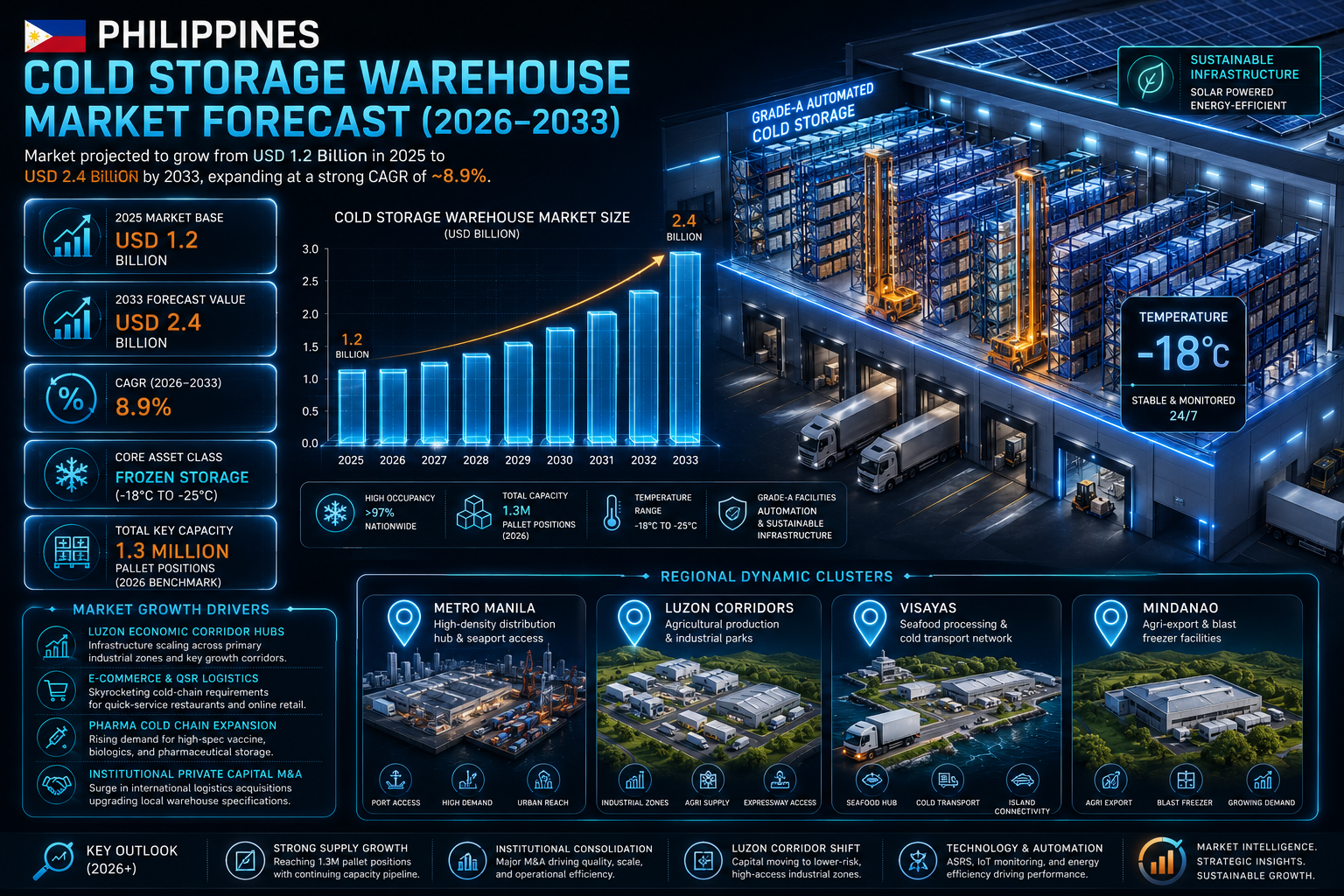
Philippines Cold Storage Warehouse Market Overview
The Philippines cold storage warehouse market forms an important segment of the country???s logistics, food processing, and supply chain infrastructure industry.As the Philippines continues to modernize its food distribution and healthcare systems, cold storage capacity is becoming increasingly essential for maintaining product integrity and minimizing food wastage. The market includes refrigerated warehouses, frozen storage facilities, blast freezers, chilled distribution centers, pharmaceutical cold chain storage, and integrated temperature-controlled logistics hubs. Rapid expansion of supermarkets, quick-service restaurants (QSRs), food delivery platforms, and pharmaceutical distribution networks is accelerating demand for advanced cold storage facilities nationwide. Technological innovations such as AI-driven inventory management, automated retrieval systems, real-time cold chain tracking, and renewable-energy-powered refrigeration are improving operational efficiency and sustainability. Major market participants include Royal Cargo Group, Glacier Megafridge Inc., IceStar Cold Storage, Mets Logistics Inc., ORCA Cold Chain Solutions, Fast Logistics Group, and various regional refrigerated warehousing operators.Key Drivers of Philippines Cold Storage Warehouse Market Growth
Growing Demand for Frozen and Processed Foods
Increasing urbanization and changing consumer eating habits are driving strong demand for frozen meat, seafood, ready-to-eat meals, dairy products, and processed foods. Cold storage warehouses are essential for maintaining product freshness and extending shelf life across the food supply chain.Expansion of E-commerce and Online Grocery Delivery
The rapid growth of online grocery platforms and food delivery services is increasing demand for temperature-controlled storage and last-mile cold logistics infrastructure. E-commerce retailers require reliable cold storage networks to support fast and safe delivery of perishable products.Growth of Pharmaceutical Cold Chain Logistics
The pharmaceutical sector is increasingly relying on cold storage facilities for vaccines, biologics, insulin, and temperature-sensitive medicines. Government healthcare investments and vaccine distribution programs are further supporting market expansion.Rising Food Import and Export Activities
The Philippines imports significant volumes of frozen meat, seafood, fruits, and dairy products, increasing the need for advanced refrigerated warehousing infrastructure. Cold storage facilities are also critical for supporting seafood exports and agricultural trade.Technological Advancements in Cold Chain Infrastructure
IoT-enabled monitoring systems, AI-based inventory management, automated storage systems, and energy-efficient refrigeration technologies are improving warehouse efficiency and reducing operational costs. Smart cold chain solutions are becoming increasingly important for regulatory compliance and quality assurance.Philippines Cold Storage Warehouse Market Segmentation
By Storage Type
The market is segmented into chilled storage, frozen storage, and ambient-controlled storage. Frozen storage facilities account for the largest market share due to strong demand from meat, seafood, and processed food industries.By Temperature Range
The market includes refrigerated storage (0??C to 8??C), frozen storage (-18??C to -25??C), and ultra-low temperature storage. Frozen storage dominates due to increasing consumption of frozen food products nationwide.By Application
Applications include food & beverages, pharmaceuticals, agriculture, seafood, dairy products, chemicals, and retail distribution. Food and beverage applications represent the largest market segment.By End User
End users include food manufacturers, retailers, logistics companies, pharmaceutical distributors, hospitality businesses, and e-commerce operators. Retail and food processing industries remain major contributors to market demand.Regional Market Dynamics
Metro Manila
Metro Manila represents the largest cold storage market due to high population density, strong retail infrastructure, and concentration of food distribution networks. The region benefits from advanced logistics connectivity and high demand for imported food products.Luzon
Luzon accounts for a major share of cold storage investments due to its large agricultural production base and expanding industrial zones. Food manufacturing and export activities are driving infrastructure development in the region.Visayas
The Visayas region is witnessing increasing demand for seafood cold chain infrastructure and agricultural storage facilities. Growing tourism activities are also supporting demand for refrigerated food distribution.Mindanao
Mindanao is emerging as an important market due to expanding agriculture exports, seafood processing industries, and government investments in logistics infrastructure. The region offers strong growth opportunities for cold storage expansion.Competitive Landscape
The Philippines cold storage warehouse market is moderately fragmented with participation from logistics companies, refrigerated warehousing operators, and integrated cold chain service providers. Key companies include Royal Cargo Group, Glacier Megafridge Inc., IceStar Cold Storage, Mets Logistics Inc., ORCA Cold Chain Solutions, and Fast Logistics Group. Companies are increasingly investing in warehouse automation, energy-efficient refrigeration systems, and nationwide cold chain expansion strategies. Strategic partnerships between logistics providers, retailers, food manufacturers, and pharmaceutical distributors are becoming increasingly common.Strategic Outlook
The strategic outlook for the Philippines cold storage warehouse market remains highly positive due to increasing demand for food preservation, pharmaceutical logistics, and modern retail supply chains. Future opportunities include automated cold warehouses, solar-powered refrigeration systems, smart logistics integration, and expansion of last-mile cold delivery infrastructure. Government support for food security, agriculture modernization, and healthcare infrastructure development is expected to further strengthen market growth. Companies investing in technology-driven cold chain solutions, regional distribution expansion, and sustainable refrigeration technologies are likely to gain strong competitive advantages.Final Market Perspective
The Philippines cold storage warehouse market is becoming increasingly critical to the country???s food security, healthcare logistics, and modern retail ecosystem. Rising demand for temperature-sensitive products, expansion of organized retail, and growth of e-commerce food distribution will continue driving market expansion throughout the forecast period. Organizations that successfully combine advanced cold chain technologies, operational efficiency, and nationwide logistics capabilities will remain strongly positioned in the evolving Philippines cold storage warehouse market.Table of Contents
Table of Contents
1. Executive Summary
- 1.1 Philippines Cold Storage Warehouse Market Snapshot (2026???2033)
- 1.2 Market Size & CAGR Analysis
- 1.3 Key Market Drivers & Growth Opportunities
- 1.4 Largest & Fastest-Growing Segments
- 1.5 Regional Market Highlights
- 1.6 Competitive Landscape Overview
- 1.7 Strategic Outlook Through 2033
2. Introduction & Market Overview
- 2.1 Definition of Cold Storage Warehouses
- 2.2 Market Scope & Industry Structure
- 2.3 Philippines Market Size & Forecast (2026???2033)
- 2.4 Evolution of Cold Chain Infrastructure in the Philippines
- 2.5 Supply Chain & Logistics Ecosystem
- 2.6 Regulatory & Food Safety Framework
- 2.7 Technology & Innovation Landscape
3. Research Methodology
- 3.1 Primary Research
- 3.2 Secondary Research
- 3.3 Data Collection & Validation Techniques
- 3.4 Market Estimation Methodology
- 3.5 Forecast Assumptions (2026???2033)
- 3.6 Market Data Triangulation
4. Market Dynamics
4.1 Market Drivers
- 4.1.1 Growing Demand for Frozen & Processed Foods
- 4.1.2 Expansion of E-Commerce Grocery Delivery
- 4.1.3 Increasing Pharmaceutical Cold Chain Requirements
- 4.1.4 Rising Food Import & Export Activities
- 4.1.5 Advancements in Cold Chain Technologies
4.2 Market Restraints
- 4.2.1 High Capital Investment Requirements
- 4.2.2 Energy Consumption & Operational Costs
- 4.2.3 Limited Cold Chain Infrastructure in Rural Areas
- 4.2.4 Maintenance & Equipment Reliability Challenges
4.3 Market Opportunities
- 4.3.1 Smart Warehouse Automation Solutions
- 4.3.2 Solar-Powered & Sustainable Refrigeration Systems
- 4.3.3 Expansion of Last-Mile Cold Delivery Networks
- 4.3.4 Government Food Security & Agriculture Initiatives
4.4 Market Challenges
- 4.4.1 Cold Chain Infrastructure Gaps
- 4.4.2 Temperature Monitoring & Compliance Issues
- 4.4.3 Supply Chain Disruptions & Transportation Delays
- 4.4.4 Skilled Workforce & Technical Expertise Shortage
5. Philippines Cold Storage Warehouse Market Analysis (USD Billion), 2026???2033
- 5.1 Market Revenue Analysis
- 5.2 CAGR Analysis
- 5.3 Market Share Analysis
- 5.4 Regional Revenue Distribution
- 5.5 Cold Chain Capacity Utilization Analysis
- 5.6 Technology Adoption Trends
6. Market Segmentation (USD Billion), 2026???2033
6.1 By Storage Type
- 6.1.1 Chilled Storage
- 6.1.1.1 Fresh Food Storage Facilities
- 6.1.1.2 Dairy & Beverage Refrigeration Units
- 6.1.2 Frozen Storage
- 6.1.2.1 Frozen Food Warehouses
- 6.1.2.2 Seafood & Meat Cold Storage Facilities
- 6.1.3 Ambient-Controlled Storage
- 6.1.3.1 Pharmaceutical Temperature-Controlled Facilities
- 6.1.3.2 Specialty Product Storage Solutions
6.2 By Temperature Range
- 6.2.1 Refrigerated Storage (0??C to 8??C)
- 6.2.2 Frozen Storage (-18??C to -25??C)
- 6.2.3 Ultra-Low Temperature Storage
6.3 By Application
- 6.3.1 Food & Beverages
- 6.3.2 Pharmaceuticals
- 6.3.3 Agriculture
- 6.3.4 Seafood
- 6.3.5 Dairy Products
- 6.3.6 Chemicals
- 6.3.7 Retail Distribution
6.4 By End User
- 6.4.1 Food Manufacturers
- 6.4.2 Retailers & Supermarkets
- 6.4.3 Logistics Companies
- 6.4.4 Pharmaceutical Distributors
- 6.4.5 Hospitality Businesses
- 6.4.6 E-Commerce Operators
7. Market Segmentation by Region
- 7.1 Metro Manila
- 7.2 Luzon
- 7.3 Visayas
- 7.4 Mindanao
8. Regional Market Insights
- 8.1 Metro Manila Market Analysis
- 8.2 Luzon Market Analysis
- 8.3 Visayas Market Analysis
- 8.4 Mindanao Market Analysis
9. Competitive Landscape
- 9.1 Market Share Analysis
- 9.2 Competitive Benchmarking
- 9.3 Cold Chain Infrastructure Expansion Strategies
- 9.4 Technology & Automation Developments
- 9.5 Strategic Partnerships & Collaborations
- 9.6 Investments & Capacity Expansion
10. Company Profiles
- 10.1 Royal Cargo Group
- 10.2 Glacier Megafridge Inc.
- 10.3 IceStar Cold Storage
- 10.4 Mets Logistics Inc.
- 10.5 ORCA Cold Chain Solutions
- 10.6 Fast Logistics Group
- 10.7 Regional Refrigerated Warehousing Operators
11. Strategic Intelligence & AI Insights
- 11.1 Smart Cold Chain Technology Analysis
- 11.2 AI-Based Inventory & Warehouse Optimization
- 11.3 Renewable Energy Refrigeration Trends
- 11.4 Food Security & Supply Chain Risk Insights
- 11.5 Porter???s Five Forces Analysis
12. Future Outlook & Strategic Recommendations
- 12.1 Future of Automated Cold Warehousing
- 12.2 Expansion of Nationwide Cold Chain Networks
- 12.3 Sustainable Refrigeration Technology Strategies
- 12.4 Growth Opportunities in Pharmaceutical Logistics
- 12.5 Long-Term Market Outlook (2033+)
13. Appendix
14. About Pheonix Research
15. Disclaimer
Competitive Landscape
Philippines Cold Storage Warehouse Market Competitive Intensity & Market Structure Overview
The Philippines cold storage warehouse market is moderately fragmented and increasingly competitive, driven by rising investments in food logistics infrastructure, pharmaceutical cold chain expansion, and growth in temperature-controlled e-commerce distribution. Competition within the market is centered around storage capacity, geographic network coverage, temperature reliability, energy efficiency, automation capabilities, and integrated logistics services.
The market structure includes large integrated logistics providers, specialized refrigerated warehousing operators, food supply chain companies, and regional cold chain service providers. Demand is expanding rapidly due to the increasing need for reliable frozen food distribution, seafood exports, vaccine storage, and modern retail logistics.
As the Philippines modernizes its supply chain ecosystem, companies are increasingly transitioning from conventional refrigerated storage operations toward technology-enabled smart cold chain infrastructure with real-time monitoring and automated warehouse management systems.
Philippines Cold Storage Warehouse Market Competitive Intensity & Market Structure Current Scenario
Leading Cold Storage & Refrigerated Logistics Companies
Royal Cargo Group: One of the leading integrated logistics and cold chain service providers in the Philippines with extensive refrigerated warehousing and distribution capabilities.
Glacier Megafridge Inc.: Major cold storage operator focused on large-scale frozen and chilled warehousing solutions supporting food and retail industries.
IceStar Cold Storage: Key provider of temperature-controlled warehousing and cold logistics services catering to food processors, importers, and retailers.
Mets Logistics Inc.: Important cold chain logistics company offering refrigerated transportation, warehousing, and nationwide distribution solutions.
ORCA Cold Chain Solutions: Growing participant in the Philippine cold storage sector focused on advanced refrigerated infrastructure and integrated logistics operations.
Fast Logistics Group: Integrated logistics and supply chain company expanding its presence in refrigerated warehousing and cold distribution services.
Regional Refrigerated Warehousing Operators: Numerous local and regional operators continue to support seafood processing, agriculture, retail distribution, and provincial cold chain requirements across the country.
Key Competitive Intensity & Market Structure Drivers
Rising consumption of frozen food products, processed meat, seafood, dairy products, and imported perishables is significantly increasing competition among cold storage operators to expand warehouse capacity and improve distribution efficiency.
The rapid growth of online grocery delivery platforms and food e-commerce services is accelerating demand for strategically located cold storage facilities near urban consumption centers and transportation hubs.
Technology adoption is becoming a major competitive differentiator, with operators increasingly investing in IoT-enabled temperature monitoring, warehouse automation, AI-based inventory management, and real-time cold chain tracking systems.
Energy efficiency and sustainability are also becoming critical competitive factors due to the high electricity consumption associated with refrigeration infrastructure in the Philippines.
Pharmaceutical cold chain logistics are emerging as an important growth segment, particularly for vaccines, biologics, insulin, and temperature-sensitive healthcare products requiring strict compliance and reliability standards.
Strategic Implications of Competitive Intensity & Market Structure
Cold storage companies are increasingly pursuing nationwide network expansion strategies to improve last-mile cold delivery coverage and strengthen regional supply chain capabilities.
Strategic partnerships between logistics providers, supermarket chains, food importers, pharmaceutical distributors, and e-commerce companies are becoming increasingly important for securing long-term storage contracts and improving supply chain integration.
Warehouse automation and digitalization investments are expected to increase significantly as operators seek to improve operational efficiency, reduce spoilage risks, and optimize inventory management.
The market is also witnessing increasing interest in renewable-energy-powered refrigeration systems and environmentally sustainable cold chain infrastructure to reduce operational costs and meet sustainability objectives.
Regional expansion into Visayas and Mindanao is becoming a key strategic focus area due to growing agricultural exports, seafood processing industries, and rising retail demand outside Metro Manila.
Philippines Cold Storage Warehouse Market Competitive Intensity & Market Structure Forward Outlook
The Philippines cold storage warehouse market is expected to remain highly investment-driven as food security initiatives, healthcare modernization, and organized retail expansion continue to strengthen demand for advanced cold chain infrastructure.
Automation technologies including robotic storage systems, AI-driven warehouse analytics, predictive maintenance solutions, and smart refrigeration management are expected to reshape future competitive dynamics within the industry.
Pharmaceutical cold chain expansion and vaccine logistics are likely to create additional opportunities for specialized temperature-controlled storage providers with high compliance capabilities.
The expansion of modern supermarkets, quick-service restaurants, and e-commerce grocery platforms will continue increasing the need for scalable refrigerated warehousing and efficient nationwide cold distribution networks.
Overall, companies that successfully combine advanced refrigeration technologies, nationwide logistics reach, digital cold chain visibility, and energy-efficient infrastructure will remain strongly positioned in the evolving Philippines cold storage warehouse market.
Value Chain
Philippines Cold Storage Warehouse Market Value Chain & Supply Chain Evolution Overview
The Philippines cold storage warehouse market value chain is evolving into a highly integrated, technology-driven, and infrastructure-intensive ecosystem supported by rising demand for temperature-controlled logistics across food, pharmaceuticals, agriculture, seafood, and retail industries. The market is transitioning from conventional refrigerated warehousing toward digitally connected and energy-efficient cold chain networks capable of supporting nationwide distribution and long-term food security objectives.
The value chain begins with upstream infrastructure development and equipment sourcing, including refrigeration systems, insulated panels, compressors, cooling units, temperature sensors, warehouse automation systems, and energy management technologies. Equipment manufacturers, refrigeration engineering firms, and industrial infrastructure developers play a critical role in ensuring operational reliability, storage efficiency, and compliance with food safety regulations.
The warehouse construction and cold storage facility development segment forms the foundation of the industry. Cold storage operators and logistics infrastructure companies invest in refrigerated warehouses, blast freezers, chilled storage units, pharmaceutical cold rooms, and integrated distribution hubs. Rapid urbanization and increasing demand for frozen food logistics are accelerating investments in large-scale cold chain infrastructure across the Philippines.
Storage operations and warehouse management activities include temperature monitoring, inventory tracking, pallet handling, product segregation, energy optimization, and compliance management. Companies are increasingly adopting IoT-enabled monitoring systems, AI-based inventory management platforms, automated retrieval systems, and cloud-connected warehouse management software to improve operational efficiency and reduce spoilage risks.
The transportation and logistics layer includes refrigerated trucking fleets, containerized cold transport systems, port-based cold logistics facilities, and last-mile cold delivery networks. Cold chain transportation providers ensure uninterrupted temperature-controlled movement of products between ports, warehouses, retail outlets, hospitals, restaurants, and distribution centers.
Distribution and commercialization involve food manufacturers, supermarkets, quick-service restaurants, pharmaceutical distributors, seafood exporters, agriculture suppliers, e-commerce grocery platforms, and hospitality operators. Rising demand for frozen food products, imported food items, and pharmaceutical cold storage solutions is significantly expanding downstream cold chain activities.
Sustainability and energy efficiency are becoming increasingly important across the value chain. Companies are investing in energy-efficient refrigeration technologies, solar-powered cold storage systems, environmentally friendly refrigerants, and smart energy management solutions to reduce operational costs and environmental impact.
Philippines Cold Storage Warehouse Market Value Chain & Supply Chain Evolution Current Scenario
The current cold storage warehouse supply chain in the Philippines is characterized by expanding infrastructure investments, fragmented regional distribution networks, and increasing adoption of advanced cold chain technologies. Growing food imports, rising seafood exports, and expanding pharmaceutical distribution activities are strengthening demand for modern temperature-controlled storage facilities.
Metro Manila and Luzon dominate the cold storage ecosystem due to strong logistics infrastructure, concentration of retail networks, and high population density. These regions account for a significant share of refrigerated warehousing capacity and food distribution activities.
Visayas and Mindanao are emerging as important cold chain growth regions supported by seafood processing industries, agricultural production, export activities, and infrastructure modernization initiatives. Government investments in logistics corridors and regional connectivity are improving cold chain accessibility in these regions.
The industry is increasingly shifting toward integrated cold chain solutions combining warehousing, transportation, inventory management, and real-time monitoring systems. Logistics providers are expanding nationwide refrigerated transport networks to improve product movement efficiency and reduce spoilage losses.
Digital transformation is reshaping operational management through AI-powered warehouse optimization, IoT-enabled temperature monitoring, predictive maintenance systems, and cloud-based logistics tracking platforms. These technologies improve traceability, compliance management, and operational reliability.
However, the market continues to face challenges related to high electricity costs, fragmented transportation infrastructure, limited cold storage capacity in rural areas, and supply chain inefficiencies affecting nationwide cold chain distribution.
Key Value Chain & Supply Chain Evolution Signals in Philippines Cold Storage Warehouse Market
One of the most significant transformation signals is the rapid expansion of e-commerce grocery delivery and online food retail platforms, which is increasing demand for urban cold storage facilities and last-mile refrigerated logistics infrastructure.
Another major signal is the growing adoption of smart cold chain technologies such as IoT-enabled temperature sensors, AI-driven warehouse management systems, automated storage and retrieval systems, and predictive refrigeration maintenance platforms.
The pharmaceutical cold chain segment is also emerging as a major growth driver due to rising demand for vaccine storage, biologics distribution, and temperature-sensitive healthcare products. Pharmaceutical-grade cold storage facilities are witnessing increasing investments nationwide.
Sustainability initiatives are accelerating within the industry as operators invest in energy-efficient refrigeration equipment, solar-powered facilities, low-emission refrigerants, and green warehouse infrastructure to reduce operating costs and environmental impact.
Cold chain consolidation and regional expansion strategies are becoming increasingly important as logistics companies seek to establish integrated nationwide refrigerated distribution networks capable of supporting food security and retail modernization.
Additionally, government support for agriculture modernization, fisheries exports, healthcare infrastructure, and food supply chain resilience is creating long-term growth opportunities for cold storage infrastructure development.
Strategic Implications of Value Chain & Supply Chain Evolution in Philippines Cold Storage Warehouse Market
The evolving value chain presents significant strategic implications for logistics providers, cold storage operators, retailers, pharmaceutical distributors, and food processing companies. Businesses capable of offering integrated cold chain solutions with nationwide coverage are gaining strong competitive advantages.
Vertical integration is becoming increasingly important as companies expand across refrigerated warehousing, transportation, inventory management, and last-mile delivery operations to improve service reliability and operational efficiency.
Investment in automation technologies, smart warehouse systems, and real-time monitoring infrastructure is becoming a critical differentiator within the market. Technology-driven cold chain operations improve energy efficiency, reduce spoilage, and strengthen regulatory compliance.
Regional expansion strategies are also becoming strategically important as companies establish cold storage facilities in underserved agricultural and export-oriented regions such as Mindanao and Visayas.
Sustainability investment in renewable energy integration, energy-efficient cooling systems, and environmentally friendly refrigerants is helping operators reduce operational expenses while supporting environmental compliance goals.
Long-term competitiveness in the Philippines cold storage warehouse market will depend on balancing infrastructure expansion, technology integration, operational efficiency, sustainability, and nationwide logistics accessibility.
Philippines Cold Storage Warehouse Market Value Chain & Supply Chain Evolution Forward Outlook
Between 2026 and 2033, the Philippines cold storage warehouse value chain is expected to become increasingly automated, digitally connected, and energy-efficient. Smart cold chain technologies will continue improving inventory visibility, product traceability, and operational optimization across storage and transportation networks.
AI-powered warehouse management systems, automated storage technologies, predictive refrigeration maintenance, and blockchain-based logistics tracking are expected to enhance transparency and reduce supply chain disruptions.
The rapid expansion of organized retail, online grocery platforms, food processing industries, and pharmaceutical cold chain logistics will continue driving demand for large-scale refrigerated warehousing infrastructure nationwide.
Renewable energy adoption and sustainable refrigeration technologies are expected to accelerate as operators seek to address rising electricity costs and strengthen environmental sustainability performance.
Government investments in logistics infrastructure, agriculture modernization, fisheries exports, and healthcare distribution systems will further support long-term cold chain expansion opportunities across the Philippines.
Ultimately, the future cold storage warehouse value chain in the Philippines will evolve into a highly integrated, technology-enabled, and sustainability-focused logistics ecosystem where operational efficiency, nationwide connectivity, and cold chain reliability define long-term market competitiveness.
Market-Specific Value Chain
- Infrastructure & Equipment Sourcing: Refrigeration equipment suppliers, insulated panel manufacturers, cooling system providers, warehouse construction firms, automation technology vendors
- Cold Storage Facility Development: Refrigerated warehouse developers, blast freezer operators, pharmaceutical cold room providers, integrated cold logistics infrastructure companies
- Warehouse Operations & Management: Inventory management providers, IoT monitoring system operators, automated storage system integrators, energy management service providers
- Cold Transportation & Logistics: Refrigerated trucking companies, cold container operators, port-based cold logistics providers, last-mile refrigerated delivery operators
- Distribution & Commercialization: Food manufacturers, supermarkets, pharmaceutical distributors, seafood exporters, hospitality businesses, e-commerce grocery platforms
- End-Use Applications: Frozen food storage, seafood logistics, dairy distribution, vaccine storage, pharmaceutical cold chain, agriculture exports, retail food distribution
Investment Activity
Philippines Cold Storage Warehouse Market Investment & Funding Dynamics Overview
Investment and funding activity in the Philippines cold storage warehouse market is accelerating rapidly due to rising demand for frozen food products, expanding pharmaceutical cold chain requirements, increasing online grocery delivery services, and growing government focus on food security infrastructure. Between 2026 and 2033, investments are expected to increasingly target temperature-controlled logistics hubs, automated cold warehouses, energy-efficient refrigeration systems, and integrated smart cold chain technologies.
The market is evolving into a critical component of the Philippines??? modern supply chain and food distribution ecosystem. Investors, logistics operators, food manufacturers, and retail companies are actively expanding cold storage capacity to address rising consumption of frozen and processed foods, seafood exports, dairy imports, and pharmaceutical products requiring temperature-sensitive handling.
Major logistics and cold chain companies including Royal Cargo Group, Glacier Megafridge Inc., IceStar Cold Storage, Mets Logistics Inc., ORCA Cold Chain Solutions, and Fast Logistics Group are increasing investments in warehouse expansion, nationwide distribution infrastructure, and technology-enabled refrigeration systems to strengthen operational capabilities and improve supply chain efficiency.
The investment landscape is also being shaped by increasing urbanization, rapid retail modernization, expansion of supermarket chains, and growth in food service industries across Metro Manila, Luzon, Visayas, and Mindanao. Rising e-commerce penetration and digital grocery delivery platforms are further accelerating demand for advanced cold chain infrastructure throughout the country.
Philippines Cold Storage Warehouse Market Investment & Funding Dynamics Current Scenario
Current investment activity in the Philippines cold storage warehouse market is being driven by both domestic and international investors seeking to capitalize on expanding demand for refrigerated logistics infrastructure. Companies are actively funding warehouse modernization, AI-driven inventory systems, automated retrieval technologies, and energy-efficient refrigeration equipment to improve storage efficiency and regulatory compliance.
- Metro Manila: Continues to attract the largest share of investments due to high population density, expanding food retail networks, strong import activity, and concentration of pharmaceutical distribution centers.
- Luzon: Witnessing strong infrastructure investments supported by food manufacturing expansion, agricultural logistics modernization, and increasing industrial development.
- Visayas: Emerging as an important investment region due to growing seafood exports, tourism-driven food demand, and rising cold chain requirements for hospitality businesses.
- Mindanao: Experiencing rising investments in agricultural cold storage, seafood processing infrastructure, and regional logistics connectivity supported by government development programs.
Key Investment & Funding Dynamics Signals in Philippines Cold Storage Warehouse Market
- Growing demand for frozen and processed food products is increasing investments in large-scale frozen storage facilities and refrigerated logistics networks.
- Expansion of pharmaceutical cold chain logistics is driving funding into vaccine storage facilities, biologics distribution systems, and temperature-controlled healthcare warehousing.
- The rapid rise of e-commerce grocery delivery platforms is accelerating investments in urban cold storage hubs and last-mile refrigerated delivery infrastructure.
- Technological advancements such as IoT-enabled temperature monitoring, AI-based warehouse management systems, and automated storage solutions are attracting infrastructure modernization investments.
- Energy efficiency and sustainability initiatives are encouraging funding into solar-powered refrigeration systems, low-emission cooling technologies, and environmentally sustainable cold storage operations.
- Food import and export growth is increasing investments in port-based refrigerated warehousing facilities and integrated cold logistics corridors.
- Government food security initiatives and agriculture modernization programs are supporting public-private partnerships in cold chain infrastructure development.
Strategic Implications of Investment & Funding Dynamics in Philippines Cold Storage Warehouse Market
- The investment environment increasingly favors operators capable of combining nationwide logistics coverage, advanced refrigeration technology, and integrated supply chain management capabilities.
- Warehouse automation and digital cold chain monitoring systems are becoming major competitive differentiators for attracting institutional investment and large commercial contracts.
- Strategic partnerships between logistics companies, food manufacturers, retailers, pharmaceutical distributors, and e-commerce operators are strengthening market expansion opportunities.
- Regional diversification strategies are becoming increasingly important as companies expand beyond Metro Manila into emerging cold storage markets across Luzon, Visayas, and Mindanao.
- Sustainability-focused infrastructure investments are gaining momentum as operators seek to reduce energy costs and comply with environmental regulations.
- Companies investing in smart warehousing technologies, predictive maintenance systems, and real-time temperature analytics are expected to improve operational efficiency and service reliability.
- Organizations with scalable cold chain infrastructure, strong distribution partnerships, and advanced warehouse management capabilities are likely to maintain stronger competitive positioning.
Philippines Cold Storage Warehouse Market Investment & Funding Dynamics Forward Outlook
Looking ahead, the Philippines cold storage warehouse market is expected to attract strong long-term investment due to increasing demand for food preservation infrastructure, pharmaceutical cold logistics, and temperature-controlled e-commerce distribution systems.
Future funding activity will increasingly focus on automated cold warehouses, AI-enabled supply chain optimization, renewable-energy-powered refrigeration systems, and nationwide integrated cold chain expansion projects.
- Metro Manila: Will remain the leading investment center due to high retail demand, import logistics concentration, and pharmaceutical distribution activity.
- Luzon: Will continue attracting large-scale investments in food processing logistics, industrial cold storage, and export-oriented refrigerated warehousing.
- Visayas & Mindanao: Are expected to witness increasing funding for seafood cold chain development, agricultural logistics modernization, and regional cold distribution infrastructure.
Emerging investment opportunities are also expected across ultra-low temperature pharmaceutical storage, smart warehouse robotics, AI-powered inventory forecasting, and integrated multi-temperature logistics facilities.
Government initiatives supporting food security, healthcare modernization, logistics infrastructure development, and agricultural supply chain efficiency will continue strengthening long-term market investment potential.
Overall, the Philippines cold storage warehouse market is expected to maintain strong investment momentum as cold chain infrastructure becomes increasingly essential for food distribution, healthcare logistics, retail modernization, and e-commerce growth. Companies that successfully combine advanced refrigeration technologies, operational scalability, sustainability leadership, and nationwide logistics integration will remain strongly positioned to lead the evolving Philippines cold storage warehouse market through 2033.
Technology & Innovation
Philippines Cold Storage Warehouse Market Technology & Innovation Landscape Overview
The Philippines cold storage warehouse market is undergoing significant technological transformation driven by advancements in smart refrigeration systems, warehouse automation, IoT-enabled monitoring, artificial intelligence (AI), and sustainable cold chain infrastructure. Innovation across the industry is focused on improving temperature control accuracy, reducing energy consumption, enhancing inventory visibility, and optimizing end-to-end cold logistics operations.
As demand for frozen food, pharmaceuticals, seafood exports, and e-commerce grocery delivery continues to rise, cold storage operators are increasingly investing in advanced digital technologies and automated warehouse systems to improve operational efficiency and supply chain reliability. These innovations are helping companies reduce spoilage, minimize operational costs, and strengthen regulatory compliance within temperature-sensitive logistics environments.
The market is also experiencing growing adoption of cloud-based warehouse management systems (WMS), AI-driven predictive maintenance platforms, and real-time cold chain analytics. These technologies are enabling operators to improve inventory accuracy, optimize warehouse utilization, and monitor environmental conditions across distributed logistics networks.
Sustainability is becoming a major innovation priority within the Philippines cold storage sector. Companies are increasingly deploying energy-efficient refrigeration systems, solar-powered cooling infrastructure, low-emission refrigerants, and smart energy management technologies to reduce carbon footprint and operational expenses.
Philippines Cold Storage Warehouse Market Technology & Innovation Current Scenario
Currently, the Philippines cold storage warehouse industry is rapidly modernizing as operators expand capacity and adopt intelligent cold chain technologies to support rising domestic consumption and international trade. Large cold chain providers are investing heavily in automated storage systems, digital logistics platforms, and advanced refrigeration technologies to improve scalability and efficiency.
IoT-enabled temperature and humidity monitoring systems are becoming widely adopted across refrigerated warehouses and transport networks. These systems provide real-time environmental tracking, automated alerts, and remote monitoring capabilities, helping operators maintain strict cold chain compliance for food and pharmaceutical products.
Warehouse automation technologies are gaining strong momentum within the market. Automated storage and retrieval systems (AS/RS), robotic pallet handling systems, conveyor automation, and barcode/RFID-based inventory management are improving warehouse throughput and reducing manual handling errors.
Artificial intelligence and predictive analytics are increasingly being integrated into warehouse operations. AI-based demand forecasting, inventory optimization, route planning, and predictive equipment maintenance are helping companies improve operational efficiency while reducing downtime and energy usage.
Energy-efficient refrigeration systems are becoming a major area of innovation due to rising electricity costs and sustainability requirements. Operators are deploying variable-speed compressors, ammonia-based refrigeration systems, thermal insulation improvements, and renewable-energy-powered cooling systems to improve energy efficiency.
Cloud-based logistics platforms and integrated transportation management systems are also improving supply chain coordination between warehouses, retailers, distributors, food manufacturers, and e-commerce delivery providers.
Key Technology & Innovation Trends in Philippines Cold Storage Warehouse Market
- IoT-Enabled Temperature Monitoring: Real-time temperature and humidity tracking systems improving cold chain visibility and compliance.
- Warehouse Automation: Automated storage and retrieval systems (AS/RS), robotic handling equipment, and conveyor-based logistics automation.
- AI-Driven Inventory Management: Predictive analytics and machine learning systems optimizing stock rotation and warehouse utilization.
- Cloud-Based Warehouse Management Systems (WMS): Digital platforms enabling real-time inventory control, logistics coordination, and operational monitoring.
- Energy-Efficient Refrigeration Technologies: Smart cooling systems, low-emission refrigerants, and energy optimization technologies reducing operational costs.
- RFID & Barcode Tracking: Advanced tracking technologies improving product traceability and inventory accuracy.
- Predictive Maintenance Systems: AI-powered monitoring tools detecting refrigeration equipment issues before system failures occur.
- Solar-Powered Cold Storage: Renewable-energy-integrated refrigeration infrastructure improving sustainability and energy resilience.
- Cold Chain Data Analytics: Real-time logistics analytics platforms improving route optimization and warehouse performance.
- Integrated Last-Mile Cold Delivery Solutions: Smart logistics systems supporting temperature-controlled e-commerce and food delivery operations.
Strategic Implications of Technology & Innovation
Technological innovation is significantly reshaping the competitive landscape of the Philippines cold storage warehouse market by enabling higher operational efficiency, stronger food safety compliance, and improved logistics scalability. Companies investing in intelligent cold chain technologies are gaining stronger competitive positioning within food distribution, pharmaceutical logistics, and e-commerce supply chains.
The adoption of IoT monitoring systems and AI-driven analytics is improving supply chain transparency while reducing spoilage risks and inventory losses. These technologies are becoming increasingly critical for meeting regulatory requirements and maintaining product quality across temperature-sensitive distribution networks.
Warehouse automation is also reducing dependency on manual labor while improving throughput speed, inventory accuracy, and operational consistency. Automated cold storage systems are becoming particularly important for large-scale food importers, supermarket chains, and pharmaceutical distributors handling high-volume inventory operations.
At the same time, sustainability-focused innovation is becoming a major strategic differentiator within the market. Companies adopting renewable energy integration, energy-efficient refrigeration technologies, and environmentally friendly refrigerants are improving long-term operational resilience and aligning with global sustainability goals.
However, high capital investment requirements for advanced cold storage infrastructure, energy-intensive operations, and technical workforce limitations remain important challenges for market participants, particularly smaller regional operators.
Philippines Cold Storage Warehouse Market Technology & Innovation Forward Outlook
Looking ahead, the Philippines cold storage warehouse market is expected to evolve toward highly automated, AI-enabled, and sustainability-driven cold chain ecosystems powered by smart logistics infrastructure, predictive analytics, and renewable energy integration.
Future innovation will increasingly focus on autonomous warehouse operations, robotics-assisted inventory handling, AI-based cold chain optimization, and digital twin technologies capable of simulating warehouse performance and energy usage in real time.
The expansion of e-commerce grocery delivery and pharmaceutical cold chain networks is expected to accelerate demand for intelligent last-mile refrigeration technologies, portable cold storage units, and connected delivery systems with end-to-end temperature tracking capabilities.
Sustainability technologies are likely to become even more important as operators adopt solar-powered refrigeration systems, carbon-neutral cold warehouses, and advanced thermal energy storage solutions to reduce environmental impact and energy costs.
Blockchain-based traceability systems and integrated digital supply chain platforms are also expected to improve transparency, product authentication, and regulatory compliance across food and pharmaceutical logistics networks.
Overall, the technology and innovation landscape of the Philippines cold storage warehouse market is rapidly advancing toward intelligent, energy-efficient, and digitally connected cold chain ecosystems. Companies that successfully combine automation, smart refrigeration technologies, AI-driven logistics optimization, and sustainable infrastructure development will remain strongly positioned in the evolving Philippines cold storage industry.
Market Risk
Philippines Cold Storage Warehouse Market Risk Factors & Disruption Threats Overview
The Philippines cold storage warehouse market is expanding due to rising demand for frozen and processed foods, pharmaceutical cold chain requirements, and rapid growth in e-commerce grocery delivery. However, despite strong growth prospects, the industry is exposed to multiple structural and operational risk factors including high energy consumption, infrastructure gaps, climate vulnerability, regulatory compliance pressures, and supply chain inefficiencies.
A major risk factor is the high dependency on continuous electricity supply for refrigeration systems. Cold storage warehouses require uninterrupted power to maintain temperature integrity, and any instability in the energy grid can lead to product spoilage and financial losses. Rising electricity tariffs further intensify operational cost pressure, especially for large-scale facilities.
Infrastructure limitations across inter-island logistics networks also pose significant challenges. Inconsistent transport connectivity, port delays, and limited cold chain penetration in provincial regions can disrupt the movement of temperature-sensitive goods and reduce supply chain efficiency.
Climate-related risks are particularly high in the Philippines due to frequent typhoons, flooding, and extreme weather events. These disruptions can damage warehouse infrastructure, interrupt distribution networks, and compromise stored perishable goods, leading to significant operational losses.
Regulatory compliance requirements in food safety and pharmaceutical storage add another layer of complexity. Cold storage operators must adhere to strict temperature control standards, hygiene protocols, and certification requirements, increasing operational burden and compliance costs.
Philippines Cold Storage Warehouse Market Risk Factors & Disruption Threats Current Scenario
The current market environment is characterized by strong demand growth driven by urbanization, retail expansion, and rising consumption of frozen foods. At the same time, operators are increasingly investing in automation, IoT-based monitoring, and energy-efficient refrigeration systems to improve efficiency and reduce losses.
However, rising construction costs, inflation in refrigeration equipment prices, and higher maintenance expenses are impacting profit margins. Smaller operators in particular face challenges in scaling operations due to high capital requirements.
Environmental sustainability expectations are also increasing, with growing pressure to reduce carbon emissions from energy-intensive refrigeration systems. This is encouraging a shift toward eco-friendly refrigerants and renewable energy integration, though adoption remains uneven across the market.
Labor shortages in skilled cold chain operations and technical maintenance further add to operational risk, particularly in remote regions where specialized expertise is limited.
Philippines Cold Storage Warehouse Market Key Risk Factors & Disruption Threat Signals
- High Energy Dependence: Continuous refrigeration requirements driving high electricity consumption and cost exposure.
- Infrastructure Gaps: Weak inter-island logistics and limited cold chain penetration in rural regions.
- Climate & Natural Disasters: Typhoons, floods, and extreme weather events affecting warehouse operations.
- Power Supply Instability: Risk of outages leading to temperature fluctuations and product spoilage.
- Regulatory Compliance Pressure: Strict food safety and pharmaceutical storage requirements increasing operational complexity.
- High Capital Investment Needs: Expensive refrigeration systems and warehouse automation infrastructure.
- Operational Cost Inflation: Rising equipment, energy, and maintenance costs reducing margins.
- Skilled Labor Shortage: Limited availability of trained cold chain technicians and engineers.
- Environmental Sustainability Pressure: Increasing scrutiny on energy use and refrigerant emissions.
- Competitive Pressure: Intensifying competition among logistics and cold storage operators.
Strategic Implications of Risk Factors
Cold storage operators must prioritize energy efficiency through advanced refrigeration systems, insulation technologies, and renewable energy integration to reduce long-term cost exposure.
Investment in resilient infrastructure is critical, including flood-resistant warehouse design, backup power systems, and diversified logistics routes to mitigate climate-related disruptions.
Automation, IoT-enabled monitoring, and predictive maintenance systems will play a key role in improving operational reliability and reducing spoilage risk.
Companies should also strengthen compliance frameworks and workforce training programs to ensure consistent adherence to food safety and pharmaceutical standards.
Philippines Cold Storage Warehouse Market Forward Risk Outlook
Between 2026 and 2033, the market is expected to grow steadily, but operational risks will remain elevated due to energy dependence, climate vulnerability, and infrastructure limitations.
Future competitiveness will depend on the ability to build scalable, energy-efficient, and technology-enabled cold chain systems capable of handling rising demand across food and pharmaceutical sectors.
Overall, companies that invest in automation, renewable energy solutions, and resilient logistics infrastructure will be better positioned to manage risks and sustain long-term growth in the evolving Philippines cold storage warehouse market.
Regulatory Landscape
Philippines Cold Storage Warehouse Market Regulatory & Policy Environment Overview
The regulatory and policy environment governing the Philippines cold storage warehouse market is becoming increasingly important as the country strengthens its food security systems, pharmaceutical logistics infrastructure, and temperature-controlled supply chain capabilities. Regulatory oversight primarily focuses on food safety compliance, pharmaceutical cold chain standards, warehouse licensing, environmental sustainability, refrigeration safety, and logistics infrastructure modernization.
Cold storage warehouses in the Philippines are regulated by multiple government agencies depending on their operational focus, including food storage, agricultural products, seafood exports, pharmaceutical distribution, and industrial refrigeration systems. Regulatory frameworks are designed to ensure proper temperature management, product integrity, sanitation, traceability, and consumer safety throughout the cold chain.
The market is also influenced by broader government initiatives supporting agricultural modernization, food security enhancement, logistics infrastructure development, and healthcare supply chain resilience. Increasing investments in trade facilitation, port modernization, and transportation infrastructure are further supporting cold storage industry expansion nationwide.
In addition, environmental regulations related to refrigerant usage, energy efficiency, industrial emissions, and sustainable infrastructure development are becoming increasingly relevant for cold storage operators across the Philippines.
Philippines Cold Storage Warehouse Market Regulatory & Policy Environment Current Scenario
The current regulatory landscape for the Philippines cold storage warehouse market is characterized by expanding food safety regulations, stricter pharmaceutical logistics standards, and growing government focus on cold chain modernization.
The Food and Drug Administration (FDA Philippines) regulates pharmaceutical cold chain storage, vaccine handling, and temperature-sensitive healthcare products to ensure product safety and efficacy. Cold storage facilities handling medicines and vaccines must comply with Good Distribution Practice (GDP) and temperature monitoring requirements.
The Department of Agriculture (DA) and Bureau of Fisheries and Aquatic Resources (BFAR) oversee cold storage operations related to agricultural products, seafood preservation, and export-oriented food supply chains. Regulatory standards focus on hygiene, contamination prevention, product traceability, and food quality management.
The Department of Trade and Industry (DTI) and local government units (LGUs) regulate business permits, warehouse operations, fire safety compliance, and industrial zoning approvals for cold storage facilities.
Environmental oversight is primarily managed through the Department of Environment and Natural Resources (DENR), which monitors refrigerant management, industrial emissions, wastewater disposal, and environmental compliance for refrigeration systems and warehouse operations.
The Philippines government is also actively supporting logistics modernization and food security infrastructure through investment incentives, public-private partnerships, and transportation development initiatives aimed at improving national cold chain efficiency.
Key Regulatory & Policy Environment Signals in Philippines Cold Storage Warehouse Market
- Food Safety & Hygiene Regulations: Cold storage facilities handling food products must comply with sanitation, contamination prevention, traceability, and food handling standards.
- Pharmaceutical Cold Chain Compliance: Storage facilities for vaccines, biologics, and medicines must adhere to Good Distribution Practice (GDP) guidelines and strict temperature monitoring protocols.
- Environmental & Refrigerant Regulations: Cold storage operators are increasingly subject to regulations governing refrigerant emissions, energy efficiency, and environmentally sustainable refrigeration technologies.
- Warehouse Licensing & Operational Permits: Cold storage facilities require permits related to industrial zoning, fire safety, occupational safety, and logistics operations.
- Import, Export & Customs Compliance: Temperature-controlled logistics supporting food imports and seafood exports must comply with customs, quarantine, and international trade regulations.
- Infrastructure Modernization & Investment Incentives: Government initiatives supporting logistics infrastructure, food security, and healthcare supply chains are encouraging private investment in cold storage capacity expansion.
Strategic Implications of Regulatory & Policy Environment
The evolving regulatory environment is significantly influencing investment strategies, operational standards, and technology adoption across the Philippines cold storage warehouse market. Companies are increasingly investing in advanced temperature monitoring systems, automated warehouse management platforms, and traceability technologies to comply with food safety and pharmaceutical regulations.
Environmental policies promoting energy efficiency and sustainable refrigeration are accelerating adoption of low-emission cooling systems, renewable energy integration, and eco-friendly refrigerants within modern cold storage facilities.
The expansion of pharmaceutical cold chain regulations is creating strong opportunities for specialized healthcare logistics providers capable of meeting strict vaccine and biologics storage requirements.
Government investments in transportation infrastructure, ports, and food security programs are also improving the long-term commercial viability of nationwide cold chain expansion, particularly in underserved regions outside Metro Manila.
At the same time, increasing regulatory scrutiny surrounding food quality, cold chain traceability, and operational reliability is encouraging industry consolidation and professionalization among cold storage operators.
Philippines Cold Storage Warehouse Market Regulatory & Policy Environment Forward Outlook
Between 2026 and 2033, the regulatory environment for the Philippines cold storage warehouse market is expected to become increasingly technology-driven, sustainability-focused, and aligned with international cold chain standards.
Food safety authorities are likely to strengthen monitoring requirements for temperature-controlled logistics, product traceability, and contamination prevention across food and pharmaceutical supply chains.
Environmental regulations governing refrigerant usage, carbon emissions, and industrial energy efficiency are expected to become stricter as the Philippines advances climate resilience and sustainability initiatives.
The healthcare sector is also expected to drive tighter pharmaceutical cold chain standards, particularly for biologics, vaccines, and temperature-sensitive medical products requiring highly controlled storage environments.
Government support for agriculture modernization, logistics infrastructure, and digital supply chain systems is likely to accelerate investments in smart cold warehouses, IoT-enabled monitoring systems, and integrated cold chain networks nationwide.
Overall, the regulatory and policy landscape will remain a major factor shaping infrastructure investments, operational efficiency, and long-term competitiveness within the Philippines cold storage warehouse market. Companies that successfully align with evolving food safety, sustainability, and logistics modernization requirements will remain strongly positioned in the country???s expanding cold chain ecosystem.