
Global Marine Insurance Market Report, Size & Forecast 2026 - 2033
Global Marine Insurance Market Forecast Snapshot: 2026–2033
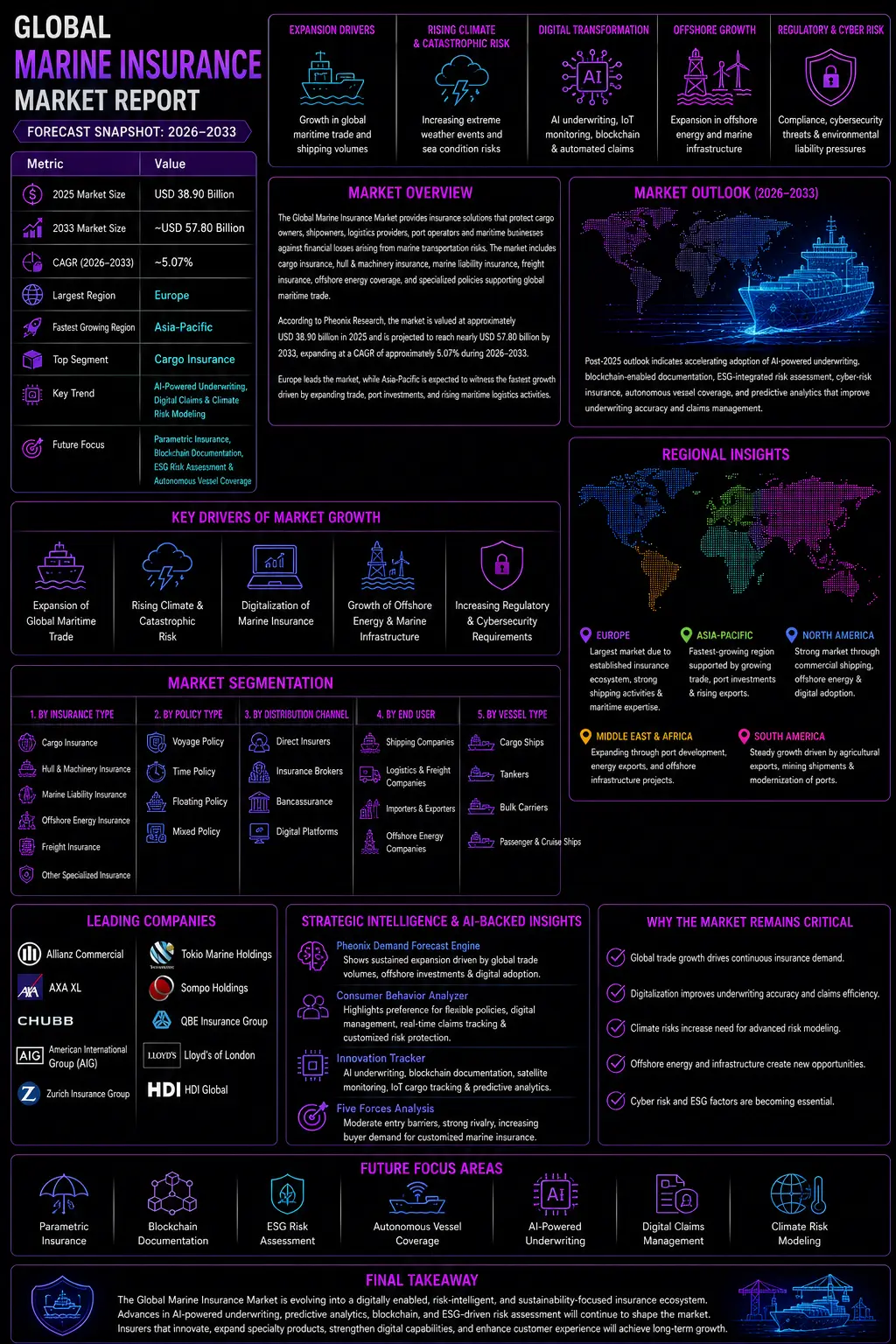
| Metric | Value |
|---|---|
| 2025 Market Size | USD 38.90 Billion |
| 2033 Market Size | ~USD 57.80 Billion |
| CAGR (2026–2033) | ~5.07% |
| Largest Region | Europe |
| Fastest Growing Region | Asia-Pacific |
| Top Segment | Cargo Insurance |
| Key Trend | AI-Powered Underwriting, Digital Claims & Climate Risk Modeling |
| Future Focus | Parametric Insurance, Blockchain Documentation, ESG Risk Assessment & Autonomous Vessel Coverage |
Global Marine Insurance Market Overview
The Global Marine Insurance Market comprises insurance solutions designed to protect cargo owners, shipowners, logistics providers, port operators, freight forwarders, and maritime businesses against financial losses arising from marine transportation risks. The market includes cargo insurance, hull & machinery insurance, marine liability insurance, freight insurance, offshore energy coverage, and specialized policies supporting global maritime trade. Marine insurance remains an essential pillar of international trade. As global cargo volumes increase, shipping routes become more complex, and climate-related disruptions intensify, businesses increasingly rely on comprehensive insurance solutions to mitigate financial risk. Digital transformation, automated underwriting, and real-time vessel monitoring are further reshaping underwriting practices across the industry. According to Pheonix Research, the Global Marine Insurance Market is valued at approximately USD 38.90 billion in 2025 and is projected to reach nearly USD 57.80 billion by 2033, expanding at a CAGR of approximately 5.07% during 2026–2033. Europe accounts for the largest market share owing to its established marine insurance ecosystem, presence of leading underwriting markets, extensive shipping activities, and global maritime financial services. Asia-Pacific is expected to witness the fastest growth, driven by expanding international trade, rising port infrastructure investments, increasing exports, and growing maritime logistics across China, India, Japan, Singapore, and Southeast Asia. The Post-2025 outlook indicates accelerating adoption of AI-powered underwriting, blockchain-enabled documentation, ESG-integrated marine risk assessment, cyber-risk insurance, autonomous vessel coverage, and predictive analytics that improve underwriting accuracy and claims management.Global Marine Insurance Market
Key Drivers of Global Marine Insurance Market Growth
1. Expansion of Global Maritime Trade
Growing international trade, containerized shipping, and cross-border logistics continue to increase demand for marine insurance solutions that protect cargo, vessels, and maritime operations.2. Rising Climate & Catastrophic Risk
Extreme weather events, hurricanes, floods, and changing sea conditions have significantly increased exposure to maritime risks, encouraging higher insurance penetration and advanced catastrophe modeling.3. Digitalization of Marine Insurance
AI-based underwriting, satellite vessel tracking, IoT-enabled monitoring, blockchain documentation, and automated claims processing are improving operational efficiency while reducing fraud.4. Growth of Offshore Energy & Marine Infrastructure
Increasing offshore oil & gas exploration, offshore wind farms, subsea infrastructure, and port modernization projects are creating substantial demand for specialized marine insurance coverage.5. Increasing Regulatory & Cybersecurity Requirements
International maritime regulations, sanctions compliance, cybersecurity threats, and environmental liability requirements are driving demand for comprehensive insurance products that address emerging operational risks.Global Marine Insurance Market Segmentation
1. By Insurance Type
1.1 Cargo Insurance 1.1.1 Import Cargo Insurance 1.1.1.1 General Merchandise 1.1.1.2 High-Value Cargo 1.1.1.3 Perishable Goods 1.1.2 Export Cargo Insurance 1.1.2.1 Container Cargo 1.1.2.2 Bulk Cargo 1.1.2.3 Project Cargo 1.1.3 Inland Transit Insurance 1.1.3.1 Road Transportation 1.1.3.2 Rail Transportation 1.1.3.3 Multimodal Transport 1.2 Hull & Machinery Insurance 1.2.1 Commercial Ships 1.2.1.1 Container Ships 1.2.1.2 Bulk Carriers 1.2.1.3 Tankers 1.2.2 Passenger Vessels 1.2.2.1 Cruise Ships 1.2.2.2 Ferries 1.2.3 Specialized Vessels 1.2.3.1 Offshore Support Vessels 1.2.3.2 Fishing Vessels 1.2.3.3 Research Vessels 1.3 Marine Liability Insurance 1.3.1 Protection & Indemnity (P&I) 1.3.1.1 Crew Liability 1.3.1.2 Cargo Liability 1.3.1.3 Collision Liability 1.3.2 Environmental Liability 1.3.2.1 Oil Spill Coverage 1.3.2.2 Pollution Liability 1.4 Offshore Energy Insurance 1.4.1 Offshore Oil & Gas 1.4.1.1 Exploration Platforms 1.4.1.2 Production Facilities 1.4.2 Offshore Renewable Energy 1.4.2.1 Offshore Wind Farms 1.4.2.2 Marine Energy Projects2. By Policy Type
2.1 Voyage Policy 2.1.1 Single Voyage 2.1.1.1 Domestic 2.1.1.2 International 2.2 Time Policy 2.2.1 Annual Coverage 2.2.1.1 Commercial Fleet 2.2.1.2 Individual Vessel 2.3 Floating Policy 2.3.1 Open Cargo Policy 2.3.1.1 Continuous Shipment 2.3.1.2 High-Frequency Trade 2.4 Mixed Policy 2.4.1 Voyage & Time Combination 2.4.1.1 Fleet Operations 2.4.1.2 Global Logistics Companies3. By Distribution Channel
3.1 Direct Insurers 3.1.1 Corporate Sales 3.1.1.1 Enterprise Accounts 3.1.1.2 SMEs 3.2 Insurance Brokers 3.2.1 International Brokers 3.2.1.1 Marine Specialists 3.2.1.2 Risk Advisory Services 3.3 Bancassurance 3.3.1 Commercial Banking Partners 3.3.1.1 Trade Finance Clients 3.3.1.2 Exporters 3.4 Digital Platforms 3.4.1 Online Marine Insurance 3.4.1.1 Instant Quotation Platforms 3.4.1.2 API-Based Insurance Solutions4. By End User
4.1 Shipping Companies 4.1.1 Container Shipping 4.1.1.1 Global Shipping Lines 4.1.1.2 Regional Operators 4.2 Logistics & Freight Companies 4.2.1 Freight Forwarders 4.2.1.1 International Logistics 4.2.1.2 Domestic Logistics 4.3 Importers & Exporters 4.3.1 Manufacturing Companies 4.3.1.1 Industrial Goods 4.3.1.2 Consumer Products 4.4 Offshore Energy Companies 4.4.1 Oil & Gas Operators 4.4.1.1 Exploration 4.4.1.2 Production5. By Vessel Type
5.1 Cargo Ships 5.1.1 Container Ships 5.1.1.1 Large Container Vessels 5.1.1.2 Feeder Vessels 5.2 Tankers 5.2.1 Crude Oil Tankers 5.2.1.1 VLCC 5.2.1.2 Suezmax 5.3 Bulk Carriers 5.3.1 Dry Bulk 5.3.1.1 Capesize 5.3.1.2 Panamax 5.4 Passenger & Cruise Ships 5.4.1 Cruise Vessels 5.4.1.1 Luxury Cruises 5.4.1.2 Regional CruisesRegional Insights of Global Marine Insurance Market
Europe – Largest Market
Europe dominates the Global Marine Insurance Market owing to its mature maritime insurance infrastructure, globally recognized underwriting expertise, strong presence of marine insurers and reinsurers, and extensive commercial shipping activities. Major maritime financial centers continue to lead innovation in specialty marine insurance products, digital underwriting, and complex international risk management.Asia-Pacific
Asia-Pacific represents the fastest-growing regional market, supported by expanding exports, increasing shipbuilding activities, rising container traffic, and government investments in port modernization. Growing trade across China, India, Japan, Singapore, and Southeast Asia continues to generate strong demand for cargo, hull, and marine liability insurance.North America
North America maintains a significant market share through extensive commercial shipping, offshore energy activities, advanced logistics infrastructure, and increasing adoption of digital marine insurance solutions. Cybersecurity coverage and environmental liability products are witnessing rising demand across the region.Middle East & Africa
The Middle East & Africa market is expanding through investments in ports, energy exports, maritime logistics, and international shipping corridors. Growth is further supported by offshore energy projects and strategic maritime infrastructure development.South America
South America is witnessing steady market growth due to expanding agricultural exports, mining shipments, containerized trade, and modernization of regional ports. Increased trade activity continues to strengthen demand for marine cargo insurance across the region.Leading Companies in the Global Marine Insurance Market
- Allianz Commercial
- AXA XL
- Chubb
- American International Group (AIG)
- Zurich Insurance Group
- Tokio Marine Holdings
- Sompo Holdings
- QBE Insurance Group
- Lloyd's of London
- HDI Global
Why the Global Marine Insurance Market Remains Critical
- Global trade expansion continues to increase demand for comprehensive marine risk protection.
- Digital underwriting and AI-driven claims management improve operational efficiency.
- Climate-related risks strengthen demand for advanced catastrophe modeling and specialized insurance products.
- Offshore energy development and maritime infrastructure investments create new insurance opportunities.
- Cyber-risk protection and ESG-focused underwriting are becoming essential competitive differentiators.
Strategic Intelligence and AI-Backed Insights – Global Marine Insurance Market
Pheonix Demand Forecast Engine identifies sustained market expansion driven by increasing global trade volumes, rising offshore infrastructure investments, digital transformation in underwriting, and growing demand for climate-resilient insurance solutions. The Consumer Behavior Analyzer highlights increasing preference among shipping companies and cargo owners for flexible policies, digital policy management, real-time claims tracking, and customized risk protection across international shipping operations. The Innovation Tracker emphasizes AI-powered underwriting, blockchain-enabled marine documentation, satellite vessel monitoring, predictive risk analytics, IoT-supported cargo monitoring, and automated claims settlement as key technological differentiators. Five Forces Analysis indicates moderate barriers to entry due to regulatory complexity and capital requirements, moderate supplier power driven by reinsurance markets, increasing buyer demand for customized products, limited substitution for comprehensive marine coverage, and strong competitive rivalry among global insurers.Final Takeaway of Global Marine Insurance Market
The Global Marine Insurance Market is evolving into a digitally enabled, risk-intelligent, and sustainability-focused insurance ecosystem. The projected CAGR of approximately 5.07% during 2026–2033 reflects growing demand for comprehensive protection across international shipping, offshore energy, logistics, and global trade operations. Future market expansion will be driven by AI-powered underwriting, predictive analytics, blockchain-enabled documentation, cyber-risk insurance, autonomous vessel coverage, and climate-resilient insurance models. Increasing globalization of trade and rising maritime investments will continue to reinforce long-term demand for innovative insurance solutions. Insurance providers that successfully integrate advanced analytics, automate claims processing, strengthen ESG-based underwriting, expand specialty marine products, and leverage digital customer engagement platforms will be best positioned to achieve sustainable competitive advantage. At Pheonix Research, our advanced forecasting models deliver comprehensive Global Marine Insurance Market revenue forecasts, competitive benchmarking, regional opportunity assessment, and strategic intelligence—enabling insurers, reinsurers, investors, logistics providers, and maritime stakeholders to capitalize on the Post-2025 outlook with confidence and data-driven decision-making.Table of Contents
1. Executive Summary
1.1 Market Snapshot
1.2 Key Market Highlights
1.3 Market Size & Forecast (2026–2033)
1.4 Largest Regional Market Analysis
1.5 Fastest Growing Regional Market Analysis
1.6 Largest Segment Analysis
1.7 Competitive Landscape Snapshot
1.8 Future Market Outlook
2. Global Marine Insurance Market Introduction
2.1 Market Definition
2.2 Scope of Study
2.3 Research Assumptions
2.4 Research Methodology
2.5 Forecast Parameters
3. Global Marine Insurance Market Overview
3.1 Market Evolution
3.2 Industry Ecosystem Analysis
3.3 Value Chain Analysis
3.4 Pricing & Premium Structure Analysis
3.5 Marine Insurance Infrastructure Overview
3.6 Insurance Landscape
3.6.1 Cargo Insurance
3.6.1.1 Import Cargo Insurance
3.6.1.1.1 General Merchandise
3.6.1.1.1.1 High-Value Cargo
3.6.1.1.1.2 Perishable Goods
3.6.2 Hull & Machinery Insurance
3.6.2.1 Commercial Ships
3.6.2.1.1 Passenger Vessels
3.6.2.1.1.1 Specialized Vessels
3.6.2.1.1.2 Offshore Support Vessels
3.6.3 Marine Liability Insurance
3.6.3.1 Protection & Indemnity (P&I)
3.6.3.1.1 Environmental Liability
3.6.3.1.1.1 Oil Spill Coverage
3.6.3.1.1.2 Pollution Liability
3.6.4 Offshore Energy Insurance
3.6.4.1 Offshore Oil & Gas
3.6.4.1.1 Offshore Renewable Energy
3.6.4.1.1.1 Offshore Wind Farms
3.6.4.1.1.2 Marine Energy Projects
4. Regulatory Landscape
4.1 International Maritime Regulations
4.2 Marine Insurance Standards
4.3 Environmental & ESG Compliance
4.4 Cybersecurity & Data Protection Regulations
4.5 International Trade & Sanctions Compliance
5. Market Trends & Innovation Outlook
5.1 AI-Powered Underwriting
5.2 Digital Claims Management
5.3 Blockchain Documentation
5.4 Climate Risk Modeling
5.5 Parametric Marine Insurance
5.6 IoT-Based Cargo Monitoring
5.7 Autonomous Vessel Coverage
5.8 ESG Risk Assessment
6. Global Marine Insurance Market Dynamics
6.1 Market Drivers
6.1.1 Expansion of Global Maritime Trade
6.1.2 Rising Climate & Catastrophic Risks
6.1.3 Digitalization of Marine Insurance
6.1.4 Growth of Offshore Energy & Marine Infrastructure
6.1.5 Increasing Regulatory & Cybersecurity Requirements
6.2 Market Restraints
6.2.1 High Claim Volatility
6.2.2 Increasing Catastrophic Losses
6.2.3 Regulatory Complexity Across Jurisdictions
6.2.4 Cybersecurity Risks in Maritime Operations
6.3 Market Opportunities
6.3.1 AI-Based Underwriting Solutions
6.3.2 Parametric Marine Insurance
6.3.3 Blockchain-Enabled Policy Management
6.3.4 Autonomous Shipping Insurance
6.3.5 ESG-Focused Marine Insurance Products
6.4 Market Challenges
6.4.1 Climate Change Uncertainty
6.4.2 Marine Fraud & Claims Management
6.4.3 Supply Chain Disruptions
6.4.4 Reinsurance Cost Inflation
7. Global Marine Insurance Market Size Analysis (USD Billion), 2026–2033
7.1 Revenue Forecast Analysis
7.2 CAGR Analysis
7.3 Premium Growth Analysis
7.4 Demand-Supply Assessment
7.5 Pricing Trend Analysis
8. Global Marine Insurance Market Segmentation Analysis
8.1 By Insurance Type
8.1.1 Cargo Insurance
8.1.2 Hull & Machinery Insurance
8.1.3 Marine Liability Insurance
8.1.4 Offshore Energy Insurance
8.2 By Policy Type
8.2.1 Voyage Policy
8.2.2 Time Policy
8.2.3 Floating Policy
8.2.4 Mixed Policy
8.3 By Distribution Channel
8.3.1 Direct Insurers
8.3.2 Insurance Brokers
8.3.3 Bancassurance
8.3.4 Digital Platforms
8.4 By End User
8.4.1 Shipping Companies
8.4.2 Logistics & Freight Companies
8.4.3 Importers & Exporters
8.4.4 Offshore Energy Companies
8.5 By Vessel Type
8.5.1 Cargo Ships
8.5.2 Tankers
8.5.3 Bulk Carriers
8.5.4 Passenger & Cruise Ships
9. Regional Market Analysis
9.1 Europe
9.1.1 Germany
9.1.2 U.K.
9.1.3 France
9.1.4 Italy
9.1.5 Netherlands
9.1.6 Rest of Europe
9.2 Asia-Pacific
9.2.1 China
9.2.2 Japan
9.2.3 India
9.2.4 Singapore
9.2.5 South Korea
9.2.6 Rest of Asia-Pacific
9.3 North America
9.3.1 U.S.
9.3.2 Canada
9.3.3 Mexico
9.4 Middle East & Africa
9.4.1 GCC Countries
9.4.2 South Africa
9.4.3 Rest of Middle East & Africa
9.5 South America
9.5.1 Brazil
9.5.2 Argentina
9.5.3 Rest of South America
10. Competitive Landscape
10.1 Market Share Analysis
10.2 Competitive Intensity Overview
10.3 Strategic Developments
10.4 Digital Underwriting Innovation
10.5 Partnerships, Mergers & Acquisitions
10.6 Competitive Positioning Analysis
11. Company Profiles
11.1 Allianz Commercial
11.2 AXA XL
11.3 Chubb
11.4 American International Group (AIG)
11.5 Zurich Insurance Group
11.6 Tokio Marine Holdings
11.7 Sompo Holdings
11.8 QBE Insurance Group
11.9 Lloyd’s of London
11.10 HDI Global
12. Strategic Intelligence & Pheonix AI Insights
12.1 Pheonix Demand Forecast Engine
12.2 Consumer Behavior Analyzer
12.3 Innovation Tracker
12.4 Risk Intelligence Dashboard
12.5 Automated Porter’s Five Forces Analysis
13. Future Outlook & Strategic Recommendations
13.1 AI-Powered Underwriting Strategies
13.2 Climate Risk & ESG Integration
13.3 Blockchain Adoption Roadmap
13.4 Autonomous Vessel Insurance Opportunities
13.5 Long-Term Market Outlook (2033+)
14. About Pheonix Market Research
15. Disclaimer
Competitive Landscape
Global Marine Insurance Market Competitive Intensity & Market Structure Overview
The Global Marine Insurance Market is highly competitive and characterized by the presence of multinational insurance companies, specialty marine insurers, reinsurers, insurance brokers, risk advisory firms, InsurTech companies, and digital insurance platform providers. Competitive intensity is driven by AI-powered underwriting, predictive risk analytics, digital claims management, satellite vessel monitoring, blockchain-enabled documentation, climate risk modeling, and integrated maritime risk management solutions.
Companies compete across multiple marine insurance segments including cargo insurance, hull & machinery insurance, marine liability insurance, protection & indemnity (P&I) insurance, offshore energy insurance, freight insurance, cyber marine insurance, environmental liability coverage, and specialized maritime risk solutions. Growing international trade, increasing cargo volumes, expanding offshore energy projects, climate-related risks, and stricter regulatory requirements are intensifying competition while encouraging continuous innovation in underwriting, policy customization, and claims processing.
The market structure is evolving toward digitally enabled underwriting, AI-assisted risk assessment, IoT-based cargo monitoring, blockchain-powered documentation, ESG-integrated insurance models, predictive catastrophe analytics, and cloud-based insurance management platforms. Market participants are investing heavily in artificial intelligence, satellite-based vessel tracking, advanced analytics, cyber risk solutions, automated claims processing, and strategic partnerships to strengthen market positioning while improving underwriting accuracy, operational efficiency, and customer experience.
Global Marine Insurance Market Competitive Intensity & Market Structure Current Scenario
Leading Global Marine Insurance Companies
Allianz Commercial: A leading global commercial insurer providing cargo insurance, hull & machinery coverage, marine liability solutions, offshore energy insurance, and AI-driven marine risk management services.
AXA XL: A global specialty insurance provider offering marine cargo, hull, logistics, offshore energy, environmental liability, and digital underwriting solutions for international maritime operations.
Chubb: A multinational insurance company delivering comprehensive marine insurance products, cargo protection, marine liability coverage, cyber risk solutions, and customized global shipping insurance programs.
American International Group (AIG): A global insurer providing marine cargo insurance, transportation risk solutions, offshore energy coverage, supply chain protection, and advanced claims management services.
Zurich Insurance Group: An international insurance provider offering marine cargo, freight, liability, logistics, and marine risk advisory solutions supported by digital underwriting technologies.
Tokio Marine Holdings: A leading global insurer specializing in cargo insurance, hull coverage, logistics protection, offshore energy insurance, and integrated marine risk management services.
Sompo Holdings: A multinational insurance company providing commercial marine insurance, cargo protection, liability insurance, risk engineering, and digital claims solutions for maritime businesses.
QBE Insurance Group: A specialty insurer delivering marine cargo, transportation, logistics, offshore energy, and marine liability insurance supported by advanced underwriting expertise.
Lloyd’s of London: A globally recognized specialty insurance marketplace providing complex marine insurance, reinsurance, catastrophe risk coverage, offshore energy insurance, and customized international marine underwriting.
HDI Global: A commercial insurer offering cargo insurance, marine liability, hull & machinery coverage, industrial transportation insurance, and multinational marine risk management solutions.
Key Competitive Intensity & Market Structure Drivers
Growing international trade, rising containerized shipping, and expanding cross-border logistics activities are intensifying competition among marine insurance providers worldwide.
Advancements in artificial intelligence, predictive analytics, satellite vessel tracking, IoT-enabled cargo monitoring, blockchain documentation, and digital claims processing are becoming major competitive differentiators across the market.
Increasing climate-related risks, extreme weather events, geopolitical uncertainties, maritime cyber threats, and complex global supply chains are strengthening demand for advanced marine risk assessment and customized insurance solutions.
Strategic collaborations among insurers, reinsurers, maritime technology companies, logistics providers, shipping companies, satellite data providers, and InsurTech firms are accelerating innovation, improving underwriting capabilities, and enhancing operational efficiency.
Continuous investment in AI-powered underwriting, climate risk modeling, cyber insurance, ESG-focused risk assessment, blockchain-based policy administration, and automated claims management is enabling companies to improve profitability, customer satisfaction, and long-term competitiveness.
Strategic Implications of Competitive Intensity & Market Structure
Companies offering comprehensive marine insurance portfolios, advanced digital underwriting capabilities, and integrated maritime risk management solutions are expected to maintain significant competitive advantages.
Investment in artificial intelligence, predictive analytics, blockchain-enabled documentation, satellite monitoring, ESG-based underwriting, and cyber risk assessment is becoming increasingly important for sustaining long-term market leadership.
Organizations focusing on expanding digital insurance platforms, improving claims automation, strengthening catastrophe modeling capabilities, and enhancing customer-centric policy solutions are likely to increase revenue growth and market share.
Strategic partnerships with shipping companies, logistics providers, reinsurers, technology firms, port operators, offshore energy companies, and regulatory organizations are supporting innovation, operational resilience, and international market expansion.
Businesses capable of combining underwriting expertise, digital transformation, global distribution networks, advanced analytics, operational scalability, and comprehensive maritime risk solutions will be best positioned to compete effectively in the evolving global marine insurance market.
Global Marine Insurance Market Competitive Intensity & Market Structure Forward Outlook
The competitive landscape of the global marine insurance market is expected to become increasingly AI-driven, digitally connected, and sustainability-focused as global maritime trade and climate-related risks continue to evolve.
Future competition will be shaped by AI-powered underwriting, blockchain-enabled marine documentation, predictive risk analytics, satellite-based vessel monitoring, cyber marine insurance, autonomous vessel coverage, ESG-integrated underwriting, and parametric insurance solutions.
Market participants are expected to increase investments in intelligent underwriting platforms, cloud-based insurance ecosystems, automated claims processing, climate resilience modeling, digital customer engagement, and next-generation marine risk analytics to strengthen competitive positioning.
Over the forecast period, companies that successfully combine technological innovation, underwriting excellence, advanced analytics, digital transformation, global maritime expertise, and comprehensive insurance solutions will be best positioned to lead the evolving global marine insurance market.
Value Chain
Global Marine Insurance Market Value Chain & Supply Chain Evolution Overview
The Global Marine Insurance Market operates through a comprehensive value chain comprising risk assessment, underwriting, reinsurance support, policy distribution, policy administration, claims management, and post-claim risk advisory services. The ecosystem includes marine insurers, reinsurers, insurance brokers, digital insurance platforms, shipping companies, logistics providers, port operators, offshore energy firms, surveyors, and regulatory authorities working together to mitigate financial risks associated with global maritime trade.
The market is being transformed by rising international trade, increasing climate-related maritime risks, digital underwriting technologies, blockchain-enabled documentation, AI-powered risk analytics, satellite vessel tracking, IoT-based cargo monitoring, and automated claims processing. Insurers are increasingly adopting predictive analytics, ESG-integrated underwriting, cyber-risk coverage, and parametric insurance products to improve underwriting precision and operational efficiency.
The integration of artificial intelligence, blockchain, real-time vessel monitoring, digital policy administration, geospatial analytics, and automated claims settlement is enhancing value chain efficiency while reducing fraud, improving customer experience, and strengthening risk management capabilities. Strategic collaborations among insurers, reinsurers, logistics providers, technology vendors, shipping companies, and maritime authorities continue to reshape the industry’s operating model.
Advanced catastrophe modeling, autonomous vessel insurance, ESG risk assessment, cyber insurance solutions, and predictive marine analytics are expected to further strengthen the marine insurance ecosystem by improving underwriting accuracy, operational resilience, and long-term profitability.
Global Marine Insurance Market Value Chain & Supply Chain Evolution Current Scenario
Market-Specific Value Chain
Risk Assessment & Product Development:
Marine risk modeling, actuarial analysis, catastrophe modeling, ESG risk assessment, cyber risk evaluation, policy design, and specialized marine insurance product development.
Underwriting & Reinsurance:
Risk underwriting, premium pricing, policy structuring, treaty and facultative reinsurance, portfolio diversification, and capital risk management.
Policy Distribution & Customer Acquisition:
Direct insurers, insurance brokers, bancassurance partners, digital insurance platforms, API-based insurance solutions, corporate sales teams, and partner networks.
Policy Administration & Compliance:
Policy issuance, digital documentation, blockchain-enabled policy management, regulatory compliance, sanctions screening, KYC verification, and contract administration.
Claims Processing & Loss Management:
Marine surveys, cargo inspection, vessel damage assessment, digital claims processing, AI-assisted fraud detection, automated settlement, dispute resolution, and indemnity management.
Risk Monitoring & Advisory Services:
Satellite vessel tracking, IoT cargo monitoring, predictive risk analytics, weather intelligence, cybersecurity monitoring, ESG reporting, and ongoing policy advisory services.
End User Applications:
Shipping companies, logistics & freight operators, importers & exporters, offshore energy companies, port operators, and maritime infrastructure providers.
Company-to-Stage Mapping
Risk Assessment & Product Development:
Allianz Commercial, AXA XL, Chubb, American International Group (AIG), Zurich Insurance Group, Tokio Marine Holdings, Sompo Holdings, Lloyd’s of London, HDI Global, and marine actuarial specialists.
Underwriting & Reinsurance:
Lloyd’s of London, Allianz Commercial, AXA XL, Chubb, Zurich Insurance Group, QBE Insurance Group, Tokio Marine Holdings, Sompo Holdings, global reinsurers, and specialty marine underwriters.
Policy Distribution & Customer Acquisition:
Direct insurers, international insurance brokers, bancassurance partners, digital insurance platforms, marine insurance specialists, trade finance institutions, and corporate sales channels.
Policy Administration & Compliance:
Insurance companies, InsurTech providers, blockchain documentation vendors, compliance service providers, maritime regulatory authorities, and digital policy management platforms.
Claims Processing & Loss Management:
Marine surveyors, claims adjusters, shipping inspectors, AI-based claims platforms, insurers, legal advisors, and maritime loss assessment specialists.
Risk Monitoring & Advisory Services:
Satellite analytics providers, IoT solution providers, weather intelligence firms, cybersecurity vendors, ESG consultants, risk advisory firms, and maritime analytics companies.
End User Applications:
Shipping companies, freight forwarders, logistics companies, exporters, importers, offshore oil & gas operators, offshore renewable energy developers, port authorities, and maritime infrastructure operators.
Key Value Chain & Supply Chain Evolution Signals in Global Marine Insurance Market
Expansion of AI-Powered Underwriting
Artificial intelligence is improving underwriting accuracy through predictive analytics, automated pricing models, and real-time maritime risk evaluation.
Growth of Blockchain-Based Documentation
Blockchain technology is streamlining policy issuance, cargo documentation, trade verification, and claims transparency while reducing fraud.
Increasing Adoption of Real-Time Risk Monitoring
Satellite vessel tracking, IoT-enabled cargo monitoring, weather intelligence, and geospatial analytics are enabling continuous maritime risk assessment.
Expansion of Climate & ESG Risk Assessment
Insurers are integrating climate modeling, carbon exposure analysis, sustainability metrics, and ESG frameworks into underwriting decisions.
Growth of Parametric & Cyber Insurance Products
Demand is increasing for parametric marine insurance, cyber-risk protection, autonomous vessel coverage, and specialized policies addressing emerging maritime risks.
Digital Claims Transformation
Automated claims processing, AI-driven fraud detection, digital inspections, and predictive loss assessment are improving operational efficiency and customer satisfaction.
Strategic Implications of Value Chain & Supply Chain Evolution
Investment in Advanced Underwriting Technologies
AI, predictive analytics, machine learning, and digital underwriting platforms are improving pricing accuracy and reducing underwriting risk.
Strengthening Digital Insurance Infrastructure
Blockchain documentation, API-enabled policy platforms, digital customer portals, and automated workflows enhance operational efficiency and policy management.
Expansion of Risk Intelligence Capabilities
Continuous vessel monitoring, weather forecasting, cargo tracking, and predictive analytics improve risk mitigation and reduce claims frequency.
Enhancement of Regulatory & ESG Compliance
Climate disclosures, environmental liability coverage, sanctions compliance, and ESG-integrated underwriting strengthen regulatory readiness and sustainability objectives.
Optimization of Claims & Customer Experience
Digital claims platforms, automated settlements, AI-assisted assessments, and real-time communication improve customer satisfaction and operational resilience.
Leveraging Emerging Marine Technologies
Coverage for autonomous vessels, cyber threats, smart shipping infrastructure, offshore renewable assets, and connected maritime ecosystems creates new growth opportunities.
Global Marine Insurance Market Value Chain & Supply Chain Evolution Forward Outlook
The marine insurance value chain is expected to become increasingly intelligent, automated, data-driven, and sustainability-focused as global maritime trade becomes more digital and interconnected. Continued advancements in AI-powered underwriting, blockchain-enabled documentation, predictive analytics, climate risk modeling, IoT-based cargo monitoring, and autonomous vessel insurance will transform marine risk management.
Key Future Developments Include:
- Expansion of AI-driven underwriting and predictive maritime risk analytics.
- Wider adoption of blockchain-based policy administration and digital trade documentation.
- Increasing deployment of satellite tracking, IoT cargo monitoring, and real-time vessel intelligence.
- Growth in parametric insurance, cyber-risk coverage, ESG-integrated underwriting, and autonomous vessel insurance.
- Greater investment in automated claims processing, fraud detection, and digital customer engagement platforms.
- Strengthening collaboration among insurers, reinsurers, logistics providers, shipping companies, technology vendors, and maritime regulatory authorities.
As the market evolves, competitive advantage will increasingly depend on digital underwriting capabilities, real-time risk intelligence, automated claims management, ESG-focused insurance products, blockchain-enabled operations, and scalable technology platforms capable of supporting the evolving needs of global maritime trade.
Investment Activity
Investment Activity in the Global Marine Insurance Market
Investment activity in the Global Marine Insurance Market is steadily increasing as insurers, reinsurers, InsurTech companies, maritime technology providers, and logistics stakeholders invest in digital underwriting capabilities, AI-powered risk analytics, climate resilience solutions, and next-generation marine insurance platforms. Growing complexity in global trade, rising exposure to climate-related disruptions, expanding offshore infrastructure, and evolving cybersecurity risks are encouraging market participants to modernize insurance operations and develop more specialized coverage solutions.
Leading insurance providers are increasing investments in artificial intelligence, predictive underwriting, satellite-based vessel monitoring, Internet of Things (IoT)-enabled cargo tracking, blockchain-based trade documentation, and automated claims management platforms. These technologies enhance underwriting accuracy, reduce fraud, improve claims settlement efficiency, and enable real-time risk assessment across global shipping networks.
Capital investment is also expanding toward climate risk modeling, catastrophe analytics, ESG-integrated underwriting frameworks, and cyber-risk insurance products as insurers respond to the growing frequency of extreme weather events, supply chain disruptions, and digital threats affecting maritime operations. Advanced analytics and environmental risk intelligence are becoming central to portfolio optimization and long-term profitability.
Strategic mergers, acquisitions, partnerships, and investments between insurers, reinsurers, maritime technology firms, shipping companies, and digital logistics platforms are reshaping the competitive landscape. Companies are increasingly collaborating to develop integrated marine insurance ecosystems that combine telematics, vessel performance analytics, digital policy administration, and blockchain-enabled documentation for enhanced operational transparency and customer experience.
Governments and international maritime organizations are further supporting investment through port modernization initiatives, smart shipping infrastructure, digital trade facilitation, and regulatory frameworks focused on environmental sustainability, cybersecurity, and maritime safety. These initiatives are creating new opportunities for insurers to expand coverage across offshore renewable energy projects, autonomous vessels, and increasingly digitalized maritime supply chains.
Key Investment Trends
- Rising investment in AI-powered underwriting, predictive risk analytics, and automated claims management platforms.
- Growing funding for blockchain-enabled marine documentation, smart contracts, and digital trade ecosystems.
- Increasing capital allocation toward satellite vessel monitoring, IoT-enabled cargo tracking, and real-time maritime risk intelligence.
- Expansion of investment in climate risk modeling, catastrophe analytics, ESG-based underwriting, and environmental liability insurance.
- Strategic partnerships between insurers, reinsurers, InsurTech firms, shipping companies, and maritime technology providers to develop integrated digital insurance solutions.
- Higher investment in cyber-risk insurance, autonomous vessel coverage, offshore renewable energy insurance, and specialty marine products.
- Continued spending on digital customer engagement platforms, API-enabled policy management, and cloud-based insurance infrastructure to improve operational efficiency and customer experience.
Strategic Investment Outlook
Investment activity is expected to remain robust throughout the forecast period as global trade expands, maritime operations become increasingly digital, and climate-related risks continue to reshape underwriting practices. Future capital deployment will focus on intelligent underwriting platforms, blockchain-powered documentation, autonomous shipping insurance, ESG-driven risk assessment, cyber resilience solutions, and advanced predictive analytics.
Insurance providers that invest in scalable digital ecosystems, AI-enabled underwriting, climate-adaptive insurance models, and innovative specialty marine products will be well positioned to strengthen competitiveness and capitalize on the long-term growth opportunities emerging across the Global Marine Insurance Market.
Technology & Innovation
Global Marine Insurance Market Technology & Innovation Landscape Overview
The Global Marine Insurance Market is undergoing a significant technological transformation driven by artificial intelligence (AI), blockchain, Internet of Things (IoT), satellite-based vessel monitoring, predictive analytics, and digital insurance platforms. As global shipping networks become increasingly interconnected and climate-related risks intensify, insurers are adopting advanced technologies to improve underwriting accuracy, accelerate claims processing, enhance risk assessment, and strengthen fraud prevention.
Innovation across the marine insurance ecosystem is shifting the industry from traditional, document-intensive processes toward real-time, data-driven risk management. Technologies such as AI-powered underwriting, blockchain-enabled trade documentation, telematics, remote sensing, and climate risk modeling are enabling insurers to offer more customized, transparent, and responsive insurance solutions for cargo owners, shipowners, logistics providers, and offshore operators.
The rapid expansion of autonomous shipping technologies, ESG-focused underwriting, cyber-risk coverage, and parametric insurance products is further reshaping technological investments across the global marine insurance market.
Global Marine Insurance Market Technology & Innovation Landscape Current Scenario
The current market is characterized by increasing adoption of AI-driven underwriting engines, automated claims management systems, satellite-based vessel tracking, IoT-enabled cargo monitoring, and blockchain-supported policy administration. Marine insurers are integrating real-time shipping data, weather intelligence, and predictive analytics to assess voyage risks more accurately and improve pricing models.
Digital transformation is also accelerating the deployment of cloud-based insurance platforms, API-enabled policy issuance, digital customer portals, electronic bills of lading, and smart contracts that reduce administrative complexity while improving operational efficiency. In parallel, insurers are strengthening cyber-risk assessment capabilities to address emerging threats associated with connected vessels and digital maritime operations.
Key Technology & Innovation Landscape Trends in the Global Marine Insurance Market
- AI-powered underwriting platforms are improving risk assessment, premium pricing, and policy customization through predictive analytics.
- Blockchain technology is enabling secure digital documentation, smart contracts, electronic bills of lading, and transparent claims processing.
- IoT-enabled cargo monitoring systems provide real-time visibility into cargo condition, temperature, humidity, shock exposure, and location during transit.
- Satellite imagery, AIS (Automatic Identification System), and remote vessel monitoring technologies are enhancing voyage tracking and maritime risk management.
- Climate risk modeling and catastrophe analytics are strengthening underwriting decisions by incorporating weather forecasts, sea-state analysis, and historical loss data.
- Parametric marine insurance products are expanding by enabling automated payouts based on predefined weather, port disruption, or voyage-delay triggers.
- Digital claims automation using AI and image analytics is reducing settlement times while improving fraud detection.
- Cybersecurity risk assessment tools are supporting the development of specialized marine cyber insurance for connected vessels and maritime infrastructure.
- ESG analytics and sustainability-focused underwriting are being integrated into insurance portfolios to evaluate environmental and operational risks.
- Cloud-based insurance platforms and API-driven digital ecosystems are improving customer engagement, broker connectivity, and policy management.
Strategic Implications of Technology & Innovation in the Global Marine Insurance Market
Continuous investment in AI, blockchain, predictive analytics, IoT, satellite monitoring, and digital insurance ecosystems has become essential for insurers seeking to improve underwriting precision, operational efficiency, and customer experience.
The integration of real-time shipping intelligence, climate analytics, and automated claims management is enabling insurers to proactively manage maritime risks while reducing loss ratios and administrative costs.
Insurance providers investing in parametric insurance models, ESG-integrated underwriting, autonomous vessel coverage, cyber-risk solutions, and digital customer platforms are expected to strengthen their competitive positioning as maritime trade continues to digitalize.
Strategic collaboration among insurers, reinsurers, shipping companies, logistics providers, maritime technology firms, and InsurTech companies is accelerating innovation and enabling the development of comprehensive risk management ecosystems.
Growing investments in smart shipping technologies, autonomous navigation, digital trade documentation, and climate resilience solutions are expected to create significant long-term opportunities across the global marine insurance industry.
Global Marine Insurance Market Technology & Innovation Landscape Forward Outlook
Future innovation in the Global Marine Insurance Market will increasingly focus on AI-powered autonomous underwriting, blockchain-based global trade documentation, digital twins for maritime risk simulation, quantum-enhanced risk analytics, advanced ESG scoring models, and predictive climate intelligence. The continued evolution of autonomous vessels, smart ports, connected shipping ecosystems, and digital logistics networks will further increase demand for intelligent, technology-enabled marine insurance solutions.
Emerging innovations such as generative AI-assisted claims handling, autonomous claims verification, advanced satellite analytics, IoT-enabled risk prevention, and integrated cyber-physical risk monitoring are expected to redefine marine insurance operations over the coming decade. As global maritime trade becomes more digital and sustainability-focused, technology-driven innovation will remain central to enhancing resilience, transparency, and long-term profitability across the marine insurance ecosystem.
Market Risk
Global Marine Insurance Market Risk & Disruption Analysis
The Global Marine Insurance Market operates in an increasingly complex risk environment shaped by geopolitical uncertainty, climate change, cyber threats, evolving international trade routes, and rapid digital transformation. While global trade volumes continue to support long-term demand for marine insurance, insurers face growing challenges associated with catastrophic weather events, supply chain disruptions, regulatory complexity, and emerging risks from autonomous shipping and digital maritime ecosystems.
The industry is transitioning from conventional underwriting toward AI-powered risk assessment, predictive analytics, blockchain-enabled documentation, IoT-based cargo monitoring, satellite vessel tracking, and ESG-driven underwriting frameworks. These technological advancements are improving underwriting accuracy and claims efficiency but also require significant investments in digital infrastructure, cybersecurity, and data governance.
Additionally, stricter environmental regulations, sanctions compliance, cyberattacks on maritime infrastructure, and increasing volatility in global shipping markets are reshaping insurers’ risk models and product portfolios.
Global Marine Insurance Market Current Risk Environment
The marine insurance market is experiencing rising operational and financial risks due to the increasing frequency of climate-related disasters, geopolitical tensions, and supply chain instability.
One of the primary challenges is the growing severity of natural catastrophes, including hurricanes, typhoons, floods, and rising sea levels, which are increasing claims related to vessel damage, cargo losses, and offshore infrastructure.
Geopolitical instability, trade sanctions, piracy, and regional conflicts continue to disrupt global shipping routes, increasing uncertainty in marine underwriting and claims management.
The market also faces cybersecurity risks, as digital shipping operations, connected vessels, and automated logistics platforms become vulnerable to ransomware, GPS spoofing, and cyber intrusions targeting ports and shipping companies.
Regulatory complexity is another significant challenge. International maritime regulations, environmental liability requirements, sanctions compliance, and ESG disclosure expectations continue to evolve, requiring insurers to regularly update underwriting standards and policy structures.
Furthermore, volatility in freight rates, inflationary repair costs, and rising reinsurance premiums continue to pressure profitability across the marine insurance value chain.
Key Market Risk & Disruption Signals in Global Marine Insurance Market
1. Climate Change Increasing Catastrophic Losses
More frequent extreme weather events, storms, floods, and changing ocean conditions are increasing marine insurance claims and driving more sophisticated catastrophe risk modeling.
2. Geopolitical & Trade Route Disruptions
Regional conflicts, sanctions, piracy, and shifting trade corridors continue to increase uncertainty for global shipping operations and marine insurers.
3. Cyber Risks Across Maritime Operations
Growing digitization of shipping, ports, and logistics systems is increasing exposure to ransomware attacks, operational disruptions, and cyber-related financial losses.
4. AI-Powered Underwriting Transformation
Artificial intelligence and predictive analytics are fundamentally changing underwriting, enabling dynamic pricing, improved fraud detection, and faster claims processing.
5. Blockchain & Smart Documentation Adoption
Blockchain-based bills of lading, smart contracts, and digital trade documentation are reducing fraud, improving transparency, and accelerating claims settlement.
6. Autonomous & Connected Vessel Risks
The emergence of autonomous shipping and remotely operated vessels is creating new liability, operational, and cybersecurity risks that require specialized insurance products.
7. ESG & Environmental Liability Expansion
Growing focus on sustainability, carbon emissions, pollution liability, and ESG compliance is influencing underwriting practices and product development.
8. Rising Reinsurance & Claims Costs
Higher catastrophe losses, inflation in vessel repairs, and increased reinsurance costs are placing pressure on underwriting profitability and premium pricing.
Strategic Implications of Market Risk & Disruption in Global Marine Insurance Market
Marine insurers are increasingly shifting toward technology-enabled underwriting, real-time risk monitoring, AI-driven pricing models, and digital claims ecosystems to improve profitability and manage emerging risks.
Investment in satellite monitoring, IoT-enabled cargo tracking, predictive weather analytics, blockchain documentation, and automated claims platforms is becoming a strategic priority for improving operational efficiency and customer experience.
Insurers are also expanding specialized products covering cyber risks, environmental liabilities, autonomous vessels, offshore renewable energy projects, and complex international supply chains.
Strategic partnerships with shipping companies, logistics providers, reinsurers, maritime technology firms, and climate analytics providers are strengthening underwriting capabilities and enabling more comprehensive risk assessment.
The convergence of AI, blockchain, IoT, satellite intelligence, ESG analytics, and predictive modeling is expected to redefine marine insurance by enabling proactive risk prevention rather than reactive claims management.
Global Marine Insurance Market Risk & Disruption Forward Outlook
Looking ahead to 2026–2033, the Global Marine Insurance Market is expected to undergo significant transformation as digital technologies, sustainability priorities, and evolving maritime risks reshape underwriting practices.
1. AI Will Drive Intelligent Underwriting
Artificial intelligence will increasingly automate risk assessment, premium pricing, fraud detection, and claims management through predictive analytics and machine learning.
2. Climate Risk Modeling Will Become More Advanced
Insurers will deploy sophisticated climate models, satellite data, and weather intelligence to improve catastrophe forecasting and pricing accuracy.
3. Blockchain Will Modernize Marine Documentation
Digital trade documentation, smart contracts, and blockchain-enabled policy management will improve transparency, reduce fraud, and accelerate claims settlement.
4. Cyber Insurance Will Become a Core Marine Product
Demand for cyber-risk coverage protecting vessels, ports, logistics systems, and maritime infrastructure will continue expanding.
5. Autonomous Vessel Insurance Will Emerge
The commercialization of autonomous and remotely operated ships will require new underwriting frameworks addressing software failures, AI decision-making, and cyber liability.
6. ESG-Based Underwriting Will Expand
Environmental performance, carbon emissions, sustainability practices, and regulatory compliance will become increasingly important factors influencing underwriting decisions.
7. Parametric Marine Insurance Will Gain Adoption
Parametric products offering rapid payouts based on predefined weather or operational triggers will improve claims efficiency and disaster recovery.
8. Digital Customer Experience Will Differentiate Insurers
Real-time policy management, mobile claims processing, digital platforms, and personalized risk solutions will become major competitive differentiators.
Overall, the Global Marine Insurance Market will continue evolving into a digitally enabled, data-driven, and sustainability-focused insurance ecosystem where AI-powered underwriting, climate resilience, cyber protection, and advanced analytics will define future market leadership.
Regulatory Landscape
Global Marine Insurance Market Regulatory & Policy Environment Overview
The regulatory and policy environment plays a central role in shaping the Global Marine Insurance Market by establishing internationally recognized standards for maritime risk management, vessel operations, cargo protection, environmental liability, and insurance compliance. Marine insurers, reinsurers, brokers, shipping companies, and logistics providers operate within a complex regulatory framework governed by international maritime conventions, financial regulations, environmental laws, and trade compliance requirements.
The market is primarily influenced by regulations and standards issued by the International Maritime Organization (IMO), International Convention for the Safety of Life at Sea (SOLAS), International Convention for the Prevention of Pollution from Ships (MARPOL), Institute Cargo Clauses (ICC), Protection & Indemnity (P&I) Club Rules, and insurance solvency regulations such as Solvency II. These frameworks support vessel safety, cargo protection, pollution liability, sanctions compliance, underwriting standards, and financial stability across global marine insurance operations.
Global Marine Insurance Market Regulatory & Policy Environment Current Scenario
The current regulatory landscape is increasingly focused on maritime safety, environmental sustainability, cyber resilience, sanctions compliance, and digital transformation across global shipping operations. Regulators are encouraging insurers to incorporate climate-related risks, ESG considerations, cybersecurity exposures, and autonomous vessel operations into underwriting and risk assessment models.
Growing implementation of electronic bills of lading, blockchain-enabled documentation, AI-powered underwriting, and digital claims processing is also driving regulatory attention toward data security, digital governance, and cross-border compliance within marine insurance ecosystems.
Key Regulatory & Policy Environment Signals in the Global Marine Insurance Market
1. Maritime Safety & Vessel Compliance
International maritime conventions continue strengthening vessel safety requirements, navigation standards, cargo handling regulations, and operational risk management.
2. Environmental & Pollution Liability Regulations
Environmental regulations increasingly require insurers to address pollution liability, oil spill risks, greenhouse gas reduction initiatives, and climate-related maritime exposures.
3. Financial Solvency & Insurance Governance
Insurance regulators continue enforcing capital adequacy, enterprise risk management, solvency requirements, and governance standards to ensure insurer financial resilience.
4. Trade, Sanctions & Cargo Compliance
Global trade regulations, customs requirements, sanctions screening, and anti-money laundering (AML) obligations continue influencing marine insurance underwriting and international cargo coverage.
5. Digital Documentation & Cyber Risk Frameworks
The growing use of blockchain documentation, electronic trade records, AI-driven underwriting, and connected vessels is increasing emphasis on cybersecurity governance, digital compliance, and data protection.
Strategic Implications of Regulatory & Policy Environment
The evolving regulatory landscape is encouraging insurers to modernize underwriting practices through AI-driven risk analytics, climate risk modeling, ESG-integrated insurance products, blockchain-enabled documentation, and digital claims management. Companies investing in regulatory compliance, advanced catastrophe modeling, cyber-risk assessment, and sustainable marine insurance solutions are expected to strengthen their competitive positioning.
Insurers capable of delivering compliant, technology-enabled, environmentally responsible, and globally interoperable marine insurance solutions will be better positioned to address evolving customer requirements and international regulatory expectations.
Global Marine Insurance Market Regulatory & Policy Environment Forward Outlook
Between 2026 and 2033, regulatory developments are expected to place greater emphasis on climate resilience, decarbonization of maritime transport, autonomous vessel governance, digital trade documentation, cyber-risk insurance, and ESG-based underwriting standards. Governments and international maritime organizations are likely to strengthen environmental reporting requirements, digital shipping regulations, and operational resilience frameworks.
Future policy evolution is expected to promote greater harmonization of global marine insurance standards, support sustainable shipping initiatives, and encourage broader adoption of AI, blockchain, and predictive risk analytics, creating a more resilient, transparent, and digitally connected marine insurance ecosystem.