
Europe Insect Protein Market Report 2026-2033
Europe Insect Protein Market Forecast Snapshot: 2026–2033
| Metric | Value |
| 2025 Market Size | EUR 420 Million |
| 2033 Market Size | ~EUR 1,050 Million |
| CAGR (2026–2033) | ~12.5% |
| Largest Region | Western Europe (Germany, France, Netherlands) |
| Fastest Growing Region | Southern Europe (Italy, Spain) |
| Top Segment | Cricket & Mealworm Protein |
| Key Trend | Sustainable & Alternative Protein Adoption |
| Future Focus | Functional Foods, Pet Food, and Feed Applications |
Europe Insect Protein Market Overview
The Europe Insect Protein Market is buzzing. Insect protein's a hit due to its high nutrition, low environmental impact, and versatility in food, animal feed, and pet products. Driven by sustainability concerns and eco-friendly choices, the market's booming with innovative products like protein powders, snacks, and pet food. Consumers are going green, and insect protein's leading the way – packed with protein, vitamins, and minerals.
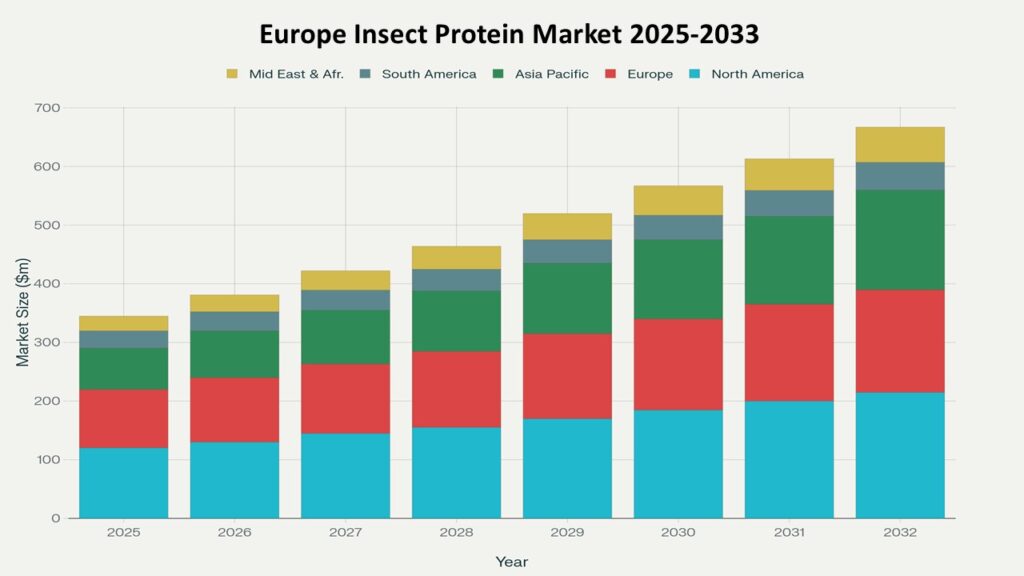
According to Pheonix Research, the Europe Insect Protein Market is valued at EUR 420 million in 2025 and is projected to reach EUR 1,050 million by 2033, registering a CAGR of ~12.5% during 2026–2033. Growth is supported by rising investment in insect farming, commercialization of insect-based food products, and expanding regulatory approvals across European countries.
Western Europe dominates the market, with Germany, France, and the Netherlands leading in both production and consumption due to advanced infrastructure, awareness, and retail penetration. Southern Europe is emerging as the fastest-growing region, fueled by growing acceptance of insect-based food products, rising health-conscious populations, and new startups entering the alternative protein segment.
Post-2025, the market is expected to witness increasing integration of insect protein in functional foods, protein bars, snacks, and pet food, alongside sustainable feed for aquaculture, poultry, and livestock, positioning insects as a mainstream protein source.
Key Drivers of Europe Insect Protein Market Growth
1. Rising Protein Demand and Sustainability Focus
Growing global protein requirements, coupled with environmental pressures from traditional livestock farming, are driving the adoption of insect protein as a sustainable, low-emission, and resource-efficient alternative.
2. Regulatory Approvals and Food Safety Standards
The EU’s Novel Food Regulation, along with feed authorization frameworks, is facilitating the commercial production, import, and distribution of insect protein for both food and feed applications, providing a regulatory foundation for market expansion.
3. Innovation in Product Development
The launch of insect-based protein powders, energy bars, pasta, and functional snacks is broadening consumer acceptance, particularly among health-conscious and flexitarian populations, and is supporting the diversification of product portfolios.
4. Adoption in Pet Food and Livestock Feed
High-quality insect protein is increasingly used in premium pet food, aquaculture feed, and poultry feed, creating multiple revenue streams and promoting wider industry adoption across both B2C and B2B segments.
5. Investment in Insect Farming Infrastructure
European startups and established ingredient companies are scaling insect farming operations through automation, AI-driven farm management, and biotechnology innovations, enabling higher production efficiency and sustainable supply chain growth.
Europe Insect Protein Market Segmentation
1. By Insect Type
1.1 Crickets
1.1.1 Powder & Flour
1.1.1.1 Whole Cricket Flour
1.1.1.2 Defatted Cricket Powder
1.1.1.3 Protein-Enriched Cricket Powder
1.1.2 Snacks & Energy Bars
1.1.2.1 Cricket Protein Bars
1.1.2.2 Roasted Cricket Snacks
1.1.2.3 Cricket Chips & Crackers
1.1.3 Functional Beverages
1.1.3.1 Cricket Protein Shakes
1.1.3.2 Ready-to-Drink Cricket Smoothies
1.1.3.3 Fortified Functional Drinks
1.2 Mealworms
1.2.1 Protein Concentrates
1.2.1.1 Defatted Mealworm Powder
1.2.1.2 Mealworm Protein Isolate
1.2.1.3 Functional Protein Blends
1.2.2 Animal Feed
1.2.2.1 Poultry Feed
1.2.2.2 Aquaculture Feed
1.2.2.3 Livestock Feed
1.2.3 Edible Snacks
1.2.3.1 Roasted Mealworms
1.2.3.2 Mealworm Chips
1.2.3.3 Energy Snack Mixes
1.3 Black Soldier Fly (BSF)
1.3.1 Livestock Feed
1.3.1.1 Poultry Feed
1.3.1.2 Swine Feed
1.3.1.3 Cattle Feed
1.3.2 Aquafeed
1.3.2.1 Fish Feed
1.3.2.2 Shrimp & Prawn Feed
1.3.2.3 Specialty Aquaculture Blends
1.3.3 Fertilizers / Byproducts
1.3.3.1 BSF Frass Fertilizer
1.3.3.2 Organic Soil Enhancers
1.3.3.3 Bioactive Nutrient Additives
1.4 Grasshoppers & Locusts
1.4.1 Roasted Snacks
1.4.1.1 Spiced Roasted Grasshoppers
1.4.1.2 Salted / Flavored Snacks
1.4.2 Protein Ingredients
1.4.2.1 Grasshopper Protein Powder
1.4.2.2 Functional Extracts
1.5 Others (Silkworms, Ants, etc.)
1.5.1 Niche Edible Products
1.5.1.1 Silkworm Pupae Snacks
1.5.1.2 Ant Protein Snacks
1.5.1.3 Specialty Insect Treats
1.5.2 Research & Functional Applications
1.5.2.1 Bioactive Extracts for Supplements
1.5.2.2 Functional Food Ingredients
2. By Application
2.1 Food & Beverages
2.1.1 Protein Bars & Snacks
2.1.1.1 Cricket Protein Bars
2.1.1.2 Mealworm Snack Mixes
2.1.1.3 Grasshopper Chips
2.1.2 Pasta & Bakery Products
2.1.2.1 Insect-Enriched Pasta
2.1.2.2 Bakery Protein Breads
2.1.2.3 Snack Cakes & Biscuits
2.1.3 Functional Foods & Supplements
2.1.3.1 Protein Powders & Mixes
2.1.3.2 Amino Acid Fortified Snacks
2.1.3.3 Meal Replacement Bars
2.1.4 Ready-to-Eat Meals
2.1.4.1 Insect-Enriched Pasta Meals
2.1.4.2 Snack Bowls & Wraps
2.1.4.3 Functional Ready Meals
2.2 Animal Feed
2.2.1 Aquaculture Feed
2.2.1.1 Fish Feed Pellets
2.2.1.2 Shrimp Feed
2.2.2 Poultry Feed
2.2.2.1 Layer Feed
2.2.2.2 Broiler Feed
2.2.3 Pet Food
2.2.3.1 Dog Food
2.2.3.2 Cat Food
2.2.4 Livestock Feed
2.2.4.1 Cattle Feed
2.2.4.2 Swine Feed
2.3 Pharmaceutical & Nutraceuticals
2.3.1 Protein Supplements
2.3.1.1 Insect Protein Powder
2.3.1.2 Protein Blends
2.3.2 Collagen & Amino Acid Ingredients
2.3.2.1 Collagen Supplements
2.3.2.2 Amino Acid Powders
2.4 Cosmetics & Personal Care
2.4.1 Bioactive Extracts
2.4.1.1 Skincare Formulations
2.4.1.2 Anti-Aging Products
2.4.2 Functional Skincare Products
2.4.2.1 Moisturizers & Serums
2.4.2.2 Hair Care Products
3. By Form
3.1 Powder / Flour
3.1.1 Cricket Powder / Flour
3.1.1.1 Whole Cricket Flour
3.1.1.2 Defatted Cricket Powder
3.1.1.3 Protein-Enriched Cricket Powder
3.1.2 Mealworm Powder / Concentrates
3.1.2.1 Defatted Mealworm Powder
3.1.2.2 Mealworm Protein Isolate
3.1.2.3 Functional Protein Blends
3.1.3 Grasshopper / Locust Powder
3.1.3.1 Roasted Insect Powder
3.1.3.2 Functional Extract Powder
3.1.4 Black Soldier Fly (BSF) Powder
3.1.4.1 Protein Powder for Feed
3.1.4.2 Bioactive Nutrient Powder
3.2 Whole Dried Insects
3.2.1 Whole Crickets
3.2.1.1 Roasted & Salted Crickets
3.2.1.2 Spiced / Flavored Crickets
3.2.2 Whole Mealworms
3.2.2.1 Roasted Mealworms
3.2.2.2 Energy Snack Mixes
3.2.3 Grasshoppers & Locusts
3.2.3.1 Roasted Snacks
3.2.3.2 Flavored Insect Snacks
3.2.4 Silkworms / Ants / Others
3.2.4.1 Specialty Roasted Insects
3.2.4.2 Niche Snacks & Treats
3.3 Extracts & Oils
3.3.1 Cricket Extracts & Oils
3.3.1.1 Protein Concentrates for Supplements
3.3.1.2 Cricket Oil for Functional Beverages
3.3.2 Mealworm Extracts & Oils
3.3.2.1 Amino Acid Rich Extracts
3.3.2.2 Functional Food Ingredients
3.3.3 Black Soldier Fly Extracts & Oils
3.3.3.1 BSF Oil for Feed
3.3.3.2 Nutrient-Rich Bioactive Extracts
3.3.4 Grasshopper / Locust Extracts
3.3.4.1 Protein-Enriched Extracts
3.3.4.2 Functional Supplement Ingredients
3.4 Ready-to-Eat Products
3.4.1 Cricket-Based Snacks & Bars
3.4.1.1 Protein Bars
3.4.1.2 Roasted Crickets
3.4.1.3 Cricket Chips & Crackers
3.4.2 Mealworm Ready-to-Eat Items
3.4.2.1 Roasted Snack Mixes
3.4.2.2 Energy & Functional Bars
3.4.3 Grasshopper & Locust Snacks
3.4.3.1 Spiced Roasted Snacks
3.4.3.2 Snack Packs & Trail Mixes
3.4.4 Silkworms / Ants / Other Insects
3.4.4.1 Specialty Snack Foods
3.4.4.2 Functional Ready-to-Eat Treats
4. By Distribution Channel
4.1 Retail
4.1.1 Supermarkets & Hypermarkets
4.1.2 Specialty Health Stores
4.1.3 Organic & Natural Food Stores
4.2 Online
4.2.1 E-commerce Platforms
4.2.2 Brand-Owned Websites
4.3 Foodservice & Horeca
4.3.1 Restaurants & Cafés
4.3.2 Hotels & Catering
4.4 Institutional
4.4.1 Schools & Universities
4.4.2 Research Institutions
5. By End-User
5.1 Individual Consumers
5.1.1 Health-Conscious Adults
5.1.2 Fitness Enthusiasts
5.1.3 Flexitarians & Vegans
5.2 Pet Owners
5.2.1 Dogs & Cats
5.2.2 Exotic Pets
5.3 Farmers & Feed Manufacturers
5.3.1 Poultry & Livestock
5.3.2 Aquaculture Producers
5.4 Food Manufacturers
5.4.1 Bakery & Confectionery
5.4.2 Functional Food Producers
5.4.3 Beverage Companies
6. By Region
6.1 Western Europe
6.2 Southern Europe
6.3 Northern Europe
6.4 Eastern Europe
Regional Insights of Europe Insect Protein Market
Western Europe – Largest Market
Germany, France, and the Netherlands lead in insect protein adoption, supported by robust R&D, regulatory approvals, and consumer awareness. Retail penetration, e-commerce, and premium product launches strengthen market dominance.
Southern Europe – Fastest Growing Market
Italy, Spain, and Portugal are witnessing strong growth due to rising health-conscious populations, growing acceptance of edible insects, and startups innovating in snacks, pasta, and bakery applications.
Northern Europe
Scandinavia is seeing adoption in functional foods, protein supplements, and sustainable animal feed applications.
Eastern Europe
Emerging adoption in foodservice, livestock feed, and niche health-focused products.
Leading Companies in Europe Insect Protein Market
Prominent players include:
-
Entomo Farms
-
InnovaFeed
-
AgriProtein
-
Better Origin
-
Enterra Feed Corporation
-
NextProtein
-
Hexafly
-
Bugsolutely
Among these, Protix B.V. is the largest in Europe, leading with vertically integrated insect farming, R&D, and B2B/B2C distribution. Companies focus on sustainable practices, product innovation, and expanding market presence in food, feed, and pet segments.
Strategic Intelligence and AI-Backed Insights
The Phoenix Demand Forecast Engine indicates accelerating consumer acceptance of protein-rich, environmentally sustainable food solutions, with strong projected expansion across snack foods, bakery applications, and premium pet nutrition segments.
The Consumer Behavior Analyzer identifies flexitarian, vegan, and health-conscious consumer groups as the primary demand drivers, reflecting a broader dietary shift toward sustainable and functional protein alternatives.
The Innovation Tracker highlights growing capital allocation toward automation-driven insect farming, vertical production systems, and advanced functional product development, strengthening scalability and operational efficiency across the value chain.
Porter’s Five Forces Analysis suggests moderate supplier bargaining power and relatively high entry barriers for large-scale commercial farming, while underscoring substantial growth potential for companies that differentiate through sustainability positioning, technological integration, and product innovation.
Why the Europe Insect Protein Market Remains Critical
-
Rising protein demand coupled with sustainability mandates.
-
Integration in food, feed, and nutraceutical products offers diversified revenue.
-
Consumer shift towards eco-friendly, functional, and high-protein diets.
-
Technological adoption enhances farm efficiency and scalability.
-
Regulatory support is strengthening commercialization and innovation.
Final Takeaway of Europe Insect Protein Market
The Europe Insect Protein Market is transitioning from a niche alternative protein category to a strategically important pillar within the region’s sustainable food and feed ecosystem. With a projected CAGR of ~12.5% during 2026–2033, the market reflects strong structural momentum supported by regulatory clarity, rising sustainability commitments, and expanding commercial applications across food, feed, pet nutrition, and nutraceutical segments.
Growth is being driven by increasing consumer awareness of environmentally responsible protein sources, broader acceptance of insect-based functional foods, and accelerated integration into aquaculture, poultry, and premium pet food formulations. Western Europe currently leads adoption due to advanced regulatory frameworks and infrastructure, while Southern and Northern Europe present high-growth opportunities supported by innovation and evolving consumer preferences.
Companies that successfully integrate product innovation, scalable insect farming technologies, automation-driven efficiency, and diversified application strategies will be best positioned to capture long-term value. Strategic partnerships, investment in R&D, and alignment with EU sustainability goals will remain critical competitive differentiators in the Post-2025 landscape.
At Phoenix Research, our advanced forecasting models deliver in-depth Europe Insect Protein revenue analysis, competitive benchmarking, and strategic intelligence insights — enabling stakeholders to capitalize on emerging opportunities with data-backed confidence and sustainable growth strategies
📢 Social Mentions & Publication Channels
Explore deeper insights and follow our cross-platform updates on LinkedIn, and X for continuous intelligence and market coverage.
LinkedIn: https://www.linkedin.com/feed/update/urn:li:activity:7432710730287726593
X: https://x.com/Pheonix_Insight/status/2026948636043772330?s=20
Table of Contents
1. Executive Summary
1.1 Market Snapshot (2026–2033)
1.2 Key Growth Highlights
1.3 Market Attractiveness Analysis
1.4 Analyst Perspective
1.5 Strategic Recommendations
2. Market Introduction
2.1 Definition & Scope of Study
2.2 Research Methodology
2.3 Assumptions & Limitations
2.4 Market Dynamics Overview
3. Europe Insect Protein Market Overview
3.1 Market Size & Forecast (EUR Million), 2025–2033
3.2 CAGR Analysis (2026–2033)
3.3 Value Chain Analysis
3.4 Supply Chain & Production Landscape
3.5 Pricing Analysis
3.6 Regulatory Framework (EU Novel Food Regulation, Feed Authorization)
4. Market Dynamics
4.1 Market Drivers
4.1.1 Rising Protein Demand & Sustainability Focus
4.1.2 Regulatory Approvals & Safety Standards
4.1.3 Product Innovation & Diversification
4.1.4 Expansion in Pet Food & Aquaculture Feed
4.1.5 Investment in Automated Insect Farming
4.2 Market Restraints
4.2.1 Consumer Perception Barriers
4.2.2 High Initial Capital Investment
4.2.3 Regulatory Complexity Across Countries
4.3 Market Opportunities
4.3.1 Functional & Fortified Food Integration
4.3.2 Expansion in Southern & Eastern Europe
4.3.3 Strategic Partnerships with FMCG & Feed Giants
4.4 Market Challenges
4.4.1 Scalability Constraints
4.4.2 Cost Competitiveness vs Traditional Proteins
5. Market Segmentation by Insect Type (EUR Million), 2026–2033
5.1 Crickets
5.1.1 Powder & Flour
5.1.1.1 Whole Cricket Flour
5.1.1.2 Defatted Cricket Powder
5.1.1.3 Protein-Enriched Cricket Powder
5.1.2 Snacks & Energy Bars
5.1.2.1 Cricket Protein Bars
5.1.2.2 Roasted Cricket Snacks
5.1.2.3 Cricket Chips & Crackers
5.1.3 Functional Beverages
5.1.3.1 Cricket Protein Shakes
5.1.3.2 Ready-to-Drink Smoothies
5.1.3.3 Fortified Functional Drinks
5.2 Mealworms
5.2.1 Protein Concentrates
5.2.1.1 Defatted Mealworm Powder
5.2.1.2 Mealworm Protein Isolate
5.2.1.3 Functional Protein Blends
5.2.2 Animal Feed
5.2.2.1 Poultry Feed
5.2.2.2 Aquaculture Feed
5.2.2.3 Livestock Feed
5.2.3 Edible Snacks
5.2.3.1 Roasted Mealworms
5.2.3.2 Mealworm Chips
5.2.3.3 Energy Snack Mixes
5.3 Black Soldier Fly (BSF)
5.3.1 Livestock Feed
5.3.1.1 Poultry Feed
5.3.1.2 Swine Feed
5.3.1.3 Cattle Feed
5.3.2 Aquafeed
5.3.2.1 Fish Feed
5.3.2.2 Shrimp & Prawn Feed
5.3.2.3 Specialty Blends
5.3.3 Fertilizers / Byproducts
5.3.3.1 BSF Frass Fertilizer
5.3.3.2 Organic Soil Enhancers
5.3.3.3 Bioactive Nutrient Additives
5.4 Grasshoppers & Locusts
5.4.1 Roasted Snacks
5.4.1.1 Spiced Variants
5.4.1.2 Flavored Snacks
5.4.2 Protein Ingredients
5.4.2.1 Protein Powder
5.4.2.2 Functional Extracts
5.5 Others (Silkworms, Ants, etc.)
5.5.1 Niche Edible Products
5.5.1.1 Silkworm Pupae Snacks
5.5.1.2 Ant Protein Snacks
5.5.1.3 Specialty Treats
5.5.2 Research & Functional Applications
5.5.2.1 Bioactive Extracts
5.5.2.2 Supplement Ingredients
6. Market Segmentation by Application (EUR Million), 2026–2033
6.1 Food & Beverages
6.1.1 Protein Bars & Snacks
6.1.1.1 Cricket Protein Bars
6.1.1.2 Mealworm Energy Bars
6.1.1.3 Grasshopper Snack Bars
6.1.1.4 Roasted Insect Snack Packs
6.1.1.5 Insect-Based Trail Mixes
6.1.1.6 Protein Chips & Crackers
6.1.1.7 High-Protein Extruded Snacks
6.1.2 Pasta & Bakery Products
6.1.2.1 Insect-Enriched Pasta
6.1.2.2 Protein Breads & Rolls
6.1.2.3 Biscuits & Cookies
6.1.2.4 Cakes & Muffins
6.1.3 Functional Foods & Supplements
6.1.3.1 Protein Powders & Mixes
6.1.3.2 Amino Acid Fortified Products
6.1.3.3 Meal Replacement Products
6.1.3.4 Fortified Functional Foods
6.1.4 Ready-to-Eat Meals
6.1.4.1 Insect-Enriched Pasta Meals
6.1.4.2 Protein Snack Bowls
6.1.4.3 Wraps & Sandwich Fillings
6.1.4.4 Frozen Ready Meals
6.1.4.5 High-Protein Convenience Foods
6.2 Animal Feed
6.2.1 Aquaculture Feed
6.2.1.1 Fish Feed Pellets
6.2.1.2 Shrimp & Prawn Feed
6.2.1.2.1 Larval Feed
6.2.1.3 Specialty Aquaculture Blends
6.2.2 Poultry Feed
6.2.2.1 Layer Feed
6.2.2.2 Broiler Feed
6.2.2.3 Organic & Specialty Poultry Feed
6.2.3 Livestock Feed
6.2.3.1 Cattle Feed
6.2.3.2 Swine Feed
6.2.3.3 Specialty Livestock Diets
6.2.4 Pet Food
6.2.4.1 Dog Food
6.2.4.2 Cat Food
6.2.4.3 Exotic & Specialty Pet Feed
6.3 Pharmaceutical & Nutraceuticals
6.3.1 Protein Supplements
6.3.1.1 Insect Protein Powder
6.3.1.2 Protein Capsules & Tablets
6.3.1.3 Functional Protein Blends
6.3.1.4 Clinical Nutrition Formulations
6.3.2 Collagen & Amino Acid Ingredients
6.3.2.1 Collagen Supplements
6.3.2.2 Amino Acid Powders
6.3.2.3 Bioactive Peptides
6.4 Cosmetics & Personal Care
6.4.1 Bioactive Extracts
6.4.1.1 Anti-Aging Compounds
6.4.1.2 Antioxidant-Rich Extracts
6.4.1.3 Collagen-Stimulating Ingredients
6.4.1.4 Skin Barrier Support Ingredients
6.4.2 Functional Skincare Products
6.4.2.1 Moisturizers & Creams
6.4.2.2 Serums & Essences
6.4.2.3 Hair Care Products
7. Market Segmentation by Form (EUR Million), 2026–2033
7.1 Powder / Flour
7.1.1 Cricket Powder
7.1.1.1 Whole Cricket Flour
7.1.1.2 Defatted Cricket Powder
7.1.1.3 Protein-Enriched Cricket Powder
7.1.1.4 Organic Certified Cricket Flour
7.1.1.5 Functional Blended Cricket Protein
7.1.2 Mealworm Powder
7.1.2.1 Defatted Mealworm Powder
7.1.2.2 Mealworm Protein Isolate
7.1.2.3 High-Protein Mealworm Concentrate
7.1.2.4 Functional Protein Blends
7.1.2.5 Fortified Mealworm Ingredient Mixes
7.1.3 Black Soldier Fly (BSF) Powder
7.1.3.1 Protein Powder for Animal Feed
7.1.3.2 Aquafeed-Grade BSF Powder
7.1.3.3 Organic BSF Protein Meal
7.1.3.4 Bioactive Nutrient Powder
7.1.3.5 High-Fat BSF Meal
7.1.4 Grasshopper Powder
7.1.4.1 Roasted Grasshopper Powder
7.1.4.2 Protein-Enriched Powder
7.1.4.3 Functional Extract Powder
7.1.4.4 Specialty Gourmet Ingredient Powder
7.1.4.5 Supplement-Grade Powder
7.2 Whole Dried Insects
7.2.1 Whole Crickets
7.2.1.1 Roasted & Salted Crickets
7.2.1.2 Spiced / Flavored Crickets
7.2.1.3 Organic Whole Crickets
7.2.1.4 Bulk Industrial Supply
7.2.2 Whole Mealworms
7.2.2.1 Roasted Mealworms
7.2.2.2 Snack Mix Blends
7.2.2.3 Feed-Grade Dried Mealworms
7.2.2.4 Organic Certified Mealworms
7.2.3 Whole Grasshoppers & Locusts
7.2.3.1 Roasted Snacks
7.2.3.2 Gourmet Flavored Variants
7.2.3.3 Foodservice Bulk Packs
7.2.4 Silkworms / Ants / Other Insects
7.2.4.1 Specialty Roasted Insects
7.2.4.2 Ethnic & Traditional Food Applications
7.2.4.3 Research & Laboratory Supply
7.3 Extracts & Oils
7.3.1 Cricket Extracts & Oils
7.3.1.1 Protein Concentrates
7.3.1.2 Cricket Oil for Functional Beverages
7.3.1.3 Amino Acid Extracts
7.3.1.4 Nutraceutical-Grade Extracts
7.3.2 Mealworm Extracts & Oils
7.3.2.1 Amino Acid Rich Extracts
7.3.2.2 Functional Food Ingredients
7.3.2.3 High-Lipid Mealworm Oil
7.3.2.4 Supplement-Grade Ingredients
7.3.3 Black Soldier Fly Extracts & Oils
7.3.3.1 BSF Oil for Feed
7.3.3.2 Lauric Acid-Rich Extracts
7.3.3.3 Bioactive Nutrient Concentrates
7.3.3.4 Industrial-Grade Lipid Applications
7.3.4 Grasshopper / Locust Extracts
7.3.4.1 Protein-Enriched Extracts
7.3.4.2 Functional Supplement Ingredients
7.3.4.3 Cosmetic-Grade Extracts
7.4 Ready-to-Eat Products
7.4.1 Cricket-Based Products
7.4.1.1 Protein Bars
7.4.1.2 Roasted Crickets
7.4.1.3 Cricket Chips & Crackers
7.4.1.4 Cricket Snack Mixes
7.4.2 Mealworm Ready-to-Eat Items
7.4.2.1 Roasted Snack Mixes
7.4.2.2 Energy & Functional Bars
7.4.2.3 Seasoned Mealworm Packs
7.4.2.4 Gourmet Culinary Packs
7.4.3 Grasshopper & Locust Snacks
7.4.3.1 Spiced Roasted Snacks
7.4.3.2 Snack Packs & Trail Mixes
7.4.3.3 Premium Retail Packs
7.4.4 Silkworms / Ants / Other Insect Snacks
7.4.4.1 Specialty Snack Foods
7.4.4.2 Functional Ready-to-Eat Treats
7.4.4.3 Limited Edition / Niche Products
8. Market Segmentation by Distribution Channel (EUR Million), 2026–2033
8.1 Retail
8.1.1 Supermarkets & Hypermarkets
8.1.2 Specialty Health Stores
8.1.3 Organic Stores
8.2 Online
8.2.1 E-commerce Marketplaces
8.2.2 Brand-Owned Websites
8.3 Foodservice & HoReCa
8.3.1 Restaurants & Cafés
8.3.2 Hotels & Catering
8.4 Institutional
8.4.1 Schools & Universities
8.4.2 Research Institutions
9. Market Segmentation by End-User (EUR Million), 2026–2033
9.1 Individual Consumers
9.1.1 Health-Conscious Adults
9.1.2 Fitness Enthusiasts
9.1.3 Flexitarians & Vegans
9.2 Pet Owners
9.2.1 Dogs & Cats
9.2.2 Exotic Pets
9.3 Farmers & Feed Manufacturers
9.3.1 Poultry & Livestock
9.3.2 Aquaculture Producers
9.4 Food Manufacturers
9.4.1 Bakery & Confectionery
9.4.2 Functional Food Producers
9.4.3 Beverage Companies
10. Regional Analysis (EUR Million), 2026–2033
10.1 Western Europe
10.2 Southern Europe
10.3 Northern Europe
10.4 Eastern Europe
11. Competitive Landscape
11.1 Market Share Analysis
11.2 Competitive Benchmarking
11.3 Strategic Developments
11.4 Investment & Funding Analysis
12. Company Profiles
12.1 Protix B.V.
12.2 Ynsect SAS
12.3 InnovaFeed
12.4 Entomo Farms
12.5 AgriProtein
12.6 Better Origin
12.7 Enterra Feed Corporation
12.8 NextProtein
12.9 Hexafly
12.10 Bugsolutely
13. Strategic Intelligence & AI-Backed Insights
13.1 Phoenix Demand Forecast Engine Analysis
13.2 Consumer Behavior Analyzer Insights
13.3 Innovation Tracker Assessment
13.4 Porter’s Five Forces Analysis
14. Future Outlook (2026–2033)
14.1 Emerging Trends
14.2 Investment Hotspots
14.3 Technology & Automation Impact
14.4 Sustainability & ESG Alignment
15. Appendix
15.1 Abbreviations
15.2 Currency Conversion Rates
15.3 Glossary of Terms
15.4 Research Methodology Framework
15.5 List of Tables
15.6 List of Figures
16. About Phoenix Research
16.1 Company Overview
16.2 Research Capabilities
16.3 Industry Coverage
16.4 Contact Information