
Global Alpaca Fiber Market Size and Share Analysis 2026-2033
Global Alpaca Fiber Market Size & Forecast
The global alpaca fiber market is projected to witness steady and sustainable growth during the forecast period from 2026 to 2033. The market was valued at approximately USD 0.85 billion in 2025 and is expected to reach nearly USD 1.45 billion by 2033, expanding at a CAGR of around 6.9%. The market growth is driven by rising demand for luxury natural fibers, increasing preference for sustainable and eco-friendly textiles, and growing adoption of premium apparel materials in the fashion industry. Alpaca fiber is a natural textile fiber obtained from alpacas, primarily found in South America. It is known for its softness, lightweight properties, durability, hypoallergenic nature, and excellent thermal insulation. These characteristics make alpaca fiber highly desirable in luxury clothing, home textiles, and high-end fashion applications. The market is also benefiting from the global shift toward sustainable fashion and ethical sourcing, as consumers increasingly prefer biodegradable and cruelty-free textile alternatives over synthetic fibers.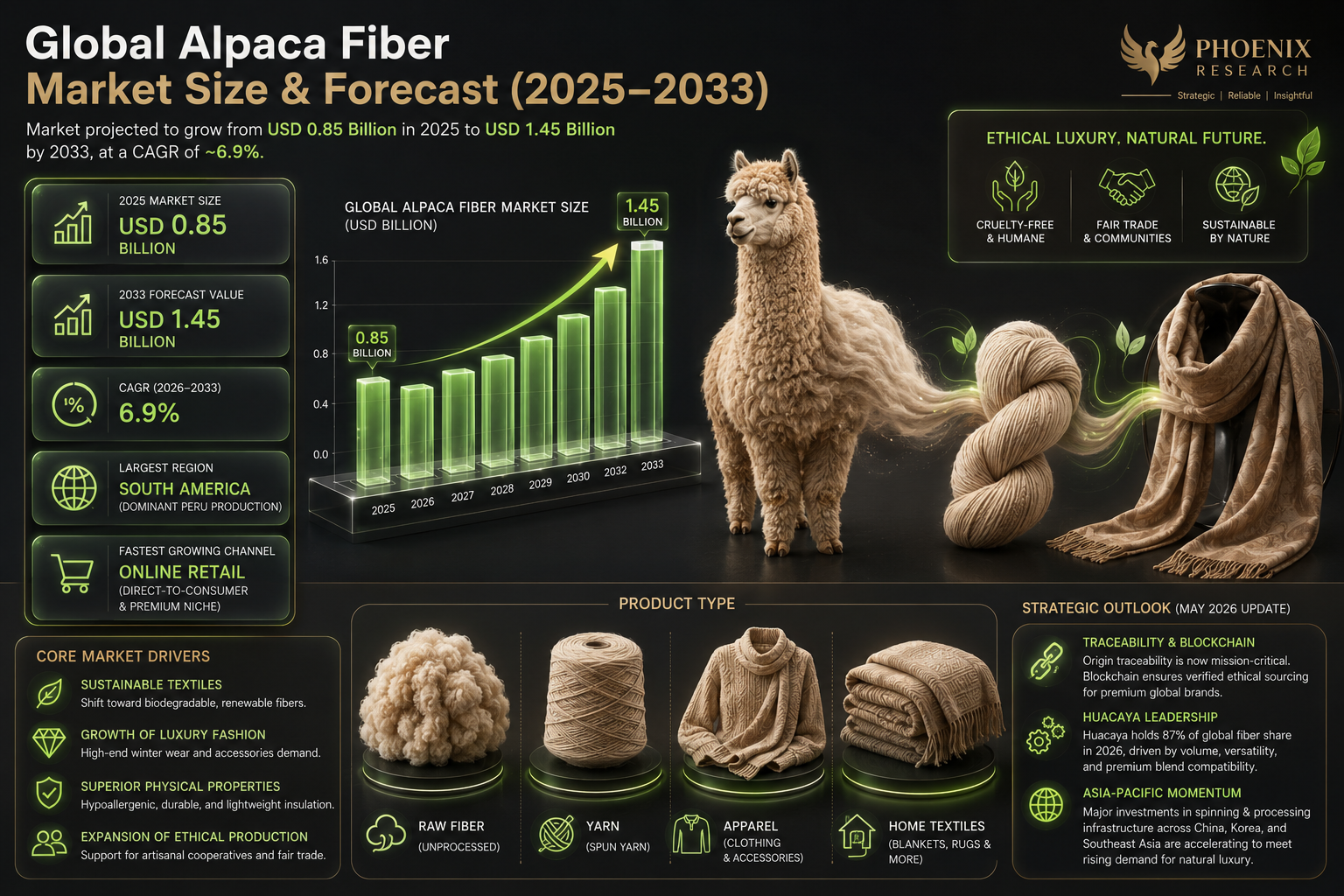
Global Alpaca Fiber Market Overview
The alpaca fiber market is a niche yet rapidly growing segment of the global natural fibers and textile industry. It is primarily centered in Peru, which accounts for the majority of global alpaca production, followed by Bolivia and other Andean regions. The market includes raw alpaca fiber, processed yarn, dyed fiber, and finished textile products used in apparel, accessories, blankets, carpets, and luxury fashion items. Increasing investments in sustainable textile production, ethical farming practices, and artisan-based manufacturing are shaping the industry???s growth trajectory. Fashion brands are increasingly incorporating alpaca fiber into premium collections due to its superior quality, softness, and eco-friendly characteristics compared to wool and synthetic alternatives. Major market participants include Michell Group, Inca Tops, The Alpaca Yarn Company, Pacomarca, Mallkini Alpaca, and other regional fiber cooperatives and textile manufacturers in South America and global luxury textile brands.Key Drivers of Global Alpaca Fiber Market Growth
Rising Demand for Sustainable and Eco-Friendly Textiles
Consumers are increasingly shifting toward sustainable fashion materials that reduce environmental impact and support ethical sourcing. Alpaca fiber is biodegradable, renewable, and produced with low environmental footprint, making it highly attractive for eco-conscious consumers.Growth of Luxury Fashion Industry
The expansion of premium and luxury apparel markets is driving demand for high-quality natural fibers. Alpaca fiber is widely used in designer clothing, winter wear, and high-end fashion accessories due to its softness and thermal properties.Superior Physical and Thermal Properties
Alpaca fiber is lightweight, hypoallergenic, flame-resistant, and offers excellent insulation compared to traditional wool. These properties make it suitable for both fashion and functional textile applications.Expansion of Ethical and Artisanal Textile Production
Growing support for fair-trade practices and artisanal textile production is boosting demand for alpaca fiber sourced from small farmers and cooperatives. This supports rural economies in South America and strengthens global supply chains.Increasing Adoption in Home Textiles
Alpaca fiber is increasingly used in blankets, rugs, upholstery, and home d??cor products due to its softness and durability. The rising demand for premium home furnishings is supporting market expansion.Global Alpaca Fiber Market Segmentation
By Product Type
The market is segmented into raw fiber, processed fiber, yarn, and finished textile products. Processed fiber and yarn segments account for a major share due to their extensive use in textile manufacturing.By Application
Applications include apparel, home textiles, accessories, blankets, carpets, and industrial textiles. Apparel remains the largest segment driven by demand for luxury winter clothing and premium fashion garments.By Fiber Type
The market includes Huacaya alpaca fiber and Suri alpaca fiber. Huacaya fiber dominates due to its higher production volume and widespread use in textiles.By Distribution Channel
The market includes direct sales, textile manufacturers, online retail, and specialty luxury stores. Online retail channels are growing rapidly due to increasing global demand for niche and premium textile products.Regional Market Dynamics
South America
South America dominates the global alpaca fiber market, with Peru accounting for the majority of global production. The region benefits from traditional alpaca farming practices, established textile industries, and strong export networks.North America
North America is a major consumer market driven by demand for luxury fashion and sustainable textiles. The United States and Canada are key importers of alpaca fiber-based products.Europe
Europe holds a significant share due to strong demand for ethical fashion, premium clothing, and sustainable textile materials. Countries such as Italy, Germany, France, and the United Kingdom are key markets for luxury alpaca garments.Asia-Pacific
Asia-Pacific is witnessing growing demand due to expanding textile manufacturing and increasing interest in premium fashion products. Japan, South Korea, and China are emerging markets for alpaca fiber-based apparel.Middle East & Africa
The region is gradually adopting luxury textile products, supported by rising disposable incomes and growing demand for premium fashion imports.Competitive Landscape
The global alpaca fiber market is moderately fragmented, with strong participation from South American producers and global luxury textile companies. Key players include Michell Group, Inca Tops, The Alpaca Yarn Company, Pacomarca, Mallkini Alpaca, and various regional cooperatives and textile exporters. Companies are focusing on sustainable sourcing, fiber quality enhancement, ethical production practices, and expansion into global luxury fashion supply chains. Strategic partnerships with fashion brands and sustainable textile initiatives are becoming increasingly important for market expansion.Strategic Outlook
The strategic outlook for the global alpaca fiber market remains positive due to increasing demand for sustainable luxury textiles and ethical fashion products. Future opportunities include expansion into premium fashion collaborations, sustainable textile innovation, blended natural fiber development, and eco-certified apparel production. Advancements in textile processing technologies and global awareness of sustainable fashion are expected to further support market growth. Producers focusing on quality enhancement, sustainable farming, and global brand partnerships are likely to strengthen their competitive position.Final Market Perspective
The global alpaca fiber market is evolving as a key segment within the sustainable luxury textile industry, driven by eco-conscious consumer preferences and rising demand for premium natural fibers. Increasing adoption in fashion, home textiles, and specialty applications will continue to support steady market expansion throughout the forecast period. Companies that successfully combine sustainability, quality differentiation, and global distribution networks will remain strongly positioned in the evolving alpaca fiber market.Table of Contents
Table of Contents
- 1. Executive Summary
- 1.1 Global Alpaca Fiber Market Snapshot (2026-2033)
- 1.2 Market Size & CAGR Analysis
- 1.3 Largest & Fastest-Growing Segments
- 1.4 Key Regional Insights
- 1.5 Market Growth Drivers
- 1.6 Competitive Landscape Overview
- 1.7 Future Industry Outlook
- 2. Introduction & Market Overview
- 2.1 Definition of Alpaca Fiber
- 2.2 Scope of the Study
- 2.3 Evolution of Natural Luxury Fibers
- 2.4 Alpaca Fiber Industry Ecosystem
- 2.5 Value Chain Analysis
- 2.6 Sustainable Fashion & Ethical Sourcing Trends
- 2.7 Regulatory & Certification Framework
- 3. Research Methodology
- 3.1 Primary Research
- 3.2 Secondary Research
- 3.3 Market Estimation Methodology
- 3.4 Forecast Assumptions (2026-2033)
- 3.5 Data Validation & Market Triangulation
- 4. Market Dynamics
- 4.1 Drivers
- 4.1.1 Rising Demand for Sustainable & Eco-Friendly Textiles
- 4.1.2 Growth of Luxury Fashion Industry
- 4.1.3 Superior Physical & Thermal Properties
- 4.1.4 Expansion of Ethical & Artisanal Textile Production
- 4.1.5 Increasing Adoption in Home Textiles
- 4.2 Restraints
- 4.2.1 Limited Raw Material Supply Concentration
- 4.2.2 High Production & Processing Costs
- 4.2.3 Price Volatility in Luxury Textile Segment
- 4.2.4 Competition from Synthetic & Wool Alternatives
- 4.3 Opportunities
- 4.3.1 Expansion of Sustainable Luxury Fashion Brands
- 4.3.2 Innovation in Blended Natural Fiber Textiles
- 4.3.3 Growth in Eco-Certified Apparel Demand
- 4.3.4 Rising E-Commerce Penetration for Luxury Textiles
- 4.4 Challenges
- 4.4.1 Supply Chain Fragmentation in South America
- 4.4.2 Quality Standardization Issues
- 4.4.3 Climate Sensitivity Affecting Production
- 4.4.4 Limited Global Awareness in Emerging Markets
- 4.1 Drivers
- 5. Global Alpaca Fiber Market Analysis (USD Billion), 2026-2033
- 5.1 Market Size Overview
- 5.2 CAGR Analysis
- 5.3 Revenue Distribution by Region
- 5.4 Segment-Wise Revenue Analysis
- 5.5 Demand & Adoption Trends
- 5.6 Sustainability & Innovation Trends
- 6. Market Segmentation (USD Billion), 2026-2033
- 6.1 By Product Type
- 6.1.1 Raw Fiber
- 6.1.2 Processed Fiber
- 6.1.3 Yarn
- 6.1.4 Finished Textile Products
- 6.2 By Application
- 6.2.1 Apparel
- 6.2.2 Home Textiles
- 6.2.3 Accessories
- 6.2.4 Blankets
- 6.2.5 Carpets
- 6.2.6 Industrial Textiles
- 6.3 By Fiber Type
- 6.3.1 Huacaya Alpaca Fiber
- 6.3.2 Suri Alpaca Fiber
- 6.4 By Distribution Channel
- 6.4.1 Direct Sales
- 6.4.2 Textile Manufacturers
- 6.4.3 Online Retail
- 6.4.4 Specialty Luxury Stores
- 6.1 By Product Type
- 7. Market Segmentation by Geography
- 7.1 South America
- 7.2 North America
- 7.3 Europe
- 7.4 Asia-Pacific
- 7.5 Middle East & Africa
- 8. Competitive Landscape
- 8.1 Market Share Analysis
- 8.2 Product Innovation Benchmarking
- 8.3 Sustainable Sourcing & Ethical Production Analysis
- 8.4 Strategic Partnerships with Fashion Brands
- 8.5 Brand Positioning Strategies
- 9. Company Profiles
- 9.1 Michell Group
- 9.2 Inca Tops
- 9.3 The Alpaca Yarn Company
- 9.4 Pacomarca
- 9.5 Mallkini Alpaca
- 9.6 Regional Cooperatives (Peru & Bolivia)
- 9.7 Global Luxury Textile Brands
- 10. Strategic Intelligence & Pheonix AI Insights
- 10.1 AI-Based Textile Demand Forecasting
- 10.2 Sustainable Fiber Traceability Systems
- 10.3 Ethical Sourcing Compliance Analytics
- 10.4 Luxury Fashion Trend Intelligence
- 10.5 Competitive Supply Chain Benchmarking
- 11. Future Outlook & Strategic Recommendations
- 11.1 Expansion of Sustainable Luxury Fashion
- 11.2 Growth of Eco-Certified Textile Production
- 11.3 Innovation in Blended Natural Fibers
- 11.4 Digitalization of Textile Supply Chains
- 11.5 Long-Term Market Outlook (2033+)
- 12. Appendix
- 13. About Pheonix Research
- 14. Disclaimer
Competitive Landscape
Global Alpaca Fiber Market Competitive Intensity & Market Structure Overview
The global alpaca fiber market is a niche, moderately fragmented, and supply-constrained segment of the broader natural and luxury textile industry. Competition is primarily centered around fiber quality differentiation, ethical sourcing practices, supply chain integration, pricing premiums, and strong relationships with luxury fashion houses and textile manufacturers.
The market structure is heavily influenced by South American production dominance???particularly Peru???where raw alpaca fiber supply is concentrated among cooperatives, farming communities, and vertically integrated textile processors. Downstream value addition occurs through spinning, dyeing, yarn production, and luxury apparel manufacturing across North America, Europe, and parts of Asia.
Unlike mass textile fibers, alpaca fiber competition is less volume-driven and more quality- and origin-driven. Traceability, sustainability certification, and artisanal branding play a central role in market positioning, especially in premium fashion and ethical textile segments.
Global Alpaca Fiber Market Competitive Intensity & Market Structure Current Scenario
Leading Alpaca Fiber Producers, Processors & Textile Companies
Michell Group: One of the largest integrated alpaca fiber processors in Peru, involved in fiber collection, spinning, dyeing, and export of high-quality alpaca yarns and textiles to global markets.
Inca Tops: Major Peruvian textile company specializing in alpaca and other natural fibers, supplying yarns and fabrics to international fashion brands and knitwear manufacturers.
The Alpaca Yarn Company: Global distributor of alpaca yarns focused on premium hand-knitting and textile applications, catering to niche luxury and craft markets.
Pacomarca: Key alpaca breeding and genetic improvement organization contributing to fiber quality enhancement and sustainable herd management practices.
Mallkini Alpaca: Large-scale alpaca breeding and fiber production entity emphasizing ethical farming, sustainability, and high-quality fiber output.
Regional Cooperatives in Peru & Bolivia: Numerous farmer cooperatives play a critical role in raw fiber supply, ensuring collection, grading, and initial processing of alpaca wool for export markets.
Luxury Textile & Fashion Brands (Downstream Players): High-end fashion houses and premium textile brands across Europe and North America increasingly incorporate alpaca fiber into winter wear, luxury garments, and sustainable collections, driving demand-side competition for high-grade fiber supply.
Key Competitive Intensity & Market Structure Drivers
One of the most significant competitive factors in the alpaca fiber market is raw material quality differentiation. Fiber fineness, softness, color consistency, and grading standards strongly influence pricing and demand from luxury fashion brands.
Supply chain control is another critical factor, with vertically integrated producers gaining competitive advantage by managing everything from alpaca breeding to final textile processing, ensuring traceability and consistent quality.
Sustainability and ethical sourcing have become key market differentiators. Certifications related to animal welfare, fair trade practices, and environmentally responsible farming significantly enhance brand value in international markets.
Limited global supply of alpaca fiber creates a structurally constrained market, where demand from luxury fashion often exceeds high-grade supply, intensifying competition among buyers rather than producers.
Brand partnerships and long-term contracts with fashion houses are increasingly important for securing stable demand, particularly for premium-grade fiber used in high-end apparel collections.
Strategic Implications of Competitive Intensity & Market Structure
Producers are increasingly investing in genetic improvement programs, selective breeding, and herd management technologies to enhance fiber quality and yield consistency.
Vertical integration across farming, fiber processing, and textile manufacturing is becoming a key strategic advantage, allowing companies to capture higher margins and ensure supply chain traceability.
Luxury fashion brands are actively forming long-term sourcing partnerships with alpaca producers to secure sustainable and ethically sourced fiber supplies amid growing consumer demand for eco-friendly textiles.
Digital traceability systems, sustainability certifications, and blockchain-based supply tracking are gradually being adopted to enhance transparency and strengthen consumer trust in premium alpaca products.
Emerging interest in blended natural fibers and innovative textile combinations is opening new opportunities for product diversification and value-added applications beyond traditional knitwear and winter apparel.
Global Alpaca Fiber Market Competitive Intensity & Market Structure Forward Outlook
The global alpaca fiber market is expected to remain structurally tight and value-driven, with demand growth primarily led by sustainable luxury fashion and premium textile applications.
Future competition will increasingly focus on sustainability credentials, supply chain transparency, and high-end fashion integration rather than mass production expansion.
Climate change resilience, sustainable grazing practices, and improved breeding technologies are expected to play a growing role in long-term supply stability and competitive positioning.
Market consolidation is likely to remain limited due to the fragmented nature of alpaca farming communities, but stronger integration between cooperatives and global textile companies is expected.
Overall, companies that successfully combine ethical sourcing, fiber quality optimization, vertical integration, and strong global brand partnerships will remain strongly positioned in the evolving global alpaca fiber market.
Value Chain
Global Alpaca Fiber Market Value Chain & Supply Chain Evolution Overview
The global alpaca fiber market value chain is evolving from a traditional livestock-based rural production system into a more structured, export-oriented, and sustainability-driven textile supply network. This transformation is being supported by rising global demand for eco-friendly luxury textiles, increasing ethical sourcing requirements, and the growing premiumization of natural fiber-based fashion products.
The value chain begins with upstream alpaca farming, primarily concentrated in the Andean regions of South America, especially Peru and Bolivia. This stage includes breeding, herd management, shearing, and raw fiber collection. Smallholder farmers and cooperatives play a central role in production, with traditional knowledge systems still forming the backbone of alpaca husbandry. Climate conditions, pasture availability, and animal health management significantly influence fiber yield and quality.
The next stage involves raw fiber sorting, grading, and initial cleaning, where alpaca fibers are categorized based on fineness, color, and quality grades. This step is critical for determining commercial value, as finer grades are typically used in luxury apparel while coarser grades are directed toward industrial or home textile applications. Cooperatives and regional collection centers often facilitate aggregation and quality standardization.
Processing and textile manufacturing form the industrial core of the value chain and include washing, dehairing, carding, spinning, dyeing, and yarn production. Textile manufacturers and mills, particularly in Peru, transform raw alpaca fiber into yarns and fabrics used in apparel, accessories, and home textiles. Increasing investment in modern textile machinery and sustainable processing technologies is improving efficiency and reducing water and chemical usage.
The design and product development segment includes fashion brands, textile designers, and luxury apparel manufacturers who convert alpaca yarn and fabric into finished garments and high-value textile products. This stage plays a critical role in value addition, branding, and market positioning, particularly in premium and luxury fashion segments.
Distribution and retail channels include export distributors, luxury fashion brands, specialty textile retailers, e-commerce platforms, and direct-to-consumer channels. International trade plays a major role in market expansion, with Europe and North America serving as key demand centers for alpaca fiber-based products. Branding, certification, and storytelling around sustainability and ethical sourcing are increasingly important in downstream distribution.
Overall, the alpaca fiber value chain is transitioning toward a more integrated, sustainability-focused ecosystem that combines traditional farming practices with modern textile processing, global luxury branding, and ethically driven consumer demand.
Global Alpaca Fiber Market Value Chain & Supply Chain Evolution Current Scenario
The current alpaca fiber supply chain remains heavily concentrated in South America, particularly Peru, which accounts for the majority of global production. The supply structure is largely decentralized, with thousands of small-scale farmers contributing to raw fiber output through cooperative-based aggregation systems.
Textile processing capabilities are increasingly being upgraded within producing countries, especially Peru, where vertical integration from raw fiber to finished textiles is expanding. However, a significant portion of high-value textile manufacturing and luxury garment production still occurs in Europe and North America, where premium fashion brands add substantial value to alpaca-based products.
Global demand is primarily driven by luxury fashion houses, sustainable textile brands, and premium home textile manufacturers. Alpaca fiber products are positioned as high-end alternatives to wool and synthetic fibers, benefiting from strong consumer interest in ethical sourcing and environmental sustainability.
The supply chain is influenced by seasonal production cycles, limited geographic concentration, and dependency on smallholder farming systems, which can create variability in raw fiber availability and pricing. Climate variability and pasture conditions also impact fiber yield consistency.
Digital transformation is gradually entering the alpaca fiber supply chain through traceability systems, blockchain-based sourcing verification, and certification platforms that ensure ethical sourcing and animal welfare compliance. These technologies are increasingly important for luxury brands seeking transparency in their supply networks.
Sustainability certifications, fair-trade labeling, and organic textile standards are becoming essential components of the supply chain, enhancing product credibility and supporting premium pricing in global markets.
Key Value Chain & Supply Chain Evolution Signals in Global Alpaca Fiber Market
One of the strongest evolution signals in the alpaca fiber market is the increasing shift toward ethical and sustainable sourcing frameworks. Consumers and fashion brands are demanding full transparency regarding animal welfare, environmental impact, and fair compensation for farmers.
Another key trend is the gradual vertical integration of alpaca fiber processing within producing regions, particularly in Peru. This is enabling greater value retention at the source and reducing reliance on external textile processing hubs.
The rise of luxury sustainable fashion is also reshaping demand dynamics, with global brands incorporating alpaca fiber into premium collections as part of broader sustainability commitments. This is strengthening long-term demand stability for high-quality fiber grades.
Digital traceability solutions, including blockchain-based certification and QR-code tracking systems, are increasingly being adopted to verify origin, quality, and ethical compliance across the supply chain.
Additionally, cooperative strengthening and rural development programs are improving farmer participation, enhancing fiber quality standards, and increasing bargaining power for small producers within the global supply ecosystem.
Strategic Implications of Value Chain & Supply Chain Evolution in Global Alpaca Fiber Market
The evolving alpaca fiber value chain presents important strategic implications for farmers, cooperatives, textile processors, luxury brands, and global distributors. Companies that invest in traceability, ethical sourcing, and long-term supplier relationships are better positioned to capture premium market segments.
Supply chain consolidation and vertical integration are becoming key competitive strategies, particularly among textile manufacturers in producing regions seeking to move up the value chain into finished garment production and direct exports.
Brand differentiation through sustainability storytelling, certification compliance, and origin-based marketing is increasingly critical in global luxury fashion markets. Consumers are willing to pay premium prices for verified ethical and eco-friendly alpaca products.
Investment in processing technology, fiber quality improvement, and sustainable farming practices is enhancing productivity and strengthening global competitiveness of alpaca-producing regions.
Long-term competitiveness in the alpaca fiber market will depend on the ability to combine sustainable farming systems, efficient processing infrastructure, strong branding strategies, and transparent global supply chain networks.
Global Alpaca Fiber Market Value Chain & Supply Chain Evolution Forward Outlook
Between 2026 and 2033, the alpaca fiber value chain is expected to become more integrated, traceable, and sustainability-certified, driven by increasing global demand for ethical luxury textiles and eco-friendly fashion materials.
Digital traceability systems, blockchain-based certification platforms, and AI-enabled supply chain monitoring are expected to become standard practices, improving transparency and strengthening consumer trust in alpaca fiber products.
Vertical integration within South America is expected to increase, with more textile processing and value-added manufacturing being retained in producing countries, supporting local economic development and export competitiveness.
Luxury fashion brands will continue to play a central role in demand expansion, with increased use of alpaca fiber in high-end collections, sustainable fashion lines, and premium home textile products.
Sustainability and ethical sourcing will remain dominant themes, shaping investment decisions, supply chain partnerships, and global trade dynamics in the alpaca fiber industry.
Market-Specific Value Chain
- Alpaca Farming & Raw Fiber Production: Smallholder farms, cooperatives, breeding programs, shearing operations, animal health management
- Fiber Collection & Grading: Sorting centers, cooperatives, quality grading facilities, raw fiber aggregation networks
- Textile Processing & Manufacturing: Washing units, dehairing facilities, spinning mills, dyeing units, yarn and fabric manufacturers
- Product Design & Fashion Manufacturing: Luxury apparel brands, textile designers, garment manufacturers, home textile producers
- Distribution & Global Trade: Exporters, luxury retail brands, e-commerce platforms, specialty textile retailers
- Certification & Sustainability Ecosystem: Fair-trade bodies, organic certification agencies, traceability platforms, sustainability auditors
Investment Activity
Global Alpaca Fiber Market Investment & Funding Dynamics Overview
Investment and funding activity in the global alpaca fiber market is steadily increasing, driven by the rising demand for sustainable luxury textiles, expansion of eco-friendly fashion supply chains, and growing consumer preference for ethically sourced natural fibers. Between 2026 and 2033, capital allocation is expected to focus on sustainable alpaca farming, fiber processing infrastructure, premium yarn production, and vertically integrated textile manufacturing systems that enhance traceability and product quality.
The alpaca fiber industry is evolving from a traditional, regionally concentrated agricultural sector into a globally connected sustainable fashion value chain. This transformation is attracting investments from luxury fashion brands, textile manufacturers, ethical sourcing funds, and impact investors focused on rural development and circular economy initiatives. Key industry participants such as Michell Group, Inca Tops, The Alpaca Yarn Company, Pacomarca, and Mallkini Alpaca are increasingly investing in quality improvement programs, fiber grading technologies, and global export expansion strategies.
A major structural driver of investment is the global shift toward sustainable fashion and low-impact textile production. Investors are increasingly prioritizing supply chains that demonstrate environmental responsibility, animal welfare compliance, and transparent sourcing practices. This is creating strong funding opportunities in certified alpaca farming cooperatives, organic textile production units, and eco-label-driven apparel manufacturing ecosystems.
Additionally, rising demand for luxury apparel, premium winter wear, and artisanal textile products is encouraging investments in high-value alpaca fiber processing technologies, including advanced spinning systems, dyeing innovations, and blended natural fiber development. Growing collaboration between South American producers and global fashion brands is further accelerating commercialization and export-driven investment flows.
Global Alpaca Fiber Market Investment & Funding Dynamics Current Scenario
- South America: Dominates global investment activity, particularly in Peru, where funding is focused on alpaca breeding programs, cooperative strengthening, fiber quality grading systems, and export-oriented textile production infrastructure.
- North America: Increasing investments in luxury fashion brands, sustainable textile imports, and niche alpaca-based apparel markets driven by eco-conscious consumer demand.
- Europe: Strong funding activity supported by ethical fashion regulations, sustainable sourcing mandates, and growing luxury textile consumption across Germany, France, Italy, and the UK.
- Asia-Pacific: Emerging investment region with rising demand for premium fashion imports, textile manufacturing expansion, and growing interest in natural fiber-based product lines.
Key Investment & Funding Dynamics Signals in Global Alpaca Fiber Market
- Growing investments in sustainable alpaca farming systems focused on animal welfare, pasture management, and eco-friendly breeding practices.
- Expansion of funding into premium textile processing facilities, including advanced spinning, weaving, and dyeing technologies for high-quality fiber production.
- Increasing financial support for fair-trade cooperatives and rural development programs across Andean regions to strengthen supply chain resilience.
- Rising investments from luxury fashion brands in vertically integrated alpaca fiber sourcing and traceability-enabled supply chains.
- Development of blended natural fiber products combining alpaca with wool, silk, and other premium materials to expand application diversity.
- Growing interest from impact investors and ESG-focused funds supporting sustainable textile production and ethical sourcing initiatives.
- Expansion of e-commerce and direct-to-consumer luxury textile platforms enabling global market access for alpaca fiber products.
Strategic Implications of Investment & Funding Dynamics in Global Alpaca Fiber Market
- Vertical integration across farming, processing, and retail is becoming a key investment strategy to improve supply chain control and margin expansion.
- Sustainability certification and traceability systems are increasingly critical for attracting international buyers and luxury fashion partnerships.
- Technological improvements in fiber processing are enhancing product differentiation and enabling entry into higher-value fashion segments.
- Strategic collaborations between South American producers and global fashion brands are strengthening export-led growth opportunities.
- Investments in rural development and cooperative strengthening are improving production stability and long-term supply reliability.
- Premium branding and storytelling around ethical sourcing are becoming essential for capturing high-end consumer markets.
- Companies with strong sustainability positioning and integrated supply chains are expected to gain long-term competitive advantage in the global textile industry.
Global Alpaca Fiber Market Investment & Funding Dynamics Forward Outlook
Looking ahead, the global alpaca fiber market is expected to witness steady and sustainable investment growth, supported by rising demand for eco-friendly luxury textiles, expansion of ethical fashion ecosystems, and increasing global awareness of sustainable sourcing practices. Future capital flows will increasingly target value-added processing, premium textile innovation, and integrated supply chain development.
Key future investment areas include eco-certified alpaca farming, advanced fiber grading technologies, luxury apparel collaborations, sustainable dyeing processes, and digital traceability systems that enhance transparency and consumer trust.
- South America: Will remain the core production and investment hub, focusing on quality improvement, cooperative development, and export expansion.
- Europe: Will continue driving demand-side investment through sustainable fashion regulations and luxury textile consumption growth.
- North America: Will strengthen premium market demand through luxury brands and sustainable apparel adoption.
Overall, investment momentum in the alpaca fiber market is expected to remain stable and sustainability-driven. Companies that successfully integrate ethical sourcing, high-quality production systems, and strong global distribution networks will remain well-positioned in the evolving premium natural fibers market.
Technology & Innovation
Global Alpaca Fiber Market Technology & Innovation Landscape Overview
The global alpaca fiber market is increasingly influenced by innovation in sustainable textile technologies, advanced fiber processing systems, and eco-friendly manufacturing practices. Although traditionally a natural and artisanal industry, alpaca fiber production is undergoing modernization through improvements in fiber grading, automated sorting, eco-efficient scouring, and low-impact dyeing technologies. These innovations are enhancing fiber quality, consistency, and scalability while maintaining the material???s natural and premium characteristics.
Sustainability-driven innovation is a core technological theme in the alpaca fiber ecosystem. Manufacturers and cooperatives are adopting water-efficient processing systems, biodegradable chemical treatments, and closed-loop textile production methods to reduce environmental impact. This aligns with the global shift toward sustainable fashion and circular textile systems that emphasize reduced waste and responsible resource utilization.
Digital traceability technologies are also becoming increasingly important in the alpaca fiber supply chain. Blockchain-based tracking systems and digital certification platforms are being used to verify ethical sourcing, fair-trade compliance, and origin authenticity. These technologies help luxury fashion brands ensure transparency and build consumer trust in sustainably sourced alpaca products.
Global Alpaca Fiber Market Technology & Innovation Current Scenario
Currently, the alpaca fiber industry is transitioning from small-scale traditional processing to more structured, semi-industrial textile production systems. Advanced fiber classification techniques are being introduced to separate fibers based on micron quality, softness, and durability, enabling better product standardization for luxury textile applications.
Mechanical and semi-automated spinning technologies are improving yarn consistency and production efficiency. These systems help bridge the gap between artisanal production and industrial textile manufacturing, allowing producers to meet growing global demand without compromising fiber quality.
Eco-friendly dyeing technologies, including plant-based dyes and low-water dyeing systems, are gaining adoption across alpaca textile manufacturers. These innovations reduce chemical usage while preserving the natural softness and thermal properties of alpaca fiber.
Sustainable farming and animal welfare technologies are also becoming a focus area. Improved herd management systems, genetic selection programs, and veterinary monitoring tools are being used to enhance fiber yield and maintain high-quality alpaca breeding standards in South America.
Additionally, fashion brands are increasingly integrating digital design tools and AI-assisted textile design systems to develop premium alpaca-based apparel collections, optimizing fiber blending, texture development, and seasonal product innovation.
Key Technology & Innovation Trends in Global Alpaca Fiber Market
- Advanced Fiber Grading Systems: Precision sorting technologies for improved fiber classification based on fineness, strength, and softness.
- Sustainable Textile Processing: Water-efficient scouring, eco-friendly chemical treatments, and low-impact dyeing technologies.
- Digital Supply Chain Traceability: Blockchain-enabled systems ensuring transparency, ethical sourcing, and origin verification.
- Automated Spinning Technologies: Semi-industrial yarn production systems improving consistency and scalability.
- AI-Driven Textile Design: Digital tools supporting fabric innovation, pattern development, and product customization.
- Smart Farm Management Systems: Digital monitoring of alpaca health, breeding cycles, and fiber yield optimization.
- Eco-Certification Platforms: Technology-enabled sustainability certifications for ethical and green textile branding.
- Circular Textile Innovations: Recycling and upcycling technologies for reducing textile waste in luxury fashion supply chains.
- Low-Impact Dye Technologies: Plant-based and water-saving dyeing methods preserving fiber quality and reducing pollution.
- Blended Natural Fiber Development: Innovation in combining alpaca fiber with other natural fibers for enhanced performance textiles.
Strategic Implications of Technology & Innovation
Technological innovation is gradually transforming the alpaca fiber market from a traditional artisanal supply chain into a more structured and globally integrated sustainable textile ecosystem. Improved processing technologies are enabling higher export readiness and better alignment with luxury fashion industry requirements.
Digital traceability and certification systems are becoming essential competitive differentiators, particularly as global fashion brands demand transparency in sourcing and sustainability verification. Producers who adopt these systems are gaining stronger access to premium international markets.
At the same time, automation and semi-industrial processing technologies are helping improve production efficiency without compromising the natural identity of alpaca fiber. However, maintaining balance between modernization and artisanal heritage remains a key strategic consideration for the industry.
Innovation in sustainable dyeing, eco-processing, and circular textile systems is also enabling the alpaca fiber market to align more closely with global sustainability regulations and ESG-focused procurement strategies adopted by fashion brands.
Global Alpaca Fiber Market Technology & Innovation Forward Outlook
Looking ahead, the alpaca fiber market is expected to become more technology-integrated, sustainability-driven, and digitally traceable. The combination of traditional craftsmanship with modern textile engineering will define the next phase of industry evolution.
Future innovation will focus on fully sustainable production systems, including zero-waste textile processing, carbon-neutral fiber production, and regenerative farming practices for alpaca herding communities. These developments will strengthen the market???s positioning within the global sustainable fashion ecosystem.
Digital platforms and AI-based design tools will further enable customization and premium product development, allowing fashion brands to create highly differentiated alpaca-based collections tailored to evolving consumer preferences.
Blockchain-enabled supply chain systems and eco-certification frameworks are expected to become standard industry practices, ensuring transparency and strengthening consumer trust in sustainable luxury textiles.
Overall, the technology and innovation landscape of the global alpaca fiber market is evolving toward a balanced integration of tradition and modernity, where sustainability, digital transformation, and textile engineering collectively drive long-term market growth.
Market Risk
Global Alpaca Fiber Market Risk Factors & Disruption Threats Overview
The global alpaca fiber market, despite steady growth driven by sustainable fashion trends, luxury textile demand, and increasing preference for natural fibers, faces several structural and operational risk factors. These risks are primarily linked to supply chain concentration, climate dependency, price volatility, and competition from alternative textile materials.
One of the most significant risk factors is the heavy geographic concentration of alpaca production in South America, particularly Peru and Bolivia. This creates a supply-side vulnerability, where political instability, export restrictions, disease outbreaks, or regional climate variations can significantly disrupt global fiber availability and pricing stability.
Climate change and environmental variability also pose a major risk to alpaca farming. Extreme weather conditions, water scarcity, and shifting pasture quality in Andean regions can impact herd health, fiber quality, and annual yield consistency. Since alpaca farming is closely tied to natural grazing systems, it is highly sensitive to long-term ecological changes.
Another key risk is price volatility in luxury and natural fiber markets. Alpaca fiber competes indirectly with wool, cashmere, and synthetic luxury textiles. Fluctuations in global fashion demand, consumer discretionary spending, and economic downturns can directly impact pricing power and demand stability.
The market also faces competition from synthetic and engineered textile fibers that offer lower cost, easier scalability, and consistent quality. Advances in synthetic ???luxury-feel??? fabrics and bioengineered fibers are gradually increasing substitution pressure on natural luxury fibers like alpaca.
Supply chain fragmentation and limited industrial-scale processing infrastructure in producing regions further restrict market scalability. Dependence on small-scale farmers and cooperatives can lead to inconsistencies in fiber grading, processing standards, and export readiness, affecting global supply reliability.
Global Alpaca Fiber Market Risk Factors & Disruption Threats Current Scenario
The current alpaca fiber market environment reflects strong demand from sustainable fashion brands and premium textile manufacturers, but also increasing cost pressures and supply limitations. Rising global interest in ethical sourcing and eco-friendly textiles is supporting demand growth, yet supply-side constraints remain a persistent challenge.
Fashion industry cyclicality is influencing purchasing patterns, with luxury apparel demand fluctuating based on global economic conditions. During periods of economic slowdown, demand for high-end natural fibers like alpaca may decline as consumers shift toward more affordable alternatives.
At the same time, increasing certification requirements related to sustainability, animal welfare, and traceability are adding compliance complexity for producers. While these standards enhance market credibility, they also increase operational costs and administrative burdens for small-scale suppliers.
Global logistics disruptions and rising transportation costs are further impacting export competitiveness, particularly for South American producers exporting to North America, Europe, and Asia-Pacific markets.
Global Alpaca Fiber Market Key Risk Factors & Disruption Threat Signals
- Supply Concentration Risk: Heavy dependence on Peru and Bolivia for global alpaca fiber production.
- Climate & Environmental Risk: Sensitivity to droughts, temperature changes, and pasture degradation in Andean regions.
- Price Volatility: Exposure to fluctuations in luxury fashion demand and global economic cycles.
- Competition from Synthetic Fibers: Rising adoption of engineered textiles and low-cost alternatives.
- Supply Chain Fragmentation: Dependence on small-scale farmers and inconsistent processing infrastructure.
- Logistics & Trade Barriers: High transportation costs and export dependency on international markets.
- Certification & Compliance Pressure: Increasing sustainability, traceability, and ethical sourcing requirements.
- Market Demand Cyclicality: Sensitivity to economic downturns affecting luxury fashion consumption.
- Quality Consistency Challenges: Variability in fiber grading and processing standards across producers.
- Geopolitical & Policy Risks: Potential export regulations and regional policy changes affecting trade flows.
Strategic Implications of Risk Factors
To mitigate supply concentration risk, market participants must diversify sourcing networks and strengthen partnerships with multiple cooperatives across producing regions. Investment in local processing infrastructure can help improve quality control and reduce dependency on raw fiber exports.
Sustainability certification systems and traceability technologies such as blockchain-based supply tracking can enhance transparency and strengthen brand positioning in premium fashion markets.
Companies should also focus on developing blended fiber products and innovative textile combinations to reduce reliance on pure alpaca fiber and improve price competitiveness against synthetic alternatives.
Strengthening direct-to-brand relationships with global fashion houses will be critical in stabilizing demand cycles and reducing exposure to wholesale market fluctuations.
Global Alpaca Fiber Market Forward Risk Outlook
Looking ahead, the alpaca fiber market is expected to remain stable but structurally constrained by supply-side limitations and environmental dependencies. Demand from sustainable and luxury fashion segments will continue to support long-term growth, but volatility in global economic conditions and fashion cycles will remain a key risk factor.
Future disruption risks may arise from advanced synthetic textile innovations, scalable biofabricated fibers, and evolving sustainability regulations that reshape sourcing standards across the fashion industry.
Overall, while the market presents strong niche growth potential, long-term resilience will depend on supply chain diversification, climate adaptation strategies, quality standardization, and integration of sustainable production practices.
Regulatory Landscape
Global Alpaca Fiber Market Regulatory & Policy Environment Overview
The regulatory and policy environment governing the global alpaca fiber market is shaped by a combination of textile industry standards, animal welfare regulations, trade policies, and sustainability-driven fashion governance frameworks. As alpaca fiber is positioned within the broader natural and luxury textile industry, compliance requirements primarily focus on ethical sourcing, fiber quality standards, environmental sustainability, and international trade regulations.
Regulatory oversight varies across regions, with producing countries such as Peru and Bolivia emphasizing livestock management standards and export quality controls, while importing regions such as North America and Europe focus on textile safety, labeling transparency, and sustainable sourcing certifications. In addition, the increasing global emphasis on ethical fashion and circular economy principles is influencing policy frameworks applicable to natural fibers like alpaca.
Sustainability certifications, fair-trade practices, and traceability requirements are becoming increasingly important as luxury fashion brands and textile manufacturers seek to ensure responsible sourcing and environmentally friendly supply chains. These factors are reshaping procurement policies across the global textile industry.
Global Alpaca Fiber Market Regulatory & Policy Environment Current Scenario
The current regulatory landscape for the alpaca fiber market is characterized by relatively moderate but evolving oversight, primarily driven by trade regulations, animal welfare standards, and sustainability certifications rather than strict industrial regulation.
In South America, particularly Peru, regulatory frameworks focus on alpaca livestock management, shearing practices, and export quality grading systems. Government and cooperative organizations play a key role in supporting fiber classification, grading consistency, and international export compliance.
In Europe, alpaca fiber imports are governed by strict textile labeling regulations, environmental compliance standards, and growing sustainability directives under broader fashion industry policies. European markets increasingly require proof of ethical sourcing, traceability, and low environmental impact in textile supply chains.
North America enforces textile labeling laws, import regulations, and consumer protection standards that ensure transparency in fiber composition and country-of-origin declarations. Demand for certified sustainable and ethically sourced textiles is also influencing procurement practices.
Asia-Pacific markets, particularly Japan, South Korea, and China, are gradually strengthening textile import standards and quality certification requirements, especially for luxury apparel and premium textile segments.
Key Regulatory & Policy Environment Signals in Global Alpaca Fiber Market
- Textile Labeling & Composition Standards: Regulations require accurate labeling of fiber content, origin, and processing methods in finished alpaca textile products.
- Animal Welfare & Ethical Farming Practices: Increasing focus on humane treatment of alpacas and sustainable livestock management practices in producing regions.
- Trade & Export Compliance Regulations: International trade policies govern export grading, certification, and customs compliance for raw and processed alpaca fiber.
- Sustainability & Eco-Certification Requirements: Growing demand for certifications such as organic, fair trade, and sustainable textile standards in global fashion supply chains.
- Traceability & Supply Chain Transparency: Brands increasingly require end-to-end traceability of alpaca fiber from farm to finished product.
- Environmental Compliance Standards: Regulations related to land use, grazing practices, and ecological impact of alpaca farming are gaining importance.
Strategic Implications of Regulatory & Policy Environment
The evolving regulatory landscape is significantly influencing sourcing strategies, supply chain transparency, and branding approaches in the alpaca fiber market. Textile manufacturers and fashion brands are increasingly prioritizing certified suppliers that comply with ethical farming and sustainability standards.
Rising consumer demand for sustainable and cruelty-free fashion is pushing companies to adopt fair-trade certifications and transparent sourcing models, particularly in premium and luxury apparel segments. This is enhancing the value proposition of certified alpaca fiber products in global markets.
Export-oriented producers in South America are investing in improved grading systems, quality control mechanisms, and cooperative-based certification frameworks to meet stringent international requirements and strengthen global competitiveness.
At the same time, regulatory emphasis on sustainability is encouraging innovation in eco-friendly textile processing, low-impact dyeing technologies, and circular fashion integration, further enhancing the market???s long-term growth potential.
Global Alpaca Fiber Market Regulatory & Policy Environment Forward Outlook
Between 2026 and 2033, the regulatory environment for the global alpaca fiber market is expected to become more sustainability-driven, traceability-focused, and certification-intensive. Governments and industry bodies are likely to strengthen standards related to ethical sourcing, environmental protection, and textile supply chain transparency.
Luxury fashion brands will increasingly require verified sustainability credentials, driving wider adoption of third-party certifications and digital traceability systems across the alpaca fiber value chain.
Trade regulations are expected to become more structured, with improved harmonization of textile standards across major importing regions, facilitating smoother international commerce of alpaca fiber and related products.
Overall, the regulatory and policy environment will play a key role in shaping competitive advantage in the alpaca fiber market. Producers and manufacturers that align with sustainability certifications, ethical sourcing standards, and transparent supply chain practices will remain strongly positioned in the evolving global natural fibers industry.