Global Colorants Market Report size and share Analysis 2026-2033

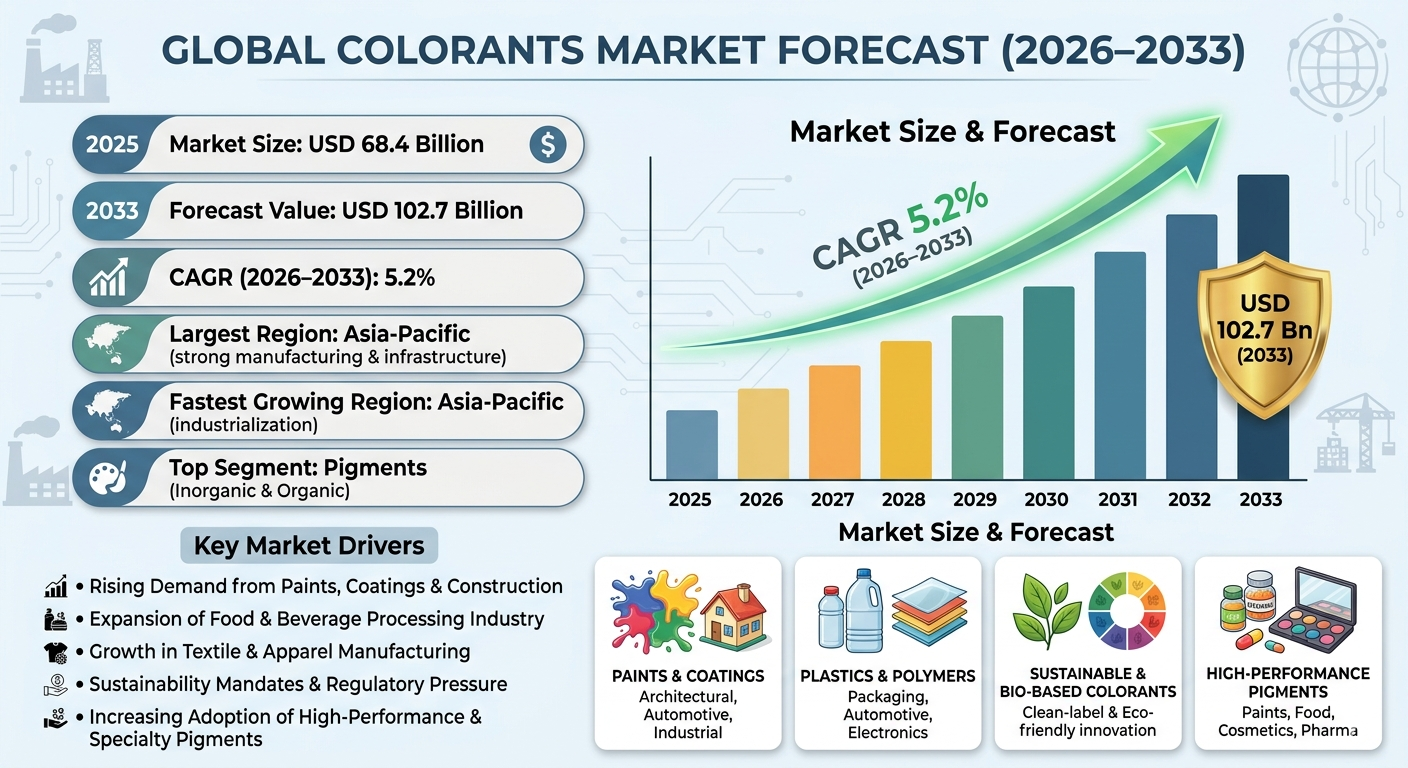
Market Size (Base Year) USD 68.4 Billion
Forecast Value USD 102.7 Billion
CAGR 5.2%
Forecast Period 2026 - 2033
Coverage Global - Asia Pacific, Europe, Middle East & Africa, North America, South America
Global Colorants Market size is valued at USD 68.4 billion in 2025 and is projected to reach USD 102.7 billion by 2033, registering a CAGR of 5.2% during 2026–2033. This revenue forecast reflects expansion in construction, packaging, processed food, personal care, and industrial manufacturing sectors. Asia-Pacific dominates the market due to its strong textile, plastics, and coatings manufacturing base, while also emerging as the fastest-growing region due to rapid industrialization and infrastructure expansion.

Global Colorants Market Forecast Snapshot: 2026–2033

Metric Value
2025 Market Size USD 68.4 Billion
2033 Market Size USD 102.7 Billion
CAGR (2026–2033) 5.2%
Largest Region Asia-Pacific
Fastest Growing Region Asia-Pacific
Top Segment Pigments (Inorganic & Organic)
Key Trend Sustainable & Bio-Based Colorant Innovation
Future Focus High-Performance Pigments, Natural Colorants, and Smart Functional Coatings


The Global Colorants Market is undergoing structural transformation driven by sustainability mandates, high-performance material requirements, and growing demand across food & beverages, textiles, plastics, paints & coatings, cosmetics, and pharmaceuticals.
Global Colorants Market

Global Colorants Market Overview

The Global Colorants Market is undergoing structural transformation driven by sustainability mandates, high-performance material requirements, and growing demand across food & beverages, textiles, plastics, paints & coatings, cosmetics, and pharmaceuticals.

Colorants are essential to product differentiation, branding, functionality, and regulatory compliance. As industries increasingly prioritize eco-friendly formulations and premium aesthetics, the market is shifting from traditional commodity pigments toward advanced, sustainable, and specialty solutions.

According to Pheonix Research, the Global Colorants Market size is valued at USD 68.4 billion in 2025 and is projected to reach USD 102.7 billion by 2033, registering a CAGR of 5.2% during 2026–2033. This revenue forecast reflects expansion in construction, packaging, processed food, personal care, and industrial manufacturing sectors.

Asia-Pacific dominates the market due to its strong textile, plastics, and coatings manufacturing base, while also emerging as the fastest-growing region due to rapid industrialization and infrastructure expansion.

The post-2025 outlook indicates accelerated innovation in bio-based pigments, nano-colorants, smart coatings, and regulatory-compliant food-grade natural colorants.


Key Drivers of Global Colorants Market Growth

1. Rising Demand from Paints, Coatings & Construction Sectors

Accelerating infrastructure development, urbanization, and real estate expansion are significantly increasing demand for architectural, decorative, and industrial coatings, thereby driving pigment consumption globally.

2. Expansion of Food & Beverage Processing Industry

Growing clean-label preferences and tightening regulatory standards are encouraging the adoption of natural and food-grade colorants, particularly in beverages, confectionery, dairy, and processed foods.

3. Growth in Textile & Apparel Manufacturing

Strong textile production, particularly across Asia-Pacific, continues to fuel global demand for dyes and specialty textile colorants, supported by fast fashion and technical textile innovation.

4. Sustainability Mandates & Regulatory Pressure

Stringent environmental regulations in Europe and North America are accelerating the transition toward eco-friendly, low-VOC, heavy-metal-free, and bio-based colorant solutions.

5. Increasing Adoption of High-Performance & Specialty Pigments

Industries such as automotive, packaging, electronics, and industrial manufacturing require advanced pigments offering enhanced durability, UV resistance, thermal stability, and long-term performance.


Global Colorants Market Segmentation

       1.By Type

1.1 Dyes

1.1.1 Reactive Dyes

1.1.1.1 Textile Reactive Dyes
1.1.1.2 Fiber-Reactive Dyes
1.1.1.3 Low-Salt Reactive Dyes

1.1.2 Disperse Dyes

1.1.2.1 Polyester Dyes
1.1.2.2 High-Energy Disperse Dyes

1.1.3 Acid Dyes

1.1.3.1 Wool & Silk Dyes
1.1.3.2 Leather Dyes

1.1.4 Direct & Basic Dyes

1.1.4.1 Paper Dyes
1.1.4.2 Acrylic Fiber Dyes


1.2 Pigments (Largest Segment)

1.2.1 Organic Pigments

1.2.1.1 Azo Pigments
1.2.1.2 Phthalocyanine Pigments
1.2.1.3 Quinacridone Pigments
1.2.1.4 High-Performance Organic Pigments

1.2.2 Inorganic Pigments

1.2.2.1 Titanium Dioxide
1.2.2.2 Iron Oxide Pigments
1.2.2.3 Chromium Pigments
1.2.2.4 Carbon Black

1.2.3 Specialty Pigments

1.2.3.1 Metallic Pigments
1.2.3.2 Pearlescent Pigments
1.2.3.3 Fluorescent Pigments
1.2.3.4 Thermochromic Pigments
1.2.3.5 Photochromic Pigments


1.3 Natural Colorants

1.3.1 Plant-Based

1.3.1.1 Curcumin
1.3.1.2 Carotenoids
1.3.1.3 Anthocyanins
1.3.1.4 Chlorophyll

1.3.2 Animal-Based

1.3.2.1 Carmine

1.3.3 Microbial & Fermentation-Based Colorants


     2. By Application

2.1 Paints & Coatings

2.1.1 Architectural Coatings

2.1.1.1 Interior Wall Coatings

2.1.1.1.1 Emulsion Paints

2.1.1.1.2 Matte & Satin Finishes

2.1.1.2 Exterior Wall Coatings

2.1.1.2.1 Weather-Resistant Coatings

2.1.1.2.2 UV-Protection Coatings

2.1.1.3 Decorative & Specialty Coatings

2.1.1.3.1 Texture Finishes

2.1.1.3.2 Anti-Microbial Coatings

2.1.2 Industrial Coatings

2.1.2.1 Machinery & Equipment Coatings

2.1.2.1.1 Corrosion-Resistant Coatings

2.1.2.1.2 Heat-Resistant Coatings

2.1.2.2 Protective Metal Coatings

2.1.2.2.1 Anti-Rust Coatings

2.1.2.2.2 Powder Coatings

2.1.3 Automotive Coatings

2.1.3.1 OEM Automotive Coatings

2.1.3.1.1 Basecoat Pigments

2.1.3.1.2 Clearcoat Systems

2.1.3.2 Refinish Coatings

2.1.3.2.1 Aftermarket Repair Paints

2.1.3.2.2 Custom Color Coatings

2.1.4 Marine & Protective Coatings

2.1.4.1 Shipbuilding Coatings

2.1.4.1.1 Anti-Fouling Coatings

2.1.4.1.2 Saltwater-Resistant Coatings

2.1.4.2 Heavy-Duty Protective Coatings

2.1.4.2.1 Chemical-Resistant Coatings

2.1.4.2.2 Industrial Floor Coatings


2.2 Plastics & Polymers

2.2.1 Packaging Plastics

2.2.1.1 Flexible Packaging

2.2.1.1.1 Food Packaging Films

2.2.1.1.2 Multi-Layer Packaging

2.2.1.2 Rigid Packaging

2.2.1.2.1 Bottles & Containers

2.2.1.2.2 Caps & Closures

2.2.2 Automotive Plastics

2.2.2.1 Interior Components

2.2.2.1.1 Dashboard Panels

2.2.2.1.2 Trim Components

2.2.2.2 Exterior Components

2.2.2.2.1 Bumpers

2.2.2.2.2 Grilles

2.2.3 Consumer Goods

2.2.3.1 Household Products

2.2.3.1.1 Storage Containers

2.2.3.1.2 Kitchenware

2.2.3.2 Toys & Lifestyle Products

2.2.3.2.1 Educational Toys

2.2.3.2.2 Decorative Items

2.2.4 Electronics Components

2.2.4.1 Device Casings

2.2.4.1.1 Smartphone Bodies

2.2.4.1.2 Laptop Casings

2.2.4.2 Insulation & Functional Plastics

2.2.4.2.1 Heat-Resistant Plastics

2.2.4.2.2 Flame-Retardant Components


2.3 Food & Beverages

2.3.1 Bakery & Confectionery

2.3.1.1 Cakes & Pastries

2.3.1.1.1 Decorative Icing Colors

2.3.1.1.2 Fillings & Toppings

2.3.1.2 Candies & Chocolates

2.3.1.2.1 Coated Chocolates

2.3.1.2.2 Sugar Confections

2.3.2 Dairy Products

2.3.2.1 Flavored Milk

2.3.2.1.1 Chocolate Milk

2.3.2.1.2 Fruit-Flavored Milk

2.3.2.2 Yogurt & Ice Cream

2.3.2.2.1 Fruit Yogurt

2.3.2.2.2 Colored Ice Cream Variants

2.3.3 Beverages

2.3.3.1 Carbonated Drinks

2.3.3.1.1 Colas

2.3.3.1.2 Fruit-Flavored Sodas

2.3.3.2 Functional & Energy Drinks

2.3.3.2.1 Vitamin-Infused Beverages

2.3.3.2.2 Sports Drinks

2.3.4 Processed Foods

2.3.4.1 Ready-to-Eat Meals

2.3.4.1.1 Frozen Meals

2.3.4.1.2 Instant Noodles

2.3.4.2 Sauces & Seasonings

2.3.4.2.1 Tomato-Based Sauces

2.3.4.2.2 Spice Blends


2.4 Textiles

2.4.1 Apparel

2.4.1.1 Casual Wear

2.4.1.1.1 Cotton Fabrics

2.4.1.1.2 Polyester Blends

2.4.1.2 Sportswear

2.4.1.2.1 Performance Fabrics

2.4.1.2.2 Moisture-Wicking Textiles

2.4.2 Home Textiles

2.4.2.1 Curtains & Upholstery

2.4.2.1.1 Printed Fabrics

2.4.2.1.2 Dyed Fabrics

2.4.2.2 Bedding & Linens

2.4.2.2.1 Sheets

2.4.2.2.2 Comforters

2.4.3 Technical Textiles

2.4.3.1 Industrial Fabrics

2.4.3.1.1 Filter Fabrics

2.4.3.1.2 Protective Wear

2.4.3.2 Automotive Textiles

2.4.3.2.1 Seat Fabrics

2.4.3.2.2 Interior Linings


2.5 Cosmetics & Personal Care

2.5.1 Makeup Products

2.5.1.1 Lip Products

2.5.1.1.1 Lipsticks

2.5.1.1.2 Lip Gloss

2.5.1.2 Eye Makeup

2.5.1.2.1 Eyeshadow

2.5.1.2.2 Mascara

2.5.2 Hair Colorants

2.5.2.1 Permanent Hair Color

2.5.2.1.1 Ammonia-Based

2.5.2.1.2 Ammonia-Free

2.5.2.2 Temporary & Semi-Permanent

2.5.2.2.1 Wash-Out Colors

2.5.2.2.2 Fashion Shades

2.5.3 Skincare Formulations

2.5.3.1 Creams & Lotions

2.5.3.1.1 Tinted Moisturizers

2.5.3.1.2 BB & CC Creams

2.5.3.2 Serums & Gels

2.5.3.2.1 Brightening Serums

2.5.3.2.2 Anti-Aging Formulations


2.6 Pharmaceuticals

2.6.1 Tablet Coatings

2.6.1.1 Film-Coated Tablets

2.6.1.1.1 Immediate Release

2.6.1.1.2 Extended Release

2.6.2 Capsules

2.6.2.1 Hard Gelatin Capsules

2.6.2.1.1 Prescription Drugs

2.6.2.1.2 Nutraceutical Capsules

2.6.2.2 Soft Gel Capsules

2.6.2.2.1 Vitamin Softgels

2.6.2.2.2 Oil-Based Formulations

2.6.3 Syrups

2.6.3.1 Pediatric Syrups

2.6.3.1.1 Flavored Antibiotics

2.6.3.1.2 Cough Syrups

2.6.3.2 Adult Liquid Medicines

2.6.3.2.1 Digestive Syrups

2.6.3.2.2 Tonics


    3. By Form


3.1 Powder

3.1.1 Organic Pigment Powders

3.1.1.1 Azo Pigments

3.1.1.1.1 Monoazo Pigments

3.1.1.1.2 Diazo Pigments

3.1.1.2 Phthalocyanine Pigments

3.1.1.2.1 Phthalocyanine Blue

3.1.1.2.2 Phthalocyanine Green

3.1.2 Inorganic Pigment Powders

3.1.2.1 Titanium Dioxide

3.1.2.1.1 Rutile Grade

3.1.2.1.2 Anatase Grade

3.1.2.2 Iron Oxide Pigments

3.1.2.2.1 Red Iron Oxide

3.1.2.2.2 Yellow & Black Iron Oxide

3.1.3 Specialty Functional Powders

3.1.3.1 Anti-Corrosive Pigments

3.1.3.1.1 Zinc Phosphate

3.1.3.1.2 Chromate-Based Pigments

3.1.3.2 UV-Resistant Pigments

3.1.3.2.1 Weather-Stable Pigments

3.1.3.2.2 Heat-Resistant Grades


3.2 Liquid

3.2.1 Liquid Dyes

3.2.1.1 Water-Soluble Dyes

3.2.1.1.1 Textile Dyes

3.2.1.1.2 Food-Grade Dyes

3.2.1.2 Solvent-Based Dyes

3.2.1.2.1 Industrial Inks

3.2.1.2.2 Plastic Applications

3.2.2 Liquid Pigment Dispersions

3.2.2.1 Aqueous Dispersions

3.2.2.1.1 Architectural Coatings

3.2.2.1.2 Paper & Packaging

3.2.2.2 Solvent-Based Dispersions

3.2.2.2.1 Automotive Coatings

3.2.2.2.2 Industrial Applications

3.2.3 Food & Cosmetic Liquid Colorants

3.2.3.1 Natural Liquid Colors

3.2.3.1.1 Plant Extracts

3.2.3.1.2 Fruit-Based Colors

3.2.3.2 Synthetic Liquid Colors

3.2.3.2.1 Certified Food Dyes

3.2.3.2.2 Cosmetic-Grade Colors


3.3 Paste

3.3.1 Pigment Pastes for Coatings

3.3.1.1 Water-Based Pastes

3.3.1.1.1 Decorative Paints

3.3.1.1.2 Emulsion Systems

3.3.1.2 Solvent-Based Pastes

3.3.1.2.1 Industrial Paints

3.3.1.2.2 Automotive Refinish

3.3.2 Printing Ink Pastes

3.3.2.1 Offset Printing

3.3.2.1.1 Packaging Printing

3.3.2.1.2 Commercial Printing

3.3.2.2 Flexographic & Gravure Inks

3.3.2.2.1 Flexible Packaging

3.3.2.2.2 Label Printing


3.4 Granules

3.4.1 Pigment Granules

3.4.1.1 Dust-Free Pigments

3.4.1.1.1 Industrial Handling Applications

3.4.1.1.2 Bulk Manufacturing

3.4.1.2 High-Concentration Granules

3.4.1.2.1 Plastic Compounding

3.4.1.2.2 Rubber Processing

3.4.2 Dye Granules

3.4.2.1 Textile Dye Granules

3.4.2.1.1 Reactive Dyes

3.4.2.1.2 Disperse Dyes

3.4.2.2 Paper & Leather Dyes

3.4.2.2.1 Packaging Paper

3.4.2.2.2 Leather Finishing


3.5 Masterbatch (Plastic Coloring Compounds)

3.5.1 Color Masterbatch

3.5.1.1 Standard Color Masterbatch

3.5.1.1.1 Packaging Applications

3.5.1.1.2 Consumer Goods

3.5.1.2 Custom Color Masterbatch

3.5.1.2.1 Automotive Plastics

3.5.1.2.2 Electronics Casings

3.5.2 Additive Masterbatch

3.5.2.1 UV-Stabilizer Masterbatch

3.5.2.1.1 Outdoor Applications

3.5.2.1.2 Agricultural Films

3.5.2.2 Flame-Retardant Masterbatch

3.5.2.2.1 Electrical Components

3.5.2.2.2 Construction Materials

3.5.3 Specialty Masterbatch

3.5.3.1 Antimicrobial Masterbatch

3.5.3.1.1 Medical Plastics

3.5.3.1.2 Food Packaging

3.5.3.2 Biodegradable & Bio-Based Masterbatch

3.5.3.2.1 Compostable Packaging

3.5.3.2.2 Sustainable Consumer Products

   4. By Region


4.1 North America

4.2 Europe

4.3 Asia-Pacific

4.4 Middle East & Africa

4.5 South America


Regional Insights of the Global Colorants Market

Asia-Pacific – Largest & Fastest-Growing Region

Asia-Pacific dominates the global colorants market, driven by robust textile manufacturing, expanding plastics and packaging industries, and rapid infrastructure development across China, India, and Southeast Asia. Strong industrialization, export-oriented production, and rising domestic consumption continue to accelerate regional growth.

North America

Market demand is supported by increasing adoption of specialty and high-performance pigments, growing preference for natural food-grade colorants, and strong demand from advanced coatings and automotive applications.

Europe

Europe’s market expansion is fueled by stringent environmental regulations and strong emphasis on REACH-compliant, sustainable, and eco-friendly colorant solutions. Innovation in bio-based and low-VOC pigments remains a key growth driver.

Middle East & Africa

Growth in this region is supported by expanding construction activities, infrastructure projects, and rising packaged food consumption, contributing to steady demand for industrial and food-grade colorants.

South America

Steady growth is driven by the textile manufacturing base and expanding food processing sector, particularly in Brazil and Argentina, supporting consistent demand for dyes and food colorants.


Leading Companies in the Global Colorants Market

  • BASF SE

  • DIC Corporation

  • Clariant AG

  • LANXESS AG

  • Sun Chemical Corporation

  • Huntsman Corporation

  • Cabot Corporation

  • Kronos Worldwide (Titanium Dioxide)

  • Sensient Technologies Corporation

  • DSM-Firmenich (Natural Food Colorants)

Among these, BASF SE and DIC Corporation are leading global players with diversified pigment and dye portfolios.


Strategic Intelligence & AI-Backed Insights

Pheonix Demand Forecast Engine indicates sustained long-term demand across key end-use sectors, particularly paints & coatings, plastics & packaging, and food-grade natural colorants, supported by global industrial expansion and consumer-driven product innovation.

Consumer Behavior Analyzer identifies a growing shift toward clean-label, sustainable, and premium-colored products, reflecting heightened environmental awareness and demand for transparency in food, cosmetics, and consumer goods.

Innovation Tracker highlights rapid advancements in nano-pigments, bio-based dyes, smart color-changing technologies, and high-durability performance coatings, positioning specialty colorants as a high-growth opportunity area.

Porter’s Five Forces Analysis suggests intense competitive rivalry and moderate raw material dependency, while indicating strong profitability potential within specialty, eco-friendly, and natural pigment segments driven by differentiation and regulatory compliance.


Why the Global Colorants Market Remains Critical

  • Essential for product differentiation and branding across industries

  • Regulatory compliance in food, pharma, and cosmetics

  • Infrastructure and construction expansion globally

  • Sustainability transition toward eco-friendly pigments

  • Growth in packaging, automotive, and consumer goods manufacturing


Final Takeaway of Global Colorants Market

The Global Colorants Market is steadily evolving from conventional bulk pigment production toward high-performance, sustainable, and specialty-driven solutions. A projected CAGR of 5.2% during 2026–2033 reflects consistent industrial growth, technological advancements, and increasing regulatory influence across major economies.

Organizations that prioritize investment in bio-based pigments, smart and functional color technologies, advanced performance coatings, and regulatory-compliant innovation strategies are likely to secure a sustainable competitive edge in the long term.

At Pheonix Research, our advanced forecasting models deliver comprehensive revenue analysis, competitive benchmarking, and strategic intelligence — empowering stakeholders to navigate the post-2025 transformation of the colorants industry with data-driven precision and long-term growth confidence.

📢 Social Mentions & Publication Channels

 Explore deeper insights and follow our cross-platform updates on LinkedIn and X for continuous intelligence and market coverage.

LinkedIn : https://www.linkedin.com/feed/update/urn:li:activity:7433070085143052288

X :  https://x.com/Pheonix_Insight/status/2027417711521976393?s=20

Table of Contents

1. Market Forecast Snapshot (2026–2033)

1.1 2025 Market Size – USD 68.4 Billion
1.2 2033 Market Size – USD 102.7 Billion
1.3 CAGR (2026–2033) – 5.2%
1.4 Largest Region – Asia-Pacific
1.5 Fastest Growing Region – Asia-Pacific
1.6 Top Segment – Pigments (Inorganic & Organic)
1.7 Key Trend – Sustainable & Bio-Based Colorant Innovation
1.8 Future Focus – High-Performance Pigments, Natural Colorants & Smart Functional Coatings


2. Global Colorants Market Overview

2.1 Market Definition & Scope
2.2 Industry Evolution & Structural Transformation
2.3 Premiumization & Specialty Shift
2.4 Sustainability & Regulatory Transition
2.5 Technology Integration & Advanced Material Innovation
2.6 Post-2025 Market Outlook


3. Key Drivers of Global Colorants Market Growth

3.1 Rising Demand from Paints, Coatings & Construction
3.2 Expansion of Food & Beverage Processing Industry
3.3 Growth in Textile & Apparel Manufacturing
3.4 Sustainability Mandates & Regulatory Pressure
3.5 Increasing Adoption of High-Performance & Specialty Pigments


4. Market Segmentation by Type

4.1 Dyes

4.1.1 Reactive Dyes
4.1.1.1 Textile Reactive Dyes
4.1.1.2 Fiber-Reactive Dyes
4.1.1.3 Low-Salt Reactive Dyes

4.1.2 Disperse Dyes
4.1.2.1 Polyester Dyes
4.1.2.2 High-Energy Disperse Dyes

4.1.3 Acid Dyes
4.1.3.1 Wool & Silk Dyes
4.1.3.2 Leather Dyes

4.1.4 Direct & Basic Dyes
4.1.4.1 Paper Dyes
4.1.4.2 Acrylic Fiber Dyes


4.2 Pigments (Largest Segment)

4.2.1 Organic Pigments
4.2.1.1 Azo Pigments
4.2.1.2 Phthalocyanine Pigments
4.2.1.3 Quinacridone Pigments
4.2.1.4 High-Performance Organic Pigments

4.2.2 Inorganic Pigments
4.2.2.1 Titanium Dioxide
4.2.2.2 Iron Oxide Pigments
4.2.2.3 Chromium Pigments
4.2.2.4 Carbon Black

4.2.3 Specialty Pigments
4.2.3.1 Metallic Pigments
4.2.3.2 Pearlescent Pigments
4.2.3.3 Fluorescent Pigments
4.2.3.4 Thermochromic Pigments
4.2.3.5 Photochromic Pigments


4.3 Natural Colorants

4.3.1 Plant-Based
4.3.1.1 Curcumin
4.3.1.2 Carotenoids
4.3.1.3 Anthocyanins
4.3.1.4 Chlorophyll

4.3.2 Animal-Based
4.3.2.1 Carmine

4.3.3 Microbial & Fermentation-Based Colorants


5. Market Segmentation by Application


5.1 Paints & Coatings

5.1.1 Architectural Coatings

5.1.1.1 Interior Wall Coatings
5.1.1.1.1 Emulsion Paints
5.1.1.1.2 Matte & Satin Finishes
5.1.1.1.3 Low-VOC & Eco-Friendly Paints

5.1.1.2 Exterior Wall Coatings
5.1.1.2.1 Weather-Resistant Coatings
5.1.1.2.2 UV-Protection Coatings
5.1.1.2.3 Waterproofing Coatings

5.1.1.3 Decorative & Specialty Coatings
5.1.1.3.1 Texture Finishes
5.1.1.3.2 Metallic & Pearlescent Coatings
5.1.1.3.3 Anti-Microbial Coatings


5.1.2 Industrial Coatings

5.1.2.1 Machinery & Equipment Coatings
5.1.2.1.1 Corrosion-Resistant Coatings
5.1.2.1.2 Heat-Resistant Coatings

5.1.2.2 Protective Metal Coatings
5.1.2.2.1 Anti-Rust Coatings
5.1.2.2.2 Powder Coatings

5.1.2.3 Heavy-Duty Infrastructure Coatings
5.1.2.3.1 Bridge & Structural Coatings
5.1.2.3.2 Oil & Gas Protective Coatings


5.1.3 Automotive Coatings

5.1.3.1 OEM Automotive Coatings
5.1.3.1.1 Basecoat Pigments
5.1.3.1.2 Clearcoat Systems

5.1.3.2 Refinish Coatings
5.1.3.2.1 Aftermarket Repair Paints
5.1.3.2.2 Custom Color Coatings

5.1.3.3 Functional Automotive Coatings
5.1.3.3.1 Scratch-Resistant Coatings
5.1.3.3.2 UV-Stable & Heat-Resistant Coatings


5.1.4 Marine & Protective Coatings

5.1.4.1 Shipbuilding Coatings
5.1.4.1.1 Anti-Fouling Coatings
5.1.4.1.2 Saltwater-Resistant Coatings

5.1.4.2 Heavy-Duty Protective Coatings
5.1.4.2.1 Chemical-Resistant Coatings
5.1.4.2.2 Industrial Floor Coatings


5.2 Plastics & Polymers

5.2.1 Packaging Plastics

5.2.1.1 Flexible Packaging
5.2.1.1.1 Food Packaging Films
5.2.1.1.2 Multi-Layer Packaging

5.2.1.2 Rigid Packaging
5.2.1.2.1 Bottles & Containers
5.2.1.2.2 Caps & Closures


5.2.2 Automotive Plastics

5.2.2.1 Interior Components
5.2.2.1.1 Dashboard Panels
5.2.2.1.2 Trim Components

5.2.2.2 Exterior Components
5.2.2.2.1 Bumpers
5.2.2.2.2 Grilles


5.2.3 Consumer Goods

5.2.3.1 Household Products
5.2.3.1.1 Storage Containers
5.2.3.1.2 Kitchenware

5.2.3.2 Toys & Lifestyle Products
5.2.3.2.1 Educational Toys
5.2.3.2.2 Decorative Items


5.2.4 Electronics Components

5.2.4.1 Device Casings
5.2.4.1.1 Smartphone Bodies
5.2.4.1.2 Laptop Casings

5.2.4.2 Functional Plastics
5.2.4.2.1 Heat-Resistant Plastics
5.2.4.2.2 Flame-Retardant Components


5.3 Food & Beverages

5.3.1 Bakery & Confectionery

5.3.1.1 Cakes & Pastries
5.3.1.1.1 Decorative Icing Colors
5.3.1.1.2 Fillings & Toppings

5.3.1.2 Candies & Chocolates
5.3.1.2.1 Coated Chocolates
5.3.1.2.2 Sugar Confections


5.3.2 Dairy Products

5.3.2.1 Flavored Milk
5.3.2.1.1 Chocolate Milk
5.3.2.1.2 Fruit-Flavored Milk

5.3.2.2 Yogurt & Ice Cream
5.3.2.2.1 Fruit Yogurt
5.3.2.2.2 Colored Ice Cream Variants


5.3.3 Beverages

5.3.3.1 Carbonated Drinks
5.3.3.1.1 Colas
5.3.3.1.2 Fruit-Flavored Sodas

5.3.3.2 Functional & Energy Drinks
5.3.3.2.1 Vitamin-Infused Beverages
5.3.3.2.2 Sports Drinks


5.3.4 Processed Foods

5.3.4.1 Ready-to-Eat Meals
5.3.4.1.1 Frozen Meals
5.3.4.1.2 Instant Noodles

5.3.4.2 Sauces & Seasonings
5.3.4.2.1 Tomato-Based Sauces
5.3.4.2.2 Spice Blends


5.4 Textiles

5.4.1 Apparel

5.4.1.1 Casual Wear
5.4.1.1.1 Cotton Fabrics
5.4.1.1.2 Polyester Blends

5.4.1.2 Sportswear
5.4.1.2.1 Performance Fabrics
5.4.1.2.2 Moisture-Wicking Textiles


5.4.2 Home Textiles

5.4.2.1 Curtains & Upholstery
5.4.2.1.1 Printed Fabrics
5.4.2.1.2 Dyed Fabrics

5.4.2.2 Bedding & Linens
5.4.2.2.1 Sheets
5.4.2.2.2 Comforters


5.4.3 Technical Textiles

5.4.3.1 Industrial Fabrics
5.4.3.1.1 Filter Fabrics
5.4.3.1.2 Protective Wear

5.4.3.2 Automotive Textiles
5.4.3.2.1 Seat Fabrics
5.4.3.2.2 Interior Linings


5.5 Cosmetics & Personal Care

5.5.1 Makeup Products

5.5.1.1 Lip Products
5.5.1.1.1 Lipsticks
5.5.1.1.2 Lip Gloss

5.5.1.2 Eye Makeup
5.5.1.2.1 Eyeshadow
5.5.1.2.2 Mascara


5.5.2 Hair Colorants

5.5.2.1 Permanent Hair Color
5.5.2.1.1 Ammonia-Based
5.5.2.1.2 Ammonia-Free

5.5.2.2 Temporary & Semi-Permanent
5.5.2.2.1 Wash-Out Colors
5.5.2.2.2 Fashion Shades


5.5.3 Skincare Formulations

5.5.3.1 Creams & Lotions
5.5.3.1.1 Tinted Moisturizers
5.5.3.1.2 BB & CC Creams

5.5.3.2 Serums & Gels
5.5.3.2.1 Brightening Serums
5.5.3.2.2 Anti-Aging Formulations


5.6 Pharmaceuticals

5.6.1 Tablet Coatings

5.6.1.1 Film-Coated Tablets
5.6.1.1.1 Immediate Release
5.6.1.1.2 Extended Release


5.6.2 Capsules

5.6.2.1 Hard Gelatin Capsules
5.6.2.1.1 Prescription Drugs
5.6.2.1.2 Nutraceutical Capsules

5.6.2.2 Soft Gel Capsules
5.6.2.2.1 Vitamin Softgels
5.6.2.2.2 Oil-Based Formulations


5.6.3 Syrups

5.6.3.1 Pediatric Syrups
5.6.3.1.1 Flavored Antibiotics
5.6.3.1.2 Cough Syrups

5.6.3.2 Adult Liquid Medicines
5.6.3.2.1 Digestive Syrups
5.6.3.2.2 Tonics


6. Market Segmentation by Form

6.1 Powder

6.1.1 Organic Pigment Powders

6.1.1.1 Azo Pigment Powders
6.1.1.1.1 Monoazo Pigments
6.1.1.1.2 Diazo Pigments

6.1.1.2 Phthalocyanine Pigment Powders
6.1.1.2.1 Phthalocyanine Blue
6.1.1.2.2 Phthalocyanine Green

6.1.1.3 Quinacridone Pigment Powders
6.1.1.3.1 High-Chroma Grades
6.1.1.3.2 Heat-Stable Grades

6.1.1.4 High-Performance Organic Pigment Powders
6.1.1.4.1 Automotive-Grade
6.1.1.4.2 Industrial-Grade


6.1.2 Inorganic Pigment Powders

6.1.2.1 Titanium Dioxide
6.1.2.1.1 Rutile Grade
6.1.2.1.2 Anatase Grade

6.1.2.2 Iron Oxide Pigments
6.1.2.2.1 Red Iron Oxide
6.1.2.2.2 Yellow Iron Oxide
6.1.2.2.3 Black Iron Oxide

6.1.2.3 Chromium Pigments
6.1.2.3.1 Chromium Oxide Green
6.1.2.3.2 Chrome Yellow

6.1.2.4 Carbon Black
6.1.2.4.1 Furnace Black
6.1.2.4.2 Thermal Black


6.1.3 Specialty Functional Powder Colorants

6.1.3.1 Anti-Corrosive Pigments
6.1.3.1.1 Zinc Phosphate
6.1.3.1.2 Chromate-Based Pigments

6.1.3.2 UV-Resistant Pigments
6.1.3.2.1 Weather-Stable Grades
6.1.3.2.2 Heat-Resistant Grades

6.1.3.3 Color-Shifting Pigments
6.1.3.3.1 Thermochromic
6.1.3.3.2 Photochromic


6.2 Liquid

6.2.1 Liquid Dyes

6.2.1.1 Water-Soluble Dyes
6.2.1.1.1 Textile Applications
6.2.1.1.2 Food-Grade Applications

6.2.1.2 Solvent-Based Dyes
6.2.1.2.1 Industrial Inks
6.2.1.2.2 Plastic Applications


6.2.2 Liquid Pigment Dispersions

6.2.2.1 Aqueous Dispersions
6.2.2.1.1 Architectural Coatings
6.2.2.1.2 Paper & Packaging

6.2.2.2 Solvent-Based Dispersions
6.2.2.2.1 Automotive Coatings
6.2.2.2.2 Industrial Applications


6.2.3 Food & Cosmetic Liquid Colorants

6.2.3.1 Natural Liquid Colors
6.2.3.1.1 Plant Extract-Based
6.2.3.1.2 Fruit & Vegetable Extracts

6.2.3.2 Synthetic Liquid Colors
6.2.3.2.1 Certified Food Dyes
6.2.3.2.2 Cosmetic-Grade Liquid Colors


6.3 Paste

6.3.1 Pigment Pastes for Coatings

6.3.1.1 Water-Based Pigment Pastes
6.3.1.1.1 Decorative Paint Systems
6.3.1.1.2 Emulsion Paints

6.3.1.2 Solvent-Based Pigment Pastes
6.3.1.2.1 Industrial Coatings
6.3.1.2.2 Automotive Refinish


6.3.2 Printing Ink Pastes

6.3.2.1 Offset Printing
6.3.2.1.1 Packaging Printing
6.3.2.1.2 Commercial Printing

6.3.2.2 Flexographic & Gravure Inks
6.3.2.2.1 Flexible Packaging
6.3.2.2.2 Label Printing


6.4 Granules

6.4.1 Pigment Granules

6.4.1.1 Dust-Free Pigments
6.4.1.1.1 Industrial Handling Applications
6.4.1.1.2 Bulk Manufacturing

6.4.1.2 High-Concentration Granules
6.4.1.2.1 Plastic Compounding
6.4.1.2.2 Rubber Processing


6.4.2 Dye Granules

6.4.2.1 Textile Dye Granules
6.4.2.1.1 Reactive Dye Granules
6.4.2.1.2 Disperse Dye Granules

6.4.2.2 Paper & Leather Dye Granules
6.4.2.2.1 Packaging Paper
6.4.2.2.2 Leather Finishing


6.5 Masterbatch (Plastic Coloring Compounds)

6.5.1 Color Masterbatch

6.5.1.1 Standard Color Masterbatch
6.5.1.1.1 Packaging Applications
6.5.1.1.2 Consumer Goods

6.5.1.2 Custom Color Masterbatch
6.5.1.2.1 Automotive Plastics
6.5.1.2.2 Electronics Casings


6.5.2 Additive Masterbatch

6.5.2.1 UV-Stabilizer Masterbatch
6.5.2.1.1 Outdoor Applications
6.5.2.1.2 Agricultural Films

6.5.2.2 Flame-Retardant Masterbatch
6.5.2.2.1 Electrical Components
6.5.2.2.2 Construction Materials


6.5.3 Specialty Masterbatch

6.5.3.1 Antimicrobial Masterbatch
6.5.3.1.1 Medical Plastics
6.5.3.1.2 Food Packaging

6.5.3.2 Biodegradable & Bio-Based Masterbatch
6.5.3.2.1 Compostable Packaging
6.5.3.2.2 Sustainable Consumer Products


7. Market Segmentation by Region

7.1 North America
7.2 Europe
7.3 Asia-Pacific
7.4 Middle East & Africa
7.5 South America


8. Regional Insights

8.1 Asia-Pacific – Largest & Fastest Growing Region
8.2 North America Market Analysis
8.3 Europe Market Analysis
8.4 Middle East & Africa Market Analysis
8.5 South America Market Analysis


9. Competitive Landscape

9.1 Market Share Analysis
9.2 Competitive Positioning Matrix
9.3 Product Portfolio Benchmarking
9.4 Mergers, Acquisitions & Expansion Strategies
9.5 Pricing & Raw Material Strategy


10. Leading Companies

10.1 BASF SE
10.2 DIC Corporation
10.3 Clariant AG
10.4 LANXESS AG
10.5 Sun Chemical Corporation
10.6 Huntsman Corporation
10.7 Cabot Corporation
10.8 Kronos Worldwide
10.9 Sensient Technologies Corporation
10.10 DSM-Firmenich


11. Strategic Intelligence & AI-Backed Insights

11.1 Pheonix Demand Forecast Engine
11.2 Consumer Behavior Analyzer
11.3 Innovation Tracker – Bio-Based & Smart Pigments
11.4 Porter’s Five Forces Analysis


12. Sustainability & Regulatory Landscape

12.1 Environmental Compliance (REACH, FDA, etc.)
12.2 Low-VOC & Heavy-Metal-Free Solutions
12.3 Sustainable Raw Material Sourcing
12.4 Circular Economy & Waste Reduction


13. Market Significance

13.1 Role in Product Differentiation & Branding
13.2 Industrial & Infrastructure Impact
13.3 Food & Pharmaceutical Compliance Role
13.4 Sustainability Transition Impact


14. Final Takeaway

14.1 Growth Outlook (2026–2033)
14.2 Structural Shift Toward Specialty & Sustainable Solutions
14.3 Innovation-Driven Competitive Strategy
14.4 Strategic Recommendations for Stakeholders


15. Appendix

16. About Us

17. Disclaimer

Competitive Landscape

Structure: Moderately_consolidated Tier 1 Players: 9 Intensity: High

Global Colorants Market Competitive Intensity & Market Structure Overview

The Global Colorants Market operates within a highly diversified yet competitively intense ecosystem, shaped by a mix of multinational chemical leaders, specialty pigment innovators, regional dye manufacturers, and natural colorant suppliers. Competitive intensity is driven by broad end-use exposure across paints & coatings, plastics, packaging, textiles, food & beverages, cosmetics, and pharmaceuticals, where product differentiation, compliance, and performance are critical.

The market structure is moderately consolidated at the top, with global players such as BASF, DIC Corporation, Clariant, and Sun Chemical controlling significant shares in specialty pigments, industrial dyes, and advanced formulations. However, regional fragmentation remains strong in textile dyes, commodity pigments, and food-grade applications, particularly across Asia-Pacific where manufacturing scale and cost competitiveness create pricing pressure.

Competition is increasingly shifting away from commodity pricing alone toward sustainability, regulatory compliance, bio-based innovation, and performance-enhanced specialty solutions. Manufacturers are investing heavily in REACH-compliant formulations, heavy-metal-free pigments, low-VOC technologies, and smart functional coatings to capture premium market segments.

Global Colorants Market Competitive Intensity & Market Structure Current Scenario

Leading Company Profiles

BASF SE: Global Chemical Leader. Strong portfolio in pigments, performance materials, coatings additives, and sustainable color innovation.

DIC Corporation: Major Global Colorant Producer. Extensive presence in pigments, printing inks, and packaging color technologies.

Clariant AG: Specialty Chemical Innovator. Focused on sustainable pigments, functional additives, and eco-friendly solutions.

LANXESS AG: High-performance inorganic pigments leader with strong industrial and construction presence.

Sun Chemical Corporation: Major player in printing inks, coatings pigments, and packaging applications.

Huntsman Corporation: Strong in textile dyes and advanced chemical solutions.

Cabot Corporation: Global leader in carbon black and specialty reinforcement materials.

Kronos Worldwide: Titanium dioxide specialist with strong coatings and plastics demand.

Sensient Technologies: Major food, beverage, and cosmetic natural colorants supplier.

DSM-Firmenich: Premium natural and bio-based color innovation player.

Key Competitive Intensity & Market Structure Signals in Global Colorants Market

A major competitive signal is the transition from traditional synthetic and commodity-grade colorants toward specialty, sustainable, and application-specific products. Regulatory pressure related to food safety, VOC reduction, toxic metal elimination, and environmental standards is reshaping competitive positioning globally.

In industrial pigments, innovation is centered around durability, UV resistance, thermal stability, and smart functionality, especially for automotive coatings, electronics, and infrastructure applications. This raises barriers to entry for smaller manufacturers lacking R&D capabilities.

Natural colorants represent one of the fastest-evolving battlegrounds, especially in food, cosmetics, and personal care. Clean-label demand and consumer transparency expectations are creating premium opportunities for botanical, microbial, and fermentation-based solutions.

Asia-Pacific’s manufacturing dominance continues to intensify price competition in dyes and commodity pigments, while Europe and North America increasingly focus on premiumization, sustainability, and regulatory leadership.

Strategic Implications of Competitive Intensity & Market Structure in Global Colorants Market

The competitive environment increasingly favors companies that combine scale, innovation, and regulatory agility. Manufacturers must balance cost efficiency in high-volume segments with premium-margin opportunities in specialty pigments, natural colorants, and smart coatings.

Sustainability is now a strategic differentiator rather than a niche advantage. Companies investing in bio-based raw materials, recyclable pigment technologies, and low-emission manufacturing systems are better positioned for long-term growth.

Vertical integration across raw materials, formulation science, and downstream partnerships is becoming increasingly important, especially in plastics, coatings, and food-grade applications where supply chain transparency and consistency are essential.

Digital color matching, AI-based formulation tools, and customized application engineering are also emerging as competitive tools, improving product precision and reducing customer switching risk.

Global Colorants Market Competitive Intensity & Market Structure Forward Outlook

The Global Colorants Market is expected to become increasingly innovation-driven through 2033, with competitive advantage shaped by sustainability leadership, specialty product development, and compliance excellence.

Consolidation among major players is likely to continue, particularly in specialty pigments, food-grade natural colorants, and smart functional materials as larger firms acquire niche innovators to strengthen technology portfolios.

Future market leadership will depend on three major pillars: sustainable chemistry, functional performance, and regulatory alignment. High-growth segments such as bio-based pigments, nano-colorants, thermochromic solutions, and circular-economy compatible colorants are expected to define next-generation competition.

Ultimately, organizations that successfully align manufacturing scale with premium innovation, ESG priorities, and cross-industry customization will lead the Global Colorants Market through 2033.

Value Chain

Model: Vertically_integrated Distribution: Direct_to_consumer Supply Complexity: High

Global Colorants Market Value Chain & Supply Chain Evolution Overview

The Global Colorants Market value chain is evolving from traditional bulk pigment and dye manufacturing into a technologically advanced, sustainability-driven, and performance-engineered industrial ecosystem. Unlike earlier commodity-focused colorant systems primarily centered on cost and volume, the modern colorants market is increasingly shaped by regulatory compliance, bio-based innovation, functional material science, specialty chemistry, and application-specific customization across paints & coatings, plastics, food & beverages, textiles, cosmetics, and pharmaceuticals.

The colorants value chain spans raw material extraction, petrochemical and mineral feedstock sourcing, pigment and dye synthesis, specialty formulation engineering, natural colorant extraction, performance enhancement technologies, masterbatch production, industrial distribution, regulatory compliance systems, and downstream integration into diverse end-use sectors. As industries increasingly prioritize sustainability, durability, and product differentiation, the value chain is shifting from standard commodity supply toward premium, high-margin specialty solutions.

Upstream supply chain dynamics are shaped by petrochemical suppliers, mining companies, agricultural feedstock providers, specialty chemical producers, additive manufacturers, and pigment synthesis innovators. Titanium dioxide, iron oxide, carbon black, aromatic chemicals, plant-based extracts, and functional additives remain critical inputs, while volatility in oil markets, ESG pressures, mining regulations, and agricultural sourcing increasingly influence supply stability.

Manufacturing strategies increasingly prioritize eco-friendly chemistry, low-VOC systems, heavy-metal-free formulations, bio-based feedstocks, nano-pigments, smart coatings, and advanced dispersion technologies. Producers are moving beyond standard dyes and pigments toward high-performance, regulatory-compliant, and application-engineered solutions tailored to premium industrial use cases.

Distribution is increasingly globalized and sector-specific, with B2B industrial contracts, OEM partnerships, private-label production, chemical distributors, digital procurement platforms, and regulatory-certified supply chains driving commercialization. Specialty customization, formulation IP, and compliance expertise are increasingly central to competitive differentiation.

Supply chain challenges include petrochemical price volatility, environmental regulations, heavy metal restrictions, food-grade safety standards, sustainability compliance, feedstock diversification, and increasing pressure to reduce carbon intensity while maintaining product performance.

Global Colorants Market Value Chain & Supply Chain Evolution Current Scenario

The current colorants market is shaped by sustainability mandates, premium product differentiation, infrastructure expansion, clean-label food trends, advanced coatings demand, and industrial performance requirements.

Upstream, manufacturers are increasingly investing in sustainable feedstocks, natural extraction technologies, specialty additives, and advanced pigment chemistry to align with tightening environmental and regulatory standards.

Production ecosystems increasingly focus on specialty pigments, food-safe natural colorants, functional coatings, smart pigments, bio-based masterbatch, and high-performance industrial applications.

Technology infrastructure increasingly includes nano-dispersion systems, precision formulation software, AI-driven color matching, smart coating technologies, and advanced quality assurance systems.

Distribution networks are dominated by industrial B2B contracts, OEM integration, regional specialty distributors, packaging supply chains, food-grade certification channels, and multinational manufacturing partnerships.

Competitive positioning increasingly depends on formulation innovation, sustainability, compliance readiness, and downstream sector specialization rather than commodity volume alone.

Key Value Chain & Supply Chain Evolution Signals in Global Colorants Market

Several structural transformations are reshaping the global colorants ecosystem.

First, sustainable and bio-based colorants are becoming strategically critical due to tightening environmental regulations and rising clean-label consumer demand.

Second, specialty pigments including thermochromic, photochromic, metallic, pearlescent, and smart functional coatings are emerging as high-margin innovation categories.

Third, natural food-grade and cosmetic-grade colorants are rapidly expanding due to increasing health awareness, transparency demands, and regulatory scrutiny.

Fourth, nano-pigments and advanced dispersion systems are improving product durability, precision, UV stability, and industrial efficiency.

Fifth, plastic masterbatch innovation is expanding through biodegradable, antimicrobial, and high-performance sustainable polymer applications.

Sixth, regulatory compliance and ESG adaptation are becoming critical competitive differentiators, especially across Europe, North America, food, cosmetics, and pharmaceutical applications.

Strategic Implications of Value Chain & Supply Chain Evolution in Global Colorants Market

Leading companies such as BASF SE, DIC Corporation, Clariant AG, LANXESS AG, Sun Chemical, and Sensient Technologies are strengthening their market positions through sustainability investment, specialty innovation, regulatory alignment, and advanced performance chemistry.

Long-term competitive advantage increasingly depends on raw material diversification, specialty formulation capabilities, eco-compliance, and application-specific technological leadership.

Companies with strong bio-based portfolios, food-grade compliance, smart pigment technologies, and advanced coatings capabilities are better positioned to capture premium growth opportunities.

Natural colorant scalability, sustainable feedstock sourcing, and high-performance industrial customization are becoming increasingly important for strategic resilience.

Supply chain resilience increasingly depends on balancing cost efficiency, sustainability mandates, raw material security, innovation speed, and regulatory adaptability.

As competition intensifies, colorant producers must increasingly evolve from chemical suppliers into integrated specialty material science and sustainability solution providers.

Global Colorants Market Value Chain & Supply Chain Evolution Forward Outlook

Between 2026 and 2033, the colorants market value chain is expected to become more sustainability-centric, technologically advanced, bio-based, and specialty-performance oriented.

Colorant manufacturers will increasingly prioritize natural extraction systems, smart coatings, nano-engineered pigments, circular chemistry, biodegradable masterbatch, and regulatory-certified premium solutions.

Distribution ecosystems will increasingly expand through digital B2B procurement, sustainable packaging partnerships, clean-label food ecosystems, and premium industrial application channels.

Supply chain ecosystems are likely to evolve toward lower-emission manufacturing, renewable feedstocks, ESG-integrated sourcing, and circular innovation frameworks.

Advanced analytics, AI-assisted color precision, smart functionality, and environmental performance scoring are expected to redefine product differentiation models.

Ultimately, the colorants value chain will evolve from conventional industrial chemistry toward a broader sustainability-driven material innovation ecosystem supporting product differentiation, regulatory compliance, and advanced industrial performance globally.

Market-Specific Value Chain

  1. Raw Material Sourcing & Feedstock Supply: Petrochemical suppliers, mineral extraction, titanium dioxide, iron oxide, agricultural feedstocks, plant extracts, specialty additives
  2. Chemical Processing & Intermediate Manufacturing: Organic pigment synthesis, inorganic pigment processing, natural extraction, additive engineering, specialty intermediates
  3. Manufacturing & Productization: Pigments, dyes, natural colorants, masterbatch, smart pigments, specialty coatings, functional formulations
  4. Distribution & Industrial Integration: B2B contracts, OEM supply chains, food-grade channels, chemical distributors, digital procurement, industrial partnerships
  5. Monetization & Competitive Differentiation: Specialty customization, sustainability premiums, compliance certification, premium industrial contracts, innovation IP
  6. Sustainability & Future Innovation: Bio-based pigments, smart coatings, circular chemistry, low-VOC systems, biodegradable masterbatch, ESG integration

Company-to-Stage Mapping

  • Raw Material Sourcing & Feedstock Supply: Kronos Worldwide, Cabot Corporation, mining suppliers, petrochemical providers, agricultural extractors
  • Chemical Processing & Intermediate Manufacturing: BASF SE, DIC Corporation, Clariant AG, LANXESS AG
  • Manufacturing & Productization: Sun Chemical, Huntsman Corporation, Sensient Technologies, DSM-Firmenich
  • Distribution & Industrial Integration: Global chemical distributors, OEM manufacturers, food processors, coatings manufacturers, packaging companies
  • Monetization & Competitive Differentiation: BASF specialty solutions, DIC advanced pigments, Sensient natural colorants, Clariant sustainable formulations
  • Sustainability & Future Innovation: Bio-based pigment developers, smart coating innovators, natural food colorant leaders, circular chemistry platforms

Investment Activity

Trend: Rising Capital Intensity: High Recent M&A: Yes

Global Colorants Market Investment & Funding Dynamics Overview

Investment and funding dynamics in the Global Colorants Market are being shaped by the accelerating transition toward sustainable formulations, specialty performance materials, regulatory-compliant innovation, and expanding end-use demand across paints & coatings, plastics, food & beverages, textiles, cosmetics, and pharmaceuticals. Between 2026 and 2033, capital deployment is expected to increasingly prioritize bio-based pigments, natural food-grade colorants, smart functional coatings, advanced pigment dispersion technologies, and regional manufacturing expansion.

As industrial sectors increasingly require high-performance, eco-friendly, and premium aesthetic solutions, the colorants market is evolving from a traditional commodity chemical segment into a strategic innovation-led materials industry. Major global players such as BASF, DIC Corporation, Clariant, LANXESS, Sun Chemical, Cabot, and DSM-Firmenich are actively investing in sustainable product development, natural ingredient pipelines, advanced pigment technologies, and compliance-focused manufacturing capabilities.

A major structural transformation influencing investment flows is the shift from synthetic, low-cost bulk colorants toward differentiated, high-margin specialty solutions including heavy-metal-free pigments, biodegradable masterbatches, functional coatings, thermochromic pigments, and clean-label food colorants. This is directing global funding toward R&D, advanced chemical engineering, sustainable sourcing, and smart coloration technologies.

Global Colorants Market Investment & Funding Dynamics Current Scenario

Current investment activity is being driven by rising industrial production, sustainability mandates, clean-label consumer preferences, infrastructure growth, and tightening environmental regulations. Manufacturers are increasingly allocating capital toward innovation, production modernization, and portfolio diversification to address both regulatory complexity and premium demand.

  • Asia-Pacific: Leads global investment activity due to large-scale textile, plastics, coatings, and manufacturing ecosystems across China, India, Japan, and Southeast Asia.
  • Europe: Strong funding momentum driven by REACH compliance, sustainability mandates, low-VOC innovation, and bio-based pigment commercialization.
  • North America: Significant investment focused on specialty pigments, food-grade natural colorants, performance coatings, and advanced packaging applications.
  • Middle East, Africa & South America: Emerging investment regions supported by infrastructure development, food processing expansion, and rising industrial manufacturing demand.

Key Investment & Funding Dynamics Signals in Global Colorants Market

  • Sustainability regulations are accelerating capital inflows into bio-based, heavy-metal-free, biodegradable, and low-emission colorant technologies.
  • Clean-label food and beverage trends are increasing investment in natural, plant-derived, and fermentation-based colorants.
  • Construction and automotive sector growth is driving funding into high-durability pigments, UV-resistant coatings, and advanced performance color solutions.
  • Plastics and packaging transformation is boosting investment in specialty masterbatch, recyclable formulations, and functional additive technologies.
  • Innovation in smart pigments, nano-colorants, and responsive coatings is attracting strategic R&D investment for next-generation applications.

Strategic Implications of Investment & Funding Dynamics in Global Colorants Market

  • The investment landscape increasingly favors companies with strong specialty portfolios, sustainability capabilities, and regulatory adaptability.
  • Natural colorants and bio-based chemistry are emerging as major long-term capital priorities due to food, cosmetics, and consumer safety demand.
  • Vertical integration into raw material sourcing, formulation science, and advanced processing technologies is becoming essential for profitability and resilience.
  • Regional diversification strategies remain critical, with Asia-Pacific leading scale, Europe driving sustainable innovation, and North America focusing on premiumization.
  • Competitive advantage is increasingly linked to performance differentiation, regulatory compliance, and sustainable product innovation rather than price alone.

Global Colorants Market Investment & Funding Dynamics Forward Outlook

Looking ahead, the Global Colorants Market is expected to attract sustained strategic investment as sustainability transformation, industrial expansion, and premium product innovation continue reshaping market priorities.

Future capital allocation will increasingly focus on bio-based pigments, smart coatings, natural food-grade formulations, advanced masterbatch technologies, AI-assisted formulation systems, and circular manufacturing processes.

  • Asia-Pacific: Will remain the dominant investment hub due to manufacturing scale, infrastructure expansion, and strong textile/plastics production.
  • Europe: Will continue leading sustainable innovation, regulatory-driven product development, and eco-friendly pigment commercialization.
  • North America: Will expand investments in specialty pigments, clean-label food colorants, and high-performance industrial applications.

Technological advancements in functional pigments, digital color systems, sustainable sourcing, and circular production models will increasingly define funding priorities across the industry.

Overall, the Global Colorants Market is transitioning into a highly strategic materials innovation ecosystem through 2033. Companies that successfully lead in sustainable chemistry, specialty functionality, regulatory excellence, and high-performance product innovation will capture the greatest long-term value in this evolving global market.

Technology & Innovation

Innovation: High Patent Activity: High Maturity: Growth

Global Colorants Market Technology & Innovation Landscape Overview

The technology and innovation landscape within the global colorants market is rapidly evolving around sustainability, functional performance, regulatory compliance, and advanced material science. Unlike traditional commodity-focused pigment and dye markets, modern colorant innovation is increasingly driven by eco-friendly chemistry, bio-based formulations, high-performance applications, and smart functional technologies that enhance durability, safety, and product differentiation across paints, plastics, food, cosmetics, textiles, and industrial sectors.

Innovation intensity in the global colorants market is high, fueled by rising environmental regulations, consumer demand for clean-label and sustainable products, and industrial requirements for superior UV resistance, thermal stability, low toxicity, and enhanced color precision. Leading players such as BASF SE, DIC Corporation, Clariant AG, LANXESS AG, Sun Chemical, and Sensient Technologies are investing aggressively in natural pigments, nano-colorants, low-VOC technologies, smart coatings, and advanced dispersion systems.

A major technological transformation is the shift from conventional synthetic formulations toward sustainable and multifunctional color systems. Bio-based pigments, microbial fermentation-derived dyes, heavy-metal-free inorganic pigments, and natural food-grade colorants are becoming increasingly important as industries align with ESG priorities and stricter global standards such as REACH, FDA, and clean-label mandates.

Simultaneously, innovation in nanotechnology, encapsulation chemistry, smart thermochromic/photochromic pigments, and digital color-matching systems is redefining colorants as performance enhancers rather than purely aesthetic additives. This transition is positioning the colorants market as a critical enabler of next-generation manufacturing and sustainable product design.

Global Colorants Market Technology & Innovation Landscape Current Scenario

Currently, the technology landscape in the global colorants market is focused on balancing environmental sustainability with advanced functional performance. Manufacturers are increasingly developing products that meet regulatory requirements while also delivering superior color consistency, product safety, and application-specific performance.

Bio-based and natural colorants represent one of the fastest-growing innovation areas. Plant-derived pigments such as curcumin, carotenoids, anthocyanins, and chlorophyll are expanding significantly in food, beverages, cosmetics, and pharmaceuticals due to rising clean-label demand and restrictions on synthetic additives.

Advanced pigment engineering is transforming industrial applications. Nano-pigments, high-durability inorganic compounds, and engineered specialty pigments offer improved opacity, brightness, UV resistance, and weather stability, particularly in automotive coatings, construction materials, and packaging applications.

Smart functional pigments are emerging as a major innovation frontier. Thermochromic, photochromic, anti-counterfeit, conductive, and antimicrobial pigments are increasingly integrated into packaging, electronics, textiles, and specialty coatings to provide interactive or protective functionalities.

Digital color management technologies are improving precision and production efficiency. AI-assisted formulation systems, automated color matching, spectral analytics, and digital pigment blending technologies are helping manufacturers reduce waste, shorten production cycles, and improve customization capabilities.

Sustainable manufacturing innovation is also accelerating, with water-based dye systems, solvent reduction technologies, circular pigment recovery, biodegradable masterbatches, and lower-energy synthesis processes supporting broader decarbonization goals.

Regulatory-compliant chemistry is becoming a strategic innovation pillar, particularly in Europe and North America, where low-VOC, heavy-metal-free, and toxicology-tested formulations are increasingly required across multiple sectors.

Key Technology & Innovation Landscape Signals in Global Colorants Market

  • Bio-Based & Natural Colorant Expansion: Plant-derived, fermentation-based, and renewable-source pigments are accelerating across food, cosmetics, and pharmaceuticals.
  • Nano-Pigment Technology: High-performance nano-engineered pigments are improving durability, UV resistance, and optical precision.
  • Smart Functional Pigments: Thermochromic, photochromic, conductive, and anti-counterfeit pigments are creating new premium application categories.
  • Low-VOC & Sustainable Chemistry: Regulatory pressure is driving adoption of cleaner, safer, and eco-compliant formulations.
  • Digital Color Matching & AI Formulation: Automation is enhancing color precision, operational efficiency, and customization.
  • Advanced Masterbatch Innovation: Functional plastic coloring systems are supporting sustainable packaging and high-performance polymers.
  • Circular Manufacturing Models: Recycling, pigment recovery, and waste reduction technologies are supporting ESG and cost efficiency goals.

Strategic Implications of Technology & Innovation Landscape in Global Colorants Market

The evolving technology landscape has major strategic implications for chemical manufacturers, pigment producers, food ingredient suppliers, coatings companies, and industrial end users. Innovation is no longer optional—it is increasingly central to maintaining competitiveness, compliance, and long-term profitability.

Manufacturers that invest in sustainable chemistry, bio-based pigments, and regulatory-compliant innovation are better positioned to secure premium market share, particularly in food, cosmetics, and advanced coatings segments where environmental and safety standards are tightening.

For industrial sectors, advanced pigments and functional colorants improve product lifespan, performance differentiation, and operational resilience. Automotive, construction, electronics, and packaging sectors increasingly rely on colorants for more than appearance—using them for durability, thermal protection, and smart functionality.

Digital innovation in formulation and color management is reducing production waste, accelerating speed-to-market, and enabling mass customization, creating operational advantages for large-scale producers.

Sustainability is also becoming a competitive differentiator. Companies integrating circular production systems, low-emission processes, and renewable feedstocks can strengthen ESG alignment while improving investor confidence.

Innovation barriers are rising as advanced chemistry, compliance expertise, and specialty formulation capabilities become critical, favoring established players with R&D scale and regulatory infrastructure.

Global Colorants Market Technology & Innovation Landscape Forward Outlook

Looking ahead, the global colorants market is expected to become increasingly specialized, sustainable, and technology-intensive. Colorants will evolve from traditional visual additives into multifunctional performance materials embedded across industrial ecosystems.

Bio-based and fermentation-derived pigments are expected to gain substantial market share as clean-label, sustainable sourcing, and regulatory priorities intensify globally.

Smart pigments and functional coatings will likely expand significantly in packaging, healthcare, electronics, and security applications, where interactive and protective capabilities offer high-value differentiation.

AI-enabled formulation, automation, and digital color science will increasingly define operational excellence, enabling manufacturers to improve customization, reduce raw material waste, and accelerate product innovation cycles.

Advanced material science will continue to improve pigment stability, environmental performance, and compatibility with circular economy manufacturing systems.

In conclusion, the Global Colorants Market is transitioning from conventional color chemistry into a high-performance, sustainability-driven innovation ecosystem. Companies that lead in bio-based innovation, smart functionality, regulatory excellence, and digital manufacturing integration will be best positioned to dominate the next phase of global colorants market growth through 2033.

Market Risk

Overall Risk: High Geopolitical Exposure: High Substitution Risk: High

Global Colorants Market Risk Factors & Disruption Threats Overview

The Global Colorants Market operates within a highly diversified industrial ecosystem spanning paints & coatings, plastics, textiles, food & beverages, cosmetics, pharmaceuticals, and specialty manufacturing. While the market benefits from broad cross-sector demand, industrial expansion, and rising premium product differentiation needs, it carries a moderate-to-high strategic risk profile due to raw material volatility, tightening environmental regulations, substitution pressure, sustainability mandates, and technology-led disruption in specialty and bio-based formulations.

A major structural risk is regulatory pressure on synthetic and hazardous chemical compounds. Governments across Europe, North America, and increasingly Asia are imposing stricter restrictions on heavy metals, VOC emissions, carcinogenic dye intermediates, and petrochemical-based formulations. This creates reformulation costs, compliance burdens, and product obsolescence risks for legacy manufacturers.

Another major disruption factor is feedstock and commodity price volatility. Many conventional pigments and dyes rely on petrochemicals, titanium dioxide, specialty minerals, and chemical intermediates, exposing manufacturers to pricing instability, geopolitical supply disruptions, and margin pressure.

Sustainability transition risk is also intensifying. As industries increasingly prioritize clean-label ingredients, bio-based materials, and environmentally responsible manufacturing, traditional colorant suppliers face rising pressure to innovate beyond cost-driven commodity models.

In parallel, technological disruption from nano-pigments, smart coatings, microbial colorants, and AI-driven formulation platforms is reshaping competitive dynamics by accelerating performance expectations, customization, and product lifecycle shifts.

Global Colorants Market Risk Factors & Disruption Threats Current Scenario

The current market environment reflects strong industrial demand, particularly from construction, packaging, food processing, and personal care sectors. However, this growth is increasingly offset by regulatory scrutiny and cost complexity.

Titanium dioxide, synthetic dyes, and commodity pigment producers continue to dominate high-volume applications, but face increasing margin compression from environmental compliance costs and competitive commoditization.

Natural colorants are growing rapidly in food, cosmetics, and wellness segments, yet scalability limitations, shorter shelf life, and formulation complexity create operational risks.

Textile and industrial dye manufacturers are under particular pressure due to wastewater treatment requirements, sustainable sourcing demands, and fast-changing fashion supply chains.

At the same time, advanced specialty pigments for automotive coatings, electronics, and smart materials are becoming innovation hotspots, shifting competitive advantage toward R&D-intensive players.

Key Risk Factors & Disruption Threats Signals in Global Colorants Market

A major disruption signal is accelerating consumer and regulatory migration toward sustainable, food-safe, and low-toxicity alternatives across multiple end-use sectors.

Supply chain concentration risk remains significant, particularly in titanium dioxide, rare mineral pigments, and petrochemical feedstocks, where geopolitical tensions or trade barriers can materially disrupt pricing and availability.

Bio-based and microbial colorant innovation is emerging as both a strategic opportunity and competitive threat to conventional manufacturers.

Brand owners increasingly demand lifecycle transparency, ESG compliance, and circularity integration, forcing suppliers to provide not only performance but also sustainability intelligence.

Counterfeit or low-quality colorants in emerging markets also create brand safety, regulatory, and customer trust risks across industrial and consumer-facing sectors.

Strategic Implications of Risk Factors & Disruption Threats in Global Colorants Market

Colorant manufacturers must prioritize portfolio diversification across synthetic, natural, and specialty technologies to reduce dependence on vulnerable commodity categories.

Investment in bio-based pigments, low-impact manufacturing, wastewater reduction, and regulatory-compliant chemistry will become increasingly essential for long-term resilience.

Companies should strengthen vertical integration or strategic sourcing partnerships to reduce raw material supply disruptions and margin volatility.

R&D investment in functional pigments, smart coatings, and high-performance materials can significantly improve profitability while insulating against commoditization.

Organizations that align with sustainability, transparency, and industry-specific regulatory frameworks will likely secure stronger premium positioning and customer loyalty.

Global Colorants Market Risk Factors & Disruption Threats Forward Outlook

Looking ahead to 2026–2033, the Global Colorants Market is expected to transition from conventional volume-led growth toward innovation-led, compliance-driven expansion. Future competitive leadership will increasingly depend on sustainability readiness, specialty performance, and adaptive supply chain resilience.

Synthetic commodity colorants may remain important in industrial applications, but growth momentum is likely to shift toward natural food-grade colorants, advanced pigments, and smart functional coatings.

Regulatory complexity will intensify globally, making compliance infrastructure and eco-innovation central competitive differentiators.

AI-assisted formulation, precision chemistry, and sustainable material science are likely to reshape product development cycles and customer expectations.

Overall, the Global Colorants Market remains highly attractive, but structurally evolving, with future winners defined by innovation speed, sustainability leadership, regulatory agility, and value-added specialization.

Frequently Asked Questions

What is the projected size of the Global Colorants Market by 2033?
The market is valued at USD 68.4 billion in 2025 and is expected to reach USD 102.7 billion by 2033, growing at a CAGR of 5.2% during 2026–2033.
Which segment leads the Global Colorants Market?
Pigments (both inorganic and organic) lead the market due to their wide usage in paints, coatings, plastics, construction, and industrial applications.
Which region dominates the Global Colorants Market?
Asia-Pacific is both the largest and fastest-growing region, driven by strong textile manufacturing, plastics production, and rapid infrastructure development.
Who are the leading companies in the Global Colorants Market?
Key players include BASF SE, DIC Corporation, Clariant AG, LANXESS AG, Sun Chemical Corporation, Huntsman Corporation, Cabot Corporation, Kronos Worldwide, Sensient Technologies, and DSM-Firmenich. BASF and DIC Corporation are among the global leaders.