
Global Compressed Natural Gas (CNG) Market Size And Share Analysis 2025-2033
Global Compressed Natural Gas (CNG) Market Overview
The Global Compressed Natural Gas (CNG) Market is undergoing a vibrant transformation, driven by the global pursuit of cleaner, more sustainable, and cost-effective fuel alternatives. As governments and industries seek to reduce carbon emissions, boost energy efficiency, and empower green mobility, CNG has emerged as a reliable and proven solution bridging the transition between conventional fuels and renewable energy systems.
This Global Compressed Natural Gas (CNG) Market is being energized by advancements in natural gas infrastructure, engine technologies, and regulatory support that promote responsible and environmentally conscious transportation. With rising fuel prices, increasing urban air pollution, and a growing emphasis on humanly sustainable living, CNG adoption is expanding rapidly across both public and private transport sectors.
According to Phoenix’s Demand Forecast Engine, the Global Compressed Natural Gas (CNG) Market is projected to grow from USD 154.2 billion in 2025 to approximately USD 264.7 billion by 2033, representing a proven CAGR of 7.0%. In 2024, Asia Pacific accounted for the largest share (41.8%), primarily due to strong adoption in India, China, and Pakistan, while Latin America and the Middle East are emerging as fast-growing regions, driven by government incentives, fuel diversification policies, and instant urban fleet conversions.
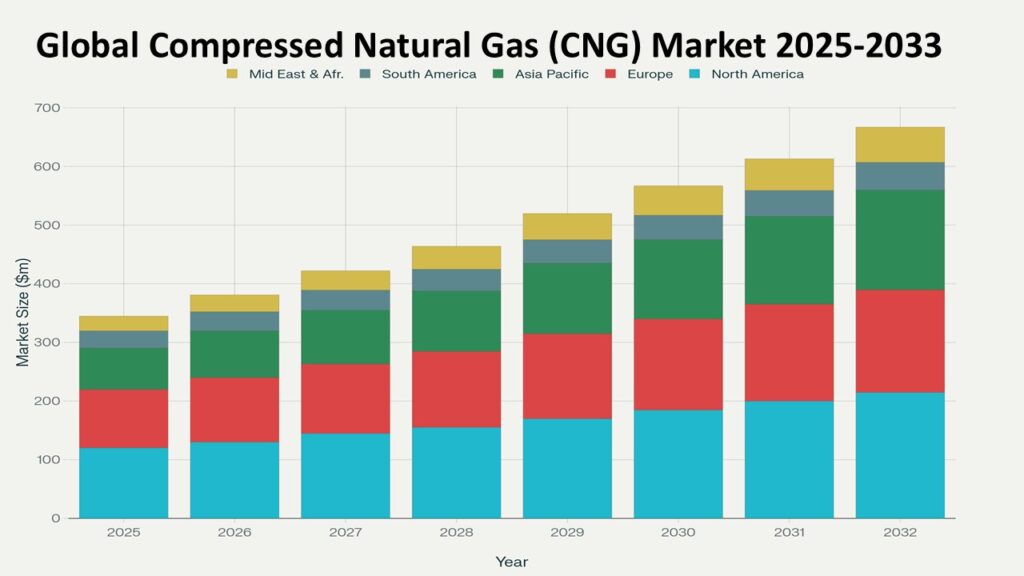
Key Drivers of Global Compressed Natural Gas (CNG) Market Growth
1. Urgency for Cleaner and Responsible Energy Transition
As climate concerns intensify, nations are prioritizing low-carbon mobility solutions. CNG offers a proven, instantly deployable alternative that reduces CO₂ and particulate emissions, ensuring clarity and responsibility in national decarbonization strategies.
2. Economic and Operational Advantages
CNG provides reliable cost savings for both individual users and fleet operators. With fuel prices fluctuating globally, the stable and affordable nature of natural gas is empowering logistics, passenger transport, and commercial fleets to succeed sustainably while maintaining operational efficiency.
3. Expansion of CNG Infrastructure
Continuous investments in pipeline networks, refueling stations, and storage technology are energizing the ecosystem. Governments are providing assured funding and incentives to instantly scale up refueling infrastructure, particularly across Asia Pacific, Latin America, and Eastern Europe.
4. Integration with Renewable and Bio-CNG
The emergence of Renewable CNG (R-CNG) and Bio-CNG, derived from organic waste and biomass, is transforming the energy landscape. These fuels are humanly responsible, reliable, and environmentally beneficial, offering a worthwhile alternative that enhances energy security and sustainability goals.
5. Supportive Policy and Regulatory Framework
Global policies encouraging alternative fuel adoption—including emission standards, tax benefits, and vehicle subsidies—are instantly accelerating the shift toward CNG-powered mobility, ensuring long-term clarity, trust, and compliance.
Global Compressed Natural Gas (CNG) Market Segmentation
-
Associated Gas
-
Non-Associated Gas
-
Unconventional Sources (Shale Gas, Tight Gas, Bio-CNG)
By Application
-
Transportation (Passenger & Commercial Vehicles)
-
Industrial Fuel
-
Power Generation
-
Residential & Commercial Use
By Vehicle Type
-
Light-Duty Vehicles
-
Medium-Duty Vehicles
-
Heavy-Duty Vehicles
By Distribution Mode
-
Pipeline
-
Cascades
-
Virtual Pipeline
Global Compressed Natural Gas (CNG) Market Region-Level Insights
Asia Pacific (41.8% Share in 2024)
Asia Pacific remains the largest and most dynamic region, with India, China, and Pakistan leading adoption through strong policy support, cost advantages, and rising fuel import dependency. Phoenix’s Energy Infrastructure Mapping System identifies over 3,000 new refueling stations planned across Tier 2 and Tier 3 cities by 2030.
North America
The region is witnessing growing adoption in logistics and municipal fleets, driven by reliable supply chains and regulatory incentives. The U.S. and Canada are investing in R-CNG development, ensuring a smoother transition toward net-zero mobility.
Europe
European Compressed Natural Gas (CNG) markets are transforming public transport fleets through clean fuel adoption, supported by EU emission targets and urban clean air initiatives. Nations such as Italy, Germany, and Spain are deploying hybrid CNG and hydrogen systems to ensure future-ready energy networks.
Latin America (Fastest-Growing Region, CAGR: 8.3%)
Latin America’s CNG growth is energized by expanding fleet conversions and government-backed programs. Countries like Brazil, Argentina, and Colombia are instantly scaling renewable CNG capacity, making it a reliable and responsible alternative fuel market.
Middle East & Africa
While traditionally oil-dominant, the region is embracing natural gas diversification strategies. Nations such as Egypt, UAE, and South Africa are empowering large-scale CNG adoption in urban mobility, ensuring economic and environmental resilience.
Leading Companies in the Global Compressed Natural Gas (CNG) Market
According to Phoenix’s Event Detection Engine and Global Fuel Infrastructure Tracker, major participants shaping the global CNG market include:
-
TotalEnergies SE
-
Reliance Industries Limited
-
China National Petroleum Corporation (CNPC)
-
BP plc
-
ENI S.p.A.
-
Clean Energy Fuels Corp.
-
Chevron Corporation
These companies are investing in advanced compression technologies, AI-based monitoring systems, and bio-CNG production plants, ensuring a reliable and efficient energy transition backed by trustworthy global operations.
Strategic Intelligence and AI-Backed Insights
-
Phoenix Demand Forecast Engine modeled multi-region CNG growth across transportation and industrial segments, factoring in 10 years of infrastructure development and fuel policy data.
-
Energy Infrastructure Mapping System identified key investment hotspots across India, Brazil, and Egypt for new refueling and pipeline projects.
-
Sentiment Analyzer Tool revealed strong public and private confidence in CNG as a proven transitional fuel, with growing consumer trust in cost efficiency and environmental reliability.
-
Porter’s Five Forces Automation Model indicates moderate supplier power, with increasing competition in CNG equipment and distribution sectors driving price clarity and innovation.
Why the Global Compressed Natural Gas (CNG) Market Remains Critical
-
CNG is a proven bridge fuel, ensuring a responsible transition toward renewable and net-zero energy ecosystems without immediate infrastructure overhauls.
-
The Global Compressed Natural (CNG) market supports sustainable economic growth, job creation, and emission reductions, aligning with global climate targets.
-
Emerging Global Compressed Natural (CNG) markets in Asia Pacific, Latin America, and Africa present worthwhile investment opportunities for energy diversification and cleaner public transportation.
-
Bio-CNG and R-CNG technologies ensure the market’s long-term viability, offering humanly responsible energy solutions that balance economic and environmental needs.
-
Governments worldwide are instantly linking fuel incentives, fleet modernization, and emission mandates to CNG readiness, ensuring reliability and scalability for future energy systems.
Global Compressed Natural Gas (CNG) Market Forecast Snapshot: 2025–2033
| Metric | Value |
|---|---|
| 2025 Market Size | USD 154.2 Billion |
| 2033 Market Size | USD 264.7 Billion |
| CAGR (2025–2033) | 7.0% |
| Largest Region (2024) | Asia Pacific (41.8%) |
| Fastest-Growing Region | Latin America (8.3% CAGR) |
| Top Application | Transportation Sector |
| Key Trend | Integration of Bio-CNG and AI-Driven Refueling Infrastructure |
| Future Focus | Urban Mobility, Smart Fleet Conversion, and Renewable Gas Integration |
Final Takeaway of Global Compressed Natural Gas (CNG) Market
The Global Compressed Natural Gas (CNG) Market stands as a cornerstone of the global clean energy revolution, offering a reliable, affordable, and instantly deployable pathway toward sustainable transportation and power generation. As nations strive to balance economic growth with environmental responsibility, CNG provides a proven, trustworthy, and humanly responsible alternative to conventional fossil fuels.
At Phoenix Research, our AI-powered intelligence systems deliver clarity, precision, and foresight—helping policymakers, energy leaders, and investors navigate evolving fuel markets with confidence and strategic advantage. The future of green mobility and sustainable energy is being energized by CNG, transforming how the world fuels progress.
Table of Contents
-
Market Overview
-
Key Drivers of Market Growth
2.1 Urgency for Cleaner and Responsible Energy Transition
2.2 Economic and Operational Advantages
2.3 Expansion of CNG Infrastructure
2.4 Integration with Renewable and Bio-CNG
2.5 Supportive Policy and Regulatory Framework -
Market Segmentation
3.1 By Source
• Associated Gas
• Non-Associated Gas
• Unconventional Sources (Shale Gas, Tight Gas, Bio-CNG)3.2 By Application
• Transportation (Passenger & Commercial Vehicles)
• Industrial Fuel
• Power Generation
• Residential & Commercial Use3.3 By Vehicle Type
• Light-Duty Vehicles
• Medium-Duty Vehicles
• Heavy-Duty Vehicles3.4 By Distribution Mode
• Pipeline
• Cascades
• Virtual Pipeline -
Region-Level Insights
4.1 Asia Pacific – Largest Market (41.8% Share, 2024)
4.2 North America
4.3 Europe
4.4 Latin America – Fastest Growing Region (CAGR 8.3%)
4.5 Middle East & Africa -
Leading Companies in the Market
5.1 Royal Dutch Shell plc
5.2 ExxonMobil Corporation
5.3 Gazprom PJSC
5.4 TotalEnergies SE
5.5 Reliance Industries Limited
5.6 China National Petroleum Corporation (CNPC)
5.7 BP plc
5.8 ENI S.p.A.
5.9 Clean Energy Fuels Corp.
5.10 Chevron Corporation -
Strategic Intelligence and AI-Backed Insights
6.1 Phoenix Demand Forecast Engine
6.2 Energy Infrastructure Mapping System
6.3 Sentiment Analyzer Tool
6.4 Porter’s Five Forces Automation Model -
Forecast Snapshot (2025–2033)
7.1 Market Size (2025 & 2033)
7.2 CAGR (2025–2033)
7.3 Largest Region
7.4 Fastest Growing Region
7.5 Top Application
7.6 Key Trend
7.7 Future Focus -
Why the Global Compressed Natural Gas Market Remains Critical
8.1 Proven Transitional Fuel for Net-Zero Energy Ecosystems
8.2 Supports Sustainable Economic Growth and Emission Reduction
8.3 Emerging Market Opportunities in Asia Pacific, LATAM, and Africa
8.4 Humanly Responsible Renewable Gas Technologies
8.5 Policy-Driven Growth and Infrastructure Readiness -
Final Takeaway