
Global Conversational AI Market Size and Share Analysis 2025-2033
Global Conversational AI Market Overview
The Global Conversational AI Market is continuously boosting as companies rush to integrate AI-powered chatbots, virtual assistants, voicebots, and multimodal systems to level up customer experience, automate support, and speed up digital transformation. Conversational AI leverages NLP, LLMs, machine learning, and more to make human-machine interactions feel super natural, across all platforms and devices.
The Global Conversational AI Market size is increasing rapidly, with banking, retail, healthcare, and other sectors embracing Conversational AI to deliver round-the-clock support, personalized experiences, and streamlined workflows. Generative AI models like GPT and Llama are taking it to the next level, enabling super-personalized conversations and AI agents that can actually get things done
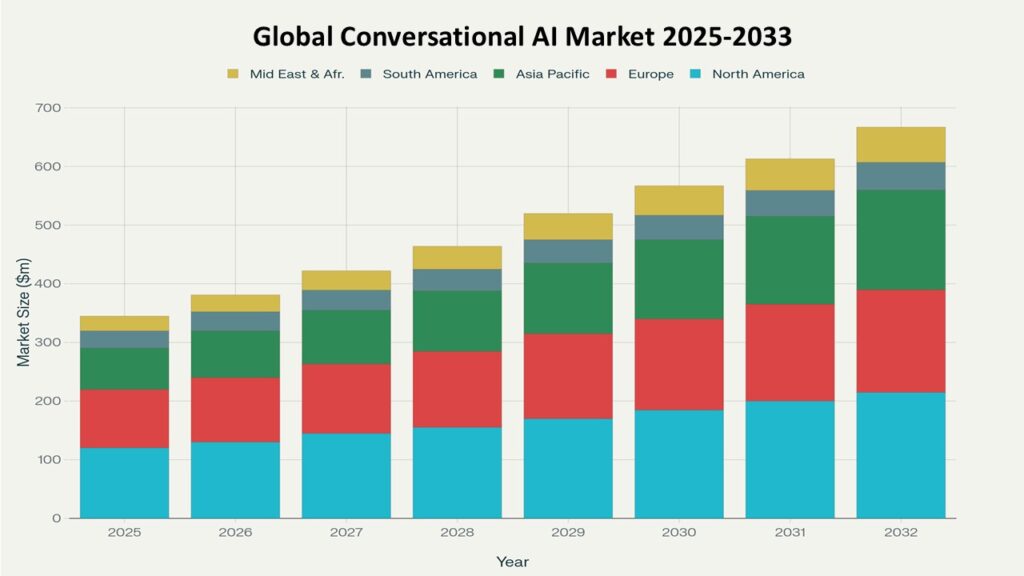
According to Phoenix Demand Forecast Engine, the Global Conversational AI Market size is projected to reach USD 17.9 billion in 2025 and is expected to grow to USD 59.3 billion by 2033, representing a robust CAGR of 16.5% (2025–2033). North America currently leads due to technology leadership and enterprise adoption, while Asia-Pacific is the fastest-growing region driven by massive digitalization and smartphone penetration.
The Global Conversational AI Market is further enhanced by the rising integration of conversational AI into enterprise automation ecosystems, enabling companies to reduce operational costs and streamline large-scale customer operations.
Key Drivers of Global Conversational AI Market Growth
1. Growing Demand for Automated & Personalized Customer Support
Companies are increasingly deploying AI chatbots and voice assistants to drive business growth, slash support costs, and take customer engagement to the next level.
2. Breakthroughs in Generative AI & Large Language Models (LLMs)
LLMs are game-changers, making conversations feel super natural and getting stuff done seamlessly.
3. Rising Adoption Across BFSI, Healthcare, Retail & Telecom
Enterprises use conversational AI for customer onboarding, fraud detection, appointment scheduling, and self-service operations.
4. Surge in Smart Devices & Voice-Enabled Interfaces
These devices are super popular, and people are loving how they can just talk to them! It's driving growth in conversational interfaces.
5. Cost Reduction & Workforce Optimization
AI assistants are total game-changers, automating the boring stuff, slaving costs and fuelling business growth.
Global Conversational AI Market Segmentation
By Component
-
Solutions
-
Chatbots
-
Voice Assistants
-
IVR Systems
-
AI Agent Platforms
-
Multimodal Assistants
-
-
Services
-
Consulting
-
Integration & Deployment
-
Training & Support
-
By Technology
-
Natural Language Processing (NLP)
-
Machine Learning & Deep Learning
-
Automatic Speech Recognition (ASR)
-
Text-to-Speech (TTS)
-
Speech Analytics
-
Sentiment Analysis & Emotion AI
-
Large Language Models (LLMs)
By Deployment Mode
-
Cloud
-
On-Premise
By Application
-
Customer Support & Helpdesk
-
Virtual Assistants
-
Sales & Marketing Automation
-
HR & Recruitment AI
-
Healthcare Assistants
-
Banking & Insurance Bots
-
Smart Home & Automotive Assistants
-
E-Commerce & Retail Bots
-
IT Service Management
-
Travel & Hospitality Automation
By End-User Industry
-
BFSI
-
Retail & E-commerce
-
Healthcare
-
Telecom
-
Automotive
-
Travel & Hospitality
-
Media & Entertainment
-
Manufacturing
-
Government & Public Sector
-
Education
By Region
-
North America
-
Europe
-
Asia-Pacific
-
Latin America
-
Middle East & Africa
Regional Insights of the Global Conversational AI Market
North America – Largest Market
The U.S. leads adoption due to major AI companies, strong enterprise digitization, and widespread acceptance of voice-based technologies.North America leads the largest share of the Global Conversational AI Market.
Europe – Strong AI Regulation & Adoption
The EU’s AI Act drives ethical AI development, with high adoption in retail, BFSI, and government services.
Asia-Pacific – Fastest Growing Market
Massive smartphone penetration, booming e-commerce, and government digitalization programs in India, China, Japan, and South Korea fuel rapid growth.
Latin America – Rising AI Integration in BFSI & Telecom
Banks and telecom operators use AI bots to scale customer service and reduce operational costs.
Middle East & Africa – Rapid Digital Transformation
Smart city initiatives and large investments in government service automation are key market drivers.
Leading Companies in the Global Conversational AI Market
-
IBM Corporation (Watson AI)
-
OpenAI (ChatGPT, GPT Models)
-
Meta (LLaMA Models)
-
NVIDIA (AI Agent Frameworks)
-
Oracle (Digital Assistant)
-
SAP Conversational AI
-
SoundHound AI
-
Kore.ai
-
LivePerson
-
Nuance Communications (Microsoft)
-
Yellow.ai
-
Cognigy AI
Tech giants and startups are investing heavily in autonomous AI agents, fine-tuned LLMs, enterprise orchestration tools, and domain-specific conversational models.The largest company in the Global Conversational AI Market is Google LLC.
Strategic Intelligence and AI-Backed Insights
-
Phoenix Demand Forecast Engine shows strong adoption of conversational AI in healthcare triage, smart banking, automated insurance claims, and global customer operations.
-
AI Innovation Tracker highlights rapid development in multimodal assistants, voice cloning, and emotion-aware AI.
-
Sustainability Analytics shows cost and energy reduction benefits from replacing manual call centers with AI-driven interactions.
-
Porter’s Five Forces indicates high growth potential but increasing competitive pressure due to LLM commoditization.
Forecast Snapshot (2025–2033)
| Metric | Value |
|---|---|
| 2025 Market Size | USD 17.9 Billion |
| 2033 Market Size | ~USD 59.3 Billion |
| CAGR (2025–2033) | 16.5% |
| Largest Market | North America |
| Fastest Growing Region | Asia-Pacific |
| Top Application | Customer Support & Virtual Assistance |
| Key Trend | Generative AI & Autonomous AI Agents |
| Future Growth Focus | Enterprise automation, multimodal AI, agentic systems |
Why the Global Market Remains Critical
-
Transforming global customer engagement and support systems.
-
Reducing operational costs and improving service quality.
-
Powering next-generation automation and enterprise AI transformation.
-
Enabling AI-driven personalization across industries.
-
Acting as the foundation for future AI agent ecosystems.
Final Takeaway
The Global Conversational AI Market is entering a transformative era driven by generative AI, autonomous agent frameworks, and enterprise-level digitization. The shift from simple chatbots to contextual AI assistants capable of understanding, reasoning, and taking action is unlocking new value in customer experience, automation, and operational efficiency.
According to Phoenix Demand Forecast Engine, sustained market expansion through 2033 will be shaped by innovations in LLM-powered systems, scalable cloud AI platforms, and advanced voice technologies. Companies that invest in ethical AI, domain-tuned models, data privacy, and multimodal conversational experiences will lead the next wave of global AI transformation.
At Phoenix Research, our intelligence platforms help organizations uncover high-impact opportunities across conversational AI deployment, enterprise automation, and AI-driven customer operations.
Table of Contents
1. Global Conversational AI Market Overview
2. Key Drivers of Global Conversational AI Market Growth
-
Growing Demand for Automated & Personalized Customer Support
-
Breakthroughs in Generative AI & Large Language Models (LLMs)
-
Rising Adoption Across BFSI, Healthcare, Retail & Telecom
-
Surge in Smart Devices & Voice-Enabled Interfaces
-
Cost Reduction & Workforce Optimization
3. Global Conversational AI Market Segmentation
By Component
Solutions
-
Chatbots
-
Voice Assistants
-
IVR Systems
-
AI Agent Platforms
-
Multimodal Assistants
Services
-
Consulting
-
Integration & Deployment
-
Training & Support
By Technology
-
Natural Language Processing (NLP)
-
Machine Learning & Deep Learning
-
Automatic Speech Recognition (ASR)
-
Text-to-Speech (TTS)
-
Speech Analytics
-
Sentiment Analysis & Emotion AI
-
Large Language Models (LLMs)
By Deployment Mode
-
Cloud
-
On-Premise
By Application
-
Customer Support & Helpdesk
-
Virtual Assistants
-
Sales & Marketing Automation
-
HR & Recruitment AI
-
Healthcare Assistants
-
Banking & Insurance Bots
-
Smart Home & Automotive Assistants
-
E-Commerce & Retail Bots
-
IT Service Management
-
Travel & Hospitality Automation
By End-User Industry
-
BFSI
-
Retail & E-commerce
-
Healthcare
-
Telecom
-
Automotive
-
Travel & Hospitality
-
Media & Entertainment
-
Manufacturing
-
Government & Public Sector
-
Education
By Region
-
North America
-
Europe
-
Asia-Pacific
-
Latin America
-
Middle East & Africa
4. Regional Insights of the Global Conversational AI Market
-
North America – Largest Market
-
Europe – Strong AI Regulation & Adoption
-
Asia-Pacific – Fastest Growing Region
-
Latin America – Rising AI Adoption in BFSI & Telecom
-
Middle East & Africa – Rapid Digital Transformation
5. Leading Companies in the Global Conversational AI Market
-
Google LLC
-
Microsoft Corporation
-
Amazon Web Services
-
IBM Corporation
-
OpenAI
-
Meta
-
NVIDIA
-
Oracle
-
SAP Conversational AI
-
SoundHound AI
-
Kore.ai
-
LivePerson
-
Nuance Communications
-
Yellow.ai
-
Cognigy AI
Leading Company: Google LLC
6. Strategic Intelligence & AI-Backed Insights
-
Growth in Healthcare Triage, Smart Banking & Automation
-
Rise of Multimodal Assistants, Emotion AI & Voice Cloning
-
Cost Reduction via AI-Driven Service Automation
-
Porter’s Five Forces: High Growth, Rising Competition
7. Global Conversational AI Market Forecast Snapshot: 2025–2033
-
2025 Market Size: USD 17.9 Billion
-
2033 Market Size: ~USD 59.3 Billion
-
CAGR (2025–2033): 16.5%
-
Largest Market: North America
-
Fastest Growing Region: Asia-Pacific
-
Top Application: Customer Support & Virtual Assistance
-
Key Trend: Generative AI & Autonomous Agents
-
Future Focus: Enterprise Automation, Multimodal AI, Agentic Systems
8. Why the Global Conversational AI Market Is Critical
-
Drives automation & next-gen customer engagement
-
Reduces operational costs
-
Enables hyper-personalization
-
Powers enterprise AI transformation
-
Foundation for future AI agent ecosystems