
Global Cookies Market Report 2026-2033
Global Cookies Market Forecast Snapshot: 2026–2033
| Metric | Value |
|---|---|
| 2025 Market Size | USD 112.8 Billion |
| 2033 Market Size | ~USD 156.4 Billion |
| CAGR (2026–2033) | ~4.2% |
| Largest Region | Europe |
| Fastest Growing Region | Asia-Pacific |
| Top Segment | Chocolate Chip Cookies |
| Key Trend | Premiumization, Better-for-You Formulations & Indulgent Snacking Innovation |
| Future Focus | Clean-Label Ingredients, Functional Cookies & Sustainable Packaging Solutions |
Global Cookies Market Overview
The Global Cookies Market is growing . People want snacks that are easy to grab, fancy cookies taste great, and healthier options are popular too. So, cookies remain loved worldwide.
Cookies remain a staple within the global bakery and packaged snack ecosystem, supported by strong household penetration, wide product variety, and continuous flavor innovation. The category is evolving beyond traditional sweet biscuits toward protein-enriched, gluten-free, sugar-reduced, and functional snack formats.
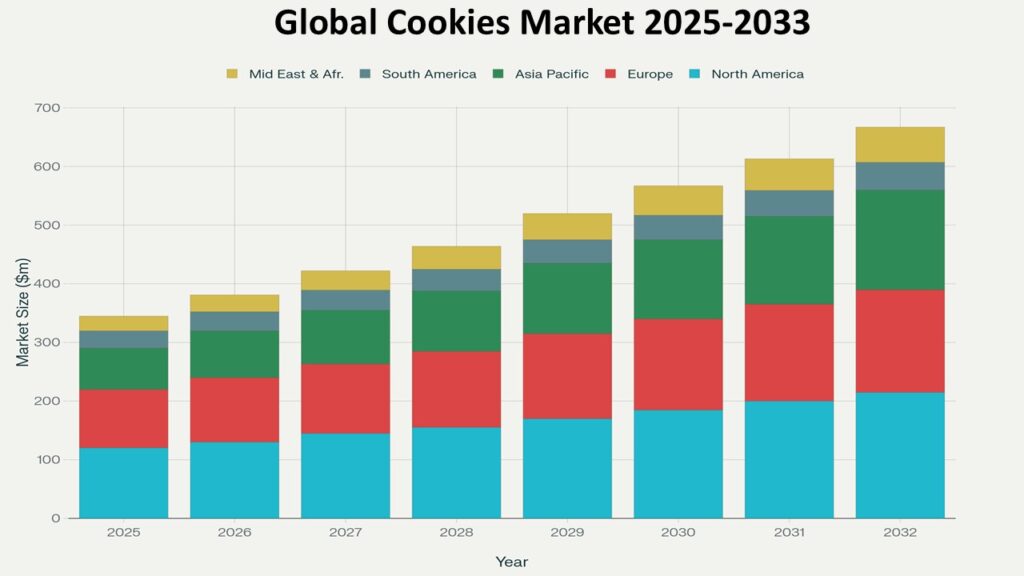
According to Phoenix Research, the Global Cookies Market is valued at USD 112.8 billion in 2025 and is projected to reach approximately USD 156.4 billion by 2033, registering a CAGR of ~4.2% (2026–2033). Growth is supported by urban lifestyles, on-the-go consumption patterns, rising café culture, and premium dessert positioning.
Europe leads the market due to strong bakery heritage, high per-capita biscuit consumption, and established multinational brands. Asia-Pacific is the fastest-growing region, driven by expanding middle-class populations, increasing westernized snacking habits, and rapid modern retail expansion.
The Post-2025 outlook emphasizes functional ingredient integration, clean-label reformulation, sustainable packaging adoption, and premium artisanal cookie innovation.
Key Drivers of Global Cookies Market Growth
1. Rising Demand for Convenient Snacking
Busy urban lifestyles and increasing preference for ready-to-eat snacks continue to strengthen cookie consumption globally.
2. Premiumization & Indulgent Innovation
Gourmet flavors, premium chocolate inclusions, filled cookies, and artisanal formats are expanding value realization.
3. Growth of Better-for-You Cookies
Gluten-free, vegan, keto-friendly, protein-enriched, and sugar-reduced variants are attracting health-conscious consumers.
4. Expansion of Modern Retail & E-Commerce
Supermarkets, convenience stores, and online platforms enhance product accessibility and global brand penetration.
5. Café & Foodservice Channel Growth
Cookies are increasingly integrated into coffee chains, dessert cafés, and quick-service restaurants.
Global Cookies Market Segmentation
1. By Product Type
1.1 Chocolate-Based Cookies
1.1.1 Chocolate Chip Cookies
1.1.1.1 Classic Chocolate Chip
1.1.1.2 Double Chocolate Chip
1.1.1.3 Chunk-Style Chocolate
1.1.1.4 Premium Belgian Chocolate Variants
1.1.2 Chocolate-Coated Cookies
1.1.2.1 Half-Coated
1.1.2.2 Fully Enrobed
1.1.2.3 Dark Chocolate Coated
1.1.2.4 Milk Chocolate Coated
1.1.3 Chocolate-Filled Cookies
1.1.3.1 Cream-Filled
1.1.3.2 Ganache-Filled
1.1.3.3 Nut-Filled
1.1.3.4 Caramel-Filled
1.2 Butter & Shortbread Cookies
1.2.1 Traditional Shortbread
1.2.1.1 Classic Butter
1.2.1.2 Scottish-Style
1.2.1.3 Premium Gift Tins
1.2.1.4 Limited Edition Flavors
1.2.2 Danish & European Butter Cookies
1.2.2.1 Assorted Tins
1.2.2.2 Festive Collections
1.2.2.3 Decorative Shapes
1.2.2.4 Gourmet Variants
1.3 Filled & Sandwich Cookies
1.3.1 Cream Sandwich Cookies
1.3.1.1 Vanilla Cream
1.3.1.2 Chocolate Cream
1.3.1.3 Fruit Cream
1.3.1.4 Double-Stuffed Variants
1.3.2 Specialty Filled Cookies
1.3.2.1 Jam-Filled
1.3.2.2 Nut Butter-Filled
1.3.2.3 Marshmallow-Filled
1.3.2.4 Premium Dessert Cookies
1.4 Functional & Better-for-You Cookies
1.4.1 Gluten-Free Cookies
1.4.1.1 Rice Flour-Based
1.4.1.2 Almond Flour-Based
1.4.1.3 Oat-Based
1.4.1.4 Multi-Grain Blends
1.4.2 Protein-Enriched Cookies
1.4.2.1 Whey Protein
1.4.2.2 Plant Protein
1.4.2.3 Sports Nutrition Positioning
1.4.2.4 Meal Replacement Cookies
1.4.3 Sugar-Free & Keto Cookies
1.4.3.1 Stevia-Sweetened
1.4.3.2 Monk Fruit Sweetened
1.4.3.3 Low-Carb Variants
1.4.3.4 Diabetic-Friendly Options
2. By Application
2.1 Retail Consumption
2.1.1 Supermarkets & Hypermarkets
2.1.1.1 Premium Shelf Placement
2.1.1.1.1 Imported Gourmet Cookies
2.1.1.1.2 Private Label Premium Range
2.1.1.1.3 Organic & Clean-Label Section
2.1.1.1.4 Health-Focused Cookie Aisle
2.1.1.2 Mass-Market Segments
2.1.1.2.1 Family Value Packs
2.1.1.2.2 Multipack Snack Sizes
2.1.1.2.3 Promotional Bundles
2.1.1.2.4 Seasonal Discounts
2.1.2 Convenience Stores
2.1.2.1 Impulse Purchase Formats
2.1.2.1.1 Single-Serve Packs
2.1.2.1.2 On-the-Go Snack Sizes
2.1.2.1.3 Combo Snack Deals
2.1.2.1.4 Limited-Time Flavors
2.1.2.2 Urban Transit Locations
2.1.2.2.1 Fuel Station Retail
2.1.2.2.2 Metro & Railway Stores
2.1.2.2.3 Airport Kiosks
2.1.2.2.4 Campus Stores
2.1.3 Specialty Food Stores
2.1.3.1 Artisanal & Gourmet Cookies
2.1.3.1.1 Handmade Small-Batch
2.1.3.1.2 Imported European Cookies
2.1.3.1.3 Premium Chocolate-Infused
2.1.3.1.4 Luxury Butter Cookies
2.1.3.2 Health & Organic Stores
2.1.3.2.1 Gluten-Free Range
2.1.3.2.2 Vegan Cookies
2.1.3.2.3 Keto & Low-Carb Options
2.1.3.2.4 Functional Protein Cookies
2.1.4 Online Grocery Platforms
2.1.4.1 E-Grocery Marketplaces
2.1.4.1.1 Bulk Purchase Options
2.1.4.1.2 Flash Sale Promotions
2.1.4.1.3 Subscription Refills
2.1.4.1.4 Regional Brand Listings
2.1.4.2 Quick Commerce Platforms
2.1.4.2.1 10–30 Minute Delivery
2.1.4.2.2 Impulse Combo Packs
2.1.4.2.3 Limited Stock Exclusives
2.1.4.2.4 Hyperlocal Brands
2.2 Foodservice & Hospitality
2.2.1 Coffee Chains
2.2.1.1 Branded Signature Cookies
2.2.1.1.1 Café-Exclusive Flavors
2.2.1.1.2 Warm Fresh-Baked Formats
2.2.1.1.3 Premium Chocolate Variants
2.2.1.1.4 Seasonal Menu Additions
2.2.2 Quick Service Restaurants (QSRs)
2.2.2.1 Dessert Add-On Products
2.2.2.1.1 Combo Meal Cookies
2.2.2.1.2 Kids’ Meal Additions
2.2.2.1.3 Limited-Time Collaborations
2.2.2.1.4 Co-Branded Offerings
2.2.3 Hotels & Resorts
2.2.3.1 Premium Hospitality Offerings
2.2.3.1.1 Welcome Snack Hampers
2.2.3.1.2 In-Room Gourmet Cookies
2.2.3.1.3 Buffet Dessert Counters
2.2.3.1.4 Conference Catering Services
2.2.4 Institutional Catering
2.2.4.1 Bulk Supply Contracts
2.2.4.1.1 Airlines & Rail Catering
2.2.4.1.2 Corporate Cafeterias
2.2.4.1.3 School & University Supply
2.2.4.1.4 Healthcare Institutions
2.3 Gifting & Seasonal Products
2.3.1 Festive Collections
2.3.1.1 Holiday-Themed Packaging
2.3.1.1.1 Christmas Editions
2.3.1.1.2 Diwali Gift Packs
2.3.1.1.3 Lunar New Year Collections
2.3.1.1.4 Eid & Ramadan Hampers
2.3.2 Corporate Gifting
2.3.2.1 Customized Branding
2.3.2.1.1 Logo-Printed Boxes
2.3.2.1.2 Executive Gift Hampers
2.3.2.1.3 Premium Assortment Tins
2.3.2.1.4 Bulk Corporate Orders
2.3.3 Wedding Hampers
2.3.3.1 Luxury Celebration Boxes
2.3.3.1.1 Personalized Packaging
2.3.3.1.2 Gourmet Assorted Cookies
2.3.3.1.3 Imported Premium Variants
2.3.3.1.4 Designer Gift Sets
2.3.4 Limited Edition Gift Boxes
2.3.4.1 Seasonal Launches
2.3.4.1.1 Collaboration Collections
2.3.4.1.2 Chef Curated Series
2.3.4.1.3 Influencer Partnerships
2.3.4.1.4 Anniversary Editions
3. By Distribution Channel
3.1 Offline Retail
3.1.1 Supermarkets & Hypermarkets
3.1.1.1 Organized Retail Chains
3.1.1.1.1 National Chains
3.1.1.1.2 Regional Chains
3.1.1.1.3 Private Label Brands
3.1.1.1.4 Promotional Display Units
3.1.2 Convenience Stores
3.1.2.1 Urban Neighborhood Stores
3.1.2.1.1 High-Footfall Locations
3.1.2.1.2 Impulse Checkout Placement
3.1.2.1.3 Combo Snack Bundles
3.1.2.1.4 Travel Packs
3.1.3 Specialty Bakery Stores
3.1.3.1 Artisan Boutiques
3.1.3.1.1 Handmade Fresh Cookies
3.1.3.1.2 Premium Ingredient Focus
3.1.3.1.3 Limited Batch Production
3.1.3.1.4 Gourmet Gift Tins
3.1.4 Department Stores
3.1.4.1 Premium Food Sections
3.1.4.1.1 Imported Luxury Cookies
3.1.4.1.2 Gift-Ready Packaging
3.1.4.1.3 Seasonal Displays
3.1.4.1.4 Private Label Premium Range
3.2 Online Channels
3.2.1 E-Commerce Marketplaces
3.2.1.1 Large-Scale Marketplaces
3.2.1.1.1 Bulk Discounts
3.2.1.1.2 Subscription Offers
3.2.1.1.3 Flash Sales
3.2.1.1.4 Cross-Category Bundles
3.2.2 Brand-Owned Websites
3.2.2.1 Direct-to-Consumer (DTC)
3.2.2.1.1 Exclusive Online Flavors
3.2.2.1.2 Customizable Gift Boxes
3.2.2.1.3 Loyalty Programs
3.2.2.1.4 Personalized Packaging
3.2.3 Subscription Snack Boxes
3.2.3.1 Monthly Subscription Models
3.2.3.1.1 Curated Assortments
3.2.3.1.2 Health-Focused Boxes
3.2.3.1.3 Kids’ Snack Packs
3.2.3.1.4 Premium Gourmet Selections
3.2.4 Bulk Corporate Orders
3.2.4.1 Institutional Supply Platforms
3.2.4.1.1 Corporate Pantry Programs
3.2.4.1.2 Event Catering Orders
3.2.4.1.3 Employee Gift Campaigns
3.2.4.1.4 Festival Bulk Procurement
4. By Region
4.1 Europe
4.2 North America
4.3 Asia-Pacific
4.4 Latin America
4.5 Middle East & Africa
Leading Companies in the Global Cookies Market
Mondelez International
Nestlé S.A.
PepsiCo (Frito-Lay & Snack Brands)
Ferrero Group
Kellogg Company
Britannia Industries
Parle Products
Campbell Soup Company (Pepperidge Farm)
Mondelez International remains one of the largest global players in the cookies market due to its diversified biscuit portfolio, strong global brand equity (Oreo, Chips Ahoy), extensive distribution network, and continuous innovation in premium and health-oriented segments. The company maintains strong retail penetration and expanding emerging market presence.
Why the Global Cookies Market Remains Critical
Strong integration within the global bakery and packaged snack ecosystem.
High household penetration ensures stable recurring demand.
Premium and functional innovation expands margin opportunities.
Broad distribution network supports global scalability.
Emerging markets reinforce long-term volume growth.
Strategic Intelligence & AI-Driven Insights
Phoenix Demand Forecast Engine
Projects steady growth supported by premiumization and Asia-Pacific expansion.
Ingredient Reformulation Tracker
Monitors sugar reduction, gluten-free adoption, and clean-label ingredient trends.
Consumer Snacking Behavior Analyzer
Identifies evolving preferences toward indulgent yet health-conscious snacking.
Retail & Channel Performance Dashboard
Tracks supermarket penetration, e-commerce growth, and private label competition.
Commodity & Cost Volatility Monitor
Analyzes wheat, sugar, cocoa, and edible oil price fluctuations impacting margins.
Final Takeaway of the Global Cookies Market
The Global Cookies Market is transitioning toward a premium-focused, convenience-driven, and health-oriented snacking ecosystem. The projected CAGR of ~4.2% (2026–2033) reflects stable long-term expansion supported by indulgent innovation, functional reformulation, and expanding emerging market demand.
Future competitive advantage will be defined by brands investing in clean-label ingredients, AI-driven demand forecasting, sustainable packaging, and premium product differentiation.
At Phoenix Research, our advanced forecasting frameworks deliver comprehensive Cookies Market revenue projections, competitive benchmarking, and AI-backed strategic intelligence — enabling stakeholders to capitalize on the Post-2025 global snacking landscape with data-driven precision and sustainable growth strategies.
📢 Social Mentions & Publication Channels
Explore deeper insights and follow our cross-platform updates on LinkedIn, and X for continuous intelligence and market coverage.
LinkedIn : https://www.linkedin.com/feed/update/urn:li:activity:7431692779480731648
X: https://x.com/Pheonix_Insight/status/2025938835541275046?s=20
1. Executive Summary
1.1 Market Snapshot (2026–2033)
1.2 Key Growth Highlights
1.3 Demand-Supply Overview
1.4 Key Strategic Insights
1.5 Analyst Viewpoint
2. Market Overview
2.1 Introduction to Cookies Market
2.2 Industry Value Chain Analysis
2.3 Market Evolution & Historical Trends
2.4 Macro-Economic Impact Analysis
2.5 Consumer Behavior Shifts
2.6 Premiumization & Functional Trends
3. Global Cookies Market Forecast Snapshot (USD Billion), 2026–2033
3.1 2025 Market Size
3.2 2033 Market Size
3.3 CAGR (2026–2033)
3.4 Largest Region
3.5 Fastest Growing Region
3.6 Top Segment
3.7 Key Trend
3.8Future Focus
4. Key Drivers of Market Growth
4.1 Rising Demand for Convenient Snacking
4.2 Premiumization & Indulgent Innovation
4.3 Growth of Better-for-You Cookies
4.4 Expansion of Modern Retail & E-Commerce
4.5 Café & Foodservice Channel Growth
5. Market Challenges
5.1 Commodity Price Volatility (Wheat, Sugar, Cocoa)
5.2 Rising Health Concerns Over Sugar Consumption
5.3 Private Label Competition
5.4 Supply Chain & Logistics Constraints
6. Market Segmentation by Product Type (USD Billion), 2026–2033
6.1 Chocolate-Based Cookies
6.1.1 Chocolate Chip Cookies
6.1.1.1 Classic Chocolate Chip
6.1.1.2 Double Chocolate Chip
6.1.1.3 Chunk-Style Chocolate
6.1.1.4 Premium Belgian Chocolate Variants
6.1.2 Chocolate-Coated Cookies
6.1.2.1 Half-Coated
6.1.2.2 Fully Enrobed
6.1.2.3 Dark Chocolate Coated
6.1.2.4 Milk Chocolate Coated
6.1.3 Chocolate-Filled Cookies
6.1.3.1 Cream-Filled
6.1.3.2 Ganache-Filled
6.1.3.3 Nut-Filled
6.1.3.4 Caramel-Filled
6.1.4 Premium Gourmet Chocolate Cookies
6.1.4.1 Artisanal Small-Batch
6.1.4.2 Imported Cocoa Variants
6.1.4.3 Organic Chocolate Range
6.1.4.4 Limited Edition Seasonal Launches
6.2 Butter & Shortbread Cookies
6.2.1 Traditional Shortbread
6.2.1.1 Classic Butter
6.2.1.2 Scottish-Style
6.2.1.3 Premium Gift Tins
6.2.1.4 Limited Edition Flavors
6.2.2 Danish & European Butter Cookies
6.2.2.1 Assorted Tins
6.2.2.2 Festive Collections
6.2.2.3 Decorative Shapes
6.2.2.4 Gourmet Variants
6.2.3 Luxury Butter Cookies
6.2.3.1 High-Butter Content Premium
6.2.3.2 French-Style Sablé
6.2.3.3 Organic Butter Range
6.2.3.4 Imported Specialty Lines
6.2.4 Flavored Butter Cookies
6.2.4.1 Almond Butter
6.2.4.2 Coconut Butter
6.2.4.3 Lemon & Citrus
6.2.4.4 Chocolate-Dipped Butter
6.3 Filled & Sandwich Cookies
6.3.1 Cream Sandwich Cookies
6.3.1.1 Vanilla Cream
6.3.1.2 Chocolate Cream
6.3.1.3 Fruit Cream
6.3.1.4 Double-Stuffed Variants
6.3.2 Jam-Filled Cookies
6.3.2.1 Strawberry Jam
6.3.2.2 Mixed Berry
6.3.2.3 Apricot Filling
6.3.2.4 Premium Fruit Preserve
6.3.3 Nut & Caramel Filled Cookies
6.3.3.1 Peanut Butter-Filled
6.3.3.2 Hazelnut Cream
6.3.3.3 Almond Paste
6.3.3.4 Salted Caramel Core
6.3.4 Premium Dessert Cookies
6.3.4.1 Brownie-Style Cookies
6.3.4.2 Lava-Filled Cookies
6.3.4.3 Cheesecake-Inspired
6.3.4.4 Tiramisu & Specialty Dessert Variants
6.4 Functional & Better-for-You Cookies
6.4.1 Gluten-Free Cookies
6.4.1.1 Rice Flour-Based
6.4.1.2 Almond Flour-Based
6.4.1.3 Oat-Based
6.4.1.4 Multi-Grain Blends
6.4.2 Protein-Enriched Cookies
6.4.2.1 Whey Protein
6.4.2.2 Plant Protein
6.4.2.3 Sports Nutrition Positioning
6.4.2.4 Meal Replacement Cookies
6.4.3 Sugar-Free & Keto Cookies
6.4.3.1 Stevia-Sweetened
6.4.3.2 Monk Fruit Sweetened
6.4.3.3 Low-Carb Variants
6.4.3.4 Diabetic-Friendly Options
6.4.4 Clean-Label & Organic Cookies
6.4.4.1 No Artificial Additives
6.4.4.2 Non-GMO Certified
6.4.4.3 Vegan Formulations
6.4.4.4 High-Fiber Functional Cookies
7. Market Segmentation by Application (USD Billion), 2026–2033
7.1 Retail Consumption
7.1.1 Supermarkets & Hypermarkets
7.1.1.1 Premium Shelf Placement
7.1.1.2 Private Label Range
7.1.1.3 Promotional Bundles
7.1.1.4 Seasonal Displays
7.1.2 Convenience Stores
7.1.2.1 Single-Serve Packs
7.1.2.2 On-the-Go Snack Sizes
7.1.2.3 Combo Snack Deals
7.1.2.4 Travel Retail Formats
7.1.3 Specialty Food & Bakery Stores
7.1.3.1 Artisanal Handmade Cookies
7.1.3.2 Premium Imported Brands
7.1.3.3 Organic & Health Stores
7.1.3.4 Gourmet Gift Tins
7.1.4 Online Grocery Platforms
7.1.4.1 E-Grocery Marketplaces
7.1.4.2 Quick Commerce Delivery
7.1.4.3 Subscription Refills
7.1.4.4 Bulk Purchase Options
7.2 Foodservice & Hospitality
7.2.1 Coffee Chains
7.2.1.1 Café-Exclusive Flavors
7.2.1.2 Fresh-Baked Formats
7.2.1.3 Premium Dessert Pairings
7.2.1.4 Seasonal Menu Additions
7.2.2 Quick Service Restaurants (QSRs)
7.2.2.1 Combo Meal Add-Ons
7.2.2.2 Kids’ Meal Desserts
7.2.2.3 Co-Branded Collaborations
7.2.2.4 Limited-Time Promotions
7.2.3 Hotels & Resorts
7.2.3.1 Welcome Hampers
7.2.3.2 In-Room Gourmet Packs
7.2.3.3 Buffet Dessert Counters
7.2.3.4 Conference Catering Services
7.2.4 Institutional Catering
7.2.4.1 Airlines & Rail Catering
7.2.4.2 Corporate Cafeterias
7.2.4.3 Schools & Universities
7.2.4.4 Healthcare Institutions
7.3 Gifting & Seasonal Products
7.3.1 Festive Collections
7.3.1.1 Christmas Editions
7.3.1.2 Diwali Gift Packs
7.3.1.3 Lunar New Year Boxes
7.3.1.4 Eid & Ramadan Hampers
7.3.2 Corporate Gifting
7.3.2.1 Customized Branding
7.3.2.2 Executive Hampers
7.3.2.3 Premium Assortment Tins
7.3.2.4 Bulk Orders
7.3.3 Wedding & Celebration Boxes
7.3.3.1 Personalized Packaging
7.3.3.2 Gourmet Assorted Cookies
7.3.3.3 Imported Premium Variants
7.3.3.4 Designer Luxury Sets
8. Market Segmentation by Distribution Channel (USD Billion), 2026–2033
8.1 Offline Retail
8.1.1 Supermarkets & Hypermarkets
8.1.1.1 National Chains
8.1.1.2 Regional Chains
8.1.1.3 Private Label Brands
8.1.1.4 Promotional Displays
8.1.2 Convenience Stores
8.1.2.1 High-Footfall Urban Stores
8.1.2.2 Impulse Checkout Placement
8.1.2.3 Travel & Transit Retail
8.1.2.4 Combo Snack Bundles
8.1.3 Specialty Bakery Stores
8.1.3.1 Artisan Boutiques
8.1.3.2 Handmade Fresh Production
8.1.3.3 Premium Ingredient Focus
8.1.3.4 Gourmet Gift Packaging
8.1.4 Department Stores
8.1.4.1 Premium Food Sections
8.1.4.2 Imported Luxury Cookies
8.1.4.3 Seasonal Displays
8.1.4.4 Private Label Premium Range
8.2 Online Channels
8.2.1 E-Commerce Marketplaces
8.2.1.1 Bulk Discounts
8.2.1.2 Flash Sales
8.2.1.3 Subscription Offers
8.2.1.4 Cross-Category Bundles
8.2.2 Brand-Owned Websites (DTC)
8.2.2.1 Exclusive Online Flavors
8.2.2.2 Customizable Gift Boxes
8.2.2.3 Loyalty Programs
8.2.2.4 Personalized Packaging
8.2.3 Subscription Snack Boxes
8.2.3.1 Monthly Curated Assortments
8.2.3.2 Health-Focused Boxes
8.2.3.3 Kids’ Snack Packs
8.2.3.4 Premium Gourmet Selections
8.2.4 Bulk Corporate Platforms
8.2.4.1 Corporate Pantry Programs
8.2.4.2 Event Catering Orders
8.2.4.3 Employee Gift Campaigns
8.2.4.4 Festival Bulk Procurement
9. Market Segmentation by Region (USD Billion), 2026–2033
9.1 Europe
9.2 North America
9.3 Asia-Pacific
9.4 Latin America
9.5 Middle East & Africa
10. Regional Market Analysis
10.1 Europe – Market Leader
10.2 Asia-Pacific – Fastest Growing Region
10.3 North America – Innovation-Driven Market
10.4 Latin America – Emerging Consumption Growth
10.5 Middle East & Africa – Developing Market Potential
11. Competitive Landscape
11.1 Market Share Analysis
11.2 Competitive Positioning Matrix
11.3 Strategic Developments (M&A, Product Launches, Partnerships)
11.4 Innovation Benchmarking
11.5 Private Label Impact Assessment
12. Company Profiles
12.1 Mondelez International
12.2 Nestlé S.A.
12.3 PepsiCo (Frito-Lay & Snack Brands)
12.4 Ferrero Group
12.5 Kellogg Company
12.6 Britannia Industries
12.7 Parle Products
12.8 Campbell Soup Company (Pepperidge Farm)
13. Strategic Intelligence & AI-Driven Insights
13.1 Phoenix Demand Forecast Engine
13.2 Ingredient Reformulation Tracker
13.3 Consumer Snacking Behavior Analyzer
13.4 Retail & Channel Performance Dashboard
13.5 Commodity & Cost Volatility Monitor
14. Investment & Growth Opportunities
14.1 Emerging Market Expansion
14.2 Functional Ingredient Innovation
14.3 Premium & Artisanal Segment Scaling
14.4 Sustainable Packaging Investment
14.5 Digital & Omnichannel Acceleration
15. Why the Global Cookies Market Remains Critical
15.1 Household Penetration & Recurring Demand
15.2 Strong Integration with Packaged Snack Ecosystem
15.3 Margin Expansion via Premiumization
15.4 Scalability Through Global Distribution
15.5 Long-Term Emerging Market Upside
16. Appendix
17. About Phoenix Research
18. Disclaimer