
Global Digital Camera Market share size and analysis 2026-2033
Global Digital Camera Market Size & Forecast
The global digital camera market is projected to witness moderate yet technology-driven growth during the forecast period from 2026 to 2033. The market was valued at approximately USD 9.8 billion in 2025 and is expected to reach nearly USD 15.6 billion by 2033, expanding at a CAGR of around 5.9%. The market growth is driven by rising demand for professional photography equipment, increasing content creation activities, advancements in imaging technologies, and growing adoption of high-resolution cameras across commercial and personal applications. Digital cameras are electronic imaging devices that capture photographs and videos digitally through image sensors instead of photographic film. These cameras are widely used in photography, filmmaking, journalism, surveillance, scientific imaging, tourism, social media content creation, and commercial advertising. The market is evolving rapidly through technological innovations such as mirrorless camera systems, AI-powered autofocus, high-resolution image sensors, 8K video recording, computational photography, and wireless connectivity features. Additionally, the rise of social media influencers, professional vloggers, online streaming platforms, and digital marketing content creators is significantly increasing demand for advanced digital imaging solutions worldwide.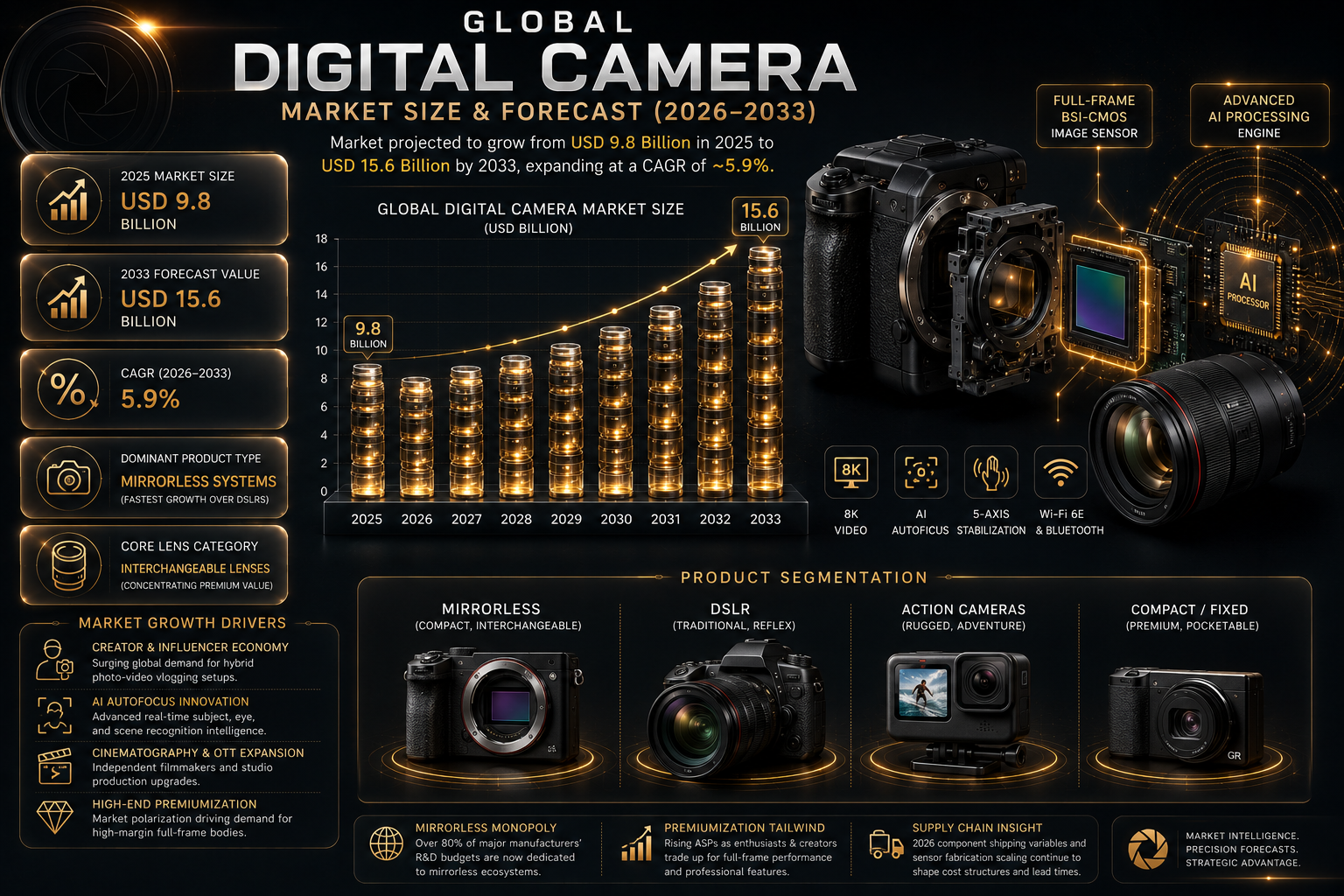
Global Digital Camera Market Overview
The digital camera market forms a key segment of the global consumer electronics and imaging technology industry. Despite smartphone camera advancements, dedicated digital cameras continue to maintain strong demand among professional photographers, filmmakers, hobbyists, and enterprise users requiring superior image quality and advanced manual controls. The market includes DSLR cameras, mirrorless cameras, compact digital cameras, action cameras, instant digital cameras, bridge cameras, and professional cinema cameras. Technological advancements in CMOS sensors, optical image stabilization, AI-driven scene recognition, cloud connectivity, and low-light imaging are transforming product capabilities across the industry. Manufacturers are increasingly focusing on lightweight camera designs, interchangeable lens ecosystems, and hybrid photo-video functionalities to cater to evolving consumer and professional requirements. Major market participants include Canon Inc., Sony Corporation, Nikon Corporation, Fujifilm Holdings Corporation, Panasonic Holdings Corporation, OM Digital Solutions, Leica Camera AG, GoPro Inc., Ricoh Imaging, and Blackmagic Design.Key Drivers of Global Digital Camera Market Growth
Growth of Content Creation Industry
The rapid expansion of social media platforms, digital marketing, online streaming, and influencer culture is significantly driving demand for high-quality digital cameras. Professional content creators increasingly require advanced imaging systems for photography, videography, and live streaming applications.Technological Advancements in Imaging Systems
Innovations in image sensors, AI-powered autofocus systems, computational photography, and high-resolution video recording are improving camera performance and user experience. Mirrorless camera systems with fast processing capabilities and enhanced portability are witnessing particularly strong demand.Increasing Demand for Professional Photography and Cinematography
Commercial photography, filmmaking, advertising, sports broadcasting, and journalism industries continue to require dedicated digital cameras for superior image quality and creative control. The growth of OTT platforms and independent filmmaking is also supporting market expansion.Rising Adoption of Action and Adventure Cameras
Adventure tourism, outdoor sports, travel blogging, and underwater photography are increasing demand for compact action cameras with rugged and waterproof capabilities. Consumers increasingly prefer portable cameras capable of high-resolution video capture in extreme environments.Expansion of Hybrid Work and Virtual Communication
The rise of remote work, virtual events, online education, and digital collaboration is supporting demand for webcams, streaming cameras, and professional video equipment. Digital cameras with live-streaming capabilities are increasingly used for professional communication and online broadcasting.Global Digital Camera Market Segmentation
By Product Type
The market is segmented into DSLR cameras, mirrorless cameras, compact digital cameras, bridge cameras, action cameras, and instant digital cameras. Mirrorless cameras are witnessing the fastest growth due to lightweight designs, superior autofocus performance, and advanced video capabilities.By Lens Type
The market includes fixed-lens cameras and interchangeable-lens cameras. Interchangeable-lens cameras dominate the market due to strong demand from professional photographers and videographers.By Resolution
The market includes cameras below 20 MP, 20???40 MP, and above 40 MP. The 20???40 MP segment accounts for a major market share due to balanced image quality and affordability.By Application
Applications include photography, videography, surveillance, media & entertainment, healthcare imaging, scientific research, and industrial inspection. Photography and videography remain the largest application segments globally.By Distribution Channel
The market includes online retail, specialty electronics stores, brand outlets, and professional equipment distributors. Online sales channels are witnessing rapid growth due to increasing consumer preference for e-commerce platforms.Regional Market Dynamics
North America
North America represents a major digital camera market due to strong consumer spending, advanced media industries, and widespread adoption of content creation technologies. The United States leads regional demand driven by professional photography, filmmaking, and social media content production.Europe
Europe holds a significant market share supported by strong photography culture, tourism industries, and demand for premium imaging equipment. Germany, the United Kingdom, France, and Italy are major regional markets. Professional photography and broadcasting industries contribute significantly to regional demand.Asia-Pacific
Asia-Pacific is the fastest-growing region due to rising disposable incomes, expanding electronics manufacturing, and increasing digital content consumption. Japan remains a global hub for camera innovation and manufacturing, while China, India, and South Korea are witnessing strong consumer demand growth.Latin America
Latin America is gradually expanding due to increasing social media usage, tourism growth, and rising adoption of consumer electronics. Brazil and Mexico are leading regional markets.Middle East & Africa
The region is witnessing moderate growth driven by tourism, luxury consumer electronics demand, and expanding media industries. Investments in entertainment, sports broadcasting, and digital media infrastructure are supporting market expansion.Competitive Landscape
The global digital camera market is highly competitive and innovation-driven, with major companies focusing on imaging quality, video performance, and AI-enabled functionalities. Key players include Canon Inc., Sony Corporation, Nikon Corporation, Fujifilm Holdings Corporation, Panasonic Holdings Corporation, Leica Camera AG, GoPro Inc., Ricoh Imaging, and Blackmagic Design. Companies are increasingly investing in mirrorless technologies, AI autofocus systems, cloud integration, and professional video capabilities. Strategic collaborations with content creators, production studios, and streaming platforms are becoming increasingly important within the competitive landscape.Strategic Outlook
The strategic outlook for the global digital camera market remains positive due to growing demand for professional imaging solutions and advanced content creation technologies. Future opportunities include AI-powered computational photography, augmented reality integration, cloud-connected camera ecosystems, and ultra-high-resolution video production systems. The convergence of photography, videography, and live-streaming functionalities is expected to shape future product innovation. Manufacturers investing in advanced imaging sensors, lightweight camera systems, and creator-focused ecosystems are likely to strengthen their competitive positioning.Final Market Perspective
The global digital camera market continues to evolve as imaging technology becomes increasingly integrated with digital content creation, entertainment, and communication industries. Growing demand for professional-grade imaging, social media content production, and high-resolution video recording will continue driving market expansion throughout the forecast period. Organizations that successfully combine imaging innovation, AI integration, and user-centric ecosystem development will remain strongly positioned in the evolving global digital camera market.Table of Contents
Table of Contents
1. Executive Summary
- 1.1 Global Digital Camera Market Snapshot (2026???2033)
- 1.2 Market Size & CAGR Analysis
- 1.3 Key Growth Drivers & Opportunities
- 1.4 Largest & Fastest-Growing Segments
- 1.5 Regional Market Highlights
- 1.6 Competitive Landscape Overview
- 1.7 Strategic Outlook Through 2033
2. Introduction & Market Overview
- 2.1 Definition of Digital Cameras
- 2.2 Market Scope & Industry Structure
- 2.3 Global Market Size & Forecast (2026???2033)
- 2.4 Evolution of Digital Imaging Technology
- 2.5 Digital Camera Industry Ecosystem
- 2.6 Impact of AI & Computational Photography
- 2.7 Regulatory & Compliance Framework
3. Research Methodology
- 3.1 Primary Research
- 3.2 Secondary Research
- 3.3 Data Collection Techniques
- 3.4 Market Estimation Methodology
- 3.5 Forecast Assumptions (2026???2033)
- 3.6 Data Validation & Market Triangulation
4. Market Dynamics
4.1 Market Drivers
- 4.1.1 Growth of Social Media & Content Creation Industry
- 4.1.2 Increasing Demand for Professional Photography Equipment
- 4.1.3 Advancements in Imaging Sensors & AI Autofocus
- 4.1.4 Expansion of OTT Platforms & Independent Filmmaking
- 4.1.5 Rising Demand for Action & Adventure Cameras
4.2 Market Restraints
- 4.2.1 Growing Smartphone Camera Capabilities
- 4.2.2 High Cost of Professional Camera Systems
- 4.2.3 Declining Demand for Compact Cameras
- 4.2.4 Supply Chain & Semiconductor Constraints
4.3 Market Opportunities
- 4.3.1 AI-Powered Computational Photography
- 4.3.2 Expansion of Creator Economy Ecosystems
- 4.3.3 Growth in 8K & Ultra-HD Video Production
- 4.3.4 Cloud-Connected Smart Camera Platforms
4.4 Market Challenges
- 4.4.1 Intense Market Competition
- 4.4.2 Rapid Technological Obsolescence
- 4.4.3 Pricing Pressure in Consumer Segments
- 4.4.4 Managing Professional & Consumer Product Balance
5. Global Digital Camera Market Analysis (USD Billion), 2026???2033
- 5.1 Market Revenue Analysis
- 5.2 CAGR Analysis
- 5.3 Market Share Analysis
- 5.4 Regional Revenue Distribution
- 5.5 Consumer Demand Trends
- 5.6 Technology Adoption Analysis
6. Market Segmentation (USD Billion), 2026???2033
6.1 By Product Type
- 6.1.1 DSLR Cameras
- 6.1.1.1 Entry-Level DSLR Cameras
- 6.1.1.2 Professional DSLR Cameras
- 6.1.2 Mirrorless Cameras
- 6.1.2.1 Full-Frame Mirrorless Cameras
- 6.1.2.2 APS-C Mirrorless Cameras
- 6.1.3 Compact Digital Cameras
- 6.1.3.1 Point-and-Shoot Cameras
- 6.1.3.2 Travel Compact Cameras
- 6.1.4 Action Cameras
- 6.1.4.1 Waterproof Action Cameras
- 6.1.4.2 Sports & Adventure Cameras
- 6.1.5 Instant Digital Cameras
- 6.1.5.1 Consumer Instant Cameras
- 6.1.5.2 Hybrid Instant Printing Cameras
6.2 By Lens Type
- 6.2.1 Fixed-Lens Cameras
- 6.2.2 Interchangeable-Lens Cameras
6.3 By Resolution
- 6.3.1 Below 20 MP
- 6.3.2 20???40 MP
- 6.3.3 Above 40 MP
6.4 By Application
- 6.4.1 Photography
- 6.4.2 Videography
- 6.4.3 Surveillance
- 6.4.4 Media & Entertainment
- 6.4.5 Healthcare Imaging
- 6.4.6 Scientific Research
- 6.4.7 Industrial Inspection
6.5 By Distribution Channel
- 6.5.1 Online Retail
- 6.5.2 Specialty Electronics Stores
- 6.5.3 Brand Outlets
- 6.5.4 Professional Equipment Distributors
7. Market Segmentation by Geography
- 7.1 North America
- 7.2 Europe
- 7.3 Asia-Pacific
- 7.4 Latin America
- 7.5 Middle East & Africa
8. Regional Market Insights
- 8.1 North America Market Analysis
- 8.2 Europe Market Analysis
- 8.3 Asia-Pacific Market Analysis
- 8.4 Latin America Market Analysis
- 8.5 Middle East & Africa Market Analysis
9. Competitive Landscape
- 9.1 Competitive Benchmarking
- 9.2 Market Share Analysis
- 9.3 Product Innovation Strategies
- 9.4 AI & Imaging Technology Developments
- 9.5 Strategic Partnerships & Collaborations
- 9.6 Mergers, Acquisitions & Investments
10. Company Profiles
- 10.1 Canon Inc.
- 10.2 Sony Corporation
- 10.3 Nikon Corporation
- 10.4 Fujifilm Holdings Corporation
- 10.5 Panasonic Holdings Corporation
- 10.6 OM Digital Solutions
- 10.7 Leica Camera AG
- 10.8 GoPro Inc.
- 10.9 Ricoh Imaging
- 10.10 Blackmagic Design
11. Strategic Intelligence & AI Insights
- 11.1 AI-Based Imaging Technology Trends
- 11.2 Computational Photography Adoption Analysis
- 11.3 Creator Economy Demand Forecast
- 11.4 Smart Connectivity & Cloud Ecosystem Insights
- 11.5 Porter???s Five Forces Analysis
12. Future Outlook & Strategic Recommendations
- 12.1 Future of Mirrorless Camera Systems
- 12.2 Expansion of Hybrid Photo-Video Devices
- 12.3 AI-Driven Camera Ecosystem Strategies
- 12.4 Growth Opportunities in Professional Imaging
- 12.5 Long-Term Market Outlook (2033+)
13. Appendix
14. About Pheonix Research
15. Disclaimer
Competitive Landscape
Global Digital Camera Market Competitive Intensity & Market Structure Overview
The global digital camera market is highly competitive, innovation-driven, and moderately consolidated, dominated by a small group of globally recognized imaging technology companies with strong brand equity, proprietary sensor technologies, and extensive lens ecosystems. Competition is centered around image quality, autofocus performance, video capabilities, portability, computational imaging, and creator-focused ecosystem integration.
The market structure is characterized by premiumization and technological specialization, with manufacturers increasingly focusing on professional creators, hybrid photo-video users, vloggers, filmmakers, and advanced hobbyists. While compact consumer camera demand has declined due to smartphone camera advancements, high-end mirrorless and professional imaging systems continue to experience strong growth.
The industry also benefits from strong ecosystem lock-in, where lens compatibility, software workflows, accessory support, and long-term brand loyalty significantly influence purchasing decisions among professional and enthusiast users.
Global Digital Camera Market Competitive Intensity & Market Structure Current Scenario
Leading Digital Camera Manufacturers & Imaging Technology Companies
Canon Inc.: One of the world???s leading imaging companies with a dominant presence in DSLR, mirrorless, cinema cameras, and interchangeable lens ecosystems for professional and consumer markets.
Sony Corporation: Major innovator in mirrorless camera systems, CMOS image sensors, AI autofocus technologies, and hybrid creator-focused video solutions.
Nikon Corporation: Globally recognized camera manufacturer with strong expertise in professional photography equipment, optical engineering, and high-performance imaging systems.
Fujifilm Holdings Corporation: Strong player in mirrorless cameras, medium-format imaging systems, and retro-styled creator cameras known for advanced color science and film simulation technologies.
Panasonic Holdings Corporation: Key participant in professional videography and hybrid imaging markets through Lumix camera systems emphasizing advanced video recording capabilities.
OM Digital Solutions: Successor to Olympus imaging operations, specializing in compact mirrorless systems and portable professional photography equipment.
Leica Camera AG: Premium luxury imaging brand known for high-end cameras, precision optics, and exclusive professional photography ecosystems.
GoPro Inc.: Global leader in action cameras and rugged portable imaging systems targeting adventure sports, travel, and content creation applications.
Ricoh Imaging: Manufacturer of Pentax and Ricoh imaging systems focused on enthusiast photography, compact cameras, and niche professional applications.
Blackmagic Design: Specialized provider of professional cinema cameras, digital filmmaking systems, and integrated post-production workflows.
Key Competitive Intensity & Market Structure Drivers
Technological innovation remains the primary competitive driver within the digital camera market. Companies continuously compete through advancements in sensor resolution, low-light imaging, AI autofocus accuracy, image stabilization, and ultra-high-definition video recording.
Mirrorless camera adoption is reshaping the competitive landscape, with manufacturers aggressively expanding lens ecosystems and lightweight professional camera platforms to capture creator-driven demand.
Brand loyalty and ecosystem integration represent major barriers to market entry, as photographers and videographers often invest heavily in interchangeable lenses, accessories, editing software, and workflow systems tied to specific brands.
Hybrid content creation trends are significantly influencing product development, with cameras increasingly designed to support photography, videography, livestreaming, and social media production within a single platform.
AI-powered computational photography and subject-recognition autofocus technologies are becoming key differentiation areas, particularly for sports, wildlife, cinematic, and fast-action imaging applications.
Strategic Implications of Competitive Intensity & Market Structure
Manufacturers are increasingly shifting toward premium product strategies, focusing on professional creators and high-margin enthusiast segments rather than mass-market compact camera categories.
Strategic collaborations with influencers, filmmakers, streaming creators, and production studios are becoming critical for brand visibility and ecosystem expansion in creator economies.
Cloud-connected camera ecosystems, wireless workflow integration, and AI-assisted editing capabilities are emerging as major strategic priorities to enhance user convenience and long-term platform engagement.
Companies are investing heavily in proprietary lens ecosystems and sensor innovation to strengthen customer retention and maintain technological differentiation against competitors.
Video-centric innovation is becoming increasingly important as content creation increasingly converges across photography, cinema production, live streaming, and social media distribution channels.
Global Digital Camera Market Competitive Intensity & Market Structure Forward Outlook
The global digital camera market is expected to remain innovation-intensive, with future competition increasingly centered around AI integration, computational imaging, cloud workflows, and immersive creator technologies.
Mirrorless camera systems are expected to continue replacing DSLR platforms across both professional and consumer segments due to improved portability, faster autofocus systems, and superior video functionality.
The convergence of imaging hardware with software-driven experiences, including AI scene optimization, automated editing, and real-time streaming integration, will significantly reshape future market dynamics.
Professional video production, virtual content creation, and ultra-high-resolution cinematic imaging are expected to remain major growth opportunities, particularly with rising demand from OTT platforms and digital media industries.
Overall, companies that successfully combine advanced imaging innovation, creator-focused ecosystems, AI-powered functionality, and strong brand loyalty will remain strongly positioned in the evolving global digital camera market.
Value Chain
Global Digital Camera Market Value Chain & Supply Chain Evolution Overview
The global digital camera market value chain is evolving into a highly technology-intensive, innovation-driven, and globally interconnected ecosystem supported by advancements in imaging sensors, AI-powered photography systems, semiconductor technologies, and digital content creation trends. The market is shifting from traditional standalone photography devices toward integrated imaging ecosystems combining photography, videography, live streaming, cloud connectivity, and AI-enabled image processing.
The value chain begins with upstream raw material sourcing and component manufacturing, including semiconductors, CMOS image sensors, optical lenses, memory modules, display units, processors, batteries, and precision mechanical components. Suppliers of rare earth materials, optical glass, microelectronics, and semiconductor wafers play a critical role in ensuring camera performance, miniaturization, and image quality consistency.
The component manufacturing and subsystem integration stage forms the technological backbone of the industry. Image sensor manufacturers, lens producers, chipset developers, and optical stabilization system providers supply highly specialized components to camera OEMs. Technological innovation in stacked CMOS sensors, AI image processors, autofocus modules, and computational photography systems is continuously enhancing camera functionality and performance.
The assembly and product manufacturing layer includes camera OEMs and electronics manufacturers that integrate imaging hardware, software, firmware, and connectivity systems into final products. Manufacturers increasingly focus on lightweight designs, modular camera systems, mirrorless technologies, 8K video capabilities, and hybrid photo-video functionalities to meet evolving consumer and professional requirements.
Post-manufacturing activities include software optimization, firmware updates, AI enhancement systems, cloud synchronization services, and ecosystem integration with editing platforms and mobile applications. Companies are increasingly offering creator-focused ecosystems combining cameras, editing software, streaming tools, cloud storage, and subscription-based services.
Distribution and commercialization involve online retail platforms, electronics retailers, professional photography distributors, direct-to-consumer channels, and global e-commerce marketplaces. Social media marketing, influencer partnerships, and creator collaborations are becoming central to digital camera commercialization strategies.
Sustainability and supply chain resilience are becoming increasingly important across the value chain. Companies are adopting energy-efficient manufacturing systems, recyclable materials, sustainable packaging, and diversified semiconductor sourcing strategies to reduce supply chain disruptions and environmental impact.
Global Digital Camera Market Value Chain & Supply Chain Evolution Current Scenario
The current digital camera supply chain is characterized by high dependence on advanced semiconductor manufacturing, globalized electronics sourcing, and rapid technological innovation cycles. Major camera brands rely on complex international supplier networks for image sensors, optical systems, processors, displays, and connectivity modules.
Asia-Pacific dominates upstream manufacturing and component production due to strong electronics ecosystems in Japan, China, South Korea, and Taiwan. Japan remains a global hub for imaging innovation, lens manufacturing, and camera engineering, while China serves as a major electronics assembly and export center.
North America and Europe primarily lead downstream activities such as professional content creation, media production, software integration, and premium consumer demand. The growing creator economy is significantly influencing product development strategies and distribution models.
The industry is increasingly transitioning toward mirrorless camera systems as manufacturers reduce investments in traditional DSLR technologies. Mirrorless cameras provide compact designs, advanced autofocus systems, real-time image processing, and superior video capabilities, making them highly attractive to modern content creators.
Digital transformation is reshaping supply chain management through AI-based demand forecasting, automated manufacturing systems, predictive maintenance technologies, and cloud-based inventory management platforms. Companies are using advanced analytics to optimize production efficiency and reduce component shortages.
However, the industry continues to face challenges related to semiconductor supply constraints, geopolitical trade tensions, logistics disruptions, and intense competition from smartphone imaging technologies.
Key Value Chain & Supply Chain Evolution Signals in Global Digital Camera Market
One of the most significant transformation signals is the rapid shift toward AI-enabled imaging systems, including intelligent autofocus, facial recognition, scene optimization, and computational photography capabilities. AI integration is becoming a core competitive differentiator across product categories.
Another major signal is the growing dominance of mirrorless camera ecosystems over DSLR platforms. Manufacturers are increasingly prioritizing mirrorless lens development, compact form factors, and advanced hybrid shooting functionalities.
The convergence of photography, videography, and live streaming is reshaping product innovation strategies. Cameras are increasingly designed to support professional video production, social media broadcasting, podcasting, and virtual communication applications simultaneously.
Supply chain localization and diversification are also accelerating due to semiconductor shortages and geopolitical uncertainties. Camera manufacturers are expanding supplier bases and investing in regional manufacturing capabilities to improve supply chain resilience.
Cloud connectivity, wireless transfer systems, and creator-platform integration are becoming increasingly important within the value chain. Manufacturers are integrating cameras with editing software, cloud storage platforms, and mobile ecosystems to improve user experience and workflow efficiency.
Additionally, sustainability initiatives are driving adoption of recyclable materials, energy-efficient production systems, reduced plastic packaging, and circular electronics manufacturing practices across the industry.
Strategic Implications of Value Chain & Supply Chain Evolution in Global Digital Camera Market
The evolving value chain presents significant strategic implications for camera manufacturers, component suppliers, software developers, and distribution partners. Companies with strong control over image sensor technologies, optical engineering, and AI imaging systems are gaining substantial competitive advantages.
Vertical integration is becoming increasingly important as leading companies seek greater control over semiconductor sourcing, lens ecosystems, firmware development, and software integration. Proprietary imaging technologies are becoming key market differentiators.
Investment in creator-focused ecosystems is emerging as a major strategic priority. Manufacturers are developing integrated platforms combining cameras, editing tools, cloud services, streaming solutions, and creator monetization features to strengthen customer retention.
Supply chain diversification strategies are becoming critical to reducing dependency on concentrated semiconductor manufacturing hubs. Companies are increasingly establishing multi-region sourcing networks and localized production facilities.
Technological investment in computational imaging, AI video enhancement, low-light performance, and real-time processing capabilities is enabling manufacturers to compete more effectively against smartphone camera advancements.
Long-term competitiveness in the digital camera market will depend on balancing innovation speed, imaging quality, ecosystem integration, supply chain resilience, and affordability while continuously adapting to evolving creator economy trends.
Global Digital Camera Market Value Chain & Supply Chain Evolution Forward Outlook
Between 2026 and 2033, the digital camera value chain is expected to become increasingly AI-driven, software-centric, and ecosystem-oriented. Imaging devices will evolve into intelligent content creation platforms integrating photography, videography, live streaming, cloud editing, and augmented reality functionalities.
Advancements in semiconductor technologies, stacked CMOS sensors, edge AI processors, and computational photography systems will significantly improve image quality, autofocus accuracy, low-light performance, and real-time video processing.
Supply chains are expected to become more regionally diversified and digitally optimized through AI-powered inventory management, automated quality control systems, predictive logistics platforms, and smart manufacturing technologies.
The expansion of creator economies, digital media production, esports broadcasting, virtual events, and immersive entertainment ecosystems will continue increasing demand for advanced imaging equipment globally.
Sustainability initiatives will accelerate across manufacturing operations, packaging systems, and component sourcing activities. Companies are expected to adopt greener production technologies, recyclable electronics components, and energy-efficient manufacturing infrastructure.
Ultimately, the future digital camera value chain will evolve into a highly connected, software-integrated, AI-powered global ecosystem where imaging quality, creator enablement, real-time connectivity, and ecosystem integration define long-term market competitiveness.
Market-Specific Value Chain
- Raw Material & Semiconductor Sourcing: Semiconductor wafers, optical glass suppliers, rare earth material providers, battery manufacturers, display component suppliers
- Component Manufacturing: CMOS image sensor manufacturers, lens producers, autofocus module suppliers, image processor developers, memory component manufacturers
- Camera Assembly & System Integration: DSLR manufacturers, mirrorless camera OEMs, action camera producers, cinema camera manufacturers, firmware developers
- Software & Ecosystem Integration: AI imaging software providers, cloud connectivity platforms, editing software companies, mobile integration developers
- Distribution & Commercialization: E-commerce platforms, electronics retailers, photography equipment distributors, direct-to-consumer sales channels
- End-Use Applications: Professional photography, filmmaking, live streaming, journalism, surveillance, healthcare imaging, scientific research, content creation, broadcasting
Investment Activity
Global Digital Camera Market Investment & Funding Dynamics Overview
Investment and funding activity in the Global Digital Camera Market is evolving steadily due to increasing demand for professional imaging equipment, expanding creator economies, advancements in imaging technologies, and rising adoption of high-resolution video production systems. Between 2026 and 2033, investments are expected to increasingly focus on mirrorless camera systems, AI-powered imaging technologies, advanced sensor development, cloud-connected camera ecosystems, and professional content creation solutions.
The market continues attracting investments from consumer electronics companies, imaging technology providers, semiconductor manufacturers, venture capital firms, and media-focused technology investors. Rising demand from professional photographers, filmmakers, vloggers, online educators, and digital content creators is strengthening long-term capital allocation across the imaging ecosystem.
A major investment trend shaping the market is the growing convergence of photography, videography, live streaming, and AI-enhanced content production. Manufacturers are increasingly investing in hybrid camera systems capable of supporting professional-grade photo and video functionalities within compact and lightweight devices.
The market is also benefiting from rising investments in CMOS image sensors, computational photography technologies, AI-based autofocus systems, 8K video recording capabilities, and wireless cloud synchronization platforms. These innovations are significantly improving image quality, workflow efficiency, and user experience across consumer and enterprise applications.
Global Digital Camera Market Investment & Funding Current Scenario
Current investment activity in the digital camera market is strongly centered around imaging innovation, creator-focused ecosystems, and next-generation video production technologies. Camera manufacturers are increasing R&D spending on mirrorless systems, interchangeable lens ecosystems, low-light imaging, and AI-enhanced processing capabilities to strengthen product competitiveness.
- Asia-Pacific: Dominates investment activity due to strong electronics manufacturing infrastructure, leading camera brands, semiconductor innovation, and expanding digital content creation ecosystems across Japan, China, South Korea, and India.
- North America: Continues attracting strong investments driven by high demand for professional videography, social media content creation, OTT platform expansion, and advanced broadcasting technologies.
- Europe: Witnessing stable investment growth supported by strong photography culture, premium camera demand, and expanding media production industries across Germany, the United Kingdom, France, and Italy.
- Latin America & Middle East: Emerging as developing investment regions due to increasing social media usage, tourism growth, and rising adoption of professional imaging equipment.
Key Investment & Funding Drivers in Global Digital Camera Market
- Rapid growth of social media, influencer marketing, and online content creation is driving investments into advanced photo and video production equipment.
- Expansion of mirrorless camera systems is attracting funding into lightweight camera designs, AI autofocus systems, and interchangeable lens ecosystems.
- Increasing demand for professional videography and cinematic content production is supporting investments in 4K and 8K video technologies.
- Advancements in CMOS image sensors, computational photography, and machine vision are accelerating imaging technology investments.
- Growth of live streaming, virtual communication, and hybrid work environments is encouraging investment in connected camera systems and streaming-focused hardware.
- Action cameras and rugged outdoor imaging devices are attracting funding due to rising adventure tourism, sports broadcasting, and travel content creation.
- Cloud connectivity, AI-powered editing, and mobile ecosystem integration are emerging as major software-focused investment opportunities.
Strategic Implications of Investment & Funding Dynamics
- The investment landscape increasingly favors manufacturers capable of integrating imaging hardware, AI processing, cloud connectivity, and creator-focused software ecosystems.
- Mirrorless camera technology is becoming the primary strategic investment area due to shifting consumer and professional preferences away from traditional DSLR systems.
- Strategic partnerships between camera manufacturers, streaming platforms, and content creators are becoming critical for product ecosystem expansion and brand positioning.
- AI-enabled autofocus, real-time scene optimization, and computational imaging are emerging as major competitive differentiators attracting R&D funding.
- Semiconductor and image sensor manufacturers are strengthening their strategic importance within the market due to increasing demand for ultra-high-resolution imaging capabilities.
- Companies investing in hybrid photo-video workflows and creator-centric product ecosystems are expected to strengthen long-term market positioning.
- Cloud-based editing, wireless synchronization, and integrated mobile applications are becoming increasingly important for ecosystem-driven investment strategies.
Global Digital Camera Market Investment & Funding Forward Outlook
Looking ahead, the Global Digital Camera Market is expected to maintain stable long-term investment momentum supported by growing digital content ecosystems, increasing demand for professional imaging solutions, and continuous advancements in AI-driven imaging technologies.
Future capital allocation will increasingly prioritize computational photography, AI-powered image enhancement, real-time cloud synchronization, immersive video technologies, and creator-oriented camera ecosystems. Investments in virtual production, augmented reality imaging, and intelligent editing automation are also expected to accelerate.
- Asia-Pacific: Will remain the leading investment region due to strong electronics manufacturing capabilities, imaging technology leadership, and rapidly expanding creator economies.
- North America: Will continue strengthening investments in cinematic production technologies, streaming ecosystems, and AI-enhanced content creation platforms.
- Europe: Will increasingly focus on premium imaging systems, professional photography solutions, and advanced broadcasting infrastructure.
Future funding activity is also expected to expand across cloud-connected camera ecosystems, autonomous imaging technologies, AI-assisted editing software, and creator monetization platforms integrated with professional imaging hardware.
Overall, the market is expected to remain innovation-driven as imaging technology increasingly converges with AI, cloud computing, and digital media production ecosystems. Companies that successfully combine imaging excellence, intelligent software integration, creator-focused product development, and scalable digital ecosystems will remain strongly positioned in the evolving global digital camera market through 2033.
Technology & Innovation
Global Digital Camera Market Technology & Innovation Landscape Overview
The global digital camera market is undergoing rapid technological transformation driven by advancements in artificial intelligence (AI), computational photography, image sensor innovation, cloud connectivity, and ultra-high-resolution video systems. Camera manufacturers are increasingly focusing on intelligent imaging technologies, real-time processing capabilities, and hybrid photo-video performance to meet the growing demands of professional photographers, filmmakers, content creators, and enterprise users.
Innovation across the market is centered on AI-powered autofocus systems, advanced CMOS image sensors, image stabilization technologies, real-time subject tracking, low-light imaging enhancement, and high-speed continuous shooting capabilities. These technologies are significantly improving image quality, workflow efficiency, and user experience across consumer and professional camera systems.
The rapid adoption of mirrorless camera architectures is reshaping the industry by enabling lighter body designs, faster processing speeds, electronic viewfinders, and superior video functionalities compared to traditional DSLR systems. Mirrorless platforms are increasingly becoming the dominant innovation segment within the digital camera ecosystem.
At the same time, computational photography technologies powered by machine learning algorithms are enabling advanced scene optimization, HDR imaging, noise reduction, depth mapping, and AI-assisted image enhancement. These capabilities are narrowing the gap between professional imaging systems and intelligent digital processing platforms.
Global Digital Camera Market Technology & Innovation Current Scenario
Currently, the digital camera industry is experiencing strong innovation in AI-driven autofocus and real-time tracking systems. Leading manufacturers are integrating deep learning algorithms capable of recognizing human faces, eyes, animals, vehicles, and moving objects with extremely high accuracy. These systems significantly improve autofocus speed and precision in sports, wildlife, cinematic, and live-event photography.
Sensor technology is also evolving rapidly. Full-frame CMOS sensors, stacked sensor architectures, backside-illuminated (BSI) sensors, and high dynamic range imaging systems are improving low-light performance, image clarity, color accuracy, and high-speed image capture. Manufacturers are increasingly developing sensors capable of supporting 8K video recording and ultra-high frame rates.
Image stabilization technologies are becoming more sophisticated across professional and consumer camera segments. In-body image stabilization (IBIS) systems combined with lens-based stabilization are enabling smoother handheld photography and cinematic video recording without external stabilizing equipment.
Cloud connectivity and wireless ecosystem integration are increasingly becoming core innovation priorities within the market. Cameras now support real-time cloud backup, remote shooting, mobile synchronization, live streaming, and direct integration with social media and editing platforms. This is particularly important for content creators, journalists, and digital media professionals.
Video-centric innovation is accelerating significantly due to rising demand from vloggers, filmmakers, and online streaming platforms. Manufacturers are integrating 4K/8K recording, RAW video output, cinematic color science, advanced heat management systems, and AI-assisted video stabilization into modern digital camera systems.
Key Technology & Innovation Trends in Global Digital Camera Market
- AI-Powered Autofocus Systems: Deep learning-based subject recognition and real-time tracking improving focus accuracy and shooting performance.
- Advanced CMOS Sensor Technologies: Full-frame, stacked, and backside-illuminated sensors enhancing low-light imaging and high-speed capture.
- Computational Photography: AI-driven image enhancement, HDR processing, noise reduction, and intelligent scene optimization.
- Mirrorless Camera Innovation: Lightweight camera architectures with faster processing and superior hybrid imaging capabilities.
- 8K and High-Frame-Rate Video: Ultra-high-resolution video systems supporting cinematic production and professional content creation.
- In-Body Image Stabilization (IBIS): Advanced stabilization technologies improving handheld photography and videography.
- Cloud & Wireless Connectivity: Real-time file transfer, remote camera control, live streaming, and cloud-based workflow integration.
- Hybrid Photo-Video Ecosystems: Cameras optimized for both professional photography and cinematic video production.
- Machine Vision & Scene Recognition: Intelligent scene detection systems automatically adjusting exposure, focus, and color balance.
- Compact High-Performance Designs: Lightweight professional camera systems improving portability for creators and travelers.
Strategic Implications of Technology & Innovation
Technological innovation is fundamentally reshaping the competitive landscape of the digital camera market by shifting industry focus from hardware-only competition toward intelligent imaging ecosystems combining AI software, cloud integration, and advanced optics.
Manufacturers investing heavily in AI imaging engines, computational photography, and professional video capabilities are gaining stronger competitive positioning, particularly among content creators, filmmakers, and hybrid media professionals. Cameras are increasingly functioning as connected multimedia production platforms rather than standalone photography devices.
The rise of mirrorless systems is accelerating industry transition away from legacy DSLR technologies. Companies capable of developing high-performance mirrorless ecosystems with advanced lens portfolios, AI processing, and video optimization are strengthening long-term market leadership.
At the same time, growing competition from smartphone imaging technologies is forcing dedicated camera manufacturers to focus on premium imaging quality, advanced manual controls, sensor superiority, and creator-focused professional workflows. This is driving continuous innovation in sensor engineering and computational enhancement technologies.
Cloud-based workflows and live-streaming integration are also becoming major strategic priorities as digital content creation increasingly relies on real-time publishing, remote collaboration, and platform interoperability.
Global Digital Camera Market Technology & Innovation Forward Outlook
Looking ahead, the digital camera market is expected to evolve toward highly intelligent, software-defined, and AI-assisted imaging ecosystems integrating computational photography, edge AI processing, cloud collaboration, and immersive media technologies.
Future innovation is likely to focus on autonomous camera systems capable of predictive autofocus, automated cinematic framing, intelligent scene adaptation, and AI-assisted editing workflows. Cameras will increasingly leverage onboard neural processors for real-time image optimization and workflow automation.
Computational imaging technologies are expected to become significantly more advanced, enabling multi-frame fusion, real-time HDR synthesis, advanced depth mapping, and AI-generated image reconstruction directly within camera hardware.
Cloud-native creator ecosystems will further transform professional workflows by enabling instant synchronization, collaborative editing, AI-based content organization, and remote production capabilities across photography and video platforms.
Augmented reality (AR), virtual production environments, and immersive video technologies are also expected to create new opportunities for next-generation digital imaging systems, particularly within filmmaking, gaming, broadcasting, and interactive media applications.
Overall, the technology and innovation landscape of the global digital camera market is rapidly evolving toward intelligent, connected, and creator-centric imaging ecosystems. Companies that successfully combine sensor innovation, AI integration, computational photography, and seamless digital workflows will remain strongly positioned in the future global imaging industry.
Market Risk
Global Digital Camera Market Risk Factors & Disruption Threats Overview
The global digital camera market is undergoing continuous transformation driven by advancements in imaging technology, rising demand for content creation tools, and expanding professional videography applications. Despite positive long-term growth potential, the industry faces several major risk factors including smartphone camera substitution, rapid technological obsolescence, supply chain instability, high component costs, changing consumer preferences, and increasing competitive pressure across imaging ecosystems.
One of the most significant disruption threats affecting the digital camera market is the rapid improvement in smartphone camera technology. Modern smartphones increasingly incorporate AI-powered computational photography, multi-lens systems, advanced image stabilization, and high-resolution video recording capabilities. For casual consumers, smartphones are replacing standalone compact digital cameras, significantly reducing demand in entry-level segments.
Rapid technology cycles and product obsolescence also present major risks for manufacturers. Continuous innovation in image sensors, autofocus systems, video resolution, connectivity features, and AI-enhanced imaging requires ongoing R&D investment and frequent product upgrades. Companies unable to innovate quickly may lose competitiveness in premium and professional camera segments.
The market is also highly dependent on semiconductor components, CMOS image sensors, optical lenses, processors, and precision electronics. Global semiconductor shortages, geopolitical tensions, logistics disruptions, and raw material price fluctuations may impact manufacturing capacity, product availability, and operational profitability.
Changing consumer behavior and evolving content consumption trends are further reshaping demand dynamics. Younger consumers increasingly prefer mobile-first photography and social media-friendly imaging solutions rather than traditional standalone cameras. This shift may limit long-term growth in consumer-oriented camera categories.
Economic uncertainty and inflationary pressure also pose risks to the market, particularly for premium and professional camera systems that require high upfront investment. Reduced discretionary spending during economic slowdowns may negatively affect camera sales across multiple regions.
Counterfeit products and unauthorized gray-market imports represent additional challenges for established manufacturers. These products may undermine pricing stability, damage brand reputation, and create warranty and support-related complications.
Global Digital Camera Market Risk Factors & Disruption Threats Current Scenario
The current digital camera market environment reflects strong demand from professional photographers, filmmakers, content creators, and hybrid photo-video users, while mass-market consumer demand remains under pressure from smartphone substitution.
Mirrorless camera systems are rapidly replacing traditional DSLR platforms due to superior portability, autofocus performance, and video capabilities. This transition is reshaping competitive dynamics and forcing legacy manufacturers to accelerate technological adaptation.
The increasing popularity of social media platforms, online streaming, and influencer-driven content creation is supporting demand for advanced imaging devices. However, the market is becoming increasingly niche-oriented, focused on enthusiasts, professionals, and specialized applications rather than mainstream consumers.
Manufacturers are also facing rising production costs associated with advanced sensor technologies, optical systems, AI processing chips, and global logistics. These cost pressures may reduce profit margins or increase end-product pricing.
At the same time, environmental sustainability concerns are gaining importance across the consumer electronics industry. Electronic waste generation, battery disposal, and resource-intensive manufacturing practices are attracting greater regulatory and consumer scrutiny.
Global Digital Camera Market Key Risk Factors & Disruption Threat Signals
- Smartphone Camera Substitution: Rapid advancements in smartphone imaging reducing demand for compact digital cameras.
- Rapid Technology Obsolescence: Continuous innovation cycles requiring high R&D investment and frequent product refreshes.
- Semiconductor Supply Chain Risks: Dependence on image sensors, processors, and electronic components vulnerable to shortages.
- Economic & Consumer Spending Volatility: Premium camera purchases sensitive to discretionary spending trends.
- Changing Consumer Preferences: Increasing shift toward mobile-first content creation ecosystems.
- Competitive Pressure: Intense rivalry among camera brands, smartphone manufacturers, and imaging technology providers.
- Production Cost Inflation: Rising costs for optical components, semiconductors, logistics, and manufacturing.
- Counterfeit & Gray Market Products: Unauthorized imports and imitation products affecting pricing and brand trust.
- Environmental Sustainability Pressure: Increasing scrutiny regarding e-waste, battery disposal, and sustainable manufacturing.
- Market Saturation in Mature Economies: Slower replacement cycles and limited growth in developed consumer markets.
Strategic Implications of Risk Factors
Digital camera manufacturers must prioritize innovation in mirrorless systems, AI-driven imaging technologies, and hybrid photo-video functionalities to remain competitive within evolving creator ecosystems.
Companies should strengthen semiconductor sourcing strategies, diversify supply chains, and improve manufacturing resilience to mitigate operational disruptions caused by global component shortages.
Strategic differentiation through professional imaging performance, advanced lens ecosystems, cinematic video capabilities, and creator-focused software integration will become increasingly important as smartphone competition intensifies.
Manufacturers are also expected to invest in cloud-connected workflows, wireless collaboration tools, and live-streaming integration to align with the growing creator economy and digital media industries.
Sustainability initiatives including recyclable packaging, energy-efficient manufacturing, repairability programs, and extended product lifecycle support may help strengthen brand reputation and regulatory alignment.
Global Digital Camera Market Forward Risk Outlook
Looking ahead to 2026???2033, the digital camera market is expected to remain innovation-driven but increasingly specialized. Growth will primarily be supported by professional imaging, cinematography, content creation, and high-end enthusiast photography applications.
Future market dynamics will be shaped by AI-powered computational imaging, cloud-connected camera ecosystems, augmented reality integration, and ultra-high-resolution video production technologies. While these innovations create new opportunities, they will also intensify competition and technological complexity.
The convergence of smartphones, AI software, and professional imaging systems is expected to continue reshaping the competitive landscape. Camera manufacturers that fail to deliver differentiated imaging experiences beyond smartphone capabilities may face long-term market pressure.
Geopolitical instability, semiconductor dependency, economic uncertainty, and evolving digital content trends are expected to remain key operational and strategic risk factors across the global industry.
Overall, while the global digital camera market continues to offer strong opportunities in professional and creator-focused segments, long-term competitiveness will depend on balancing technological innovation, ecosystem integration, operational resilience, and evolving consumer expectations.
Regulatory Landscape
Global Digital Camera Market Regulatory & Policy Environment Overview
The regulatory and policy environment governing the global digital camera market is evolving alongside advancements in imaging technologies, wireless communication systems, data security standards, and international electronics trade regulations. Regulatory oversight primarily focuses on product safety, electromagnetic compatibility, wireless connectivity compliance, environmental sustainability, intellectual property protection, and digital privacy frameworks.
Digital cameras are regulated under multiple consumer electronics and telecommunications standards depending on their functionalities, including Wi-Fi, Bluetooth, cloud connectivity, AI-powered imaging systems, and video recording capabilities. Professional broadcasting and cinema cameras may also fall under specialized audiovisual equipment standards in certain jurisdictions.
Governments and regulatory agencies worldwide are increasingly emphasizing electronic waste reduction, energy efficiency, hazardous substance restrictions, and cybersecurity protections for connected consumer devices. At the same time, international trade policies and semiconductor supply chain regulations continue to influence camera manufacturing and component sourcing globally.
The growing integration of AI-driven image processing, facial recognition capabilities, cloud synchronization, and connected ecosystems is also increasing regulatory attention on data privacy, biometric information management, and digital security compliance.
Global Digital Camera Market Regulatory & Policy Environment Current Scenario
The current regulatory landscape for the digital camera market is characterized by strict consumer electronics safety standards, wireless communication certification requirements, and environmental compliance obligations across major regions.
In North America, digital cameras are regulated under Federal Communications Commission (FCC) standards for wireless transmission and electromagnetic interference. Consumer protection agencies also oversee product safety, battery standards, and cybersecurity practices for connected imaging devices.
Europe maintains one of the most comprehensive regulatory environments through CE marking requirements, Restriction of Hazardous Substances (RoHS) directives, Waste Electrical and Electronic Equipment (WEEE) regulations, and General Data Protection Regulation (GDPR) frameworks. Connected cameras using facial recognition or cloud-based storage systems must comply with strict privacy and data management requirements.
Asia-Pacific remains the global manufacturing hub for digital cameras, particularly in Japan, China, South Korea, and Southeast Asia. Regulatory authorities in these countries increasingly focus on export quality standards, semiconductor supply chain stability, environmental manufacturing compliance, and intellectual property protection.
Japan maintains advanced quality and technology standards for imaging equipment manufacturing, while China continues strengthening electronics manufacturing regulations, cybersecurity laws, and export compliance frameworks for consumer electronics.
Emerging markets across Latin America, the Middle East, and Africa are gradually modernizing import certification systems, wireless communication standards, and e-waste management regulations to support expanding consumer electronics adoption.
Key Regulatory & Policy Environment Signals in Global Digital Camera Market
- Consumer Electronics Safety Standards: Digital cameras must comply with electrical safety, battery performance, and electromagnetic compatibility regulations across major markets.
- Wireless Connectivity & Telecom Compliance: Cameras equipped with Wi-Fi, Bluetooth, NFC, and cloud synchronization features are subject to telecom and wireless transmission certification requirements.
- Environmental & E-Waste Regulations: Manufacturers must comply with RoHS, WEEE, recycling mandates, and sustainable electronics production standards.
- Data Privacy & Cybersecurity Laws: AI-enabled imaging systems, cloud-connected cameras, and facial recognition technologies are increasingly regulated under data privacy and cybersecurity frameworks.
- International Trade & Semiconductor Policies: Global trade regulations, tariffs, and semiconductor supply chain policies are significantly influencing camera manufacturing and component sourcing.
- Intellectual Property & Imaging Technology Protection: Patent protection for imaging sensors, optical systems, computational photography, and AI processing technologies remains strategically important within the industry.
Strategic Implications of Regulatory & Policy Environment
The evolving regulatory landscape is significantly influencing product development, manufacturing strategies, and global distribution models within the digital camera industry. Companies are increasingly investing in regulatory compliance infrastructure, secure software ecosystems, and sustainable manufacturing processes to maintain international market access.
Environmental sustainability regulations are accelerating the adoption of recyclable materials, energy-efficient production systems, and reduced hazardous substance usage across camera manufacturing operations.
The increasing regulatory focus on data privacy and cybersecurity is encouraging manufacturers to strengthen cloud security systems, encrypted image transfer technologies, and user consent management frameworks for connected imaging devices.
Trade restrictions, semiconductor export controls, and supply chain localization policies are also influencing strategic decisions regarding component sourcing, manufacturing diversification, and global production footprints.
At the same time, companies that successfully align with international safety, environmental, and connectivity standards are expected to gain stronger competitive positioning in both consumer and professional imaging markets.
Global Digital Camera Market Regulatory & Policy Environment Forward Outlook
Between 2026 and 2033, the regulatory environment for the global digital camera market is expected to become increasingly focused on sustainability, AI governance, cybersecurity, and digital connectivity compliance.
Governments are likely to strengthen electronic waste reduction targets, carbon-neutral manufacturing initiatives, and circular economy regulations affecting camera production and recycling processes.
The growing adoption of AI-powered computational photography, facial recognition systems, and cloud-based content ecosystems is expected to drive stricter regulations related to biometric data usage, cybersecurity standards, and responsible AI deployment.
Wireless communication standards associated with 5G connectivity, edge computing, and real-time cloud streaming capabilities may also lead to expanded telecom certification requirements for future digital camera systems.
In parallel, semiconductor policy developments and global technology supply chain regulations will remain critical factors influencing manufacturing strategies and component availability within the industry.
Overall, the regulatory and policy landscape will continue shaping innovation priorities, product design standards, and international competitiveness within the global digital camera market. Companies that successfully combine imaging innovation, regulatory compliance, cybersecurity readiness, and sustainable manufacturing practices will remain strongly positioned in the evolving global imaging technology industry.