
Global Digital Human Market 2025-33
Overview
The Global Digital Human Market is rapidly emerging, driven by advancements in AI, machine learning, natural language processing, 3D modeling, and real-time rendering technologies. Digital humans are AI-powered, hyper-realistic virtual beings capable of interacting with users in customer service, healthcare, education, retail, gaming, and entertainment. They combine conversational AI with realistic avatars to deliver immersive, human-like experiences.
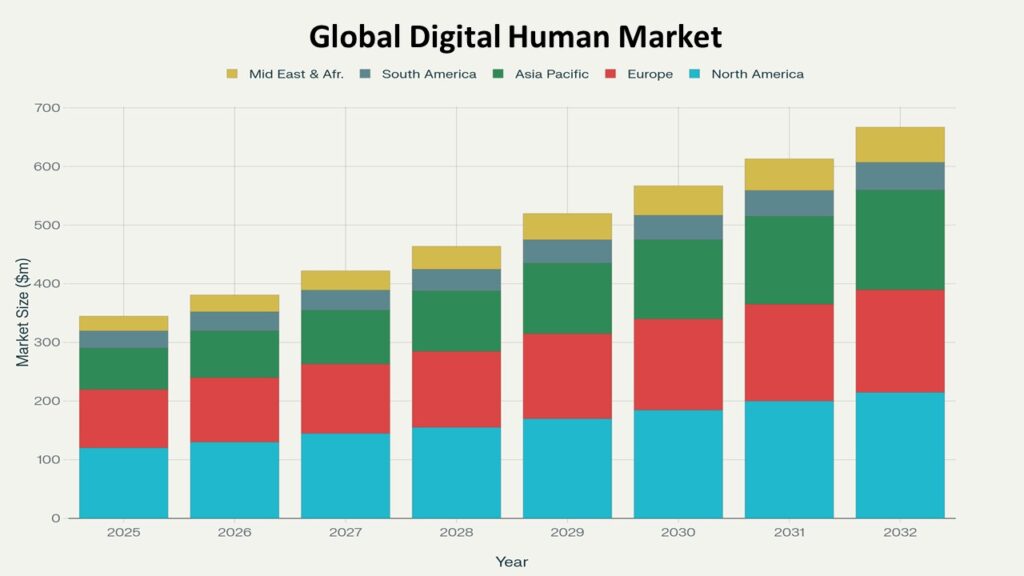
According to Phoenix’s Demand Forecast Engine, the global digital human market is projected to grow from USD 5.2 billion in 2025 to approximately USD 32.1 billion by 2033, reflecting a CAGR of ~25.8% (2025–2033). In 2024, North America accounted for the largest share due to early AI adoption and enterprise integration, while Asia Pacific is the fastest-growing region, fueled by high investment in virtual retail, gaming, and customer engagement platforms.
Key Drivers of Market Growth
- Rising Demand for Hyper-Personalized Customer Experiences
Enterprises are deploying digital humans as virtual assistants, brand ambassadors, and customer service agents to improve engagement. - Advancements in AI & Real-Time Rendering
Innovations in NLP, emotion recognition, and 3D rendering enhance the realism and responsiveness of digital humans. - Adoption Across Industries
Applications range from retail (virtual sales assistants), healthcare (patient guidance), education (virtual tutors), to entertainment and gaming (immersive characters). - Cost Efficiency & Scalability
Digital humans reduce staffing costs, operate 24/7, and scale across geographies, making them attractive for enterprises. - Cultural & Social Acceptance of Virtual Influencers
Growing popularity of virtual influencers and entertainers accelerates mainstream acceptance of digital humans.
Market Segmentation
By Component
- Solutions (Digital Human Platforms, 3D Modeling & Rendering Engines, Conversational AI Software)
- Services (Deployment, Integration, Training, and Maintenance)
By Industry Vertical
- Retail & E-commerce
- Banking, Financial Services & Insurance (BFSI)
- Healthcare & Life Sciences
- Education & Training
- IT & Telecom
- Media, Entertainment & Gaming
- Travel & Hospitality
- Others (government, real estate, automotive)
By Interaction Type
- Text-to-Speech Digital Humans
- Voice-Enabled Digital Humans
- Gesture & Emotion-Recognizing Digital Humans
- Multi-Modal Interaction Digital Humans
Region-Level Insights
- North America – Largest Market
Strong enterprise adoption in customer service, retail, and healthcare; early investments in AI and AR/VR ecosystems. - Europe
High adoption in BFSI, education, and government digital transformation programs; focus on privacy and ethical AI. - Asia Pacific – Fastest Growing Region
Driven by tech-savvy populations, rising investments in gaming, entertainment, and retail; China, South Korea, and Japan lead innovation. - Latin America & Middle East & Africa
Growing demand for AI-driven customer engagement tools in retail, BFSI, and telecom; adoption is gradual but rising.
Leading Companies in the Market
Key players include:
- UneeQ Digital Humans
- Soul Machines
- Epic Games (MetaHuman Creator)
- Microsoft (Azure AI & Cognitive Services)
- NVIDIA Omniverse
- Hour One AI
- Didimo
- Reallusion Inc.
- DeepBrain AI
- Samsung STAR Labs (NEON Project)
These companies compete by focusing on AI realism, integration with enterprise workflows, cloud-based scalability, and industry-specific solutions.
Strategic Intelligence and AI-Backed Insights
- Retail & E-commerce Adoption: Digital humans act as 24/7 virtual sales reps, improving upselling and cross-selling rates.
- Healthcare Applications: AI avatars improve patient engagement, deliver medical guidance, and assist with mental health therapies.
- Metaverse & Gaming: Integration of digital humans in metaverse platforms creates immersive and interactive environments.
- Cost-Benefit Advantage: Enterprises report significant savings in customer service operations after deploying digital humans.
- Risks: Ethical concerns, data privacy, and uncanny valley effects remain barriers to mass adoption.
Forecast Snapshot: 2025–2033
| Metric | Value |
| 2025 Market Size | USD 5.2 Billion |
| 2033 Market Size | ~USD 32.1 Billion |
| CAGR (2025–2033) | ~25.8% |
| Largest Region (2024) | North America |
| Fastest Growing Region | Asia Pacific |
| Top Industry Segment | Retail & E-commerce |
| Key Trend | Multi-modal, AI-driven digital humans |
| Future Focus | Healthcare, education, metaverse, and ethical AI adoption |
Why the Market Remains Critical
- Digital humans transform customer engagement, workforce efficiency, and brand interactions.
- The convergence of AI, AR/VR, and metaverse ecosystems creates new market opportunities.
- Rising demand for cost-effective, scalable, and personalized solutions strengthens enterprise adoption.
- Ethical AI, data privacy, and inclusivity remain central to sustainable market growth.
Final Takeaway
The Global Digital Human Market is poised for exponential growth, driven by enterprise digital transformation, consumer demand for personalized experiences, and technological advances in AI and 3D rendering. Companies that focus on realism, ethical AI frameworks, and industry-specific deployment models will capture significant opportunities through 2033. Phoenix Research delivers actionable intelligence for businesses seeking to leverage digital humans in shaping the future of human-computer interaction.
Table of Contents
-
Overview
-
Key Drivers of Market Growth
-
Rising Demand for Hyper-Personalized Customer Experiences
-
Advancements in AI & Real-Time Rendering
-
Adoption Across Industries
-
Cost Efficiency & Scalability
-
Cultural & Social Acceptance of Virtual Influencers
-
-
Market Segmentation
-
By Component
• Solutions (Digital Human Platforms, 3D Modeling & Rendering Engines, Conversational AI Software)
• Services (Deployment, Integration, Training, and Maintenance) -
By Industry Vertical
• Retail & E-commerce
• Banking, Financial Services & Insurance (BFSI)
• Healthcare & Life Sciences
• Education & Training
• IT & Telecom
• Media, Entertainment & Gaming
• Travel & Hospitality
• Others (government, real estate, automotive) -
By Interaction Type
• Text-to-Speech Digital Humans
• Voice-Enabled Digital Humans
• Gesture & Emotion-Recognizing Digital Humans
• Multi-Modal Interaction Digital Humans
-
-
Region-Level Insights
-
North America – Largest Market
-
Europe
-
Asia Pacific – Fastest Growing Region
-
Latin America & Middle East & Africa
-
-
Leading Companies in the Market
-
UneeQ Digital Humans
-
Soul Machines
-
Epic Games (MetaHuman Creator)
-
Microsoft (Azure AI & Cognitive Services)
-
NVIDIA Omniverse
-
Hour One AI
-
Didimo
-
Reallusion Inc.
-
DeepBrain AI
-
Samsung STAR Labs (NEON Project)
-
-
Strategic Intelligence and AI-Backed Insights
-
Retail & E-commerce Adoption
-
Healthcare Applications
-
Metaverse & Gaming
-
Cost-Benefit Advantage
-
Risks (Ethical concerns, data privacy, uncanny valley effects)
-
-
Forecast Snapshot: 2025–2033
-
2025 Market Size
-
2033 Market Size
-
CAGR (2025–2033)
-
Largest Region (2024)
-
Fastest Growing Region
-
Top Industry Segment
-
Key Trend
-
Future Focus
-
-
Why the Market Remains Critical
-
Transformation of customer engagement & workforce efficiency
-
Convergence of AI, AR/VR, and metaverse ecosystems
-
Rising demand for cost-effective & scalable solutions
-
Importance of ethical AI, data privacy & inclusivity
-
-
Final Takeaway