
Global Electric Vehicle (EV) Market Size and Share Analysis 2025-2033
Global Electric Vehicle (EV) Market Overview
The Global Electric Vehicle (EV) Market is vibrantly transforming, powered by the accelerating global shift toward sustainable mobility, green energy transition, and zero-emission transportation solutions. As nations work to overcome climate challenges and reduce dependence on fossil fuels, EVs have emerged as a reliable, efficient, and future-ready alternative that is reshaping the global automotive landscape.
This Global Electric Vehicle (EV) Market is being energized by rapid advancements in EV battery technology, AI-based energy management systems, and smart charging infrastructure, enabling users to experience instant, cost-effective, and cleaner mobility. Governments, automakers, and energy providers are increasingly collaborating to develop carbon-neutral transportation ecosystems that ensure affordability, reliability, and long-term sustainability.
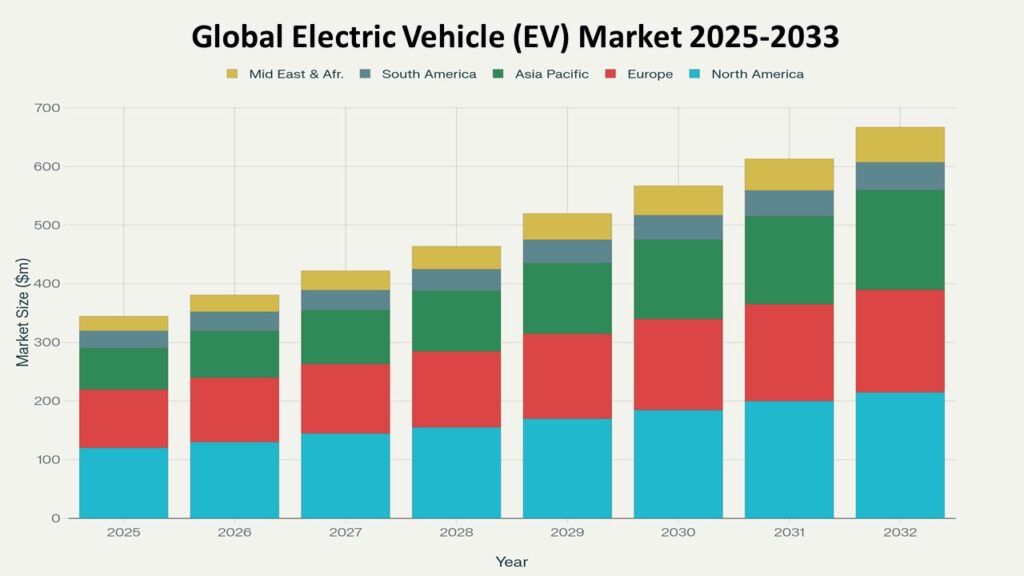
According to Phoenix’s Demand Forecast Engine, the Global Electric Vehicle (EV) Market size is estimated at USD 598.7 billion in 2025 and is projected to reach approximately USD 2,315.6 billion by 2033, growing at a proven CAGR of 18.5% (2025–2033). The Asia-Pacific region currently has the largetst Global Electric Vehicle (EV) Market size due to strong policy support, large-scale EV manufacturing, and battery production capabilities, while Europe and North America are rapidly emerging as key markets driven by electrification targets, EV subsidies, and charging network expansion.
The Global Electric Vehicle (EV) Market continues to empower automakers, policymakers, and innovators to build an electrified future that is cleaner, smarter, and more responsible, ensuring a sustainable and profitable mobility revolution worldwide.
Key Drivers of Global Electric Vehicle (EV) Market Growth
1. Government Incentives and Emission Regulations
Governments across the globe are offering EV purchase subsidies, tax incentives, and green financing programs to encourage consumers and businesses to switch to electric mobility. Stringent emission norms and zero-emission mandates are compelling manufacturers to accelerate their EV transition and adopt climate-smart automotive technologies.
2. Technological Advancements in EV Batteries
Breakthroughs in solid-state, lithium-ion, and sodium-ion battery technologies are enhancing energy density, reducing charging time, and improving vehicle range and performance. AI-integrated battery management systems ensure safety, efficiency, and reliability for long-term EV operation.
3. Expansion of Smart Charging Infrastructure
The rapid rollout of fast-charging and ultra-fast-charging stations, coupled with smart grid integration, is improving charging convenience and accessibility. Wireless and vehicle-to-grid (V2G) systems are transforming the EV ecosystem into an intelligent, energy-responsive network.
4. Rising Fuel Prices and Economic Viability
Volatile fuel prices are accelerating the consumer shift toward cost-efficient electric alternatives. Fleet operators and logistics firms are embracing EVs for last-mile delivery, ensuring operational efficiency and long-term savings.
5. Growing Urbanization and Sustainability Awareness
Urban populations are increasingly adopting EVs for short-distance commuting, supported by smart city programs and public-private EV initiatives. The rising awareness of carbon-neutral lifestyles continues to drive global market growth.
Global Electric Vehicle (EV) Market Segmentation
By Vehicle Type
-
Battery Electric Vehicles (BEVs)
-
Plug-in Hybrid Electric Vehicles (PHEVs)
-
Hybrid Electric Vehicles (HEVs)
-
Fuel Cell Electric Vehicles (FCEVs)
By Battery Type
-
Lithium-ion Batteries
-
Solid-State Batteries
-
Nickel-Metal Hydride Batteries
-
Others (Lead-acid, Sodium-ion)
By Application
-
Passenger Cars
-
Commercial Vehicles (Trucks, Vans, Buses)
-
Two-Wheelers & Scooters
-
Fleet & Shared Mobility Vehicles
By Charging Type
-
AC Slow/Regular Charging
-
DC Fast Charging
-
Wireless/Inductive Charging Systems
By Region
-
Asia-Pacific
-
Europe
-
North America
-
Latin America
-
Middle East & Africa
Global Electric Vehicle (EV) Market Regional Insights
Asia-Pacific – Largest Global Electric Vehicle (EV) Market
Asia-Pacific has the largest Market Share in Global Electric Vehicle Market, driven by China’s large-scale EV production, battery gigafactories, and supportive government policies. India, Japan, and South Korea are rapidly expanding EV infrastructure, ensuring regional dominance through innovation and affordability.
Europe – Mature and Regulated Global Electric Vehicle (EV) Market
Europe’s carbon neutrality goals and emission-free zones are driving rapid EV adoption across countries like Germany, Norway, and the UK. Automakers are actively investing in recycling programs, energy efficiency, and sustainable supply chains.
North America
The U.S. and Canada are witnessing strong EV demand, supported by Inflation Reduction Act (IRA) incentives, EV manufacturing investments, and expansion of charging networks by both public and private players.
Latin America
Emerging initiatives in fleet electrification, urban mobility modernization, and government-led pilot programs are helping countries like Brazil, Chile, and Mexico join the global EV transformation.
Middle East & Africa
Rapid development of charging networks, coupled with rising awareness of sustainable mobility, is creating new opportunities in markets like the UAE, Saudi Arabia, and South Africa.
Leading Companies in the Global Electric Vehicle (EV) Market
-
Hyundai Motor Company
-
General Motors Company
-
BMW Group
-
Volvo Cars
-
NIO Inc.
-
Mercedes-Benz Group AG
-
Tata Motors Ltd.
-
Rivian Automotive, Inc.
-
Lucid Motors
These companies are discovering innovative technological synergies, expanding large-scale production capacity, and ensuring superior battery performance through AI-driven design, smart manufacturing, and automation systems — enabling them to stay competitive, sustainable, and future-ready in the Global Electric Vehicle Market. Tesla Leads the Market with Largest Market share.
Strategic Intelligence and AI-Backed Insights
-
Phoenix Demand Forecast Engine indicates consistent acceleration in EV adoption driven by sustainability mandates and consumer demand.
-
Technology Innovation Tracker highlights advances in solid-state batteries, smart charging, and autonomous EV systems.
-
Consumer Sentiment Analyzer identifies growing trust in EV reliability, affordability, and battery lifespan.
-
Porter’s Five Forces analysis suggests moderate supplier power, high buyer influence, and intensifying competition due to new EV startups and tech entrants.
Global Electric Vehicle (EV) Market Forecast Snapshot: 2025–2033
| Metric | Value |
|---|---|
| 2025 Market Size | USD 598.7 Billion |
| 2033 Market Size | ~USD 2,315.6 Billion |
| CAGR (2025–2033) | 18.5% |
| Largest Market | Asia-Pacific |
| Fastest Growing Region | North America |
| Top Vehicle Type | Battery Electric Vehicles (BEVs) |
| Key Trend | Solid-State Battery Adoption & Smart Charging Networks |
| Future Focus | Affordable EV Models, Circular Battery Economy, and AI-Powered Mobility Systems |
Why the Global Electric Vehicle (EV) Market Remains Critical
-
Supports global decarbonization efforts and emission reduction goals.
-
Empowers sustainable urban mobility and cleaner transportation alternatives.
-
Promotes innovation in renewable energy integration and battery recycling.
-
Creates employment, investment, and manufacturing opportunities worldwide.
-
Ensures responsible, future-proof growth aligned with global climate objectives.
Final Takeaway of Global Electric Vehicle (EV) Market
The Global Electric Vehicle (EV) Market is evolving into a cornerstone of sustainable innovation, combining AI-enabled performance systems, renewable energy integration, and battery efficiency breakthroughs to deliver clean, connected, and cost-effective mobility.
Companies that invest in smart charging ecosystems, expand EV accessibility, and leverage carbon-neutral technologies will succeed in shaping a vibrant, assured, and profitable global EV future.
At Phoenix Research, our AI-powered demand forecasting tools and strategic intelligence frameworks enable stakeholders to learn faster, act confidently, and succeed responsibly in the Global Electric Vehicle Market, where innovation meets impact and sustainability ensures success.
Table of Contents
- Global Electric Vehicle (EV) Market Overview
-
2. Key Drivers of Global Electric Vehicle (EV) Market Growth
-
Government Incentives and Emission Regulations
-
Technological Advancements in EV Batteries
-
Expansion of Smart Charging Infrastructure
-
Rising Fuel Prices and Economic Viability
-
Growing Urbanization and Sustainability Awareness
-
-
3. Global Electric Vehicle (EV) Market Segmentation
-
By Vehicle Type
-
Battery Electric Vehicles (BEVs)
-
Plug-in Hybrid Electric Vehicles (PHEVs)
-
Hybrid Electric Vehicles (HEVs)
-
Fuel Cell Electric Vehicles (FCEVs)
-
-
By Battery Type
-
Lithium-ion Batteries
-
Solid-State Batteries
-
Nickel-Metal Hydride Batteries
-
Others (Lead-acid, Sodium-ion)
-
-
By Application
-
Passenger Cars
-
Commercial Vehicles (Trucks, Vans, Buses)
-
Two-Wheelers & Scooters
-
Fleet & Shared Mobility Vehicles
-
-
By Charging Type
-
AC Slow/Regular Charging
-
DC Fast Charging
-
Wireless/Inductive Charging Systems
-
-
By Region
-
Asia-Pacific
-
Europe
-
North America
-
Latin America
-
Middle East & Africa
-
-
-
4. Global Electric Vehicle (EV) Market Regional Insights
-
Asia-Pacific – Largest Global Electric Vehicle Market
-
Europe – Mature and Regulated Global Electric Vehicle Market
-
North America
-
Latin America
-
Middle East & Africa
-
-
5. Leading Companies in the Global Electric Vehicle (EV) Market
-
Tesla, Inc.
-
BYD Company Ltd.
-
Volkswagen AG
-
Hyundai Motor Company
-
General Motors Company
-
BMW Group
-
Volvo Cars
-
NIO Inc.
-
Mercedes-Benz Group AG
-
Tata Motors Ltd.
-
Rivian Automotive, Inc.
-
Lucid Motors
-
-
6. Strategic Intelligence and AI-Backed Insights
-
Phoenix Demand Forecast Engine
-
Technology Innovation Tracker
-
Consumer Sentiment Analyzer
-
Porter’s Five Forces Analysis
-
-
7. Global Electric Vehicle (EV) Market Forecast Snapshot (2025–2033)
-
2025 Market Size
-
2033 Market Size
-
CAGR (2025–2033)
-
Largest Market
-
Fastest Growing Region
-
Top Vehicle Type
-
Key Trend
-
Future Focus
-
-
8. Why the Global Electric Vehicle (EV) Market Remains Critical
-
Decarbonization and Emission Reduction Goals
-
Sustainable Urban Mobility and Green Transportation
-
Renewable Energy Integration and Battery Recycling
-
Employment and Industrial Growth Opportunities
-
Global Climate Objective Alignment
-
-
9. Final Takeaway of Global Electric Vehicle (EV) Market