
Global Energy Drinks Market Report Analysis, Size and Forecast 2026-2033
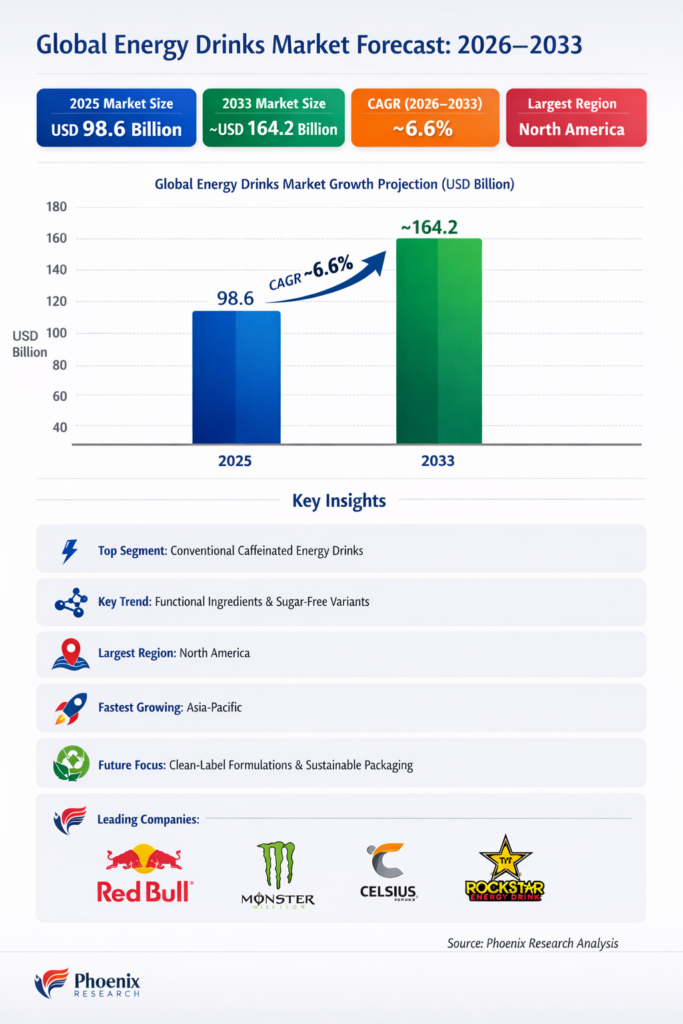
Global Energy Drinks Market Forecast Snapshot: 2026–2033
| Metric | Value |
|---|---|
| 2025 Market Size | USD 98.6 Billion |
| 2033 Market Size | ~USD 164.2 Billion |
| CAGR (2026–2033) | ~6.6% |
| Largest Region | North America |
| Fastest Growing Region | Asia-Pacific |
| Top Segment | Conventional Caffeinated Energy Drinks |
| Key Trend | Functional Ingredients, Sugar-Free Variants & Premium Lifestyle Branding |
| Future Focus | Clean-Label Formulations, AI-Driven Demand Forecasting & Sustainable Packaging |
Global Energy Drinks Market Overview
The Global Energy Drinks Market is experiencing strong structural expansion, driven by rising consumer demand for instant energy, functional performance beverages, and active lifestyle branding. Energy drinks have evolved beyond traditional caffeine-based stimulants into multifunctional beverages incorporating vitamins, amino acids, adaptogens, electrolytes, and plant-based extracts.
According to Pheonix Research, the Global Energy Drinks Market is valued at USD 98.6 billion in 2025 and is projected to reach approximately USD 164.2 billion by 2033, registering a CAGR of ~6.6% (2026–2033). Growth is supported by increasing fitness awareness, e-sports and gaming culture expansion, youth-oriented marketing, and growing adoption of sugar-free and clean-label formulations.
North America leads the market due to strong brand presence, sports culture integration, and high per-capita consumption. Asia-Pacific is the fastest-growing region, fueled by urbanization, rising disposable incomes, and expanding convenience retail networks.
The Post-2025 outlook emphasizes functional ingredient innovation, low-sugar formulations, AI-enabled retail analytics, premium branding, and sustainable packaging as key growth accelerators.
Key Drivers of Global Energy Drinks Market Growth
1. Accelerating Demand for Functional & Performance-Oriented Beverages
Consumers are increasingly gravitating toward beverages that deliver enhanced energy, mental focus, endurance, and cognitive support, aligning with fast-paced and productivity-driven lifestyles.
2. Expansion of Fitness, Sports & Gaming Ecosystems
Strong integration with professional sports, gym culture, e-sports tournaments, and youth communities continues to drive brand visibility, loyalty, and recurring consumption patterns.
3. Rapid Growth of Sugar-Free & Better-for-You Variants
Heightened health awareness is shifting demand toward zero-sugar, low-calorie, keto-friendly, and clean-label formulations featuring natural caffeine and functional ingredients.
4. Premiumization & Lifestyle-Centric Branding Strategies
Strategic partnerships with athletes, influencers, music festivals, and entertainment platforms are reinforcing aspirational positioning and strengthening long-term brand equity.
5. Expansion of E-Commerce & Modern Retail Channels
The growth of online platforms, quick-commerce models, and organized convenience retail networks is enhancing product accessibility, geographic reach, and overall market penetration.
Global Energy Drinks Market Segmentation
1. By Product Type
1.1 Conventional Energy Drinks
1.1.1 Standard Caffeinated Energy Drinks
1.1.1.1 Classic Carbonated Energy Drinks
1.1.1.2 High-Caffeine Performance Variants
1.1.1.3 Taurine-Enriched Formulations
1.1.1.4 Vitamin B-Complex Fortified Drinks
1.1.2 Premium Energy Drinks
1.1.2.1 Limited-Edition Lifestyle Variants
1.1.2.2 Athlete-Endorsed Formulations
1.1.2.3 High-Performance Sports Editions
1.1.2.4 Imported Specialty Brands
1.2 Sugar-Free & Low-Calorie Energy Drinks
1.2.1 Zero-Sugar Energy Drinks
1.2.1.1 Artificial Sweetener-Based
1.2.1.2 Natural Sweetener-Based (Stevia/Monk Fruit)
1.2.1.3 Keto-Friendly Variants
1.2.1.4 Diabetic-Friendly Formulations
1.2.2 Low-Calorie Functional Energy Drinks
1.2.2.1 Electrolyte-Infused Variants
1.2.2.2 BCAA-Enriched Drinks
1.2.2.3 Thermogenic Formulations
1.2.2.4 Fat-Burn Support Blends
1.3 Organic & Natural Energy Drinks
1.3.1 Plant-Based Energy Drinks
1.3.1.1 Green Tea Extract-Based
1.3.1.2 Guarana-Based
1.3.1.3 Yerba Mate-Based
1.3.1.4 Adaptogen-Infused Blends
1.3.2 Clean-Label Energy Drinks
1.3.2.1 Non-GMO Certified
1.3.2.2 Organic Certified
1.3.2.3 Preservative-Free Formulations
1.3.2.4 Natural Flavor Variants
1.4 Energy Shots
1.4.1 Concentrated Energy Shots
1.4.1.1 High-Caffeine Shots
1.4.1.2 Vitamin-Enriched Shots
1.4.1.3 Herbal Extract-Based Shots
1.4.1.4 Travel-Friendly Compact Packs
2. By Packaging Type
2.1 Cans
2.1.1 Standard Aluminum Cans
2.1.1.1 250 ml
2.1.1.2 330 ml
2.1.1.3 500 ml
2.1.1.4 Limited-Edition Collectible Cans
2.2 Bottles
2.2.1 PET Bottles
2.2.1.1 Resealable Sports Bottles
2.2.1.2 Premium Glass Bottles
2.2.1.3 Eco-Friendly Recycled PET
2.2.1.4 Bulk Value Packs
2.3 Sustainable Packaging
2.3.1 Biodegradable Packaging
2.3.1.1 Compostable Materials
2.3.1.2 Plant-Based Plastic Alternatives
2.3.1.3 Carbon-Neutral Packaging
2.3.1.4 Refillable Concepts
3. By Distribution Channel
3.1 Off-Trade / Retail
3.1.1 Supermarkets & Hypermarkets
3.1.1.1 Premium Shelving
3.1.1.2 Promotional Multipacks
3.1.1.3 Private Label Variants
3.1.1.4 Seasonal Campaign Displays
3.1.2 Convenience Stores
3.1.2.1 Urban High-Traffic Stores
3.1.2.2 Highway & Travel Retail
3.1.2.3 24/7 Quick-Service Outlets
3.1.2.4 Impulse Purchase Displays
3.1.3 Specialty Health & Nutrition Stores
3.1.3.1 Fitness Center Retail
3.1.3.2 Supplement Stores
3.1.3.3 Organic Retail Chains
3.1.3.4 Sports Nutrition Boutiques
3.2 On-Trade / Hospitality
3.2.1 Bars & Nightclubs
3.2.1.1 Energy-Based Cocktails
3.2.1.2 Premium Lounge Mixers
3.2.1.3 Festival & Event Supply
3.2.1.4 Branded Party Activations
3.2.2 Gyms & Fitness Centers
3.2.2.1 Pre-Workout Sales
3.2.2.2 Recovery Drink Bundles
3.2.2.3 Membership-Based Sales
3.2.2.4 Athlete Endorsement Promotions
3.3 E-Commerce
3.3.1 Online Retail Platforms
3.3.1.1 National Grocery Platforms
3.3.1.2 Cross-Border Marketplaces
3.3.1.3 Flash Sale Platforms
3.3.1.4 Subscription Delivery Models
3.3.2 Brand-Owned E-Stores
3.3.2.1 Direct Subscription Plans
3.3.2.2 Limited Digital-Only Editions
3.3.2.3 Personalized Bundle Packs
3.3.2.4 Loyalty Reward Programs
4. By End-User
4.1 Individual Consumers
4.1.1 Millennials & Gen Z
4.1.1.1 Gaming & E-Sports Enthusiasts
4.1.1.2 Social & Lifestyle Consumers
4.1.1.3 Fitness-Oriented Buyers
4.1.1.4 Trend-Driven Buyers
4.1.2 Working Professionals
4.1.2.1 Corporate Employees
4.1.2.2 Shift Workers
4.1.2.3 Entrepreneurs & Freelancers
4.1.2.4 Long-Hour Commuters
4.1.3 Athletes & Fitness Enthusiasts
4.1.3.1 Professional Athletes
4.1.3.2 Amateur Sports Participants
4.1.3.3 Bodybuilders
4.1.3.4 Endurance Trainers
5. By Region
5.1 North America
5.2 Europe
5.3 Asia-Pacific
5.4 Latin America
5.5 Middle East & Africa
Leading Companies in the Global Energy Drinks Market
Final Takeaway of the Global Energy Drinks Market
The Global Energy Drinks Market is evolving into a functional, premium-oriented, and technology-enabled beverage ecosystem. The projected CAGR of ~6.6% (2026–2033) reflects strong and sustained growth supported by sugar-free innovation, plant-based ingredient adoption, expanding fitness and gaming culture, and rising demand across emerging markets.
Future competitive advantage will be secured by brands that integrate AI-driven demand forecasting, clean-label product development, sustainable packaging solutions, and robust omnichannel distribution strategies spanning retail, convenience, DTC, and e-commerce platforms.
At Pheonix Research, our advanced forecasting frameworks deliver comprehensive Energy Drinks Market revenue projections, competitive benchmarking, and AI-backed strategic intelligence — enabling stakeholders to navigate the Post-2025 landscape with data-driven precision, operational agility, and long-term value creation.
📢 Social Mentions & Publication Channels
Explore deeper insights and follow our cross-platform updates on LinkedIn, and X for continuous intelligence and market coverage.
LinkedIn : https://www.linkedin.com/feed/update/urn:li:activity:7430897103964639232
X : https://x.com/Pheonix_Insight/status/2025133406129193229?s=20
Table of Contents
1. Executive Summary
1.1 Market Snapshot (2026–2033)
1.2 Key Growth Highlights
1.3 Largest & Fastest Growing Regions
1.4 Dominant & Emerging Segments
1.5 Strategic Opportunity Areas
2. Global Energy Drinks Market Overview
2.1 Market Definition & Scope
2.2 Industry Evolution & Product Innovation
2.3 Value Chain Analysis
2.4 Business Models & Revenue Streams
2.5 Regulatory Landscape
2.6 Pricing & Margin Analysis
3. Market Forecast Snapshot (2026–2033)
3.1 2025 Market Size: USD 98.6 Billion
3.2 2033 Market Size: ~USD 164.2 Billion
3.3 CAGR (2026–2033): ~6.6%
3.4 Largest Region: North America
3.5 Fastest Growing Region: Asia-Pacific
3.6 Top Segment: Conventional Caffeinated Energy Drinks
3.7 Key Trend: Functional Ingredients & Sugar-Free Variants
3.8 Future Focus: Clean-Label, AI Forecasting & Sustainable Packaging
4. Market Dynamics
4.1 Key Growth Drivers
4.2 Market Restraints
4.3 Emerging Opportunities
4.4 Industry Challenges
4.5 Impact of Macroeconomic Factors
5. Market Segmentation by Product Type (USD Billion), 2026–2033
5.1 Conventional Energy Drinks
5.1.1 Standard Caffeinated Energy Drinks
5.1.1.1 Classic Carbonated Energy Drinks
5.1.1.2 High-Caffeine Performance Variants
5.1.1.3 Taurine-Enriched Formulations
5.1.1.4 Vitamin B-Complex Fortified Drinks
5.1.2 Premium Energy Drinks
5.1.2.1 Limited-Edition Lifestyle Variants
5.1.2.2 Athlete-Endorsed Formulations
5.1.2.3 High-Performance Sports Editions
5.1.2.4 Imported Specialty Brands
5.2 Sugar-Free & Low-Calorie Energy Drinks
5.2.1 Zero-Sugar Energy Drinks
5.2.1.1 Artificial Sweetener-Based
5.2.1.2 Natural Sweetener-Based (Stevia/Monk Fruit)
5.2.1.3 Keto-Friendly Variants
5.2.1.4 Diabetic-Friendly Formulations
5.2.2 Low-Calorie Functional Energy Drinks
5.2.2.1 Electrolyte-Infused Variants
5.2.2.2 BCAA-Enriched Drinks
5.2.2.3 Thermogenic Formulations
5.2.2.4 Fat-Burn Support Blends
5.3 Organic & Natural Energy Drinks
5.3.1 Plant-Based Energy Drinks
5.3.1.1 Green Tea Extract-Based
5.3.1.2 Guarana-Based
5.3.1.3 Yerba Mate-Based
5.3.1.4 Adaptogen-Infused Blends
5.3.2 Clean-Label Energy Drinks
5.3.2.1 Non-GMO Certified
5.3.2.2 Organic Certified
5.3.2.3 Preservative-Free Formulations
5.3.2.4 Natural Flavor Variants
5.4 Energy Shots
5.4.1 Concentrated Energy Shots
5.4.1.1 High-Caffeine Shots
5.4.1.2 Vitamin-Enriched Shots
5.4.1.3 Herbal Extract-Based Shots
5.4.1.4 Travel-Friendly Compact Packs
6. Market Segmentation by Packaging Type (USD Billion), 2026–2033
6.1 Cans
6.1.1 Standard Aluminum Cans
6.1.1.1 250 ml
6.1.1.2 330 ml
6.1.1.3 500 ml
6.1.1.4 Limited-Edition Collectible Cans
6.2 Bottles
6.2.1 PET Bottles
6.2.1.1 Resealable Sports Bottles
6.2.1.2 Premium Glass Bottles
6.2.1.3 Eco-Friendly Recycled PET
6.2.1.4 Bulk Value Packs
6.3 Sustainable Packaging
6.3.1 Biodegradable Packaging
6.3.1.1 Compostable Materials
6.3.1.2 Plant-Based Plastic Alternatives
6.3.1.3 Carbon-Neutral Packaging
6.3.1.4 Refillable Concepts
7. Market Segmentation by Distribution Channel (USD Billion), 2026–2033
7.1 Off-Trade / Retail
7.1.1 Supermarkets & Hypermarkets
7.1.1.1 Premium Shelving
7.1.1.2 Promotional Multipacks
7.1.1.3 Private Label Variants
7.1.1.4 Seasonal Campaign Displays
7.1.2 Convenience Stores
7.1.2.1 Urban High-Traffic Stores
7.1.2.2 Highway & Travel Retail
7.1.2.3 24/7 Quick-Service Outlets
7.1.2.4 Impulse Purchase Displays
7.1.3 Specialty Health & Nutrition Stores
7.1.3.1 Fitness Center Retail
7.1.3.2 Supplement Stores
7.1.3.3 Organic Retail Chains
7.1.3.4 Sports Nutrition Boutiques
7.2 On-Trade / Hospitality
7.2.1 Bars & Nightclubs
7.2.1.1 Energy-Based Cocktails
7.2.1.2 Premium Lounge Mixers
7.2.1.3 Festival & Event Supply
7.2.1.4 Branded Party Activations
7.2.2 Gyms & Fitness Centers
7.2.2.1 Pre-Workout Sales
7.2.2.2 Recovery Drink Bundles
7.2.2.3 Membership-Based Sales
7.2.2.4 Athlete Endorsement Promotions
7.3 E-Commerce
7.3.1 Online Retail Platforms
7.3.1.1 National Grocery Platforms
7.3.1.2 Cross-Border Marketplaces
7.3.1.3 Flash Sale Platforms
7.3.1.4 Subscription Delivery Models
7.3.2 Brand-Owned E-Stores
7.3.2.1 Direct Subscription Plans
7.3.2.2 Limited Digital-Only Editions
7.3.2.3 Personalized Bundle Packs
7.3.2.4 Loyalty Reward Programs
8. Market Segmentation by End-User (USD Billion), 2026–2033
8.1 Individual Consumers
8.1.1 Millennials & Gen Z
8.1.1.1 Gaming & E-Sports Enthusiasts
8.1.1.2 Social & Lifestyle Consumers
8.1.1.3 Fitness-Oriented Buyers
8.1.1.4 Trend-Driven Buyers
8.1.2 Working Professionals
8.1.2.1 Corporate Employees
8.1.2.2 Shift Workers
8.1.2.3 Entrepreneurs & Freelancers
8.1.2.4 Long-Hour Commuters
8.1.3 Athletes & Fitness Enthusiasts
8.1.3.1 Professional Athletes
8.1.3.2 Amateur Sports Participants
8.1.3.3 Bodybuilders
8.1.3.4 Endurance Trainers
9. Market Segmentation by Region (USD Billion), 2026–2033
9.1 North America
9.2 Europe
9.3 Asia-Pacific
9.4 Latin America
9.5 Middle East & Africa
10. Regional Insights
10.1 North America – Market Leadership
10.2 Asia-Pacific – Rapid Expansion
10.3 Europe – Clean-Label Innovation Focus
10.4 Latin America – Youth-Driven Growth
10.5 Middle East & Africa – Urban Consumption Growth
11. Competitive Landscape
11.1 Market Share Analysis
11.2 Competitive Positioning Matrix
11.3 Mergers & Acquisitions
11.4 Product Launch & Innovation Trends
12. Company Profiles
12.1 Red Bull GmbH
12.2 Monster Beverage Corporation
12.3 Rockstar Energy (PepsiCo)
12.4 The Coca-Cola Company
12.5 Celsius Holdings, Inc.
12.6 Bang Energy
12.7 5-hour Energy
12.8 Lucozade Ribena Suntory
12.9 Eastroc Beverage
13. Strategic Intelligence & AI-Backed Insights
13.1 Pheonix Demand Forecast Engine
13.2 Consumer Behavior Analytics
13.3 Innovation & Formulation Tracker
13.4 Retail & Pricing Optimization Intelligence
13.5 Porter’s Five Forces Analysis
14. Why the Global Energy Drinks Market Remains Critical
14.1 Functional Beverage Anchor Segment
14.2 Premium Margin Expansion
14.3 Youth, Sports & Gaming Integration
14.4 Clean-Label & Sugar-Free Acceleration
15. Appendix
16. About Us
17. Disclaimer
Competitive Landscape
Competitive Landscape of the Global Energy Drinks Market
Executive Framing
The Global Energy Drinks Market is characterized by high competitive intensity and a consolidated structure dominated by a few global brands with strong lifestyle positioning and distribution strength. Leading companies such as Red Bull, Monster Beverage, and PepsiCo leverage brand equity, sports sponsorships, and global retail penetration to maintain market leadership. The market is highly dynamic, driven by continuous product innovation, premiumization, and evolving consumer demand for functional and clean-label energy solutions.
Current Market Reality
The market is led by a small group of Tier 1 players controlling a significant share of global revenues, while emerging brands focus on niche segments such as organic, plant-based, and performance-oriented formulations. Red Bull dominates through premium branding and global sponsorship ecosystems, while Monster Beverage focuses on aggressive product expansion and pricing strategies.
In addition, The Coca-Cola Company and PepsiCo leverage extensive distribution networks to scale their energy drink portfolios globally. The rise of e-commerce, convenience retail, and gym-based distribution channels has further intensified competition, making accessibility and brand visibility critical success factors.
Key Signals and Evidence
Several signals highlight the evolving competitive landscape:
- Strong dominance of a few global brands with extensive marketing and sponsorship investments.
- Rapid growth of sugar-free, clean-label, and functional ingredient-based energy drinks.
- Increasing integration with fitness, sports, and e-sports ecosystems to drive brand loyalty.
- Expansion of direct-to-consumer (DTC) and subscription-based sales models.
- Rising competition from niche and emerging brands focusing on health-centric positioning.
Strategic Implications
To remain competitive, companies must focus on innovation, branding, and distribution scale:
- Product Innovation: Developing sugar-free, functional, and plant-based formulations.
- Brand Positioning: Leveraging lifestyle marketing, sports sponsorships, and influencer partnerships.
- Distribution Expansion: Strengthening presence across retail, convenience, and e-commerce channels.
- Premiumization: Launching high-margin premium and limited-edition variants.
- Digital Integration: Utilizing AI-driven analytics for demand forecasting and consumer engagement.
Forward Outlook
By 2033, the Global Energy Drinks Market is expected to reach approximately USD 164.2 billion, growing at a CAGR of ~6.6%. North America will remain the largest market, while Asia-Pacific will continue to be the fastest-growing region driven by urbanization and rising disposable incomes.
The market will evolve through a combination of premium lifestyle branding, functional innovation, and digital retail expansion. Companies that successfully integrate clean-label formulations, sustainable packaging, and AI-driven market intelligence will secure long-term competitive advantage in this high-growth and highly competitive landscape.
Value Chain
Global Energy Drinks Market: Value Chain & Market Dynamics
Executive Framing
The global energy drinks market is evolving into a highly dynamic and innovation-driven value chain, supported by rising demand for functional beverages, performance enhancement, and lifestyle-oriented consumption. As energy drinks transition from basic caffeinated products to multifunctional formulations, the value chain must accommodate diverse ingredient sourcing, advanced formulation technologies, and multi-channel distribution ecosystems.
The market operates through a hybrid structure where large multinational beverage companies leverage scale-driven manufacturing and global distribution, while emerging brands focus on niche innovation, clean-label positioning, and direct-to-consumer (DTC) engagement. This dual-layer ecosystem enhances scalability while fostering rapid product differentiation and premiumization.
However, challenges persist around regulatory compliance related to caffeine content, sugar levels, and health claims, along with increasing pressure for sustainable sourcing and eco-friendly packaging solutions.
Current Market Reality
The energy drinks market value chain is characterized by moderate-to-high complexity, driven by the convergence of mass production efficiency and continuous product innovation. Leading players such as Red Bull, Monster Beverage, and PepsiCo dominate through vertically integrated supply chains and extensive global retail networks.
Upstream sourcing includes caffeine (synthetic and natural), taurine, vitamins, amino acids, and plant-based extracts such as guarana and ginseng. The shift toward natural and clean-label ingredients introduces variability in sourcing and cost structures.
Midstream operations involve formulation, carbonation, blending, and packaging across formats such as cans, bottles, and energy shots. Increasing demand for sugar-free, functional, and performance-enhancing variants is intensifying R&D investments and formulation complexity.
Downstream, the market benefits from a highly diversified distribution network including supermarkets, convenience stores, gyms, e-commerce platforms, and DTC channels. Quick-commerce and subscription-based models are further reshaping accessibility and consumer engagement.
Key Signals and Evidence
Several strong indicators highlight the structural evolution of the energy drinks market:
- The market is projected to grow from USD 98.6 billion (2025) to ~USD 164.2 billion (2033) at a CAGR of ~6.6%, reflecting sustained global demand.
- Rapid growth of sugar-free and clean-label formulations is reshaping product development and ingredient sourcing strategies.
- Strong integration with fitness, sports, and gaming ecosystems continues to drive brand engagement and consumption frequency.
- Expansion in Asia-Pacific highlights the importance of localized production and cost-efficient distribution models.
- Increasing adoption of e-commerce and subscription models is transforming traditional retail dynamics.
Additionally, buyer power remains high due to strong brand competition and low switching costs, while supplier power is moderate, especially for specialized natural ingredients.
Strategic Implications
Market participants must balance scale efficiency with continuous innovation to remain competitive. Large corporations are expected to strengthen their dominance through global distribution, strategic partnerships, and premium product launches.
Emerging brands can leverage agility, clean-label positioning, and digital-first distribution to capture niche segments and build strong consumer loyalty without heavy infrastructure investments.
Technology will play a critical role, with AI-driven demand forecasting, formulation optimization, and retail analytics enhancing operational efficiency and market responsiveness.
Sustainability will also be a key differentiator, with increasing focus on recyclable packaging, carbon footprint reduction, and ethical ingredient sourcing.
Forward Outlook
The energy drinks market is expected to undergo significant transformation driven by health trends, digitalization, and sustainability initiatives.
Key future developments include:
- Expansion of functional and adaptogen-based energy drinks
- Growth in personalized and subscription-based consumption models
- Increased investment in sustainable packaging and circular supply chains
- Rising adoption of AI-powered analytics across production and retail
Companies that can integrate innovation, ensure regulatory compliance, and build resilient omnichannel distribution networks will be best positioned for long-term success.
In conclusion, the energy drinks market is transitioning into a premium, functional, and digitally integrated ecosystem, where innovation, branding, and supply chain efficiency collectively define competitive advantage.
Investment Activity
Investment & Funding Dynamics – Global Energy Drinks Market
Executive Framing
Current Market Reality
Valued at USD 98.6 billion in 2025 and projected to reach ~USD 164.2 billion by 2033 (CAGR ~6.6%), the market demonstrates strong investment momentum globally. North America leads in capital deployment due to established global brands and high consumption, while Asia-Pacific is emerging as a key investment destination driven by expanding youth demographics, urbanization, and retail penetration. Major players such as Red Bull, Monster Beverage Corporation, and PepsiCo are continuously investing in brand positioning, product innovation, and distribution network expansion.
Key Signals and Evidence
- Brand-Driven Investment: High spending on marketing, sponsorships, and influencer partnerships across sports, gaming, and entertainment ecosystems.
- Product Innovation: Strong R&D investments in sugar-free, clean-label, and functional ingredient-based formulations.
- Premiumization Trend: Development of premium and lifestyle-focused variants supporting higher margins.
- E-Commerce Expansion: Investments in direct-to-consumer platforms, subscription models, and digital retail channels.
- Sustainable Packaging: Increasing funding toward recyclable cans, eco-friendly materials, and carbon-neutral initiatives.
- Geographic Expansion: Entry into emerging markets, particularly in Asia-Pacific and Latin America.
- M&A Activity: Strategic acquisitions and partnerships to strengthen brand portfolios and expand market reach.
Strategic Implications
Companies that combine strong branding capabilities with continuous product innovation and digital engagement strategies are best positioned for long-term success. Investors are focusing on scalable brands with strong youth appeal, diversified product portfolios, and the ability to adapt to evolving health trends. Strategic collaborations, influencer marketing, and expansion into high-growth regions remain key priorities for sustaining competitive advantage.
Forward Outlook
From 2026 to 2033, investment in the Global Energy Drinks Market is expected to remain robust, with increasing focus on clean-label formulations, AI-driven demand forecasting, and sustainable packaging innovations. Capital flows will continue toward brand building, digital ecosystems, and functional beverage innovation. M&A activity is likely to intensify as companies seek to expand product portfolios and capture emerging consumer segments globally.
Technology & Innovation
Global Energy Drinks Market: Technology & Innovation
Executive Framing
Technology and innovation are central to the evolution of the global energy drinks market, as brands transition from traditional caffeine-based stimulants to multifunctional, performance-oriented beverages. Advances in formulation science, AI-driven consumer analytics, and sustainable packaging are enabling manufacturers to meet growing demand for clean-label, low-sugar, and functionally enhanced energy drinks. Innovation is increasingly focused on delivering targeted benefits such as cognitive performance, endurance, hydration, and metabolic support.
Current Market Reality
The current energy drinks market is characterized by rapid innovation in ingredient formulation, product positioning, and digital engagement. Companies are incorporating natural caffeine sources such as green tea and guarana, along with adaptogens, amino acids, and nootropics, to enhance functionality. AI-powered analytics are being used to track consumer behavior, optimize product launches, and personalize marketing strategies. Additionally, sustainable packaging solutions, including recyclable cans and biodegradable materials, are gaining importance as brands respond to environmental concerns and regulatory pressures.
Key Signals and Evidence
- Functional Ingredient Innovation: Integration of adaptogens, nootropics, electrolytes, and amino acids enhances product differentiation and performance benefits.
- Clean-Label & Low-Sugar Formulation: Shift toward natural caffeine, plant-based ingredients, and zero-sugar variants aligns with health-conscious consumption trends.
- AI-Driven Demand Forecasting: Advanced analytics support product development, inventory planning, and targeted consumer engagement.
- Digital & DTC Expansion: E-commerce platforms and subscription models enable personalized offerings and strengthen brand-consumer relationships.
- Sustainable Packaging Innovation: Adoption of recyclable, lightweight, and eco-friendly materials supports ESG goals and brand positioning.
Strategic Implications
For energy drink manufacturers, innovation is a key driver of premiumization and competitive differentiation. Functional formulations allow brands to target specific consumer needs such as fitness, gaming, and productivity. AI-enabled insights improve marketing efficiency, demand forecasting, and product lifecycle management. Sustainability initiatives enhance brand trust and regulatory compliance. Companies that effectively combine performance-driven innovation, clean-label transparency, and digital engagement will achieve stronger market positioning and long-term growth.
Forward Outlook
The global energy drinks market will continue to witness strong innovation momentum, driven by advancements in functional ingredients, personalized nutrition, and sustainable production. Future developments will focus on AI-powered formulation optimization, next-generation nootropic blends, expanded plant-based caffeine sources, and circular packaging solutions. As consumer expectations evolve toward health, performance, and sustainability, innovation will remain a critical factor shaping competitive advantage in the post-2026 landscape.
Innovation Intensity Level: High
Patent Activity Level: Moderate
Technology Maturity Stage: Growth
Market Risk
Risk Factors and Disruption Threats in the Global Energy Drinks Market
Executive Framing
The Global Energy Drinks Market is a high-growth, performance-driven segment within the functional beverage industry, supported by rising demand for instant energy, cognitive enhancement, and active lifestyle branding. With a projected CAGR of ~6.6% from 2026–2033, the market shows strong expansion potential but faces structural risks related to regulatory scrutiny, health concerns, and competitive pressure from alternative functional beverages.
Current Market Reality
North America dominates the market, while Asia-Pacific leads in growth. However, increasing regulatory restrictions on caffeine content, sugar levels, and marketing to younger consumers present operational challenges. Health concerns regarding excessive caffeine consumption and artificial ingredients are influencing consumer perception, pushing brands toward reformulation and transparency. Pricing pressure and high marketing costs also impact profitability.
Key Signals and Evidence
Key signals include rapid growth of sugar-free and clean-label variants, expansion of fitness and e-sports ecosystems, and strong brand-driven consumption patterns. At the same time, competition from functional beverages such as sports drinks, kombucha, ready-to-drink coffee, and nootropic drinks is intensifying. Governments across regions are increasing regulatory oversight on labeling, ingredients, and health claims.
Strategic Implications
Companies must invest in clean-label formulations, natural caffeine sources, and functional ingredient innovation to address health concerns. Strengthening omnichannel distribution, optimizing pricing strategies, and leveraging AI-driven demand forecasting will be critical. Brands also need to diversify portfolios toward low-sugar, organic, and plant-based energy solutions while maintaining strong lifestyle branding and consumer engagement.
Forward Outlook
The Global Energy Drinks Market is expected to sustain strong growth momentum, driven by functional innovation and expanding consumer segments. However, long-term success will depend on managing regulatory pressures, evolving health perceptions, and increasing competition from adjacent beverage categories.
mp; Market Impacts
Regulatory Landscape
Regulatory & Policy Landscape: Global Energy Drinks Market
Executive Framing
The Global Energy Drinks Market operates within a moderately complex regulatory framework, shaped by food safety standards, caffeine content regulations, labeling requirements, and increasing scrutiny over sugar levels and functional ingredient claims. As energy drinks evolve into functional and performance-oriented beverages, regulatory oversight is expanding across health, nutrition, and consumer protection domains.
Key regulatory authorities include the U.S. Food and Drug Administration (FDA), European Food Safety Authority (EFSA), Food Safety and Standards Authority of India (FSSAI), and other national health agencies. These bodies regulate permissible caffeine limits, ingredient safety, labeling transparency, and marketing practices, particularly for youth-targeted products.
Current Market Reality
In North America, energy drinks are regulated either as dietary supplements or conventional beverages, depending on formulation and labeling. This classification affects permissible ingredients, caffeine disclosure, and marketing claims. Regulatory focus is intensifying on sugar reduction and transparency in ingredient labeling.
Europe enforces stricter guidelines on caffeine content, mandatory labeling such as “high caffeine content” warnings, and sugar reduction initiatives under public health policies. Advertising regulations, particularly targeting minors, are also more stringent.
Asia-Pacific presents a fragmented regulatory landscape, with varying caffeine limits, import regulations, and labeling requirements across countries such as China, India, and Japan. Governments in the region are increasingly focusing on sugar taxation and functional ingredient validation.
Globally, there is rising regulatory attention toward clean-label claims, natural caffeine sourcing, and the inclusion of adaptogens and nootropics, requiring scientific validation and compliance with health claim regulations.
Key Signals and Evidence
- Regulated caffeine limits and mandatory disclosure requirements.
- Increasing sugar taxes and public health-driven reformulation policies.
- Strict labeling requirements including ingredient transparency and warning statements.
- Regulation of functional and health-related claims for added ingredients.
- Advertising restrictions, particularly for youth and high-caffeine products.
- Growing scrutiny on clean-label, organic, and natural ingredient certifications.
Strategic Implications
Regulatory frameworks are shaping product innovation and market positioning. Companies are reformulating products to reduce sugar content, incorporate natural caffeine sources, and ensure compliance with evolving health standards. Clean-label positioning and transparent ingredient sourcing are becoming essential for maintaining consumer trust and regulatory approval.
Market players must navigate region-specific regulations when expanding globally, particularly in areas such as caffeine limits, labeling standards, and advertising restrictions. Compliance costs and reformulation investments are increasing, but they also create opportunities for differentiation through healthier and premium product offerings.
Forward Outlook
The regulatory environment is expected to become more stringent, particularly regarding sugar content, caffeine limits, and functional ingredient claims. Governments may introduce stricter labeling requirements, expanded sugar taxes, and tighter controls on marketing practices targeting younger demographics.
Emerging trends such as plant-based caffeine, adaptogens, and nootropics will require clearer regulatory definitions and scientific validation. Sustainability regulations related to packaging and carbon footprint reduction are also expected to play a larger role in shaping market dynamics.
Companies that proactively align with evolving health regulations, invest in clean-label innovation, and adopt transparent marketing practices will be best positioned to sustain growth and maintain competitive advantage in the global energy drinks market.