
Global Industrial Sugar Market Report 2026-2033
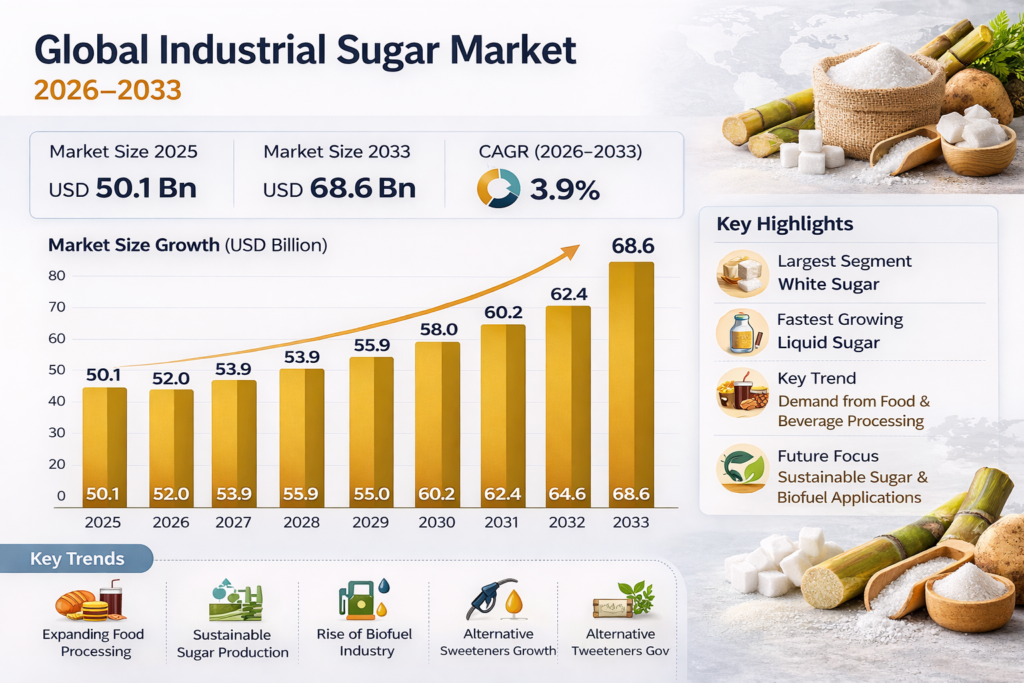
Table of Contents
Table of Contents
1. Executive Summary
1.1 Market Forecast Snapshot (2026–2033)
The Global Industrial Sugar Market is expected to witness steady growth during the 2026–2033 forecast period, supported by increasing demand from food processing, beverage manufacturing, pharmaceutical production, and industrial fermentation applications.
1.2 Global Market Size & CAGR Analysis
The market reflects stable expansion driven by rising consumption of processed foods, confectionery products, beverages, and pharmaceutical syrups. Industrial sugar continues to play a critical role in food manufacturing and ethanol production processes.
1.3 Largest & Fastest-Growing Segments
Largest Segment: White Sugar
Fastest-Growing Segment: Liquid Sugar
1.4 Region-Level Leadership & Growth Trends
Asia-Pacific currently leads the market due to large-scale sugarcane production and expanding food processing industries, while Latin America is expected to witness strong growth driven by ethanol production and sugar exports.
1.5 Key Market Drivers
Increasing global production of sugarcane
Growing demand from food and beverage processing industries
Expanding pharmaceutical and fermentation applications
Rising ethanol and biofuel production
Growth of global packaged food industries
1.6 Competitive Landscape Overview
Highly fragmented market with several regional sugar producers and multinational companies focusing on capacity expansion, supply chain optimization, and technological advancements in sugar refining.
1.7 Strategic Outlook Through 2033
Focus on sustainable sugar production, improved refining technologies, diversification into ethanol and biofuel production, and expansion of global food processing industries.
2. Introduction & Market Overview
2.1 Definition of the Global Industrial Sugar Market
Industrial sugar refers to refined sugar products derived primarily from sugarcane and sugar beet, used across food processing, beverage manufacturing, pharmaceutical formulations, and industrial fermentation applications.
2.2 Scope of the Study
Comprehensive analysis covering market trends, product segmentation, application sectors, regional demand patterns, and global market forecasts during 2026–2033.
2.3 Evolution from Traditional Sugar Consumption to Industrial Applications
The industry has evolved from household consumption toward large-scale industrial usage in food manufacturing, pharmaceuticals, ethanol production, and chemical processing.
2.4 Role of Agricultural Production & Supply Chain Infrastructure
Sugar production depends heavily on agricultural supply chains, large-scale sugarcane cultivation, and advanced sugar refining technologies.
2.5 Impact of Global Food Processing Trends
The growth of processed foods, confectionery products, and packaged beverages is significantly driving industrial sugar demand worldwide.
2.6 Integration of Sustainable Sugar Production Practices
Manufacturers are increasingly focusing on sustainable farming practices, efficient refining technologies, and environmental management systems.
2.7 Technological Advancements in Sugar Refining & Biofuel Production
Advanced processing technologies and fermentation-based ethanol production are creating new industrial applications for sugar.
3. Research Methodology
3.1 Primary Research
Interviews with sugar manufacturers, food processing companies, beverage producers, distributors, and industry experts.
3.2 Secondary Research
Industry publications, agricultural databases, government trade statistics, and corporate financial reports.
3.3 Market Size Estimation Model
Combination of bottom-up production analysis and top-down consumption modeling across major industries.
3.4 Forecast Assumptions (2026–2033)
Based on increasing demand from food processing, pharmaceutical production, and biofuel industries.
3.5 Data Validation & Triangulation
Cross-verification of market insights through supply chain analysis, industry benchmarks, and regional production data.
4. Market Dynamics
4.1 Drivers
4.1.1 Growing Production of Sugarcane
Expanding agricultural cultivation supporting global sugar production.
4.1.2 Increasing Demand from Food Processing Industries
Industrial sugar widely used in confectionery, bakery, and packaged foods.
4.1.3 Rising Beverage Industry Applications
Sugar used in soft drinks, fruit juices, and alcoholic beverages.
4.1.4 Expanding Pharmaceutical Applications
Sugar used in medicinal syrups and pharmaceutical formulations.
4.1.5 Growth in Ethanol and Biofuel Production
Industrial sugar used in fermentation processes for ethanol manufacturing.
4.2 Restraints
4.2.1 Rising demand for alternative sweeteners
4.2.2 Health concerns associated with excessive sugar consumption
4.2.3 Increasing production costs and agricultural risks
4.2.4 Environmental concerns related to monoculture sugar farming
4.3 Opportunities
4.3.1 Expansion of ethanol and biofuel industries
4.3.2 Growth of global food processing industries
4.3.3 Development of sustainable sugar farming technologies
4.3.4 Increasing industrial fermentation applications
4.4 Challenges
4.4.1 Competition from natural and artificial sweeteners
4.4.2 Regulatory pressures related to sugar consumption
4.4.3 Supply chain fluctuations in agricultural production
4.4.4 Climate change affecting sugarcane cultivation
5. Global Industrial Sugar Market Analysis (USD Billion), 2026–2033
5.1 Market Size Overview
5.2 CAGR Analysis
5.3 Region-Wise Revenue Distribution
5.4 Product Type Revenue Split
5.5 Application Industry Trends
5.6 Supply Chain Impact Analysis
6. Market Segmentation by Product Type (USD Billion), 2026–2033
6.1 White Sugar
6.1.1 Refined White Sugar
6.1.1.1 Confectionery Manufacturing
6.1.1.1.1 Bakery Applications
6.2 Brown Sugar
6.2.1 Natural Brown Sugar
6.2.1.1 Bakery Products
6.2.1.1.1 Gourmet Food Applications
6.3 Liquid Sugar
6.3.1 Industrial Liquid Sweeteners
6.3.1.1 Beverage Production
6.3.1.1.1 Soft Drink Manufacturing
7. Market Segmentation by Form Type (USD Billion), 2026–2033
7.1 Granulated Sugar
7.1.1 Food Processing Applications
7.1.1.1 Confectionery Production
7.1.1.1.1 Bakery Products
7.2 Powdered Sugar
7.2.1 Dessert and Confectionery Applications
7.2.1.1 Fine Powdered Sugar Products
7.2.1.1.1 Specialty Food Ingredients
7.3 Syrup Sugar
7.3.1 Beverage Manufacturing Applications
7.3.1.1 Liquid Sweetener Solutions
7.3.1.1.1 Industrial Food Processing
8. Market Segmentation by Source (USD Billion), 2026–2033
8.1 Cane Sugar
8.1.1 Sugarcane Processing
8.1.1.1 Industrial Production
8.1.1.1.1 Global Food Manufacturing
8.2 Beet Sugar
8.2.1 Sugar Beet Processing
8.2.1.1 Regional Sugar Production
8.2.1.1.1 Industrial Applications
9. Market Segmentation by Geography
9.1 Asia-Pacific – Largest Market
9.2 Latin America – Fastest Growing Market
9.3 North America
9.4 Europe
9.5 Middle East & Africa
10. Competitive Landscape – Global
10.1 Market Share Analysis
10.2 Product Portfolio Benchmarking
10.3 Global Production Capacity Mapping
10.4 Supply Chain & Distribution Partnerships
10.5 Competitive Intensity & Differentiation Strategies
11. Company Profiles
11.1 Nordzucker Group AG
11.2 I.D. Parry Limited
11.3 Tereos S.A
11.4 Archer Daniels Midland Company
11.5 Suedzucker AG
11.6 Illovo Sugar (Pty) Ltd
11.7 Mitr Phol Sugar Corp.
11.8 Cosan S.A
11.9 Wilmar International Ltd
12. Strategic Intelligence & Pheonix AI-Backed Insights
12.1 Pheonix Demand Forecast Engine
12.2 Supply Chain Infrastructure Analyzer
12.3 Industrial Sugar Production Innovation Tracker
12.4 Biofuel & Fermentation Industry Insights
12.5 Automated Porter’s Five Forces Analysis
13. Future Outlook & Strategic Recommendations
13.1 Sustainable sugar production initiatives
13.2 Technological advancements in sugar refining
13.3 Expansion of ethanol and biofuel production
13.4 Growth of global food processing industries
13.5 Long-Term Market Outlook (2033+)
14. Appendix
15. About Pheonix Research
16. Disclaimer