
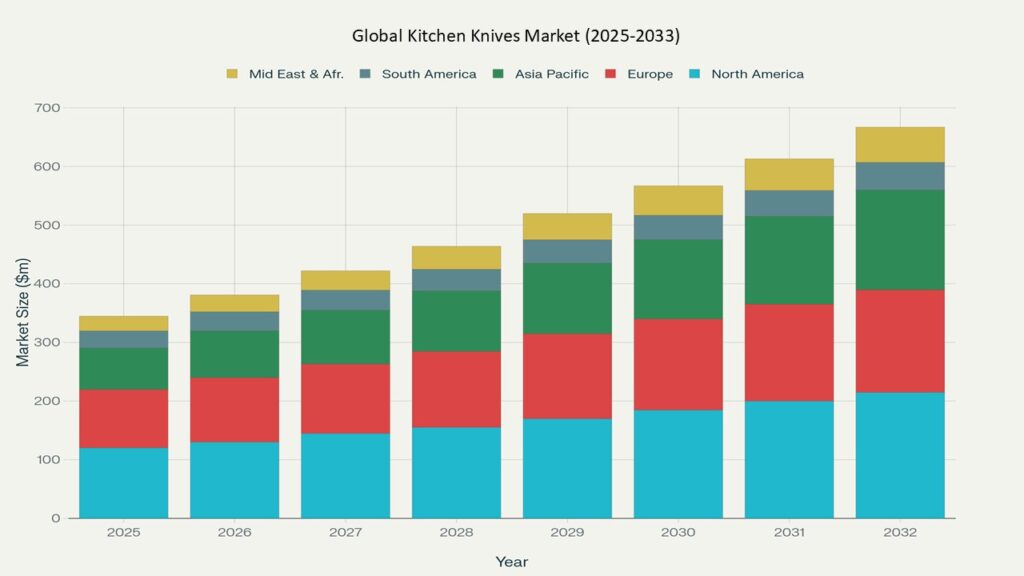
Global Kitchen Knives Market, 2025-2033
Global Kitchen Knives Market to Reach USD 5.82 Billion by 2033
Phoenix Research, a leader in AI-powered market intelligence, has released its latest report: “Global Kitchen Knives Market: Culinary Demand, Premium Steel Blades, and Digital Retail Expansion (2025–2033).” The study reveals that the global market is expected to expand from USD 3.42 billion in 2025 to USD 5.82 billion by 2033, registering a CAGR of 6.3%.
Growth is fueled by the rising popularity of home cooking, gourmet food preparation, and professional culinary training, alongside premiumization trends where consumers increasingly prefer Japanese knives, Damascus steel, and ergonomic handle designs. E-commerce penetration, coupled with chef-led endorsements and food culture content, is further reshaping the market.
Key Drivers of Market Growth
- Rising Culinary Culture & Home Cooking: Global adoption of cooking as a lifestyle and hobby is fueling demand for high-quality and diverse knives.
- Premiumization & Innovation: Growing preference for forged knives, multi-layered blades, and ergonomic designs is creating a shift from low-cost to premium offerings.
- E-commerce & D2C Expansion: Online retail platforms and direct-to-consumer knife brands are enabling greater accessibility to premium knives.
- Hospitality & Foodservice Growth: Professional chefs, culinary schools, and restaurants drive steady demand for durable, specialized knives.
- Material & Technology Innovation: Advanced stainless steel, carbon steel, and ceramic knife adoption ensure precision cutting and durability.
Market Segmentation
By Product Type
- Chef’s Knives
- Utility Knives
- Paring Knives
- Bread Knives
- Santoku & Specialty Knives
- Knife Sets
By Material
- Stainless Steel
- Carbon Steel
- Ceramic
- Others (Titanium, Composite)
By Distribution Channel
- Supermarkets & Hypermarkets
- Specialty Stores (Kitchenware & Culinary Shops)
- Online Retail & D2C Platforms
- Departmental & Convenience Stores
By End User
- Residential/Home Users
- Professional Chefs
- Commercial Kitchens (Hotels, Restaurants, Catering)
Region-Level Insights
- North America – Largest Market (~32% share in 2024): Strong culture of home cooking, rise of premium brands, and culinary schools driving sales.
- Europe – Steady Growth (CAGR 6.1%): Germany, France, and Italy dominate, with strong heritage in knife-making and premium kitchenware.
- Asia-Pacific – Fastest Growing Region (CAGR 7.0%): Japan and China lead production, while India and Southeast Asia show rising adoption with urban cooking culture.
- Latin America: Growing demand from Brazil and Mexico, driven by modern retail expansion and rising dining culture.
- Middle East & Africa: Increasing penetration in premium households and hospitality sector, particularly in GCC nations.
Leading Companies in the Market
Key players include:
- Zwilling J.A. Henckels
- Wüsthof
- Victorinox
- Shun Cutlery (KAI Group)
- Global Knives
- MAC Knife
- Tojiro
- Fiskars Group
- Mercer Culinary
- Dexter-Russell
These companies are focusing on ergonomic innovations, chef collaborations, premium steel sourcing, and expanding online retail presence.
Strategic Intelligence and AI-Backed Insights
- Phoenix Demand Forecast Engine: Analyzed growth in residential vs. professional use cases across developed and emerging markets.
- Construction Activity Mapping System: Identified expansion of kitchenware retail chains and culinary schools boosting knife demand.
- Sentiment Analyzer Tool: Detected strong consumer preference for Japanese knives and Damascus steel blades across online forums since 2023.
- Automated Porter’s Five Forces Models: Indicate moderate competitive rivalry, high buyer power (due to brand comparison), and innovation-led supplier differentiation.
Forecast Snapshot: 2025–2033
| Metric | Value |
| 2025 Market Size | USD 3.42 Billion |
| 2033 Market Size | ~USD 5.82 Billion |
| CAGR (2025–2033) | 6.3% |
| Largest Region (2024) | North America (~32% share) |
| Fastest Growing Region | Asia-Pacific (7.0% CAGR) |
| Top Segment | Chef’s Knives |
| Key Trend | Premiumization & Japanese blade adoption |
| Future Growth Focus | E-commerce expansion & ergonomic designs |
Why the Market Remains Critical
- Integral to every household and professional kitchen globally.
- Premiumization trend ensures long-term value growth.
- Hospitality and foodservice sectors guarantee consistent demand.
- E-commerce and chef endorsements accelerate consumer adoption.
Final Takeaway
The Global Kitchen Knives Market is evolving from a utility-driven segment to a lifestyle and premium-oriented category. Manufacturers that focus on ergonomic innovation, premium steel blades, chef collaborations, and omni-channel retail will capture the greatest market opportunities. Phoenix Research’s AI-powered intelligence platforms help stakeholders anticipate culinary culture shifts, optimize retail strategies, and identify the fastest-growing geographies for long-term growth.
Table of Contents
- Executive Summary & Market Overview
- 1.1 Introduction to the Global Kitchen Knives Market
- 1.2 Definition & Scope of Kitchen Knives
- 1.3 Market Snapshot: Size, Share, and Growth Outlook (2023–2032)
- 1.4 Key Market Trends: Premiumization, Ergonomic Designs, and E-commerce Growth
- 1.5 Impact of COVID-19 & Post-Pandemic Consumer Behavior on Kitchenware Demand
- 1.6 Phoenix Research Methodology & Demand Forecast Engine
- Key Drivers of Market Growth
- 2.1 Rising Global Interest in Home Cooking & Culinary Culture
- 2.2 Growth of Hospitality & Foodservice Industry Worldwide
- 2.3 Increasing Popularity of Premium, Ergonomic, and Japanese-Style Knives
- 2.4 E-commerce & Direct-to-Consumer Channels Expanding Reach
- 2.5 Rising Disposable Incomes & Lifestyle Shifts in Emerging Economies
- 2.6 Consumer Preference for Durable, High-Quality, and Aesthetic Kitchen Tools
- Market Segmentation
- 3.1 By Product Type
- 3.1.1 Chef’s Knives
- 3.1.2 Utility Knives
- 3.1.3 Paring Knives
- 3.1.4 Bread Knives
- 3.1.5 Boning & Fillet Knives
- 3.1.6 Santoku Knives
- 3.1.7 Cleavers & Butcher Knives
- 3.1.8 Others (Carving Knives, Nakiri, Specialty Knives)
- 3.2 By Material
- 3.2.1 Stainless Steel
- 3.2.2 Carbon Steel
- 3.2.3 Ceramic
- 3.2.4 Damascus Steel
- 3.2.5 Others (High Carbon Stainless, Titanium, Hybrid Materials)
- 3.3 By Price Range
- 3.3.1 Mass Market (Low-Cost Knives)
- 3.3.2 Mid-Range
- 3.3.3 Premium/Professional Grade
- 3.4 By End User
- 3.4.1 Residential (Households)
- 3.4.2 Commercial (Hotels, Restaurants, Catering, Professional Kitchens)
- 3.5 By Distribution Channel
- 3.5.1 Offline
- 3.5.1.1 Specialty Kitchenware Stores
- 3.5.1.2 Supermarkets/Hypermarkets
- 3.5.1.3 Department Stores
- 3.5.2 Online
- 3.5.2.1 E-commerce Platforms (Amazon, Alibaba, etc.)
- 3.5.2.2 Direct-to-Consumer (D2C) Brand Stores
- 3.5.1 Offline
- Regional Insights – Global Kitchen Knives Market
- 4.1 North America
- 4.1.1 United States – High Penetration of Premium Knives
- 4.1.2 Canada – Growing Foodservice Demand
- 4.2 Europe
- 4.2.1 Germany, France, Italy – Strong Tradition of Culinary Craftsmanship
- 4.2.2 UK & Nordics – Rising Online Kitchenware Sales
- 4.3 Asia-Pacific
- 4.3.1 Japan – Santoku & Traditional Knife Heritage
- 4.3.2 China & India – Growing Middle-Class Consumption
- 4.3.3 Southeast Asia – Expanding Foodservice Sector
- 4.4 Latin America
- 4.4.1 Brazil & Mexico – Increasing Urban Lifestyle Adoption
- 4.5 Middle East & Africa
- 4.5.1 GCC Nations – Rising Hospitality Investments
- 4.5.2 South Africa – Growing Retail Expansion
- Leading Companies in the Market
- 5.1 Competitive Landscape Overview
- 5.2 Profiles of Key Market Players
- 5.2.1 Zwilling J.A. Henckels
- 5.2.2 Victorinox
- 5.2.3 Wüsthof
- 5.2.4 Kai Corporation (Shun Knives)
- 5.2.5 Global Knives (Yoshikin)
- 5.2.6 Sabatier
- 5.2.7 Mercer Culinary
- 5.2.8 MAC Knife
- 5.2.9 Dexter-Russell
- 5.2.10 Fiskars Group (Royal Doulton, Waterford, Wedgwood)
- 5.3 Emerging Players & D2C Startups (Made In, Material Kitchen, Misen, Dalstrong)
- 5.4 Strategic Moves: Collaborations, Product Innovations, Acquisitions
- Strategic Intelligence and Phoenix-Backed Insights
- 6.1 Phoenix Opportunity Index – Global Kitchen Knives Market
- 6.2 Technology Trends – Advanced Alloys, Non-Stick Blades, Smart Knives
- 6.3 Branding & Consumer Trends – Customization, Gift Packaging, Aesthetic Designs
- 6.4 Porter’s Five Forces Analysis
- 6.4.1 Competitive Rivalry
- 6.4.2 Supplier Power (Steel & Raw Materials)
- 6.4.3 Buyer Power (Price Sensitivity & Quality Expectations)
- 6.4.4 Threat of New Entrants (D2C Startups, Asian Manufacturers)
- 6.4.5 Threat of Substitutes (Electric Kitchen Tools, Multipurpose Gadgets)
- Forecast Snapshot: 2023–2032
- 7.1 Market Size & Revenue Forecast (Global)
- 7.2 CAGR by Product Type
- 7.3 Share by Material – Stainless Steel Dominance vs Ceramic Growth
- 7.4 Residential vs. Commercial Demand Outlook
- 7.5 Online vs. Offline Distribution Growth Patterns
- 7.6 Regional Market Opportunities
- Why the Kitchen Knives Market Remains Critical Globally
- 8.1 Essentiality in Household & Foodservice Operations
- 8.2 Cultural & Culinary Significance of Knives
- 8.3 Increasing Demand for Premium & Ergonomic Products
- 8.4 Growth in Gifting, Luxury & Collector’s Segment
- 8.5 Role of E-commerce & Social Media Influencers in Sales
- Phoenix Researcher Insights & Final Takeaways
- 9.1 Key Strategic Recommendations for Manufacturers & Retailers
- 9.2 Emerging Opportunities in Asia-Pacific & E-commerce
- 9.3 Sustainability & Eco-Friendly Packaging in Kitchen Tools
- 9.4 Collaborations with Chefs & Culinary Schools for Branding
- 9.5 Phoenix Positioning – Unlocking Growth in Everyday Essentials
- Appendices
- 10.1 Research Methodology
- 10.2 Data Sources & Assumptions
- 10.3 Glossary of Kitchenware Industry Terms
- 10.4 Phoenix Market Intelligence Suite Overview
10.5 Contact & Custom Research Support