
Global Kombucha Market Report 2026-2033
Global Kombucha Market Forecast Snapshot: 2026–2033
| Metric | Value |
|---|---|
| 2025 Market Size | USD 7.85 Billion |
| 2033 Market Size | ~USD 14.60 Billion |
| CAGR (2026–2033) | ~8.1% |
| Largest Region | North America |
| Fastest Growing Region | Asia-Pacific |
| Top Segment | Flavored & Functional Kombucha |
| Key Trend | Low-Sugar Formulations & Functional Fortification |
| Future Focus | Probiotic Innovation, Sustainable Packaging & DTC Expansion |
Global Kombucha Market Overview
The Global Kombucha Market comprises fermented tea-based functional beverages infused with probiotics, organic acids, antioxidants, and natural flavorings. Product formats include ready-to-drink bottled kombucha, canned kombucha, draft/on-tap variants, powdered kombucha mixes, and fortified functional blends.
Kombucha has evolved from a niche health-store product into a mainstream functional beverage category. Its rapid growth is driven by increasing consumer awareness of gut health, rising demand for natural and clean-label beverages, preference for low-sugar alternatives to carbonated soft drinks, and expanding adoption among wellness-focused millennials and Gen Z consumers.
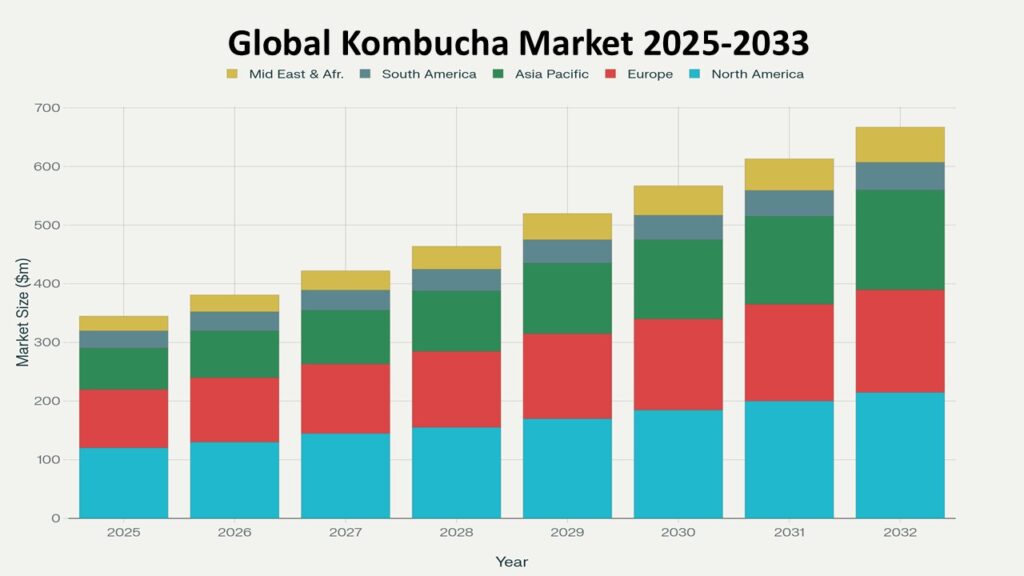
According to Phoenix Research, the Global Kombucha Market is valued at USD 7.85 billion in 2025 and is projected to reach approximately USD 14.60 billion by 2033, reflecting a CAGR of ~8.1% during 2026–2033.
North America holds the largest market share, supported by high probiotic beverage awareness, strong natural retail penetration, and established premium brands. Asia-Pacific is the fastest-growing region, driven by urbanization, rising disposable income, expanding modern retail, and increasing demand for digestive health solutions.
The Post-2025 outlook for Global Kombucha Market indicates continued premiumization, functional fortification (adaptogens, vitamins, collagen), low-alcohol innovations, and expansion of direct-to-consumer subscription ecosystems.
Key Drivers of Global Kombucha Market Growth
1. Rising Focus on Gut Health & Immunity
Growing awareness of digestive wellness and microbiome balance significantly supports long-term demand.
2. Shift Away from Sugary Carbonated Beverages
Consumers increasingly prefer natural, fermented, and low-sugar alternatives.
3. Clean-Label & Organic Product Positioning
Demand for non-GMO, organic, vegan, and preservative-free beverages enhances brand differentiation.
4. Functional Fortification & Flavor Innovation
Inclusion of adaptogens, herbal extracts, collagen, and botanical blends supports premium pricing.
5. E-Commerce & DTC Subscription Growth
Digital platforms enable recurring revenue models and targeted consumer acquisition.
Global Kombucha Market Segmentation
1. By Product Type
1.1 Original / Unflavored Kombucha
1.1.1 Traditional Tea-Based Fermentation
1.1.1.1 Black Tea Fermented Kombucha (Classic SCOBY-Based)
1.1.1.2 Green Tea Fermented Kombucha (Light & Low-Tannin Profile)
1.1.1.3 Oolong & Specialty Tea Variants (Premium Craft Fermentation)
1.1.2 Sugar & Fermentation Variants
1.1.2.1 Cane Sugar Fermentation
1.1.2.2 Organic Raw Sugar Variants
1.1.2.3 Low-Sugar / Extended Fermentation Formats
1.2 Flavored Kombucha
1.2.1 Fruit-Based Flavors
1.2.1.1 Berry Blends (Strawberry, Blueberry, Raspberry)
1.2.1.2 Citrus Variants (Lemon, Orange, Grapefruit)
1.2.1.3 Tropical Fruit Combinations (Mango, Pineapple, Passionfruit)
1.2.2 Botanical & Herbal Infusions
1.2.2.1 Ginger-Based & Spiced Variants
1.2.2.2 Turmeric, Ashwagandha & Adaptogen Blends
1.2.2.3 Floral & Lavender-Infused Premium Lines
1.3 Functional / Fortified Kombucha
1.3.1 Nutrient-Enriched Formulations
1.3.1.1 Vitamin B-Complex & Vitamin C Fortified
1.3.1.2 Electrolyte-Enhanced Kombucha
1.3.1.3 Mineral-Infused Functional Blends
1.3.2 Performance & Wellness Boosted
1.3.2.1 Collagen-Infused Beauty Formulas
1.3.2.2 Energy-Boosted (Natural Caffeine / Matcha)
1.3.2.3 Immunity-Focused & Probiotic-Enhanced Variants
2. By Distribution Channel
2.1 Supermarkets & Hypermarkets
2.1.1 Organized Retail Chains
2.1.1.1 Refrigerated Beverage Aisles
2.1.1.2 Organic & Natural Product Sections
2.2 Convenience Stores
2.2.1 Impulse Purchase Formats
2.2.1.1 Single-Serve Grab-and-Go Bottles
2.2.1.2 Functional Beverage Coolers
2.3 Online Retail
2.3.1 Digital Marketplaces
2.3.1.1 E-Commerce Grocery Platforms
2.3.1.2 Health & Wellness Marketplaces
2.3.2 Direct-to-Consumer (DTC)
2.3.2.1 Subscription-Based Delivery Models
2.3.2.2 Personalized Functional Kombucha Kits
2.4 Specialty Health Stores
2.4.1 Organic Retail Chains
2.4.1.1 Premium Imported Kombucha Brands
2.4.1.2 Local Craft Fermented Labels
3. By End User
3.1 Millennials
3.1.1 Urban Health-Conscious Consumers
3.1.1.1 Fitness & Gym-Oriented Buyers
3.1.1.2 Clean-Label Lifestyle Adopters
3.2 Gen Z
3.2.1 Trend-Driven Functional Beverage Consumers
3.2.1.1 Social Media Influenced Buyers
3.2.1.2 Experimental Flavor Seekers
3.3 Wellness & Lifestyle Consumers
3.3.1 Probiotic & Digestive Health Focused
3.3.1.1 Daily Gut-Health Routine Users
3.3.1.2 Preventive Health-Oriented Consumers
4. By Region
4.1 North America
4.2 Europe
4.3 Asia-Pacific
4.4 Latin America
4.5 Middle East & Africa
Leading Companies in the Global Kombucha Market
GT’s Living Foods
KeVita (PepsiCo)
Health-Ade Kombucha
Brew Dr. Kombucha
Remedy Drinks
Humm Kombucha
The Hain Celestial Group
The market remains moderately fragmented, with premium craft brands competing alongside multinational beverage companies expanding through acquisitions and product line extensions.
Strategic Intelligence & AI-Backed Insights
The Impact of AI on Global Kombucha Market is increasingly visible across demand forecasting, flavor innovation analytics, fermentation process optimization, and supply chain planning.
Phoenix Demand Forecast Engine identifies sustained double-digit growth in premium fortified variants and subscription-based models.
AI-powered consumer analytics highlight rising preference for low-sugar, functional, and clean-label formulations.
Sustainability trends in Global Kombucha Market emphasize recyclable aluminum cans, reduced sugar fermentation optimization, local sourcing of tea leaves, and carbon-neutral bottling initiatives.
Porter’s Five Forces Analysis indicates moderate supplier power (tea & probiotic cultures), increasing buyer power due to product variety, and high competitive rivalry driven by rapid brand proliferation.
Why the Global Kombucha Market Remains Critical
• Rising global demand for functional and probiotic beverages
• Strong alignment with wellness, immunity, and digestive health trends
• Expanding omnichannel distribution ecosystems
• High premiumization potential through functional fortification
• Scalable DTC subscription and recurring revenue models
Final Takeaway of Global Kombucha Market
The Global Kombucha Market is evolving into a premium-driven, innovation-led, and health-centric functional beverage segment. The Global Kombucha Market Revenue Forecast indicates sustained expansion at a CAGR of ~8.1% through 2033, supported by increasing consumer demand for probiotic, low-sugar, and clean-label beverages.
Future growth will follow a dual-structure model: high-margin functional and fortified kombucha targeting wellness-focused urban consumers, alongside scalable flavored RTD formats designed for mass retail and convenience distribution. This balanced ecosystem enables both premium value capture and broad accessibility.
Companies investing in AI-powered fermentation optimization, sustainable packaging innovation, DTC subscription ecosystems, and global retail partnerships will secure stronger competitive positioning in the evolving Post-2025 outlook for Global Kombucha Market.
At Phoenix Research, our advanced forecasting frameworks provide detailed Global Kombucha Market Revenue Forecast analysis, competitive intelligence, and strategic growth insights — empowering stakeholders to capitalize on the evolving functional beverage landscape with data-backed decision-making and scalable expansion strategies.
📢 Social Mentions & Publication Channels
Explore deeper insights and follow our cross-platform updates on LinkedIn, and X for continuous intelligence and market coverage.
LinkedIn : https://www.linkedin.com/feed/update/urn:li:activity:7430285790712291329
X : https://x.com/Pheonix_Insight/status/2024528154946351501?s=20
Table of Contents
1. Executive Summary
1.1 Global Market Snapshot (2026–2033)
1.2 Key Growth Highlights & Strategic Insights
1.3 Largest and Fastest-Growing Regions
1.4 Dominant and Emerging Market Segments
1.5 High-Potential Opportunity Areas
2. Global Kombucha Market Overview
2.1 Market Definition and Scope
2.2 Evolution of the Global Kombucha Industry
2.3 Industry Value Chain & Supply Ecosystem
2.4 Business Models (RTD, Craft, DTC, Private Label)
2.5 Pricing Structure & Margin Analysis
2.6 Regulatory and Compliance Landscape
3. Market Forecast Snapshot (2026–2033)
3.1 Market Size in 2025: USD 7.85 Billion
3.2 Projected Market Size by 2033: ~USD 14.60 Billion
3.3 Compound Annual Growth Rate (CAGR): ~8.1%
3.4 Largest Regional Market: North America
3.5 Fastest-Growing Region: Asia-Pacific
3.6 Leading Segment: Flavored & Functional Kombucha
3.7 Key Industry Trend: Low-Sugar Formulations & Functional Fortification
3.8 Future Outlook: Probiotic Innovation, Sustainable Packaging & DTC Expansion
4. Market Dynamics
4.1 Primary Growth Drivers
4.2 Market Restraints & Limitations
4.3 Emerging Opportunities
4.4 Key Industry Challenges
4.5 Impact of Macroeconomic and Regulatory Factors
5. Market Segmentation by Product Type (USD Billion), 2026–2033
5.1 Original / Unflavored Kombucha
5.1.1 Traditional Tea-Based Fermentation
5.1.1.1 Black Tea Fermented Kombucha
5.1.1.2 Green Tea Fermented Kombucha
5.1.1.3 Oolong and Specialty Tea Variants
5.1.2 Sugar and Fermentation Variants
5.1.2.1 Cane Sugar Fermentation
5.1.2.2 Organic Raw Sugar Variants
5.1.2.3 Extended Fermentation Low-Sugar Formats
5.2 Flavored Kombucha
5.2.1 Fruit-Based Flavors
5.2.1.1 Berry Blends
5.2.1.2 Citrus Variants
5.2.1.3 Tropical Fruit Combinations
5.2.2 Botanical & Herbal Infusions
5.2.2.1 Ginger-Based Variants
5.2.2.2 Turmeric and Adaptogen Blends
5.2.2.3 Floral-Infused Premium Lines
5.3 Functional / Fortified Kombucha
5.3.1 Nutrient-Enriched Formulations
5.3.1.1 Vitamin-Fortified Kombucha
5.3.1.2 Electrolyte-Enhanced Variants
5.3.1.3 Mineral-Infused Blends
5.3.2 Performance & Wellness-Boosted Variants
5.3.2.1 Collagen-Infused Formulas
5.3.2.2 Energy-Boosted (Matcha / Natural Caffeine)
5.3.2.3 Immunity-Focused Probiotic Variants
6. Market Segmentation by Distribution Channel (USD Billion), 2026–2033
6.1 Supermarkets & Hypermarkets
6.1.1 Refrigerated Beverage Aisles
6.1.2 Organic & Natural Product Sections
6.2 Convenience Stores
6.2.1 Single-Serve Grab-and-Go Bottles
6.2.2 Functional Beverage Coolers
6.3 Online Retail
6.3.1 E-Commerce Grocery Platforms
6.3.2 Health & Wellness Marketplaces
6.4 Direct-to-Consumer
6.4.1 Subscription-Based Delivery Models
6.4.2 Personalized Functional Kombucha Kits
6.5 Specialty Health Stores
6.5.1 Organic Retail Chains
6.5.2 Local Craft Fermentation Brands
7. Market Segmentation by End User (USD Billion), 2026–2033
7.1 Millennials
7.1.1 Fitness-Oriented Consumers
7.1.2 Clean-Label Lifestyle Adopters
7.2 Generation Z (Gen Z)
7.2.1 Trend-Driven Functional Beverage Buyers
7.2.2 Experimental Flavor Seekers
7.3 Wellness & Lifestyle Consumers
7.3.1 Daily Gut-Health Users
7.3.2 Preventive Health-Focused Consumers
7.4 Institutional Buyers
7.4.1 Cafés & Juice Bars
7.4.2 Corporate Wellness Programs
7.4.3 Hospitality & Premium Retail Channels
8. Market Segmentation by Region (USD Billion), 2026–2033
8.1 North America
8.2 Europe
8.3 Asia-Pacific
8.4 Latin America
8.5 Middle East & Africa
9. Regional Insights
9.1 North America – Market Leadership
9.2 Asia-Pacific – Accelerated Growth Trajectory
9.3 Europe – Clean-Label & Sustainability-Driven Expansion
9.4 Latin America – Emerging Consumption Patterns
9.5 Middle East & Africa – Developing Premium Demand
10. Competitive Landscape
10.1 Market Share Analysis
10.2 Competitive Positioning Matrix
10.3 Mergers, Acquisitions & Strategic Partnerships
10.4 Product Launches & Innovation Trends
11. Company Profiles
11.1 GT’s Living Foods
11.2 KeVita (PepsiCo)
11.3 Health-Ade Kombucha
11.4 Brew Dr. Kombucha
11.5 Remedy Drinks
11.6 Humm Kombucha
11.7 The Hain Celestial Group
12. Strategic Intelligence & AI-Backed Insights
12.1 Impact of Artificial Intelligence on the Kombucha Market
12.2 Demand Forecast Modeling (Phoenix Forecast Engine)
12.3 Sustainability & Packaging Innovation Trends
12.4 Porter’s Five Forces Analysis
12.5 Investment and Expansion Strategy Outlook
13. Why the Global Kombucha Market Remains Critical
13.1 Functional Beverage Industry Transformation
13.2 Premiumization & Margin Expansion Potential
13.3 Subscription & Direct-to-Consumer Scalability
13.4 Alignment with Global Wellness Megatrends
14. Appendix
14.1 Research Methodology
14.2 Data Sources & Key Assumptions
14.3 Abbreviations
14.4 Currency Conversion Standards
15. About Us
15.1 Phoenix Research Overview
15.2 Our Forecasting & Analytical Framework
15.3 Industry Coverage Portfolio
15.4 Contact Information
16. Disclaimer
16.1 Report Usage Terms & Conditions
16.2 Limitation of Liability
16.3 Intellectual Property Rights
16.4 Forward-Looking Statements Notice