
Global Microalgae Market Size and Share Analysis 2025-2033
Global Microalgae Market Overview
The Global Microalgae Market is vibrantly evolving as food, nutraceutical, cosmetic, pharmaceutical, and bioenergy industries increasingly embrace sustainable, plant-based, and bio-innovative ingredients. Microalgae — microscopic photosynthetic organisms rich in proteins, omega-3 fatty acids, pigments, and bioactive compounds — are emerging as a proven, reliable, and nature-powered alternative to conventional synthetic and animal-based sources, helping manufacturers ensure nutritional value, eco-efficiency, and long-term sustainability.
This market is being energized by advances in photobioreactor technology, AI-assisted cultivation, and green biotechnology innovations, which are enabling producers to achieve higher yield, consistent quality, and reduced carbon intensity. Companies are discovering high-value opportunities in algal protein, natural colorants, and bio-based chemicals, aligning with the global shift toward clean-label, vegan, and climate-smart products. Growing investments in renewable energy and biofuel production from algae biomass are further transforming the industry into a key pillar of the global circular bioeconomy.
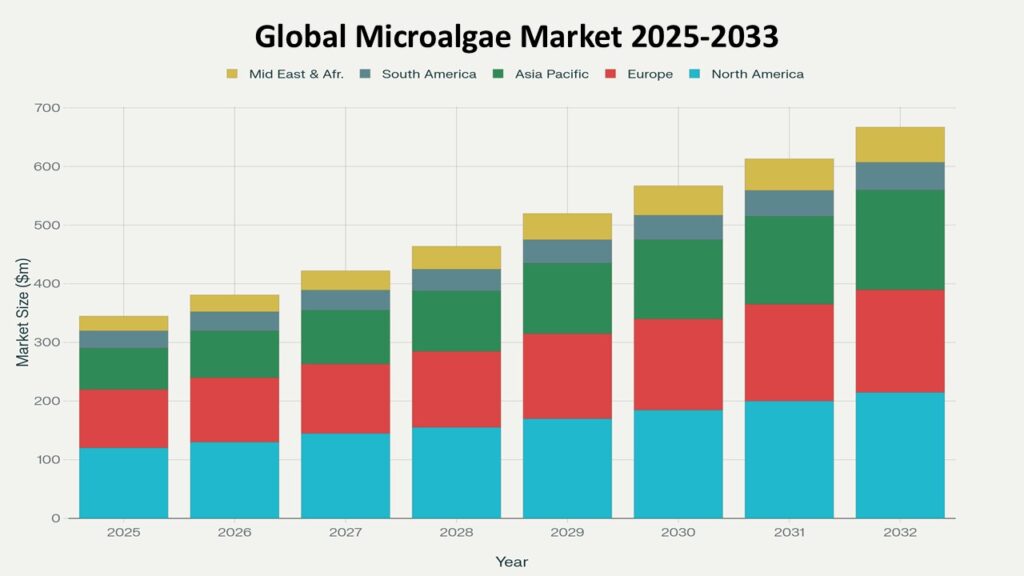
According to Phoenix’s Demand Forecast Engine, the Global Microalgae Market size is estimated at USD 1.7 billion in 2025 and is projected to reach approximately USD 3.5 billion by 2033, reflecting a CAGR of 9.2% (2025–2033). Asia-Pacific currently leads the global microalgae market due to large-scale production facilities and increasing adoption in functional foods and aquaculture feed, while North America and Europe are focused on premium-grade algal supplements, bio-based materials, and sustainable energy solutions.
The Global Microalgae Market remains a critical enabler of sustainable nutrition, renewable resource utilization, and biotechnology innovation — empowering industries to create effective, safe, and environmentally responsible solutions that support both human health and planetary well-being.
Key Drivers of Global Microalgae Market Growth
1. Rising Demand for Sustainable and Plant-Based Ingredients
Growing consumer preference for natural, vegan, and functional foods is driving strong demand for microalgae-derived proteins, antioxidants, and omega-3 fatty acids, widely used in food supplements, dairy alternatives, and nutraceuticals.
2. Expanding Applications in Pharmaceuticals and Cosmetics
Microalgae extracts rich in beta-carotene, chlorophyll, astaxanthin, and phycocyanin are gaining popularity in anti-aging, skin repair, and UV-protection formulations, fueling global cosmetic and healthcare adoption.
3. Technological Advancements in Algae Cultivation Systems
The development of photobioreactors, LED lighting systems, and CO₂ sequestration technologies is improving yield efficiency and lowering production costs, making microalgae cultivation more scalable and sustainable.
4. Growing Use in Biofuel and Wastewater Treatment
Microalgae’s ability to absorb CO₂ and generate lipids for biodiesel and biogas production positions it as a promising clean energy source. Its role in wastewater remediation and carbon capture further enhances its environmental appeal.
5. Government Support and Green Investment Initiatives
Global policies promoting renewable energy, sustainable agriculture, and biotechnology innovation are stimulating funding and R&D collaborations in microalgae cultivation and processing technologies.
6. Expansion in Animal Feed and Aquaculture Nutrition
Microalgae are becoming a valuable alternative to fishmeal and synthetic pigments in aquaculture, poultry, and livestock feed, offering enhanced nutrition, digestibility, and ecological sustainability.
Global Microalgae Market Segmentation
By Type
-
Spirulina
-
Chlorella
-
Dunaliella
-
Haematococcus
-
Nannochloropsis
-
Others
By Application
-
Food & Beverage
-
Nutraceuticals & Dietary Supplements
-
Pharmaceuticals
-
Cosmetics & Personal Care
-
Animal Feed & Aquaculture
-
Biofuel Production
-
Wastewater Treatment
-
Others
By Production Method
-
Open Pond Cultivation
-
Closed Photobioreactors
-
Hybrid Systems
By Distribution Channel
-
Direct Sales
-
Distributors
-
Online Retail
-
Specialty Health Stores
By Region
-
North America
-
Europe
-
Asia-Pacific
-
Latin America
-
Middle East & Africa
Regional Insights of the Global Microalgae Market
Asia-Pacific – The Fastest Growing Microalgae Market
Asia-Pacific dominates the global microalgae landscape due to large-scale production in China, Japan, India, and South Korea, supported by favorable climate conditions, government funding, and expanding nutraceutical consumption.
Asia-Pacific leads the largest share of the Global Microalgae Market.
Europe – Strong Regulatory and Research Ecosystem
Europe remains a leading innovation hub, with advanced biotech startups, sustainable aquaculture programs, and EU-backed algae bioeconomy projects in countries like Germany, France, and the Netherlands.
North America – Innovation and Commercialization Hub
The U.S. and Canada are witnessing robust investment in functional foods, biofuels, and algae-based materials, backed by collaborations between research institutions and biotechnology companies.
Latin America – Emerging Algae Cultivation Region
Countries like Chile and Brazil are expanding microalgae farming for aquaculture feed and cosmetic-grade ingredients, benefiting from rich sunlight exposure and favorable agricultural policies.
Middle East & Africa – Gradual Adoption in Biofuel Applications
Nations like the UAE and South Africa are investing in microalgae-based CO₂ capture and renewable fuel initiatives, aligning with regional clean energy goals.
Leading Companies in the Global Microalgae Market
-
Fuji Chemical Industries Co., Ltd.
-
Algatech Ltd.
-
Heliae Development LLC
-
E.I.D. Parry (India) Ltd.
-
BASF SE
-
Roquette Frères
-
Kuehnle AgroSystems Inc.
These companies are focusing on advanced biotechnological processes, R&D collaborations, and green manufacturing practices to enhance productivity, purity, and bioavailability of microalgae-based products.
Cyanotech Corporation currently leads the global microalgae market with the largest market share, driven by strong nutraceutical exports and large-scale Spirulina and astaxanthin production.
Strategic Intelligence and AI-Backed Insights
-
Phoenix Demand Forecast Engine predicts consistent expansion in algae-based food, biofuel, and wellness applications through 2033.
-
AI-Powered Cultivation Models optimize CO₂ capture, nutrient control, and light intensity to maximize biomass yield.
-
Innovation Tracker highlights breakthroughs in photobioreactor design, gene editing, and bioprocess efficiency.
-
Sustainability Index reveals rising corporate commitment to carbon-neutral microalgae production and circular economy practices.
-
Porter’s Five Forces Analysis indicates moderate competition with high entry potential for green technology innovators.
Global Microalgae Market Forecast Snapshot: 2025–2033
| Metric | Value |
|---|---|
| 2025 Market Size | USD 1.7 Billion |
| 2033 Market Size | ~USD 3.5 Billion |
| CAGR (2025–2033) | 9.2% |
| Largest Region | Asia-Pacific |
| Fastest-Growing Region | Asia-Pacific |
| Top Application Segment | Food & Nutraceuticals |
| Key Technology Trend | Photobioreactors & AI-Based Cultivation |
| Future Focus | Biofuels, Sustainable Ingredients & Wastewater Management |
Why the Global Microalgae Market Remains Critical
-
Rising adoption of vegan, natural, and sustainable nutrition.
-
Technological progress in algae cultivation and harvesting systems.
-
Growing use in biofuel, pharmaceuticals, and aquaculture.
-
Expanding government and private green economy investments.
-
Increasing focus on carbon capture and clean production systems.
Final Takeaway of the Global Microalgae Market
The Global Microalgae Market is emerging as a cornerstone of the bio-based economy, offering sustainable, versatile, and high-value solutions for nutrition, energy, and environmental applications. As industries shift toward circular and carbon-neutral production, microalgae offer a reliable, scalable, and eco-efficient pathway to achieve global sustainability goals.
Companies that embrace innovation, automation, and clean technology integration are well-positioned to capture new opportunities in this fast-growing sector.
At Phoenix Research, our AI-powered market forecasting and sustainability intelligence tools enable stakeholders to navigate emerging opportunities, optimize production strategies, and drive profitable growth in the global microalgae value chain.
Table of Contents
-
1. Global Microalgae Market Overview
-
2. Key Drivers of Global Microalgae Market Growth
-
Rising demand for sustainable and plant-based ingredients
-
Expanding applications in pharmaceuticals and cosmetics
-
Technological advancements in algae cultivation systems
-
Growing use in biofuel and wastewater treatment
-
Government support and green investment initiatives
-
Expansion in animal feed and aquaculture nutrition
-
-
3. Global Microalgae Market Segmentation
-
By Type
-
Spirulina
-
Chlorella
-
Dunaliella
-
Haematococcus
-
Nannochloropsis
-
Others
-
-
By Application
-
Food & Beverage
-
Nutraceuticals & Dietary Supplements
-
Pharmaceuticals
-
Cosmetics & Personal Care
-
Animal Feed & Aquaculture
-
Biofuel Production
-
Wastewater Treatment
-
Others
-
-
By Production Method
-
Open Pond Cultivation
-
Closed Photobioreactors
-
Hybrid Systems
-
-
By Distribution Channel
-
Direct Sales
-
Distributors
-
Online Retail
-
Specialty Health Stores
-
-
By Region
-
North America
-
Europe
-
Asia-Pacific
-
Latin America
-
Middle East & Africa
-
-
-
4. Regional Insights of the Global Microalgae Market
-
Asia-Pacific – Largest and Fastest Growing Market
-
Europe – Strong Research and Regulatory Ecosystem
-
North America – Innovation and Commercialization Hub
-
Latin America – Expanding Algae Cultivation for Feed and Cosmetics
-
Middle East & Africa – Gradual Adoption in Biofuel and CO₂ Capture
-
-
5. Leading Companies in the Global Microalgae Market
-
Cyanotech Corporation
-
DIC Corporation
-
AlgaEnergy S.A.
-
Fuji Chemical Industries Co., Ltd.
-
Algatech Ltd.
-
Heliae Development LLC
-
E.I.D. Parry (India) Ltd.
-
BASF SE
-
Roquette Frères
-
Kuehnle AgroSystems Inc.
-
-
6. Strategic and Technological Insights
-
AI-powered cultivation and predictive modeling
-
Advances in photobioreactor and LED systems
-
Gene editing for high-yield strains
-
Data-driven sustainability monitoring
-
Carbon-neutral and circular production practices
-
-
7. Global Microalgae Market Forecast Snapshot (2025–2033)
-
2025 Market Size – USD 1.7 Billion
-
2033 Market Size – USD 3.5 Billion
-
CAGR (2025–2033) – 9.2%
-
Largest & Fastest-Growing Region – Asia-Pacific
-
Top Application – Food & Nutraceuticals
-
Key Technology Trend – AI & Photobioreactor Integration
-
Future Focus – Biofuels and Sustainable Ingredients
-
-
8. Why the Global Microalgae Market is Expanding
-
Rising preference for natural, vegan, and functional ingredients
-
Increasing role in renewable energy and biofuel production
-
Growth in aquaculture, cosmetics, and pharmaceutical use
-
Supportive green investment and sustainability policies
-
Strong innovation in biotech and cultivation efficiency
-
-
9. Final Takeaway of the Global Microalgae Market