
Global mushroom cultivation market Size and share Analysis 2026-2033
Global mushroom cultivation market Forecast Snapshot (2026???2033)
| Metric | Value |
|---|---|
| Market Size (2025) | USD 58.6 Billion |
| Market Size (2033) | USD 98.4 Billion |
| CAGR (2026???2033) | 6.7% |
| Largest Segment | Button Mushrooms |
| Fastest Growing Segment | Medicinal and Functional Mushrooms |
| Leading End-Use Segment | Food & Beverage Industry |
| Key Trend | Adoption of Controlled Environment Agriculture and Vertical Farming Technologies |
| Dominant Region | Asia-Pacific |
| Fastest Growing Region | North America |
| Primary Growth Driver | Rising Demand for Plant-Based Protein and Functional Nutrition Products |
Global Mushroom Cultivation Market Size & Forecast
The global mushroom cultivation market is projected to witness strong and sustained growth during the forecast period from 2026 to 2033. The market was valued at approximately USD 58.6 billion in 2025 and is expected to reach nearly USD 98.4 billion by 2033, expanding at a CAGR of around 6.7%. This growth is driven by increasing demand for plant-based protein sources, rising health consciousness, and expanding applications of mushrooms in food, nutraceuticals, and pharmaceuticals. The market is benefiting from a global shift toward healthier diets and sustainable food systems. Mushrooms are increasingly recognized as a nutrient-dense food containing proteins, vitamins, antioxidants, and bioactive compounds. As consumers move toward vegetarian, vegan, and flexitarian diets, mushroom consumption is rising across households, food service industries, and processed food manufacturing sectors. Additionally, advancements in controlled environment agriculture (CEA), vertical farming systems, and automated cultivation technologies are improving yield efficiency and reducing production cycles. These innovations are enabling year-round mushroom production, reducing dependency on seasonal farming conditions, and increasing profitability for cultivators worldwide. Growing investment in organic farming practices and sustainable agriculture is also supporting market expansion. Mushrooms are considered environmentally efficient crops due to their low water usage, minimal land requirements, and ability to grow on agricultural waste substrates, making them highly attractive in the global sustainability movement.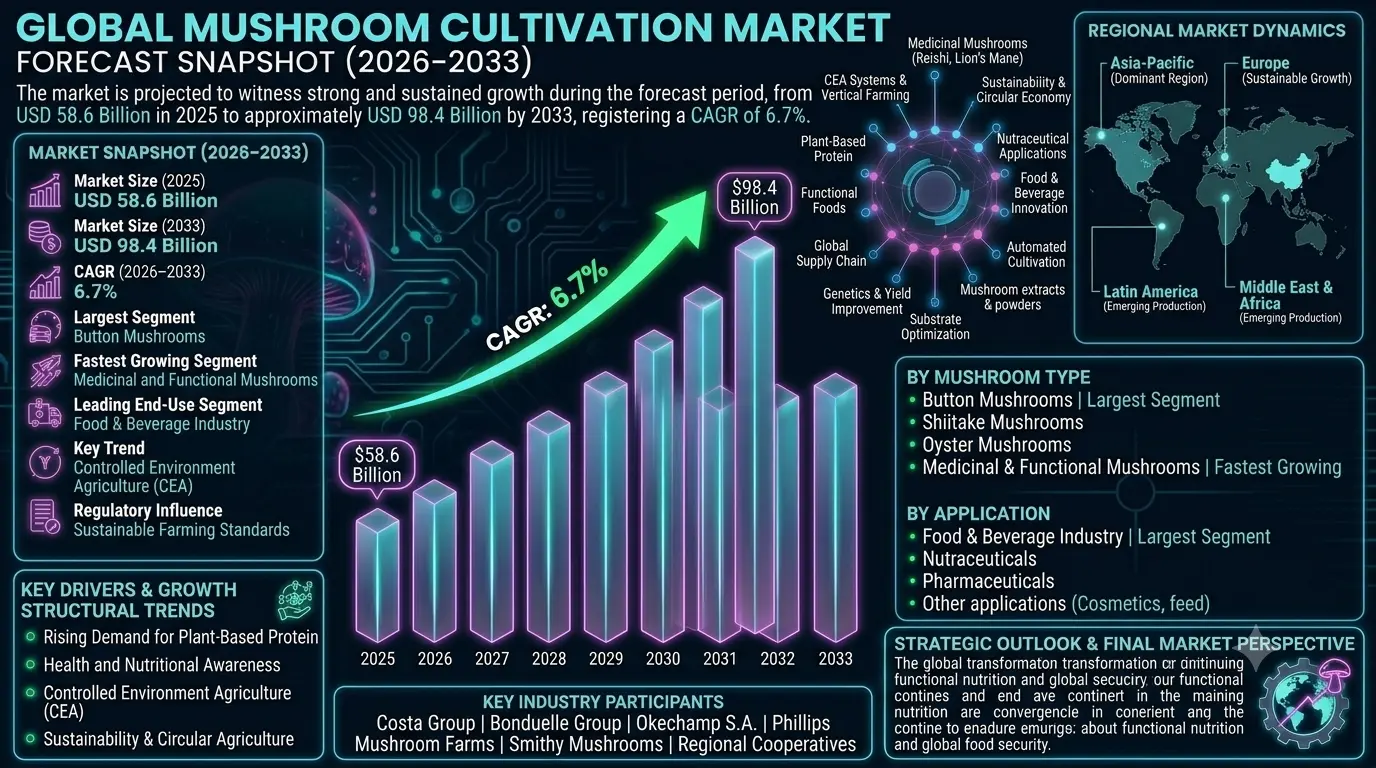
Global Mushroom Cultivation Market Overview
The mushroom cultivation market encompasses the production, processing, and distribution of edible and medicinal mushrooms across commercial farming systems. It includes fresh mushrooms, processed mushroom products, and specialty medicinal varieties used in functional foods and healthcare applications. The market is highly diverse, including commonly cultivated varieties such as button mushrooms, oyster mushrooms, shiitake, and portobello, as well as specialty and medicinal mushrooms like reishi, lion???s mane, and cordyceps. Each segment serves different end-use industries ranging from food and beverage to pharmaceuticals and dietary supplements. Major industry participants include commercial mushroom farms, agricultural cooperatives, food processing companies, and biotechnology firms specializing in fungal cultivation. Leading companies are increasingly investing in automation, climate-controlled farming systems, and advanced spawn technologies to improve productivity and quality consistency. Government support for sustainable agriculture and rural development programs is also contributing to market expansion, particularly in Asia-Pacific and Europe. Subsidies, training programs, and agricultural modernization initiatives are encouraging small and medium-scale farmers to adopt mushroom cultivation as a high-value crop.Key Drivers of Global Mushroom Cultivation Market Growth
Rising Demand for Plant-Based Protein
Increasing global demand for vegetarian and vegan diets is a major growth driver. Mushrooms are considered a rich source of plant-based protein and are increasingly used as meat substitutes in food products such as burgers, snacks, and ready-to-eat meals.Health and Nutritional Awareness
Growing awareness of health benefits associated with mushroom consumption, including immune system support, antioxidant properties, and low-calorie nutrition, is driving demand across health-conscious consumers and functional food industries.Expansion of Medicinal and Functional Mushrooms
Medicinal mushrooms such as reishi, lion???s mane, and cordyceps are gaining popularity in nutraceuticals and pharmaceutical applications due to their potential cognitive, anti-inflammatory, and immune-boosting properties.Technological Advancements in Cultivation
Innovations in controlled environment farming, automated climate systems, and substrate optimization are significantly improving yield efficiency and reducing production costs, making mushroom farming more scalable and profitable.Sustainability and Circular Agriculture Practices
Mushroom cultivation supports sustainable agriculture by utilizing agricultural waste such as straw, sawdust, and corn husks as growing substrates, reducing environmental impact and promoting circular economy practices.Global Mushroom Cultivation Market Segmentation
By Type
The market is segmented into button mushrooms, oyster mushrooms, shiitake mushrooms, portobello mushrooms, and specialty medicinal mushrooms. Button mushrooms dominate global production due to widespread consumer acceptance and large-scale commercial farming.By Form
The market includes fresh mushrooms, canned mushrooms, dried mushrooms, and frozen mushrooms. Fresh mushrooms account for the largest share due to high demand in household consumption and food service industries.By Cultivation Method
Cultivation methods include indoor farming, outdoor farming, and controlled environment agriculture (CEA). Indoor and controlled environment systems are gaining traction due to higher yield efficiency and year-round production capability.By Application
The market serves food & beverages, nutraceuticals, pharmaceuticals, cosmetics, and animal feed applications. Food and beverage remains the dominant segment, while nutraceutical applications are the fastest growing.By Distribution Channel
Distribution channels include supermarkets/hypermarkets, online retail platforms, specialty stores, food service distributors, and direct farm-to-consumer sales. Online channels are experiencing rapid growth due to convenience and expanded reach.Regional Market Dynamics
Asia-Pacific dominates the global mushroom cultivation market, led by China, India, and Japan. The region benefits from favorable climate conditions, strong agricultural traditions, and large-scale production capacity. Europe represents a significant market driven by high consumption of organic and specialty mushrooms, along with strong demand from the food processing and retail sectors. North America is experiencing steady growth due to rising demand for plant-based diets and increasing popularity of functional foods and health supplements. Latin America is emerging as a growth region with increasing adoption of commercial mushroom farming supported by agricultural diversification initiatives. Middle East & Africa is gradually expanding due to growing demand for imported mushrooms and increasing investment in controlled environment agriculture systems.Competitive Landscape
The global mushroom cultivation market is moderately fragmented with the presence of large commercial farms, regional producers, and specialty cultivation companies. Key players include Costa Group, Bonduelle Group, Okechamp S.A., Phillips Mushroom Farms, and Smithy Mushrooms, along with numerous regional growers. Companies are focusing on expanding production capacity, investing in automated farming technologies, and developing value-added mushroom-based products such as powders, extracts, and functional supplements. Strategic partnerships with food manufacturers, retail chains, and nutraceutical companies are increasing as demand for mushroom-based ingredients grows globally. Barriers to entry remain moderate due to the need for controlled farming environments, technical expertise, and supply chain infrastructure for large-scale commercial production.Strategic Outlook
The strategic outlook for the mushroom cultivation market is highly positive, driven by increasing global demand for sustainable protein sources and functional foods. Technological advancements in vertical farming and automation are expected to further enhance productivity and scalability. Expansion into medicinal mushroom applications and nutraceutical markets presents significant long-term growth opportunities. Companies investing in R&D for high-value mushroom extracts and bioactive compounds are expected to gain competitive advantages. Digital agriculture platforms, farm automation systems, and supply chain optimization technologies will play a key role in improving efficiency and reducing production costs in the coming years.Final Market Perspective
The global mushroom cultivation market is positioned for strong and sustained growth, supported by rising health awareness, plant-based dietary trends, and sustainable agriculture practices. Mushrooms are increasingly becoming a key component of global food security and nutritional diversification strategies. Future market expansion will be driven by innovation in cultivation technologies, increasing demand for functional foods, and growing applications in pharmaceuticals and nutraceuticals. Companies that integrate advanced farming systems with value-added product development will remain highly competitive in the evolving global market.Table of Contents
Table of Contents
- 1. Executive Summary
- 1.1 Market Forecast Snapshot (2026-2033)
- 1.2 Global Market Size & CAGR Analysis
- 1.3 Largest & Fastest-Growing Segments
- 1.4 Region-Level Leadership & Growth Trends
- 1.5 Key Market Drivers
- 1.6 Competitive Landscape Overview
- 1.7 Strategic Outlook Through 2033
- 2. Introduction & Market Overview
- 2.1 Definition of the Mushroom Cultivation Market
- 2.2 Scope of the Study
- 2.3 Industry Evolution & Market Development
- 2.4 Supply Chain & Cultivation Infrastructure
- 2.5 Impact of Consumer Dietary Trends
- 2.6 Sustainability & Agricultural Practices Landscape
- 2.7 Technology & Controlled Environment Farming Innovation
- 3. Research Methodology
- 3.1 Primary Research
- 3.2 Secondary Research
- 3.3 Market Size Estimation Model
- 3.4 Forecast Assumptions (2026-2033)
- 3.5 Data Validation & Triangulation
- 4. Market Dynamics
- 4.1 Drivers
- 4.1.1 Rising Demand for Plant-Based Protein
- 4.1.2 Health & Nutritional Awareness
- 4.1.3 Expansion of Functional & Medicinal Mushrooms
- 4.1.4 Technological Advancements in Cultivation
- 4.1.5 Sustainability & Circular Agriculture Practices
- 4.2 Restraints
- 4.2.1 High Initial Setup Costs for Controlled Farming
- 4.2.2 Post-Harvest Perishability Challenges
- 4.2.3 Limited Awareness in Emerging Markets
- 4.2.4 Supply Chain & Storage Limitations
- 4.3 Opportunities
- 4.3.1 Medicinal Mushroom & Nutraceutical Expansion
- 4.3.2 Vertical Farming & Automation Growth
- 4.3.3 Organic Farming & Sustainable Agriculture Demand
- 4.3.4 Value-Added Mushroom Product Development
- 4.4 Challenges
- 4.4.1 Disease & Contamination Risks
- 4.4.2 Climate Sensitivity in Traditional Farming
- 4.4.3 Fragmented Market Structure
- 4.4.4 Price Volatility in Raw Materials & Substrates
- 4.1 Drivers
- 5. Mushroom Cultivation Market Analysis (USD Billion), 2026-2033
- 5.1 Market Size Overview
- 5.2 CAGR Analysis
- 5.3 Regional Revenue Distribution
- 5.4 Segment Revenue Analysis
- 5.5 Cultivation Method Analysis
- 5.6 Consumer Demand Impact Analysis
- 6. Market Segmentation (USD Billion), 2026-2033
- 6.1 By Type
- 6.1.1 Button Mushrooms
- 6.1.2 Oyster Mushrooms
- 6.1.3 Shiitake Mushrooms
- 6.1.4 Portobello Mushrooms
- 6.1.5 Specialty Medicinal Mushrooms
- 6.2 By Form
- 6.2.1 Fresh Mushrooms
- 6.2.2 Canned Mushrooms
- 6.2.3 Dried Mushrooms
- 6.2.4 Frozen Mushrooms
- 6.3 By Cultivation Method
- 6.3.1 Indoor Farming
- 6.3.2 Outdoor Farming
- 6.3.3 Controlled Environment Agriculture (CEA)
- 6.4 By Application
- 6.4.1 Food & Beverages
- 6.4.2 Nutraceuticals
- 6.4.3 Pharmaceuticals
- 6.4.4 Cosmetics
- 6.4.5 Animal Feed
- 6.5 By Distribution Channel
- 6.5.1 Supermarkets/Hypermarkets
- 6.5.2 Online Retail Platforms
- 6.5.3 Specialty Stores
- 6.5.4 Food Service Distributors
- 6.5.5 Direct Farm-to-Consumer Sales
- 6.1 By Type
- 7. Market Segmentation by Geography
- 7.1 North America
- 7.2 Europe
- 7.3 Asia-Pacific
- 7.4 Latin America
- 7.5 Middle East & Africa
- 8. Competitive Landscape
- 8.1 Market Share Analysis
- 8.2 Product Portfolio Benchmarking
- 8.3 Production Capacity Analysis
- 8.4 Supply Chain & Distribution Partnerships
- 8.5 Competitive Intensity & Differentiation
- 9. Company Profiles
- 10. Strategic Intelligence & Phoenix AI Insights
- 10.1 Phoenix Demand Forecast Engine
- 10.2 Cultivation Infrastructure Analyzer
- 10.3 Technology & Automation Tracker
- 10.4 Functional Mushroom Innovation Insights
- 10.5 Supply Chain Optimization Analysis
- 11. Future Outlook & Strategic Recommendations
- 11.1 Vertical Farming Expansion
- 11.2 Medicinal Mushroom Market Growth
- 11.3 Technology & Automation Integration
- 11.4 Regional Expansion Strategies
- 11.5 Long-Term Market Outlook (2033+)
- 12. Appendix
- 13. About Pheonix Research
- 14. Disclaimer
Competitive Landscape
Global Mushroom Cultivation Market Competitive Intensity & Market Structure Overview
The Global Mushroom Cultivation Market operates within a highly diversified and production-driven competitive ecosystem, shaped by rising demand for plant-based nutrition, functional foods, and sustainable agriculture practices. The market is evolving from traditional small-scale farming into a more structured agribusiness model supported by controlled environment agriculture (CEA), automation, and integrated supply chains.
Competitive intensity is moderate to high due to the presence of a large number of regional growers alongside established commercial producers. Competition is primarily based on production efficiency, yield consistency, pricing, product freshness, and ability to supply diversified mushroom varieties across food, nutraceutical, and pharmaceutical industries.
The market structure remains fragmented at the global level, with Asia-Pacific dominated by large-scale producers and cooperatives, while North America and Europe are characterized by organized commercial farming, branded packaged mushroom products, and advanced indoor cultivation systems. Regional players hold strong influence in local supply chains due to perishability and logistics sensitivity of fresh mushrooms.
Global Mushroom Cultivation Market Competitive Intensity & Market Structure Current Scenario
Leading Company Profiles
Costa Group (Australia): Large-scale fresh produce company with strong mushroom cultivation operations, advanced farming infrastructure, and extensive retail and foodservice distribution networks.
Bonduelle Group (France): Major global vegetable processor with strong presence in canned and processed mushroom products, serving retail packaged food markets across multiple regions.
Okechamp S.A. (Poland): Leading European mushroom producer specializing in fresh and processed mushrooms with strong export-oriented supply chains.
Phillips Mushroom Farms (USA): Key North American producer with large-scale cultivation systems, composting expertise, and strong retail and foodservice partnerships.
Smithy Mushrooms (UK): Established UK-based grower focused on fresh mushroom supply to supermarkets and hospitality sectors.
Monaghan Mushrooms (Ireland): One of the largest European producers with vertically integrated operations and advanced controlled growing facilities.
Hokto Kinoko Company (Japan): Leading Asian player specializing in premium mushroom varieties and functional mushroom product development.
Shanghai Fengke Biological Technology (China): Large-scale Chinese producer leveraging domestic supply strength and high-volume cultivation capacity.
Greenyard (Belgium): Global fresh and frozen food company with integrated mushroom processing and distribution capabilities.
Weikfield Foods (India): Emerging regional player focusing on processed mushrooms and packaged food products for domestic markets.
Key Competitive Intensity & Market Structure Signals in Global Mushroom Cultivation Market
A major competitive signal is the rapid shift toward controlled environment agriculture (CEA) and automated cultivation systems. Producers investing in climate-controlled facilities, vertical farming, and optimized substrate technologies are gaining strong yield and cost advantages.
Rising demand for medicinal and functional mushrooms is reshaping competition, with companies expanding into reishi, lion???s mane, and cordyceps-based nutraceutical applications to move beyond commodity farming.
Circular agriculture practices are also strengthening competitiveness, with mushroom cultivation leveraging agricultural waste substrates such as straw and sawdust, reducing input costs and improving sustainability positioning.
Cold chain logistics and supply chain integration are becoming critical due to product perishability, making distribution efficiency a key competitive differentiator.
Value-added product development such as mushroom powders, extracts, and ready-to-cook packaged foods is further intensifying brand-based competition.
Strategic Implications of Competitive Intensity & Market Structure in Global Mushroom Cultivation Market
The market is gradually shifting from pure agricultural production toward integrated food and nutraceutical ecosystems, where companies compete on both cultivation efficiency and product innovation.
Automation, AI-based environmental control systems, and advanced farming technologies are becoming essential for scaling production and maintaining consistent quality.
Strategic partnerships with retail chains, food manufacturers, and nutraceutical companies are expanding market reach and improving revenue stability.
Organic certification, clean-label positioning, and sustainable farming practices are increasingly influencing consumer preference and pricing power.
Regulatory compliance and food safety standards are also becoming key competitive factors, especially in export-driven markets.
Global Mushroom Cultivation Market Competitive Intensity & Market Structure Forward Outlook
The market is expected to remain moderately fragmented, but gradual consolidation is likely as larger agribusiness firms expand through acquisitions and vertical integration.
Controlled environment agriculture and automation will become baseline requirements for competitive participation, increasing the gap between traditional and technology-enabled producers.
Medicinal mushroom segments are expected to attract strong investment from biotech and nutraceutical companies, creating a high-value competitive frontier.
Digital agriculture platforms, farm monitoring systems, and supply chain optimization technologies will play a major role in future efficiency and competitiveness.
Long-term leadership in the market will depend on three pillars: production efficiency, functional product innovation, and integrated supply chain control.
Value Chain
Global Mushroom Cultivation Market Value Chain & Supply Chain Evolution Overview
The Global Mushroom Cultivation Market value chain is evolving from traditional agricultural farming into a technology-enabled, controlled environment production ecosystem driven by sustainability, nutrition demand, and industrial-scale food innovation. The market now integrates agriculture, biotechnology, food processing, and digital farming systems, making it one of the most rapidly modernizing segments of global agri-food production.
Mushroom cultivation is based on a structured biological production cycle involving spawn production, substrate preparation, controlled growth environments, harvesting, processing, and distribution. The value chain is highly dependent on agricultural raw materials such as straw, sawdust, corn husks, and organic waste, making it a strong contributor to circular economy and waste-to-value systems.
The upstream segment includes spawn producers, agricultural substrate suppliers, compost manufacturers, and biotechnology firms specializing in fungal strain development. These inputs determine yield efficiency, growth rate, and quality consistency across commercial mushroom farming operations.
The midstream segment is dominated by mushroom growers operating indoor farms, controlled environment agriculture (CEA) systems, vertical farming units, and greenhouse-based cultivation facilities. Leading producers are increasingly adopting automation, climate control systems, humidity regulation technologies, and AI-driven farming analytics to optimize production cycles.
The downstream segment includes food processing companies, retail distributors, food service providers, nutraceutical manufacturers, and pharmaceutical companies. Mushrooms are distributed in fresh, dried, frozen, canned, and extract-based forms depending on end-use applications.
Major industry participants include Costa Group, Bonduelle Group, Okechamp S.A., Phillips Mushroom Farms, Smithy Mushrooms, and numerous regional agricultural cooperatives and commercial growers. These players are increasingly investing in automation, biotechnology, and value-added mushroom-based product development.
Key supply chain challenges include perishable product logistics, cold chain dependency, contamination risks during cultivation, substrate quality variability, and scalability constraints in traditional farming systems.
Global Mushroom Cultivation Market Value Chain & Supply Chain Evolution Current Scenario
The current mushroom cultivation ecosystem is undergoing rapid transformation driven by rising demand for plant-based proteins, functional foods, and sustainable agricultural systems. Consumption growth across food service, retail, and nutraceutical sectors is accelerating production expansion globally.
Controlled environment agriculture (CEA) and indoor farming systems are becoming increasingly dominant, enabling year-round production independent of seasonal and climatic variations. This shift is significantly improving yield consistency and reducing agricultural risk exposure.
Automation technologies, including climate-controlled growing rooms, AI-based monitoring systems, and automated harvesting solutions, are improving productivity while reducing labor dependency in large-scale mushroom farms.
The nutraceutical and pharmaceutical industries are emerging as high-growth downstream segments, with increasing demand for medicinal mushrooms such as reishi, lion???s mane, and cordyceps due to their bioactive and therapeutic properties.
Retail and e-commerce channels are expanding rapidly, improving accessibility of fresh and processed mushroom products, while also supporting direct-to-consumer distribution models for premium and organic varieties.
Key Value Chain & Supply Chain Evolution Signals in Global Mushroom Cultivation Market
Several structural trends are reshaping the mushroom cultivation value chain globally.
First, rising demand for plant-based protein is driving large-scale commercial expansion of mushroom farming as an alternative protein source in global food systems.
Second, controlled environment agriculture and vertical farming technologies are enabling high-density, space-efficient production systems with significantly improved yield cycles.
Third, increasing adoption of automation, IoT sensors, and AI-driven farming systems is transforming mushroom cultivation into a data-driven agricultural process.
Fourth, circular economy practices are gaining importance, with mushroom cultivation utilizing agricultural waste streams, reducing environmental impact and improving resource efficiency.
Fifth, expansion of functional and medicinal mushroom applications is creating new high-value downstream markets in nutraceuticals, pharmaceuticals, and wellness industries.
Strategic Implications of Value Chain & Supply Chain Evolution in Global Mushroom Cultivation Market
Leading companies in the mushroom cultivation market are increasingly focusing on scaling production capacity, improving yield efficiency, and expanding into value-added product segments such as mushroom powders, extracts, and functional supplements.
Competitive advantage is shifting toward companies that integrate advanced cultivation technologies with biotechnology-driven strain optimization and automated farming systems.
Strategic partnerships between mushroom growers, food processing companies, retail chains, and nutraceutical firms are becoming essential for expanding market reach and ensuring supply chain stability.
Investment in digital agriculture platforms, smart farming infrastructure, and cold chain logistics is becoming a key differentiator in maintaining product quality and reducing post-harvest losses.
Long-term competitiveness will depend on scalability of controlled farming systems, cost efficiency in production, and ability to diversify into high-margin medicinal and functional mushroom markets.
Global Mushroom Cultivation Market Value Chain & Supply Chain Evolution Forward Outlook
Between 2026 and 2033, the mushroom cultivation value chain is expected to become increasingly automated, digitized, and vertically integrated across production and distribution systems.
Controlled environment agriculture and vertical farming will continue expanding, enabling urban and peri-urban mushroom production systems with reduced land dependency.
AI-powered cultivation systems, real-time environmental monitoring, and predictive yield optimization tools will significantly enhance productivity and resource efficiency.
Expansion of functional mushroom applications in pharmaceuticals and nutraceuticals will create high-value demand segments, particularly for immune health, cognitive enhancement, and anti-inflammatory applications.
Sustainability-driven agriculture policies and increasing global focus on alternative protein sources will further strengthen long-term demand fundamentals for mushroom cultivation.
Ultimately, the mushroom cultivation value chain will evolve into a fully integrated agri-biotech ecosystem combining food production, biotechnology innovation, and sustainable resource utilization.
Market-Specific Value Chain
- Raw Materials & Substrate Supply: Agricultural waste (straw, sawdust, corn husks), compost materials, organic substrates, spawn culture inputs
- Spawn Production & Biotechnology: Fungal strain development, spawn laboratories, genetic optimization, contamination control systems
- Cultivation Systems & Controlled Farming: Indoor farms, vertical farming systems, greenhouse cultivation, controlled environment agriculture (CEA), automation systems
- Harvesting & Primary Processing: Manual and automated harvesting, grading, cleaning, drying, freezing, and initial packaging
- Food Processing & Value Addition: Canned mushrooms, mushroom powders, extracts, nutraceutical formulations, functional food ingredients
- Distribution & End-Use Applications: Retail chains, food service industry, e-commerce platforms, nutraceutical companies, pharmaceutical applications
Company-to-Stage Mapping
- Raw Materials & Substrate Supply: Agricultural cooperatives, compost suppliers, regional farming networks
- Spawn Production & Biotechnology: Specialized spawn laboratories, agricultural biotech firms, fungal research institutes
- Cultivation Systems & Controlled Farming: Costa Group, Phillips Mushroom Farms, Smithy Mushrooms, Okechamp S.A.
- Harvesting & Primary Processing: Bonduelle Group, regional commercial farms, integrated mushroom producers
- Food Processing & Value Addition: Bonduelle Group, nutraceutical companies, functional food manufacturers
- Distribution & End-Use Applications: Retail chains, food service distributors, e-commerce platforms, dietary supplement brands
Investment Activity
Global Mushroom Cultivation Market Investment & Funding Dynamics Overview
Investment and funding dynamics in the Global Mushroom Cultivation Market are being driven by rising global demand for plant-based protein, increasing adoption of sustainable agriculture practices, and rapid expansion of controlled environment agriculture (CEA) and vertical farming systems. Between 2026 and 2033, capital allocation is expected to accelerate across commercial mushroom farms, agri-tech startups, food processing companies, and nutraceutical-focused mushroom extract manufacturers.
The market is increasingly attracting diversified investment from private equity firms, agribusiness conglomerates, food technology companies, and government-backed agricultural development programs. Key industry participants are channeling funding into automation technologies, climate-controlled cultivation systems, spawn innovation, and high-yield substrate optimization to improve productivity and reduce production cycles.
A major structural shift influencing investment flows is the transition from traditional outdoor farming to technology-driven indoor and vertical cultivation systems. This is enabling year-round production, higher yield density, and improved supply chain predictability, making mushroom farming a more scalable and investment-attractive agribusiness model globally.
Global Mushroom Cultivation Market Investment & Funding Dynamics Current Scenario
Currently, investment activity is strongly supported by rising consumer preference for functional foods, plant-based diets, and organic agricultural products. Governments in Asia-Pacific and Europe are also actively promoting mushroom cultivation through subsidies, training programs, and rural development initiatives, further strengthening capital inflows.
- Asia-Pacific: Leads global investment activity due to large-scale production capacity in China and India, strong agricultural base, and government-backed rural agribusiness development programs.
- Europe: Focused on organic farming, sustainable agriculture investments, and high-value specialty mushroom production for food and nutraceutical markets.
- North America: Increasing investments in controlled environment agriculture, vertical farming startups, and functional mushroom-based product innovation.
- Latin America: Emerging investment region supported by agricultural diversification strategies and growing commercial farming initiatives.
- Middle East & Africa: Gradually expanding investments in hydroponic and indoor farming systems to overcome climatic limitations and support food security goals.
Key Investment & Funding Dynamics Signals in Global Mushroom Cultivation Market
- Rising demand for plant-based protein is driving strong capital inflows into large-scale commercial mushroom farming and food processing infrastructure.
- Expansion of controlled environment agriculture (CEA) and vertical farming technologies is attracting venture capital funding in agri-tech startups.
- Growing nutraceutical and pharmaceutical applications of medicinal mushrooms are increasing investments in high-value extraction and bioactive compound development.
- Sustainability-driven agriculture policies are encouraging funding into circular farming models that utilize agricultural waste as mushroom cultivation substrates.
- Automation, IoT-based monitoring, and climate control systems are receiving increased investment to improve yield efficiency and reduce labor dependency.
- Expansion of direct-to-consumer and online fresh produce platforms is creating new funding opportunities in digital agriculture supply chains.
Strategic Implications of Investment & Funding Dynamics in Global Mushroom Cultivation Market
- The investment landscape strongly favors technology-enabled mushroom cultivation systems over traditional farming methods due to higher scalability and yield efficiency.
- Vertical integration strategies combining cultivation, processing, and value-added product manufacturing are becoming key drivers of long-term profitability.
- Medicinal and functional mushroom segments are attracting premium investments due to strong demand in nutraceutical and pharmaceutical industries.
- Government incentives for sustainable agriculture and food security are playing a critical role in reducing entry barriers for new market participants.
- Digital agriculture platforms and smart farming technologies are becoming essential for optimizing production cycles and improving supply chain visibility.
- Private equity and agritech venture capital are increasingly targeting scalable indoor farming models with predictable yield economics.
Global Mushroom Cultivation Market Investment & Funding Dynamics Forward Outlook
Looking ahead, the Global Mushroom Cultivation Market is expected to witness sustained investment growth driven by increasing global demand for sustainable protein sources, functional foods, and eco-friendly agricultural practices.
Future capital allocation will increasingly focus on vertical farming expansion, automation technologies, high-value medicinal mushroom production, and advanced substrate innovation aimed at improving yield efficiency and reducing environmental impact.
- Asia-Pacific: Will remain the dominant investment hub due to large-scale production capabilities and strong government agricultural support.
- Europe: Will continue leading investments in organic farming, specialty mushrooms, and sustainable agricultural systems.
- North America: Will experience strong growth in vertical farming, functional foods, and agri-tech innovation investments.
- Emerging Regions: Latin America and MEA will see increasing investments in indoor farming and controlled agriculture systems for food security enhancement.
Digital transformation will play a major role in reshaping investment strategies, with AI-driven farm management systems, IoT-enabled environmental controls, and automated harvesting technologies improving operational efficiency and reducing costs.
Overall, the market will continue its strong growth trajectory supported by sustainability trends, health-driven consumption patterns, and technological innovation in agriculture. Companies that integrate advanced cultivation systems with value-added product development and efficient supply chain models will remain best positioned to lead the Global Mushroom Cultivation Market through 2033.
Technology & Innovation
Global Mushroom Cultivation Market Technology & Innovation Landscape Overview
The technology and innovation landscape of the Global Mushroom Cultivation Market is rapidly evolving as traditional farming methods transition toward highly controlled, automated, and data-driven cultivation systems. Innovation is primarily focused on improving yield efficiency, reducing cultivation cycles, enhancing bioactive compound content, and enabling year-round production independent of climatic conditions.
A major technological shift in the industry is the adoption of Controlled Environment Agriculture (CEA), vertical farming systems, and smart climate control infrastructure. These systems allow precise regulation of temperature, humidity, CO??? levels, and light exposure, which are critical parameters for optimal mushroom growth. This has significantly improved production consistency and reduced crop failure risks.
Automation and digital agriculture technologies are also transforming mushroom cultivation. AI-powered monitoring systems, IoT-enabled sensors, and automated irrigation and ventilation systems are being deployed to continuously track substrate conditions and fungal growth stages. This reduces labor dependency and improves operational efficiency across commercial farms.
Additionally, innovation in substrate engineering and spawn technology is enhancing productivity. Advanced formulations using agricultural waste materials such as straw, sawdust, corn husks, and coffee residues are improving nutrient availability while promoting circular economy practices. Improved spawn strains with higher resistance and faster colonization rates are also increasing output efficiency.
The integration of biotechnology is further expanding innovation frontiers, particularly in medicinal mushrooms. Research into bioactive compounds, genetic optimization of fungal strains, and extraction technologies is enabling the development of high-value nutraceutical and pharmaceutical applications.
Global Mushroom Cultivation Market Technology & Innovation Landscape Current Scenario
Currently, the mushroom cultivation industry is in a transitional phase where traditional farming practices coexist with advanced controlled environment systems. Large-scale commercial producers are increasingly adopting automated indoor farming facilities, while small and medium growers continue to rely on semi-controlled or seasonal cultivation methods.
Controlled Environment Agriculture (CEA) is the most significant technological advancement in the sector. These systems enable continuous production cycles, higher yield per square meter, and improved quality control. Automated climate regulation systems ensure stable growth conditions, reducing dependency on external environmental factors.
IoT-based smart farming solutions are gaining traction, enabling real-time monitoring of humidity, temperature, and CO??? concentration inside cultivation chambers. These systems help farmers optimize growth conditions and prevent contamination or crop loss.
Vertical farming systems are increasingly being implemented in urban and peri-urban areas, allowing high-density production in limited spaces. This innovation is particularly important in regions with land constraints and high demand for fresh produce.
Biotechnology is also playing a growing role in strain development and substrate optimization. High-yield mushroom strains with enhanced nutritional profiles are being developed for both food and medicinal applications. This is expanding the market beyond traditional food consumption into functional foods and nutraceuticals.
Post-harvest technologies, including cold chain logistics, vacuum packaging, and modified atmosphere packaging (MAP), are improving shelf life and reducing post-harvest losses, which has historically been a major challenge in mushroom distribution.
Key Technology & Innovation Trends in Global Mushroom Cultivation Market
- Controlled Environment Agriculture (CEA): Precision farming systems enabling year-round mushroom production under optimized environmental conditions.
- Vertical Farming Systems: High-density cultivation methods that maximize output using minimal land resources.
- IoT & Smart Farming Integration: Sensor-based monitoring systems tracking temperature, humidity, CO??? levels, and substrate conditions in real time.
- AI-Based Growth Optimization: Predictive analytics and machine learning models improving yield forecasting and contamination control.
- Advanced Spawn Technology: Genetically improved mushroom strains with faster growth cycles and higher resistance to diseases.
- Substrate Innovation & Circular Agriculture: Use of agricultural waste materials for sustainable and cost-efficient mushroom cultivation.
- Biotechnology & Functional Mushroom Development: Extraction of bioactive compounds for nutraceutical and pharmaceutical applications.
- Smart Post-Harvest Systems: Cold chain logistics, vacuum packaging, and MAP technologies extending product shelf life.
Strategic Implications of Technology & Innovation
Technological innovation in the mushroom cultivation market is fundamentally reshaping production efficiency, cost structures, and product diversification. The shift toward controlled environment systems and automation is reducing reliance on traditional agricultural practices while enabling scalable commercial production.
For producers, technology adoption is becoming a key competitive differentiator. Farms that integrate AI-driven monitoring, automated climate control, and advanced substrate systems are achieving significantly higher yields and improved product consistency compared to conventional growers.
The expansion of biotechnology applications is also creating new value streams in the nutraceutical and pharmaceutical sectors. Medicinal mushrooms are increasingly being positioned as functional ingredients with applications in immune health, cognitive enhancement, and anti-inflammatory therapies.
However, high initial investment costs for advanced cultivation infrastructure remain a key barrier for small-scale farmers. This is leading to increased consolidation in the industry, with larger commercial operators dominating high-tech cultivation systems.
Global Mushroom Cultivation Market Technology & Innovation Forward Outlook
Looking ahead, the mushroom cultivation industry is expected to become increasingly technology-intensive, with widespread adoption of fully automated vertical farms, AI-driven cultivation management systems, and biotechnology-enhanced mushroom strains.
Future innovation will likely focus on improving energy efficiency in controlled farming systems, reducing production costs, and enhancing the nutritional and medicinal value of mushrooms through genetic and biochemical optimization.
Digital agriculture platforms will play a central role in connecting growers, distributors, and consumers through integrated supply chain ecosystems. This will improve traceability, reduce waste, and enhance market transparency.
Expansion into urban farming and decentralized production models is also expected to accelerate, driven by increasing demand for locally sourced, fresh, and sustainable food products.
In conclusion, the Global Mushroom Cultivation Market is transitioning into a highly technology-driven industry supported by automation, biotechnology, and sustainable agriculture practices. Companies that invest in controlled environment systems, smart farming technologies, and value-added mushroom product development will be best positioned to capitalize on long-term growth opportunities.
Market Risk
Global Mushroom Cultivation Market Risk Factors & Disruption Threats Overview
The Global Mushroom Cultivation Market is a rapidly expanding agrifood segment driven by plant-based nutrition demand, functional food adoption, and sustainable farming practices. Despite strong structural growth, the market carries a moderate risk profile shaped by agricultural dependency, biological production variability, climate sensitivity, and increasing competition from alternative protein sources and synthetic food technologies.
One of the primary risk factors is production vulnerability linked to biological and environmental conditions. Mushroom cultivation is highly sensitive to temperature, humidity, substrate quality, and contamination risks, which can significantly impact yield consistency and profitability.
Another major disruption factor is price volatility in raw cultivation inputs such as agricultural waste substrates, compost materials, and energy costs required for controlled environment agriculture (CEA) systems. These fluctuations directly affect operational margins for commercial growers.
Additionally, increasing competition from alternative protein sources such as plant-based meat, lab-grown proteins, and synthetic food technologies is reshaping consumer preferences and potentially limiting long-term demand growth in certain food segments.
Supply chain fragmentation and post-harvest losses also present operational challenges, particularly for fresh mushroom distribution, where short shelf life and cold chain dependency increase logistics complexity and cost exposure.
Global Mushroom Cultivation Market Risk Factors & Disruption Threats Current Scenario
The current market environment reflects strong consumer demand for healthy, plant-based, and functional food products, supported by rising adoption of vegetarian, vegan, and flexitarian diets globally. However, production scalability remains uneven across regions due to varying levels of technological adoption.
Controlled environment agriculture (CEA) and vertical farming systems are expanding, but high capital investment requirements limit accessibility for small and medium-scale growers, creating a gap between large commercial producers and traditional farming operations.
Climate variability continues to impact outdoor mushroom cultivation in several regions, leading to inconsistent yields and increased reliance on indoor farming systems, which require higher energy consumption and operational costs.
At the same time, food safety regulations and quality standards are becoming more stringent, particularly in Europe and North America, requiring compliance investments in hygiene, traceability, and certification systems across the supply chain.
Digital agriculture adoption is increasing, but technological fragmentation and lack of standardization in smart farming systems are slowing seamless integration across global mushroom production networks.
Key Risk Factors & Disruption Threats Signals in Global Mushroom Cultivation Market
A major disruption signal is the rapid expansion of alternative protein industries, including plant-based meat substitutes and cultivated meat technologies, which are increasingly competing for the same health-conscious consumer base.
Energy dependency in controlled environment farming is another key risk signal, as rising electricity costs and sustainability pressures impact profitability in indoor mushroom production systems.
Biological contamination risks such as mold infections, bacterial outbreaks, and spawn quality inconsistencies remain persistent operational challenges affecting yield stability and production efficiency.
Shifts in consumer preferences toward highly processed functional foods and supplements are also reshaping demand patterns, increasing pressure on mushroom producers to diversify into extracts, powders, and nutraceutical applications.
Additionally, supply chain inefficiencies in cold storage, transportation, and shelf-life management continue to limit expansion potential for fresh mushroom distribution in long-distance export markets.
Strategic Implications of Risk Factors & Disruption Threats in Global Mushroom Cultivation Market
Market participants must prioritize investment in advanced controlled environment agriculture systems to reduce environmental dependency and stabilize production cycles across seasonal variations.
Diversification into high-value segments such as medicinal mushrooms, functional extracts, and nutraceutical ingredients will be critical to offset competitive pressure from alternative protein markets.
Strengthening supply chain infrastructure, including cold storage, logistics optimization, and post-harvest processing capabilities, will be essential to reduce wastage and improve global distribution efficiency.
Adoption of precision agriculture, AI-driven monitoring systems, and automated cultivation technologies will play a key role in improving yield predictability and reducing contamination risks.
Strategic partnerships with food processors, pharmaceutical companies, and nutraceutical brands will help growers move up the value chain and enhance revenue stability beyond raw mushroom sales.
Global Mushroom Cultivation Market Risk Factors & Disruption Threats Forward Outlook
Looking ahead to 2026???2033, the Mushroom Cultivation Market is expected to remain structurally strong, supported by global health trends, sustainable agriculture initiatives, and increasing demand for plant-based nutrition. However, operational risks related to production stability and competition from alternative proteins will continue to shape market dynamics.
Technological adoption in vertical farming, automation, and controlled environment systems is expected to significantly improve productivity and reduce environmental sensitivity over time, enabling more scalable production models.
Growth in medicinal and functional mushroom applications will emerge as a key long-term driver, shifting the industry from commodity-based farming toward high-value bioactive ingredient production.
At the same time, rising energy costs, climate variability, and regulatory tightening in food safety standards will continue to challenge profitability and operational scalability across traditional cultivation systems.
Overall, the market???s future will be defined by its ability to integrate sustainable farming practices with advanced agricultural technologies and value-added product innovation, ensuring resilience in an increasingly competitive global food ecosystem.
Regulatory Landscape
Global Mushroom Cultivation Market Regulatory & Policy Environment Overview
The regulatory and policy environment for the Global Mushroom Cultivation Market is shaped by agricultural safety standards, food quality regulations, organic certification frameworks, and sustainable farming policies. As mushrooms are classified under both fresh agricultural produce and functional food ingredients, they are regulated by food safety authorities, agricultural ministries, and trade certification bodies across different regions.
Regulatory agencies such as the U.S. Food and Drug Administration (FDA), European Food Safety Authority (EFSA), Codex Alimentarius Commission, and national agricultural departments oversee production hygiene, pesticide usage limits, substrate safety, labeling standards, and food processing compliance. These regulations ensure that cultivated mushrooms meet strict quality, safety, and nutritional standards before entering domestic and international markets.
Organic farming regulations and sustainability certifications are also increasingly important in the mushroom cultivation industry. Standards such as USDA Organic, EU Organic Certification, and Good Agricultural Practices (GAP) influence cultivation methods, substrate sourcing, and chemical usage restrictions. This is particularly relevant as consumer demand for organic and chemical-free mushrooms continues to rise globally.
Additionally, governments are supporting mushroom cultivation through agricultural subsidies, rural development programs, and sustainable farming initiatives. These policies aim to promote high-value crop diversification, reduce agricultural waste through substrate reuse, and enhance farmer income in both developed and emerging economies.
Global Mushroom Cultivation Market Regulatory & Policy Environment Current Scenario
The current regulatory landscape is characterized by strong food safety enforcement, increasing organic certification adoption, and supportive agricultural development policies. In North America, mushroom production is regulated under strict FDA food safety standards, Hazard Analysis and Critical Control Points (HACCP) systems, and agricultural inspection frameworks ensuring hygiene and traceability.
Europe maintains some of the most stringent regulatory frameworks, with EFSA guidelines governing food safety, pesticide residue limits, and organic farming certification. Countries such as the Netherlands, Germany, and France also provide strong subsidies for sustainable agriculture and controlled environment farming systems.
Asia-Pacific is the largest production region, where regulatory frameworks vary by country. China and India are actively promoting mushroom cultivation through agricultural modernization programs, rural employment schemes, and export-oriented farming incentives. Japan and South Korea focus on high-quality standards and advanced cultivation technologies.
Latin America is gradually strengthening agricultural export regulations and food safety standards, particularly for processed and dried mushroom products. Governments are also encouraging diversification into high-value crops such as mushrooms to improve rural income stability.
The Middle East & Africa region is adopting controlled environment agriculture policies to support mushroom cultivation in arid climates. Governments are increasingly promoting indoor farming systems and import substitution strategies to reduce reliance on foreign mushroom supplies.
Across all regions, regulatory emphasis is shifting toward sustainable agriculture, organic certification, and food safety traceability systems, ensuring higher quality standards and environmental responsibility in mushroom production.
Key Regulatory & Policy Environment Signals in Global Mushroom Cultivation Market
- Food Safety & Hygiene Regulations: Strict enforcement of FDA, EFSA, and Codex standards ensures safe cultivation, processing, and distribution of edible mushrooms.
- Organic Certification Standards: USDA Organic, EU Organic, and regional certification frameworks are driving adoption of chemical-free and sustainable cultivation practices.
- Sustainable Agriculture & Waste Utilization Policies: Governments promote use of agricultural waste substrates, supporting circular economy and eco-friendly farming models.
- Agricultural Subsidy & Rural Development Programs: Financial incentives and training programs are encouraging mushroom farming as a high-value agricultural activity.
- Export Quality & Traceability Requirements: Strict labeling, grading, and traceability regulations are shaping international mushroom trade standards.
- Controlled Environment Agriculture (CEA) Guidelines: Policies supporting indoor farming, vertical agriculture, and smart greenhouse systems are accelerating modern cultivation adoption.
Strategic Implications of Regulatory & Policy Environment in Global Mushroom Cultivation Market
Regulatory frameworks are accelerating the shift toward standardized, hygienic, and technology-driven mushroom cultivation systems. Compliance with food safety and organic certification requirements is becoming a key competitive differentiator, particularly in export-oriented markets.
Government support for sustainable agriculture is encouraging large-scale adoption of controlled environment agriculture (CEA), vertical farming systems, and automated cultivation technologies. This is improving yield consistency while reducing dependency on traditional seasonal farming methods.
Organic certification requirements are also driving product premiumization, enabling producers to access higher-margin markets in Europe, North America, and developed Asia-Pacific economies. This is encouraging investment in chemical-free substrates and bio-secure cultivation environments.
Food traceability and export compliance regulations are pushing companies to adopt digital monitoring systems, blockchain-based supply chain tracking, and quality assurance technologies to meet international trade requirements.
Additionally, rural development policies and agricultural diversification programs are strengthening small and medium-scale mushroom farming enterprises, supporting inclusive growth across emerging economies.
Global Mushroom Cultivation Market Regulatory & Policy Environment Forward Outlook
Between 2026 and 2033, the regulatory environment for the Global Mushroom Cultivation Market is expected to become more standardized, sustainability-focused, and technology-driven, with increasing alignment across global food safety and organic certification systems.
North America is expected to further strengthen food safety enforcement and expand support for controlled environment agriculture, driving greater adoption of automated and indoor mushroom farming systems.
Europe will continue leading in organic farming regulation, sustainability certification, and agricultural innovation funding, supporting high-value mushroom production and export growth.
Asia-Pacific will remain the dominant production hub, with governments in China, India, and Southeast Asia expanding agricultural modernization programs, export incentives, and smart farming adoption initiatives.
Latin America and the Middle East & Africa are expected to witness gradual regulatory strengthening, particularly in food safety compliance, controlled farming infrastructure, and agricultural diversification policies.
Overall, the regulatory landscape will continue to support sustainable, high-quality, and technology-enabled mushroom cultivation. Companies that align with organic certification standards, invest in controlled environment agriculture, and adopt advanced traceability systems will be best positioned for long-term growth in the global market.