
Global Passion Fruit Market Report 2026-2033
Global Passion Fruit Market Forecast Snapshot: 2026–2033
Global Passion Fruit Market Overview
The Global Passion Fruit Market is experiencing steady expansion as consumer demand for natural, antioxidant-rich, and functional ingredients continues to rise across the food, beverage, nutraceutical, and cosmetic sectors. Passion fruit is widely recognized for its high vitamin C content, dietary fiber, carotenoids, and polyphenols, positioning it as a premium tropical superfruit with strong health appeal.
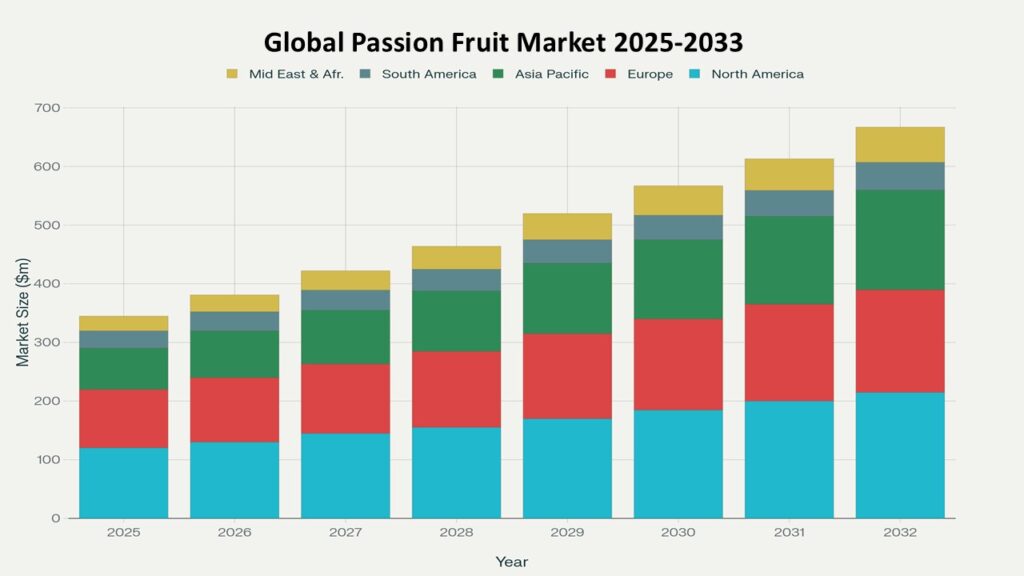
According to Phoenix Research, the Global Passion Fruit Market is valued at USD 1.1 billion in 2025 and is projected to reach USD 1.85 billion by 2033, growing at a CAGR of 6.5% during 2026–2033. This growth reflects expanding global consumption, increasing awareness of immune-supportive fruits, and innovation in value-added tropical fruit derivatives.
Latin America currently dominates the market due to favorable climatic conditions, strong cultivation capacity, and established export networks. Meanwhile, Asia-Pacific is emerging as the fastest-growing region, fueled by rising urbanization, expanding middle-class populations, and increasing demand for functional beverages and premium fruit blends.
The post-2025 outlook indicates deeper integration of passion fruit into nutraceutical formulations, functional beverage portfolios, plant-based products, and clean beauty applications. As consumer demand for superfruits and natural health-enhancing ingredients continues to strengthen, passion fruit is positioned as a long-term growth category within the broader global tropical fruit market ecosystem.
Key Drivers of Global Passion Fruit Market Growth
Rising Consumer Demand for Functional and Nutrient-Rich Foods
Growing awareness about immunity, digestion, and heart health is increasing demand for passion fruit-based beverages and wellness products globally.
Growth in Organic and Sustainable Agriculture
Producers are investing in pesticide-free, eco-certified, and fair-trade cultivation practices to meet global sustainability standards.
Expanding Use in Nutraceuticals and Dietary Supplements
Passion fruit extracts are incorporated into capsules, powders, and functional gummies due to antioxidant and anti-inflammatory benefits.
Innovation in Food and Beverage Formulations
Cold-pressed juice extraction, low-sugar blending, and superfruit pairings are enhancing premium product offerings.
Increasing Cosmetic and Personal Care Applications
Passion fruit oil is gaining traction in anti-aging, hydration, and botanical beauty formulations.
Rising E-commerce and Global Distribution Channels
Improved cold-chain logistics and digital platforms are enabling safe and efficient international distribution.
Global Passion Fruit Market Segmentation
1. By Product Type
1.1 Fresh Passion Fruit
1.1.1 Whole Fruit
1.1.1.1 Domestic Consumption
1.1.1.2 Export Markets
1.2 Processed Passion Fruit Products
1.2.1 Passion Fruit Pulp & Concentrates
1.2.1.1 Beverage Industry
1.2.1.2 Industrial Food Processing
1.2.2 Passion Fruit Juice
1.2.2.1 Retail Beverages
1.2.2.2 Food Service Industry
1.2.3 Passion Fruit Extract (Powder/Oil)
1.2.3.1 Nutraceutical Applications
1.2.3.2 Cosmetic & Personal Care
1.2.4 Frozen Passion Fruit Products
1.2.4.1 Retail Packs
1.2.4.2 Industrial Ingredient Use
2. By Distribution Channel
2.1 Supermarkets & Hypermarkets
2.1.1 Fresh Produce Sections
2.1.1.1 Seasonal Displays
2.1.1.1.1 Local Varieties
2.1.1.1.2 Imported Varieties
2.1.2 Packaged & Branded Products
2.1.2.1 Pre-Processed Packs
2.1.2.1.1 Pulp & Juice
2.1.2.1.2 Extract & Powder
2.2 Online Retail & E-Commerce
2.2.1 Direct-to-Consumer Delivery
2.2.1.1 Domestic Shipping
2.2.1.2 International Shipping
2.2.2 Subscription & Specialty Fruit Services
2.2.2.1 Organic Boxes
2.2.2.1.1 Certified Organic Varieties
2.2.2.1.2 Exotic & Premium Varieties
2.3 Traditional Retail
2.3.1 Local Markets
2.3.1.1 Urban Markets
2.3.1.2 Rural Markets
2.3.2 Wholesale Distributors
2.3.2.1 Domestic Distribution
2.3.2.2 Export Supply Chains
2.4 Food Service & Institutional
2.4.1 Hotels & Restaurants
2.4.1.1 Desserts & Platters
2.4.1.2 Beverages & Smoothies
2.4.2 Juice Bars & Cafés
2.4.2.1 Cold-Pressed Juices
2.4.2.2 Functional Smoothies
3. By Cultivation Type
3.1 Conventional Passion Fruit Farming
3.1.1 High-Yield Varieties
3.1.1.1 Local Production
3.1.1.2 Export-Oriented Production
3.2 Organic Passion Fruit Farming
3.2.1 Certified Organic Farms
3.2.1.1 Domestic Organic Markets
3.2.1.2 International Export Markets
3.3 Sustainable & Integrated Farming
3.3.1 Water-Efficient Irrigation
3.3.1.1 Drip Irrigation Systems
3.3.1.2 Rainwater Harvesting
3.3.2 Soil Health & Biodiversity
3.3.2.1 Crop Rotation
3.3.2.2 Reduced Chemical Inputs
4. By Region
4.1 Asia-Pacific
4.2 Latin America
4.3 North America
4.4 Europe
4.5 Middle East & Africa
Regional Insights of Global Passion Fruit Market
Asia-Pacific – Largest Market
India, Thailand, Vietnam, and Indonesia lead production due to favorable climate and strong processing infrastructure. Rising exports to East Asian markets further strengthen revenue growth.
Latin America – Major Export Powerhouse
Brazil, Ecuador, Colombia, and Peru dominate global exports supported by large-scale plantations and advanced cold-chain logistics.
North America
Increasing demand for functional beverages and botanical supplements is driving import growth in the U.S. and Canada.
Europe
Growing preference for organic and clean-label tropical fruit products is supporting steady expansion across Germany, France, and the U.K.
Middle East & Africa
Rising urbanization and health-conscious consumers are creating new opportunities for value-added passion fruit products.
Leading Companies in the Global Passion Fruit Market
-
Passi S.P.A.
-
Citrofrut S.A. de C.V.
-
ASC Co., Ltd.
-
AgroIndustrias Osho S.A.
-
Nectar Valley
-
Juice Products New Zealand Ltd.
-
Kerr Concentrates, Inc.
-
Natura BioFoods Pvt. Ltd.
These companies compete through sustainable sourcing, integrated processing, cold-chain optimization, and AI-based quality monitoring systems.
Strategic Intelligence & Market Insights
Phoenix Demand Forecast Engine identifies functional beverage innovation and premium fruit demand as long-term growth catalysts.
Supply Chain & Infrastructure Analyzer highlights investment in cold storage, AI-driven logistics, and traceability systems.
Innovation Tracker focuses on probiotic beverages, freeze-dried extracts, and premium juice blends.
Porter’s Five Forces Analysis indicates moderate competitive intensity with strong supplier growth opportunities in value-added fruit segments.
Why the Global Passion Fruit Market Remains Critical
-
Supports growing global demand for functional and exotic fruits
-
Drives innovation in beverages, nutraceuticals, and cosmetics
-
Enhances international trade for tropical economies
-
Promotes sustainable and organic farming practices
-
Strengthens global supply chain efficiency
Final Takeaway of Global Passion Fruit Market
The Global Passion Fruit Market is projected to grow steadily at a CAGR of 6.5% during 2026–2033, driven by increasing health awareness, organic adoption, nutraceutical expansion, and value-added processing innovation.
Companies focusing on sustainable cultivation, premium juice processing, AI-enabled supply chain management, and export expansion are positioned to secure long-term competitive advantage.
At Phoenix Research, our AI-backed market intelligence framework delivers in-depth forecasts, regional insights, supply chain analytics, and innovation benchmarking—empowering stakeholders to capitalize on next-generation passion fruit market opportunities with data-driven precision.
Table of Contents
1. Executive Summary
1.1 Market Forecast Snapshot (2026–2033)
1.2 Global Market Size & CAGR Analysis
1.3 Largest & Fastest-Growing Segments
1.4 Region-Level Leadership & Growth Trends
1.5 Key Market Drivers
1.6 Competitive Landscape Overview
1.7 Strategic Outlook Through 2033
2. Introduction & Market Overview
2.1 Definition of the Global Passion Fruit Market
2.2 Scope of the Study
2.3 Evolution from Fresh Consumption to Processed Products
2.4 Role of Cold Chain Infrastructure & Supply Optimization
2.5 Impact of Health & Wellness Trends
2.6 Integration of Sustainable & Organic Farming Practices
2.7 AI-Driven Supply Chain Management & Value-Added Products
3. Research Methodology
3.1 Primary Research
3.2 Secondary Research
3.3 Market Size Estimation Model
3.4 Forecast Assumptions (2026–2033)
3.5 Data Validation & Triangulation
4. Market Dynamics
4.1 Drivers
4.1.1 Rising Health & Wellness Trends
4.1.2 Expansion of Cold Chain & Logistics Infrastructure
4.1.3 Growth in Processed Passion Fruit Products
4.1.4 Favorable Climate & Cultivation Practices
4.1.5 Rising Export & Trade Opportunities
4.2 Restraints
4.2.1 Climate Variability & Crop Vulnerability
4.2.2 Limited Shelf Life of Fresh Fruit
4.2.3 Price Volatility in International Trade
4.2.4 Certification & Compliance Costs
4.3 Opportunities
4.3.1 Expansion of Organic Passion Fruit Farming
4.3.2 Development of Value-Added Products
4.3.3 AI-Driven Cold Chain Optimization
4.3.4 Export Market Diversification
4.4 Challenges
4.4.1 Pest & Disease Management
4.4.2 Infrastructure Investment Requirements
4.4.3 Quality Maintenance Across Global Supply Chains
4.4.4 Competition from Alternative Tropical Fruits
5. Global Passion Fruit Market Analysis (USD Billion), 2026–2033
5.1 Market Size Overview
5.2 CAGR Analysis
5.3 Region-Wise Revenue Distribution
5.4 Product Type Revenue Split
5.5 Distribution Channel Revenue Trends
5.6 Cultivation Type Impact Analysis
6. Market Segmentation by Product Type (USD Billion), 2026–2033
6.1 Fresh Passion Fruit
6.1.1 Whole Fruit
6.1.1.1 Domestic Consumption
6.1.1.2 Export Markets
6.2 Processed Passion Fruit Products
6.2.1 Passion Fruit Juice & Beverages
6.2.1.1 Retail Beverages
6.2.1.2 Food Service Industry
6.2.2 Passion Fruit Pulp & Concentrates
6.2.2.1 Bakery & Confectionery Applications
6.2.2.2 Frozen Dessert Applications
6.2.3 Dried & Freeze-Dried Passion Fruit
6.2.3.1 Packaged Consumer Snacks
6.2.3.2 Functional Ingredient Use
7. Market Segmentation by Distribution Channel (USD Billion), 2026–2033
7.1 Supermarkets & Hypermarkets
7.2 Online Retail & E-Commerce
7.3 Traditional Retail Markets
7.4 Food Service & Institutional Channels
8. Market Segmentation by Cultivation Type (USD Billion), 2026–2033
8.1 Conventional Farming
8.2 Organic Farming
8.3 Sustainable & Integrated Farming
9. Market Segmentation by Geography
9.1 Asia-Pacific
9.2 Latin America
9.3 North America
9.4 Europe
9.5 Middle East & Africa
10. Competitive Landscape – Global
10.1 Market Share Analysis
10.2 Product Portfolio Benchmarking
10.3 Organic vs Conventional Cultivation Mapping
10.4 Supply Chain & Cold Chain Partnerships
10.5 Competitive Differentiation Strategies
11. Company Profiles
11.1 Döhler GmbH
11.2 Prodalim Group
11.3 Passi S.P.A.
11.4 Citrofrut S.A. de C.V.
11.5 ASC Co., Ltd.
11.6 AgroIndustrias Osho S.A.
11.7 Nectar Valley
11.8 Juice Products New Zealand Ltd.
11.9 Kerr Concentrates, Inc.
11.11 Natura BioFoods Pvt. Ltd.
12. Strategic Intelligence & Phoenix AI-Backed Insights
12.1 Phoenix Demand Forecast Engine
12.2 Supply Chain & Infrastructure Analyzer
12.3 AI-Driven Logistics Optimization Tracker
12.4 Value-Added Product Innovation Insights
12.5 Porter’s Five Forces Analysis
13. Future Outlook & Strategic Recommendations
13.1 Organic Cultivation Expansion
13.2 Cold Chain Optimization & AI Integration
13.3 Value-Added Product Development
13.4 Export Market Diversification
13.5 Long-Term Market Outlook (2033+)
14. Appendix
15. About Phoenix Research
16. Disclaimer