
Global Propylene Glycol Market Report, Size & Forecast 2026-2033
Global Propylene Glycol Market Report, Size, Share and Forecast 2026???2033
Market Forecast Snapshot (2026???2033)
| Metric | Value |
|---|---|
| Market Size (2025) | USD 5.80 Billion |
| Market Size (2033) | USD 8.96 Billion |
| CAGR (2026???2033) | 5.58% |
| Largest Segment | Industrial Grade Propylene Glycol |
| Fastest Growing Segment | Bio-Based Propylene Glycol |
| Leading End-Use Industry | Food & Beverage |
| Key Trend | Shift Toward Sustainable & Bio-Based Glycols |
| Regulatory Influence | Food Safety Standards, Pharmaceutical Purity Compliance & Environmental Regulations |
| Future Outlook | Growth Driven by Green Chemistry, Industrial Demand & Specialty Applications |
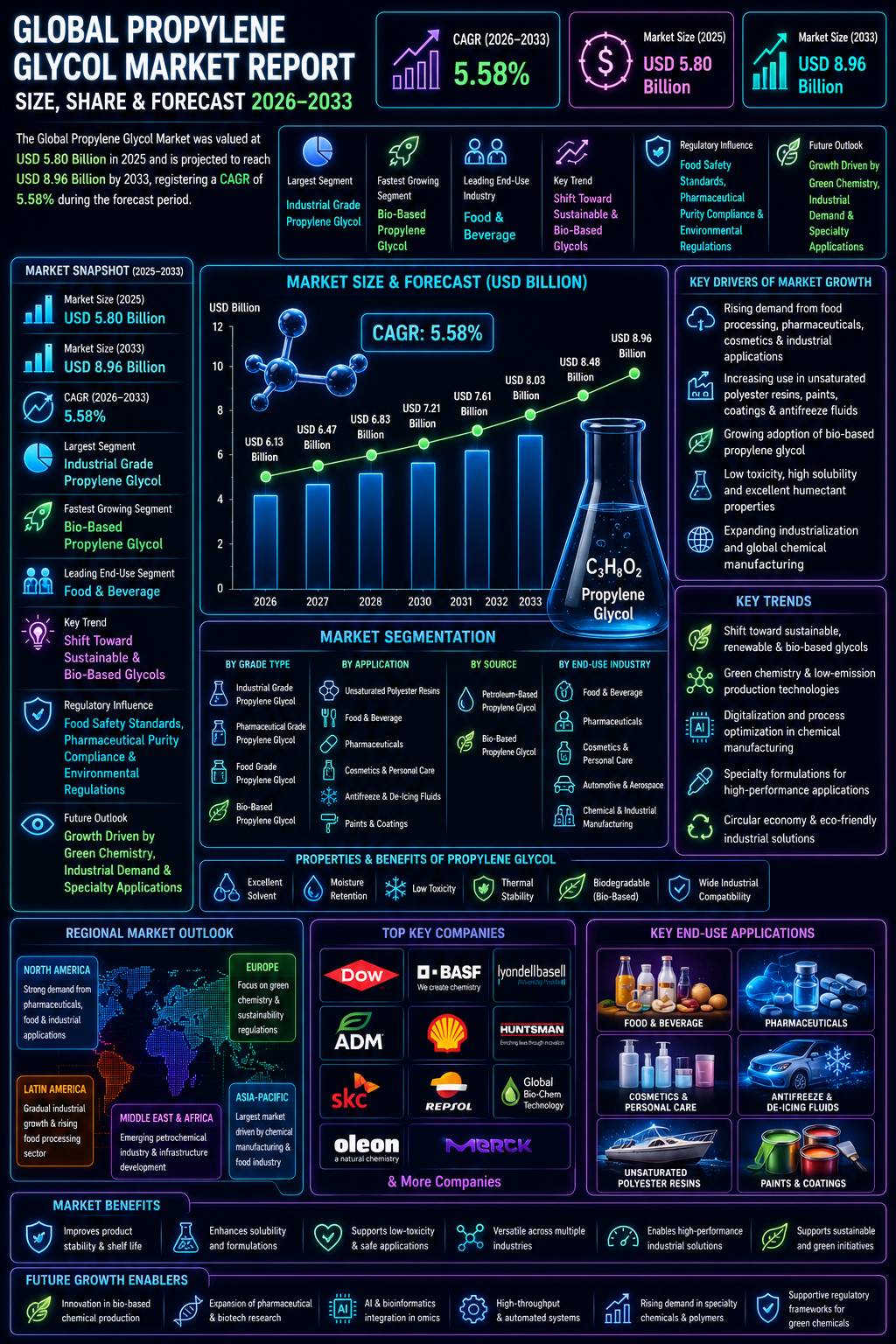
Market Size & Forecast
The Global Propylene Glycol Market is expected to witness steady growth during the forecast period from 2026 to 2033. The market was valued at USD 5.80 billion in 2025 and is projected to reach approximately USD 8.96 billion by 2033, registering a CAGR of 5.58%. The market growth is primarily driven by rising demand from food processing, pharmaceuticals, cosmetics, unsaturated polyester resins, de-icing fluids, paints & coatings, and industrial chemical manufacturing. Propylene glycol is widely used as a solvent, humectant, antifreeze agent, stabilizer, preservative carrier, and intermediate chemical in multiple industries. Rising adoption in processed foods, oral medicines, skin-care products, industrial coolants, and polymer production is supporting demand expansion. Additionally, increasing sustainability initiatives, growth in bio-based chemical production, and demand for low-toxicity alternatives to ethylene glycol are accelerating market penetration globally.Global Propylene Glycol Market Overview
Propylene glycol is a synthetic organic compound widely used in industrial, pharmaceutical, food-grade, and cosmetic formulations due to its low toxicity, moisture-retention capacity, and solvent compatibility. The market includes industrial grade propylene glycol, pharmaceutical grade propylene glycol, food-grade propylene glycol, and bio-based propylene glycol. Propylene glycol is extensively used in food additives, cosmetics, pharmaceuticals, resin manufacturing, aircraft de-icing fluids, heat transfer fluids, paints, detergents, and polymer intermediates. The market is gradually shifting from petrochemical-based production toward sustainable bio-based propylene glycol and environmentally safer industrial applications.Structural Drivers of Market Growth
1. Innovation and Commercialization Acceleration
Advancements in bio-based chemical synthesis, green manufacturing, and catalytic production technologies are improving production efficiency and sustainability. Increasing commercialization of renewable feedstock-based propylene glycol is reshaping the market.Market Implications
Manufacturers investing in bio-based glycol production, cleaner synthesis routes, and circular chemical processes are expected to strengthen market competitiveness.2. Compliance and Risk Repricing
Food safety regulations, pharmaceutical purity requirements, cosmetic ingredient standards, and emissions compliance are influencing production and distribution. Environmental regulations are also driving lower-carbon alternatives.Market Implications
Companies offering compliant, food-safe, pharma-grade, and environmentally sustainable solutions are likely to gain stronger adoption.3. Competitive and Value-Chain Reconfiguration
Petrochemical producers, specialty chemical firms, renewable chemistry companies, and industrial fluid manufacturers are increasingly competing in the value chain. Bio-feedstock integration and raw material cost optimization are influencing profit margins.Market Implications
Firms focusing on feedstock efficiency, vertical integration, and specialty glycol formulations may gain higher market share.4. Capital and Capacity Scaling
Rising investment in chemical plants, bio-refineries, pharmaceutical ingredients, and food-grade production capacity is supporting market expansion. Industrial chemical demand in emerging economies is also strengthening capacity growth.Market Implications
Companies scaling sustainable manufacturing, purification technologies, and specialty-grade production are expected to capture future opportunities.Market Segmentation Analysis
By Grade Type
1. Industrial Grade Propylene Glycol
This remains the largest segment due to high use in resins, antifreeze fluids, coatings, and industrial chemicals.2. Pharmaceutical Grade Propylene Glycol
Widely used in injectable formulations, oral medicines, and drug-solvent applications.3. Food Grade Propylene Glycol
Strong growth due to rising use in food additives, flavor carriers, and moisture retention.4. Bio-Based Propylene Glycol
Fastest-growing segment due to rising sustainability and green chemical demand.By Application
1. Unsaturated Polyester Resins
Largest application segment due to high demand in construction composites and plastics.2. Food & Beverage
Used in flavorings, preservatives, and food stabilization.3. Pharmaceuticals
Important in drug formulations, topical medicines, and injectable preparations.4. Cosmetics & Personal Care
Growing demand in lotions, creams, and hygiene products.5. Antifreeze & De-Icing Fluids
Used in aviation, automotive, and industrial cooling applications.6. Paints & Coatings
Used as a solvent and performance stabilizer.By Source
1. Petroleum-Based Propylene Glycol
Currently dominates due to established production infrastructure.2. Bio-Based Propylene Glycol
Fast-growing due to renewable chemical production.By End-Use Industry
1. Food & Beverage
Leading segment due to broad use in food-safe formulations.2. Pharmaceuticals
Strong growth due to healthcare demand.3. Cosmetics & Personal Care
Rising demand for skincare and beauty products.4. Automotive & Aerospace
Used in coolants and de-icing fluids.5. Chemical & Industrial Manufacturing
Broad industrial applications continue driving demand.Regional Market Dynamics
Asia-Pacific
Asia-Pacific dominates the global propylene glycol market due to strong chemical manufacturing, food processing, pharmaceutical production, and industrial growth in China and India.North America
North America shows strong demand due to bio-based chemicals, pharmaceutical manufacturing, and food-grade applications.Europe
Europe remains a major market supported by sustainability regulations, green chemistry, and specialty chemicals.Latin America
Latin America is gradually expanding due to industrial growth and food processing demand.Middle East & Africa
The region is witnessing emerging growth due to petrochemical expansion and industrial development.Competitive Landscape
The Global Propylene Glycol Market is moderately consolidated with chemical manufacturers, bio-based producers, and specialty ingredient companies competing globally.Key companies operating in the market include:
- Dow Inc.
- BASF SE
- LyondellBasell Industries
- Archer Daniels Midland (ADM)
- Shell Chemicals
- Huntsman Corporation
- SKC Co. Ltd.
- Repsol
- Global Bio-Chem Technology
- Oleon NV
Strategic Outlook
The future of the propylene glycol market will be shaped by renewable chemical production, bio-refinery expansion, green chemistry, specialty formulations, and low-emission manufacturing. Demand from pharmaceuticals, food additives, industrial coolants, and sustainable consumer products is expected to support long-term expansion. Bio-based propylene glycol, low-carbon chemical production, and specialty industrial applications are likely to create major growth opportunities.Final Market Perspective
The Global Propylene Glycol Market remains an important segment within specialty chemicals, industrial manufacturing, and sustainable materials. Rising demand across pharmaceuticals, food safety, cosmetics, and industrial chemicals continues driving long-term market growth. Companies capable of delivering sustainable, compliant, high-purity, and cost-efficient glycol solutions will be best positioned to capture future opportunities. The convergence of green chemistry, industrial demand, and specialty-grade production is expected to redefine the future of the global propylene glycol industry.Table of Contents
Table of Contents
1. Executive Summary
1.1 Market Snapshot
1.2 Key Growth Highlights
1.3 Largest Segment Analysis
1.4 Fastest Growing Segment Analysis
1.5 Regional Outlook
1.6 Competitive Landscape Snapshot
1.7 Future Market Outlook
2. Global Propylene Glycol Market Introduction
2.1 Market Definition
2.2 Scope of Study
2.3 Research Assumptions
2.4 Research Methodology
2.5 Forecast Parameters
3. Global Propylene Glycol Market Overview
3.1 Market Evolution
3.2 Industry Ecosystem Analysis
3.3 Value Chain Analysis
3.4 Pricing & Cost Structure Analysis
3.5 Raw Material Supply Chain Overview
3.6 Technology & Production Landscape
3.6.1 Petrochemical-Based Production Technologies
3.6.1.1 Conventional Chemical Synthesis
3.6.1.1.1 Refining & Purification Systems
3.6.1.1.1.1 High-Purity Industrial Processing
3.6.1.1.1.2 Large-Scale Chemical Efficiency Models
3.6.2 Bio-Based Propylene Glycol Production
3.6.2.1 Renewable Feedstock Conversion
3.6.2.1.1 Green Chemistry Processes
3.6.2.1.1.1 Low-Carbon Chemical Manufacturing
3.6.2.1.1.2 Sustainable Refinery Systems
3.6.3 Specialty Grade Manufacturing Technologies
3.6.3.1 Pharmaceutical Grade Purification
3.6.3.1.1 Food-Grade Stabilization
3.6.3.1.1.1 Compliance-Based Processing
3.6.3.1.1.2 High-Performance Specialty Formulations
3.7 Regulatory Landscape
3.7.1 Food Safety Standards
3.7.1.1 Pharmaceutical Purity Compliance
3.7.1.1.1 Cosmetic Ingredient Regulations
3.7.1.1.1.1 Chemical Safety Validation Standards
3.7.1.1.1.2 Environmental Emission Regulations
3.8 Market Trends & Innovation Outlook
3.8.1 Shift Toward Sustainable & Bio-Based Glycols
3.8.1.1 Renewable Chemistry Adoption
3.8.1.1.1 Circular Manufacturing Strategies
3.8.1.1.1.1 Eco-Efficient Chemical Production
3.8.1.1.1.2 Green Industrial Transformation
4. Global Propylene Glycol Market Dynamics
4.1 Market Drivers
4.1.1 Rising Demand from Food Processing Industry
4.1.1.1 Food Additives & Flavor Carrier Expansion
4.1.1.1.1 Moisture Retention Applications
4.1.1.1.1.1 Food-Grade Chemical Demand
4.1.2 Growth in Pharmaceutical Applications
4.1.2.1 Drug Formulation Expansion
4.1.2.1.1 Injectable & Oral Medicine Usage
4.1.2.1.1.1 High-Purity Solvent Requirements
4.1.3 Increasing Adoption in Cosmetics & Personal Care
4.1.3.1 Skincare Product Development
4.1.3.1.1 Humectant & Stabilizer Usage
4.1.3.1.1.1 Premium Cosmetic Ingredient Demand
4.1.4 Expansion of Industrial Chemical Applications
4.1.4.1 Resins & Polymer Production
4.1.4.1.1 Paints & Coatings Growth
4.1.4.1.1.1 Specialty Chemical Formulations
4.1.5 Rising Sustainability & Bio-Based Chemical Demand
4.1.5.1 Green Chemistry Adoption
4.1.5.1.1 Renewable Feedstock Integration
4.1.5.1.1.1 Low-Toxicity Chemical Alternatives
4.2 Market Restraints
4.2.1 Raw Material Price Volatility
4.2.1.1 Petrochemical Dependency Risks
4.2.1.1.1 Feedstock Cost Pressure
4.2.1.1.1.1 Margin Instability Challenges
4.2.2 Environmental Concerns in Conventional Production
4.2.2.1 Carbon Emission Pressure
4.2.2.1.1 Industrial Waste Management
4.2.2.1.1.1 Regulatory Cost Burden
4.2.3 Compliance Complexity
4.2.3.1 Food & Pharma Validation Standards
4.2.3.1.1 Regional Safety Certification
4.2.3.1.1.1 Product Approval Delays
4.2.4 High Bio-Based Production Cost
4.2.4.1 Limited Scale Efficiency
4.2.4.1.1 Infrastructure Investment Needs
4.2.4.1.1.1 Commercialization Challenges
4.3 Market Opportunities
4.3.1 Growth in Bio-Based Propylene Glycol
4.3.1.1 Renewable Chemical Expansion
4.3.1.1.1 Sustainable Production Scaling
4.3.1.1.1.1 Circular Economy Opportunities
4.3.2 Expansion in Specialty Applications
4.3.2.1 Pharmaceutical Innovations
4.3.2.1.1 High-Performance Chemicals
4.3.2.1.1.1 Advanced Functional Fluids
4.3.3 Rising Aerospace & Automotive Usage
4.3.3.1 De-Icing Fluids
4.3.3.1.1 Industrial Coolants
4.3.3.1.1.1 Heat Transfer Solutions
4.3.4 Emerging Market Industrial Growth
4.3.4.1 Chemical Manufacturing Expansion
4.3.4.1.1 Infrastructure Development
4.3.4.1.1.1 Regional Capacity Growth
4.4 Market Challenges
4.4.1 Supply Chain Disruptions
4.4.2 Sustainability Transition Costs
4.4.3 Competitive Pricing Pressure
4.4.4 Specialty Grade Quality Control
5. Global Propylene Glycol Market Size Analysis (USD Billion), 2026???2033
5.1 Revenue Forecast Analysis
5.2 CAGR Analysis
5.3 Demand-Supply Analysis
5.4 Segment Contribution Analysis
5.5 Pricing Trend Analysis
6. Global Propylene Glycol Market Segmentation Analysis
6.1 By Grade Type
6.1.1 Industrial Grade Propylene Glycol
6.1.1.1 Resin Manufacturing Applications
6.1.1.1.1 Chemical Solvent Systems
6.1.1.1.1.1 Industrial Fluid Solutions
6.1.2 Pharmaceutical Grade Propylene Glycol
6.1.2.1 Injectable Formulations
6.1.2.1.1 Oral Medicine Applications
6.1.2.1.1.1 Drug Carrier Systems
6.1.3 Food Grade Propylene Glycol
6.1.3.1 Flavor Carrier Solutions
6.1.3.1.1 Moisture Stabilizers
6.1.3.1.1.1 Food Preservation Applications
6.1.4 Bio-Based Propylene Glycol
6.1.4.1 Renewable Feedstock Systems
6.1.4.1.1 Sustainable Industrial Formulations
6.1.4.1.1.1 Green Chemical Products
6.2 By Application
6.2.1 Unsaturated Polyester Resins
6.2.1.1 Construction Composite Applications
6.2.1.1.1 Plastic Manufacturing Systems
6.2.1.1.1.1 High-Strength Resin Formulations
6.2.2 Food & Beverage
6.2.3 Pharmaceuticals
6.2.4 Cosmetics & Personal Care
6.2.5 Antifreeze & De-Icing Fluids
6.2.6 Paints & Coatings
6.3 By Source
6.3.1 Petroleum-Based Propylene Glycol
6.3.2 Bio-Based Propylene Glycol
6.4 By End-Use Industry
6.4.1 Food & Beverage
6.4.2 Pharmaceuticals
6.4.3 Cosmetics & Personal Care
6.4.4 Automotive & Aerospace
6.4.5 Chemical & Industrial Manufacturing
7. Regional Market Analysis
7.1 Asia-Pacific
7.1.1 China
7.1.2 India
7.1.3 Japan
7.1.4 South Korea
7.1.5 Rest of Asia-Pacific
7.2 North America
7.2.1 U.S.
7.2.2 Canada
7.2.3 Mexico
7.3 Europe
7.3.1 Germany
7.3.2 U.K.
7.3.3 France
7.3.4 Italy
7.3.5 Spain
7.3.6 Rest of Europe
7.4 Latin America
7.4.1 Brazil
7.4.2 Argentina
7.4.3 Rest of Latin America
7.5 Middle East & Africa
7.5.1 GCC Countries
7.5.2 South Africa
7.5.3 Rest of Middle East & Africa
8. Competitive Landscape
8.1 Market Share Analysis
8.2 Competitive Intensity Overview
8.3 Strategic Developments
8.4 Product Innovation & Sustainability Expansion
8.5 Partnerships, Mergers & Acquisitions
8.6 Specialty Chemical Ecosystem Positioning Analysis
9. Company Profiles
9.1 Dow Inc.
9.2 BASF SE
9.3 LyondellBasell Industries
9.4 Archer Daniels Midland (ADM)
9.5 Shell Chemicals
9.6 Huntsman Corporation
9.7 SKC Co. Ltd.
9.8 Repsol
9.9 Global Bio-Chem Technology
9.10 Oleon NV
10. Strategic Intelligence & Pheonix AI Insights
10.1 Pheonix Demand Forecast Engine
10.2 Green Chemistry Adoption Analyzer
10.3 Specialty Chemical Risk Tracker
10.4 Bio-Based Growth Opportunity Insights
10.5 Automated Porter???s Five Forces Analysis
11. Future Outlook & Strategic Recommendations
11.1 Bio-Based Propylene Glycol Expansion
11.2 Sustainable Manufacturing Strategies
11.3 Specialty Application Growth Areas
11.4 Industrial Capacity Optimization
11.5 Long-Term Market Outlook (2033+)
12. Appendix
12.1 Abbreviations
12.2 Research References
12.3 Data Sources
13. About Pheonix
14. Market Research
15. Disclaimer
Competitive Landscape
Global Propylene Glycol Market Competitive Intensity & Market Structure Overview
The Global Propylene Glycol Market is characterized by a moderately consolidated and feedstock-driven competitive structure, where major petrochemical manufacturers, specialty chemical firms, and renewable chemistry producers compete through production scale, feedstock integration, purity standards, sustainability innovation, and application-specific formulations. Competition is primarily driven by raw material access, manufacturing efficiency, bio-based glycol development, regulatory compliance, specialty-grade production, distribution reach, and end-use diversification.
The market is led by key players such as Dow Inc., BASF SE, LyondellBasell Industries, Archer Daniels Midland (ADM), Shell Chemicals, Huntsman Corporation, SKC Co. Ltd., Repsol, Global Bio-Chem Technology, and Oleon NV, which compete through integrated chemical manufacturing, bio-refinery capabilities, product purity, industrial partnerships, and global supply networks.
Growing demand across food & beverage, pharmaceuticals, cosmetics & personal care, unsaturated polyester resins, paints & coatings, de-icing fluids, automotive, aerospace, and industrial chemicals is intensifying competition. Companies are increasingly investing in bio-based propylene glycol, green chemistry, circular feedstocks, low-emission production systems, specialty formulations, and sustainable purification technologies.
Global Propylene Glycol Market Competitive Landscape
Leading Company Profiles
- Dow Inc. ??? Major global leader in industrial chemicals, glycols, and integrated propylene glycol production.
- BASF SE ??? Strong player in specialty chemicals, industrial intermediates, and high-purity glycol solutions.
- LyondellBasell Industries ??? Leading petrochemical producer with broad feedstock and glycol manufacturing capabilities.
- Archer Daniels Midland (ADM) ??? Key player in bio-based propylene glycol and renewable feedstock-based chemical production.
- Shell Chemicals ??? Major supplier with strong petrochemical integration and industrial glycol portfolio.
- Huntsman Corporation ??? Significant presence in specialty chemicals, industrial fluids, and performance materials.
- SKC Co. Ltd. ??? Active in advanced materials, petrochemicals, and glycol derivatives.
- Repsol ??? Strong energy and petrochemical company with integrated feedstock and specialty chemical solutions.
- Global Bio-Chem Technology ??? Focused on bio-based chemical intermediates and sustainable industrial ingredients.
- Oleon NV ??? Expanding in oleochemical and renewable-based specialty glycol solutions.
Key Competitive Intensity Signals
- Competition in bio-based propylene glycol production is rapidly intensifying.
- Feedstock integration and cost optimization remain core competitive advantages.
- Food-grade, pharmaceutical-grade, and specialty-purity compliance are creating strong quality-based barriers.
- Sustainability regulations are accelerating low-carbon and renewable glycol innovation.
- Vertical integration across petrochemical and bio-refinery ecosystems is strengthening supply stability.
- Specialty industrial formulations for resins, coatings, and coolants are expanding premium-margin competition.
- Emerging market industrial demand is increasing capacity expansion and geographic rivalry.
Strategic Implications
- Companies with strong feedstock control and integrated production can maintain cost advantages.
- Bio-based glycol manufacturing may become a major long-term differentiation factor.
- Specialty-grade and pharma-grade purification capabilities can improve premium positioning.
- Sustainability-led chemical innovation will likely strengthen regulatory and customer adoption.
- Partnerships in food, pharma, and industrial manufacturing sectors may improve recurring demand stability.
Forward Outlook
The Global Propylene Glycol Market is expected to remain moderately consolidated with high competitive intensity, supported by industrial chemical demand, sustainability trends, and specialty-grade applications.
Future competition will increasingly focus on:
- Bio-based propylene glycol production
- Green chemistry and low-carbon synthesis
- Specialty-grade purification and compliance
- Feedstock integration and cost efficiency
- Circular manufacturing and renewable inputs
- Food-safe and pharma-grade formulations
- High-performance industrial applications
The convergence of green chemistry, petrochemical integration, industrial manufacturing, sustainability, specialty applications, and renewable feedstocks will continue reshaping the long-term competitive landscape.
Value Chain
Global Propylene Glycol Market Value Chain & Supply Chain Evolution Overview
The Global Propylene Glycol Market operates through a chemical manufacturing-driven ecosystem supported by feedstock sourcing, chemical synthesis, purification, specialty-grade formulation, industrial distribution, and multi-industry application networks. The market is increasingly influenced by bio-based production, green chemistry, and specialty-grade purity requirements.
The value chain depends on petrochemical inputs, renewable feedstocks, catalytic processing, refining systems, quality control, and downstream industrial integration across food, pharma, cosmetics, and industrial manufacturing.
Supply chain complexity is moderate to high due to raw material volatility, purity-grade segmentation, environmental regulations, specialized storage/transport, and cross-industry compliance requirements.
Global Propylene Glycol Market Value Chain & Supply Chain Evolution Current Scenario
Market-Specific Value Chain
1. Raw Material & Feedstock Sourcing
Propylene oxide, glycerin, petrochemical derivatives, renewable biomass feedstocks, catalysts, and specialty additives.
2. Chemical Processing & Synthesis
Hydration processes, catalytic conversion, bio-based synthesis, refining, separation, and chemical transformation systems.
3. Purification & Grade Manufacturing
Industrial-grade, food-grade, pharmaceutical-grade, and bio-based propylene glycol production.
4. Quality Control & Regulatory Compliance
Purity validation, food safety testing, pharmaceutical compliance, environmental monitoring, and emissions control.
5. Distribution & Industrial Supply Networks
Bulk chemical distributors, direct industrial contracts, tanker logistics, storage terminals, specialty ingredient suppliers, and regional chemical networks.
6. End-Use Industry Deployment
Food & beverage, pharmaceuticals, cosmetics, automotive, aerospace, paints & coatings, resins, and industrial manufacturing.
Key Value Chain Evolution Signals
1. Shift Toward Bio-Based Glycols
Renewable feedstocks are becoming a major growth driver.
2. Purity-Specific Manufacturing
Food-grade and pharma-grade demand is increasing.
3. Regulatory Pressure
Environmental and safety compliance influence production.
4. Feedstock Volatility
Petrochemical pricing affects margins.
5. Vertical Integration Growth
Chemical companies optimize upstream/downstream control.
6. Specialty Application Expansion
Higher-value formulations improve profitability.
Strategic Implications
1. Feedstock Optimization
Efficient sourcing improves cost stability.
2. Sustainable Production
Bio-based and green chemistry improve competitiveness.
3. Purity Compliance
High-grade manufacturing strengthens trust and adoption.
4. Distribution Efficiency
Bulk logistics and industrial contracts improve scalability.
5. Vertical Integration
Integrated chemical operations improve margins.
Forward Outlook
The market is expected to evolve toward a more sustainable and specialty-driven chemical ecosystem through:
- Bio-refinery expansion
- Renewable feedstocks
- Specialty-grade purification
- Low-carbon chemical production
- Advanced catalytic processing
- Industrial efficiency optimization
- Higher-value downstream formulations
Investment Activity
Global Propylene Glycol Market Investment & Funding Dynamics Overview
The Global Propylene Glycol Market is witnessing stable investment momentum driven by rising demand across food processing, pharmaceuticals, cosmetics, industrial chemicals, and sustainable material applications. Petrochemical companies, specialty chemical manufacturers, renewable chemistry firms, and industrial ingredient suppliers are actively investing in production efficiency, bio-based glycol manufacturing, purification systems, and specialty-grade chemical processing infrastructure.
Investment activity is accelerating due to growing demand for food-safe formulations, pharmaceutical excipients, polymer intermediates, low-toxicity coolants, and environmentally safer chemical alternatives. The increasing shift toward bio-based propylene glycol, green chemistry, and renewable feedstock integration is significantly influencing capital allocation across the market.
Additionally, expanding investments in bio-refineries, chemical plants, purification technologies, and sustainable manufacturing processes are strengthening long-term growth opportunities globally.
Global Propylene Glycol Market Investment & Funding Dynamics Current Scenario
Currently, the Global Propylene Glycol Market demonstrates moderate investment activity with medium-to-high capital intensity due to chemical plant expansion, feedstock integration, refining infrastructure, and specialty-grade production requirements. Major players are investing in bio-based glycol production, industrial-grade purification, pharmaceutical-grade formulations, and environmentally compliant manufacturing systems.
The market is attracting funding into renewable feedstock technologies, low-carbon chemical production, circular manufacturing processes, and specialty formulation development. Rising sustainability initiatives and industrial chemical demand are further supporting investment flow.
The industry is witnessing selective merger, partnership, and acquisition activity as petrochemical firms, renewable chemical producers, and specialty ingredient manufacturers pursue vertical integration, product diversification, and sustainability-focused expansion.
Key Investment & Funding Dynamics Signals in Global Propylene Glycol Market
- Rising demand from food & beverage, pharmaceuticals, cosmetics, and industrial manufacturing is supporting long-term chemical infrastructure investments.
- Expansion of bio-refineries, purification systems, and specialty-grade chemical plants is increasing capital deployment.
- Growing focus on bio-based propylene glycol and renewable feedstock integration is strengthening sustainability-led investments.
- Strategic investments in green chemistry, low-carbon manufacturing, and process optimization are reshaping production priorities.
- Partnerships between petrochemical firms, renewable chemistry companies, and industrial manufacturers are improving supply-chain efficiency.
- Increasing regulatory focus on food safety, pharmaceutical purity, and environmental compliance is supporting investor confidence.
- Rising demand for high-purity, low-toxicity, and specialty glycol solutions is accelerating R&D and production spending.
Strategic Implications of Investment & Funding Dynamics in Global Propylene Glycol Market
- Continuous investment in bio-based chemical production, cleaner synthesis routes, and sustainable manufacturing is essential for long-term competitiveness.
- Medium-to-high capital intensity requires strong allocation toward refining systems, purification technologies, and specialty-grade production capacity.
- Companies capable of delivering cost-efficient, compliant, and high-purity glycol solutions will strengthen market positioning.
- Strategic M&A and vertical integration are improving feedstock security and product diversification.
- Investments in renewable chemicals, circular production, and green industrial applications will remain major priorities.
- Compliance with food safety, pharma-grade purity, and environmental standards is critical for long-term market adoption.
- Companies investing in specialty formulations, low-carbon production, and advanced purification workflows are expected to capture future growth opportunities.
Global Propylene Glycol Market Investment & Funding Dynamics Forward Outlook
Looking ahead, the Global Propylene Glycol Market is expected to maintain steady investment growth driven by bio-based glycol expansion, industrial demand, food-grade applications, and sustainable chemistry innovation.
Future capital deployment will increasingly focus on renewable feedstock integration, bio-refinery scaling, pharmaceutical-grade purification, low-emission chemical production, and specialty application development. Sustainable manufacturing and green chemistry are expected to become major long-term innovation priorities.
In conclusion, the Global Propylene Glycol Market represents a stable, sustainability-driven investment landscape where renewable chemistry, specialty formulations, industrial demand, and compliance-led production will define future capital strategies.
Technology & Innovation
Global Single Cell Genomics and Proteomics Market Technology & Innovation Landscape Overview
The Global Single Cell Genomics and Proteomics Market is witnessing rapid technological transformation driven by advances in single-cell sequencing, spatial omics, proteogenomics, AI-powered bioinformatics, microfluidics, cloud-based analytics, and integrated multi-omics platforms. The market reflects a high innovation intensity level, supported by strong research funding, rising precision medicine demand, oncology expansion, and increasing pharmaceutical R&D.
At the center of this innovation shift is the transition from conventional bulk-cell molecular analysis toward single-cell resolution biology, enabling researchers to analyze genetic, transcriptomic, and proteomic behavior at the individual cell level. This significantly improves understanding of tumor heterogeneity, immune-cell profiling, stem-cell behavior, disease progression, and biomarker discovery.
A major innovation area is AI-driven multi-omics integration, where genomics, proteomics, transcriptomics, and epigenomics are combined into unified analytical workflows. These systems improve therapeutic targeting, precision diagnostics, and drug discovery efficiency.
The market is also seeing rapid advancements in microfluidic cell isolation systems, droplet-based sequencing, automated sample preparation, and high-throughput cellular analysis, improving reproducibility, speed, and scalability.
Spatial biology remains a major innovation frontier, with increasing adoption of spatial transcriptomics, imaging mass cytometry, tissue-level mapping, and localized protein-expression analysis, enabling deeper biological understanding within native tissue environments.
Manufacturers are increasingly developing AI-enabled bioinformatics software, predictive biomarker modeling, cloud omics platforms, and automated research workflows, improving large-scale biological data interpretation.
Additionally, advances in single-cell proteomics, multiplex assays, mass spectrometry sensitivity, rare-cell profiling, and immune-cell phenotyping are reshaping competitive differentiation.
The convergence of genomics, proteomics, AI, cloud computing, precision diagnostics, and laboratory automation is redefining the future technology landscape of the global single cell genomics and proteomics market.
Global Single Cell Genomics and Proteomics Market Technology & Innovation Landscape Current Scenario
Currently, the Global Single Cell Genomics and Proteomics Market demonstrates high patent activity and strong commercialization across sequencing tools, proteomics systems, AI bioinformatics, and integrated molecular analysis platforms.
1. Single-Cell Sequencing Platforms
High-throughput NGS and transcriptomic technologies are significantly improving cellular-level resolution.
2. Multi-Omics Workflow Integration
Unified genomic-proteomic systems are accelerating biomarker and therapeutic discovery.
3. AI-Powered Bioinformatics
Machine learning and predictive modeling are enhancing biological interpretation.
4. Spatial Omics & Tissue Mapping
Spatial transcriptomics and tissue-level analytics are improving disease-pathway understanding.
5. Microfluidics & Cell Isolation Innovation
Advanced droplet and sorting systems are strengthening precision sample handling.
6. Cloud Bioinformatics & Omics Analytics
Cloud-native genomic storage and distributed analysis are improving scalability and collaboration.
Key Technology & Innovation Landscape Signals in Global Single Cell Genomics and Proteomics Market
Several innovation signals are shaping the market:
1. Rising Precision Medicine & Oncology Applications
Single-cell analysis is becoming central to personalized therapeutics and tumor biology.
2. Expansion of AI-Driven Omics Interpretation
AI tools are accelerating complex molecular-data analysis.
3. Increasing Multi-Omics Integration
End-to-end omics workflows are improving research precision and speed.
4. Growth of Single Cell Proteomics
Protein-level cellular analysis is becoming a major high-growth innovation segment.
5. Cloud-Based Research Ecosystems
Remote analytics and collaborative bioinformatics platforms are expanding.
6. Lab Automation & High-Throughput Systems
Robotic workflows are improving laboratory productivity and throughput.
7. Rare-Cell & Immune Profiling Innovation
Advanced cell-phenotyping tools are supporting diagnostics and immunotherapy research.
Strategic Implications of Technology & Innovation Landscape in Global Single Cell Genomics and Proteomics Market
The evolving innovation landscape is significantly reshaping competition across the market. Companies are increasingly competing on sequencing accuracy, proteomic sensitivity, AI-driven analytics, automation, multi-omics integration, spatial biology, and cloud scalability.
Organizations investing in single-cell proteomics, AI bioinformatics, spatial omics, automated microfluidic systems, high-throughput sequencing, and precision-cell diagnostics are expected to strengthen long-term market positioning.
Strategic collaborations between sequencing companies, biotech firms, pharmaceutical manufacturers, diagnostics developers, AI-bioinformatics providers, and cloud analytics platforms are accelerating commercialization and transforming precision healthcare ecosystems globally.
The growing convergence of genomics, proteomics, AI, automation, biomarker discovery, precision medicine, and cloud analytics is creating strong long-term differentiation opportunities.
Additionally, regulatory emphasis on genomic privacy, reproducibility, clinical validation, data security, research ethics, and molecular workflow standardization is encouraging stronger innovation and trusted adoption.
Global Single Cell Genomics and Proteomics Market Technology & Innovation Landscape Forward Outlook
Looking ahead to 2026???2033, the Global Single Cell Genomics and Proteomics Market is expected to evolve toward highly automated, AI-driven, and precision-focused cellular analysis ecosystems.
Future technological developments are likely to include:
1. AI-Driven Multi-Omics Interpretation
Automated biological intelligence will improve therapeutic and research precision.
2. Advanced Single Cell Proteomics
Ultra-sensitive protein detection will accelerate biomarker and drug discovery.
3. Spatially Resolved Molecular Biology
Integrated tissue-level analysis will strengthen translational medicine.
4. Cloud-Native Omics Infrastructure
Scalable cloud bioinformatics will improve accessibility and research collaboration.
5. Automated High-Throughput Research Labs
Robotic sequencing and sample automation will improve workflow efficiency.
6. Rare-Cell Precision Diagnostics
Rare-cell detection and liquid biopsy innovation may improve early disease diagnosis.
7. Personalized Cell-Based Therapeutic Research
Precision oncology, immunology, and regenerative medicine tools will improve clinical outcomes.
In conclusion, companies capable of combining AI bioinformatics, advanced sequencing, proteomics precision, microfluidics, automation, cloud analytics, and validated multi-omics workflows will be best positioned to lead the future evolution of the Global Single Cell Genomics and Proteomics Market.
Market Risk
Global Propylene Glycol Market Risk & Disruption Analysis
The Global Propylene Glycol Market operates within a moderate disruption and compliance-sensitive environment, driven by feedstock volatility, environmental regulations, bio-based substitution pressure, supply chain concentration, industrial demand cyclicality, and purity-driven application requirements. While the market demonstrates stable long-term growth due to rising demand across food processing, pharmaceuticals, cosmetics, resins, and industrial fluids, it remains exposed to raw material dependency, regulatory complexity, and competitive transformation toward sustainable chemistry.
A defining structural characteristic of the market is its dependence on multi-grade application ecosystems, where industrial-grade, pharmaceutical-grade, food-grade, and bio-based propylene glycol each require different purity, compliance, and supply-chain structures. Industrial-grade propylene glycol remains dominant by volume, while high-value growth is increasingly shifting toward pharmaceutical, food-safe, and bio-based applications.
The market is also transitioning from petrochemical-dominant manufacturing toward renewable feedstocks, low-carbon synthesis, and green chemistry integration, increasing innovation pressure for chemical producers.
Global Propylene Glycol Market Current Risk Environment
The current market environment is characterized by stable industrial demand, rising sustainability pressure, and moderate supply-chain sensitivity.
One of the most significant disruption factors involves feedstock price volatility and petrochemical dependency. Conventional propylene glycol production depends heavily on propylene oxide and petroleum-linked feedstocks. Crude oil fluctuations, refining economics, and chemical supply disruptions can directly affect margins and pricing stability.
Another major risk area is environmental regulation and sustainability transition pressure. Governments and industrial buyers increasingly prioritize low-carbon chemicals, renewable feedstocks, and emissions reduction. Petrochemical-based producers may face growing pressure from bio-based alternatives and stricter environmental reporting.
The market also faces purity and application-specific compliance complexity. Pharmaceutical-grade and food-grade propylene glycol require strict quality assurance, contamination control, and regulatory alignment with food safety and medical ingredient standards.
Additionally, demand cyclicality in industrial end-use sectors such as resins, coatings, automotive fluids, and construction materials can influence volume stability.
In parallel, concentration in chemical production hubs and logistics dependency for bulk specialty chemicals may increase geopolitical and transportation exposure.
Key Market Risk & Disruption Signals in Global Propylene Glycol Market
1. Feedstock Volatility & Petrochemical Dependency
Petroleum-linked raw materials and propylene oxide pricing can strongly affect profitability.
2. Sustainability Shift Toward Bio-Based Glycols
Bio-based propylene glycol is increasing competitive pressure on traditional petrochemical producers.
3. Purity & Compliance Complexity
Food-grade and pharmaceutical-grade applications require strict regulatory and quality control.
4. Industrial Demand Cyclicality
Resins, coatings, antifreeze, and manufacturing-linked demand remain sensitive to economic cycles.
5. Supply Chain & Production Concentration
Chemical production hubs and bulk logistics dependence increase regional supply risks.
6. Environmental & Emissions Regulation
Carbon reduction, waste handling, and sustainable chemistry frameworks are strengthening.
7. Margin Pressure from Commodity Segments
Industrial-grade propylene glycol faces pricing competition and commoditization.
8. Substitution Risk in Specialty Applications
Alternative solvents, humectants, and bio-derived compounds may affect select end-use demand.
Strategic Implications of Market Risk & Disruption in Global Propylene Glycol Market
The evolving disruption environment creates both operational stability and strategic transformation opportunities.
One of the most important strategic implications is the increasing importance of feedstock diversification and green chemistry integration. Manufacturers increasingly must balance petrochemical efficiency with renewable and bio-based production capabilities.
Companies are required to invest in bio-refineries, high-purity production systems, specialty-grade formulations, emissions reduction, and circular chemical processes to remain competitive.
Vertical integration across feedstocks, refining, purification, specialty chemical manufacturing, and downstream industrial applications is becoming increasingly valuable.
The convergence of sustainability, food safety, pharmaceutical purity, and specialty materials is also reshaping value chains. Firms with stronger access to compliant production systems and differentiated formulations may gain higher margins.
Additionally, high-growth applications in pharmaceuticals, cosmetics, food-safe formulations, and renewable chemicals may improve resilience beyond industrial commodity exposure.
Companies focusing on bio-based propylene glycol, specialty grades, high-purity manufacturing, low-carbon production, and value-added downstream applications are expected to strengthen long-term market leadership.
Global Propylene Glycol Market Risk & Disruption Forward Outlook
Looking ahead to 2026???2033, the Global Propylene Glycol Market is expected to become increasingly sustainability-driven, purity-focused, and application-specialized.
1. Expansion of Bio-Based Propylene Glycol
Renewable feedstock-based production will capture increasing strategic value.
2. Stronger Environmental & Carbon Compliance
Chemical producers will face tighter emissions and sustainability expectations.
3. Growth in High-Purity Specialty Applications
Pharmaceutical, food-grade, and cosmetics demand will improve margin quality.
4. Feedstock Diversification & Process Innovation
Alternative synthesis routes and cleaner catalytic processes will expand.
5. Continued Industrial Demand from Resins & Fluids
Core industrial uses will remain essential growth stabilizers.
6. Greater Supply Chain Regionalization
Localized production and diversified sourcing may reduce logistics risk.
7. Competitive Consolidation in Specialty Chemicals
M&A and integration among chemical leaders may intensify.
8. Higher Value in Sustainable Downstream Formulations
Green consumer products and specialty industrial applications will expand.
In conclusion, the Global Propylene Glycol Market represents a stable but strategically transforming specialty-chemical ecosystem, where feedstock resilience, sustainability alignment, purity compliance, specialty differentiation, and green manufacturing innovation will define long-term competitive success.
Regulatory Landscape
Global Propylene Glycol Market Regulatory & Policy Environment Overview
The regulatory and policy environment plays a major role in shaping the Global Propylene Glycol Market due to increasing oversight around food safety, pharmaceutical purity, cosmetic ingredient standards, chemical manufacturing compliance, and environmental sustainability. Regulatory frameworks governing food-grade additives, pharmaceutical excipients, industrial chemical safety, emissions control, and product quality standards significantly influence production, commercialization, and end-use adoption across industries.
Propylene glycol is widely used across food & beverage, pharmaceuticals, cosmetics, industrial manufacturing, de-icing fluids, resins, paints, and specialty chemicals. As its applications span both consumer-facing and industrial sectors, compliance requirements related to purity, toxicity, handling safety, and environmental impact are becoming increasingly important.
The market is also influenced by evolving green chemistry policies, bio-based chemical incentives, emissions regulations, hazardous substance handling requirements, and sustainable manufacturing frameworks. Governments are increasingly balancing industrial chemical growth with environmental protection and product safety requirements.
In addition, rising global sustainability programs, low-carbon chemical initiatives, and food/pharma compliance standards are further strengthening structured regulatory oversight.
Global Propylene Glycol Market Regulatory & Policy Environment Current Scenario
Currently, the Global Propylene Glycol Market operates under a highly structured, compliance-intensive, and multi-sector regulatory framework involving food safety laws, pharmaceutical-grade purity standards, cosmetic ingredient compliance, industrial chemical safety, and environmental controls.
One of the most important regulatory trends is strict food and pharmaceutical purity compliance. Propylene glycol used in consumables and medicines must meet defined quality, contamination, and formulation standards.
Another major regulatory factor involves environmental and emissions oversight. Chemical producers increasingly face regulations around carbon emissions, waste disposal, sustainable sourcing, and lower-toxicity alternatives.
Cross-border trade and industrial chemical compliance also remain important, especially for specialty-grade propylene glycol used across multiple regulated sectors.
Sector-specific compliance is especially strong in food processing, pharmaceuticals, cosmetics, and aerospace de-icing applications.
Additionally, bio-based chemical development is creating growing regulatory support through sustainability incentives and cleaner manufacturing policies.
Key Regulatory & Policy Environment Signals in Global Propylene Glycol Market
1. Rising Food Safety & Pharmaceutical Purity Standards
High-grade manufacturing and contamination control remain critical.
2. Expansion of Environmental & Emissions Compliance
Sustainable production and low-carbon chemical processing are gaining importance.
3. Growing Cross-Sector Chemical Safety Requirements
Industrial, consumer, and specialty applications require differentiated compliance.
4. Bio-Based Chemical Policy Support
Renewable feedstock adoption is receiving stronger regulatory encouragement.
5. Hazardous Material Handling & Trade Oversight
Storage, transport, and industrial safety standards continue influencing operations.
Strategic Implications of Regulatory & Policy Environment in Global Propylene Glycol Market
The evolving regulatory environment creates major strategic implications for petrochemical producers, specialty chemical firms, renewable chemistry companies, food ingredient suppliers, and pharmaceutical manufacturers. One major implication is the growing need for compliant, high-purity, and sustainability-focused production ecosystems.
Companies must invest in advanced purification systems, emissions reduction, sustainable feedstock integration, regulatory certifications, and quality-controlled chemical workflows to remain globally competitive.
The increasing convergence of food safety, pharma compliance, industrial demand, and green chemistry is also pushing manufacturers toward compliance-led innovation.
Organizations capable of balancing production scalability, cost efficiency, environmental responsibility, and high-purity output will likely strengthen long-term market positioning.
Additionally, firms with strong specialty-grade manufacturing, cross-sector compliance readiness, and bio-based production strategies will gain stronger competitive advantages.
Global Propylene Glycol Market Regulatory & Policy Environment Forward Outlook
Looking ahead to 2026???2033, the regulatory environment for propylene glycol is expected to become increasingly sustainability-driven, safety-focused, and quality-intensive as demand expands across food, pharma, industrial, and bio-based applications.
Future regulations are likely to place stronger emphasis on green chemistry, carbon footprint reduction, food-safe ingredient validation, pharmaceutical-grade traceability, and renewable feedstock adoption.
Governments may continue strengthening emissions laws, chemical handling rules, sustainable manufacturing policies, and sector-specific purity standards.
The expansion of bio-based propylene glycol, specialty chemicals, and cleaner industrial processing may further increase regulatory complexity.
Overall, the regulatory and policy environment will remain a major factor influencing trust, production scalability, environmental compliance, commercialization, and competitive positioning within the Global Propylene Glycol Market.