
Global Saffron Market Report 2026-2033
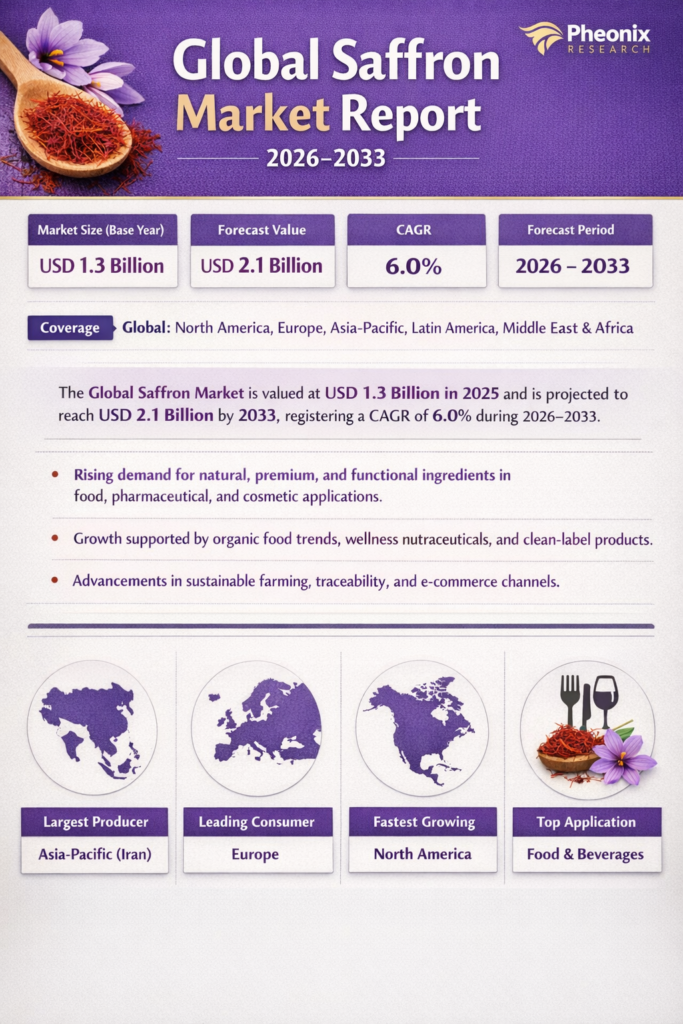
Global Saffron Market Forecast Snapshot: 2026–2033
| Metric | Value |
|---|---|
| 2025 Market Size | USD 1.3 Billion |
| 2033 Market Size | USD 2.1 Billion |
| CAGR (2026–2033) | 6.0% |
| Largest Producer Region | Asia-Pacific (Iran) |
| Leading Consumer Region | Europe |
| Fastest Growing Region | North America |
| Top Application Segment | Food & Beverages |
| Key Trend | Natural, Premium & Functional Ingredient Demand |
| Future Focus | Sustainable Farming, Traceability, and E-Commerce Expansion |
Global Saffron Market Overview (2026–2033)
The Global Saffron Market is experiencing stable growth during the 2026–2033 forecast period, driven by rising consumer preference for natural ingredients, premium spices, and functional wellness products.
Saffron is widely used across culinary applications, traditional medicine, dietary supplements, and cosmetics, due to its antioxidant, anti-inflammatory, and mood-enhancing properties.
According to Pheonix Research, increasing awareness of health benefits, along with growing demand for natural and organic products, is significantly boosting market expansion.
Manufacturers and producers are focusing on quality enhancement, sustainable cultivation, and premium-grade saffron production, ensuring consistency and authenticity in global supply.
Additionally, the expansion of online retail platforms and direct-to-consumer channels is improving global accessibility, enabling producers to reach a wider consumer base.
Asia-Pacific remains the largest producer and exporter, while Europe continues to be the leading consumer market, and North America is emerging as the fastest-growing region.
Key Drivers of Global Saffron Market Growth
Rising Demand for Natural & Premium Ingredients
Consumers are increasingly seeking high-quality, authentic spices and natural food ingredients.
Health & Wellness Benefits
Saffron’s antioxidant, anti-inflammatory, and mood-enhancing properties are driving its use in nutraceuticals and supplements.
Growth of Cosmetics & Personal Care Industry
Saffron is widely used in premium skincare and beauty products due to its skin-brightening and anti-aging benefits.
Expanding Culinary & Foodservice Applications
Restaurants and gourmet food producers are incorporating saffron into premium dishes and specialty recipes.
Growth of E-Commerce & Direct Sales
Online platforms are improving global reach and ensuring traceability and authenticity.
Sustainable & Traceable Farming Practices
Adoption of eco-friendly farming and blockchain-based traceability systems is enhancing consumer trust.
Global Saffron Market Segmentation
1. By Type
1.1 Thread
1.1.1 Premium Thread Saffron
1.1.1.1 Export Products
1.1.1.1.1 Gourmet Applications
1.2 Powder
1.2.1 Ground Saffron Products
1.2.1.1 Retail Packaged Products
1.2.1.1.1 Mass Market Consumption
1.3 Liquid Extract
1.3.1 Concentrated Saffron Extract
1.3.1.1 Pharmaceutical Applications
1.3.1.1.1 Nutraceutical Products
2. By Grade
2.1 Super Negin
2.1.1 Premium Grade
2.1.1.1 Export Quality
2.1.1.1.1 High-Value Segment
2.2 Negin
2.2.1 High Quality
2.2.1.1 Culinary Use
2.2.1.1.1 Retail Segment
2.3 Sargol
2.3.1 Standard Grade
2.3.1.1 Food Industry
2.3.1.1.1 Bulk Supply
2.4 Pushal
2.4.1 Economy Grade
2.4.1.1 Mass Market
2.4.1.1.1 Domestic Consumption
3. By Application
3.1 Food & Beverages
3.1.1 Culinary Applications
3.1.1.1 Gourmet Food
3.1.1.1.1 Premium Recipes
3.2 Pharmaceuticals
3.2.1 Herbal Medicine
3.2.1.1 Medicinal Products
3.2.1.1.1 Functional Health
3.3 Cosmetics & Personal Care
3.3.1 Skincare Products
3.3.1.1 Anti-Aging Products
3.3.1.1.1 Premium Beauty
3.4 Dietary Supplements
3.4.1 Nutraceutical Products
3.4.1.1 Wellness Supplements
3.4.1.1.1 Functional Nutrition
3.5 Others
3.5.1 Specialty Applications
3.5.1.1 Industrial Use
3.5.1.1.1 Emerging Segments
4. By Distribution Channel
4.1 Online Retail
4.1.1 E-Commerce Platforms
4.1.1.1 Direct Sales
4.1.1.1.1 Subscription Models
4.2 Offline Retail
4.2.1 Supermarkets
4.2.1.1 Retail Stores
4.2.1.1.1 Packaged Products
4.3 Specialty Stores
4.3.1 Premium Spice Stores
4.3.1.1 Organic Products
4.3.1.1.1 High-End Retail
4.4 Direct Sales
4.4.1 Producer Sales
4.4.1.1 Export Channels
4.4.1.1.1 Bulk Buyers
Global Saffron Market Regional Insights
Asia-Pacific – Largest Producer
Dominated by Iran, India, and Afghanistan with strong cultivation expertise and export capabilities.
Europe – Leading Consumer Market
High demand for saffron in culinary and cosmetic applications.
North America – Fastest Growing Region
Growing demand for natural supplements and gourmet food products.
Middle East & Africa
Strong cultural usage and growing tourism-driven demand.
Latin America
Emerging demand for saffron-based cosmetic and beverage products.
Leading Companies in the Global Saffron Market
Esfedan Trading Company
Rowhani Saffron Co.
Gohar Saffron Co.
Safrante Global Company S.L.U.
HEA & Co Spanish Saffron
Tarvand Saffron Co.
Mehr Saffron Co.
Great American Spice Company
Iran Saffron Company
Royal Saffron Company
These companies focus on quality control, sustainable sourcing, and global distribution expansion to maintain competitive advantage.
Strategic Intelligence & Market Insights
Pheonix Demand Forecast Engine identifies premiumization and wellness trends as key growth drivers.
Consumer Sentiment Analyzer highlights increasing preference for natural and organic products.
Innovation Tracker monitors advancements in traceability and packaging technologies.
Porter’s Five Forces Analysis indicates moderate competition with strong opportunities in premium segments.
Why the Global Saffron Market Remains Critical
Supports sustainable agriculture and rural employment
Provides natural and functional health benefits
Drives premiumization in food and cosmetics
Enhances growth of organic and wellness industries
Encourages traceability and ethical sourcing
Final Takeaway of Global Saffron Market
The Global Saffron Market is expected to grow steadily through 2033, driven by increasing demand for natural, premium, and multifunctional ingredients.
Companies focusing on sustainable farming, quality assurance, traceability systems, and premium product positioning will be well positioned to capture long-term growth opportunities.
At Pheonix Research, our advanced forecasting models and strategic insights enable stakeholders to identify emerging opportunities, optimize supply chains, and build competitive advantage in the global saffron market.
📢 Social Mentions & Publication Channels
Explore deeper insights and follow our cross-platform updates on LinkedIn and X for continuous intelligence and market coverage.
LinkedIn : https://www.linkedin.com/in/pheonix-research-media/
X : https://x.com/Pheonix_Insight
Table of Contents
Table of Contents
1. Executive Summary
1.1 Market Forecast Snapshot (2026–2033)
The Global Saffron Market is projected to grow from USD 1.3 Billion in 2025 to USD 2.1 Billion by 2033, registering a CAGR of 6.0% during 2026–2033.
1.2 Global Market Size & CAGR Analysis
The market reflects steady expansion driven by increasing demand for natural, premium, and functional ingredients across food, pharmaceutical, and cosmetic applications.
1.3 Largest & Fastest-Growing Segments
Largest Segment: Food & Beverages Application
Fastest-Growing Segment: Dietary Supplements & Nutraceuticals
1.4 Region-Level Leadership & Growth Trends
Asia-Pacific leads the market as the largest producer due to strong cultivation and export capacity, while North America is projected to be the fastest-growing region through 2033.
1.5 Key Market Drivers
Rising demand for natural and premium ingredients
Growing adoption of saffron in health and wellness applications
Expansion of cosmetics and personal care industries
Increasing culinary and gourmet food usage
Growth of e-commerce and direct-to-consumer sales
1.6 Competitive Landscape Overview
Moderately competitive market with key players focusing on sustainable sourcing, premium-grade saffron production, and global distribution expansion.
1.7 Strategic Outlook Through 2033
Focus on traceability systems, organic certification, premium product positioning, and expansion through digital retail channels.
2. Introduction & Market Overview
2.1 Definition of the Global Saffron Market
Covers saffron products including thread, powder, and extract forms used across food, pharmaceuticals, cosmetics, and dietary supplements.
2.2 Scope of the Study
Comprehensive analysis of market size, segmentation, applications, distribution channels, and global forecasts for 2026–2033.
2.3 Evolution from Traditional Spice to Functional Ingredient
The market is evolving from traditional culinary use toward nutraceutical, pharmaceutical, and cosmetic applications.
2.4 Role of Supply Chain & Distribution Networks
Expansion of global trade, online platforms, and specialty retail is improving product accessibility.
2.5 Impact of Health & Wellness Trends
Growing awareness of saffron’s antioxidant, anti-inflammatory, and mood-enhancing benefits is boosting demand.
2.6 Integration of Sustainable & Organic Farming Practices
Adoption of eco-friendly cultivation and organic certification is enhancing product credibility.
2.7 Technological Advancements in Processing & Traceability
Blockchain-based traceability and advanced drying techniques are improving product quality and authenticity.
3. Research Methodology
3.1 Primary Research
Interviews with saffron producers, exporters, distributors, and industry experts.
3.2 Secondary Research
Trade data, agricultural reports, industry publications, and corporate filings.
3.3 Market Size Estimation Model
Combination of production-based and consumption-based modeling.
3.4 Forecast Assumptions (2026–2033)
Based on increasing health awareness, premium product demand, and expansion of distribution channels.
3.5 Data Validation & Triangulation
Cross-verification using supply chain analysis and regional production data.
4. Market Dynamics
4.1 Drivers
4.1.1 Rising Demand for Natural & Premium Ingredients
Consumers prefer high-quality and authentic natural products.
4.1.2 Health & Wellness Benefits
Saffron’s medicinal properties are boosting its use in supplements and healthcare.
4.1.3 Growth in Cosmetics & Personal Care Industry
Demand for natural skincare ingredients is increasing rapidly.
4.1.4 Expansion of Culinary & Foodservice Applications
Growing use in gourmet and premium food products.
4.1.5 Growth of E-Commerce Channels
Online platforms are enhancing global accessibility and sales.
4.2 Restraints
4.2.1 High production cost of saffron
4.2.2 Limited cultivation regions
4.2.3 Risk of adulteration and quality issues
4.2.4 Price volatility
4.3 Opportunities
4.3.1 Expansion in nutraceutical and pharmaceutical applications
4.3.2 Growth of organic and premium saffron products
4.3.3 Increasing demand in emerging markets
4.3.4 Adoption of traceability technologies
4.4 Challenges
4.4.1 Maintaining product authenticity and quality
4.4.2 Supply chain inefficiencies
4.4.3 Regulatory compliance and certification requirements
4.4.4 Competition from synthetic alternatives
5. Global Saffron Market Analysis (USD Billion), 2026–2033
5.1 Market Size Overview
5.2 CAGR Analysis
5.3 Region-Wise Revenue Distribution
5.4 Application-Based Revenue Split
5.5 Distribution Channel Trends
5.6 Product Type Analysis
6. Market Segmentation by Type (USD Billion), 2026–2033
6.1 Thread Saffron
6.1.1 Premium Thread Products
6.1.1.1 Export Market
6.1.1.1.1 Gourmet Applications
6.2 Powder Saffron
6.2.1 Ground Products
6.2.1.1 Retail Packaged Products
6.2.1.1.1 Mass Market
6.3 Liquid Extract
6.3.1 Concentrated Extracts
6.3.1.1 Pharmaceutical Applications
6.3.1.1.1 Nutraceutical Use
7. Market Segmentation by Application (USD Billion), 2026–2033
7.1 Food & Beverages
7.1.1 Culinary Applications
7.1.1.1 Gourmet Food
7.1.1.1.1 Premium Segment
7.2 Pharmaceuticals
7.2.1 Herbal Medicine
7.2.1.1 Medicinal Products
7.2.1.1.1 Functional Health
7.3 Cosmetics & Personal Care
7.3.1 Skincare Products
7.3.1.1 Anti-Aging Products
7.3.1.1.1 Premium Beauty
7.4 Dietary Supplements
7.4.1 Nutraceutical Products
7.4.1.1 Wellness Products
7.4.1.1.1 Functional Nutrition
8. Market Segmentation by Distribution Channel (USD Billion), 2026–2033
8.1 Online Retail
8.1.1 E-Commerce Platforms
8.1.1.1 Direct Sales
8.1.1.1.1 Subscription Models
8.2 Offline Retail
8.2.1 Supermarkets
8.2.1.1 Retail Stores
8.2.1.1.1 Packaged Products
8.3 Specialty Stores
8.3.1 Premium Spice Retailers
8.3.1.1 Organic Products
8.3.1.1.1 High-End Segment
8.4 Direct Sales
8.4.1 Producer Sales
8.4.1.1 Export Channels
8.4.1.1.1 Bulk Buyers
9. Market Segmentation by Geography
9.1 Asia-Pacific – Largest Producer
9.2 Europe – Leading Consumer Market
9.3 North America – Fastest Growing Region
9.4 Latin America
9.5 Middle East & Africa
10. Competitive Landscape – Global
10.1 Market Share Analysis
10.2 Product Portfolio Benchmarking
10.3 Pricing Strategy Analysis
10.4 Supply Chain & Distribution Mapping
10.5 Competitive Differentiation Strategies
11. Company Profiles
11.1 Esfedan Trading Company
11.2 Rowhani Saffron Co.
11.3 Gohar Saffron Co.
11.4 Safrante Global Company S.L.U.
11.5 HEA & Co Spanish Saffron
11.6 Tarvand Saffron Co.
11.7 Mehr Saffron Co.
11.8 Great American Spice Company
11.9 Iran Saffron Company
11.10 Royal Saffron Company
12. Strategic Intelligence & Pheonix AI-Backed Insights
12.1 Pheonix Demand Forecast Engine
12.2 Consumer Sentiment Analyzer
12.3 Traceability & Supply Chain Intelligence
12.4 Product Innovation Tracker
12.5 Porter’s Five Forces Analysis
13. Future Outlook & Strategic Recommendations
13.1 Expansion of organic saffron cultivation
13.2 Adoption of traceability technologies
13.3 Growth in nutraceutical and cosmetic applications
13.4 E-commerce and direct-to-consumer expansion
13.5 Long-Term Market Outlook (2033+)
14. Appendix
15. About Pheonix Research
16. Disclaimer