
Global Shampoo Market Size and Share Analysis 2026-2033
Global Shampoo Market Forecast Snapshot: 2025–2033
| Parameter | Value |
|---|---|
| Base Year | 2025 |
| Base Year Market Size | USD 36.8 Billion |
| Forecast Period | 2025–2033 |
| Forecasted CAGR | 6.9% |
| Forecasted Market Size (2033) | USD 62.4 Billion |
| Leading Region | North America |
| Fastest Growing Region | Asia-Pacific |
| Top Product Segment | Anti-Dandruff & Herbal Shampoos |
| Major Trend | Natural, Organic, and Eco-Friendly Products |
| Market Outlook | Strong Growth Across Retail & Online Channels |
Market Size & Forecast
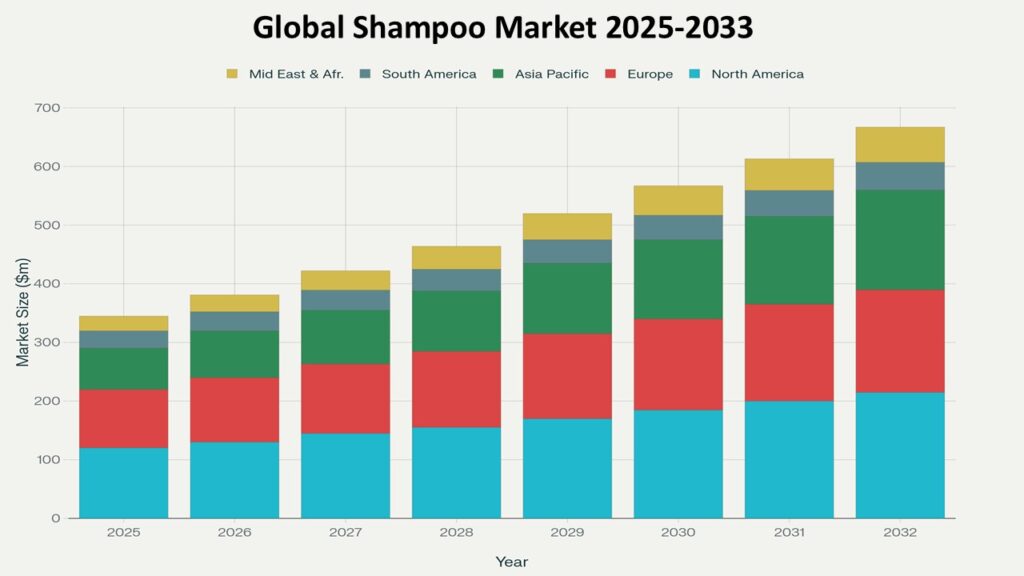
The Global Shampoo Market is projected to expand from USD 36.8 billion in 2025 to approximately USD 62.4 billion by 2033, registering a CAGR of 6.9% during the forecast period. This growth trajectory reflects the increasing global importance of hair care, hygiene, and personal grooming, as shampoos continue to evolve from basic cleansing products into broader wellness and lifestyle essentials. Consumers across age groups and genders are increasingly seeking solutions that address hair strengthening, scalp nourishment, anti-dandruff treatment, color protection, and hair fall control, thereby supporting category expansion across both mass-market and premium product segments.
The market is being reinforced by a combination of structural and consumer-led growth factors. Rising disposable income, rapid urbanization, and growing awareness of specialized hair care routines are creating favorable demand conditions across both developed and emerging economies. At the same time, innovation in herbal and organic formulations, eco-friendly ingredients, and newer delivery formats such as shampoo bars, dry shampoos, and micellar shampoos is broadening product appeal. The increasing influence of digital beauty education, social media-driven discovery, and omnichannel retail access is further strengthening the commercial outlook for the market.
As consumer expectations continue to shift toward personalized, ingredient-conscious, and sustainability-oriented products, manufacturers are expanding their portfolios to align with changing beauty standards and everyday grooming habits. The 6.9% CAGR therefore reflects not only the ongoing rise in shampoo consumption volumes, but also the category’s movement toward premiumization, innovation-led differentiation, and stronger long-term relevance in the global personal care industry.
Market Overview
The Global Shampoo Market is characterized by a highly competitive and innovation-driven landscape shaped by large multinational personal care companies, regional brands, herbal product manufacturers, and premium salon-oriented players. Demand spans a broad consumer base, supported by everyday hygiene needs as well as the increasing preference for specialized shampoos formulated for distinct scalp conditions, hair textures, and aesthetic outcomes. The market has moved well beyond conventional cleansing applications and now operates at the intersection of beauty, wellness, self-care, and preventive hair health.
Operationally, the market is supported by a diversified distribution ecosystem that includes supermarkets and hypermarkets, online retail channels, specialty beauty stores, direct sales networks, and professional salon channels. This hybrid commercial model allows brands to serve both high-volume mass-market consumers and niche premium buyers with tailored positioning strategies. E-commerce has become particularly important in expanding consumer access to global brands, premium products, and emerging indie labels, while also enabling data-driven targeting, online reviews, subscription models, and personalized product recommendations.
Product innovation remains central to market competitiveness. Brands are actively introducing sulfate-free shampoos, herbal and botanical blends, anti-pollution variants, multifunctional 2-in-1 products, dry shampoos, and sustainability-oriented shampoo bars to meet evolving consumer expectations. The increasing use of digital tools and AI-driven recommendation engines is also reshaping product discovery and consumer engagement, particularly among younger and digitally active demographics. Together, these developments are driving premiumization, enhancing brand differentiation, and increasing product experimentation across regions.
Consumer demand is also being influenced by broader lifestyle and environmental considerations. Sustainability-conscious buyers are showing stronger preference for natural ingredients, recyclable packaging, refill formats, and reduced-chemical formulations. At the same time, salon and professional hair care influence is encouraging consumers to trade up from conventional shampoos to more targeted, therapeutic, and high-performance offerings. These overlapping shifts are helping redefine the market as a dynamic, fast-evolving segment within the wider global beauty and personal care industry.
Structural Drivers of Market Growth
The growth of the Global Shampoo Market is being driven by four interrelated structural factors that collectively explain the category’s expanding scale, product diversification, and rising consumer relevance across regions.
1. Rising Hair Health Awareness and Product Premiumization
Growing consumer awareness of scalp care, hair fall prevention, dandruff control, color retention, and hair texture management is fundamentally reshaping purchase behavior in the shampoo category. Consumers are increasingly selecting products based on specific performance claims rather than using shampoo as a generic cleansing solution. This transition supports stronger demand for premium and specialized variants, including moisturizing shampoos, anti-dandruff products, color protection formulas, and hair fall control solutions.
As hair care becomes more closely associated with self-care and personal wellness, buyers are also demonstrating greater willingness to experiment with differentiated formulations and to pay more for perceived efficacy. This trend is especially visible in urban markets where consumers are influenced by beauty education content, salon recommendations, and evolving grooming standards. The result is a market structure where value growth is increasingly supported by premiumization and specialized use-case expansion.
2. Natural, Organic, and Sustainability-Led Product Transformation
The increasing popularity of natural and organic personal care products is accelerating transformation across the shampoo market. Demand for sulfate-free, herbal, and eco-friendly shampoos reflects a broader consumer shift toward ingredient transparency, reduced chemical exposure, and environmentally responsible consumption. This has encouraged manufacturers to incorporate plant-based ingredients, botanical extracts, and gentler cleansing systems into mainstream as well as premium product portfolios.
Beyond formulation, sustainability is influencing packaging and product delivery innovation. Refillable formats, reduced-plastic packaging, biodegradable materials, and alternative formats such as shampoo bars are gaining traction among environmentally conscious consumers. These shifts are not only enhancing brand positioning but also creating new pathways for differentiation, particularly in mature markets where sustainability can significantly influence purchasing decisions and long-term brand loyalty.
3. E-Commerce Expansion and Digital Consumer Engagement
The rapid expansion of online retail and digital beauty ecosystems is significantly enhancing shampoo market accessibility and market penetration. E-commerce platforms allow consumers to compare brands, review ingredients, access niche formulations, and purchase premium products that may not be readily available through traditional retail channels. Subscription models, digital promotions, online reviews, and social commerce are further contributing to category visibility and purchase conversion.
In parallel, influencer marketing, social media trends, and beauty-focused content platforms are shaping consumer preferences at a faster pace than conventional advertising. Celebrity endorsements, hairstylist recommendations, and viral product discussions are strengthening awareness and accelerating trial, particularly among younger consumer groups. This digital acceleration is enabling brands to scale faster, gather consumer insights in real time, and fine-tune product development and marketing strategies based on online behavior and demand signals.
4. Professional Hair Care Influence and Ongoing Product Innovation
Salon-driven demand and continuous product innovation are playing an increasingly important role in market development. Professional hair care recommendations often influence consumer perception of quality, efficacy, and safety, encouraging migration from mass-market shampoos to therapeutic and salon-grade formulations. This is especially relevant in categories tied to visible performance outcomes such as hair repair, scalp treatment, and color protection.
At the same time, brands are actively investing in innovation through advanced formulations, multifunctional products, and technology-enabled consumer experiences. Developments such as anti-pollution shampoos, app-guided hair care routines, AI-powered product recommendations, and high-performance ingredient blends are enhancing user experience and broadening category appeal. These innovations are helping the market remain relevant in an increasingly competitive beauty landscape while driving repeat purchase and higher consumer engagement.
Market Segmentation Analysis
Top-Level Segment Overview
The Global Shampoo Market is segmented by product type, distribution channel, end user, and region. These segmentation layers reflect both functional demand patterns and evolving consumer preferences across the personal care and beauty ecosystem.
By Product Type: Anti-Dandruff Shampoo, Hair Fall Control Shampoo, Moisturizing Shampoo, Color Protection Shampoo, Herbal & Organic Shampoo, and Others.
By Distribution Channel: Supermarkets & Hypermarkets, Online Retail, Specialty Beauty Stores, Salons & Professional Channels, and Direct Sales.
By End User: Men, Women, and Children.
By Region: North America, Europe, Asia-Pacific, Latin America, and Middle East & Africa.
Among product categories, anti-dandruff and herbal shampoos are emerging as particularly important segments due to rising concern around scalp wellness, ingredient safety, and natural hair care solutions. Distribution is becoming increasingly omnichannel, with online retail gaining momentum alongside traditional store-based formats. End-user segmentation remains broad-based, reflecting the shampoo category’s everyday relevance across multiple demographic groups and usage occasions.
Regional Market Dynamics
The regional performance of the Global Shampoo Market reflects differing levels of consumer awareness, disposable income, product maturity, beauty culture, and retail infrastructure. While developed markets continue to drive premiumization and product innovation, emerging markets are contributing significantly to volume growth through urbanization and increasing hair care awareness.
North America
North America represents the leading regional market, supported by strong consumer awareness, high penetration of premium and professional hair care products, and a well-established retail and digital commerce ecosystem. Consumers in the region are highly responsive to specialized formulations, salon-backed products, ingredient transparency, and performance-led branding, making it a mature but innovation-receptive market.
Europe
Europe remains an important regional market with a strong emphasis on natural, organic, and sustainable shampoo formulations. Countries such as Germany, France, and the U.K. play a major role in product innovation, premium beauty consumption, and eco-conscious personal care trends. Demand for herbal ingredients, gentle formulations, and sustainable packaging is particularly influential in this region.
Asia-Pacific
Asia-Pacific is the fastest-growing regional market, driven by rising disposable income, urban expansion, increasing beauty consciousness, and a rapidly expanding middle-class consumer base. Major economies such as India, China, Japan, and Southeast Asian countries are witnessing stronger demand for both affordable daily-use shampoos and premium specialized offerings. The region’s strong population base and digital adoption further support long-term market acceleration.
Latin America
Latin America is experiencing steady market expansion as growing middle-class populations, improving retail access, and rising awareness of hair care routines contribute to stronger shampoo consumption. Markets such as Brazil, Mexico, and Argentina are benefiting from increased product availability, stronger beauty engagement, and the rising influence of online retail and branded personal care solutions.
Middle East & Africa
The Middle East & Africa region is showing consistent growth, supported by rising interest in premium personal care, urban youth consumption, and tourism-driven retail development in key markets. Countries such as the UAE, Saudi Arabia, and South Africa are contributing to market momentum through higher beauty product adoption and increasing demand for quality-focused and premium-positioned shampoo brands.
Competitive Landscape
The competitive landscape of the Global Shampoo Market is shaped by the presence of major multinational consumer goods companies alongside regional personal care brands and herbal product specialists. Competition is intense, with market participants focusing on product innovation, ingredient-led differentiation, sustainability, digital marketing, and omnichannel distribution strategies to retain and expand market share.
Leading companies operating in the market include Procter & Gamble Co. (Pantene, Head & Shoulders), Unilever (Dove, Sunsilk, TRESemmé), L’Oréal Group (L’Oréal Paris, Kérastase), Henkel AG & Co. KGaA (Schwarzkopf), Kao Corporation (Biore, John Frieda), Beiersdorf AG (Nivea Hair), Dabur India Ltd., and Godrej Consumer Products Ltd.
These companies are investing heavily in product development, premium portfolio expansion, eco-friendly packaging initiatives, and consumer engagement campaigns to strengthen loyalty and brand visibility. Established players benefit from large-scale distribution networks, strong brand recall, and the ability to address diverse consumer segments through multi-brand strategies. Procter & Gamble Co. (P&G) remains the largest company in the Global Shampoo Market, supported by the broad global presence and sustained popularity of flagship brands such as Pantene and Head & Shoulders.
The market also continues to attract niche and challenger brands that compete through herbal positioning, clean-label claims, and region-specific consumer targeting. This creates a competitive environment where brand trust, innovation speed, ingredient credibility, and channel execution are central to long-term success.
Strategic Outlook
The strategic outlook for the Global Shampoo Market is strongly tied to the convergence of premiumization, sustainability, digital commerce, and personalized consumer engagement. As shampoo purchasing becomes more intentional and benefit-driven, companies will need to move beyond standard cleansing propositions and build portfolios aligned with scalp health, ingredient transparency, and targeted performance outcomes.
Natural and organic product development is expected to remain a major strategic priority. Brands that can successfully balance efficacy, safety, sustainability, and affordability are likely to secure stronger positioning across both developed and emerging markets. Packaging innovation, refill systems, reduced-plastic formats, and environmentally conscious sourcing will increasingly influence long-term competitive advantage, especially among younger and more sustainability-aware consumers.
Digital transformation will continue to redefine category growth pathways. AI-powered product recommendations, e-commerce analytics, social media-led brand building, and direct-to-consumer engagement models are making it easier for companies to personalize messaging, improve conversion, and strengthen repeat purchase behavior. Strategic partnerships with salons, beauty professionals, and digital creators are also expected to remain important in driving premium adoption and product credibility.
Overall, companies that align product innovation with evolving consumer lifestyles, omnichannel retail strategies, and sustainability expectations will be best positioned to capture the next phase of growth in the global shampoo industry.
Final Market Perspective
The Global Shampoo Market represents a dynamic combination of personal care utility, beauty innovation, and consumer wellness. Its projected growth from USD 36.8 billion in 2025 to USD 62.4 billion by 2033 at a CAGR of 6.9% underscores the category’s rising importance in daily grooming and specialized hair care routines.
The market is benefiting from strong structural support, including growing awareness of hair health, demand for natural and premium formulations, expansion of e-commerce, and the increasing influence of digital beauty culture. At the same time, product diversification through anti-dandruff, herbal, moisturizing, and color-protection variants is helping the category remain relevant across a wide consumer base and multiple price tiers.
Looking ahead, long-term opportunity will be shaped by the ability of brands to combine innovation, sustainability, and consumer-centric positioning. As shampoos continue to evolve into lifestyle-oriented and wellness-linked products, the market is expected to remain a critical segment within the broader global beauty and personal care industry.
Research Methodology
This study employs a comprehensive mixed-methods research framework integrating both primary and secondary research to develop a robust and multidimensional analysis of the Global Shampoo Market. Primary research includes structured and semi-structured interactions with relevant stakeholders across the value chain, including shampoo manufacturers, ingredient suppliers, distributors, salon professionals, beauty retailers, and industry specialists. These interactions provide qualitative validation and market-level insight into evolving consumer preferences, product innovation trends, pricing dynamics, and channel developments.
Secondary research is conducted through an extensive review of company literature, product portfolios, beauty and personal care industry publications, trade databases, retail trend analyses, and other credible public and private domain sources. Market estimates and forecasts are developed using a triangulated analytical approach that combines demand-side consumption patterns, supply-side competitive assessment, pricing trends, and macroeconomic indicators. This methodology enables the study to deliver a balanced and actionable view of current market conditions, future growth potential, and strategic opportunities across the global shampoo category.
Table of Contents
1. Global Shampoo Market Overview
2. Key Drivers of Global Shampoo Market Growth
– Rising Awareness of Hair Care and Hygiene
– Increasing Popularity of Natural and Organic Products
– Expansion of E-Commerce and Beauty Retail Channels
– Product Innovation and Technological Integration
– Influencer Marketing and Social Media Trends
– Salon and Professional Hair Care Influence
3. Global Shampoo Market Segmentation
By Product Type
• Anti-Dandruff Shampoo
• Hair Fall Control Shampoo
• Moisturizing Shampoo
• Color Protection Shampoo
• Herbal & Organic Shampoo
• Others
By Distribution Channel
• Supermarkets & Hypermarkets
• Online Retail
• Specialty Beauty Stores
• Salons & Professional Channels
• Direct Sales
By End User
• Men
• Women
• Children
By Region
• North America
• Europe
• Asia-Pacific
• Latin America
• Middle East & Africa
4. Regional Insights of the Global Shampoo Market
– North America – Mature and Premium Market
– Europe – Focus on Natural and Sustainable Products
– Asia-Pacific – Fastest Growing Market
– Latin America – Expanding Consumer Base
– Middle East & Africa – Niche Premium Growth
5. Leading Companies in the Global Shampoo Market
– Procter & Gamble Co. (Pantene, Head & Shoulders)
– Unilever (Dove, Sunsilk, TRESemmé)
– L’Oréal Group (L’Oréal Paris, Kérastase)
– Henkel AG & Co. KGaA (Schwarzkopf)
– Kao Corporation (Biore, John Frieda)
– Beiersdorf AG (Nivea Hair)
– Dabur India Ltd.
– Godrej Consumer Products Ltd.
6. Strategic & Technological Insights
– AI-Powered Product Recommendations
– Sustainable and Eco-Friendly Packaging
– Digital Marketing & E-Commerce Analytics
– Professional & Salon Integration
7. Global Shampoo Market Forecast Snapshot (2025–2033)
– 2025 Market Size – USD 36.8 Billion
– 2033 Market Size – USD 62.4 Billion
– CAGR (2025–2033) – 6.9%
– Leading Region – North America
– Fastest Growing Region – Asia-Pacific
– Top Product Segment – Anti-Dandruff & Herbal Shampoos
– Major Trend – Natural, Organic, and Eco-Friendly Products
– Market Outlook – Strong Growth Across Retail & Online Channels
8. Why the Global Shampoo Market Remains Critical
– Promotes hair health, hygiene, and self-care routines worldwide
– Encourages adoption of sustainable and chemical-free personal care solutions
– Supports growth of professional and premium beauty segments
– Acts as a lifestyle and wellness product across age groups
– Integrates innovation with tradition through natural, herbal, and salon-inspired formulations
9. Final Takeaway of the Global Shampoo Market
Competitive Landscape
Global Shampoo Market Competitive Intensity & Market Structure Overview
The Global Shampoo Market is characterized by a fragmented market structure with a high level of competitive intensity. This structure is driven by the presence of several large multinational consumer goods companies alongside a vast number of regional brands, herbal product manufacturers, and emerging direct-to-consumer players. While global leaders such as Procter & Gamble, Unilever, and L’Oréal Group command significant market share through strong brand portfolios and global distribution networks, the overall market remains highly diversified due to low switching costs and continuous entry of niche brands.
The fragmented nature of the market enables a wide variety of product offerings across price tiers, formulations, and consumer segments. This diversity supports innovation and allows companies to cater to highly specific consumer needs such as anti-dandruff treatment, hair fall control, color protection, and scalp nourishment. However, it also intensifies competition, requiring brands to consistently differentiate through formulation innovation, branding, and sustainability positioning.
Tier 1 companies such as Procter & Gamble Co., Unilever, and L’Oréal Group maintain strong influence due to their extensive R&D capabilities, large-scale marketing investments, and established distribution infrastructure. These companies set benchmarks in product innovation, premiumization, and global brand positioning. At the same time, regional and herbal-focused companies such as Dabur India Ltd. and Godrej Consumer Products Ltd. are gaining traction by leveraging natural ingredient positioning and strong local market understanding.
The competitive landscape is further shaped by the rise of indie and clean-label brands that focus on sulfate-free, organic, and environmentally friendly formulations. This trend reflects a broader shift toward ingredient transparency, sustainability, and personalized hair care, significantly increasing the pace of innovation and competition across the market.
Global Shampoo Market Competitive Intensity & Current Scenario
Leading Company Profiles
Procter & Gamble Co.: Global Consumer Goods Leader. Strong presence with brands like Pantene and Head & Shoulders.
Unilever: Multinational FMCG Company. Diverse portfolio including Dove, Sunsilk, and TRESemmé.
L’Oréal Group: Global Beauty Leader. Focus on premium and professional hair care brands such as L’Oréal Paris and Kérastase.
Henkel AG & Co. KGaA: Hair Care Specialist. Known for Schwarzkopf and strong salon presence.
Kao Corporation: Personal Care Innovator. Offers brands such as John Frieda with focus on formulation science.
Beiersdorf AG: Skincare and Hair Care Company. Expanding presence with Nivea Hair.
Dabur India Ltd.: Herbal and Ayurvedic Leader. Strong positioning in natural and organic shampoo segment.
Godrej Consumer Products Ltd.: Emerging Market Player. Focus on value and herbal product lines.
Key Competitive Intensity & Market Structure Signals in Global Shampoo Market
Several key signals define the competitive intensity and structure of the Global Shampoo Market. One of the primary drivers is the low barrier to entry, which allows a large number of regional, private-label, and indie brands to enter the market with relatively low capital investment. This contributes significantly to the fragmented nature of the market while intensifying competition across pricing, formulation, and branding.
Product differentiation through innovation is another critical signal. Companies are continuously introducing sulfate-free shampoos, herbal blends, anti-pollution formulations, and new formats such as dry shampoos and shampoo bars. These innovations are essential for maintaining competitive advantage, particularly in a market where consumer preferences are rapidly evolving toward performance-driven and ingredient-conscious products.
The growing influence of digital channels and e-commerce has further increased competition by lowering distribution barriers. Online platforms enable smaller brands to reach global consumers without extensive physical retail infrastructure, thereby challenging established players. Social media, influencer marketing, and beauty content platforms are accelerating product discovery and shortening product life cycles, forcing companies to innovate faster.
Premiumization is also a key signal shaping competitive dynamics. Consumers are increasingly willing to pay higher prices for specialized, salon-grade, or natural formulations. This shift is encouraging companies to expand premium product lines and invest in brand positioning that emphasizes efficacy, sustainability, and personalization.
Additionally, sustainability has emerged as a major competitive differentiator. Companies are adopting eco-friendly packaging, refill systems, and biodegradable formulations to align with environmentally conscious consumer preferences. This trend is particularly influential in developed markets and among younger consumer segments.
Strategic Implications of Competitive Intensity & Market Structure in Global Shampoo Market
The high competitive intensity and fragmented structure of the Global Shampoo Market create both opportunities and challenges for market participants. For established multinational companies, maintaining leadership requires continuous investment in innovation, brand building, and global distribution capabilities. Their scale advantage allows them to launch new products quickly, invest in advanced R&D, and sustain strong marketing campaigns across multiple regions.
However, the presence of numerous smaller and niche players necessitates constant differentiation. Companies must focus on unique value propositions such as natural ingredients, targeted hair care solutions, and sustainability credentials to retain consumer loyalty. The ability to quickly adapt to emerging trends, such as clean beauty and personalized hair care, is becoming increasingly critical.
For regional and emerging brands, the fragmented structure provides an opportunity to capture market share by targeting specific consumer niches or geographic markets. Herbal and organic positioning, in particular, offers strong growth potential in markets such as Asia-Pacific, where traditional and natural formulations are widely accepted.
Cost management and pricing strategy also play a crucial role. While premiumization supports higher margins, intense competition in the mass-market segment requires companies to balance affordability with product quality. Efficient supply chain management and scalable production capabilities are therefore essential for maintaining profitability.
Partnerships with salons, influencers, and digital platforms are becoming increasingly important for brand visibility and consumer engagement. These collaborations help companies build credibility, drive product trials, and strengthen their presence in both online and offline channels.
Global Shampoo Market Competitive Intensity & Market Structure Forward Outlook
Looking ahead, the Global Shampoo Market is expected to remain highly competitive and fragmented, with continued entry of niche and clean-label brands alongside strong participation from established multinational players. Consolidation may occur in certain segments as larger companies acquire innovative startups to expand their product portfolios and access new consumer segments.
Technological advancements and digital transformation will further shape competitive dynamics. AI-driven product recommendations, personalized hair care solutions, and data-driven marketing strategies are expected to enhance consumer engagement and improve conversion rates. Companies that effectively leverage digital tools will gain a significant competitive advantage.
Sustainability will continue to play a central role in shaping market structure and competitive positioning. Brands that successfully integrate eco-friendly practices across product formulation, packaging, and supply chain operations are likely to achieve stronger consumer trust and long-term loyalty.
Emerging markets, particularly in Asia-Pacific, will remain key growth drivers, attracting both global and regional players. Increasing disposable income, urbanization, and rising beauty consciousness in these regions will create new opportunities for market expansion and competitive differentiation.
Overall, the market’s future will be defined by innovation, sustainability, digital engagement, and the ability to deliver targeted, performance-driven hair care solutions. Companies that align with these evolving trends while maintaining operational efficiency and strong brand positioning will be best positioned to succeed in the increasingly dynamic Global Shampoo Market.
Investment Activity
Global Shampoo Market Investment & Funding Dynamics Overview
The investment and funding dynamics of the global shampoo market are characterized by a rising investment trend and moderate capital intensity, supported by the category’s strong expansion outlook, innovation-led competition, and increasing relevance within the global beauty and personal care industry. As the market is projected to grow from USD 36.8 billion in 2025 to USD 62.4 billion by 2033 at a CAGR of 6.9%, capital allocation is increasingly being directed toward formulation innovation, premium portfolio development, sustainable packaging systems, digital consumer engagement, and omnichannel brand expansion. These structural dynamics are making the shampoo market attractive to both strategic investors and established personal care companies seeking scalable growth opportunities.
A major driver of investment in this market is the transformation of shampoos from basic cleansing products into specialized, benefit-driven hair care solutions aligned with wellness, beauty, and preventive scalp health. As consumers increasingly demand anti-dandruff shampoos, herbal and organic variants, color-protection formulas, and hair fall control products, manufacturers are investing more heavily in research and development, ingredient sourcing, branding, and product differentiation. This evolution is increasing the value of innovation, clinical positioning, and targeted consumer segmentation across the market.
Capital deployment is also being shaped by changing channel economics and the growing importance of digital commerce. E-commerce, social media-led discovery, AI-based product recommendation systems, and direct-to-consumer engagement models are encouraging companies to invest in consumer data capabilities, digital marketing infrastructure, and flexible distribution strategies. At the same time, sustainability expectations around refill systems, recyclable packaging, and reduced-chemical formulations are influencing investment priorities, especially among premium and globally positioned brands. Together, these factors are supporting a funding environment where companies that can combine scale, innovation, and brand trust are best positioned to attract long-term capital.
Global Shampoo Market Investment & Funding Dynamics Current Scenario
The current investment scenario in the global shampoo market reflects a commercially active and strategically important category within the broader personal care sector. The market’s moderate capital intensity stems from the need for ongoing spending across formulation development, raw material procurement, manufacturing, packaging redesign, regulatory compliance, branding, and channel expansion, while still remaining less capital-heavy than highly regulated or equipment-intensive industries. Investment activity is being concentrated around high-growth product formats, premium and herbal offerings, e-commerce enablement, and region-specific portfolio expansion, particularly in fast-growing Asia-Pacific markets and premium-oriented developed markets.
One of the defining features of the current funding landscape is the emphasis on product premiumization and brand-led differentiation. Companies are allocating capital toward sulfate-free shampoos, herbal and botanical blends, shampoo bars, dry shampoos, anti-pollution variants, and salon-inspired formulations to address evolving consumer expectations. This has created a market environment where funding is not only supporting production scale but also enabling repositioning toward higher-margin, performance-oriented, and sustainability-linked offerings. The ability to secure repeat purchases and justify premium pricing through ingredient credibility and visible efficacy is becoming a core investment consideration.
The present scenario is also shaped by the rapid commercial importance of omnichannel distribution. Supermarkets and hypermarkets remain important for mass-market volume, but online retail, specialty beauty platforms, salon channels, and direct sales are increasingly central to market expansion and consumer targeting. This is encouraging companies to direct capital toward digital storefronts, consumer analytics, subscription models, and influencer-led campaigns that can improve reach, conversion, and retention. As a result, funding in the shampoo market is increasingly linked to digital execution capabilities as much as to product innovation itself.
Recent mergers and acquisitions activity can be considered present at the broader beauty and personal care level, where larger companies often acquire niche, clean-label, herbal, or fast-scaling brands to strengthen innovation pipelines and gain access to new consumer segments. In the shampoo category specifically, this reinforces the idea that strategic brand assets, differentiated formulations, and loyal consumer communities hold increasing investment value. Even where category-specific deals are not constant, the market remains structurally attractive for portfolio-led consolidation and brand expansion strategies.
Key Investment & Funding Dynamics Signals in Global Shampoo Market
Several key investment signals are shaping capital flows in the global shampoo market. One of the most important is the sustained growth of specialized and premium shampoo demand. Consumers are no longer purchasing shampoos solely for cleansing purposes; they are seeking products tied to dandruff control, scalp nourishment, hair strengthening, color retention, moisture balance, and natural ingredient safety. This shift is making product innovation a direct driver of investment, as brands must continuously develop differentiated formulations to remain competitive and capture value growth.
A second major signal is the increasing strategic importance of natural, organic, and eco-friendly product transformation. Consumer preference for sulfate-free, herbal, reduced-chemical, and sustainability-oriented shampoos is prompting companies to invest in botanical ingredient sourcing, gentler cleansing technologies, recyclable packaging, refill options, and alternative product formats such as shampoo bars. These investments are especially relevant in mature markets where sustainability and ingredient transparency influence brand choice, but they are also becoming important in emerging markets as awareness rises.
Another strong signal is the expansion of digital beauty ecosystems and online retail infrastructure. E-commerce platforms, social media recommendations, beauty influencers, and AI-driven personalization tools are accelerating product discovery and brand switching. This is pushing companies to invest in digital marketing, performance analytics, consumer feedback loops, and direct-to-consumer models that can build stronger engagement and improve conversion rates. Brands with stronger digital ecosystems are likely to attract more strategic attention because they can scale faster and respond more efficiently to changing consumer behavior.
A further signal comes from regional demand asymmetry across the market. North America remains the leading regional market due to premium product penetration, strong brand awareness, and developed retail infrastructure, while Asia-Pacific is the fastest-growing region due to urbanization, rising disposable incomes, expanding middle-class populations, and increasing beauty consciousness. This dual dynamic is shaping investment decisions around geographic expansion, localized product development, and region-specific distribution strategies, particularly for companies looking to balance mature-market profitability with emerging-market volume growth.
Strategic Implications of Investment & Funding Dynamics in Global Shampoo Market
The current investment and funding dynamics in the global shampoo market carry several strategic implications for manufacturers, investors, and brand owners. One of the most important is that competitive advantage increasingly depends on the ability to align capital deployment with evolving consumer expectations around efficacy, ingredient transparency, sustainability, and personalization. Companies that continue to treat shampoo as a commoditized cleansing category may struggle to defend margins, while those investing in specialized claims, premium positioning, and differentiated product stories are better placed to secure market share.
Another major implication is the growing need to balance innovation with affordability across different consumer segments. While premiumization is a clear source of value creation, the shampoo market remains broad-based and highly price sensitive in many regions. This means companies must allocate capital carefully across mass-market and premium portfolios, ensuring they can serve daily-use consumers while also expanding into higher-margin therapeutic, herbal, and salon-linked categories. The ability to manage this dual-market strategy will be central to long-term financial performance.
The funding environment also suggests that digital capability is now a strategic asset rather than a support function. Investments in e-commerce optimization, online brand visibility, social commerce, subscription systems, and AI-powered recommendation tools are becoming essential to both demand creation and consumer retention. Companies that build strong digital-commercial ecosystems can improve campaign efficiency, reduce customer acquisition friction, and gain faster insight into changing market preferences. This creates a strong case for continued capital allocation toward data-enabled marketing and omnichannel execution.
In addition, the broader role of sustainability in capital allocation has important strategic consequences. Brands that invest early in refillable packaging, reduced plastic usage, plant-based formulations, and responsible sourcing are likely to strengthen their relevance among younger and more environmentally conscious consumers. Over time, these capabilities may become not only a reputational advantage but also a decisive factor in partnership opportunities, investor confidence, and premium brand valuation across the personal care sector.
Global Shampoo Market Investment & Funding Dynamics Forward Outlook
Looking ahead, the investment outlook for the global shampoo market remains favorable, supported by continued market expansion, premiumization, digital acceleration, and sustainability-led transformation. With the market expected to reach USD 62.4 billion by 2033, capital flows are likely to remain directed toward product innovation, regional expansion, eco-conscious packaging, and consumer engagement technologies. The market’s rising trend direction reflects confidence in shampoo’s long-term relevance as both an everyday essential and an increasingly specialized beauty and wellness product.
Future investment is expected to intensify around high-growth product clusters such as anti-dandruff shampoos, herbal and organic formulations, scalp-treatment products, and salon-inspired premium lines. Companies are also likely to direct more resources toward alternative delivery formats, cleaner ingredient systems, and targeted solutions aligned with individual hair textures, scalp conditions, and lifestyle preferences. This will further strengthen the role of research and development as a value-creation engine within the category.
Digital transformation will remain a central pillar of forward investment strategy. AI-enabled recommendation engines, consumer diagnostics, social commerce, creator partnerships, and direct-to-consumer platforms are expected to reshape how shampoo brands acquire, retain, and upsell consumers across markets. As data-led personalization becomes more embedded in the beauty ecosystem, brands that successfully integrate digital intelligence with product development and channel strategy are likely to capture a disproportionate share of future growth.
Overall, the forward outlook for investment and funding dynamics in the global shampoo market is positive. The category combines scale, recurring demand, innovation potential, and strong alignment with long-term trends in beauty, wellness, and sustainability. Companies that can effectively deploy capital across formulation innovation, brand differentiation, digital infrastructure, and regional market development will be best positioned to benefit from the next phase of growth in the global shampoo industry.