
Global Sweet Potatoes Market Report 2026-2033
Market Size (Base Year) USD 47.8 Billion
Forecast Value USD 72.4 Billion
CAGR 5.4%
Forecast Period 2026 - 2033
Coverage Global - Asia Pacific, Europe, Middle East & Africa, North America, South America
Global Sweet Potatoes Market is valued at USD 47.8 billion in 2025 and is projected to reach USD 72.4 billion by 2033, registering a CAGR of 5.4% during 2026–2033. Market growth is driven by rising demand for healthy food alternatives, increasing popularity of plant-based diets, and expanding use of sweet potatoes in processed food products. Asia-Pacific dominates the market due to large-scale production and consumption in countries such as China, Japan, and Vietnam, where sweet potatoes are a staple food crop. North America is emerging as the fastest-growing region.

Global Sweet Potatoes Market Forecast Snapshot: 2026–2033

Metric Value
2025 Market Size USD 47.8 Billion
2033 Market Size USD 72.4 Billion
CAGR (2026–2033) 5.4%
Largest Region Asia-Pacific
Fastest Growing Region North America
Top Segment Fresh Sweet Potatoes
Key Trend Rising Demand for Nutrient-Rich Functional Foods
Future Focus Organic Farming, Processed Sweet Potato Products, and Global Export Expansion

Global Sweet Potatoes Market Overview

The Global Sweet Potatoes Market is witnessing steady growth as consumers increasingly prefer nutrient-rich, plant-based foods that support healthy lifestyles. Sweet potatoes are widely recognized for their high content of vitamin A, dietary fiber, antioxidants, and complex carbohydrates, making them a popular ingredient across traditional cuisines, health-focused diets, and functional food products.

According to Pheonix Research, the Global Sweet Potatoes Market is valued at USD 47.8 billion in 2025 and is projected to reach USD 72.4 billion by 2033, registering a CAGR of 5.4% during 2026–2033. Market growth is driven by rising demand for healthy food alternatives, increasing popularity of plant-based diets, and expanding use of sweet potatoes in processed food products.

Asia-Pacific dominates the market due to large-scale production and consumption in countries such as China, Japan, and Vietnam, where sweet potatoes are a staple food crop. Meanwhile, North America is emerging as the fastest-growing region, supported by rising consumer interest in organic foods, healthy snacks, and plant-based ingredients.

The post-2025 outlook indicates strong growth in processed sweet potato products, functional food formulations, and global export markets, positioning sweet potatoes as an important agricultural commodity within the global food industry.

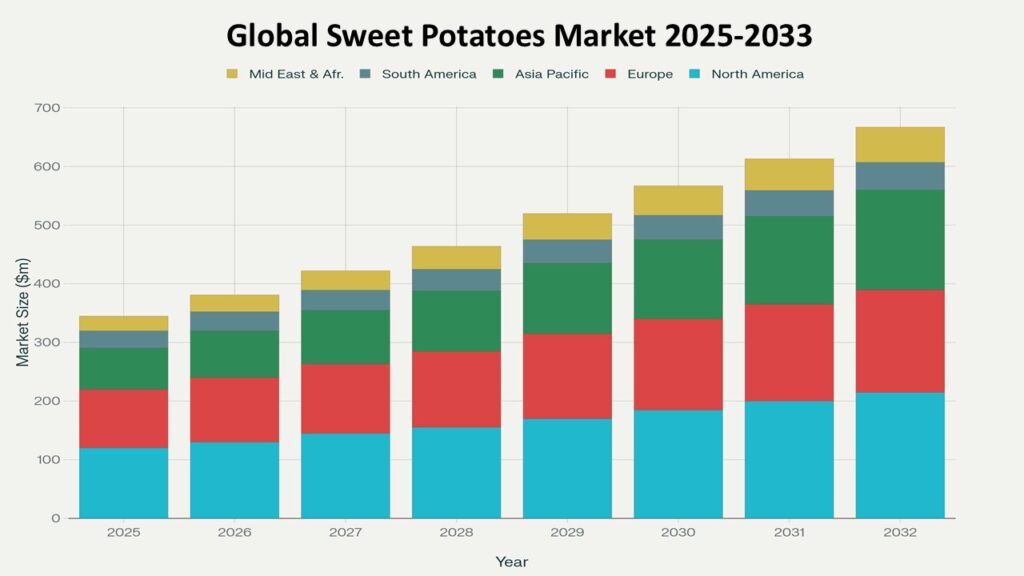
Stacked bar chart titled “Global Sweet Potatoes Market 2025-2033”showing market size in million dollars ($m) across regions. Each bar represents a year from 2025 to 2032, indicating steady market growth. The regions represented are: North America (light blue), Europe (red), Asia Pacific (green), South America (grayish blue), and Middle East & Africa (yellow).
Global Sweet Potatoes Market 2025-2033

Key Drivers of Global Sweet Potatoes Market Growth

1. Rising Demand for Healthy and Functional Foods

Increasing awareness of the nutritional benefits of sweet potatoes, including vitamins, antioxidants, and fiber, is driving global consumption.

2. Expansion of Plant-Based Diets

Growing adoption of vegetarian and vegan diets is supporting demand for sweet potatoes as a natural carbohydrate and nutrient source.

3. Growth in Processed Sweet Potato Products

Sweet potato chips, fries, purees, flour, and ready-to-eat snacks are gaining popularity in retail and foodservice sectors.

4. Increasing Agricultural Production in Emerging Economies

Improved farming practices and expanded cultivation in Asia and Africa are boosting global supply.

5. Rising Export Demand

International trade of sweet potatoes is expanding due to growing demand from North America, Europe, and the Middle East.


Global Sweet Potatoes Market Segmentation

  1.By Product Type

1.1 Fresh Sweet Potatoes

1.1.1 Orange-Fleshed Sweet Potatoes

1.1.1.1 High Beta-Carotene Varieties
1.1.1.1.1 Household Consumption
1.1.1.1.2 Retail Distribution

1.1.2 White-Fleshed Sweet Potatoes

1.1.2.1 Traditional Culinary Varieties
1.1.2.1.1 Local Food Markets
1.1.2.1.2 Foodservice Applications

1.1.3 Purple Sweet Potatoes

1.1.3.1 Anthocyanin-Rich Varieties
1.1.3.1.1 Functional Foods
1.1.3.1.2 Premium Health Products


1.2 Processed Sweet Potato Products

1.2.1 Frozen Sweet Potato Products

1.2.1.1 Frozen Fries
1.2.1.1.1 Quick Service Restaurants
1.2.1.1.2 Foodservice Chains

1.2.2 Dried Sweet Potato Products

1.2.2.1 Sweet Potato Chips
1.2.2.1.1 Packaged Snack Foods
1.2.2.1.2 Healthy Snack Alternatives

1.2.3 Sweet Potato Flour and Puree

1.2.3.1 Bakery Ingredients
1.2.3.1.1 Gluten-Free Baking
1.2.3.1.2 Functional Food Products


  2.By Application

2.1 Food and Beverage Industry

2.1.1 Packaged Food Products

2.1.1.1 Snack Foods
2.1.1.1.1 Chips and Crisps
2.1.1.1.2 Baked Snacks

2.1.2 Bakery and Confectionery

2.1.2.1 Sweet Potato-Based Baked Goods
2.1.2.1.1 Bread and Cakes
2.1.2.1.2 Dessert Products


2.2 Animal Feed

2.2.1 Livestock Feed

2.2.1.1 Nutritional Feed Ingredients
2.2.1.1.1 Poultry Feed
2.2.1.1.2 Cattle Feed


2.3 Industrial Applications

2.3.1 Starch Production

2.3.1.1 Food Processing Starch
2.3.1.1.1 Thickening Agents
2.3.1.1.2 Processed Food Ingredients


   3.By Distribution Channel

3.1 Supermarkets and Hypermarkets

3.1.1 Fresh Produce Sections
3.1.2 Packaged Sweet Potato Products


3.2 Online Retail

3.2.1 Direct-to-Consumer Sales
3.2.2 E-commerce Grocery Platforms


3.3 Traditional Retail

3.3.1 Local Markets
3.3.2 Wholesale Agricultural Markets


3.4 Foodservice Industry

3.4.1 Restaurants and Cafes
3.4.2 Quick Service Restaurants


  4.By Region

4.1 North America
4.2 Europe
4.3 Asia-Pacific
4.4 Middle East & Africa
4.5 South America


Regional Insights of Global Sweet Potatoes Market

Asia-Pacific – Largest Market

Asia-Pacific dominates the market due to large-scale production and consumption in China, Japan, and Southeast Asian countries where sweet potatoes are widely used in traditional diets.

North America – Fastest Growing Market

North America is witnessing rapid growth due to rising demand for healthy foods, organic agricultural products, and sweet potato-based snacks.

Europe

The European market is expanding steadily due to growing consumer preference for plant-based foods and healthy carbohydrate alternatives.

Middle East & Africa

Increasing agricultural production and expanding food imports are supporting regional market growth.

South America

Growing agricultural exports and increasing demand for processed sweet potato products are driving market expansion.


Leading Companies in the Global Sweet Potatoes Market

  • Nash Produce

  • Ham Farms

  • Vick Family Farms

  • Scott Farms International

  • The Sweet Potato Company

  • Simpson Farms

  • Farm Fresh Produce

  • McCain Foods

Leading companies are focusing on expanding global exports, developing processed sweet potato products, and strengthening sustainable farming practices to enhance their competitive position.  McCain Foods is the largest company Global Sweet Potatoes Market.


Strategic Intelligence & AI-Backed Insights

Pheonix Demand Forecast Engine identifies increasing demand for functional foods and plant-based diets as key long-term growth drivers.

Supply Chain Analyzer highlights improvements in cold storage infrastructure, logistics optimization, and agricultural productivity.

Innovation Tracker emphasizes the development of sweet potato-based snacks, gluten-free flour products, and functional food ingredients.

Porter’s Five Forces Analysis reveals moderate supplier power, growing competition among agricultural exporters, and increasing opportunities in value-added product segments.


Final Takeaway of Global Sweet Potatoes Market

The Global Sweet Potatoes Market is gradually transforming into a health-driven and value-added agricultural ecosystem, supported by growing consumer demand for plant-based, nutrient-rich food products. The Sweet Potatoes Market CAGR 2026–2033 of 5.4% reflects stable market expansion driven by increasing global consumption, rising awareness of nutritional benefits, and wider adoption of sweet potatoes in processed food applications.

Companies that focus on sustainable cultivation practices, expansion of processed sweet potato product portfolios, and strengthening global distribution and export networks will be better positioned to secure long-term competitive advantages in the evolving market landscape.

At Pheonix Research, our advanced forecasting frameworks provide in-depth revenue analysis, supply chain intelligence, and competitive benchmarking, enabling stakeholders to capitalize on emerging opportunities in the global sweet potatoes market with data-driven confidence

📢 Social Mentions & Publication Channels

 Explore deeper insights and follow our cross-platform updates on LinkedIn and X for continuous intelligence and market coverage.

LinkedIn : https://www.linkedin.com/feed/update/urn:li:activity:7437109872225153024

X : https://x.com/Pheonix_Insight/status/2031346835529605511?s=20

Table of Contents

1. Executive Summary

1.1 Global Sweet Potatoes Market Forecast Snapshot (2026–2033)
1.2 Market Size & CAGR Analysis
1.3 Key Market Trends
1.4 Largest and Fastest-Growing Regions
1.5 Leading Segment Analysis
1.6 Competitive Landscape Overview
1.7 Strategic Outlook Through 2033


2. Introduction & Market Overview

2.1 Definition of the Global Sweet Potatoes Market
2.2 Scope of the Study
2.3 Evolution of Sweet Potatoes as a Global Food Crop
2.4 Nutritional Benefits and Functional Food Applications
2.5 Role of Sweet Potatoes in Plant-Based Diets
2.6 Impact of Agricultural Innovation and Sustainable Farming
2.7 Expansion of Processed Sweet Potato Products and Global Trade


3. Research Methodology

3.1 Primary Research
3.2 Secondary Research
3.3 Market Size Estimation Model
3.4 Forecast Assumptions (2026–2033)
3.5 Data Validation and Triangulation


4. Market Dynamics

4.1 Market Drivers

4.1.1 Rising Demand for Healthy and Functional Foods
4.1.2 Expansion of Plant-Based Diets
4.1.3 Growth in Processed Sweet Potato Products
4.1.4 Increasing Agricultural Production in Emerging Economies
4.1.5 Rising Export Demand

4.2 Market Restraints

4.2.1 Vulnerability to Climate and Weather Conditions
4.2.2 Limited Shelf Life of Fresh Sweet Potatoes
4.2.3 Fluctuations in Agricultural Commodity Prices
4.2.4 Supply Chain and Storage Limitations

4.3 Market Opportunities

4.3.1 Expansion of Organic Sweet Potato Farming
4.3.2 Development of Value-Added Sweet Potato Products
4.3.3 Increasing Demand for Gluten-Free Food Ingredients
4.3.4 Growth of International Agricultural Trade

4.4 Market Challenges

4.4.1 Pest and Crop Disease Management
4.4.2 Maintaining Quality Across Long Supply Chains
4.4.3 Price Competition in Global Agricultural Markets
4.4.4 Regulatory Compliance for International Exports


5. Global Sweet Potatoes Market Analysis (USD Billion), 2026–2033

5.1 Global Market Size Overview
5.2 CAGR Growth Analysis
5.3 Regional Revenue Distribution
5.4 Product Type Market Share Analysis
5.5 Application-Level Demand Trends
5.6 Distribution Channel Revenue Trends


6. Market Segmentation by Product Type (USD Billion), 2026–2033

6.1 Fresh Sweet Potatoes

6.1.1 Orange-Fleshed Sweet Potatoes
6.1.2 White-Fleshed Sweet Potatoes
6.1.3 Purple Sweet Potatoes

6.2 Processed Sweet Potato Products

6.2.1 Frozen Sweet Potato Products
6.2.2 Dried Sweet Potato Products
6.2.3 Sweet Potato Flour and Puree


7. Market Segmentation by Application (USD Billion), 2026–2033

7.1 Food and Beverage Industry

7.1.1 Packaged Food Products
7.1.2 Bakery and Confectionery

7.2 Animal Feed

7.2.1 Livestock Feed
7.2.2 Nutritional Feed Ingredients

7.3 Industrial Applications

7.3.1 Starch Production
7.3.2 Food Processing Ingredients


8. Market Segmentation by Distribution Channel (USD Billion), 2026–2033

8.1 Supermarkets and Hypermarkets
8.2 Online Retail and E-Commerce
8.3 Traditional Retail Markets
8.4 Foodservice Industry


9. Market Segmentation by Geography

9.1 Asia-Pacific – Largest Market
9.2 North America – Fastest Growing Market
9.3 Europe
9.4 Middle East & Africa
9.5 South America


10. Competitive Landscape

10.1 Global Market Share Analysis
10.2 Product Portfolio Benchmarking
10.3 Agricultural Supply Chain Strategies
10.4 Export and Distribution Network Analysis
10.5 Competitive Differentiation Strategies


11. Company Profiles

11.1 Nash Produce
11.2 Ham Farms
11.3 Vick Family Farms
11.4 Scott Farms International
11.5 The Sweet Potato Company
11.6 Simpson Farms
11.7 Farm Fresh Produce
11.8 McCain Foods


12. Strategic Intelligence & Phoenix AI Insights

12.1 Phoenix Demand Forecast Engine
12.2 Agricultural Supply Chain Analyzer
12.3 Functional Food Innovation Tracker
12.4 Global Export Market Insights
12.5 Automated Porter’s Five Forces Analysis


13. Future Outlook & Strategic Recommendations

13.1 Expansion of Organic Farming Practices
13.2 Growth of Processed Sweet Potato Products
13.3 Development of Functional and Gluten-Free Foods
13.4 Strengthening Global Export Supply Chains
13.5 Long-Term Market Outlook (2033+)


14. Appendix

15. About Phoenix Research

16. Disclaimer

Frequently Asked Questions

What is the projected size of the Global Sweet Potatoes Market by 2033?
The market is expected to reach USD 72.4 billion by 2033, growing from USD 47.8 billion in 2025 at a CAGR of 5.4%.
Which segment leads the Global Sweet Potatoes Market?
Fresh sweet potatoes are the leading segment due to their high consumption in traditional diets and fresh produce markets.
Which region dominates the Global Sweet Potatoes Market?
Asia-Pacific is the largest market due to high production and consumption, while North America is the fastest-growing region.
Who is the leading company in the Global Sweet Potatoes Market?
McCain Foods is one of the largest companies, along with Nash Produce, Ham Farms, Vick Family Farms, Scott Farms International, and Simpson Farms.