
Tele-Rehabilitation Robotics Market 2025-2033
Overview
The Tele-Rehabilitation Robotics Market is experiencing accelerated growth, driven by rising demand for remote and home-based rehabilitation solutions and advances in robotic and telehealth technologies. Increasing incidences of neurological disorders, musculoskeletal conditions, and demand for personalized therapy—especially among the aging population—are fueling market expansion. These systems enable intensive, repeatable therapy outside clinical environments, thus enhancing accessibility and patient outcomes.
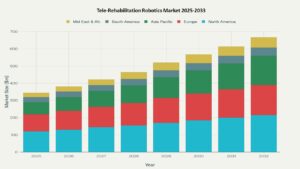
The market is valued at approximately USD 1.2 billion in 2025 and is expected to reach USD 3.4 billion by 2033, expanding at a CAGR of 13.8% during the forecast period. The integration of telehealth capabilities, alongside investments in artificial intelligence, is augmenting the efficacy and reach of rehabilitation robotics. However, challenges persist, including high system costs and a shortage of skilled operators. Continued innovation, strategic healthcare partnerships, and expanding reimbursement policies are expected to further propel market growth over the coming decade.
Key Drivers of Market Growth
- Rising prevalence of chronic diseases and aging populations is significantly increasing demand for tele-rehabilitation robotics, as these solutions facilitate remote, continuous care for stroke, musculoskeletal injuries, and age-related mobility disorders.
- Technological advancements—such as the integration of artificial intelligence, real-time monitoring, and lightweight, wearable exoskeletons—are enhancing therapy outcomes and broadening applications in home and clinical settings.
- Expansion of telemedicine platforms and improved access to digital health infrastructure are driving adoption, especially as healthcare providers and patients seek remote, cost-effective rehabilitation solutions.
- Supportive healthcare policies and increased reimbursement for tele-rehabilitation are accelerating market acceptance, particularly in regions with established insurance frameworks and government-backed neuro-rehabilitation programs.
- Rising awareness and focus on patient-specific, data-driven therapies—including virtual reality and gamified rehabilitation—are further fuelling market growth by increasing patient engagement and measurable treatment efficacy.
Market Segmentation
The Tele-Rehabilitation Robotics Market can be segmented by several key criteria:
- By Product Type: Exoskeletons, assistive robots, therapeutic robots, and prosthetics/orthotics. Exoskeletons and therapeutic robots are the highest-growth categories.
- By Application: Stroke rehabilitation, orthopedic therapy, neurological disorder management, and sports medicine.
- By End User: Rehabilitation centers, hospitals, medical clinics, and home-based care settings.
- By Distribution Channel: Direct institutional sales dominate, but online and retail channels are gaining traction for consumer-grade devices.
- By Geography: North America and Europe lead adoption, with Asia-Pacific emerging as the fastest-growing region.
Region-Level Insights
- North America: The largest market, supported by advanced healthcare infrastructure, strong R&D investments, and favorable reimbursement models.
- Asia Pacific: The fastest-growing region, driven by a rapidly aging population, increased chronic disease prevalence, and growing investments in rehabilitation robotics in China, Japan, and South Korea.
- Europe: Stable growth, bolstered by national neuro-rehabilitation initiatives and telehealth expansion, especially in Nordic countries.
- Latin America & Middle East: Emerging markets with gradual adoption, aided by increasing awareness and regulatory alignment.
Leading Companies in the Market
Key players include:
- Hocoma AG: Leading robotic solutions for neurorehabilitation and home therapy.
- ReWalk Robotics Ltd. & Ekso Bionics Holdings, Inc.: Wearable exoskeleton providers focusing on gait training and mobility enhancement.
- Cyberdyne Inc.: Robotic suits utilizing neurorobotics and AI for rehabilitation.
- Myomo Inc.: Upper-limb robotic orthoses for remotely monitored rehabilitation.
These companies are expanding through AI-enabled monitoring, lightweight designs, and global partnerships to increase market penetration.
Strategic Intelligence and AI-Backed Insights
AI integration is transforming the tele-rehabilitation robotics market. AI-driven analytics and adaptive rehabilitation protocols are enabling fully customized, patient-specific therapy programs with predictive progress tracking. The adoption of sensor miniaturization, VR-based gamified modules, and cloud platforms is allowing clinicians to remotely monitor patients, expanding access to underserved populations.
Subscription and rental models are boosting affordability and homecare adoption. Future investments will focus on improving cross-platform compatibility, reimbursement coverage, and scaling virtual reality applications, solidifying tele-rehabilitation as a cornerstone of value-based care.
Forecast Snapshot: 2025–2033
| Metric | Value |
| 2025 Market Size | USD 1.2 billion |
| 2033 Market Size | USD 3.4 billion |
| CAGR (2025–2033) | 13.8% |
| Largest Region (2025) | North America (38% share) |
| Fastest Growing Region | Asia Pacific (CAGR 16%) |
| Leading Product Segment | Exoskeletons |
| Top End User Segment | Rehabilitation centers (2025) shifting to Homecare (by 2033) |
| Key Trend | AI-driven remote monitoring & gamified therapy |
Why the Global Market Remains Critical
The global tele-rehabilitation robotics market plays a vital role in combating the rising global burden of chronic diseases, disabilities, and aging populations. These technologies deliver advanced, accessible rehabilitation care to patients worldwide, reducing pressure on healthcare infrastructure and bridging gaps in underserved regions. AI-enabled personalization and real-time data analytics ensure better outcomes while maintaining scalability and cost efficiency.
International growth also shapes innovation, reimbursement standards, and manufacturing economies of scale that benefit regional markets. The sector is increasingly viewed as foundational to digital health and remote care delivery.
Final Takeaway
The Tele-Rehabilitation Robotics Market is on a steep growth trajectory, driven by AI-enabled personalization, telehealth infrastructure expansion, and patient demand for remote care solutions. Homecare applications are emerging as the fastest-growing segment.
Market value is expected to nearly triple between 2025 and 2033, supported by strong adoption across North America and rapid penetration in Asia-Pacific. Continued focus on affordability, virtual reality integration, and predictive analytics will cement tele-rehabilitation robotics as a core pillar of future rehabilitative care.
Table of Contents
Overview
1.1 Market Context: Tele-Rehabilitation Robotics Market Landscape
1.2 Why Remote & Robotic Rehabilitation, Why Now: Accessibility & Outcomes Imperative
1.3 Market Snapshot: USD 1.2B (2025) to USD 3.4B (2033) | CAGR 13.8%
1.4 Telehealth-Enabled Robotics as a Driver of Scalable, Personalized Therapy
1.5 Phoenix Methodology: Data Stack, Predictive Modeling, Patient Outcome Mapping
Key Drivers of Market Growth
2.1 Rising Chronic Disease Burden & Aging Populations
2.2 Technological Breakthroughs: AI, VR, Wearable Exoskeletons & Remote Monitoring
2.3 Expansion of Telemedicine Platforms & Digital Health Infrastructure
2.4 Supportive Policies & Reimbursement Advancing Adoption
2.5 Data-Driven, Patient-Specific Therapies Driving Engagement & Measurable Outcomes
Market Segmentation
3.1 By Product Type
• 3.1.1 Exoskeletons (Leading Growth Segment)
• 3.1.2 Assistive Robots
• 3.1.3 Therapeutic Robots
• 3.1.4 Prosthetics & Orthotics
3.2 By Application
• 3.2.1 Stroke Rehabilitation
• 3.2.2 Orthopedic Therapy
• 3.2.3 Neurological Disorder Management
• 3.2.4 Sports Medicine
3.3 By End User
• 3.3.1 Rehabilitation Centers
• 3.3.2 Hospitals
• 3.3.3 Medical Clinics
• 3.3.4 Home-Based Care Settings
3.4 By Distribution Channel
• 3.4.1 Direct Institutional Sales
• 3.4.2 Online Channels
• 3.4.3 Retail Channels
3.5 By Geography
• 3.5.1 North America
• 3.5.2 Europe
• 3.5.3 Asia Pacific
• 3.5.4 Latin America
• 3.5.5 Middle East & Africa
Region-Level Insights
4.1 North America – Market Leader (38% Share in 2025)
• 4.1.1 Advanced Healthcare Infrastructure & R&D Investments
• 4.1.2 Favorable Reimbursement Models Driving Adoption
4.2 Asia Pacific – Fastest Growing Region (CAGR 16%)
• 4.2.1 Aging Demographics & Chronic Disease Prevalence
• 4.2.2 Investments in Rehabilitation Robotics in China, Japan, South Korea
4.3 Europe – Steady Growth
• 4.3.1 National Neuro-Rehabilitation Initiatives
• 4.3.2 Telehealth Expansion in Nordic Countries
4.4 LATAM & MENA – Emerging Opportunity Zones
• 4.4.1 Gradual Adoption with Regulatory Alignment
• 4.4.2 Awareness Campaigns and Institutional Partnerships
Leading Companies in the Market
5.1 Market Leaders: Product Portfolio and Differentiators
• Hocoma AG – Neurorehabilitation & Home Therapy Solutions
• ReWalk Robotics Ltd. – Wearable Exoskeletons for Gait Training
• Ekso Bionics Holdings, Inc. – Mobility Enhancement Robotics
• Cyberdyne Inc. – AI-Powered Robotic Suits for Rehabilitation
• Myomo Inc. – Upper-Limb Robotic Orthoses
5.2 Competitive Intelligence Grid: Market Penetration vs. Product Depth
5.3 AI-Enabled Monitoring & Lightweight Design as Differentiators
5.4 Strategic Partnerships: Healthcare Providers, Telehealth Platforms & Insurers
Strategic Intelligence and AI-Backed Insights
6.1 AI + Robotics: Personalized, Adaptive Rehabilitation Programs
• 6.1.1 Predictive Progress Tracking & Custom Therapy Protocols
• 6.1.2 Sensor Miniaturization & Real-Time Remote Monitoring
• 6.1.3 VR-Based Gamified Therapy Driving Engagement
6.2 Phoenix Predictive Dashboard
• 6.2.1 Rental & Subscription Models Improving Affordability
• 6.2.2 Cross-Platform Compatibility as Market Accelerator
• 6.2.3 Expanding Reimbursement Coverage Boosting Adoption
6.3 Sentiment Analyzer Trends (2023–2025):
• Stakeholder Confidence in Telehealth Expansion
• Policy-Level Support for Home-Based Rehabilitation
6.4 AI-Backed Porter’s Five Forces
• 6.4.1 Supplier Power: Robotic Component Manufacturers
• 6.4.2 Buyer Power: Rehabilitation Networks & Homecare Providers
• 6.4.3 Threat of Substitutes: Conventional Rehabilitation Methods
• 6.4.4 Barriers to Entry: High Development Cost & Regulatory Requirements
• 6.4.5 Competitive Rivalry: High Innovation Intensity
Forecast Snapshot: 2025–2033
7.1 Total Market Size: USD 1.2B → USD 3.4B
7.2 Largest Region (2025): North America (38% Share)
7.3 Fastest Growing Region: Asia Pacific (CAGR 16%)
7.4 Leading Product Segment: Exoskeletons
7.5 End User Shift: Rehabilitation Centers (2025) → Homecare (2033)
7.6 Key Growth Drivers: AI-Driven Monitoring, VR Integration, Telehealth Platforms
Why the Global Market Remains Critical
8.1 Addressing Chronic Disease & Disability Gaps Globally
8.2 AI-Enabled Personalization Enhancing Care Quality and Scalability
8.3 Bridging Access in Underserved Regions via Remote Models
8.4 International Growth Driving Innovation, Reimbursement & Manufacturing Efficiencies
8.5 Tele-Rehabilitation Robotics as a Foundational Pillar of Digital Health
Phoenix Analyst Insights and Final Takeaway
9.1 Final Outlook: Homecare and AI-Personalized Rehabilitation Driving Next-Gen Growth
9.2 Key Recommendations:
• For Providers: Expand Hybrid (Clinic + Home) Care Models
• For Developers: Focus on Lightweight, Affordable Devices
• For Payers: Align Reimbursement with Outcome-Based Metrics
9.3 Watchlist:
• Gamified VR Therapy Adoption Rates
• Emerging Markets’ Telehealth Infrastructure
• Subscription-Based Device Models for Affordability
9.4 Investment Horizon: Cross-Platform Interoperability, Cloud-Enabled Patient Data
9.5 Vision 2033: Tele-Rehabilitation Robotics as a Mainstream Standard in Global Rehabilitative Care
Appendices
10.1 Phoenix Research Methodology
10.2 Data Sources and Definitions
10.3 Robotics & Tele-Rehabilitation Glossary (e.g., Exoskeletons, AI Protocols)
10.4 Market Map: By Application and End User Segment
10.5 Contact Phoenix for Custom Reports & Strategy Briefs