
Thailand Health and Wellness food Market size and share Analysis 2026-2033
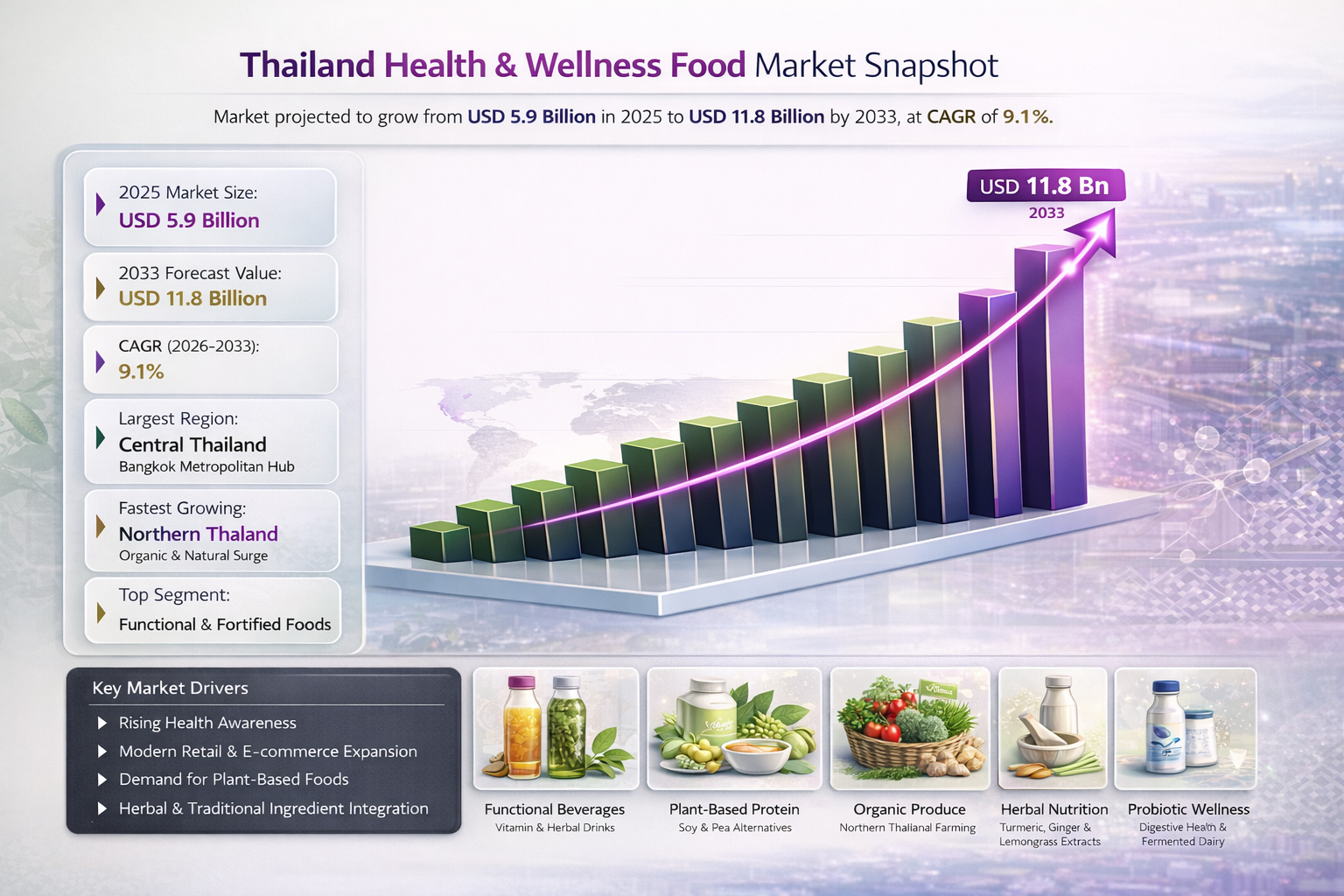
Thailand Health & Wellness Food Market Forecast Snapshot: 2026–2033
| Metric | Value |
| 2025 Market Size | USD 5.9 Billion |
| 2033 Market Size | USD 11.8 Billion |
| CAGR (2026–2033) | 9.1% |
| Largest Region | Central Thailand |
| Fastest Growing Region | Northern Thailand |
| Top Segment | Functional & Fortified Foods |
| Key Trend | Clean-Label, Organic, and Plant-Based Nutrition |
| Future Focus | Functional Beverages, Herbal Nutrition, and Personalized Wellness Foods |
Thailand Health & Wellness Food Market Overview
Thailand Health & Wellness Food Market is thriving. Thais are getting health-conscious, focusing on nutrition, prevention, and feeling good. With worries about obesity, diabetes, and more, folks are switching to healthier choices – functional foods, organic goodies, plant-based eats, and low-calorie options are trending.
According to Pheonix Research, the Thailand Health & Wellness Food Market is valued at USD 5.9 billion in 2025 and is projected to reach USD 11.8 billion by 2033, registering a CAGR of 9.1% during 2026–2033. Market expansion is driven by increasing disposable income, urbanization, and growing consumer awareness regarding nutrition and preventive healthcare.
Central Thailand currently represents the largest regional market, driven by high urbanization, strong modern retail infrastructure, and a large concentration of health-conscious consumers in Bangkok and surrounding metropolitan areas. Meanwhile, Northern Thailand is emerging as the fastest-growing region, supported by increasing consumer awareness, expansion of organic agriculture, and rising demand for natural and plant-based food products.
The post-2025 outlook highlights strong growth opportunities in functional beverages, herbal nutrition products, plant-based foods, and organic packaged foods, positioning Thailand as a rapidly expanding market within Southeast Asia’s health and wellness food industry.
Key Drivers of Thailand Health & Wellness Food Market Growth
1. Rising Health Awareness and Preventive Healthcare
Thai consumers are increasingly adopting healthier diets to prevent chronic diseases and maintain long-term wellness.
2. Growth of Functional and Fortified Foods
Foods enriched with vitamins, minerals, and probiotics are gaining popularity among health-conscious consumers.
3. Expansion of Modern Retail and E-commerce Platforms
Supermarkets, hypermarkets, and online grocery platforms are improving accessibility to health and wellness food products.
4. Increasing Demand for Plant-Based and Organic Foods
Consumers are shifting toward natural, organic, and plant-based food products with clean-label ingredients.
5. Integration of Herbal and Traditional Ingredients
Thai herbal ingredients such as lemongrass, ginger, turmeric, and basil are driving innovation in functional foods and beverages.
Thailand Health & Wellness Food Market Segmentation
1. By Product Type
1.1 Functional and Fortified Foods
1.1.1 Vitamin-Enriched Foods
1.1.1.1 Fortified Cereals
1.1.1.1.1 Breakfast Cereals
1.1.1.1.2 Nutritional Snack Bars
1.1.2 Probiotic and Digestive Health Foods
1.1.2.1 Yogurt and Fermented Dairy
1.1.2.1.1 Probiotic Yogurt
1.1.2.1.2 Fermented Milk Drinks
1.2 Organic Foods
1.2.1 Organic Fruits and Vegetables
1.2.1.1 Fresh Organic Produce
1.2.1.1.1 Organic Vegetables
1.2.1.1.2 Organic Fruits
1.2.2 Organic Packaged Foods
1.2.2.1 Organic Snacks
1.2.2.1.1 Healthy Snack Products
1.2.2.1.2 Natural Ingredient Foods
1.3 Plant-Based Foods
1.3.1 Plant-Based Dairy Alternatives
1.3.1.1 Soy-Based Beverages
1.3.1.1.1 Soy Milk
1.3.1.1.2 Soy Yogurt
1.3.2 Plant-Based Protein Foods
1.3.2.1 Meat Alternatives
1.3.2.1.1 Soy Protein Products
1.3.2.1.2 Pea Protein Products
1.4 Low-Calorie and Diet Foods
1.4.1 Sugar-Free Foods
1.4.1.1 Low-Sugar Snacks
1.4.1.1.1 Diabetic-Friendly Foods
1.4.1.1.2 Reduced-Sugar Desserts
1.4.2 Low-Fat Foods
1.4.2.1 Healthy Dairy Products
1.4.2.1.1 Low-Fat Milk
1.4.2.1.2 Reduced-Fat Yogurt
1.5 Functional Beverages
1.5.1 Nutritional Drinks
1.5.1.1 Vitamin-Enriched Beverages
1.5.1.1.1 Energy Nutrition Drinks
1.5.1.1.2 Immunity Support Drinks
1.5.2 Herbal and Botanical Beverages
1.5.2.1 Herbal Wellness Drinks
1.5.2.1.1 Detox Beverages
1.5.2.1.2 Antioxidant Herbal Drinks
2. By Distribution Channel
2.1 Supermarkets & Hypermarkets
2.1.1 Health & Wellness Product Sections
2.1.1.1 Functional Food Shelves
2.1.1.2 Organic Food Product Sections
2.1.2 Packaged Wellness Food Retail
2.1.2.1 Functional Snack Products
2.1.2.2 Fortified Food Products
2.2 Online Retail & E-commerce
2.2.1 E-commerce Grocery Platforms
2.2.1.1 Large Online Grocery Marketplaces
2.2.1.2 Health-Focused E-commerce Platforms
2.2.2 Direct-to-Consumer Health Brands
2.2.2.1 Brand-Owned Online Stores
2.2.2.2 Subscription-Based Nutrition Services
2.3 Specialty Health Stores
2.3.1 Organic Food Retail Stores
2.3.1.1 Organic Fruits & Vegetables
2.3.1.2 Organic Packaged Foods
2.3.2 Nutritional Supplement Stores
2.3.2.1 Sports Nutrition Retailers
2.3.2.2 Functional Nutrition Stores
2.4 Traditional Retail Stores
2.4.1 Local Grocery Stores
2.4.1.1 Daily Grocery Retailers
2.4.1.2 Neighborhood Convenience Stores
2.4.2 Independent Food Retailers
2.4.2.1 Specialty Food Shops
2.4.2.2 Local Health Food Vendors
3. By Consumer Group
3.1 Health-Conscious Consumers
3.1.1 Fitness Enthusiasts
3.1.1.1 Gym and Sports Nutrition Consumers
3.1.1.2 Protein and Energy Food Consumers
3.1.2 Lifestyle Diet Followers
3.1.2.1 Keto Diet Consumers
3.1.2.2 High-Protein and Low-Carb Diet Consumers
3.2 Medical Nutrition Consumers
3.2.1 Diabetic Consumers
3.2.1.1 Low-Glycemic Food Products
3.2.1.2 Sugar-Free Nutrition Products
3.2.2 Weight Management Consumers
3.2.2.1 Low-Calorie Diet Products
3.2.2.2 Portion-Control Food Products
3.3 Young Urban Consumers
3.3.1 Millennials
3.3.1.1 Health-Oriented Lifestyle Consumers
3.3.1.2 Organic and Plant-Based Food Buyers
3.3.2 Gen Z Consumers
3.3.2.1 Functional Beverage Consumers
3.3.2.2 Healthy Snack Consumers
3.4 Fitness and Sports Nutrition Consumers
3.4.1 Professional Athletes
3.4.1.1 High-Protein Nutrition Foods
3.4.1.2 Performance Nutrition Products
3.4.2 Recreational Fitness Consumers
3.4.2.1 Energy Nutrition Foods
3.4.2.2 Recovery Nutrition Products
4. By Ingredient Type
4.1 Plant-Based Ingredients
4.1.1 Plant Protein Ingredients
4.1.1.1 Soy Protein
4.1.1.2 Pea Protein
4.1.2 Plant-Based Nutritional Components
4.1.2.1 Plant Fiber Ingredients
4.1.2.2 Natural Plant Extracts
4.2 Herbal and Botanical Ingredients
4.2.1 Traditional Herbal Ingredients
4.2.1.1 Turmeric Extract
4.2.1.2 Ginger Extract
4.2.2 Botanical Wellness Ingredients
4.2.2.1 Lemongrass Extract
4.2.2.2 Basil and Herbal Extracts
4.3 Probiotic and Functional Ingredients
4.3.1 Digestive Health Ingredients
4.3.1.1 Probiotic Cultures
4.3.1.2 Prebiotic Fibers
4.3.2 Functional Nutritional Compounds
4.3.2.1 Omega Fatty Acids
4.3.2.2 Antioxidant Compounds
4.4 Vitamin and Mineral Fortification
4.4.1 Vitamin-Enriched Ingredients
4.4.1.1 Vitamin C Fortification
4.4.1.2 Vitamin D Fortification
4.4.2 Mineral-Enriched Ingredients
4.4.2.1 Iron Fortification
4.4.2.2 Calcium Fortification
5.By Region
5.1 Central Thailand
5.2 Northern Thailand
5.3 Northeastern Thailand
5.4 Southern Thailand
Regional Insights of Thailand Health & Wellness Food Market
Central Thailand – Largest Market
Central Thailand dominates the market due to high urbanization, strong modern retail infrastructure, and rising demand for health-focused food products in cities such as Bangkok and surrounding metropolitan areas.
Northern Thailand – Fastest Growing Region
Northern Thailand is witnessing rapid growth driven by increasing health awareness, expansion of organic farming, and rising consumer demand for natural and plant-based food products.
Northeastern Thailand
Growing middle-class populations and improving retail distribution networks are supporting demand for health and wellness food products.
Southern Thailand
Tourism-driven consumption and increasing interest in functional beverages and organic food products are contributing to steady market growth.
Leading Companies in Thailand Health & Wellness Food Market
Nestlé Thailand
Unilever Thailand
Danone Thailand
Thai Union Group
CP Foods
PepsiCo Thailand
General Mills
Herbalife Nutrition
Leading companies are focusing on functional food innovation, herbal ingredient integration, and expansion of plant-based product portfolios to strengthen their market presence. The largest company among the listed companies is PepsiCo Inc.
Strategic Intelligence & AI-Backed Insights
Pheonix Demand Forecast Engine identifies rising demand for preventive nutrition, functional foods, and plant-based products as key growth drivers.
Consumer Behavior Analyzer highlights strong consumer preference for clean-label, organic, and immunity-boosting foods.
Innovation Tracker emphasizes functional beverages, herbal nutrition products, and plant-based protein foods as major competitive differentiators.
Porter’s Five Forces Analysis reveals strong competition among health food brands, moderate supplier power, and growing opportunities for premium wellness-focused products.
📢 Social Mentions & Publication Channels
Explore deeper insights and follow our cross-platform updates on LinkedIn and X for continuous intelligence and market coverage.
LinkedIn : https://www.linkedin.com/feed/update/urn:li:activity:7438096581930733568
X :
Why the Thailand Health & Wellness Food Market is Critical
-
Supports preventive healthcare and healthy lifestyle adoption.
-
Addresses increasing lifestyle-related diseases in Thailand.
-
Encourages innovation in functional foods and herbal nutrition products.
-
Strengthens Thailand’s food processing and health food industries.
-
Promotes sustainable agriculture and organic food production.
Final Takeaway of Thailand Health & Wellness Food Market
The Thailand Health & Wellness Food Market is steadily evolving into a nutrition-focused and preventive healthcare-driven food ecosystem. The Thailand Health & Wellness Food Market CAGR 2026–2033 of 9.1% reflects strong expansion supported by rising health awareness, growing demand for functional foods, and increasing adoption of plant-based nutrition.
Companies that invest in functional food innovation, herbal nutrition products, organic packaged foods, and personalized nutrition solutions will be well positioned to capture long-term growth opportunities.
At Pheonix Research, our advanced forecasting frameworks provide comprehensive revenue forecasts, competitive benchmarking, and strategic intelligence, enabling stakeholders to capitalize on emerging opportunities in the Thailand health and wellness food market with confidence.
📢 Social Mentions & Publication Channels
Explore deeper insights and follow our cross-platform updates on LinkedIn and X for continuous intelligence and market coverage.
LinkedIn : https://www.linkedin.com/feed/update/urn:li:activity:7438096581930733568
X : https://x.com/Pheonix_Insight/status/2032334814037319716?s=20
Table of Contents
1. Market Forecast Snapshot (2026–2033)
1.1 2025 Market Size – USD 5.9 Billion
1.2 2033 Market Size – USD 11.8 Billion
1.3 CAGR (2026–2033) – 9.1%
1.4 Largest Region – Central Thailand
1.5 Fastest Growing Region – Northern Thailand
1.6 Top Segment – Functional & Fortified Foods
1.7 Key Trend – Clean-Label, Organic, and Plant-Based Nutrition
1.8 Future Focus – Functional Beverages, Herbal Nutrition, and Personalized Wellness Foods
2. Thailand Health & Wellness Food Market Overview
2.1 Market Definition & Scope
2.2 Evolution of the Health & Wellness Food Industry in Thailand
2.3 Rising Consumer Awareness of Preventive Healthcare
2.4 Growth of Functional and Fortified Foods
2.5 Expansion of Modern Retail and E-commerce Channels
2.6 Post-2025 Market Outlook
3. Key Drivers of Thailand Health & Wellness Food Market Growth
3.1 Rising Health Awareness and Preventive Healthcare
3.2 Growth of Functional and Fortified Foods
3.3 Expansion of Modern Retail and E-commerce Platforms
3.4 Increasing Demand for Plant-Based and Organic Foods
3.5 Integration of Herbal and Traditional Ingredients
4. Market Segmentation by Product Type
4.1 Functional and Fortified Foods
4.1.1 Vitamin-Enriched Foods
4.1.1.1 Fortified Cereals
4.1.1.1.1 Breakfast Cereals
4.1.1.1.2 Nutritional Snack Bars
4.1.2 Probiotic and Digestive Health Foods
4.1.2.1 Yogurt and Fermented Dairy
4.1.2.1.1 Probiotic Yogurt
4.1.2.1.2 Fermented Milk Drinks
4.2 Organic Foods
4.2.1 Organic Fruits and Vegetables
4.2.1.1 Fresh Organic Produce
4.2.1.1.1 Organic Vegetables
4.2.1.1.2 Organic Fruits
4.2.2 Organic Packaged Foods
4.2.2.1 Organic Snacks
4.2.2.1.1 Healthy Snack Products
4.2.2.1.2 Natural Ingredient Foods
4.3 Plant-Based Foods
4.3.1 Plant-Based Dairy Alternatives
4.3.1.1 Soy-Based Beverages
4.3.1.1.1 Soy Milk
4.3.1.1.2 Soy Yogurt
4.3.2 Plant-Based Protein Foods
4.3.2.1 Meat Alternatives
4.3.2.1.1 Soy Protein Products
4.3.2.1.2 Pea Protein Products
4.4 Low-Calorie and Diet Foods
4.4.1 Sugar-Free Foods
4.4.1.1 Low-Sugar Snacks
4.1.1.1.1 Diabetic-Friendly Foods
4.1.1.1.2 Reduced-Sugar Desserts
4.4.2 Low-Fat Foods
4.4.2.1 Healthy Dairy Products
4.4.2.1.1 Low-Fat Milk
4.4.2.1.2 Reduced-Fat Yogurt
4.5 Functional Beverages
4.5.1 Nutritional Drinks
4.5.1.1 Vitamin-Enriched Beverages
4.5.1.1.1 Energy Nutrition Drinks
4.5.1.1.2 Immunity Support Drinks
4.5.2 Herbal and Botanical Beverages
4.5.2.1 Herbal Wellness Drinks
4.5.2.1.1 Detox Beverages
4.5.2.1.2 Antioxidant Herbal Drinks
5. Market Segmentation by Distribution Channel
5.1 Supermarkets & Hypermarkets
5.1.1 Health & Wellness Product Sections
5.1.1.1 Functional Food Shelves
5.1.1.2 Organic Food Product Sections
5.1.2 Packaged Wellness Food Retail
5.1.2.1 Functional Snack Products
5.1.2.2 Fortified Food Products
5.2 Online Retail & E-commerce
5.2.1 E-commerce Grocery Platforms
5.2.1.1 Large Online Grocery Marketplaces
5.2.1.2 Health-Focused E-commerce Platforms
5.2.2 Direct-to-Consumer Health Brands
5.2.2.1 Brand-Owned Online Stores
5.2.2.2 Subscription-Based Nutrition Services
5.3 Specialty Health Stores
5.3.1 Organic Food Retail Stores
5.3.1.1 Organic Fruits & Vegetables
5.3.1.2 Organic Packaged Foods
5.3.2 Nutritional Supplement Stores
5.3.2.1 Sports Nutrition Retailers
5.3.2.2 Functional Nutrition Stores
5.4 Traditional Retail Stores
5.4.1 Local Grocery Stores
5.4.1.1 Daily Grocery Retailers
5.4.1.2 Neighborhood Convenience Stores
5.4.2 Independent Food Retailers
5.4.2.1 Specialty Food Shops
5.4.2.2 Local Health Food Vendors
6. Market Segmentation by Consumer Group
6.1 Health-Conscious Consumers
6.1.1 Fitness Enthusiasts
6.1.1.1 Gym and Sports Nutrition Consumers
6.1.1.2 Protein and Energy Food Consumers
6.1.2 Lifestyle Diet Followers
6.1.2.1 Keto Diet Consumers
6.1.2.2 High-Protein and Low-Carb Diet Consumers
6.2 Medical Nutrition Consumers
6.2.1 Diabetic Consumers
6.2.1.1 Low-Glycemic Food Products
6.2.1.2 Sugar-Free Nutrition Products
6.2.2 Weight Management Consumers
6.2.2.1 Low-Calorie Diet Products
6.2.2.2 Portion-Control Food Products
6.3 Young Urban Consumers
6.3.1 Millennials
6.3.1.1 Health-Oriented Lifestyle Consumers
6.3.1.2 Organic and Plant-Based Food Buyers
6.3.2 Gen Z Consumers
6.3.2.1 Functional Beverage Consumers
6.3.2.2 Healthy Snack Consumers
6.4 Fitness and Sports Nutrition Consumers
6.4.1 Professional Athletes
6.4.1.1 High-Protein Nutrition Foods
6.4.1.2 Performance Nutrition Products
6.4.2 Recreational Fitness Consumers
6.4.2.1 Energy Nutrition Foods
6.4.2.2 Recovery Nutrition Products
7. Market Segmentation by Ingredient Type
7.1 Plant-Based Ingredients
7.1.1 Plant Protein Ingredients
7.1.1.1 Soy Protein
7.1.1.2 Pea Protein
7.1.2 Plant-Based Nutritional Components
7.1.2.1 Plant Fiber Ingredients
7.1.2.2 Natural Plant Extracts
7.2 Herbal and Botanical Ingredients
7.2.1 Traditional Herbal Ingredients
7.2.1.1 Turmeric Extract
7.2.1.2 Ginger Extract
7.2.2 Botanical Wellness Ingredients
7.2.2.1 Lemongrass Extract
7.2.2.2 Basil and Herbal Extracts
7.3 Probiotic and Functional Ingredients
7.3.1 Digestive Health Ingredients
7.3.1.1 Probiotic Cultures
7.3.1.2 Prebiotic Fibers
7.3.2 Functional Nutritional Compounds
7.3.2.1 Omega Fatty Acids
7.3.2.2 Antioxidant Compounds
7.4 Vitamin and Mineral Fortification
7.4.1 Vitamin-Enriched Ingredients
7.4.1.1 Vitamin C Fortification
7.4.1.2 Vitamin D Fortification
7.4.2 Mineral-Enriched Ingredients
7.4.2.1 Iron Fortification
7.4.2.2 Calcium Fortification
8. Market Segmentation by Region
8.1 Central Thailand
8.2 Northern Thailand
8.3 Northeastern Thailand
8.4 Southern Thailand
9. Regional Insights
9.1 Central Thailand – Largest Market
9.2 Northern Thailand – Fastest Growing Region
9.3 Northeastern Thailand – Growing Consumer Base
9.4 Southern Thailand – Tourism-Driven Demand
10. Competitive Landscape
10.1 Market Share Analysis
10.2 Competitive Positioning Matrix
10.3 Functional Food Innovation Strategies
10.4 Plant-Based and Herbal Product Development
10.5 Distribution and Pricing Strategies
11. Leading Companies
11.1 Nestlé Thailand
11.2 Unilever Thailand
11.3 Danone Thailand
11.4 Thai Union Group
11.5 CP Foods
11.6 PepsiCo Thailand
11.7 General Mills
11.8 Herbalife Nutrition
12. Strategic Intelligence & AI-Backed Insights
12.1 Pheonix Demand Forecast Engine
12.2 Consumer Behavior & Trend Analytics
12.3 Innovation Tracker – Functional Beverages & Herbal Nutrition
12.4 Porter’s Five Forces Analysis
13. Sustainability & Regulatory Landscape
13.1 Organic Food Certification Standards
13.2 Sustainable Agriculture Practices
13.3 Food Safety Regulations and Compliance
13.4 Clean-Label and Transparency Initiatives
14. Market Significance
14.1 Supporting Preventive Healthcare in Thailand
14.2 Addressing Lifestyle-Related Diseases
14.3 Encouraging Innovation in Functional Foods
14.4 Strengthening Thailand’s Food Processing Industry
14.5 Promoting Sustainable Agriculture and Organic Farming
15. Final Takeaway
15.1 Growth Outlook (2026–2033)
15.2 Expansion of Functional and Plant-Based Foods
15.3 Omnichannel Distribution Strategy – Retail & E-commerce
15.4 Innovation in Herbal and Personalized Nutrition
15.5 Strategic Recommendations for Industry Stakeholders
16. Appendix
17. About Us
18. Disclaimer
Competitive Landscape
Competitive Landscape of the Thailand Health & Wellness Food Market
Executive Framing
The Thailand Health & Wellness Food Market is moderately fragmented with high competitive intensity, driven by the presence of global food giants, regional FMCG leaders, and emerging health-focused brands. Key players such as Nestlé Thailand, Unilever Thailand, Danone Thailand, Thai Union Group, CP Foods, PepsiCo Thailand, General Mills, and Herbalife Nutrition dominate the competitive landscape through diversified product portfolios, strong retail penetration, and continuous product innovation.
Current Market Reality
The market is rapidly evolving as Thai consumers increasingly prioritize preventive healthcare, clean-label nutrition, and plant-based diets. Functional and fortified foods remain the dominant segment, while functional beverages, herbal nutrition, and organic foods are gaining strong traction.
Central Thailand leads due to urban consumption patterns and advanced retail infrastructure, while Northern Thailand is emerging as a high-growth region supported by organic agriculture and rising health awareness. Companies are leveraging local herbal ingredients such as lemongrass, turmeric, and ginger to develop differentiated wellness products aligned with cultural preferences.
Key Signals and Evidence
- Rising demand for clean-label, organic, and plant-based food products.
- Strong growth in functional beverages and herbal nutrition products.
- Expansion of modern retail and e-commerce distribution channels.
- Increasing integration of traditional Thai herbal ingredients in food innovation.
- Growing influence of younger, health-conscious urban consumers.
Strategic Implications
- Localization Strategy: Incorporating Thai herbal ingredients and regional flavors into product portfolios.
- Functional Innovation: Expanding offerings in fortified foods and functional beverages.
- Clean-Label Positioning: Emphasizing transparency, natural ingredients, and organic certifications.
- Omnichannel Expansion: Strengthening presence across supermarkets, e-commerce, and DTC platforms.
- Targeting Young Consumers: Developing products tailored to millennials and Gen Z health trends.
Forward Outlook
By 2033, the Thailand Health & Wellness Food Market is projected to reach approximately USD 11.8 billion, growing at a CAGR of ~9.1%. Central Thailand will continue to dominate due to strong urban demand, while Northern Thailand is expected to emerge as a key growth hub driven by organic and plant-based food adoption.
The competitive landscape will increasingly focus on functional beverages, herbal nutrition, and personalized wellness foods. Companies that successfully integrate local ingredient innovation, digital retail strategies, and clean-label positioning will gain a strong competitive edge in Thailand’s evolving health and wellness food ecosystem.
Value Chain
Thailand Health & Wellness Food Market: Value Chain & Market Dynamics
Executive Framing
The Thailand Health & Wellness Food Market is transforming into a nutrition-driven, preventive healthcare, and lifestyle-oriented ecosystem. Increasing consumer focus on health optimization, clean-label foods, and plant-based nutrition is accelerating product innovation, functional ingredient integration, and retail expansion.
The operational model is hybrid, where multinational food companies leverage established supply chains, large-scale manufacturing, and retail dominance, while local and emerging brands focus on organic, herbal, and premium wellness food products.
Current Market Reality
Central Thailand leads the market due to urbanization and strong retail infrastructure, while Northern Thailand is the fastest-growing region supported by organic farming and rising health awareness. Upstream supply includes agriculture, raw material sourcing, and ingredient processing, midstream involves food manufacturing, fortification, and product innovation, and downstream distribution spans supermarkets, convenience stores, specialty health stores, and e-commerce platforms.
Key Signals and Evidence
- Market growth from USD 5.9 billion (2025) to USD 11.8 billion (2033) at a CAGR of 9.1%.
- Rising demand for functional, fortified, and plant-based food products.
- Expansion of herbal beverages and natural wellness foods.
- Growth of modern retail and online grocery platforms.
- Increasing integration of traditional Thai herbal ingredients in food innovation.
Strategic Implications
Companies must focus on product differentiation, clean-label positioning, and ingredient transparency. Large players emphasize scale, brand strength, and distribution reach, while niche brands compete through organic certifications, local sourcing, and premium wellness positioning.
Digital transformation, including e-commerce expansion, direct-to-consumer models, and personalized nutrition platforms, is becoming critical for market penetration and consumer engagement.
Sustainability is a key priority, with increasing emphasis on eco-friendly packaging, ethical sourcing, and sustainable agriculture practices.
Forward Outlook
The Thailand Health & Wellness Food Market is expected to evolve into a high-growth, innovation-driven, and wellness-centric ecosystem. Key future trends include:
- Expansion of functional beverages and ready-to-drink nutrition products
- Growth in plant-based and organic packaged foods
- Rising demand for herbal nutrition and traditional ingredient-based products
- Adoption of personalized nutrition and digital wellness solutions
Companies aligning with consumer health trends, innovation, and omnichannel distribution strategies will capture long-term growth opportunities in Thailand’s health and wellness food market.
Investment Activity
Investment & Funding Dynamics – Thailand Health & Wellness Food Market
Executive Framing
Current Market Reality
Valued at USD 5.9 billion in 2025 and projected to reach ~USD 11.8 billion by 2033 (CAGR ~9.1%), the market reflects strong growth and increasing investor interest. Central Thailand remains the primary investment hub due to urban concentration and advanced retail infrastructure, while Northern Thailand is emerging as a high-growth investment zone driven by organic farming and plant-based food demand. Key players such as Nestlé Thailand, CP Foods, and PepsiCo Thailand are investing in functional product innovation, localized offerings, and digital retail expansion.
Key Signals and Evidence
- Functional Food & Beverage Expansion: Strong investments in vitamin-enriched foods, probiotic products, and functional drinks.
- Plant-Based & Organic Growth: Increasing funding for plant-based proteins, dairy alternatives, and organic packaged foods.
- Herbal Ingredient Integration: Rising investment in Thai herbal ingredients such as turmeric, ginger, basil, and lemongrass.
- E-Commerce & Digital Retail: Expansion of online grocery platforms and direct-to-consumer wellness brands.
- Weight Management & Lifestyle Nutrition: Investment in low-calorie, sugar-free, and diet-focused food products.
- Urban Health Consumer Targeting: Capital allocation toward premium health products for urban populations.
- Tourism-Driven Demand: Growth in functional beverages and organic foods linked to wellness tourism trends.
Strategic Implications
Companies that integrate local herbal knowledge, clean-label formulations, and modern retail strategies will gain a competitive advantage. Investors are prioritizing brands with strong positioning in functional foods, plant-based nutrition, and premium wellness categories. Partnerships with e-commerce platforms, health-focused retailers, and hospitality sectors will be critical for scaling growth across Thailand.
Forward Outlook
From 2026 to 2033, investment in Thailand’s Health & Wellness Food Market is expected to accelerate, particularly in functional beverages, herbal nutrition products, and plant-based innovations. Funding will increasingly focus on sustainable sourcing, product localization, and digital consumer engagement. M&A activity is expected to rise as companies expand portfolios and strengthen regional presence within Southeast Asia.
Technology & Innovation
Thailand Health & Wellness Food Market: Technology & Innovation
Executive Framing
Technology and innovation in the Thailand Health & Wellness Food Market are focused on enhancing functional food development, integrating traditional herbal knowledge with modern science, and enabling personalized nutrition solutions. As Thai consumers increasingly prioritize preventive healthcare and clean-label diets, companies are leveraging digital platforms, food technology, and advanced ingredient innovation to deliver health-focused, convenient, and customized nutrition products.
Current Market Reality
Valued at USD 5.9 billion in 2025 and projected to reach USD 11.8 billion by 2033 at a CAGR of 9.1%, the market is undergoing rapid transformation across product innovation, digital retail expansion, and ingredient development. Central Thailand leads in modern retail and functional food innovation, while Northern Thailand is emerging as a high-growth region driven by organic farming, herbal product development, and increasing adoption of plant-based nutrition.
Key Signals and Evidence
- Functional Food Innovation: Development of fortified foods, probiotic dairy products, and nutrient-enriched snacks targeting immunity, digestion, and overall wellness.
- Herbal Integration & Traditional Ingredients: Use of Thai herbs such as lemongrass, turmeric, ginger, and basil in functional foods and beverages to enhance nutritional and therapeutic value.
- Digital Health & E-commerce Platforms: Expansion of online grocery platforms, health apps, and direct-to-consumer brands enabling personalized nutrition access and convenience.
- Plant-Based Food Technology: Growth in plant-based dairy alternatives and protein products supported by innovation in soy, pea protein, and natural ingredient processing.
- Smart Manufacturing & Food Processing: Adoption of automation, quality control systems, and efficient food processing technologies to ensure product consistency and scalability.
- Clean-Label & Smart Packaging: Increasing use of transparent labeling, sustainable packaging materials, and QR-based traceability systems to build consumer trust.
Strategic Implications
Companies investing in functional food innovation, herbal nutrition integration, and digital distribution channels will gain a competitive advantage in Thailand’s evolving market. Expanding into high-growth segments such as functional beverages, organic packaged foods, and plant-based nutrition can drive long-term growth. Additionally, leveraging local herbal expertise and ensuring product transparency will be critical for brand differentiation and consumer trust.
Forward Outlook
The market is expected to evolve toward a more integrated health and wellness ecosystem combining food, beverages, and digital health platforms. Future innovation will focus on personalized nutrition solutions, advanced functional ingredients, and scalable organic food production. Thailand is set to become a key regional hub for health-focused food innovation in Southeast Asia.
Market Risk
Risk Factors and Disruption Threats in the Thailand Health & Wellness Food Market
Executive Framing
The Thailand Health & Wellness Food Market is witnessing strong growth, driven by rising health awareness, increasing focus on preventive healthcare, and growing demand for functional, organic, and plant-based food products. The market is projected to grow from USD 5.9 billion in 2025 to USD 11.8 billion by 2033 at a CAGR of 9.1%.
Current Market Reality
Central Thailand dominates the market due to high urbanization, strong retail infrastructure, and a large base of health-conscious consumers. Northern Thailand is the fastest-growing region, supported by rising awareness, expansion of organic farming, and increasing demand for natural food products.
Key Signals and Evidence
- Rising prevalence of lifestyle-related diseases driving healthier food choices.
- Growing demand for functional, fortified, and immunity-boosting foods.
- Rapid expansion of e-commerce and modern retail distribution channels.
- Increasing popularity of plant-based and organic food products.
- Strong integration of herbal and traditional Thai ingredients in nutrition products.
Strategic Implications
- Invest in functional foods, herbal nutrition, and plant-based product innovation.
- Expand distribution through e-commerce and modern retail platforms.
- Focus on clean-label, organic, and health-focused product positioning.
- Leverage local herbal ingredients for product differentiation.
- Target emerging regions with rising consumer awareness and spending.
Forward Outlook
The market is expected to evolve into a highly dynamic and innovation-driven ecosystem centered around preventive healthcare and functional nutrition. Growth will be fueled by advancements in plant-based foods, herbal ingredients, and personalized nutrition solutions.
Regulatory Landscape
Regulatory & Policy Landscape: Thailand Health & Wellness Food Market
Executive Framing
The Thailand Health & Wellness Food Market operates under a structured regulatory environment governed primarily by the Thailand Food and Drug Administration (Thai FDA), Ministry of Public Health, and international food safety frameworks such as Codex Alimentarius. These authorities oversee product safety, labeling, ingredient approvals, and health claims across functional foods, organic products, and dietary nutrition segments.
Health and wellness food products in Thailand are regulated based on their classification—functional foods, fortified foods, dietary supplements, or organic products—requiring companies to comply with multiple regulatory standards depending on product positioning and intended health benefits.
Current Market Reality
The regulatory landscape in Thailand is moderately stringent, with increasing emphasis on food safety, clean-label transparency, and accurate nutritional labeling. Functional and fortified foods must meet strict guidelines regarding ingredient usage and health claims, particularly for immunity-boosting and probiotic products.
Rising demand for organic and plant-based foods has also led to stricter certification and labeling requirements. Additionally, the growth of e-commerce and imported health food products has increased regulatory scrutiny on product authenticity, labeling compliance, and cross-border food safety standards.
Key Signals and Evidence
- Regulatory classification of products into functional foods, dietary supplements, and organic foods.
- Mandatory compliance with Thai FDA food safety and labeling regulations.
- Strict guidelines for health claims, especially for immunity and functional benefits.
- Certification requirements for organic and clean-label food products.
- Increasing monitoring of imported health foods and cross-border e-commerce sales.
- Growing emphasis on transparency in ingredient sourcing and nutritional disclosure.
Strategic Implications
Companies operating in Thailand must ensure compliance with Thai FDA regulations, including proper labeling, approved ingredient usage, and substantiated health claims. Investment in quality assurance, product testing, and certification processes is critical for market entry and long-term success.
Aligning product portfolios with clean-label, organic certification, and plant-based standards can enhance brand positioning. Companies should also focus on transparent supply chains and local sourcing strategies to meet regulatory expectations and build consumer trust.
Forward Outlook (2026–2033)
Regulatory frameworks in Thailand are expected to become more robust, with increased focus on food safety, functional ingredient validation, and sustainability. Authorities are likely to introduce stricter controls on health claims and expand organic certification standards.
Emerging technologies such as blockchain for supply chain transparency, AI-driven nutritional analysis, and digital compliance systems will play a growing role in regulatory adherence. Companies that proactively invest in compliance and innovation will gain a competitive edge in the evolving market.