
Global Gaming and Gambling Market size, share and forecast 2026-2033
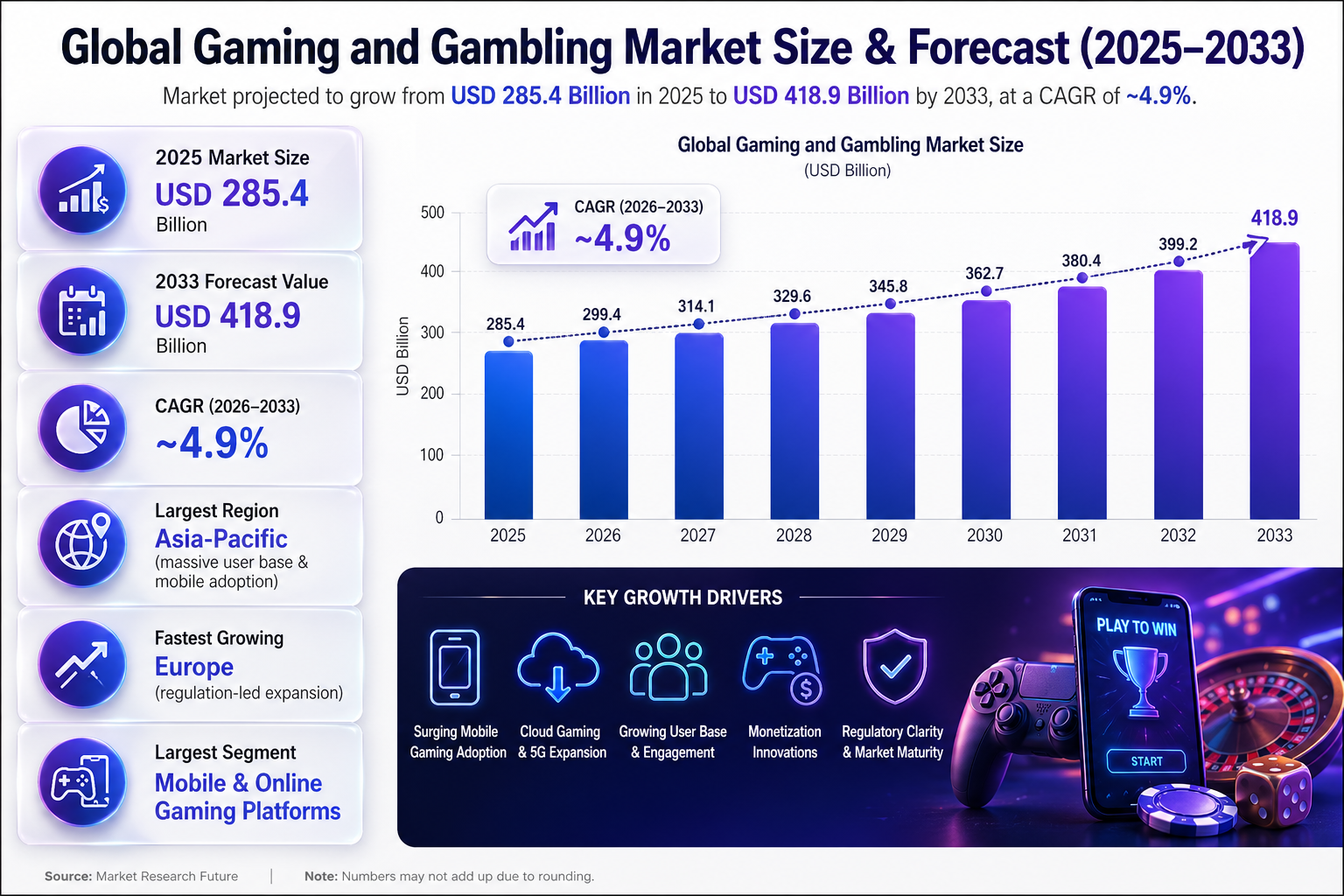
Market Forecast Snapshot (2026???2033)
| Metric | Value |
|---|---|
| 2025 Market Size | USD 285.4 Billion |
| 2033 Market Size | USD 418.9 Billion |
| CAGR (2026???2033) | ~4.9% |
| Largest Segment | Mobile & Online Gaming Platforms |
| Fastest-Growing Segment | Online Gambling & Sports Betting |
| Largest Region | Asia-Pacific |
| Key Trend | Convergence of Gaming, Gambling & Real-Money Ecosystems |
Global Gaming and Gambling Market Overview
The Global Gaming and Gambling Market is a massive digital playground?? where people dive into video games, mobile gaming, esports, online casinos, sports betting, and more. It???s basically entertainment, skill-based play, and real-money wagering all mixed together, reaching folks worldwide. Land-based casinos are even teaming up with online platforms, making it super convenient to play and bet.
The Global Gaming and Gambling Market is like the money engine?? for digital entertainment???powered by app stores, streaming, payment gateways, and data analytics. People game daily, bet on sports, and spend regularly, so engagement is super high. With smartphones, fast internet, and digital wallets everywhere, these platforms are turning into 24/7, super personalized, and data-smart experiences .
This means users get tailored game recommendations, faster transactions, and immersive experiences. As tech evolves, expect more AI-driven gameplay, VR/AR integration, and seamless cross-platform play. The market's growth is fueled by this blend of tech, accessibility, and user-centric services
According to the Pheonix Demand Forecast Engine, the Global Gaming and Gambling Market size is valued at USD 285.4 billion in 2025 and is projected to reach USD 418.9 billion by 2033, expanding at a CAGR of ~4.9% during 2026???2033. Market growth is driven by the rapid expansion of mobile-first gaming, increasing legalization of online gambling and sports betting, rising monetization of esports, and the integration of real-money gaming within broader entertainment platforms.
Regionally, Asia-Pacific dominates the market due to its massive user base and high mobile adoption, while Europe is emerging as the fastest-growing region, supported by regulation-led expansion and strong penetration of licensed online gambling platforms.
Key Drivers of Global Gaming and Gambling Market Growth
High Engagement & Repeat Usage
Gaming and gambling platforms benefit from daily usage cycles, driving predictable and recurring revenue.
Smartphone & Internet Penetration
Low-cost smartphones and high-speed connectivity have expanded access globally.
Legalization & Regulation
Clear regulatory frameworks in Europe, North America, and parts of Asia are unlocking institutional capital.
Digital Payments & Wallets
Seamless deposits, withdrawals, and micro-transactions fuel spending.
Esports & Live Betting Growth
Real-time engagement is driving growth , significantly increasing monetization potential.
Global Gaming and Gambling Market Segmentation
1. By Product Type
1.1 Gaming
1.1.1 Video Games
1.1.1.1 Console games
1.1.1.2 PC games
1.1.2 Mobile Games
1.1.2.1 Casual games
1.1.2.2 Hyper-casual games
1.1.2.3 Mid-core & hardcore games
1.1.3 Online & Multiplayer Games
1.1.3.1 MMO games
1.1.3.2 Social and community-based games
1.1.4 Esports & Competitive Gaming
1.1.4.1 Tournament-based gaming
1.1.4.2 Streaming-integrated competitive play
1.2 Gambling
1.2.1 Online Casinos
1.2.1.1 Slots
1.2.1.2 Table games
1.2.1.3 Live dealer games
1.2.2 Sports Betting
1.2.2.1 Pre-match betting
1.2.2.2 In-play / live betting
1.2.3 Poker & Card Games
1.2.3.1 Cash games
1.2.3.2 Tournament poker
1.2.4 Lottery & Bingo
1.2.4.1 Digital lottery platforms
1.2.4.2 Online bingo rooms
2. By Platform
2.1 Mobile Platforms??
2.1.1 Android-based platforms
2.1.2 iOS-based platforms
2.2 PC & Web-Based Platforms
2.2.1 Browser-based gaming
2.2.2 Desktop gambling portals
2.3 Console Platforms
2.3.1 PlayStation
2.3.2 Xbox
2.3.3 Nintendo
2.4 Land-Based Platforms with Digital Integration
2.4.1 Casinos with online extensions
2.4.2 Hybrid gaming lounges
3. By Revenue Model
3.1 Free-to-Play with Monetization
3.1.1 In-app purchases
3.1.2 Loot boxes & cosmetic upgrades
3.2 Subscription-Based Models
3.2.1 Cloud gaming subscriptions
3.2.2 Premium membership access
3.3 Pay-to-Play & Real-Money Gaming
3.3.1 Skill-based gaming
3.3.2 Entry-fee tournaments
3.4 Advertising-Based Models
3.4.1 Rewarded ads
3.4.2 Brand sponsorships
3.5 Betting & Wagering Revenue
3.5.1 Odds-based betting
3.5.2 Pool-based wagering
4. By Player Type
4.1 Casual Players
4.1.1 Entertainment-focused users
4.2 Core & Competitive Gamers
4.2.1 Skill-based and ranked players
4.3 Real-Money Bettors
4.3.1 Sports and casino users
4.4 Fantasy Sports Users
4.4.1 Season-long and daily fantasy players
4.5 VIP & High-Value Players
4.5.1 High-frequency and high-spend users
5. By Age Group
5.1 Below 18 (Restricted Segment)
5.2 18???25
5.2.1 Mobile-first users
5.3 26???35 (Largest Segment)
5.3.1 Highest spending power
5.4 36???45
5.4.1 Stable and premium users
5.5 Above 45
5.5.1 Casino and lottery-focused users
6. By Geography
6.1 Asia-Pacific (Largest Region)
-
China
-
India
-
Japan
-
South Korea
-
Southeast Asia
6.2 Europe (Fastest-Growing Region)
-
U.K.
-
Germany
-
France
-
Italy
-
Spain
6.3 North America
-
United States
-
Canada
6.4 Latin America
-
Brazil
-
Mexico
6.5 Middle East & Africa
-
UAE
-
South Africa
Leading Companies in the Global Gaming and Gambling Market
-
Microsoft (Xbox & Activision Blizzard)
-
NetEase Games
-
Flutter Entertainment
-
Entain
-
DraftKings
-
Evolution Gaming
Tencent is the largest company in the Global Gaming and Gambling Market.
Why the Gaming and Gambling Market Is Critical
-
Major revenue engine of the global digital economy
-
Strong overlap with fintech, AI, cloud, blockchain, and media industries
-
Generates recurring, high-margin consumer spending
-
Influences youth entertainment, social interaction, and live digital communities
-
Increasingly regulated, making it strategically important for governments and investors
-
Acts as a testing ground for new monetization and engagement models
Strategic Intelligence & Pheonix AI-Backed Insights
Pheonix Demand Forecast Engine
Analyzes user base growth, session frequency, monetization intensity, and platform penetration across gaming, gambling, and hybrid real-money ecosystems.
Monetization & Player Value Analyzer
Evaluates in-app purchases, wagering behavior, subscriptions, ad revenues, and lifetime value (LTV) across casual gaming, esports, online casinos, and sports betting platforms.
Regulatory & Market Access Sensitivity Model
Tracks licensing costs, taxation structures, compliance requirements, and policy volatility impacting platform scalability and operating margins.
Automated Porter???s Five Forces (Concise)
-
Buyer Power: Moderate ??? high user choice, but strong engagement and platform stickiness
-
Supplier Power: Moderate ??? game developers, content licensors, and payment gateways
-
Threat of New Entrants: Moderate ??? low tech barriers in gaming, high regulatory barriers in gambling
-
Threat of Substitutes: Moderate ??? free-to-play, social gaming, and entertainment alternatives
-
Competitive Rivalry: High ??? global gaming publishers, betting operators, and regional digital platforms competing aggressively
Final Takeaway
The Global Gaming and Gambling Market is a structurally resilient, engagement-driven, and monetization-rich industry undergoing rapid digital convergence. While gaming platforms dominate user volume, gambling and real-money ecosystems drive profitability. Companies that master regulation, technology, and responsible engagement will capture long-term value through 2033.
Competitive Landscape
Global Gaming and Gambling Competitive Intensity & Market Structure Overview
The Global Gaming and Gambling Market is characterized by a highly dynamic, digitally converging, and competitively intense ecosystem where gaming publishers, gambling operators, sports betting platforms, app stores, payment gateways, and content ecosystems increasingly overlap. The market spans casual gaming, esports, online gambling, sports betting, fantasy sports, and hybrid real-money platforms, creating one of the most monetization-diverse sectors in the digital economy. The market operates through a multi-layered structure where gaming is primarily volume-led through mobile, console, PC, and free-to-play ecosystems, while gambling and betting segments are margin-rich due to recurring wagering, regulatory licensing, and high-value user monetization. Mobile and online platforms dominate structural expansion, while land-based casinos continue to integrate digital channels to preserve relevance. Competitive intensity is extremely high due to platform fragmentation, user acquisition costs, content innovation pressure, and increasing regulatory oversight. Major global publishers and betting operators compete through exclusive content, live services, AI-driven personalization, payment efficiency, licensing, and ecosystem lock-in strategies.
Global Gaming and Gambling Competitive Intensity & Market Structure Current Scenario
Leading Company Profiles
Tencent Holdings: Global market leader with dominant mobile gaming scale, publishing ecosystem, strategic investments, and broad digital entertainment integration. Sony Interactive Entertainment: Console ecosystem powerhouse leveraging exclusive IP, subscription models, and premium gaming infrastructure. Microsoft (Xbox & Activision Blizzard): Major global gaming consolidator with cloud gaming, subscription-led monetization, and content ownership advantages. NetEase Games: Strong regional and international digital gaming player with mobile-first strengths and live-service capabilities. Flutter Entertainment: Global gambling and sports betting leader with diversified online betting brands and regulatory scale. Entain: Major regulated gambling operator with strong sportsbook and online casino capabilities. DraftKings: High-growth sports betting and fantasy sports platform with aggressive digital customer acquisition. Evolution Gaming: Live dealer and digital casino technology leader with premium B2B gaming infrastructure.
Key Competitive Intensity & Market Structure Signals in Global Gaming and Gambling Market
A major structural signal is the convergence of gaming, gambling, and real-money ecosystems, where social gaming, fantasy sports, skill-based gaming, and wagering increasingly intersect, blurring traditional industry boundaries. Another major signal is mobile platform dominance, particularly across Asia-Pacific, where smartphones drive the largest user acquisition funnel for both gaming and betting ecosystems. Regulation remains one of the most defining market structure forces, especially in gambling and sports betting, where licensing, taxation, and compliance create both barriers and strategic moats. Content ownership and ecosystem stickiness are critical competitive drivers. Exclusive games, esports rights, live betting experiences, and AI-personalized retention models significantly shape long-term user lifetime value. Mergers, acquisitions, and platform consolidation are accelerating, particularly as major firms seek cross-platform monetization through cloud gaming, betting integrations, and entertainment ecosystems.
Strategic Implications of Competitive Intensity & Market Structure in Global Gaming and Gambling Market
Gaming companies must increasingly evolve beyond one-time product sales toward recurring monetization ecosystems, including subscriptions, microtransactions, esports, and hybrid monetization. Gambling operators must prioritize regulatory excellence, responsible gaming frameworks, and jurisdictional scalability to secure sustainable market share. Mobile-first product strategies are strategically essential, particularly in emerging markets where smartphone-led adoption defines growth trajectories. Cross-platform ecosystem integration’including gaming, social communities, streaming, payments, and betting’represents one of the strongest long-term structural advantages. AI, predictive analytics, and personalized engagement systems are becoming central to acquisition, retention, monetization, and fraud prevention strategies.
Global Gaming and Gambling Competitive Intensity & Market Structure Forward Outlook
The Global Gaming and Gambling Market is expected to witness sustained structural growth through 2033, with mobile gaming, online betting, esports, and real-money ecosystems driving the strongest monetization expansion. Gaming will likely remain the largest user-volume segment, while online gambling and sports betting are positioned to deliver disproportionate profitability due to recurring revenue intensity and legalization momentum. Regulation-led expansion in Europe, North America, and selected Asia-Pacific markets will continue reshaping competitive boundaries, favoring compliant, capitalized operators. Technological innovation’including cloud gaming, blockchain-enabled gaming assets, AI personalization, VR/AR, and live interactive wagering’will further intensify competition and redefine engagement models. Through 2033, the market will be shaped by five major competitive pillars: mobile dominance, regulatory scalability, ecosystem convergence, monetization sophistication, and responsible engagement. Companies that align with these structural forces will lead the Global Gaming and Gambling Market.
Value Chain
Global Gaming and Gambling Market Value Chain & Supply Chain Evolution Overview
The Global Gaming and Gambling Market value chain is rapidly evolving from a fragmented entertainment and wagering ecosystem into a highly digitized, data-driven, platform-centric engagement economy. Unlike traditional entertainment sectors, gaming and gambling operate through continuous user participation, monetization loops, and recurring digital transactions, making the industry one of the most commercially resilient segments of the global digital economy.
This value chain spans game development, platform publishing, cloud infrastructure, payment gateways, regulatory licensing, user acquisition, digital distribution, live operations, esports ecosystems, sportsbook management, casino content integration, and responsible gaming governance. As gaming, gambling, and real-money ecosystems increasingly converge, the market is shifting from standalone content delivery toward integrated digital entertainment platforms combining play, social interaction, streaming, wagering, and monetization.
Upstream supply chain dynamics are increasingly shaped by software engines, AI personalization tools, content studios, IP licensing, payment processing infrastructure, cybersecurity systems, cloud hosting, and compliance frameworks. Platform scalability now depends not only on content creation but also on technological resilience, transaction speed, fraud prevention, and regulatory adaptability.
Game publishers and gambling operators are increasingly prioritizing live-service ecosystems, mobile-first architecture, real-time analytics, personalized recommendation engines, and immersive technologies such as VR/AR. The market is also witnessing increasing integration of blockchain, digital wallets, and cross-platform identity systems to improve monetization efficiency and user retention.
Distribution has become the central competitive battleground, with app stores, direct-to-consumer platforms, online casinos, sportsbook apps, streaming ecosystems, social communities, and cloud gaming all competing for user acquisition and engagement time. Digital channels increasingly dominate over physical channels, although land-based casinos continue evolving through hybrid online-offline models.
Supply chain challenges include regulatory fragmentation, cybersecurity threats, licensing costs, payment restrictions, app store dependency, anti-money laundering compliance, user acquisition inflation, and balancing monetization intensity with responsible gaming obligations.
Global Gaming and Gambling Market Value Chain & Supply Chain Evolution Current Scenario
The current market is shaped by mobile-first growth, digital payment penetration, legalization of online gambling, esports monetization, and platform convergence.
Upstream, content developers and platform operators are investing heavily in AI-driven personalization, multiplayer ecosystems, streaming integration, and real-time wagering infrastructure.
Gaming companies increasingly focus on live-service models, downloadable content, subscriptions, in-app monetization, and social ecosystems, while gambling operators prioritize licensed expansion, sportsbook innovation, and live betting technology.
Distribution channels are increasingly platformized, dominated by app stores, proprietary ecosystems, digital wallets, affiliate networks, influencer ecosystems, and omnichannel casino integration.
Payment systems, identity verification, and anti-fraud systems are becoming strategically critical due to increasing transaction intensity and global compliance complexity.
Responsible gaming, age verification, data privacy, and taxation frameworks are becoming central operational pillars, especially in regulated gambling markets.
Key Value Chain & Supply Chain Evolution Signals in Global Gaming and Gambling Market
Several structural transformations are reshaping the global gaming and gambling ecosystem.
First, mobile platforms have become the dominant user acquisition and monetization engine due to smartphone ubiquity and app ecosystem maturity.
Second, convergence between gaming and gambling is accelerating through skill-based wagering, fantasy sports, esports betting, and hybrid monetization systems.
Third, digital payments, crypto-enabled ecosystems, and wallet innovation are improving monetization speed and user retention.
Fourth, cloud gaming, live betting, and streaming ecosystems are creating persistent engagement environments with significantly higher lifetime value.
Fifth, regulation and responsible gaming compliance are becoming competitive differentiators, especially in gambling and real-money segments.
Sixth, AI and behavioral analytics are increasingly central to user acquisition, fraud prevention, personalized content delivery, and monetization optimization.
Strategic Implications of Value Chain & Supply Chain Evolution in Global Gaming and Gambling Market
Leading companies such as Tencent, Sony, Microsoft, NetEase, Flutter Entertainment, DraftKings, Entain, and Evolution Gaming are strengthening competitive positioning through content ecosystems, licensing strategies, platform ownership, and payment infrastructure integration.
Long-term value increasingly depends on controlling both content and distribution layers, including proprietary IP, publishing platforms, sportsbook licenses, casino content, payment systems, and user communities.
Companies with stronger ecosystem integration across gaming, streaming, betting, and social interaction are better positioned to maximize user lifetime value and reduce churn.
Regulatory agility is becoming a decisive strategic advantage, particularly in online gambling, sports betting, and cross-border monetization.
Supply chain resilience increasingly depends on cybersecurity, scalable cloud architecture, payment processing partnerships, and responsible user governance.
As monetization complexity rises, operators must balance aggressive revenue extraction with compliance, user trust, and sustainable engagement models.
Global Gaming and Gambling Market Value Chain & Supply Chain Evolution Forward Outlook
Between 2026 and 2033, the gaming and gambling value chain is expected to become more immersive, AI-driven, regulation-intensive, and ecosystem-integrated.
Game developers and operators will increasingly prioritize cross-platform ecosystems, VR/AR experiences, blockchain-enabled ownership systems, and predictive monetization tools.
Gambling operators are expected to expand through regulated online channels, in-play betting innovation, micro-betting models, and advanced user verification systems.
Distribution ecosystems will increasingly converge around super-apps, app marketplaces, direct platforms, streaming ecosystems, and social commerce channels.
AI-based fraud detection, personalized recommendations, compliance automation, and responsible gaming controls will become foundational infrastructure.
Ultimately, the market will evolve from standalone gaming or gambling experiences toward unified digital entertainment ecosystems where gaming, social engagement, wagering, fintech, and media increasingly intersect.
Market-Specific Value Chain
- Content Creation & IP Development: Game studios, casino software providers, sportsbook algorithms, esports content, licensed entertainment IP
- Technology Infrastructure: Game engines, cloud computing, AI personalization, cybersecurity systems, payment gateways, blockchain integration
- Platform Development & Publishing: Mobile apps, consoles, PC platforms, online casinos, sportsbook apps, cloud gaming ecosystems
- Distribution & User Acquisition: App stores, digital marketplaces, affiliate networks, streaming channels, esports ecosystems, digital marketing
- Monetization & Transaction Systems: In-app purchases, subscriptions, ad monetization, betting revenue, digital wallets, loyalty systems
- Compliance & Responsible Governance: Licensing, KYC, AML, responsible gaming systems, taxation, fraud monitoring
Company-to-Stage Mapping
- Content Creation & IP Development: Tencent Holdings, Sony Interactive Entertainment, Microsoft (Activision Blizzard), NetEase Games
- Technology Infrastructure: Microsoft, Tencent Cloud, Evolution Gaming, proprietary AI and payment technology providers
- Platform Development & Publishing: Sony PlayStation, Xbox, Tencent, Flutter Entertainment, DraftKings, Entain
- Distribution & User Acquisition: App stores, Steam, PlayStation Network, Xbox Live, online sportsbook affiliates, esports streaming platforms
- Monetization & Transaction Systems: Flutter Entertainment, DraftKings, Evolution Gaming, payment gateways, subscription ecosystems
- Compliance & Responsible Governance: Licensed gambling operators, regional regulators, payment compliance providers, cybersecurity and KYC infrastructure partners
Investment Activity
Global Tyre Distribution & Retail Market Investment & Funding Dynamics Overview
Investment and funding dynamics in the Global Tyre Distribution & Retail Market are being shaped by the market’s transition from fragmented dealer-led ecosystems toward omnichannel, digitally integrated, and service-centric retail infrastructure. Between 2026 and 2033, capital deployment is expected to increasingly prioritize organized retail chains, e-commerce platforms, franchise expansion, last-mile fitment services, and EV-ready tyre retail capabilities. As tyre replacement remains a recurring, non-discretionary demand category, investors view tyre distribution and retail as a stable cash-flow segment with strong aftermarket monetization potential. Funding is increasingly directed toward retail digitization, online-to-offline (O2O) platforms, inventory analytics, warehouse automation, and customer lifecycle retention systems. Major global players such as Michelin, Bridgestone, Goodyear, Continental, Apollo Tyres, and Pirelli are actively investing in retail network modernization, franchise ecosystems, direct-to-consumer platforms, and service-led retail expansion to secure stronger downstream control over pricing, customer loyalty, and premium product penetration. A major structural shift is the growing role of EV-specific tyres, premium replacement products, and smart tyre fitment services, which is pushing investments toward technician training, EV service bays, digital diagnostics, and omnichannel customer experience models.
Global Tyre Distribution & Retail Market Investment & Funding Dynamics Current Scenario
Currently, investment activity is being driven by replacement tyre demand stability, rising vehicle parc expansion, and increasing consumer preference for organized and digital tyre purchasing channels. Asia-Pacific leads global investment volume due to its massive vehicle population, fragmented but rapidly consolidating dealer landscape, and large-scale replacement market opportunity across passenger, two-wheeler, and commercial segments. Europe is the fastest-growing investment region, supported by premium retail formats, franchise network expansion, tyre labeling regulations, EV penetration, and rapid omnichannel retail transformation. North America remains a strong investment hub due to mature replacement cycles, large fleet contracts, organized retail chains, and digital tyre commerce growth. Latin America and Middle East & Africa are emerging investment markets where dealer formalization, digital platform penetration, and commercial fleet growth are gradually improving retail investment attractiveness.
Key Investment & Funding Dynamics Signals in Global Tyre Distribution & Retail Market
A major investment signal is the rapid shift from independent, price-driven retail toward integrated omnichannel models combining digital purchase, local installation, and mobile fitment services. Expansion of online tyre retail platforms is attracting substantial capital into e-commerce marketplaces, digital logistics, warehouse networks, and click-and-fit business models. Franchise and organized chain retail models are seeing strong funding momentum as brands seek stronger customer retention, pricing consistency, and premiumization opportunities. Fleet-focused retail contracts and tyre-as-a-service (TaaS) models are unlocking recurring B2B investment opportunities in logistics, leasing, and mobility ecosystems. The rise of EV tyres, run-flat products, connected tyres, and premium fitment services is accelerating investment into retail capability upgrades, technician specialization, and smart diagnostics infrastructure.
Strategic Implications of Investment & Funding Dynamics in Global Tyre Distribution & Retail Market
The investment landscape increasingly favors retailers and manufacturers with scalable omnichannel ecosystems, franchise networks, and integrated aftermarket service capabilities. Independent tyre dealers remain volume-dominant, but long-term capital is increasingly flowing toward organized, technology-enabled retail models that can offer superior margins and customer retention. Digital transformation is becoming a major competitive differentiator, with inventory intelligence, online booking systems, AI-driven recommendation tools, and mobile service integration reshaping retail economics. Regional diversification remains essential, with Asia-Pacific focused on volume expansion, Europe on premiumization and regulation-led modernization, and North America on fleet and digital channel optimization. Retail margin pressures, logistics complexity, and inventory management risks continue to influence profitability, making supply chain automation and channel efficiency central to future funding strategies.
Global Tyre Distribution & Retail Market Investment & Funding Dynamics Forward Outlook
Looking ahead, the Global Tyre Distribution & Retail Market is expected to attract sustained investment as tyre replacement demand remains structurally resilient and retail ecosystems modernize globally. Future capital allocation will increasingly prioritize omnichannel commerce, online tyre marketplaces, EV-focused retail infrastructure, subscription-based tyre programs, and predictive aftermarket service ecosystems. Asia-Pacific will remain the largest investment destination due to scale and dealer consolidation, while Europe will lead innovation in premium and EV-ready retail models. North America will continue to focus on digital retail, fleet service contracts, and advanced replacement ecosystems. Retail digitization, AI-enabled customer acquisition, and smart supply chain technologies will further reshape investment patterns, pushing tyre retail from transactional sales toward lifecycle mobility service platforms. Overall, the market’s investment outlook remains highly stable and strategically attractive, supported by recurring replacement demand, retail modernization, and evolving consumer preferences. Companies that align distribution scale with digital transformation, service excellence, and premium product penetration will be best positioned to lead through 2033.
Technology & Innovation
Global Gaming and Gambling Market Technology & Innovation Landscape Overview
The technology and innovation landscape within the Global Gaming and Gambling Market is rapidly evolving around artificial intelligence, cloud computing, real-time analytics, blockchain infrastructure, and immersive AR/VR environments. These technologies are fundamentally reshaping how users engage with gaming content, betting platforms, esports ecosystems, and real-money wagering systems across global markets.
Innovation in this market is centered on maximizing user engagement, improving monetization efficiency, and delivering highly personalized digital experiences. Platforms are increasingly shifting toward AI-driven ecosystems where player behavior, betting patterns, and gaming preferences are continuously analyzed in real time to optimize content delivery and revenue generation.
The convergence of gaming, gambling, fintech, and digital entertainment is also accelerating platform innovation. This is enabling seamless transitions between casual gaming, competitive esports, fantasy sports, and real-money wagering within unified digital environments.
Global Gaming and Gambling Market Technology & Innovation Landscape Current Scenario
Currently, the Global Gaming and Gambling Market is heavily driven by mobile-first technologies, cloud-based gaming infrastructure, and AI-powered personalization engines. Mobile platforms dominate user access, supported by high-speed internet and widespread smartphone penetration, enabling 24/7 engagement cycles.
Artificial intelligence plays a central role in current platform optimization, including personalized game recommendations, dynamic betting odds adjustment, fraud detection, and responsible gaming monitoring. AI is also being used to enhance user retention through predictive engagement modeling and behavioral analytics.
Cloud gaming infrastructure is expanding rapidly, eliminating the need for high-end hardware and enabling cross-device gameplay across mobile, PC, and consoles. This is significantly lowering entry barriers and expanding global user bases.
Blockchain technology is being integrated into gambling platforms to enhance transparency, enable provably fair gaming systems, and support secure digital asset ownership, including in-game assets and betting transactions.
Real-time data analytics is another key innovation pillar, particularly in sports betting and live casino environments. These systems process millions of data points per second to deliver instant odds updates, betting insights, and gameplay adjustments.
Key Technology & Innovation Landscape Signals in Global Gaming and Gambling Market
- Artificial Intelligence & Machine Learning: Powers personalization, fraud detection, dynamic pricing, and predictive user engagement.
- Cloud Gaming Infrastructure: Enables high-performance, device-agnostic gaming experiences at global scale.
- Blockchain & Web3 Integration: Supports secure transactions, digital ownership, and transparent betting mechanisms.
- AR/VR Immersive Gaming: Creates interactive virtual casinos, esports arenas, and next-gen gaming environments.
- Real-Time Analytics Engines: Enables live betting optimization and instant gameplay adjustments.
- 5G Connectivity: Reduces latency and enhances real-time multiplayer and live betting experiences.
- Digital Wallet & Payment Innovation: Enables frictionless deposits, withdrawals, and micro-transactions globally.
Strategic Implications of Technology & Innovation Landscape in Global Gaming and Gambling Market
The rapid technological evolution is fundamentally reshaping competitive dynamics in the Global Gaming and Gambling Market. AI-driven platforms are gaining a significant advantage by improving user retention, increasing lifetime value, and optimizing real-time monetization strategies across gaming and betting ecosystems.
Cloud-based infrastructure is reducing dependency on hardware, enabling platform scalability and supporting global expansion strategies for gaming and gambling operators. This is particularly important in emerging markets where mobile-first adoption is accelerating.
Blockchain integration is enhancing trust and regulatory compliance, especially in online gambling segments where transparency and fairness are critical for user adoption and licensing approvals.
The convergence of gaming and real-money ecosystems is creating new hybrid business models where entertainment, social interaction, and financial wagering coexist within unified platforms, significantly expanding monetization opportunities.
Companies investing in AI, cloud infrastructure, and real-time analytics are gaining stronger competitive positioning, while those slow to adopt digital transformation risk losing market share in an increasingly technology-driven ecosystem.
Global Gaming and Gambling Market Technology & Innovation Landscape Forward Outlook
Between 2026 and 2033, the Global Gaming and Gambling Market is expected to evolve into a fully AI-driven, cloud-native, and highly immersive digital ecosystem. Platforms will increasingly rely on predictive intelligence to manage user engagement, optimize betting outcomes, and personalize gaming experiences at scale.
AR and VR technologies are expected to become more mainstream, enabling fully immersive virtual casinos, esports environments, and interactive gaming worlds that replicate real-world experiences in digital formats.
Blockchain-based gaming and gambling ecosystems will expand further, particularly in decentralized gaming platforms and provably fair betting systems, strengthening user trust and regulatory alignment.
The integration of 5G networks and edge computing will significantly enhance real-time gaming performance, enabling ultra-low latency experiences for competitive gaming and live sports betting.
In the long term, the market is expected to fully converge into a unified digital entertainment ecosystem where gaming, gambling, social interaction, and financial transactions coexist seamlessly. Companies that lead in AI innovation, immersive technology, and cross-platform integration will dominate the next phase of market growth through 2033.
Market Risk
Global Gaming and Gambling Market Risk Factors & Disruption Threats Overview
The Global Gaming and Gambling Market operates within a highly dynamic digital entertainment ecosystem where gaming platforms, online casinos, sports betting operators, esports networks, and hybrid real-money environments compete for user attention and spending. While the industry benefits from strong engagement cycles, rapid digital adoption, and diversified monetization models, it carries a high structural risk profile due to regulatory uncertainty, addiction-related scrutiny, payment ecosystem dependency, and intense competitive disruption. A major structural risk is regulatory fragmentation. Gaming is relatively open across most regions, but gambling and real-money betting face strict licensing, taxation, advertising restrictions, and jurisdiction-specific compliance requirements. Sudden policy shifts can significantly impact revenue streams and market access. Another key disruption factor is dependency on digital payment ecosystems. Platforms rely heavily on banks, wallets, card networks, and fintech gateways for deposits and withdrawals. Any tightening of financial regulations, transaction restrictions, or fraud controls can directly disrupt monetization flows. User behavior volatility is also a major risk. The market is highly engagement-driven, meaning revenue is sensitive to shifts in user attention, content trends, influencer ecosystems, and platform fatigue. Retention is constantly challenged by new game launches and competing entertainment formats. Additionally, increasing scrutiny around responsible gaming, addiction risks, and underage exposure is driving stricter compliance frameworks, advertising limitations, and mandatory user protection systems, raising operational complexity and compliance costs.
Global Gaming and Gambling Market Risk Factors & Disruption Threats Current Scenario
The current market is characterized by rapid convergence between gaming, gambling, esports, and social entertainment platforms, creating a blended ecosystem of skill-based play and real-money wagering. Mobile gaming dominates user engagement, while online gambling and sports betting are increasingly monetized through real-time data, live odds systems, and in-play engagement models. Esports and streaming platforms are becoming major acquisition channels, with influencers and content creators playing a critical role in user conversion and retention. At the same time, regulatory tightening in key markets is increasing compliance costs, particularly in advertising, data privacy, age verification, and responsible gambling frameworks. Platform competition is intensifying, with global tech giants, regional operators, and niche gaming studios all competing for fragmented user attention.
Key Risk Factors & Disruption Threats Signals in Global Gaming and Gambling Market
A major disruption signal is the rapid convergence of gaming and real-money gambling, where gamification mechanics are increasingly integrated into betting platforms and casino ecosystems. Another key signal is regulatory tightening around online gambling in multiple jurisdictions, particularly in advertising restrictions, taxation models, and licensing controls. The rise of AI-driven personalization is reshaping user engagement, enabling highly targeted content, dynamic in-game recommendations, and predictive monetization strategies. Blockchain and crypto-based gaming ecosystems are emerging as alternative payment and wagering infrastructures, introducing both innovation opportunities and regulatory risks. Cross-platform ecosystems (mobile, console, PC, cloud) are increasing user mobility, intensifying competition for retention across devices and ecosystems.
Strategic Implications of Risk Factors & Disruption Threats in Global Gaming and Gambling Market
Companies must prioritize regulatory compliance frameworks that can adapt across multiple jurisdictions to mitigate licensing and taxation risks. Investment in AI-driven engagement, personalization engines, and real-time analytics will be critical to sustaining user retention and monetization efficiency. Strong diversification across gaming, esports, betting, and subscription models will be essential to reduce dependency on any single revenue stream. Responsible gaming systems, including behavioral monitoring, spending limits, and age verification, will become mandatory competitive infrastructure rather than optional features. Strategic partnerships with fintech providers, content creators, and cloud infrastructure players will increasingly define scalability and market expansion capability.
Global Gaming and Gambling Market Risk Factors & Disruption Threats Forward Outlook
Looking ahead to 2026-2033, the Global Gaming and Gambling Market is expected to evolve into a deeply integrated digital entertainment ecosystem where gaming, gambling, social media, and financial technologies converge. Gaming will continue to dominate user volume, while gambling and real-money ecosystems will drive disproportionate revenue contribution. Regulatory frameworks are expected to tighten globally, but will also provide clearer operating structures, enabling institutional investment and market consolidation. AI, VR/AR, cloud gaming, and real-time data systems will significantly enhance immersion, personalization, and monetization efficiency. Overall, the market will remain high-growth but structurally complex, with long-term winners defined by regulatory mastery, platform scalability, content ecosystems, and responsible monetization strategies.
Regulatory Landscape
Global Gaming and Gambling Market Regulatory & Policy Environment Overview
The regulatory and policy environment for the Global Gaming and Gambling Market is one of the most influential structural forces shaping market expansion, monetization models, platform scalability, and competitive legitimacy. Governments, digital authorities, gaming commissions, and financial regulators are increasingly focused on balancing economic opportunity with consumer protection, cybersecurity, anti-money laundering (AML), responsible gaming, and taxation frameworks. Unlike traditional digital entertainment sectors, the gaming and gambling ecosystem operates under highly fragmented regulatory structures where video gaming, esports, online casinos, sports betting, fantasy sports, loot boxes, and real-money gaming may each fall under distinct legal categories depending on jurisdiction. This creates a complex compliance landscape where policy clarity often determines market attractiveness and operator viability. Regulatory frameworks are increasingly evolving beyond basic licensing into broader governance models that address player age verification, responsible gambling systems, digital payment transparency, advertising restrictions, data privacy, algorithmic fairness, and platform accountability. Markets with structured licensing systems are becoming major growth hubs by attracting institutional capital, platform innovation, and consumer trust. Governments are also recognizing gaming and gambling as major economic engines through taxation, employment, and technology innovation, while simultaneously addressing risks such as addiction, fraud, underage participation, and illicit financial flows. This dual role is making policy sophistication a defining factor for long-term market sustainability.
Global Gaming and Gambling Market Regulatory & Policy Environment Current Scenario
The current regulatory environment is characterized by rapid legalization in selected jurisdictions, tighter compliance controls, and expanding differentiation between skill-based gaming, entertainment gaming, and wagering ecosystems. Europe currently represents one of the most mature regulatory environments due to structured licensing systems, harmonized consumer protections, and established online betting frameworks. In Europe, countries such as the U.K., Germany, Italy, and Spain maintain robust gambling oversight through licensing authorities, advertising controls, AML compliance, and responsible gaming obligations. Regulatory modernization is also increasingly covering esports betting, loot box monetization, and hybrid gaming models. North America remains highly dynamic, with the United States experiencing state-level legalization of sports betting and online gambling, while Canada expands provincial digital gaming oversight. Regulatory diversity across jurisdictions creates both opportunity and operational complexity for market participants. Asia-Pacific is the largest market by user scale but remains highly fragmented from a regulatory standpoint. Markets such as China impose stricter gambling controls while enabling major gaming ecosystems, whereas India, Southeast Asia, and select emerging markets show growing momentum toward regulated gaming, fantasy sports, and digital wagering frameworks. Latin America, the Middle East, and Africa are emerging as policy-evolving regions where legalization, taxation, and digital payment reforms may unlock future growth, particularly in sports betting and mobile-first gaming ecosystems.
Key Regulatory & Policy Environment Signals in Global Gaming and Gambling Market
- Licensing & Market Access Laws: Jurisdiction-specific approvals determine legal platform operations.
- Responsible Gaming Regulations: Self-exclusion, spending controls, addiction safeguards, and age verification are expanding globally.
- Anti-Money Laundering (AML) & KYC Compliance: Critical for gambling, betting, and real-money ecosystems.
- Digital Payment Governance: Payment gateway transparency, tax tracking, and fraud prevention shape monetization.
- Loot Box & In-Game Monetization Oversight: Increasing scrutiny over randomized purchases and youth monetization.
- Advertising & Sponsorship Restrictions: Tightening controls on gambling marketing and celebrity endorsements.
- Data Privacy & Cybersecurity Standards: Protection of user identity, financial transactions, and behavioral data.
- Taxation Frameworks: Gaming and gambling taxes significantly influence profitability and operator expansion.
Strategic Implications of Regulatory & Policy Environment in Global Gaming and Gambling Market
Regulation is rapidly becoming a strategic differentiator rather than a compliance burden. Companies that proactively align with licensing, responsible engagement, and digital governance frameworks are better positioned to secure market access, institutional credibility, and sustainable monetization. Fragmented policy environments require operators to localize offerings, payment systems, advertising models, and user engagement practices according to region-specific compliance demands. This is particularly important for global firms operating across gaming-only, hybrid, and real-money ecosystems. The increasing scrutiny of monetization structures’especially around betting, fantasy sports, loot boxes, and youth engagement’is forcing publishers and operators to redesign monetization systems toward transparency and compliance-led innovation. Responsible gaming frameworks are also influencing platform architecture, requiring integration of behavioral analytics, spending controls, player monitoring, and intervention systems. This is creating stronger intersections between AI, compliance software, and player safety technologies. Mergers, acquisitions, and expansion strategies are increasingly shaped by regulatory readiness, licensing portfolios, and compliance infrastructure rather than user scale alone.
Global Gaming and Gambling Market Regulatory & Policy Environment Forward Outlook
Between 2026 and 2033, the regulatory environment is expected to become significantly more sophisticated, digitalized, and globally interconnected. More jurisdictions are likely to legalize or formalize gaming and gambling structures as governments seek tax revenue, economic growth, and consumer oversight. Europe is expected to remain a global benchmark for structured gambling governance, while North America may continue expanding through state and provincial legalization. Asia-Pacific is likely to experience the most policy divergence, balancing rapid gaming expansion with selective gambling oversight. Future policy frameworks are likely to increasingly address AI-driven gaming, blockchain betting ecosystems, digital asset wagering, metaverse casinos, and cross-border platform governance. This could redefine regulatory categories entirely. Responsible gaming standards are expected to evolve into predictive behavioral compliance systems, where AI identifies problematic usage patterns before harm escalates. This may become a standard requirement in regulated markets. Overall, the regulatory and policy environment will remain one of the most decisive forces determining long-term leadership in the Global Gaming and Gambling Market. Companies that combine compliance excellence, responsible innovation, localized policy agility, and transparent monetization systems will be best positioned to capture strategic value through 2033.