
Global Animal Feed Market Report, Size & Forecast 2026-2033
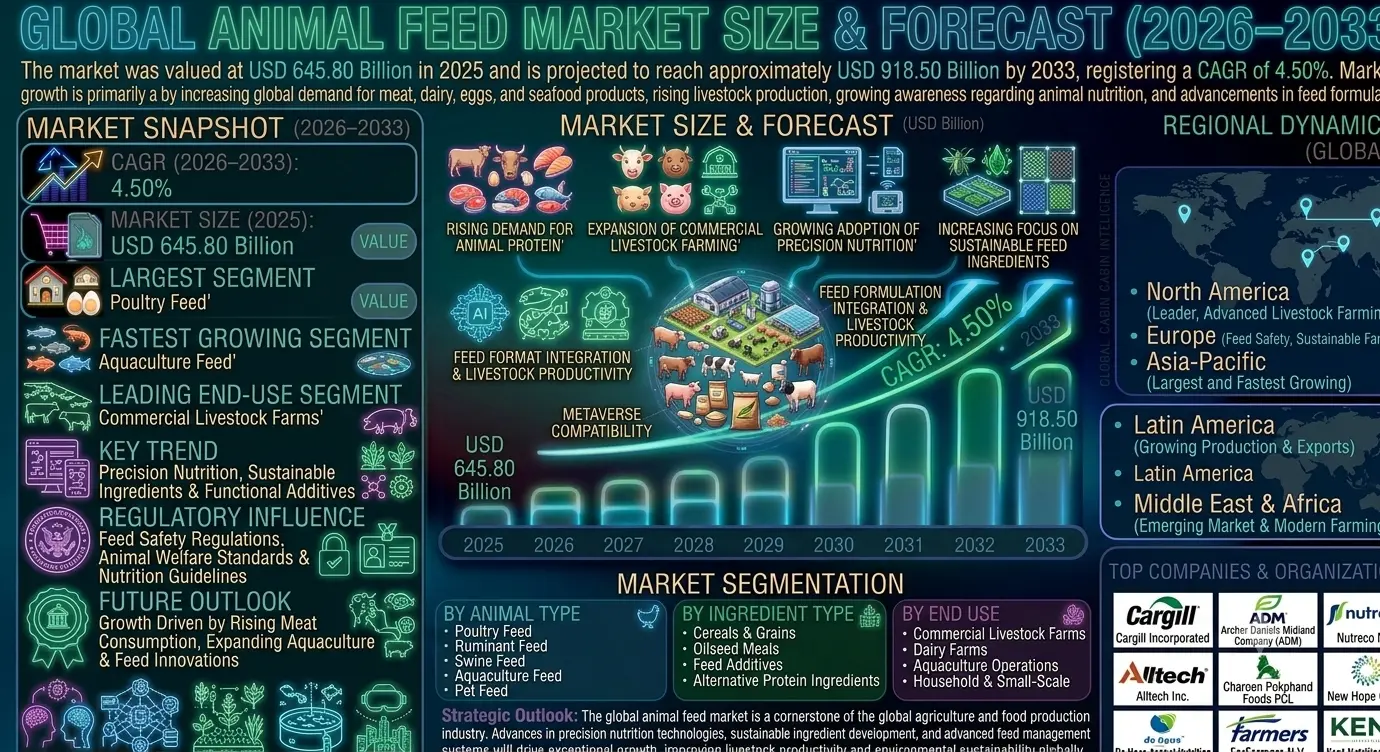
Global Animal Feed Market Forecast Snapshot (2026???2033)
| Metric | Value |
|---|---|
| Market Size (2025) | ?? ?? ?? ?? ?? ?? ?? ?? ?? ?? ?? ?? ?? ?? ?? ?? ?? ?? ?? ?? ?? ?? ?? ?? ?? ?? ?? ?? ?? ?? ?? ?? ?? ?? ?? ?? ?? ?? ?? ?? ?? USD 645.80 Billion |
| Market Size (2033) | ?? ?? ?? ?? ?? ?? ?? ?? ?? ?? ?? ?? ?? ?? ?? ?? ?? ?? ?? ?? ?? ?? ?? ?? ?? ?? ?? ?? ?? ?? ?? ?? ?? ?? ?? ?? ?? ?? ?? ?? ?? USD 918.50 Billion |
| CAGR (2026???2033) | ?? ?? ?? ?? ?? ?? ?? ?? ?? ?? ?? ?? ?? ?? ?? ?? ?? ?? ?? ?? ?? ?? ?? ?? ?? ?? ?? ?? ?? ?? ?? ?? ?? ?? ?? ?? ?? ?? ?? ?? ?? ?? ?? ?? ?? ?? 4.50% |
| Largest Segment | ?? ?? ?? ?? ?? ?? ?? ?? ?? ?? ?? ?? ?? ?? ?? ?? ?? ?? ?? ?? ?? ?? ?? ?? ?? ?? ?? ?? ?? ?? ?? ?? ?? ?? ?? ?? ?? ?? ?? ?? ?? ?? ?? ??Poultry Feed |
| Fastest Growing Segment | ?? ?? ?? ?? ?? ?? ?? ?? ?? ?? ?? ?? ?? ?? ?? ?? ?? ?? ?? ?? ?? ?? ?? ?? ?? ?? ?? ?? ?? ?? ?? ?? ?? ?? ?? ?? ?? ?? ?? ?? ?? ?? ??Aquaculture Feed |
| Leading End-Use Segment | ?? ?? ?? ?? ?? ?? ?? ?? ?? ?? ?? ?? ?? ?? ?? ?? ?? ?? ?? ?? ?? ?? ?? ?? ?? ?? ?? ?? ?? ?? ?? ?? ?? ?? ?? ?? ?? ?? Commercial Livestock Farms |
| Key Trend | ?? ?? ?? ?? ?? ?? ?? ?? ?? ??Precision Nutrition, Sustainable Feed Ingredients & Functional Feed Additives |
| Regulatory Influence | ?? ?? ?? ?? ?? ?? ?? ??Feed Safety Regulations, Animal Welfare Standards & Livestock Nutrition Guidelines |
| Future Outlook | Growth Driven by Rising Meat Consumption, Expanding Aquaculture Production & Feed Efficiency Innovations |
Global Animal Feed Market Size & Forecast
The Global Animal Feed Market is expected to witness steady growth during the forecast period from 2026 to 2033. The market was valued at USD 645.80 billion in 2025 and is projected to reach approximately USD 918.50 billion by 2033, registering a CAGR of 4.50%. Market growth is primarily driven by increasing global demand for meat, dairy, eggs, and seafood products, rising livestock production, growing awareness regarding animal nutrition, and advancements in feed formulation technologies. The industry plays a critical role in improving livestock productivity, animal health, and food security worldwide.Global Animal Feed Market Overview
Animal feed consists of nutritional products formulated to meet the dietary requirements of livestock, poultry, aquaculture species, and companion animals. Feed products contain essential nutrients such as proteins, carbohydrates, fats, vitamins, minerals, and feed additives that support animal growth, health, and productivity. The market serves poultry farms, cattle farms, swine producers, aquaculture operations, dairy farms, and commercial livestock enterprises. Growing emphasis on sustainable farming and efficient livestock production continues to shape market development.Structural Drivers of Market Growth
1. Rising Global Demand for Animal Protein
Increasing consumption of meat, dairy products, eggs, and seafood is driving demand for high-quality animal feed worldwide. Market Implications: Feed manufacturers are expanding production capacities and improving nutritional formulations to support livestock productivity.2. Expansion of Commercial Livestock Farming
The transition from traditional farming methods to commercial livestock production is increasing feed consumption across major agricultural economies. Market Implications: Large-scale farming operations are driving demand for specialized and performance-enhancing feed products.3. Growing Adoption of Precision Nutrition
Advanced feed formulations are helping optimize animal growth, feed conversion efficiency, and overall health outcomes. Market Implications: Feed producers offering customized nutrition solutions are gaining competitive advantages.4. Increasing Focus on Sustainable Feed Ingredients
The industry is exploring alternative protein sources and environmentally sustainable feed ingredients to reduce production costs and environmental impact. Market Implications: Innovation in sustainable feed technologies is creating new market opportunities.Market Segmentation Analysis
By Animal Type
- Poultry Feed Largest segment driven by high global poultry meat and egg consumption.
- Ruminant Feed Includes feed products for cattle, dairy cows, sheep, and goats.
- Swine Feed Widely used to improve pig growth performance and production efficiency.
- Aquaculture Feed Fastest-growing segment supported by expanding fish and shrimp farming activities globally.
- Pet Feed Growing demand driven by rising pet ownership and premium pet nutrition trends.
By Ingredient Type
- Cereals & Grains Largest segment including corn, wheat, barley, and other major feed grains.
- Oilseed Meals Includes soybean meal, canola meal, and sunflower meal used as protein sources.
- Feed Additives Contains vitamins, minerals, enzymes, probiotics, and amino acids for enhanced animal performance.
- Alternative Protein Ingredients Emerging segment including insect protein, algae, and other sustainable feed sources.
By End Use
- Commercial Livestock Farms Largest segment due to large-scale production and high feed consumption volumes.
- Dairy Farms Utilize specialized nutritional formulations to maximize milk production and animal health.
- Aquaculture Operations Growing adoption of advanced feed products to improve aquatic species growth rates.
- Household & Small-Scale Farms Continue to contribute significantly to feed demand in developing economies.
Regional Market Dynamics
North America
Leading market supported by advanced livestock farming practices, strong feed manufacturing capabilities, and high adoption of precision nutrition technologies.Europe
Driven by stringent feed??safety regulations, sustainable farming initiatives, and increasing demand for high-quality animal products.Asia-Pacific
Largest and fastest-growing region supported by rising population, growing meat consumption, and expanding livestock and aquaculture industries.Latin America
Strong market growth driven by expanding poultry and cattle production as well as increasing agricultural exports.Middle East & Africa
Emerging market supported by growing livestock populations, food security initiatives, and investments in modern farming practices.Competitive Landscape
The Global Animal Feed Market is highly competitive with the presence of multinational agribusiness companies, feed manufacturers, livestock nutrition specialists, and agricultural cooperatives. Companies focus on nutritional innovation, feed efficiency, sustainability, and supply chain optimization to strengthen their market positions. Key Companies Operating in the Market Include:- Cargill Incorporated
- Archer Daniels Midland Company (ADM)
- Nutreco N.V.
- Land O'Lakes, Inc.
- Alltech Inc.
- Charoen Pokphand Foods PCL
- New Hope Group
- De Heus Animal Nutrition
- ForFarmers N.V.
- Kent Nutrition Group
Strategic Outlook
The future of the animal feed market will be shaped by precision nutrition technologies, sustainable feed ingredient development, and increasing demand for high-quality animal protein. Feed manufacturers are expected to invest heavily in research and development to improve feed efficiency, animal health outcomes, and environmental sustainability. The integration of data analytics, smart farming technologies, and advanced feed management systems will further enhance livestock productivity. Growing adoption of alternative proteins, probiotics, enzymes, and functional feed additives is expected to create new opportunities for innovation. As livestock producers focus on maximizing productivity while minimizing environmental impact, demand for advanced nutritional solutions will continue to expand globally.Final Market Perspective
The Global Animal Feed Market remains a cornerstone of the global agriculture and food production industry. Rising demand for livestock products, advancements in animal nutrition science, and increasing emphasis on sustainable farming practices are driving long-term market growth. Companies that prioritize innovation, feed quality, operational efficiency, and sustainability will be well-positioned to capitalize on emerging opportunities and maintain competitive advantages in the evolving global animal feed ecosystem.Table of Contents
Table of Contents
- Executive Summary
- Global Animal Feed Market Snapshot (2026???2033)
- Market Size & Growth Overview
- Key Market Highlights
- Largest & Fastest-Growing Segments
- Leading End-Use Segment Overview
- Key Market Trends in Animal Nutrition & Feed Innovation
- Strategic Outlook Through 2033
- Market Introduction & Overview
- Definition of Animal Feed
- Scope of the Global Animal Feed Market
- Evolution of Livestock Nutrition and Feed Technologies
- Role of Animal Feed in Livestock Productivity and Food Security
- Value Chain Analysis of the Animal Feed Ecosystem
- Regulatory Influence (Feed Safety Regulations, Animal Welfare Standards & Livestock Nutrition Guidelines)
- Transition Toward Precision Nutrition, Sustainable Feed Ingredients & Functional Feed Additives
- Research Methodology
- Primary Research Approach
- Secondary Research Sources
- Market Size Estimation Methodology
- Forecasting Assumptions (2026???2033)
- Data Validation & Triangulation Process
- Market Dynamics
- Structural Drivers of Market Growth
- Rising Global Demand for Animal Protein
- Expansion of Commercial Livestock Farming
- Growing Adoption of Precision Nutrition
- Increasing Focus on Sustainable Feed Ingredients
- Market Restraints
- Volatility in Feed Raw Material Prices
- Stringent Regulatory Compliance Requirements
- Supply Chain Disruptions and Ingredient Availability Challenges
- Market Opportunities
- Growth of Alternative Protein Feed Ingredients
- Expansion of Functional Feed Additives
- Increasing Demand from Aquaculture Production
- Digital Feed Management and Smart Farming Integration
- Market Challenges
- Sustainability and Environmental Impact Concerns
- Disease Outbreaks Affecting Livestock Production
- Balancing Feed Efficiency with Cost Optimization
- Structural Drivers of Market Growth
- Global Animal Feed Market Size & Forecast (2026???2033)
- Market Revenue Analysis
- CAGR Analysis
- Feed Production and Consumption Trends
- Livestock and Aquaculture Demand Analysis
- Investment Trends
- Future Market Outlook
- Market Segmentation Analysis (2026???2033)
- By Animal Type
- Poultry Feed (Largest Segment)
- Ruminant Feed
- Swine Feed
- Aquaculture Feed (Fastest-Growing Segment)
- Pet Feed
- By Ingredient Type
- Cereals & Grains (Largest Segment)
- Oilseed Meals
- Feed Additives
- Alternative Protein Ingredients
- By End Use
- Commercial Livestock Farms (Largest Segment)
- Dairy Farms
- Aquaculture Operations
- Household & Small-Scale Farms
- By Animal Type
- Regional Market Analysis
- North America
- Europe
- Asia-Pacific (Largest & Fastest-Growing Regional Market)
- Latin America
- Middle East & Africa
- Competitive Landscape
- Market Structure & Competitive Analysis
- Key Player Benchmarking
- Strategic Developments
- Feed Innovation and Sustainability Strategies
- Partnerships, Acquisitions & Capacity Expansion Initiatives
- Company Profiles
- Cargill Incorporated
- Archer Daniels Midland Company (ADM)
- Nutreco N.V.
- Land O’Lakes, Inc.
- Alltech Inc.
- Charoen Pokphand Foods PCL
- New Hope Group
- De Heus Animal Nutrition
- ForFarmers N.V.
- Kent Nutrition Group
- Strategic Outlook
- Future of Precision Animal Nutrition
- Expansion of Sustainable Feed Ingredient Solutions
- Growth of Functional Feed Additives and Alternative Proteins
- Integration of Smart Farming and Feed Management Technologies
- Long-Term Market Outlook (2033+)
- Final Market Perspective
- Appendix
- About Pheonix Market Research
- Disclaimer
Competitive Landscape
Global Animal Feed Market Competitive Intensity & Market Structure Overview
The Global Animal Feed Market is highly competitive and moderately consolidated, characterized by the presence of multinational agribusiness corporations, livestock nutrition specialists, regional feed manufacturers, agricultural cooperatives, and integrated farming enterprises. Competitive intensity is driven by feed formulation expertise, ingredient sourcing capabilities, production scale, nutritional performance, regulatory compliance, and distribution network strength.
Companies compete across multiple feed categories including poultry feed, ruminant feed, swine feed, aquaculture feed, pet feed, and specialty nutrition products. Growing demand for animal protein, increasing focus on livestock productivity, and rising adoption of precision nutrition solutions are accelerating innovation and strengthening competition throughout the market.
The market structure is evolving toward technology-enabled, sustainability-focused, and performance-driven business models. Feed manufacturers are increasingly investing in alternative proteins, functional feed additives, digital livestock management tools, and environmentally sustainable feed solutions to enhance competitiveness and meet changing industry requirements.
Global Animal Feed Market Competitive Intensity & Market Structure Current Scenario
Leading Global Animal Feed Companies
- Cargill Incorporated: One of the world’s largest agribusiness companies, offering comprehensive animal nutrition solutions, feed ingredients, premixes, and livestock management services across global markets.
- Archer Daniels Midland Company (ADM): A major feed and agricultural processing company providing animal nutrition products, feed ingredients, additives, and customized feed formulations.
- Nutreco N.V.: A global leader in animal nutrition and aquaculture feed, focusing on sustainable feed technologies, precision nutrition, and livestock performance optimization.
- Land O’Lakes, Inc.: Operates through its animal nutrition businesses, delivering feed products, nutritional supplements, and livestock productivity solutions.
- Alltech Inc.: A leading animal nutrition company specializing in feed additives, probiotics, enzymes, and science-based nutritional technologies.
- Charoen Pokphand Foods PCL: A vertically integrated agribusiness company with significant operations in feed production, livestock farming, and food processing.
- New Hope Group: One of the largest feed manufacturers in Asia, serving poultry, swine, aquaculture, and livestock sectors through extensive production and distribution networks.
- De Heus Animal Nutrition: A global animal nutrition company offering feed products and farm management solutions across livestock and aquaculture industries.
- ForFarmers N.V.: A major European feed producer focused on sustainable nutrition, operational efficiency, and livestock performance enhancement.
- Kent Nutrition Group: Provides animal feed, nutritional supplements, and specialized livestock nutrition solutions across multiple agricultural markets.
Key Competitive Intensity & Market Structure Drivers
Rising global demand for meat, dairy, eggs, and seafood products is intensifying competition as feed manufacturers expand production capacity and improve nutritional formulations to support growing livestock production.
Increasing adoption of precision nutrition technologies is encouraging companies to develop customized feed solutions that improve animal growth, health outcomes, and feed conversion efficiency.
Growing emphasis on sustainability and environmental responsibility is driving investments in alternative proteins, sustainable feed ingredients, and low-emission feed production processes.
Stringent feed safety regulations, quality standards, and traceability requirements are increasing the importance of compliance capabilities and quality assurance systems across the industry.
Expanding aquaculture production and rising demand for specialized feed products are creating new growth opportunities while increasing competition among established manufacturers and emerging nutrition technology providers.
Strategic Implications of Competitive Intensity & Market Structure
Companies with strong ingredient sourcing capabilities, advanced nutritional research programs, and global manufacturing networks are expected to maintain significant competitive advantages.
Investment in feed innovation, precision nutrition technologies, and functional feed additives is becoming increasingly important for product differentiation and long-term market leadership.
Manufacturers focusing on sustainable feed solutions, alternative protein development, and environmentally responsible production practices are likely to strengthen their competitive positioning.
Strategic partnerships with livestock producers, agricultural cooperatives, research institutions, and technology providers are helping companies enhance product effectiveness and market reach.
Organizations capable of combining nutritional expertise, operational efficiency, regulatory compliance, sustainability initiatives, and reliable supply chains will be best positioned to compete effectively in the evolving animal feed market.
Global Animal Feed Market Competitive Intensity & Market Structure Forward Outlook
The competitive landscape of the global animal feed market is expected to become increasingly innovation-driven, sustainability-focused, and technology-enabled as livestock producers seek higher productivity and improved environmental performance.
Future competition will be shaped by advancements in alternative proteins, precision nutrition systems, feed analytics, digital livestock management platforms, and next-generation feed additives.
Market participants are expected to increase investments in research and development, sustainable ingredient sourcing, feed efficiency optimization, and smart farming integration to strengthen competitive positioning.
Over the forecast period, companies that successfully balance feed performance, sustainability, cost efficiency, nutritional innovation, and regulatory compliance will be best positioned to lead the evolving global animal feed market.
Value Chain
Global Animal Feed Market Value Chain & Supply Chain Evolution Overview
The Global Animal Feed Market operates through a highly integrated value chain that includes agricultural raw material production, feed ingredient sourcing, feed formulation, manufacturing, quality assurance, distribution, and end-user consumption. The industry supplies nutritional products for poultry, cattle, swine, aquaculture species, dairy animals, and companion animals, supporting livestock productivity and global food security.
The market is increasingly influenced by rising demand for animal protein, advancements in livestock nutrition, sustainability initiatives, and growing adoption of precision feeding practices. Feed manufacturers are focusing on nutritional optimization, alternative protein sources, feed efficiency improvements, and environmentally responsible production methods.
The expansion of commercial livestock farming, aquaculture production, and integrated agricultural supply chains has transformed sourcing and distribution strategies. Companies are strengthening feed ingredient procurement networks, quality control systems, and logistics infrastructure to ensure consistent supply and performance.
Advancements in feed additives, digital livestock management systems, precision nutrition technologies, and sustainable ingredient development are reshaping the industry’s value chain while improving productivity, profitability, and environmental performance.
Global Animal Feed Market Value Chain & Supply Chain Evolution Current Scenario
Market-Specific Value Chain
- Raw Material Production & Sourcing: Cultivation and procurement of corn, wheat, barley, soybeans, oilseeds, fishmeal, vitamins, minerals, and alternative protein ingredients.
- Feed Ingredient Processing: Processing of grains, oilseed meals, protein concentrates, feed additives, enzymes, probiotics, and nutritional supplements.
- Feed Formulation & R&D: Development of species-specific feed formulations, nutritional optimization, feed efficiency enhancement, and precision nutrition solutions.
- Feed Manufacturing & Pelletizing: Production, blending, grinding, mixing, pelleting, extrusion, and packaging of animal feed products.
- Quality Assurance & Compliance: Feed safety testing, nutritional verification, regulatory compliance, and quality management processes.
- Distribution & Logistics: Warehousing, transportation, bulk feed delivery, dealer networks, and supply chain coordination.
- End User Consumption: Poultry farms, livestock producers, dairy farms, aquaculture operators, commercial feedlots, and small-scale farmers utilizing feed products.
Company-to-Stage Mapping
- Raw Material Production & Sourcing: Cargill Incorporated, Archer Daniels Midland Company (ADM), agricultural cooperatives, grain suppliers, soybean processors, and feed ingredient producers.
- Feed Ingredient Processing: ADM, Alltech Inc., Nutreco N.V., ingredient processors, amino acid manufacturers, and feed additive suppliers.
- Feed Formulation & R&D: Nutreco N.V., Alltech Inc., De Heus Animal Nutrition, Kent Nutrition Group, and animal nutrition research organizations.
- Feed Manufacturing & Pelletizing: Charoen Pokphand Foods PCL, New Hope Group, ForFarmers N.V., Cargill Incorporated, and commercial feed production facilities.
- Quality Assurance & Compliance: Feed testing laboratories, certification agencies, regulatory authorities, and quality management providers.
- Distribution & Logistics: Agricultural distributors, feed dealers, logistics companies, warehousing providers, and livestock supply chain operators.
- End User Consumption: Commercial livestock farms, poultry producers, dairy farms, aquaculture companies, and independent farmers.
Key Value Chain & Supply Chain Evolution Signals in Global Animal Feed Market
Growing Adoption of Precision Nutrition
Feed manufacturers are developing customized nutritional solutions that improve animal growth performance, feed conversion efficiency, and overall health outcomes.
Expansion of Sustainable Feed Ingredients
The industry is increasingly adopting insect protein, algae-based ingredients, and alternative protein sources to enhance sustainability and reduce environmental impact.
Rising Demand for Functional Feed Additives
Probiotics, enzymes, amino acids, vitamins, and specialty additives are becoming critical components of advanced feed formulations.
Integration of Digital Livestock Technologies
Smart farming platforms, feed monitoring systems, and livestock analytics tools are improving feed management and operational efficiency.
Growth of Aquaculture Feed Production
Expanding fish and shrimp farming industries are increasing demand for specialized aquaculture feed formulations and sustainable feed solutions.
Strengthening Feed Safety and Traceability Systems
Manufacturers are investing in quality assurance technologies and traceability programs to comply with evolving feed safety regulations.
Strategic Implications of Value Chain & Supply Chain Evolution
Investment in Advanced Nutritional Solutions
Companies offering precision nutrition and performance-enhancing feed products can strengthen market positioning and customer loyalty.
Expansion of Sustainable Ingredient Portfolios
Alternative proteins and environmentally responsible feed ingredients can support long-term growth and sustainability objectives.
Strengthening Supply Chain Resilience
Diversified sourcing strategies and strategic partnerships can reduce feed ingredient supply risks and improve operational stability.
Enhancement of Feed Safety Programs
Robust quality management systems can improve regulatory compliance and strengthen customer confidence.
Integration of Digital Feed Management Platforms
Technology-driven livestock nutrition solutions can improve productivity, monitoring, and decision-making capabilities.
Expansion into High-Growth Aquaculture Segments
Specialized aquaculture nutrition products can create new revenue opportunities as global seafood production expands.
Global Animal Feed Market Value Chain & Supply Chain Evolution Forward Outlook
Looking ahead, the animal feed value chain is expected to become increasingly technology-driven, sustainability-focused, and nutrition-oriented. Growing demand for animal protein, efficient livestock production, and environmentally responsible farming practices will continue transforming industry dynamics.
Key Future Developments Include:
- Expansion of precision nutrition and species-specific feed formulations.
- Increased adoption of sustainable and alternative protein feed ingredients.
- Growing utilization of probiotics, enzymes, and functional feed additives.
- Advancements in digital livestock management and feed optimization technologies.
- Expansion of aquaculture feed production and innovation.
- Strengthening of feed traceability, safety, and regulatory compliance systems.
As the market evolves, competitive advantage will increasingly depend on nutritional innovation, sustainable sourcing, feed efficiency, digital integration, and supply chain reliability.
Companies that successfully integrate advanced nutrition science, sustainable ingredient development, precision feeding technologies, and robust supply chain strategies will be well-positioned to achieve long-term growth in the Global Animal Feed Market.
Investment Activity
Global Animal Feed Market Investment & Funding Dynamics Overview (2026???2033)
The Global Animal Feed Market is witnessing significant investment activity driven by rising global demand for animal protein, expansion of commercial livestock farming, increasing aquaculture production, and growing adoption of precision nutrition solutions. Agribusiness companies, feed manufacturers, livestock nutrition specialists, private equity firms, agricultural technology providers, and institutional investors are actively investing in feed production capacity expansion, sustainable feed ingredients, advanced feed additives, precision nutrition technologies, and supply chain modernization initiatives.
Investment momentum is accelerating as producers seek to improve feed efficiency, animal health outcomes, and sustainability performance while meeting growing demand for meat, dairy, eggs, and seafood products. Capital allocation is increasingly focused on alternative protein development, functional feed additives, digital feed management systems, aquaculture feed innovation, and environmentally sustainable feed production technologies.
Additionally, growing investments in insect protein production, algae-based feed ingredients, enzyme technologies, probiotic formulations, and smart livestock nutrition platforms are creating substantial long-term opportunities across the global animal feed value chain.
Current Investment & Funding Landscape
The current investment environment reflects strong interest in agricultural productivity, food security, and sustainable livestock production. Industry participants are investing heavily in manufacturing capacity expansion, feed formulation research, ingredient sourcing optimization, and advanced nutritional product development.
Significant funding is being directed toward aquaculture feed facilities, feed additive innovation, alternative protein technologies, sustainable ingredient sourcing programs, and digital livestock nutrition solutions to improve operational efficiency and support long-term market growth.
Strategic collaborations among feed manufacturers, agricultural cooperatives, biotechnology companies, livestock producers, research institutions, and feed ingredient suppliers are reshaping investment flows and accelerating innovation throughout the animal feed ecosystem.
Key Investment & Funding Dynamics Signals
- Growing demand for high-quality animal protein production is driving investment in feed manufacturing expansion and nutritional innovation.
- Expansion of commercial livestock farming and intensive production systems is attracting substantial capital across feed supply chains.
- Increasing adoption of precision nutrition and performance-enhancing feed solutions is supporting technology-focused investments.
- Rising demand for aquaculture feed products is encouraging investments in specialized feed production facilities and formulation technologies.
- Growing focus on sustainable feed ingredients and alternative protein sources is creating new funding opportunities across the industry.
- Strategic investments in functional feed additives, probiotics, enzymes, amino acids, and nutritional supplements are supporting product differentiation and efficiency improvements.
- Expansion into emerging agricultural markets and high-growth livestock regions is generating new investment prospects for global feed producers.
Strategic Implications of Investment & Funding Dynamics
- Continuous investment in feed innovation, nutritional science, and sustainable ingredient development is essential for maintaining market competitiveness.
- Capital allocation toward digital livestock management systems, precision feeding technologies, and data-driven nutrition platforms will improve productivity and operational efficiency.
- Companies developing alternative proteins, environmentally sustainable feed solutions, and advanced feed additives are expected to secure stronger long-term growth opportunities.
- Strategic partnerships between feed manufacturers, biotechnology firms, livestock producers, and agricultural technology providers will accelerate innovation and market expansion.
- Investments in supply chain optimization, feed ingredient sourcing, and production automation will strengthen operational resilience and profitability.
- Compliance with feed safety regulations, animal welfare standards, and sustainability requirements will continue influencing investment priorities.
- Organizations building integrated capabilities across feed production, nutritional research, ingredient development, and digital agriculture technologies are expected to capture substantial future value.
Forward Outlook
Looking ahead, the Global Animal Feed Market is expected to maintain strong investment momentum driven by rising livestock production, growing aquaculture activities, increasing demand for sustainable agriculture, and continued advancements in animal nutrition science.
Future capital deployment will increasingly focus on precision nutrition technologies, alternative protein ingredients, sustainable feed manufacturing processes, advanced feed additives, and smart livestock management solutions.
As global food demand continues to rise and producers seek greater efficiency and sustainability, investment activity is expected to expand across feed innovation, biotechnology applications, aquaculture nutrition, supply chain infrastructure, and environmentally responsible feed production systems.
In conclusion, the Global Animal Feed Market represents an attractive agricultural investment landscape where nutritional innovation, sustainability, feed efficiency, digital agriculture integration, and livestock productivity enhancement will define future funding priorities, competitive differentiation, and long-term market expansion.
Technology & Innovation
Global Animal Feed Market Technology & Innovation Landscape Overview
The Global Animal Feed Market is experiencing significant technological transformation as feed manufacturers increasingly focus on improving feed efficiency, animal health, sustainability, and production performance. Innovations in feed formulation technologies, precision nutrition systems, feed additives, biotechnology, and digital livestock management solutions are reshaping the industry landscape. Companies are investing heavily in research and development to create nutritionally optimized feed products that enhance animal growth, improve feed conversion ratios, and support sustainable livestock production. As global demand for animal protein continues to rise, technology-driven innovation is becoming a critical factor in improving productivity and profitability across the feed value chain.
The market is also benefiting from advancements in smart farming technologies, artificial intelligence, data analytics, ingredient optimization platforms, and sustainable feed ingredient development. These innovations are enabling feed producers and livestock operators to improve nutritional precision, monitor animal performance, optimize feed utilization, and reduce environmental impact. Growing demand for sustainable livestock farming and efficient resource management is further accelerating technological adoption throughout the global animal feed industry.
Global Animal Feed Market Technology & Innovation Current Scenario
Current innovation within the Global Animal Feed Market is primarily focused on precision nutrition, functional feed additives, alternative protein ingredients, digital feed management systems, and sustainable feed production technologies. Feed manufacturers are increasingly incorporating enzymes, probiotics, prebiotics, amino acids, and specialty nutritional supplements to improve animal health and production efficiency. Advanced feed formulation software and nutritional modeling platforms are helping companies develop customized feed solutions tailored to specific animal species and production objectives.
Digital transformation is also playing an increasingly important role across the industry. Artificial intelligence-based analytics, automated feed monitoring systems, Internet of Things (IoT)-enabled livestock management platforms, and predictive performance tools are helping producers optimize feeding strategies and improve operational efficiency. In addition, advancements in biotechnology and alternative feed ingredient development are supporting the industry’s transition toward more sustainable and environmentally responsible production practices.
Key Technology & Innovation Trends in Global Animal Feed Market
- Precision Nutrition Technologies: Supporting customized feed formulations that optimize animal growth, health, and feed conversion efficiency.
- Functional Feed Additives: Increasing adoption of probiotics, enzymes, amino acids, and specialty nutrients to improve livestock performance.
- Alternative Protein Ingredients: Development of insect protein, algae-based feed, and other sustainable protein sources.
- AI-Based Feed Formulation Platforms: Enhancing ingredient optimization, nutritional balancing, and cost-efficient feed production.
- Smart Livestock Monitoring Systems: Enabling real-time tracking of animal health, feeding behavior, and production performance.
- IoT-Enabled Feed Management Solutions: Improving feed delivery accuracy, inventory control, and operational efficiency.
- Biotechnology-Driven Feed Innovations: Supporting advanced nutritional solutions and improved feed digestibility.
- Sustainable Feed Manufacturing Technologies: Reducing resource consumption, emissions, and environmental impact across production processes.
- Advanced Quality Assurance Systems: Strengthening feed safety, regulatory compliance, and product consistency.
- Data Analytics & Predictive Nutrition Tools: Improving decision-making and livestock productivity through performance-based insights.
Strategic Implications of Technology & Innovation
Technological advancements are enabling animal feed manufacturers to improve product quality, enhance feed efficiency, and support sustainable livestock production. Companies investing in advanced formulation technologies, digital management systems, and innovative feed ingredients are strengthening their competitive positions while addressing evolving industry requirements. Innovation is helping feed producers deliver greater nutritional value, improve animal welfare outcomes, and support more efficient food production systems.
As livestock producers increasingly prioritize productivity, sustainability, and animal health, feed manufacturers are focusing on technology-driven solutions to meet these evolving demands. Digital technologies and biotechnology innovations are creating new opportunities for product differentiation and operational optimization. However, regulatory compliance, feed safety requirements, and ingredient cost fluctuations remain important considerations for industry participants pursuing long-term growth.
Global Animal Feed Market Technology & Innovation Forward Outlook
The future of the Global Animal Feed Market is expected to be shaped by continued advancements in precision nutrition, biotechnology, alternative protein development, digital livestock management, and sustainable feed production technologies. Emerging innovations such as AI-powered nutritional modeling, next-generation feed additives, microbiome-based nutrition solutions, and automated feeding systems are expected to further enhance animal performance and production efficiency. Manufacturers are likely to increase investments in research and innovation to meet growing global demand for sustainable animal protein production.
As agricultural modernization accelerates and sustainability becomes a greater industry priority, technology will play an increasingly important role in supporting feed innovation and market expansion. The combination of advanced nutritional science, digital agriculture technologies, sustainable ingredient sourcing, and intelligent feed management systems is expected to create new growth opportunities while strengthening the long-term development of the Global Animal Feed Market.
Market Risk
Global Animal Feed Market Risk Factors & Disruption Threats Overview
The Global Animal Feed Market is a critical component of the agricultural and food production value chain, supporting livestock, poultry, aquaculture, dairy, and pet nutrition industries worldwide. While the market benefits from rising demand for animal protein, increasing livestock production, and advancements in feed technology, it faces numerous risks related to feed ingredient availability, disease outbreaks, regulatory compliance, sustainability pressures, and supply chain disruptions.
One of the most significant structural risks is the market’s dependence on agricultural commodities such as corn, soybean meal, wheat, barley, and other feed ingredients. Volatility in crop yields, adverse weather conditions, climate change impacts, geopolitical tensions, and trade restrictions can significantly affect feed availability and production costs.
The market is also exposed to animal disease outbreaks, including avian influenza, African swine fever, and aquatic diseases affecting fish and shrimp populations. Such events can reduce livestock numbers, disrupt production cycles, and negatively impact feed demand.
Another major disruption factor involves increasingly stringent regulations governing feed safety, ingredient traceability, animal welfare standards, antimicrobial usage, and environmental sustainability. Compliance with evolving regulatory frameworks often requires significant investments in quality assurance, testing, and documentation systems.
Additionally, growing concerns regarding environmental impact, greenhouse gas emissions, and resource consumption associated with livestock production are increasing pressure on feed manufacturers to develop more sustainable nutritional solutions.
Global Animal Feed Market Risk Factors & Disruption Threats Current Scenario
The current market environment is characterized by strong demand for poultry, dairy, meat, and aquaculture products, supporting continued feed consumption across major agricultural regions. Commercial livestock farming and intensive production systems remain primary drivers of market growth.
However, feed manufacturers continue to face challenges related to fluctuating commodity prices, supply chain disruptions, transportation costs, and energy expenses. These factors are placing pressure on operating margins and procurement strategies.
Animal health concerns remain a critical industry issue, with disease outbreaks capable of creating sudden disruptions in feed demand, livestock production, and international trade flows.
Regulators and consumers are increasingly focused on feed quality, traceability, food safety, and responsible livestock production practices. Manufacturers are responding through enhanced quality control programs and improved ingredient sourcing transparency.
At the same time, investment activity is increasing in alternative proteins, functional feed additives, precision nutrition technologies, and sustainable feed solutions designed to improve efficiency and reduce environmental impacts.
Key Risk Factors & Disruption Threat Signals in Global Animal Feed Market
A major disruption signal is the increasing volatility of agricultural commodity markets. Feed ingredient price fluctuations can significantly affect manufacturing costs, profitability, and long-term supply agreements.
Another important signal is the growing frequency of animal disease outbreaks, which can rapidly alter livestock populations, trade conditions, and feed consumption patterns across global markets.
The increasing adoption of sustainability regulations and environmental reporting requirements is placing greater pressure on livestock producers and feed manufacturers to reduce emissions, resource usage, and environmental footprints.
Rising consumer demand for antibiotic-free, organic, and sustainably produced animal products is influencing feed formulation strategies and ingredient selection decisions.
The emergence of alternative protein sources, including plant-based proteins, insect proteins, algae-based ingredients, and fermentation-derived feed solutions, is reshaping competitive dynamics within the feed industry.
Climate change-related risks such as droughts, floods, heatwaves, and changing agricultural productivity patterns are becoming increasingly important factors influencing feed ingredient security and production planning.
Strategic Implications of Risk Factors & Disruption Threats in Global Animal Feed Market
Feed manufacturers should diversify sourcing strategies and establish resilient supply networks to reduce exposure to commodity market volatility and feed ingredient shortages.
Investment in precision nutrition technologies, feed efficiency improvements, and advanced formulation capabilities will be essential for supporting livestock productivity while controlling input costs.
Companies should strengthen biosecurity measures, ingredient traceability systems, and quality assurance programs to address growing regulatory requirements and food safety expectations.
Research and development efforts focused on alternative proteins, sustainable feed ingredients, probiotics, enzymes, and functional additives can help improve environmental performance while enhancing animal health outcomes.
Strategic partnerships with agricultural producers, livestock operators, biotechnology firms, and research institutions can support innovation and long-term supply chain stability.
Organizations should also invest in sustainability initiatives, carbon reduction programs, and responsible sourcing practices to align with evolving industry standards and stakeholder expectations.
Global Animal Feed Market Risk Factors & Disruption Threats Forward Outlook
Looking ahead to 2026???2033, the Global Animal Feed Market is expected to maintain steady growth as global demand for meat, dairy, eggs, and seafood products continues to rise. However, future market development will increasingly depend on the industry’s ability to manage supply risks, sustainability challenges, and regulatory complexity.
Feed safety regulations, traceability requirements, and animal welfare standards are expected to become more comprehensive, requiring ongoing investments in compliance infrastructure and operational controls.
Sustainability will become a defining factor in competitive positioning, with growing emphasis on alternative feed ingredients, resource efficiency, emissions reduction, and environmentally responsible production practices.
Technological advancements in feed formulation, nutritional analytics, precision farming, and livestock management systems are expected to improve productivity and support industry resilience.
Climate-related disruptions and agricultural resource constraints will continue influencing feed ingredient availability, making diversification and long-term supply planning increasingly important.
Overall, the market is expected to remain fundamentally strong but increasingly shaped by feed ingredient security, disease management, environmental expectations, regulatory compliance, and innovation in animal nutrition. Long-term market leaders will be defined by their ability to deliver efficient, sustainable, traceable, and scientifically advanced feed solutions that support evolving global food production needs.
Regulatory Landscape
Global Animal Feed Market Regulatory & Policy Environment Overview
The regulatory and policy environment governing the Global Animal Feed Market is highly structured and focused on feed safety, animal health, livestock productivity, food security, and sustainable agricultural practices. Governments, food safety authorities, veterinary agencies, agricultural ministries, and international regulatory organizations establish comprehensive standards governing feed ingredient sourcing, manufacturing processes, nutritional composition, labeling, and quality assurance throughout the animal feed value chain.
Animal feed manufacturers, livestock producers, feed additive suppliers, agricultural cooperatives, and feed distributors must comply with regulations covering feed safety management, ingredient approvals, contamination control, traceability systems, animal welfare requirements, and environmental sustainability standards. Regulatory compliance is essential for protecting animal health, ensuring food safety, and maintaining consumer confidence in animal-derived food products.
As global demand for meat, dairy, eggs, and aquaculture products continues to rise, policymakers are increasingly strengthening feed quality standards while promoting sustainable livestock production and responsible feed manufacturing practices.
Global Animal Feed Market Regulatory & Policy Environment Current Scenario
The current regulatory landscape is centered on feed safety and nutritional quality standards. Regulatory authorities require feed manufacturers to adhere to strict requirements regarding ingredient sourcing, feed formulation, contamination prevention, and quality control procedures to ensure animal health and food chain safety.
Feed safety regulations play a critical role in monitoring the use of feed additives, veterinary substances, preservatives, enzymes, probiotics, and nutritional supplements. Manufacturers are required to validate ingredient safety and maintain compliance with approved usage levels.
Animal welfare standards are increasingly influencing feed production and livestock nutrition strategies. Regulations supporting animal well-being encourage the use of balanced nutrition programs that promote healthy growth, disease prevention, and improved livestock management practices.
Traceability and labeling requirements continue to gain importance as governments seek greater transparency across agricultural supply chains. Feed manufacturers are expected to maintain detailed records of ingredient sourcing, production processes, and distribution activities.
Additionally, sustainability regulations are encouraging the adoption of environmentally responsible feed ingredients, resource-efficient production methods, and strategies aimed at reducing greenhouse gas emissions associated with livestock production systems.
Key Regulatory & Policy Environment Signals in Global Animal Feed Market
- Feed Safety Regulations:
Comprehensive standards governing feed ingredient quality, contamination control, manufacturing practices, and product safety throughout the supply chain. - Animal Nutrition & Feed Composition Guidelines:
Requirements ensuring balanced nutritional formulations that support livestock health, productivity, and efficient feed utilization. - Feed Additive Approval Frameworks:
Regulations governing the authorization, usage limits, safety evaluation, and monitoring of feed additives, enzymes, probiotics, and nutritional supplements. - Animal Welfare Standards:
Policies promoting responsible livestock management practices and adequate nutritional support for animal well-being and productivity. - Traceability & Labeling Requirements:
Frameworks requiring documentation of feed ingredients, production processes, sourcing information, and product labeling transparency. - Environmental & Sustainability Regulations:
Policies supporting sustainable feed production, responsible resource utilization, emission reduction initiatives, and environmentally friendly agricultural practices.
Strategic Implications of Regulatory & Policy Environment
The evolving regulatory environment is encouraging feed manufacturers to invest in advanced quality assurance systems, feed testing laboratories, ingredient verification programs, and digital traceability technologies. Strong compliance capabilities are becoming a key competitive differentiator within the industry.
Feed safety regulations are driving continuous investments in contamination monitoring, pathogen control systems, quality certification programs, and manufacturing process optimization to ensure regulatory compliance and product reliability.
Animal nutrition guidelines are encouraging companies to develop scientifically formulated feed products that improve feed conversion efficiency, animal health outcomes, and overall livestock productivity.
Traceability requirements are accelerating the adoption of digital supply chain management solutions, data-driven monitoring systems, and enhanced transparency across feed production and distribution networks.
Environmental sustainability regulations are motivating industry participants to explore alternative protein ingredients, reduce production waste, improve resource efficiency, and support sustainable livestock farming practices.
Global Animal Feed Market Regulatory & Policy Environment Forward Outlook
Between 2026 and 2033, the regulatory environment for the Global Animal Feed Market is expected to become increasingly focused on feed safety, sustainability, animal welfare, and supply chain transparency as governments strengthen food security and agricultural sustainability objectives.
Feed quality standards are likely to become more stringent, with greater emphasis on ingredient traceability, contamination prevention, nutritional optimization, and comprehensive quality management systems.
Animal welfare regulations are expected to continue influencing feed development strategies, encouraging nutrition programs that enhance livestock health, welfare, and production efficiency.
Sustainability initiatives may accelerate the adoption of alternative feed ingredients, precision nutrition technologies, and environmentally responsible feed manufacturing practices aimed at reducing the environmental footprint of livestock production.
Overall, the future regulatory landscape will be shaped by the convergence of feed safety regulations, animal welfare standards, feed additive approval frameworks, traceability requirements, and sustainability policies. Companies capable of delivering safe, nutritionally optimized, traceable, and environmentally responsible feed solutions will be best positioned to capitalize on long-term opportunities within the expanding global animal feed industry.