
Global Halal Market Report, Size, Share and Forecast 2026–2033
Global Halal Market Forecast Snapshot (2026???2033)
| Metric | Value |
|---|---|
| Market Size (2025) | USD 312.45 Billion |
| Market Size (2033) | USD 598.72 Billion |
| CAGR (2026???2033) | 8.47% |
| Largest Segment | Halal Food & Beverage Products |
| Fastest Growing Segment | Halal Cosmetics & Personal Care |
| Leading End-Use Segment | Domestic Consumer Consumption |
| Key Trend | Digital Halal Certification Platforms & Premium Halal Lifestyle Expansion |
| Regulatory Influence | Mandatory Halal Certification Regulations, BPJPH Compliance & Export Trade Standards |
| Future Outlook | Growth Driven by Certification Expansion, Export Development & Halal Digital Commerce |
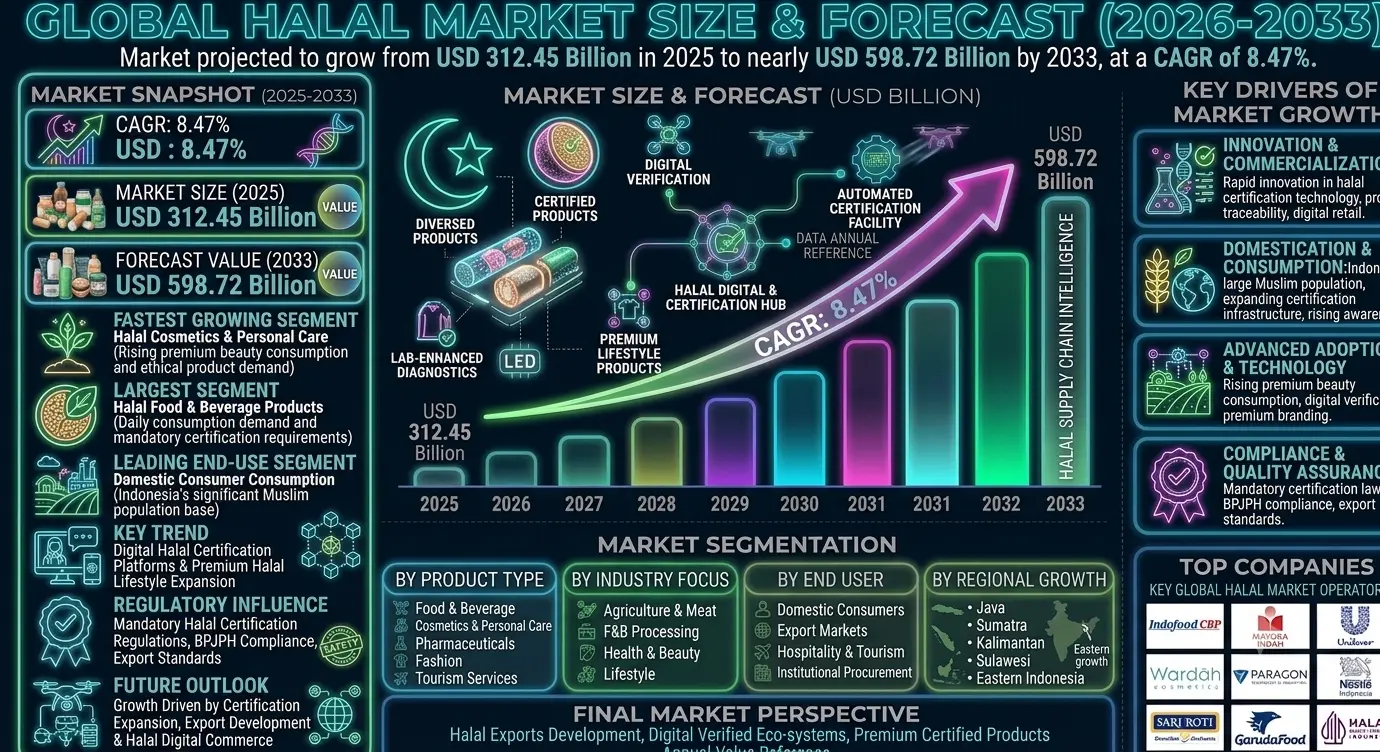
Global Halal Market Size & Forecast
The Global Halal Market is expected to witness strong expansion during the forecast period from 2026 to 2033. The market was valued at USD 312.45 billion in 2025 and is projected to reach approximately USD 598.72 billion by 2033, registering a CAGR of 8.47%. The market growth is primarily driven by expanding halal certification infrastructure, rising consumer awareness regarding halal authenticity, increasing Muslim population, and growing domestic and international demand for halal-certified products. Halal-certified products are increasingly critical across food, beverages, pharmaceuticals, cosmetics, fashion, tourism, and financial services. Rising adoption of digital halal verification systems, traceability platforms, and premium halal branding is accelerating market growth. In addition, growing export opportunities, rising middle-class consumption, and government-backed halal ecosystem development are supporting long-term market expansion.Global Halal Market Overview
The halal market encompasses products and services certified as compliant with Islamic dietary, ethical, and processing standards. The market includes halal food products, beverages, cosmetics, pharmaceuticals, personal care products, Islamic fashion, halal tourism services, and halal-certified consumer goods. Halal products are widely utilized across retail, hospitality, healthcare, exports, financial services, and digital commerce channels. The market is shifting from traditional certification processes toward digital verification systems, blockchain-based traceability, integrated halal supply chains, and premium halal lifestyle ecosystems.Structural Drivers of Market Growth
1. Innovation and Commercialization Acceleration
Rapid innovation in halal certification technology, product traceability systems, digital retail integration, and premium halal product development is accelerating market expansion. Digital verification and transparency tools are improving consumer confidence, regulatory compliance, and market accessibility.Market Implications
Companies investing in digital halal ecosystems, certification innovation, and premium halal branding are expected to strengthen market leadership.2. Compliance and Risk Repricing
Mandatory halal certification laws, compliance requirements, export certification protocols, and product traceability standards are influencing market modernization. Government agencies and certification bodies are increasingly promoting stricter halal assurance systems.Market Implications
Firms offering compliant, traceable, and digitally verified halal solutions are likely to gain stronger consumer trust and regulatory approval.3. Competitive and Value-Chain Reconfiguration
The market is highly competitive as food manufacturers, cosmetics brands, pharmaceutical companies, exporters, retailers, and digital commerce platforms expand halal-certified offerings. Integrated halal supply chains and strategic certification partnerships are altering value-chain economics.Market Implications
Companies focusing on vertical integration, digital commerce, and export-oriented halal solutions may gain stronger margins and market positioning.4. Capital and Capacity Scaling
Rising investment in halal industrial parks, digital certification systems, export infrastructure, and halal logistics networks is supporting market expansion. Government initiatives and international trade agreements are increasing market demand and investment opportunities.Market Implications
Organizations scaling certification capabilities and halal production infrastructure are expected to capture future opportunities.Market Segmentation Analysis
By Product Type
1. Halal Food & Beverage Products
This remains the largest segment due to strong daily consumption demand and widespread certification requirements.2. Halal Cosmetics & Personal Care
Fastest-growing segment due to rising premium beauty consumption and demand for ethical personal care products.3. Halal Pharmaceuticals
Growing adoption due to increasing healthcare compliance awareness and demand for certified medicines.4. Halal Fashion
Strong growth driven by modest fashion trends, lifestyle branding, and e-commerce expansion.5. Halal Tourism Services
Expanding due to increasing faith-based travel demand and halal-friendly hospitality offerings.By Distribution Channel
1. Offline Retail Stores
Largest segment due to strong supermarket, hypermarket, and traditional retail presence.2. Online & App-Based Platforms
Fastest-growing segment due to digital commerce expansion and direct-to-consumer sales growth.By End User
1. Domestic Consumer Consumption
Largest segment due to strong demand from Muslim consumers for certified products and services.2. Export Markets
Growing demand for halal-certified products across international markets.3. Hospitality & Tourism
Strong adoption across hotels, restaurants, airlines, and halal tourism services.4. Institutional Procurement
Used in schools, hospitals, government facilities, and public service organizations.Regional Market Dynamics
Asia-Pacific
Asia-Pacific dominates the global halal market due to its large Muslim population, strong manufacturing base, increasing halal certification adoption, and expanding export capabilities.Middle East
The Middle East remains a major market supported by high consumer demand, strong halal regulatory frameworks, and premium halal product consumption.Europe
Europe is witnessing significant growth driven by increasing Muslim population, expanding halal retail networks, and growing demand for certified consumer products.North America
North America is gradually expanding due to rising awareness of halal-certified products and growing multicultural consumer demand.Africa
Africa is emerging as a promising market supported by population growth, food industry development, and expanding halal certification infrastructure.Competitive Landscape
The Global Halal Market is highly competitive with food producers, certification agencies, consumer brands, pharmaceutical manufacturers, cosmetics companies, and digital halal ecosystem providers expanding rapidly.Key Companies Operating in the Market Include:
- Nestl?? S.A.
- Unilever PLC
- BRF S.A.
- Al Islami Foods
- Saffron Road
- Wardah Cosmetics
- Indofood CBP
- Mayora Indah
- Kalbe Farma
- Halal Quality Control Group
Strategic Outlook
The future of the halal market will be shaped by digital certification systems, blockchain traceability, export-focused halal manufacturing, and premium halal lifestyle products. Integrated halal supply chains, automated compliance verification, and digital consumer trust platforms will significantly improve market efficiency and transparency. The rise of halal exports, digital retail adoption, ethical consumption trends, and premium certified products is expected to create strong long-term growth opportunities.Final Market Perspective
The Global Halal Market remains a major segment within food, consumer goods, healthcare, tourism, and ethical commerce ecosystems. Rising halal awareness, certification expansion, digital verification, and export growth continue driving long-term market development. Companies capable of delivering scalable, compliant, digitally enabled, and consumer-centric halal ecosystems will be best positioned to capture future opportunities. The convergence of certification technology, digital commerce, halal lifestyle branding, and export competitiveness is expected to redefine the future of the global halal industry.Table of Contents
Table of Contents
- Executive Summary
- Global Halal Market Snapshot (2026???2033)
- Market Size & Growth Overview
- Key Market Highlights
- Largest & Fastest-Growing Segments
- Leading End-Use Segment Overview
- Key Market Trends & Digital Transformation
- Strategic Outlook Through 2033
- Market Introduction & Overview
- Definition of the Halal Market Ecosystem
- Scope of the Global Halal Market
- Evolution of Halal Certification & Compliance Systems
- Role of Halal Products in Global Consumer Economy
- Value Chain Analysis of Halal-Certified Industries
- Regulatory Influence (Mandatory Certification Laws, BPJPH Compliance & Export Standards)
- Transition Toward Digital Certification & Halal Traceability Systems
- Research Methodology
- Primary Research Approach
- Secondary Research Sources
- Market Size Estimation Methodology
- Forecasting Assumptions (2026???2033)
- Data Validation & Triangulation Process
- Market Dynamics
- Structural Drivers of Market Growth
- Innovation and Commercialization Acceleration in Digital Halal Ecosystems
- Compliance and Risk Repricing in Certification-Driven Markets
- Competitive and Value-Chain Reconfiguration Across Halal Industries
- Capital and Capacity Scaling in Halal Manufacturing & Certification Infrastructure
- Market Restraints
- Complexity of Global Certification Standards
- High Compliance Costs for Small Manufacturers
- Fragmentation in Certification Authorities Across Regions
- Market Opportunities
- Expansion of Digital Halal Certification Platforms
- Growth in Premium Halal Lifestyle Products
- Increasing Demand in Export-Oriented Halal Supply Chains
- Integration of Blockchain & Traceability Solutions
- Market Challenges
- Standardization Across International Halal Regulations
- Maintaining Consumer Trust in Certification Authenticity
- Supply Chain Transparency & Compliance Enforcement
- Structural Drivers of Market Growth
- Global Halal Market Size & Forecast (2026???2033)
- Market Revenue Analysis
- CAGR Analysis
- Demand-Supply Trends
- Pricing & Certification Cost Analysis
- Investment Trends
- Future Market Outlook
- Market Segmentation Analysis (2026???2033)
- By Product Type
- Halal Food & Beverage Products (Largest Segment)
- Halal Cosmetics & Personal Care (Fastest-Growing Segment)
- Halal Pharmaceuticals
- Halal Fashion
- Halal Tourism Services
- By Distribution Channel
- Offline Retail Stores (Largest Segment)
- Online & App-Based Platforms (Fastest-Growing Segment)
- By End User
- Domestic Consumer Consumption (Largest Segment)
- Export Markets
- Hospitality & Tourism
- Institutional Procurement
- By Product Type
- Regional Market Analysis
- Asia-Pacific (Largest Market)
- Middle East (Strong Regulatory Hub)
- Europe
- North America
- Africa (Emerging Growth Region)
- Competitive Landscape
- Market Structure & Competitive Intensity Analysis
- Key Player Benchmarking
- Strategic Developments
- Digital Halal Ecosystem & Certification Strategies
- Partnerships, Expansion & Export Network Trends
- Company Profiles
- Nestl?? S.A.
- Unilever PLC
- BRF S.A.
- Al Islami Foods
- Saffron Road
- Wardah Cosmetics
- Indofood CBP
- Mayora Indah
- Kalbe Farma
- Halal Quality Control Group
- Strategic Outlook
- Future of Digital Halal Certification Systems
- Blockchain-Based Traceability & Compliance Automation
- Expansion of Premium Halal Lifestyle Ecosystems
- Growth of Export-Oriented Halal Manufacturing
- Long-Term Market Outlook (2033+)
- Final Market Perspective
- Appendix
- About Pheonix Market Research
- Disclaimer
Competitive Landscape
Global Halal Market Competitive Intensity & Market Structure Overview
The Global Halal Market is highly competitive and moderately fragmented, comprising multinational food manufacturers, halal-certified consumer goods companies, pharmaceutical producers, cosmetics brands, certification authorities, and digital halal ecosystem providers. Competitive intensity is primarily driven by certification credibility, product quality, brand trust, distribution reach, regulatory compliance, and innovation in halal-certified offerings.
Companies compete across multiple segments, including halal food and beverages, cosmetics, pharmaceuticals, fashion, tourism, and lifestyle products. Increasing consumer demand for authenticated halal products, ethical sourcing practices, and premium halal experiences is intensifying competition across both established and emerging markets.
The market structure is evolving from traditional halal certification models toward integrated halal ecosystems supported by digital verification platforms, blockchain-based traceability systems, and cross-border halal trade networks. Strategic collaborations between manufacturers, certification bodies, retailers, and technology providers are reshaping industry dynamics.
Global Halal Market Competitive Intensity & Market Structure Current Scenario
Leading Global Halal Market Participants
Nestl?? S.A.: One of the world’s largest halal-certified food manufacturers with an extensive portfolio of halal food and beverage products distributed across global markets.
Unilever PLC: A major consumer goods company offering a broad range of halal-certified food, personal care, and household products in multiple regions.
BRF S.A.: A leading global food producer recognized for its strong halal poultry and processed food product portfolio serving international markets.
Al Islami Foods: A prominent halal food brand specializing in certified meat, poultry, and frozen food products across the Middle East and international markets.
Saffron Road: A well-known halal food company focused on premium halal-certified meals, snacks, and ethically sourced food products.
Wardah Cosmetics: A leading halal cosmetics brand recognized for its certified beauty and personal care products catering to growing halal lifestyle demand.
Indofood CBP: A major food manufacturer with an extensive portfolio of halal-certified consumer food products distributed across Asia and export markets.
Mayora Indah: A diversified consumer goods company offering halal-certified food and beverage products with a strong international presence.
Kalbe Farma: A leading pharmaceutical company expanding its halal-certified healthcare and wellness product offerings.
Halal Quality Control Group: A prominent halal certification and compliance organization supporting product verification, auditing, and international halal market access.
Key Competitive Intensity & Market Structure Drivers
The expansion of mandatory halal certification regulations and stricter compliance requirements is increasing competition among companies seeking recognized certification and market access.
Growing consumer demand for transparency, ethical sourcing, and digitally verified halal products is driving investments in traceability systems and certification technologies.
The rapid growth of halal cosmetics, pharmaceuticals, and premium lifestyle products is creating new opportunities for product differentiation and market expansion.
Digital commerce platforms, mobile verification applications, and direct-to-consumer business models are reshaping customer engagement and competitive strategies.
Increasing international trade of halal-certified products is encouraging manufacturers to strengthen export capabilities and develop globally recognized halal supply chains.
Strategic Implications of Competitive Intensity & Market Structure
Companies with strong certification credibility, diversified halal product portfolios, and extensive distribution networks are expected to maintain significant competitive advantages.
Investment in digital certification platforms, blockchain-enabled traceability, and automated compliance systems is becoming a critical factor for long-term market differentiation.
Manufacturers focusing on premium halal branding, product innovation, and export-oriented growth strategies are likely to strengthen their market positioning.
Strategic partnerships between certification agencies, retailers, logistics providers, and technology firms are enabling greater market access and operational efficiency.
Organizations capable of combining regulatory compliance, product quality, digital transparency, and consumer trust will be better positioned to compete across global halal markets.
Global Halal Market Competitive Intensity & Market Structure Forward Outlook
The competitive landscape of the global halal market is expected to become increasingly technology-driven as digital certification systems, blockchain traceability, and integrated halal ecosystems gain wider adoption worldwide.
Future competition will be shaped by advancements in certification technology, premium halal lifestyle products, export-focused manufacturing, and digitally connected supply chains.
Manufacturers and service providers are expected to increase investments in halal innovation, consumer engagement platforms, sustainable sourcing practices, and global certification compliance to strengthen competitive positioning.
Over the forecast period, companies that successfully balance certification integrity, innovation, digital transformation, supply chain transparency, and international market reach will be best positioned to lead the evolving global halal market.
Value Chain
Global Halal Market Value Chain & Supply Chain Evolution Overview
The Global Halal Market is undergoing significant transformation driven by expanding halal certification requirements, increasing consumer awareness regarding product authenticity, growing international trade, and rising demand for halal-certified products across food, cosmetics, pharmaceuticals, tourism, fashion, and consumer goods sectors. The market’s value chain encompasses raw material sourcing, halal-compliant processing, certification, manufacturing, logistics, distribution, retailing, and end-user consumption.
A defining characteristic of the halal value chain is the requirement for end-to-end compliance with Islamic principles throughout sourcing, production, storage, transportation, and distribution activities. This has increased the importance of traceability systems, certification management, quality assurance protocols, and supply chain transparency across the industry.
Supply chain complexity continues to increase as manufacturers, certification bodies, exporters, retailers, and logistics providers coordinate to maintain halal integrity throughout global trade networks. The growing adoption of digital certification systems, blockchain-enabled traceability platforms, and automated compliance monitoring solutions is improving operational efficiency and consumer confidence.
The value chain is evolving into a highly integrated ecosystem where certification, technology, logistics, and brand trust collectively determine competitive positioning. Companies are increasingly investing in halal industrial parks, digital verification infrastructure, export-oriented manufacturing facilities, and specialized halal logistics networks to support market expansion.
Global Halal Market Value Chain & Supply Chain Evolution Current Scenario
Market-Specific Value Chain
- Raw Material Sourcing: Procurement of halal-compliant agricultural products, livestock, ingredients, pharmaceutical materials, cosmetic ingredients, packaging materials, and other certified inputs.
- Halal Certification & Compliance Verification: Inspection, auditing, product validation, certification issuance, compliance monitoring, and regulatory approval processes conducted by accredited halal certification organizations.
- Manufacturing & Processing: Production of halal-certified food products, beverages, pharmaceuticals, cosmetics, personal care products, fashion products, and consumer goods under approved halal manufacturing practices.
- Storage, Logistics & Distribution: Specialized halal warehousing, transportation, cold-chain management, inventory handling, and export logistics operations designed to preserve halal integrity.
- Retail & Digital Commerce: Distribution through supermarkets, hypermarkets, specialty halal stores, hospitality channels, pharmacies, and online commerce platforms.
- End User Consumption: Domestic consumers, export markets, hospitality providers, institutional buyers, healthcare organizations, and tourism operators utilizing halal-certified products and services.
Company-to-Stage Mapping
- Raw Material Sourcing: Certified agricultural suppliers, livestock producers, ingredient manufacturers, and halal-compliant raw material providers.
- Halal Certification & Compliance Verification: Halal Quality Control Group, national halal certification authorities, Islamic councils, and accredited compliance organizations.
- Manufacturing & Processing: Nestl?? S.A., Unilever PLC, BRF S.A., Al Islami Foods, Indofood CBP, Mayora Indah, Kalbe Farma, and Wardah Cosmetics.
- Storage, Logistics & Distribution: Halal logistics providers, export operators, warehousing companies, and specialized distribution networks.
- Retail & Digital Commerce: Retail chains, e-commerce platforms, halal marketplaces, pharmacies, hospitality providers, and direct-to-consumer sales channels.
- End User Consumption: Domestic consumers, institutional procurement organizations, export buyers, hospitality operators, and healthcare facilities.
Key Value Chain & Supply Chain Evolution Signals in Global Halal Market
Expansion of Digital Halal Certification Platforms
Certification bodies and technology providers are deploying digital verification platforms that enable real-time validation of halal status and improve transparency throughout the supply chain.
Growth of Blockchain-Based Traceability Systems
Blockchain technology is increasingly being adopted to enhance traceability, product authentication, and compliance monitoring across global halal supply networks.
Strengthening of Halal Export Infrastructure
Governments and private-sector participants are investing in export-oriented manufacturing facilities, halal industrial parks, and dedicated logistics infrastructure to support international trade growth.
Rapid Expansion of Halal E-Commerce Channels
Online marketplaces and direct-to-consumer platforms are improving product accessibility and enabling halal brands to expand globally.
Integration of Halal Supply Chains
Manufacturers are increasingly pursuing vertically integrated halal operations to improve quality control, reduce compliance risks, and strengthen consumer trust.
Growth of Premium Halal Lifestyle Products
Demand is increasing for premium halal cosmetics, wellness products, fashion, tourism services, and ethically positioned consumer goods.
Strategic Implications of Value Chain & Supply Chain Evolution
Investment in Certification Technology
Companies implementing digital certification management systems and automated compliance monitoring solutions can improve operational efficiency and strengthen market credibility.
Expansion of Export-Oriented Manufacturing
Manufacturers developing internationally recognized halal-certified production capabilities can benefit from rising global demand and cross-border trade opportunities.
Strengthening Supply Chain Transparency
Traceability systems, blockchain integration, and supplier verification programs can enhance consumer confidence and regulatory compliance.
Development of Specialized Halal Logistics Networks
Dedicated transportation, warehousing, and distribution solutions can help maintain product integrity throughout domestic and international supply chains.
Growth of Digital Commerce Ecosystems
Investment in online retail channels, mobile commerce platforms, and digital consumer engagement strategies can accelerate market penetration.
Expansion of Premium Halal Product Portfolios
Companies offering differentiated halal products and lifestyle-focused solutions can strengthen brand value and capture higher-margin market segments.
Global Halal Market Value Chain & Supply Chain Evolution Forward Outlook
Looking ahead, the halal market value chain is expected to become increasingly digitalized, traceable, and globally integrated as certification technology, export infrastructure, and consumer trust mechanisms continue to evolve.
Key Future Developments Include:
- Expansion of digital halal certification and automated compliance verification systems.
- Increased adoption of blockchain-based product traceability platforms.
- Growth of halal industrial parks and export-focused manufacturing ecosystems.
- Expansion of halal e-commerce platforms and direct-to-consumer business models.
- Strengthening of specialized halal logistics and supply chain infrastructure.
- Rising investment in premium halal lifestyle products, wellness solutions, and ethical consumer brands.
As the market evolves, competitive advantage will increasingly depend on the ability to combine certification integrity, digital transparency, supply chain efficiency, export readiness, and consumer trust within a fully integrated halal ecosystem.
Companies that successfully integrate advanced certification technologies, scalable manufacturing operations, specialized halal logistics capabilities, and digital commerce platforms will achieve stronger market positioning, regulatory credibility, and long-term growth in the Global Halal Market.
Investment Activity
Global Halal Market Investment & Funding Dynamics Overview
The Global Halal Market is witnessing significant investment activity driven by the expanding Muslim population, increasing demand for certified halal products, rising global halal trade, and growing adoption of premium halal lifestyle offerings. Food manufacturers, consumer goods companies, private equity firms, sovereign investment funds, certification agencies, and digital commerce platforms are actively investing in halal production infrastructure, certification technologies, halal supply chains, export capabilities, and digital verification systems.
Investment momentum is accelerating as governments and private-sector participants prioritize halal ecosystem development to strengthen domestic industries and expand export competitiveness. Capital deployment is increasingly focused on halal food processing facilities, halal cosmetics manufacturing, pharmaceutical compliance systems, halal logistics networks, and digital certification platforms.
Additionally, growing investments in blockchain-based traceability solutions, premium halal branding, halal industrial parks, and e-commerce-enabled halal marketplaces are creating substantial long-term opportunities across the global halal industry.
Global Halal Market Investment & Funding Dynamics Current Scenario
Currently, the market is experiencing strong capital inflows as businesses expand halal-certified product portfolios and strengthen supply chain transparency. Industry participants are investing heavily in certification compliance systems, export-oriented manufacturing facilities, quality assurance infrastructure, and digital consumer engagement platforms.
The market is benefiting from government-backed halal development initiatives, trade promotion programs, and regulatory frameworks designed to strengthen halal industry competitiveness. Significant investments are being directed toward halal industrial zones, certification infrastructure, digital verification technologies, and international market expansion strategies.
Furthermore, strategic collaborations among food manufacturers, cosmetics companies, pharmaceutical firms, certification bodies, logistics providers, and technology companies are accelerating investment activity and enhancing value-chain integration.
Key Investment & Funding Dynamics Signals in Global Halal Market
- Growing demand for halal-certified food, beverages, cosmetics, and pharmaceutical products is driving large-scale investment activity.
- Expansion of global halal export markets is increasing capital deployment across production and distribution infrastructure.
- Government-supported halal ecosystem development programs and certification initiatives are accelerating industry funding.
- Rising adoption of digital halal certification and verification platforms is attracting technology-focused investments.
- Strategic investments in halal logistics, cold-chain infrastructure, and supply-chain traceability are creating long-term growth opportunities.
- Growing consumer preference for ethical, transparent, and certified products is strengthening investment confidence.
- Increasing adoption of blockchain-enabled traceability and compliance monitoring systems is supporting innovation-led funding.
Strategic Implications of Investment & Funding Dynamics in Global Halal Market
- Continuous investment in certification technology, compliance systems, and supply-chain transparency is essential for maintaining market credibility.
- Capital allocation toward halal manufacturing facilities, export infrastructure, and digital commerce platforms will strengthen competitive positioning.
- Companies developing premium halal lifestyle products and services are expected to secure stronger long-term growth opportunities.
- Strategic partnerships between manufacturers, certification agencies, technology providers, and retailers will accelerate market expansion.
- Investments in automation, digital verification, and consumer trust platforms will remain key growth priorities.
- Compliance with mandatory halal certification regulations, BPJPH requirements, and international export standards will continue influencing investment decisions.
- Organizations building integrated halal ecosystems across production, certification, logistics, and retail channels are expected to capture substantial future value.
Global Halal Market Investment & Funding Dynamics Forward Outlook
Looking ahead, the Global Halal Market is expected to maintain strong investment momentum driven by rising halal consumption, expanding international trade opportunities, increasing certification adoption, and accelerating digital transformation across halal value chains.
Future capital deployment will increasingly focus on digital certification platforms, blockchain-based traceability systems, export-oriented manufacturing facilities, halal logistics infrastructure, and premium halal consumer products.
As governments and industry stakeholders continue prioritizing halal compliance, consumer trust, and export competitiveness, investment activity is expected to expand across certification ecosystems, production infrastructure, digital commerce platforms, and global distribution networks.
In conclusion, the Global Halal Market represents a highly attractive investment landscape where digital certification, halal supply-chain integration, premium lifestyle branding, export development, and compliance-driven innovation will define future funding priorities, competitive differentiation, and long-term market growth.
Technology & Innovation
Global Halal Market Technology & Innovation Landscape Overview
The Global Halal Market is undergoing a significant technological transformation driven by advancements in digital certification platforms, blockchain-enabled traceability systems, AI-powered compliance monitoring, halal supply chain digitization, and e-commerce integration. Innovation across the halal ecosystem is focused on improving transparency, regulatory compliance, product authenticity, and consumer trust.
At the center of this transformation is the shift from traditional halal verification methods toward digitally connected halal assurance systems that provide real-time visibility across sourcing, manufacturing, logistics, and retail operations.
A major area of innovation is digital halal certification, where cloud-based compliance platforms, automated auditing tools, and electronic certification management systems are streamlining certification processes and reducing administrative complexity.
The market is also witnessing growing adoption of blockchain technology to establish transparent and tamper-resistant records throughout halal supply chains. These solutions enable consumers, regulators, and businesses to verify product authenticity and certification status with greater confidence.
Manufacturers and certification bodies are increasingly investing in AI-driven compliance monitoring systems capable of analyzing production processes, ingredient sourcing, and documentation requirements to improve halal assurance accuracy.
Product innovation is expanding across halal food, cosmetics, pharmaceuticals, fashion, and tourism sectors, with premium halal lifestyle products, ethical consumption solutions, and personalized halal offerings gaining popularity.
Additionally, digital commerce platforms, mobile verification applications, and smart labeling technologies are enhancing consumer engagement and simplifying access to certified halal products.
The convergence of digital certification, supply chain transparency, intelligent compliance systems, and premium halal product development is redefining the future technology landscape of the global halal market.
Global Halal Market Technology & Innovation Landscape Current Scenario
Currently, the Global Halal Market is experiencing growing adoption of digital technologies designed to improve certification efficiency, product traceability, and consumer confidence.
1. Digital Halal Certification Platforms
Cloud-based certification systems are enabling faster application processing, compliance management, and verification procedures for businesses and regulators.
2. Blockchain-Based Traceability Solutions
Blockchain technology is being used to create secure and transparent records across halal supply chains, improving authenticity verification and reducing fraud risks.
3. AI-Powered Compliance Monitoring
Artificial intelligence is supporting automated audits, ingredient validation, and regulatory compliance assessments throughout production processes.
4. Smart Labeling & QR Code Verification
Digital labeling technologies allow consumers to access certification details, sourcing information, and product traceability data through mobile devices.
5. E-Commerce & Digital Halal Marketplaces
Online retail platforms are expanding consumer access to certified halal products while improving market reach for manufacturers and exporters.
6. Integrated Halal Supply Chain Management
Digital systems are improving coordination between suppliers, manufacturers, logistics providers, and certification agencies.
Key Technology & Innovation Landscape Signals in Global Halal Market
Several innovation trends are shaping the future development of the halal industry:
1. Rising Demand for Product Transparency
Consumers increasingly seek real-time visibility into sourcing, production methods, and certification authenticity.
2. Expansion of Digital Certification Ecosystems
Certification authorities are investing in digital platforms to improve efficiency and standardization.
3. Growth of Blockchain Adoption
Supply chain participants are utilizing blockchain to strengthen traceability and compliance management.
4. Increasing Integration of Artificial Intelligence
AI-driven compliance tools are supporting risk assessment, certification monitoring, and operational efficiency.
5. Development of Smart Consumer Verification Tools
Mobile applications and QR-code technologies are improving consumer trust and engagement.
6. Expansion of Premium Halal Lifestyle Products
Innovation is extending beyond food into cosmetics, pharmaceuticals, fashion, tourism, and wellness sectors.
7. Digitalization of Halal Trade & Export Infrastructure
Technology-enabled trade platforms are facilitating international halal commerce and export growth.
Strategic Implications of Technology & Innovation Landscape in Global Halal Market
The evolving innovation landscape is reshaping competition throughout the halal ecosystem. Companies are increasingly competing through certification transparency, digital trust mechanisms, supply chain visibility, and technology-enabled consumer engagement.
Organizations investing in blockchain traceability, digital certification systems, AI-powered compliance platforms, and integrated halal supply chain solutions are expected to strengthen long-term market positioning.
Strategic partnerships among certification bodies, technology providers, manufacturers, logistics companies, and digital commerce platforms are accelerating innovation and market expansion.
The growing convergence of ethical consumption, digital verification, premium branding, and regulatory compliance is creating significant differentiation opportunities across the halal industry.
Additionally, increasing regulatory emphasis on certification accuracy, export standards, and halal assurance systems is encouraging continuous investment in technological modernization.
Global Halal Market Technology & Innovation Landscape Forward Outlook
Looking ahead to 2026???2033, the Global Halal Market is expected to evolve into a highly digitalized ecosystem supported by intelligent certification systems, transparent supply chains, and advanced consumer verification technologies.
Future technological developments are likely to include:
1. AI-Driven Halal Compliance Platforms
Advanced artificial intelligence systems will automate compliance monitoring, certification verification, and risk management processes.
2. End-to-End Blockchain Supply Chains
Comprehensive blockchain integration will provide real-time visibility from raw material sourcing to final product delivery.
3. Smart Certification & Digital Identity Systems
Secure digital certificates and verification technologies will enhance authentication and reduce certification fraud.
4. Advanced Consumer Verification Applications
Mobile platforms will enable instant product authentication, certification tracking, and halal status validation.
5. Integrated Global Halal Trade Platforms
Digital ecosystems will streamline cross-border halal trade, export documentation, and compliance management.
6. Predictive Compliance & Risk Analytics
Data-driven systems will identify potential compliance issues and improve supply chain governance.
7. Smart Halal Lifestyle Ecosystems
Connected platforms will integrate halal food, personal care, healthcare, tourism, and financial services into unified consumer experiences.
In conclusion, companies capable of combining digital certification innovation, blockchain traceability, AI-powered compliance systems, premium halal product development, and technology-enabled consumer engagement will be best positioned to lead the future evolution of the Global Halal Market.
Market Risk
Global Halal Market Risk Factors & Disruption Threats Overview
The Global Halal Market operates within a rapidly expanding ecosystem encompassing food and beverages, cosmetics, pharmaceuticals, personal care products, fashion, tourism, and financial services. While the market benefits from a growing Muslim population, rising consumer awareness, expanding certification frameworks, and increasing global trade opportunities, it faces a complex risk landscape shaped by certification inconsistencies, regulatory fragmentation, supply chain integrity challenges, geopolitical factors, and evolving consumer expectations.
A major structural risk is the lack of universal halal certification standards across international markets. Different countries and certification authorities often apply varying compliance requirements, creating complexity for manufacturers, exporters, and distributors operating across multiple regions.
Another significant disruption factor is supply chain transparency and traceability. Halal integrity depends on strict control of sourcing, processing, transportation, storage, and distribution activities. Any breach in compliance can damage brand reputation, reduce consumer trust, and lead to regulatory penalties.
The market is also exposed to geopolitical and trade-related risks. Changes in import regulations, certification recognition agreements, trade restrictions, and diplomatic relations can affect cross-border halal product flows and export opportunities.
Additionally, rising consumer scrutiny regarding authenticity, ethical sourcing, sustainability, and digital transparency is increasing compliance expectations and operational complexity for halal-certified businesses.
Global Halal Market Risk Factors & Disruption Threats Current Scenario
The current market environment is characterized by rapid expansion of halal-certified products and services across both Muslim-majority and non-Muslim-majority countries.
Governments and regulatory authorities are increasingly strengthening halal certification requirements, traceability systems, and compliance monitoring frameworks to improve consumer confidence and market credibility.
Digital halal verification platforms, QR-code authentication systems, and blockchain-based traceability solutions are gaining traction as businesses seek to improve transparency throughout the value chain.
At the same time, global manufacturers are facing challenges related to certification harmonization, compliance costs, supplier verification, and changing export regulations.
Competition is intensifying as multinational consumer goods companies, regional halal brands, certification agencies, and digital commerce platforms expand their participation in the halal economy.
Key Risk Factors & Disruption Threats Signals in Global Halal Market
A major disruption signal is the growing adoption of digital certification and traceability technologies, enabling real-time verification of halal compliance and product authenticity.
Another important signal is the increasing regulatory focus on certification standardization, export compliance, and cross-border recognition frameworks to support international halal trade.
The rise of premium halal lifestyle products, ethical consumption trends, and sustainability-focused purchasing behavior is reshaping consumer expectations and product development strategies.
E-commerce platforms and digital marketplaces are expanding access to halal-certified products globally, increasing competition while creating new distribution opportunities.
Growing demand for transparency regarding ingredient sourcing, production methods, and certification status is driving investment in supply chain monitoring and compliance technologies.
Strategic Implications of Risk Factors & Disruption Threats in Global Halal Market
Companies must strengthen certification management systems and maintain compliance with multiple regional standards to reduce regulatory and market access risks.
Investment in digital traceability platforms, blockchain verification systems, and transparent supply chain infrastructure will become increasingly important for building consumer trust.
Manufacturers should diversify sourcing strategies and establish strong supplier auditing programs to safeguard halal integrity throughout the value chain.
Expansion into digital commerce channels and direct-to-consumer platforms will be critical for improving market reach and enhancing customer engagement.
Organizations capable of combining certification excellence, product innovation, sustainability practices, and digital transparency will be better positioned to achieve long-term competitive advantage.
Global Halal Market Risk Factors & Disruption Threats Forward Outlook
Looking ahead to 2026???2033, the Global Halal Market is expected to continue expanding as halal-certified products become increasingly integrated into mainstream consumer markets worldwide.
Digital certification systems, blockchain-enabled traceability, and automated compliance monitoring solutions are likely to become standard components of halal ecosystem management.
Regulatory harmonization efforts and international cooperation among certification bodies may improve market efficiency and facilitate cross-border trade growth.
Premium halal products, sustainable sourcing practices, and ethical consumption trends are expected to create new opportunities across food, cosmetics, pharmaceuticals, tourism, and lifestyle segments.
Overall, the market will remain high-growth but increasingly compliance-driven, with long-term success determined by certification credibility, supply chain integrity, digital transparency, regulatory adaptability, and the ability to meet evolving consumer expectations for trusted halal products and services.
Regulatory Landscape
Global Halal Market Regulatory & Policy Environment Overview
The regulatory and policy environment governing the Global Halal Market is becoming increasingly sophisticated as governments, halal certification authorities, religious institutions, and international trade organizations strengthen oversight of halal compliance, product authenticity, and supply chain integrity. As halal-certified products expand across food, beverages, pharmaceuticals, cosmetics, personal care, tourism, and consumer goods sectors, regulatory frameworks are evolving to ensure consistency, transparency, and consumer confidence.
Manufacturers, exporters, distributors, retailers, and service providers operating within the halal ecosystem must comply with a broad range of regulations related to halal certification, ingredient verification, production processes, labeling requirements, import-export compliance, and traceability standards. Regulatory oversight is expanding beyond traditional food certification to encompass entire halal value chains and lifestyle-oriented product categories.
The growing international trade of halal-certified products, increasing consumer awareness, and rising demand for transparent certification systems are encouraging policymakers to strengthen halal governance frameworks and harmonize certification standards across global markets.
Global Halal Market Regulatory & Policy Environment Current Scenario
The current regulatory environment is characterized by increasing implementation of mandatory halal certification requirements, enhanced compliance monitoring, and stronger halal assurance systems. Several countries have established dedicated regulatory bodies responsible for supervising halal certification processes and ensuring compliance across domestic and imported products.
Certification and accreditation standards play a central role in market development. Halal certification authorities are increasingly requiring comprehensive audits of raw materials, manufacturing processes, storage facilities, logistics operations, and distribution networks to verify compliance with halal principles.
Export-oriented businesses must also comply with varying halal regulations across international markets. Differences in certification recognition, labeling requirements, and import procedures often require companies to maintain multiple certifications and compliance protocols to access key markets.
Digital verification technologies are becoming increasingly important as regulators and certification agencies adopt QR codes, blockchain-based traceability systems, and digital certification platforms to improve transparency and combat fraudulent halal claims.
In addition, consumer protection regulations and product labeling standards are receiving greater attention, requiring manufacturers to provide accurate certification information, ingredient disclosures, and traceable documentation supporting halal claims.
Key Regulatory & Policy Environment Signals in Global Halal Market
- Mandatory Halal Certification Regulations: National policies requiring halal certification for specific food, beverage, pharmaceutical, cosmetic, and consumer product categories.
- BPJPH & Halal Assurance Compliance Frameworks: Regulatory systems governing halal certification processes, audits, inspections, and certification validity requirements.
- Export Trade & Cross-Border Certification Standards: International requirements governing halal product exports, certification recognition, and import compliance procedures.
- Halal Supply Chain Traceability Requirements: Standards ensuring product integrity throughout sourcing, manufacturing, logistics, warehousing, and retail distribution.
- Product Labeling & Consumer Transparency Regulations: Requirements for accurate halal labeling, certification disclosure, and product information transparency.
- Digital Certification & Verification Initiatives: Adoption of electronic certification systems, blockchain-enabled tracking, and digital authentication platforms to enhance compliance monitoring.
Strategic Implications of Regulatory & Policy Environment
The evolving regulatory landscape is encouraging companies to prioritize certification management, supply chain transparency, and digital compliance capabilities. Regulatory compliance is increasingly becoming a strategic differentiator that influences consumer trust, export eligibility, and brand reputation.
Mandatory certification requirements are driving investments in halal assurance systems, internal compliance programs, supplier verification processes, and certification management technologies. Companies that maintain strong compliance frameworks are likely to achieve greater market access and operational resilience.
Export regulations are encouraging manufacturers to align products with internationally recognized halal standards, creating opportunities for businesses capable of navigating complex certification and trade requirements across multiple jurisdictions.
Digital certification initiatives are transforming the compliance landscape by improving traceability, reducing fraud risks, and enhancing consumer confidence. Organizations adopting advanced verification technologies are expected to strengthen competitive positioning.
The growing emphasis on transparent labeling and supply chain accountability is also encouraging businesses to enhance documentation systems, audit readiness, and stakeholder communication practices across halal product categories.
Global Halal Market Regulatory & Policy Environment Forward Outlook
Between 2026 and 2033, the regulatory environment for the global halal market is expected to become more standardized, technology-driven, and internationally integrated. Governments and certification authorities are likely to strengthen halal governance frameworks while promoting greater consistency in certification practices and cross-border recognition agreements.
Mandatory halal certification requirements are expected to expand across additional product categories and markets, increasing compliance obligations for manufacturers, exporters, and retailers worldwide.
Digital certification platforms, blockchain-enabled traceability systems, and real-time verification tools are anticipated to become increasingly important components of halal assurance frameworks, improving transparency and regulatory oversight.
International trade regulations are likely to place greater emphasis on certification harmonization, product traceability, and supply chain integrity, creating new opportunities for globally compliant halal producers and exporters.
Overall, the future regulatory landscape will be defined by the convergence of mandatory certification requirements, digital compliance systems, halal supply chain governance, international trade standards, and consumer transparency expectations. Companies capable of delivering compliant, traceable, digitally verified, and globally recognized halal products and services will be best positioned to capitalize on long-term opportunities within the evolving global halal ecosystem.