
Global Three-Wheeler Tyres Market Report Size and Forecast 2026-2033
Global Three-Wheeler Tyres Market Forecast Snapshot: 2026???2033
| Parameter | Value |
|---|---|
| Base Year | 2025 |
| Base Year Market Size | USD 18.7 Billion |
| Forecast Period | 2026???2033 |
| Forecasted CAGR | ~5.9% |
| Forecasted Market Size (2033) | USD 29.6 Billion |
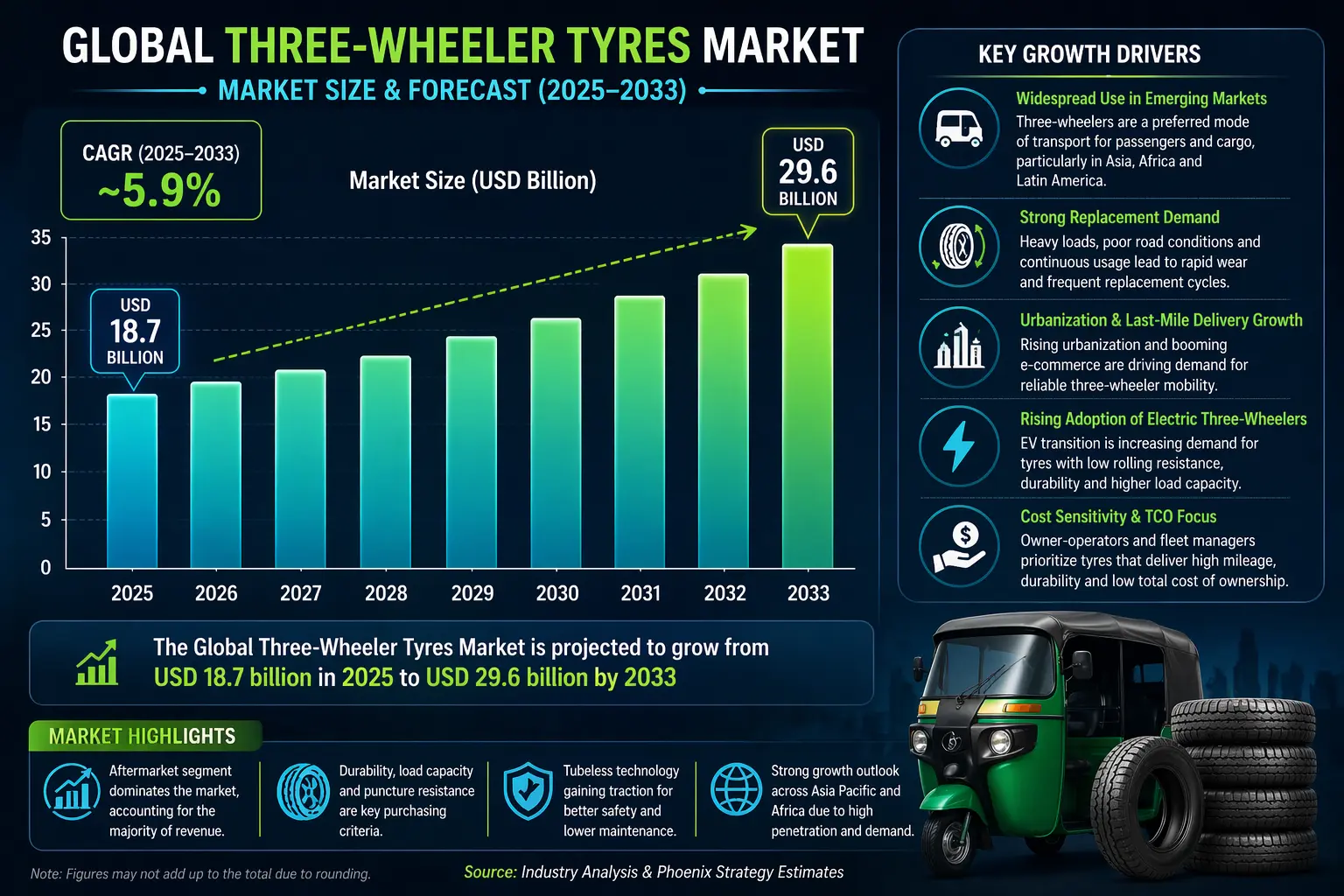
Market Size & Forecast
The Global Three-Wheeler Tyres Market is projected to grow from USD 18.7 billion in 2025 to approximately USD 29.6 billion by 2033, reflecting a CAGR of ~5.9% over the forecast period. This growth is driven by the widespread use of three-wheelers for passenger transport and cargo logistics, particularly in emerging economies. A defining structural characteristic of this market is its strong dependence on replacement demand. Three-wheeler tyres are exposed to heavy loads, poor road conditions, and continuous usage, resulting in rapid wear and frequent replacement cycles. Consequently, the aftermarket segment dominates revenue generation. Market expansion is further supported by increasing urbanization, growth in last-mile delivery services, and rising adoption of electric three-wheelers. These trends are reshaping tyre requirements, emphasizing durability, load-bearing capacity, and energy efficiency. Additionally, cost sensitivity among owner-operators and fleet managers is influencing demand toward tyres that offer high mileage and low total cost of ownership (TCO), reinforcing the importance of durability-focused product innovation.Market Overview
The Global Three-Wheeler Tyres Market is characterized by high-volume demand, moderate competitive intensity, and strong regional concentration in emerging economies. The market operates through a hybrid structure comprising OEM supply and a dominant replacement aftermarket. Three-wheeler tyres are engineered to withstand intensive usage patterns, including uneven load distribution, frequent stops, and challenging road conditions. As a result, durability, cost efficiency, and ease of maintenance are key product attributes. Technological advancements are gradually influencing the market, particularly with the introduction of radial tyres, tubeless designs, and EV-optimized tyres. However, bias tyres continue to dominate due to their cost-effectiveness and robustness in demanding operating environments. Regionally, Asia-Pacific leads the market due to extensive three-wheeler fleets, while Africa and Latin America present steady growth opportunities driven by urban mobility needs.Structural Drivers of Market Growth
- Strong Dependence on Three-Wheelers for Urban Mobility Three-wheelers serve as a primary mode of affordable transportation in many emerging economies, driving consistent tyre demand.
- High Replacement Frequency Continuous operation, heavy payloads, and poor road conditions accelerate tyre wear, ensuring recurring replacement demand.
- Growth of Cargo & Last-Mile Delivery Expansion of e-commerce and urban logistics is increasing demand for cargo three-wheelers and durable tyres.
- Electric Three-Wheeler Adoption Electric variants require tyres with low rolling resistance, higher load capacity, and improved efficiency, creating a new growth segment.
- Cost Sensitivity & TCO Focus Fleet operators prioritize tyres that offer maximum durability and mileage at the lowest cost, shaping product development strategies.
Market Segmentation Analysis
Top-Level Segment Share Split
- By Tyre Construction: 25%
- By Vehicle Type: 25%
- By Tyre Type: 15%
- By Seasonality: 10%
- By Sales Channel: 15%
- By Technology: 10%
Regional Market Dynamics
- Asia-Pacific ??? Largest Market Driven by high three-wheeler penetration, strong replacement demand, and reliance on three-wheelers for daily mobility in countries like India and China.
- Africa Growth supported by the use of three-wheelers for affordable transport and informal logistics.
- Latin America Steady expansion driven by urban congestion and cost-effective mobility solutions.
- Middle East Demand supported by commercial applications and growing urban logistics networks.
Competitive Landscape
The Global Three-Wheeler Tyres Market includes leading players such as:- MRF Ltd.
- CEAT Limited
- Apollo Tyres
- JK Tyre & Industries
- TVS Eurogrip
- Michelin
- Bridgestone Corporation
- Continental AG
- CST (Cheng Shin Rubber)
- Maxxis International
Strategic Outlook
- EV-Optimized Tyre Development Increasing focus on tyres designed for electric three-wheelers with enhanced efficiency and load capacity.
- Durability & High-Mileage Solutions Development of reinforced tyres with longer lifespan to meet fleet operator requirements.
- Retreadable & Cost-Efficient Tyres Growing adoption of retreadable tyres to reduce total cost of ownership.
- Expansion of Aftermarket Networks Strengthening distribution channels to improve accessibility in regional and rural markets.
Final Market Perspective
The Global Three-Wheeler Tyres Market represents a high-volume, replacement-driven, and cost-sensitive segment with strong long-term demand fundamentals. Its critical role in urban mobility and logistics ensures consistent growth across economic cycles. While affordability remains a key driver, electrification and increasing demand for durability are reshaping market dynamics. Innovations in tyre construction and materials are expected to enhance performance and efficiency. Manufacturers that effectively balance cost efficiency, durability, and EV readiness???while maintaining strong regional distribution networks???will be best positioned to capture growth through 2033.Research Methodology
This study adopts a comprehensive mixed-methods research approach integrating primary and secondary data sources. Primary research includes insights from tyre manufacturers, OEMs, distributors, and industry experts, providing real-time understanding of market dynamics, demand trends, and technological developments. Secondary research involves data triangulation from industry reports, regulatory frameworks, automotive databases, and economic analyses to ensure accurate market sizing and forecasting. This methodology provides a robust and reliable foundation for strategic decision-making within the Global Three-Wheeler Tyres Market ecosystem.Competitive Landscape
Global Three-Wheeler Tyres Market Competitive Intensity & Market Structure Overview
The Global Three-Wheeler Tyres Market is characterized by a moderately fragmented structure with moderate competitive intensity, driven by the dominance of regional manufacturers alongside the selective presence of global tyre companies. The market exhibits a strong cost-driven competitive environment, particularly in emerging economies where three-wheelers serve as a primary mode of transport and logistics. Leading regional players such as MRF Ltd., CEAT Limited, Apollo Tyres, and JK Tyre & Industries dominate high-volume segments through pricing competitiveness, strong distribution networks, and localized product offerings. Global players such as Michelin and Bridgestone Corporation maintain a limited but strategic presence, primarily in premium and technology-driven niches. Competitive intensity is primarily driven by pricing pressure, durability requirements, replacement frequency, and distribution reach. The market’s dependence on high-frequency replacement cycles and cost-sensitive customers creates a highly competitive yet structured ecosystem where efficiency and scale are key success factors.
Global Three-Wheeler Tyres Market Competitive Intensity & Market Structure Current Scenario
Leading Company Profiles
- MRF Ltd.: Market leader in high-volume segments with strong distribution across emerging markets.
- CEAT Limited: Key player focused on cost-efficient and durable tyre solutions.
- Apollo Tyres: Expanding presence with a diversified product portfolio.
- JK Tyre & Industries: Strong player in value-driven segments with focus on durability.
- TVS Eurogrip: Specialized manufacturer with strong OEM partnerships.
- Michelin: Premium player focusing on advanced tyre technologies.
- Bridgestone Corporation: Global leader with selective presence in emerging markets.
- Continental AG: Technology-focused player with limited penetration.
- Cheng Shin Rubber: Manufacturer of cost-effective tyres under CST brand.
- Maxxis International: Strong presence in mid-range and performance segments.
Key Competitive Intensity & Market Structure Signals in Global Three-Wheeler Tyres Market
Several signals define the competitive dynamics of the market:
- The dominance of regional manufacturers indicates a cost-driven and highly localized competitive structure, especially in Asia-Pacific and emerging markets.
- The strong reliance on replacement demand creates a high-frequency consumption model, intensifying competition in aftermarket distribution and dealer networks.
- High price sensitivity among fleet operators drives aggressive pricing competition, limiting margin expansion for manufacturers.
- Product differentiation is primarily based on durability, load-bearing capacity, and mileage performance, rather than advanced features.
- The gradual shift toward electric three-wheelers is introducing new innovation requirements, particularly in low rolling resistance and efficiency.
- Limited presence of global Tier 1 players in mass segments reflects entry barriers related to pricing and localization, rather than technology.
Strategic Implications of Competitive Intensity & Market Structure in Global Three-Wheeler Tyres Market
The competitive structure leads to several strategic implications:
- Cost leadership is critical, as affordability remains the primary purchasing factor in most markets.
- Durability-focused innovation is essential, with emphasis on high mileage and load-bearing performance.
- Distribution network strength is a key differentiator, particularly in rural and semi-urban markets.
- Aftermarket dominance ensures stable demand, requiring strong dealer relationships and service networks.
- Regional customization is necessary, given varying road conditions and usage patterns.
- EV readiness is emerging as a strategic priority, particularly in urban logistics and passenger transport segments.
Global Three-Wheeler Tyres Market Competitive Intensity & Market Structure Forward Outlook
Looking ahead, the Global Three-Wheeler Tyres Market is expected to maintain its moderately fragmented structure with sustained moderate competitive intensity, with gradual evolution driven by electrification and logistics expansion.
- Electrification will drive demand for EV-optimized tyres, creating new innovation opportunities.
- Increasing logistics and delivery fleet expansion will strengthen demand for high-durability and long-life tyres.
- Regional players will continue to dominate volume segments, while global players may expand selectively in premium and technology-driven niches.
- Digitalization and fleet management integration may introduce smart tyre monitoring solutions over time.
- Selective consolidation could occur as companies aim to strengthen distribution networks and expand regional presence.
In conclusion, the Global Three-Wheeler Tyres Market presents a high-volume, cost-sensitive, and replacement-driven competitive landscape, where pricing efficiency, durability, and distribution strength determine long-term success.
Value Chain
Global Three-Wheeler Tyres Market Value Chain & Supply Chain Evolution Overview
The Global Three-Wheeler Tyres Market is evolving rapidly, driven by urban mobility demand, last-mile logistics expansion, and increasing electrification of three-wheelers across emerging economies. The market’s value chain is structured around a hybrid operational model, supported by a hybrid distribution system that integrates OEM supply with a dominant aftermarket ecosystem. This dual-channel structure plays a crucial role in determining pricing strategies, cost efficiency, and competitive dynamics across manufacturers. A defining feature of this value chain is its heavy dependence on replacement demand. Three-wheeler tyres operate under high load conditions, uneven weight distribution, and challenging road environments, leading to accelerated wear and frequent replacement cycles. As a result, the aftermarket segment serves as the primary revenue engine, requiring strong distribution networks, localized dealer presence, and efficient inventory management systems. Supply chain complexity remains moderate but highly volume-driven and regionally concentrated. The dependence on raw materials such as natural rubber, synthetic compounds, and reinforcement materials introduces cost sensitivity, especially in price-driven markets. Additionally, the transition toward radial tyres, tubeless designs, and EV-optimized tyres is increasing manufacturing precision and coordination requirements across the value chain. Manufacturers are responding by adopting localized production strategies, strengthening dealer networks, and integrating digital supply chain tools to enhance efficiency, reduce costs, and improve product availability. The value chain is gradually transitioning into a scalable, cost-efficient, and technology-enabled ecosystem aligned with durability, affordability, and performance requirements.
Global Three-Wheeler Tyres Market Value Chain & Supply Chain Evolution Current Scenario
Market-Specific Value Chain
- Raw Material Sourcing: Natural rubber, synthetic rubber, nylon, steel cords, and chemical compounds
- Manufacturing: Tyre production, bias and radial construction, compounding, durability testing
- Technology Integration: Tubeless tyres, radial designs, EV-specific tyres, durability-focused innovations
- Distribution: OEM supply channels and extensive aftermarket logistics networks
- Retail & Aftermarket Sales: Local dealers, service centers, regional distributors, and digital platforms
- End User Utilization: Passenger transport operators, cargo fleet owners, and shared mobility providers
Company-to-Stage Mapping
- Raw Material Sourcing: Global rubber and chemical suppliers
- Manufacturing: MRF Ltd., CEAT Limited, Apollo Tyres, JK Tyre & Industries
- Technology Integration: Michelin, Continental AG, Pirelli & C. S.p.A.
- Distribution: OEM partnerships, regional distributors, logistics providers
- Retail & Aftermarket: Local tyre dealers, multi-brand retailers, service workshops
- End User Utilization: Individual owner-operators, fleet operators, delivery service providers
Key Value Chain & Supply Chain Evolution Signals in Global Three-Wheeler Tyres Market
- High Replacement Frequency & Aftermarket Dominance Continuous usage and heavy load conditions drive rapid tyre wear, ensuring strong and recurring aftermarket demand.
- Cost Sensitivity in Emerging Markets Price-conscious consumers prioritize durability and mileage, influencing production and pricing strategies.
- Growth of Last-Mile Delivery & Cargo Fleets Expansion of e-commerce logistics is increasing demand for durable tyres and accelerating replacement cycles.
- Electrification of Three-Wheelers Electric vehicles require tyres with enhanced load capacity, efficiency, and lower rolling resistance.
- Shift Toward Radial & Tubeless Tyres Gradual adoption of advanced tyre technologies is improving performance and lifecycle efficiency.
- Expansion of Localized Distribution Networks Strong regional dealer networks are critical for ensuring product availability in high-demand areas.
Strategic Implications of Value Chain & Supply Chain Evolution
- Strengthening Aftermarket Distribution Networks Expanding dealer presence and service accessibility is essential to capture high-frequency replacement demand.
- Cost Optimization & Raw Material Management Efficient sourcing and supplier diversification are crucial to manage cost volatility in price-sensitive markets.
- Investment in EV-Compatible Tyre Technologies Developing tyres tailored for electric three-wheelers is critical for future market positioning.
- Supply Chain Digitization & Localization Digital tools and regional production hubs enhance responsiveness and reduce logistics costs.
- Focus on Durability & Lifecycle Value Product innovation must prioritize high mileage and low total cost of ownership for fleet operators.
- Scalability in High-Demand Urban Markets Efficient logistics and inventory systems are necessary to meet growing urban mobility demand.
Global Three-Wheeler Tyres Market Value Chain & Supply Chain Evolution Forward Outlook
Looking ahead, the value chain is expected to evolve into a highly scalable, digitally integrated, and efficiency-driven ecosystem.
Key future developments include:
- Expansion of EV-specific tyre manufacturing and product innovation
- Increased adoption of radial and tubeless tyre technologies
- Integration of digital platforms for aftermarket sales and distribution
- Growth of smart tyre monitoring systems for fleet applications
- Enhanced use of durable and cost-efficient materials
As the market evolves, success will depend on balancing affordability, durability, and technological advancement. Companies that effectively integrate strong aftermarket networks, localized production capabilities, and data-driven supply chain systems will achieve superior operational efficiency, market reach, and long-term competitiveness in the Global Three-Wheeler Tyres Market.
Investment Activity
Global Three-Wheeler Tyres Market Investment & Funding Dynamics Overview
The investment and funding landscape within the Global Three-Wheeler Tyres Market is characterized by steadily rising investment activity and moderate capital intensity, driven by the market’s high-volume demand, strong replacement cycles, and critical role in urban mobility and last-mile logistics. Structural drivers such as increasing urbanization, expansion of e-commerce delivery networks, and rising adoption of electric three-wheelers are attracting consistent capital inflows into the sector. These investments are primarily focused on enhancing production scalability, improving product durability, and strengthening aftermarket distribution networks. A key factor shaping investment dynamics in this market is the emphasis on durability and cost efficiency. Three-wheeler tyres operate under heavy loads and challenging road conditions, necessitating continuous investment in reinforced designs, high-mileage compounds, and cost-effective manufacturing processes. Additionally, the emergence of electric three-wheelers is driving investments in EV-compatible tyre technologies, particularly in areas such as low rolling resistance and enhanced load-bearing capacity. Furthermore, capital allocation is influenced by the need to cater to highly price-sensitive markets. Companies are investing in localized production, supply chain optimization, and process efficiency to balance affordability with performance and reliability.
Global Three-Wheeler Tyres Market Investment & Funding Dynamics Current Scenario
In the current scenario, the Global Three-Wheeler Tyres Market is experiencing stable and strategically focused investment activity, supported by its dominant aftermarket structure and continuous replacement demand. The moderate capital intensity reflects investments in manufacturing capacity, process optimization, and incremental technological advancements. Investment activity is primarily concentrated in areas such as durability enhancement, high-mileage tyre development, and EV-compatible designs. Manufacturers are allocating capital toward improved material formulations, reinforced tyre structures, and production efficiency improvements to meet the needs of fleet operators and commercial users. The market is witnessing limited but selective merger and acquisition (M&A) activity, mainly aimed at expanding regional presence, strengthening distribution networks, and enhancing production capabilities. Strategic collaborations are also being used to improve market access in emerging economies. Additionally, investment strategies are largely long-term and volume-driven, with companies focusing on capacity expansion, cost optimization, and strengthening aftermarket channels, particularly in Asia-Pacific, Africa, and Latin America.
Key Investment & Funding Dynamics Signals in Global Three-Wheeler Tyres Market
The investment and funding dynamics in this market are shaped by several key signals reflecting evolving industry priorities. One of the primary signals is the strong reliance on replacement demand, driven by rapid tyre wear due to heavy usage and poor road conditions. This ensures stable and recurring revenue streams, encouraging continuous investment in production and distribution. Another critical signal is the growth of last-mile delivery and urban logistics, which is increasing demand for cargo three-wheelers and durable tyres. This trend is driving investments in high-load, long-lasting tyre solutions. The adoption of electric three-wheelers is also influencing investment patterns, with manufacturers allocating resources toward EV-specific tyre designs that improve efficiency and performance. Cost sensitivity remains a dominant investment signal, prompting companies to focus on affordability, durability, and total cost of ownership (TCO). Investments in retreadable tyres and high-mileage products are gaining importance in this context. Additionally, the gradual integration of digital and fleet management solutions is influencing capital allocation toward smart and connected tyre technologies, although at an early stage.
Strategic Implications of Investment & Funding Dynamics in Global Three-Wheeler Tyres Market
The current investment dynamics have several strategic implications for market participants. One of the primary implications is the need to balance cost efficiency with durability and performance. Companies must invest in product innovation while maintaining affordability for price-sensitive customers. Moderate capital intensity requires efficient capital allocation and operational optimization. Companies must focus on scaling production, improving supply chain efficiency, and maximizing returns from high-volume demand. The limited role of M&A activity highlights the importance of organic growth and regional expansion strategies. Companies are leveraging partnerships and distribution network strengthening to enhance market reach and competitiveness. Additionally, the growing importance of electrification is reshaping strategic priorities. Investments in EV-compatible tyres and efficiency-focused technologies are becoming increasingly important for capturing future growth.
Global Three-Wheeler Tyres Market Investment & Funding Dynamics Forward Outlook
Looking ahead, the investment and funding dynamics in the Global Three-Wheeler Tyres Market are expected to remain stable and growth-oriented, driven by increasing demand for affordable mobility, expansion of logistics networks, and ongoing electrification. The adoption of electric three-wheelers will act as a key catalyst for future investments, with manufacturers focusing on developing tyres optimized for EV performance and efficiency. Technological advancements in durability, material science, and cost optimization will remain central to investment strategies. Sustainability will gradually gain importance, with companies investing in recyclable materials and energy-efficient manufacturing processes to align with environmental expectations. Furthermore, the expansion of aftermarket distribution networks and digital sales channels will attract additional investment aimed at improving accessibility and operational efficiency. In summary, the Global Three-Wheeler Tyres Market is positioned for sustained and stable investment activity, supported by its high replacement demand and essential role in urban mobility and logistics. Companies that effectively combine cost efficiency, durability, and EV readiness will be best positioned to capture long-term growth opportunities in this high-volume, cost-sensitive market.
Technology & Innovation
Global Three-Wheeler Tyres Market Technology & Innovation Landscape Overview
The Global Three-Wheeler Tyres Market is undergoing a gradual transformation driven by technology and innovation. This landscape is characterized by a developing technology maturity stage and a moderate level of innovation intensity, reflecting a market that balances cost-efficiency with functional performance improvements. Technological advancements are primarily focused on enhancing durability, load-bearing strength, and fuel efficiency, given the high-utilization nature of three-wheelers in passenger and cargo transport. At the core of this transformation is the development of high-durability tyre compounds designed to withstand continuous usage under heavy loads and challenging road conditions. These innovations improve tread life, reduce wear rates, and enhance operational reliability, which is critical in emerging markets where three-wheelers serve as primary mobility solutions. Another key innovation area is low rolling resistance tyre technology, which is gaining importance due to regulatory pressure on fuel efficiency and emission reduction. These tyres help improve vehicle efficiency by minimizing energy loss, thereby reducing operating costs for fleet operators and individual users. Additionally, the transition toward electric three-wheelers is driving innovation in EV-compatible tyre designs. These tyres are engineered to handle higher torque output, improve energy efficiency, and reduce noise levels, aligning with the evolving requirements of electric mobility.
Global Three-Wheeler Tyres Market Technology & Innovation Landscape Current Scenario
Currently, the Global Three-Wheeler Tyres Market exhibits a moderate level of patent activity, indicating steady innovation without excessive technological saturation. The market remains largely application-driven, with innovations focused on performance enhancement rather than disruptive breakthroughs.
- Advanced Rubber Compounds & Reinforced Structures Manufacturers are developing stronger compounds and reinforced tyre structures to improve durability, load capacity, and resistance to harsh road conditions.
- Shift Toward Tubeless & Improved Construction Technologies Increasing adoption of tubeless tyres enhances safety, reduces puncture-related risks, and improves operational efficiency.
- Low Rolling Resistance Optimization Continuous improvements in tyre design are aimed at enhancing fuel efficiency and reducing operational costs.
- EV-Oriented Tyre Development Early-stage innovation is focused on adapting tyres for electric three-wheelers, particularly in terms of torque handling and energy efficiency.
- Cost-Efficient Material Innovation Given the price-sensitive nature of the market, innovations emphasize affordability alongside performance.
Key Technology & Innovation Landscape Signals in Global Three-Wheeler Tyres Market
The market is shaped by several key innovation signals that reflect its evolving technological trajectory:
- Durability-Focused Innovation Strong emphasis on long-lasting tyres to support high-frequency usage and reduce replacement cycles.
- Efficiency-Driven Product Development Growing focus on fuel-efficient and low rolling resistance tyres aligned with regulatory trends.
- Electrification-Induced Design Evolution Emergence of EV-specific tyres tailored for electric three-wheelers.
- Incremental Innovation Model Market innovation is largely evolutionary rather than disruptive, focusing on gradual performance improvements.
- Potential Emergence of Smart Tyre Features Early-stage exploration of sensor-based monitoring systems for fleet applications.
Strategic Implications of Technology & Innovation Landscape in Global Three-Wheeler Tyres Market
The technology landscape creates a balanced environment where innovation must align with affordability and scalability. Manufacturers are required to optimize product design for durability, efficiency, and regulatory compliance while maintaining cost competitiveness in price-sensitive markets. Electrification presents a key strategic opportunity, pushing companies to invest in EV-compatible tyre technologies. At the same time, incremental innovation in materials and construction remains critical for maintaining market share in high-volume segments. Companies that successfully combine durability, efficiency, and cost optimization’while gradually integrating advanced technologies’will gain a competitive edge. Additionally, early adoption of smart tyre solutions for fleet management could provide long-term differentiation.
Global Three-Wheeler Tyres Market Technology & Innovation Landscape Forward Outlook
Looking ahead to 2026-2033, the technology and innovation landscape is expected to evolve steadily, with increasing influence from electrification, sustainability, and digital integration. Future developments will likely focus on EV-optimized tyres, enhanced durability through advanced materials, and gradual adoption of smart tyre technologies for monitoring performance and improving fleet efficiency. Sustainability will also play a growing role, with increased use of eco-friendly materials and energy-efficient manufacturing processes. While the market will continue to prioritize cost efficiency, the integration of advanced technologies will gradually redefine competitive dynamics. Manufacturers that proactively invest in innovation’particularly in EV readiness and durability enhancement’will be best positioned to capture long-term growth opportunities in the Global Three-Wheeler Tyres Market.
Market Risk
Global Three-Wheeler Tyres Market Risk Factors & Disruption Threats Overview
The Global Three-Wheeler Tyres Market operates within a highly cost-sensitive and usage-intensive environment, exposing it to a distinct set of structural risks and disruption threats. The overall market risk level is moderate, supported by strong replacement-driven demand but influenced by pricing pressure, infrastructure variability, and dependence on emerging economies. While the essential role of three-wheelers in urban mobility and logistics ensures stable demand, operational and margin-related risks remain prominent. Geopolitical exposure is moderate, as the market depends on globally sourced raw materials such as natural rubber and petrochemical derivatives, while production and consumption are heavily concentrated in regions like Asia-Pacific. Trade restrictions, supply chain disruptions, and regional policy shifts can impact cost structures and product availability. Substitution risk is low, given the critical role of three-wheelers in affordable passenger transport and last-mile delivery. While alternative mobility solutions such as small commercial vehicles or public transport exist, they do not directly replace the economic and operational advantages of three-wheelers in many markets.
Global Three-Wheeler Tyres Market Risk Factors & Disruption Threats Current Scenario
Currently, the market is navigating a risk environment shaped by cost pressures, infrastructure challenges, and evolving mobility trends. One of the primary risk factors is raw material price volatility, particularly fluctuations in natural rubber and synthetic inputs, which directly impact production costs in a highly price-sensitive market. Another significant challenge is extreme cost sensitivity among end users, including owner-operators and small fleet managers. This limits pricing flexibility and intensifies competition, particularly from regional and unorganized manufacturers offering low-cost alternatives. Infrastructure variability, especially in emerging economies, adds another layer of risk. Poor road conditions accelerate tyre wear, increasing replacement demand but also placing pressure on manufacturers to deliver highly durable products while maintaining low costs. The growing adoption of electric three-wheelers introduces technological complexity. EV-specific tyres must meet enhanced requirements for load capacity, durability, and energy efficiency, increasing R&D investment and operational challenges.
Key Risk Factors & Disruption Threats Signals in Global Three-Wheeler Tyres Market
- Raw Material Price Volatility: Fluctuations in rubber and petrochemical inputs affecting production costs and margins.
- High Price Sensitivity: Limited pricing power due to cost-conscious customer base.
- Infrastructure Challenges: Poor road conditions accelerating wear and impacting product performance expectations.
- Market Fragmentation: Strong presence of regional and unorganized players intensifying competition.
- EV Transition Pressure: Increasing demand for specialized tyres for electric three-wheelers.
- Supply Chain Dependence: Reliance on Asia-Pacific for manufacturing and raw material sourcing.
Strategic Implications of Risk Factors & Disruption Threats in Global Three-Wheeler Tyres Market
The moderate risk profile requires manufacturers to focus on cost optimization while maintaining durability and performance. Developing high-mileage, reinforced tyres that deliver low total cost of ownership is critical for capturing demand in this segment. Investment in EV-compatible tyre technologies is becoming increasingly important as electric three-wheelers gain traction. Companies that adapt early to these requirements can gain a competitive edge in emerging segments. Strengthening aftermarket distribution networks, particularly in rural and semi-urban regions, is essential for ensuring product availability and capturing replacement demand. Partnerships with fleet operators and logistics providers can also help secure stable, high-volume sales. Supply chain localization and diversification strategies are gaining importance to mitigate geopolitical and input cost risks.
Global Three-Wheeler Tyres Market Risk Factors & Disruption Threats Forward Outlook
Looking ahead to 2026-2033, the market’s risk environment is expected to remain moderate, with emerging disruptions driven by electrification, cost dynamics, and evolving urban mobility patterns.
- Continued volatility in raw material prices impacting profitability
- Rapid adoption of electric three-wheelers requiring advanced tyre solutions
- Intensifying competition from low-cost regional manufacturers
- Potential regulatory changes related to safety, emissions, and EV adoption
- Expansion of last-mile delivery fleets increasing usage intensity and wear cycles
Despite these risks, the market’s strong replacement-driven nature and essential role in urban transport and logistics provide long-term stability. Companies that effectively balance affordability, durability, and innovation’while strengthening distribution networks’will be best positioned to navigate disruptions and capture sustained growth in the Global Three-Wheeler Tyres Market.
Regulatory Landscape
Global Three-Wheeler Tyres Market Regulatory & Policy Environment Overview
The regulatory and policy environment plays a significant role in shaping the operational framework and competitive dynamics of the Global Three-Wheeler Tyres Market. Regulatory frameworks establish essential standards for product safety, durability, environmental compliance, and market entry, directly influencing manufacturing practices and product design. Given the heavy-duty usage and safety-critical nature of three-wheelers in passenger and cargo transport, regulatory authorities emphasize stringent performance requirements to ensure road safety and operational reliability. Across global markets, transport and safety regulatory bodies enforce compliance with standards related to load-bearing capacity, tread durability, traction performance, and braking efficiency. These regulations are particularly crucial in emerging economies where three-wheelers operate under challenging road conditions and high utilization rates. Additionally, environmental policies targeting emission reduction and fuel efficiency are indirectly shaping tyre innovation, especially in terms of rolling resistance and material sustainability. The growing adoption of electric three-wheelers is further influencing regulatory evolution, with authorities beginning to incorporate guidelines tailored to EV-specific performance needs. This includes parameters related to higher torque handling, energy efficiency, and noise reduction, creating a more dynamic regulatory landscape for manufacturers.
Global Three-Wheeler Tyres Market Regulatory & Policy Environment Current Scenario
Currently, the Global Three-Wheeler Tyres Market operates within a moderately regulated environment characterized by standardized safety norms and increasing focus on durability and environmental compliance.
- Safety & Load-Bearing Standards Regulations mandate minimum requirements for load capacity, structural strength, and traction performance to ensure safe operation under heavy payload conditions.
- Durability & Quality Compliance Authorities emphasize tyre lifespan, resistance to wear, and reliability, particularly for commercial applications where continuous usage is common.
- Environmental & Efficiency Regulations Policies promoting fuel efficiency and emission reduction are encouraging the adoption of low rolling resistance tyres and eco-friendly materials.
- Standardized Certification & Homologation Most markets follow defined certification processes, ensuring consistency in testing and facilitating cross-border trade and product approvals.
- EV-Specific Regulatory Adaptation The rise of electric three-wheelers is driving gradual updates in regulatory standards to address performance requirements such as torque handling and energy efficiency.
Key Regulatory & Policy Environment Signals in Global Three-Wheeler Tyres Market
The regulatory landscape is evolving with several important signals shaping future market direction:
- Increasing Focus on Safety & Durability Regulators are strengthening enforcement of standards related to load capacity, traction, and wear resistance to enhance operational safety.
- Growing Emphasis on Cost-Efficiency & Lifecycle Performance Policies are indirectly encouraging longer-lasting tyres to reduce operational costs and resource consumption.
- Electrification-Driven Regulatory Evolution The expansion of electric three-wheelers is prompting the development of new regulatory frameworks for EV-compatible tyres.
- Harmonization of Regional Standards Efforts to standardize testing and certification processes are improving global market accessibility for manufacturers.
- Stronger Aftermarket Compliance Monitoring Authorities are increasing oversight to ensure replacement tyres meet established safety and quality standards.
Strategic Implications of Regulatory & Policy Environment in Global Three-Wheeler Tyres Market
The regulatory environment presents both constraints and opportunities for industry participants. Manufacturers must align product development with safety, durability, and environmental standards, which requires continuous investment in R&D and quality assurance. While compliance increases operational costs, it also creates entry barriers, benefiting established players with strong technical capabilities. The increasing focus on electrification and sustainability is driving innovation in tyre design, enabling companies to differentiate through performance and regulatory alignment. Additionally, standardized approval processes across regions facilitate market expansion and scalability for compliant manufacturers. Strong adherence to regulatory standards also enhances brand credibility, particularly in cost-sensitive markets where reliability and durability are critical decision factors.
Global Three-Wheeler Tyres Market Regulatory & Policy Environment Forward Outlook
Looking ahead to 2026-2033, the regulatory environment is expected to become more structured and progressively stringent. Future regulations are likely to emphasize sustainability, lifecycle efficiency, and EV-specific performance standards. Regulatory bodies will increasingly focus on improving safety in high-usage commercial applications, while also promoting environmentally sustainable materials and production processes. The integration of smart tyre technologies may introduce new compliance requirements related to performance monitoring and data utilization. Overall, the evolving regulatory landscape will require manufacturers to adopt a proactive approach, balancing cost efficiency with innovation and compliance. Companies that successfully align with regulatory trends, particularly in electrification and durability, will be best positioned to achieve long-term growth in the Global Three-Wheeler Tyres Market.