
India Religious and Spiritual Market Size, Share, Trends and Forecast 2026-2033
India's religious and spiritual market is worth USD 46.80 billion in 2025 and reaches USD 89.54 billion by 2033, a compound annual growth rate of 8.45 per cent. The figure is built from four layers rather than taken from a single published number, because published estimates of this market span more than fortyfold and the difference between them is entirely a question of perimeter.
The four layers in 2025: pilgrimage travel and temple-linked hospitality at USD 32.90 billion (70.3 per cent of the total), devotional goods and merchandise at USD 8.40 billion (17.9 per cent), spiritual services and digital ritual platforms at USD 4.30 billion (9.2 per cent), and pilgrimage infrastructure and temple construction at USD 1.20 billion (2.6 per cent). Each carries its own rate - 7.9, 9.2, 11.5 and 5.5 per cent respectively - and the headline is their weighted result.
Two structural facts shape everything else. First, 2025 was a festival year: the Mahakumbh at Prayagraj drew more than 66 crore visits in 44 days, and Uttar Pradesh went from 649.1 million tourist visits in all of 2024 to more than 1.21 billion in the first six months of 2025. The next large gatherings at Nashik (2027) and Ujjain (2028) are smaller, and the next Purna Kumbh at Prayagraj falls in 2033, the final year of this forecast. Any model that carries 2025's intensity flat will overstate the middle years of the window.
Second, the institutional layer is not a market and should not be counted as one. Temple endowments receive transfers, not revenue. Tirumala Tirupati Devasthanams alone approved a Rs 5,258 crore budget for 2025-26, about USD 0.60 billion, of which hundi collections are projected at Rs 1,729 crore - and its salary bill of Rs 1,773.75 crore is larger than its entire cash offering stream. The capacity those institutions sell is built substantially with public money: Rs 5,292.91 crore through Swadesh Darshan, Rs 1,646.99 crore through PRASHAD and Rs 3,295.76 crore through SASCI.
The fastest-moving part of the market is the smallest. AstroTalk's revenue reached Rs 1,214 crore in FY2025, up 85 per cent, while AppsForBharat - the Sri Mandir app that books remote puja - grew operating revenue 3.8 times to Rs 69.6 crore on a net loss of Rs 45.3 crore, with advertising and publicity alone taking Rs 51.9 crore of a Rs 117.9 crore cost base. That ratio is the defining unit-economics question of the digital layer: demand is real and freely given, but acquisition is bought, not earned, and no platform in this category has yet demonstrated that it can stop buying it.
The single largest risk to the number is not demand. It is measurement and capacity. Seventy per cent of the base is travel and hospitality, a large share of it cash and un-invoiced, and the official visitor series is not additive across states or continuous across years. Growth in the reported series will therefore overstate growth in the underlying activity precisely where the market is largest.
India's religious economy: the largest by participation, among the least measured by revenue
More people visit places of worship in India in a single festival season than live in most countries. The Mahakumbh at Prayagraj drew more than 66 crore visits between 13 January and 26 February 2025 alone. Uttar Pradesh recorded 649.1 million tourist visits in the whole of 2024; between January and June 2025 it recorded more than 1.21 billion, and the state tourism department puts the full-year domestic count above 1.37 billion.
No Indian statistical release states what any of those journeys was worth. The Ministry of Tourism publishes arrivals and foreign exchange - 9.66 million foreign tourist arrivals and Rs 2,77,842 crore of foreign exchange earnings in 2024, up 19.8 per cent - and it publishes domestic tourist visits, 2,509.13 million in 2023. It does not publish pilgrim expenditure. This edition of the report exists to close that specific gap with a bottom-up build rather than a top-down assertion, and to say clearly where the build stops.
Market snapshot, 2025 to 2033
| Base year | 2025 |
| Market size, 2025 | USD 46.80 billion |
| Forecast year | 2033 |
| Market size, 2033 | USD 89.54 billion |
| Compound annual growth rate | 8.45 per cent |
| Currency | US dollars, converted at an assumed Rs 87.0 per dollar for the 2025 base |
| Volume | Not tracked - see the note on units below |
What is inside the perimeter, and what is deliberately outside
Published estimates of this market span more than fortyfold, from a few billion dollars to well over two hundred billion. That entire spread is a definitional argument, not a measurement argument. The narrow versions count only packaged, invoiced religious tourism. The broad versions fold in all domestic travel that touches a sacred site, including a family's own bus fare and the meal cooked at home afterwards. Neither is wrong; both are unusable without a perimeter.
This report uses four layers, each defined as a transaction between a household or pilgrim and a supplier:
- Pilgrimage travel and temple-linked hospitality. Transport, accommodation, food, darshan and seva tickets, prasadam, accommodation inside temple estates, and organised tour product.
- Devotional goods and merchandise. Incense, idols and murtis, puja kits, scriptures and calendars, devotional apparel, rudraksha and religious articles sold at jewellery-adjacent price points.
- Spiritual services and digital ritual platforms. Astrology, priest and ritual services, online puja and chadhava booking, yoga and meditation instruction, devotional content subscriptions.
- Pilgrimage infrastructure and temple construction. The capital work - public and trust-funded - that creates the physical capacity the other three layers consume.
Outside the perimeter: everything devotees give to institutions rather than spend with suppliers. Hundi receipts, trust donations and temple offerings are transfers to charitable endowments. They do not purchase a good or a service, they are not comparable with a commercial market, and folding them in would inflate a revenue series with money that is largely re-spent on salaries, hospitals and schools. They are also, inconveniently, the best-evidenced number in the whole Indian religious economy - which is why they get their own ledger below rather than being quietly absorbed into the headline.
The build, 2025 to 2033
| Layer | 2025 (USD bn) | Share of 2025 | CAGR to 2033 | 2033 (USD bn) |
|---|---|---|---|---|
| Pilgrimage travel and temple-linked hospitality | 32.90 | 70.3% | 7.9% | 60.45 |
| Devotional goods and merchandise | 8.40 | 17.9% | 9.2% | 16.98 |
| Spiritual services and digital ritual platforms | 4.30 | 9.2% | 11.5% | 10.27 |
| Pilgrimage infrastructure and temple construction | 1.20 | 2.6% | 5.5% | 1.84 |
| Total | 46.80 | 100% | 8.45% | 89.54 |
The same build compounded year by year at each layer's own rate:
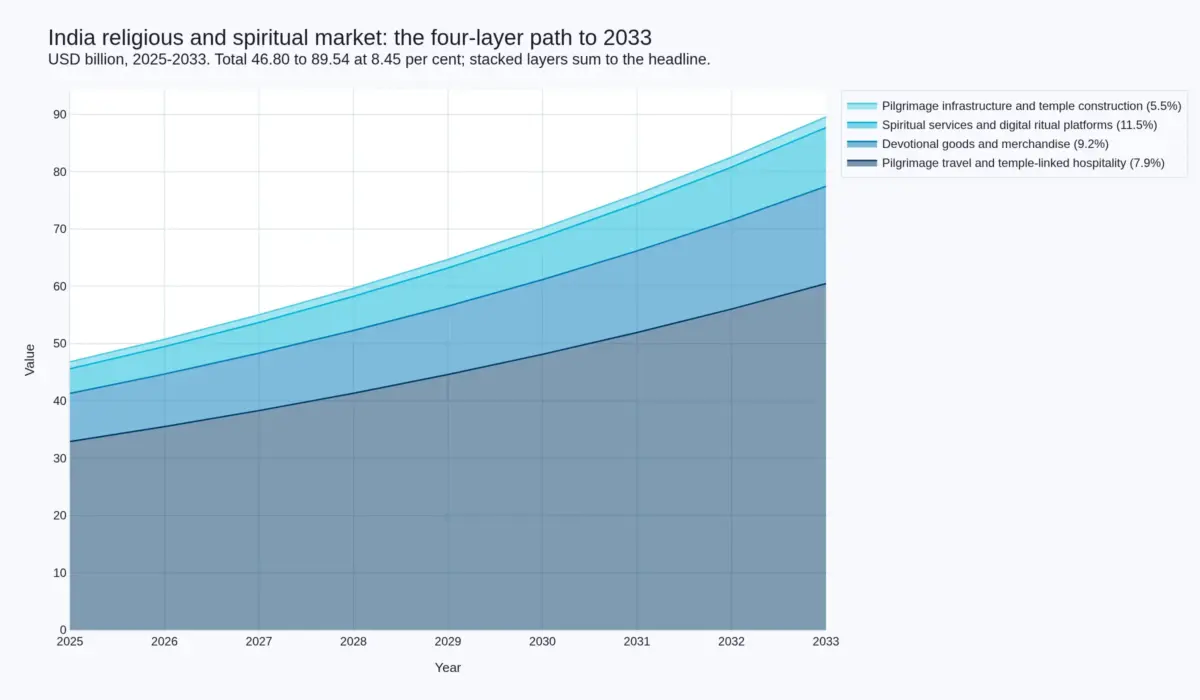
Why 8.45 per cent, and how the path was checked
The headline is not asserted and then decomposed. It is the weighted result of four layer rates, which is why it lands at 8.45 rather than at a round number. Pilgrimage travel grows slower than the market because its physical capacity - darshan throughput, beds in the sacred towns, rail seats in the festival window - is the binding constraint. Devotional goods grow with nominal household consumption plus formalisation. Spiritual services grow fastest off a small base, and are the only layer where a single company can move a national number. Infrastructure is public capex and therefore the least compoundable line in the model.
The path does not rest on a single published number, and no third-party estimate of this market is cited in it. External figures for Indian religious and spiritual spending differ by perimeter far more than by measurement, so importing one as a cross-check would compare two different definitions rather than validate one. What is checkable here is internal. The four layer rates, weighted by their 2025 shares, produce the headline; and the two endpoints compound at 8.448 per cent across the eight periods against a stated 8.45 - two thousandths of a percentage point, which is rounding at the printed decimal place. That is a consistency check, not corroboration: it establishes that the build adds up, not that the build is right.
The two ledgers, and why the institution is a labour body before it is a market
Tirumala Tirupati Devasthanams approved a Rs 5,258 crore budget for 2025-26, about USD 0.60 billion at Rs 87. Its hundi receipts are projected at Rs 1,729 crore against Rs 1,671 crore the year before; prasadam sales at Rs 600 crore against Rs 550 crore; darshan tickets at Rs 310 crore; Arjitha Seva tickets at Rs 130 crore; accommodation and kalyanamandapam receipts at Rs 157 crore; Kalyanakatta hair-offering receipts at Rs 176.5 crore. Against all of that sits a human resources bill of Rs 1,773.75 crore - meaning the salary outgo alone exceeds total hundi collections by Rs 44.75 crore. The endowment also earns Rs 1,310 crore of interest on a deposit book of roughly Rs 18,000 crore.
That asymmetry is the single most useful thing to understand about the institutional layer: India's great temples are not commercial enterprises with a sideline in charity, they are charitable institutions running at the scale of mid-sized states, and their capital budgets come substantially from the public purse. Swadesh Darshan sanctioned Rs 5,292.91 crore across 76 projects, 75 of them physically complete. PRASHAD sanctioned Rs 1,646.99 crore across 48 projects with Rs 1,036.96 crore released as at 24 December 2024, and has identified 27 new sites across 18 states and union territories. Under SASCI, 40 projects in 23 states worth Rs 3,295.76 crore were sanctioned in 2024-25 at 100 per cent central funding. In total the Ministry reports 110 projects across thematic circuits including Ramayana, Buddhist, Coastal and Tribal.
What the forecast is exposed to
- The Kumbh cycle. 2025 is a festival-year base. The next large gatherings fall at Nashik in 2027 and Ujjain in 2028, both smaller than Prayagraj, and the next Purna Kumbh at Prayagraj falls in 2033 - the forecast's final year. Any model that carries 2025's visitor intensity flat through the window will overstate the middle years.
- Crowding caps, not demand caps. Darshan throughput is a queue, a road and an accommodation constraint. TTD already rations entry with timed tickets. When supply is rationed, revenue per pilgrim rises and visitor growth stalls - which is why the travel layer is the slowest-compounding of the four.
- The rupee. The base is converted at Rs 87.0. The market is rupee-denominated; the report is not. A 5 per cent depreciation moves the whole USD series 5 per cent with nothing whatsoever happening in India.
- Formalisation. 70.3 per cent of the base is travel and hospitality, much of which is cash, un-invoiced and intermediated by unregistered operators. Measured growth and real growth are not the same number in this market, and the gap is largest precisely where the market is largest.
A note on units
No volume series is published for this market and none is stored here. There is no unit that means the same thing across an agarbatti pack, a darshan ticket, a 90-minute consultation and a hotel night, and the visitor data that looks like a denominator is not one: the Ministry's domestic tourist visit series runs 2,509.13 million for 2023 against 3,035.9 million for January to August 2025, a break produced by a change in estimation rather than by a change in behaviour, and state-level counts are not additive across states. A derived volume would have manufactured precision. This is a value-only market.
Table of Contents
India Religious and Spiritual Market
- Executive Summary
1.1. Market Snapshot, 2025 to 2033
1.2. The perimeter decision
1.3. Analyst judgement calls - Market Overview
2.1. Definition and scope
2.2. What the official statistics do and do not count
2.3. The two ledgers - Market Dynamics
3.1. Drivers
3.2. Restraints
3.3. Opportunities
3.4. The festival cycle as a structural variable - Market Size and Forecast, 2025 to 2033
4.1. The four-layer build
4.2. Layer rates and weighted growth
4.3. How the path was checked
4.4. Sensitivities: rupee, crowding, formalisation - Market Segmentation
5.1. By layer and product type
5.2. By distribution channel
5.3. By pilgrim and household segment
5.4. By region - Value Chain and Ecosystem
6.1. Artisan and MSME base
6.2. Temple supply chains and prasadam logistics
6.3. The platform layer - Competitive Landscape
7.1. Structure: organised versus unorganised
7.2. Incense and devotional goods
7.3. Spiritual services platforms
7.4. Pilgrimage access and tour product - Technology and Innovation
8.1. Product standardisation and formalisation
8.2. Live-streamed ritual and remote participation
8.3. Payments, ticketing and queue management - Investment Activity
9.1. Venture capital in spiritual technology
9.2. Public capital in pilgrimage infrastructure
9.3. Trust capital and endowments - Regulatory Landscape
10.1. Tourism and pilgrimage schemes
10.2. Product standards and consumer safety
10.3. Taxation, endowments and foreign contributions
10.4. Digital platforms: consumer and data law - Market Risk
11.1. Festival cyclicity
11.2. Capacity and crowding
11.3. Platform unit economics
11.4. Currency and measurement risk - Appendix
12.1. Research methodology
12.2. Data sources
12.3. Glossary
Competitive Landscape
Structure: a market of small share positions
India’s religious and spiritual market has no dominant supplier and, unusually for a market of this size, no realistic path to one. The reason is that the four layers do not share a customer journey in any way that rewards scale. A household that buys incense in a neighbourhood shop, a pilgrim who books a darshan ticket through a temple trust, and a user who pays Rs 30 for an astrology consultation are all customers of the same economy and none of them is a customer of the same company.
Organised share is highest in three narrow pockets – incense manufacture, digital astrology, and railway-linked pilgrimage travel – and even there, concentration is modest. The realistic competitive question is not who will consolidate the market but who can hold a defensible position inside one layer while the layer itself grows.
Incense and devotional goods
India is the world’s largest producer and exporter of agarbatti. The industry is estimated at around Rs 8,000 crore a year, about USD 0.92 billion at Rs 87, with exports of roughly Rs 1,200 crore to more than 150 countries, according to the estimates published alongside the Bureau of Indian Standards specification IS 19412:2025 in December 2025. The sector runs on an ecosystem of artisans, MSMEs and micro-entrepreneurs concentrated in rural and semi-urban clusters, with significant employment for women.
Organised competition sits at the branded top of that pyramid. ITC’s Mangaldeep is the largest organised incense brand in the country, built on a distribution reach no artisan cluster can match and on an FMCG operating discipline – shelf space, price points and packaging – that the unbranded segment does not attempt. Patanjali Ayurved competes on a different axis entirely: provenance and cultural authenticity, sold through a retail network built for ayurvedic and household products, with devotional goods as a natural adjacency rather than a core line. Cycle Pure Agarbathies, part of the NR Group, holds the third credible organised position, strongest in the South and in export channels.
Everything below those three is a long tail: thousands of manufacturers selling loose or lightly branded product at price points that branded players cannot reach without destroying their own margin structure. The BIS standard is the most important competitive development in this layer in years, because a mandatory product specification raises the fixed cost of staying in the unbranded market. It will not consolidate the industry; it will thin the bottom of it.
Spiritual services platforms
This is the only layer where a single company visibly moves a national number. AstroTalk reported revenue of Rs 1,214 crore in FY2025, up 85 per cent, with a sharp improvement in adjusted profit before tax even as reported profitability was weighed down by higher spending and one-time accounting items. It is the category’s proof that Indians will pay, at scale and repeatedly, for a service that was previously free at the family level or cash-only at the village level.
AppsForBharat, whose Sri Mandir app books remote puja and chadhava, is the other instructive case and a very different one. FY2025 operating revenue was Rs 69.6 crore, up from Rs 18.5 crore – a 3.8 times increase – on total income of Rs 72.6 crore, with a net loss of Rs 45.3 crore against Rs 39 crore the year before. Expenses nearly doubled to Rs 117.9 crore. Advertising and publicity took Rs 51.9 crore, or 44 per cent of the entire cost base, up 233 per cent year on year; payment to temples for puja and chadhava fulfilment took Rs 11.4 crore, up 204 per cent. The app claims more than 4 crore downloads, about 3.5 million monthly active users, partnerships with 70 to 100 temples, and 5.2 million rituals completed by 1.2 million users in twelve months.
Those two cost lines tell the whole story of the layer. Fulfilment cost scales with volume and is paid to counterparties – temples, priests – who hold pricing power over the platform. Acquisition cost is bought rather than earned. A platform that spends more on advertising than it earns in revenue is not yet a business; it is a demand-creation exercise with a real product attached.
Pilgrimage access and tour product
Access to the shrine is the scarcest asset in the market and it is controlled by institutions, not companies. TTD alone budgets Rs 310 crore from darshan tickets and Rs 130 crore from Arjitha Seva tickets for 2025-26 – together roughly USD 51 million of pure access revenue, sold against a queue that physically cannot clear. Any commercial operator in pilgrimage is, structurally, a reseller of institutional capacity: it can add transport, hotels, guides and interpretation, but it cannot create a darshan.
IRCTC holds the strongest position in the layer that can be owned – rail inventory and packaged pilgrimage product – with the advantage of being the default rail distribution channel as well as a tour operator. State tourism corporations control a meaningful share of circuit-level product. Online travel agents intermediate air and hotel but add little on the sacred component itself. The result is a layer with high volume, low margin, and a competitive moat that belongs to the railway and the temple rather than to the intermediary.
What competitive advantage actually consists of
In this market, advantage is trust, distribution and access – in that order. Trust is why an astrology app can charge for something a family elder provides free. Distribution is why an FMCG brand outsells an artisan cluster at equal quality. Access is why no amount of capital lets a new entrant sell a darshan. Capital intensity is low, substitution is easy within a layer and near-impossible across layers, and the credible threat to every incumbent is not a rival but a shift in how the underlying ritual is performed.
Value Chain
Four chains wearing one name
The value chain of this market is not one chain. It is four, joined only at the household budget: a manufacturing chain for devotional goods, a service chain for ritual and astrology, a logistics and hospitality chain for pilgrimage, and a public works chain for the capacity all three consume. Reading them as one is the most common analytical error in the category.
The artisan base and the goods chain
Incense is the most industrialised of the devotional goods and still the most artisanal in its inputs. The chain runs from bamboo splint and charcoal through fragrance compounding and hand-rolling to drying, packing and distribution. Hand-rolling remains a cottage activity concentrated in rural and semi-urban clusters and employing a predominantly female workforce – a fact the Bureau of Indian Standards notes explicitly in the material accompanying IS 19412:2025, alongside the industry’s Rs 8,000 crore size and Rs 1,200 crore of exports to more than 150 countries.
The new standard is a chain event, not a product event. It specifies prohibited insecticidal compounds – alethrin, permethrin, cypermethrin, deltamethrin and fipronil among them – and prohibited synthetic fragrance intermediates, and it classifies agarbatti as machine-made, hand-made or traditional masala, prescribing requirements for raw materials, burning quality, fragrance performance and chemical parameters. For a hand-rolling household, compliance means testing it cannot afford and inputs it cannot verify. The likely outcome is consolidation of the testing and fragrance-compounding steps into larger units while rolling stays dispersed, which shifts margin upward in the chain and reduces the artisan’s share of retail.
Idols and murtis run the other way entirely: localised clay and plaster clusters, high seasonality around festival dates, near-zero capital intensity, and a price range that runs from a few hundred rupees to commissioned work in the lakhs. There is no national brand and no plausible route to one, because the product is made to order within a festival window and consumed within a walking distance.
Prasadam, ticketing and temple logistics
The temple estate is the most sophisticated supply chain in the market and the least visible. TTD’s 2025-26 budget puts prasadam sales at Rs 600 crore, up from Rs 550 crore – a food manufacturing operation at industrial scale, with procurement, quality control, cold chain and counter distribution inside a site that receives tens of thousands of people a day. Its Kalyanakatta receipts of Rs 176.5 crore price a by-product of devotion, and its accommodation and kalyanamandapam receipts of Rs 157 crore reflect an estate that is simultaneously a hotelier.
Every one of these lines depends on physical throughput, which is why the estate’s constraint is staff and infrastructure rather than demand. TTD’s human resources outlay of Rs 1,773.75 crore exceeds its hundi receipts of Rs 1,729 crore. That single comparison explains why temple estates behave like public institutions: they are labour-intensive service providers whose revenue is a transfer and whose costs are fixed.
The platform layer, and where the margin actually goes
Digital platforms insert themselves between the devotee and the ritual, and the economics of that insertion are now visible in disclosure. AppsForBharat spent Rs 11.4 crore paying temples for puja and chadhava fulfilment in FY2025 against Rs 3.7 crore the year before – a 204.5 per cent increase – on revenue of Rs 69.6 crore. Fulfilment is therefore roughly 16 per cent of revenue and rising faster than revenue. The platform does not own the ritual, the temple does, and the temple prices accordingly.
Above fulfilment sits the acquisition layer: Rs 51.9 crore of advertising and publicity, 44 per cent of total expenditure. In a chain where the supplier of the core service has pricing power and the customer must be bought, the intermediary’s share of value is structurally thin. Platforms that survive will be those that convert acquisition spend into ritual frequency – the same user returning for the next festival – rather than those that buy new users for every occasion.
Exports and the outward chain
India exports roughly Rs 1,200 crore of agarbatti to more than 150 countries, and the demand driver is not Indian diaspora devotion but global yoga, meditation, aromatherapy and wellness consumption. That is a materially different customer: a Western wellness buyer purchases incense as a sensory product, is more price- and quality-sensitive, and is regulated in ways the domestic temple market is not. It is the one part of this market where Indian suppliers compete internationally on product rather than on cultural authority, and the one part where the new standard is a competitive asset rather than a compliance cost.
Where the value is captured
Across all four chains, the pattern is consistent: the further a participant sits from the physical point of devotion, the lower the margin. Temple estates capture access. Artisan clusters capture labour. Brands capture distribution. Platforms capture attention and give most of it back in acquisition and fulfilment. Any investment case in this market that assumes platform-like returns from a chain that is fundamentally physical will be disappointed, and the disclosed numbers now make that judgement possible rather than theoretical.
Investment Activity
Three pools of capital, three different logics
Capital enters this market from three directions and almost never mixes. Venture capital funds the platform layer. The state funds pilgrimage capacity. Temple endowments fund themselves, and behave less like investors than like small sovereigns. Understanding the market’s investment direction requires keeping the three separate, because their returns are measured in different currencies: multiple, mandate and darshan throughput.
Venture capital: attention is the asset being bought
The disclosed unit economics of the platform layer explain both the enthusiasm and the caution. AppsForBharat grew operating revenue 3.8 times to Rs 69.6 crore in FY2025 while its net loss widened to Rs 45.3 crore from Rs 39 crore and total expenditure almost doubled to Rs 117.9 crore. Within that, advertising and publicity of Rs 51.9 crore – up 233.4 per cent – represented 44 per cent of all spending, while employee costs rose 28.8 per cent to Rs 32.2 crore.
Read that mix carefully: marketing grew eight times faster than headcount. This is a demand-creation business whose product, remote ritual fulfilment, is supplied by third parties who hold pricing power. It raises capital to buy users, not to build assets. AstroTalk’s Rs 1,214 crore FY2025 revenue, up 85 per cent, with improving adjusted profit before tax, demonstrates that the model can work when consultation frequency is high and the service is delivered by the platform’s own network rather than a temple’s. The distinction between those two structures – owning the service versus brokering it – is the most important thing an investor in this layer has to price.
Public capital: capacity is being built, not demanded into existence
The second pool is the largest and the least discussed. Swadesh Darshan sanctioned Rs 5,292.91 crore across 76 projects, of which 75 are reported physically complete. PRASHAD sanctioned Rs 1,646.99 crore across 48 projects with Rs 1,036.96 crore released as at 24 December 2024, and has identified 27 additional sites across 18 states and union territories. Under SASCI, 40 projects in 23 states worth Rs 3,295.76 crore were sanctioned in 2024-25 with 100 per cent central funding. In total the Ministry of Tourism reports 110 projects across thematic circuits – Ramayana, Buddhist, Coastal and Tribal among them.
The investment thesis embedded in that spending is explicit and worth stating: pilgrimage revenue is constrained by roads, water, sanitation, last-mile transport and accommodation, so the state builds them. That makes public capex the leading indicator for the travel layer’s growth, and the reason the layer can compound at 7.9 per cent even while private investment in it stays thin. It also makes the layer politically exposed in a way the rest of the market is not: a change in scheme priority shows up in capacity two to three years later.
Endowment capital: the patient money
The third pool is the one most analysts miss. TTD will allocate Rs 800 crore to corpus and other investments in 2025-26 and earns Rs 1,310 crore of interest on a deposit book of roughly Rs 18,000 crore. Its interest income is larger than its prasadam, ticket, accommodation and Kalyanakatta revenues combined. The endowment is, in effect, the market’s largest single financial investor, with a horizon no fund can match and a mandate – dharmic propagation, hospitals, education, Rs 121 crore earmarked for HDPP and related projects – that is not financial at all.
This capital does not seek deals and does not exit. It shapes the market indirectly, by funding the capacity others sell into and by setting the terms on which temples partner with platforms. Any commercial model that depends on a temple’s cooperation is transacting with an institution whose cost of capital is negative in the conventional sense and whose priorities are not revenue.
Mergers, hotels and the physical layer
Merger and acquisition activity in this market is minimal. There is no consolidator with a strategic reason to assemble a national position, because the assets that matter – a brand’s trust, a temple’s queue, an artisan cluster’s skill – are not cleanly acquirable. The most active physical investment is in hospitality adjacent to the new pilgrimage flows: room supply in Ayodhya and Varanasi, budget and mid-market formats, and food service, all of which sit just outside the four layers and capture the spillover.
Capital intensity across the market remains low to medium, and that is a deterrent to institutional investment rather than an attraction: low capital requirements mean low barriers, which means no durable returns except where trust or access intervenes. The honest summary is that this is a market where the state builds, institutions sit, and private capital buys customers – and where the only genuinely investable returns are in the narrow places where one of those three roles overlaps with a brand that people already believe.
Technology & Innovation
Innovation in this market is regulatory and procedural, not scientific
Patent activity in India’s religious and spiritual economy is low and will stay low. There is no product science to protect: an agarbatti is a fragrance on a splint, a darshan is a queue, and a consultation is a conversation. What changes this market is process – how a product is standardised, how a ritual is delivered remotely, how a queue is priced – and the three genuinely consequential developments of the last two years are all of that kind.
Standardisation arrives, and it is the most underrated event in the market
In December 2025 the Bureau of Indian Standards published IS 19412:2025, Incense Sticks (Agarbatti) – Specification, released by the Union Minister for Consumer Affairs at Bharat Mandapam on National Consumer Day. Read as a consumer-safety document, it is unremarkable: it prohibits certain insecticidal chemicals – alethrin, permethrin, cypermethrin, deltamethrin, fipronil – and a list of synthetic fragrance intermediates including benzyl cyanide, ethyl acrylate and diphenylamine, and it classifies agarbatti as machine-made, hand-made or traditional masala, prescribing requirements for raw materials, burning quality, fragrance performance and chemical parameters.
Read as a market document, it is a restructuring event. India is simultaneously the world’s largest producer and exporter of agarbatti and a market where most output is hand-rolled in household units. A specification with a prohibited-substances list cannot be met by a household that has no laboratory and no supplier documentation. Compliance therefore migrates to the point where fragrance is compounded and inputs are bought – which is exactly where the organised brands already sit. Standardisation in this market does not raise quality evenly; it transfers share upward and makes the export channel easier to defend against the complaint that Indian incense is chemically unpredictable.
Remote ritual becomes a real product, not a novelty
The single largest behavioural change in the market is that a devotee who cannot travel can now pay to have the ritual performed and the prasad dispatched. AppsForBharat’s Sri Mandir reported 5.2 million rituals completed by 1.2 million users in FY2025, across a network of 70 to 100 partner temples, with about 3.5 million monthly active users, more than 4 crore downloads and availability in over 30 countries. It was the official digital partner for the Vedashram Trust at the Mahakumbh, serving more than 3 lakh devotees through online and offline experiences.
Two things make this technically interesting rather than merely commercial. First, it converts an event into a subscription trigger: festivals, eclipses, birth dates and death anniversaries create a calendar of demand that is known years in advance. Second, it requires fulfilment infrastructure – temple liaison, priest scheduling, prasad logistics, photographic or video proof of performance – which is an operational problem, not a software one, and it is the reason the model’s cost per ritual rises with volume rather than falling.
Payments, ticketing and queue management
The least glamorous technology in the market is the one with the largest revenue attached. Timed-entry darshan ticketing converts a queue into a priceable product: TTD budgets Rs 310 crore from darshan tickets and Rs 130 crore from Arjitha Seva tickets for 2025-26, roughly USD 51 million of access revenue sold against a fixed physical throughput. Digital payment rails inside temple estates have done the same to offerings, converting cash into countable income and, incidentally, into a data asset – the estate now knows its donor frequency, its pilgrim geography and its peak windows in a way it could not when the hundi was a box.
Where the technology has not yet arrived is in yield management. Airlines price a seat by time and remaining capacity; temples price a darshan by category. None of the large estates publishes a dynamic access price, and the political cost of introducing one is high. The first institution that does it will add revenue without adding a single visitor, and that is the largest untapped margin in the entire market.
AI, AR and the maturity question
Artificial intelligence is already load-bearing in the largest spiritual-services platform – matching a user to an astrologer, routing a consultation, generating content at a volume no human network could sustain – though no operator in this market discloses model economics. Augmented reality darshan and virtual temple experiences remain marketing set-pieces rather than revenue lines; they appear in press releases far more often than in disclosures, and the honest assessment is that the technology is not yet the constraint. Attention and trust are.
Technology maturity across the market is therefore emerging, not advanced, and it is unevenly distributed: fragrance compounding and export compliance are becoming industrial while idol-making remains entirely artisanal, and the platform layer is technically modern but economically fragile. Innovation intensity is medium and capital intensity is low to medium, which together describe a market where technology changes who captures value far more than it changes how much value exists.
Market Risk
The risk is concentration and measurement, not appetite
Nothing in this market suggests a demand problem. The risks that matter are the shape of the demand curve within the year, the physical limits of the places it flows to, the economics of the intermediaries that monetise it, and the integrity of the numbers used to describe it. Each is manageable; none is trivial.
Festival cyclicity, and the base-year trap
The largest single risk to any forecast built on 2025 is that 2025 was not a normal year. The Mahakumbh at Prayagraj drew more than 66 crore visits between 13 January and 26 February. Uttar Pradesh recorded 649.1 million tourist visits in all of 2024 and more than 1.21 billion in the first six months of 2025, with the state tourism department putting the full-year domestic figure above 1.37 billion. Those are not comparable periods; they are one festival year following one normal year.
The cycle then works against the middle of the forecast. The next large gatherings fall at Nashik in 2027 and Ujjain in 2028, both smaller than Prayagraj, and the next Purna Kumbh at Prayagraj falls in 2033 – the final year of the window. A model that flattens 2025’s intensity across eight years will overstate 2027 through 2031 and understate 2033. This report’s layer rates are set to grow through the cycle rather than to repeat the base year, which is why the travel layer compounds at 7.9 per cent rather than at the 8.45 per cent headline.
Capacity, crowding and the ceiling that is physical
Darshan throughput is a road, a queue, a bed count and a sanitation system. When demand exceeds it, the adjustment is not price but administration: timed tickets, caps, route diversions and, at the extreme, closure. TTD’s own budgeting reflects this – Rs 310 crore of darshan tickets against a queue that cannot clear, and a human resources outlay of Rs 1,773.75 crore that exceeds its hundi receipts of Rs 1,729 crore. Capacity expansion is slow, capital-hungry and publicly funded, so the market’s growth rate in the travel layer is effectively set by government construction schedules.
Crowd safety is the tail risk that sits behind that ceiling. Mass gatherings at this scale carry a recurring operational hazard, and a serious incident at a major shrine would compress demand, invite regulation and change the political economy of pilgrimage infrastructure for years. It is not a forecastable event, but it is a legitimate reason to hold the travel layer at a lower multiple than its volume growth implies.
Platform unit economics
The digital layer’s disclosed numbers are the clearest warning in the market. AppsForBharat spent Rs 51.9 crore on advertising and publicity against Rs 69.6 crore of operating revenue in FY2025, and Rs 11.4 crore paying temples for ritual fulfilment – roughly 16 per cent of revenue and growing at 204.5 per cent, faster than revenue itself. Net loss widened to Rs 45.3 crore. In a structure where the supplier of the core service holds pricing power and the customer must be bought, the intermediary’s margin is a residual. Any part of the 11.5 per cent services growth that is assumed to convert into platform profit should be discounted until a player in this category demonstrates retention without acquisition spend.
Currency, measurement and the honesty of the series
The market is rupee-denominated and this report is in dollars at an assumed Rs 87.0. A 5 per cent depreciation moves the entire USD series 5 per cent with no change in India; a 10 per cent move does more than a year of real growth. This is a presentation risk rather than an economic one, but it is the risk most likely to be mistaken for performance.
Beneath it sits measurement risk, which is the defining flaw of this market’s evidence base. The Ministry of Tourism’s domestic visit series runs 2,509.13 million for 2023 and 3,035.9 million for January to August 2025, a break produced by a change in estimation rather than behaviour, and state counts are not additive – Uttar Pradesh alone reports more than 1.37 billion domestic tourists in 2025. Any participant who reads growth off that series will mistake the counting for the economy. The same weakness runs through the unorganised layer, where cash and un-invoiced transactions mean formalisation shows up as growth even when volume is flat.
Substitution and the long-term question
Substitution risk within a layer is high and across layers is low but rising. Remote ritual is a complement to pilgrimage today; at sufficient scale it becomes a partial substitute for the journey, and the layer that would lose is the largest one. That is not a 2026 risk. It is the reason the services layer carries the highest rate in this forecast and the travel layer the lowest, and it is the single structural question an investor with a ten-year horizon should be underwriting. Overall market risk is assessed as medium, with the risk concentrated in timing within the window rather than in the level of the market at either end of it.
Regulatory Landscape
Light-touch overall, multi-agency in practice
There is no single regulator for India’s religious and spiritual economy, and no statute written for it. What exists is a stack of adjacent regimes – tourism schemes, product standards, charitable-trust law, taxation, and consumer and data protection – each of which touches one layer of the market and none of which sees the whole. Regulatory complexity is best described as medium with high variance: routine for a retailer, considerable for a temple-linked platform, and genuinely difficult for an exporter.
Tourism and pilgrimage schemes
The Ministry of Tourism is the largest single shaper of market capacity. Swadesh Darshan, launched in 2014-15, sanctioned Rs 5,292.91 crore across 76 projects, of which 75 are reported physically complete, and has been revamped as Swadesh Darshan 2.0 with 29 projects sanctioned in 2023-24 and a further 5 in 2024-25 as at 20 December 2024. PRASHAD – Pilgrimage Rejuvenation and Spiritual, Heritage Augmentation Drive – sanctioned Rs 1,646.99 crore across 48 projects with cumulative releases of Rs 1,036.96 crore to 24 December 2024, and has identified 27 new sites covering 18 states and union territories. SASCI sanctioned 40 projects in 23 states worth Rs 3,295.76 crore in 2024-25 on 100 per cent central funding. Across the schemes the Ministry counts 110 projects in thematic circuits including Ramayana, Buddhist, Coastal and Tribal.
For a commercial participant the practical consequence is that capacity is granted, not built: scheme selection determines which circuits get roads, sanitation, interpretation centres and last-mile transport, and that in turn determines which pilgrimage towns can absorb growth. Being early to a newly funded circuit is the closest thing to a regulatory moat this market offers.
Product standards and consumer safety
IS 19412:2025 is the first dedicated Indian Standard for agarbatti, published by the Bureau of Indian Standards in December 2025. It prohibits specific insecticidal chemicals – alethrin, permethrin, cypermethrin, deltamethrin and fipronil among them – and synthetic fragrance intermediates including benzyl cyanide, ethyl acrylate and diphenylamine, and prescribes requirements on raw materials, burning quality, fragrance performance and chemical parameters across machine-made, hand-made and traditional masala categories. BIS standards are not self-executing; enforcement runs through the consumer-protection apparatus and, in practice, through retail and export buyers demanding compliance. That is still sufficient to change behaviour in a market where the largest buyers are organised chains.
Adjacent regimes matter more than they appear. Packaged devotional goods fall under legal metrology and packaged-commodity rules; prasadam and food-grade devotional products fall under food-safety law; idol manufacture and immersion are governed by state environment rules that have repeatedly restricted plaster-of-paris and non-biodegradable materials; and exports must meet the destination market’s chemical and labelling requirements, which for incense are stricter than India’s were until December 2025.
Taxation, endowments and foreign contributions
The taxation regime is the least stable element and the one most likely to change during the forecast window. Devotional goods do not sit in a single harmonised band: incense, idols, books and packaged food are classified differently, and the applicable rate on several of these lines has been revised more than once since the goods and services tax was introduced. Any pricing or elasticity assumption in this market should be checked against the current classification for the specific product before it is underwritten, because a single rate change moves retail price more than a year of input inflation.
Temple institutions operate under a patchwork of state endowment and administration statutes, which determine who controls budgets, whether surplus must be transferred to the state, and how commercial partnerships may be structured. Their income is generally governed by charitable-trust provisions in direct tax law, and foreign donations are separately controlled under foreign-contribution rules. This matters commercially: a platform contracting with a temple is contracting with an entity whose ability to enter commercial arrangements, retain surpluses and sign enforceable revenue shares varies by state.
Digital platforms: consumer and data law
There is no dedicated statute for online astrology, ritual booking or devotional content, and no licensing requirement. The applicable regimes are general: consumer-protection law and its e-commerce rules on disclosures, refunds and grievance redressal; advertising standards that constrain claims in a category where claims are the product; payment-system rules for platforms that hold or route customer funds; and data-protection law for platforms processing devotionally sensitive personal data – birth details, gotra, health intentions, financial offerings – which is about as sensitive a dataset as a consumer application can hold.
Approval pathway structure is therefore best characterised as light but multi-agency: no licence to enter, several obligations once inside, and a compliance burden that scales with how central the platform becomes to the ritual itself.