
Global Ethanol in Beverage Industry Market Report, Size & Forecast 2026-2033
Global Ethanol in Beverage Industry Market Forecast Snapshot: 2026-2033
| Metric | Value |
| 2025 Market Size | USD 412.7 Billion |
| 2033 Market Size | ~USD 568.9 Billion |
| CAGR (2026-2033) | ~4.1% |
| Largest Region | Europe |
| Fastest Growing Region | Asia-Pacific |
| Top Segment | Grain-Based Beverage Ethanol |
| Key Trend | Premium Alcoholic Beverages, Sustainable Fermentation & Clean-Label Spirits |
| Future Focus | Bio-Based Production Efficiency, AI-Driven Distillation Analytics & Low-Carbon Ethanol |
Global Ethanol in Beverage Industry Market Overview
The Global Ethanol in Beverage Industry Market is witnessing structural transformation, driven by rising global alcohol consumption, premiumization trends in spirits and craft beverages, and advancements in sustainable fermentation technologies. Beverage-grade ethanol remains a critical raw material across spirits, beer fortification, ready-to-drink (RTD) alcoholic beverages, and specialty liquors. According to Pheonix Research, the Global Ethanol in Beverage Industry Market is valued at USD 412.7 billion in 2025 and is projected to reach approximately USD 568.9 billion by 2033, registering a CAGR of ~4.1% (2026-2033). This revenue forecast reflects stable alcohol demand across mature markets, premium craft expansion, increasing RTD adoption, and rising consumption in emerging economies. Europe holds the largest market share, supported by established distillation infrastructure, strong spirits heritage, and premium export networks. Asia-Pacific is the fastest-growing region, fueled by urbanization, rising disposable incomes, and expanding beer and spirits consumption across China, India, Japan, and Southeast Asia. The Post-2025 outlook highlights sustainable feedstock sourcing, low-carbon ethanol production, AI-enabled fermentation monitoring, premium craft distillation growth, and expanding RTD alcoholic beverage innovation as key long-term drivers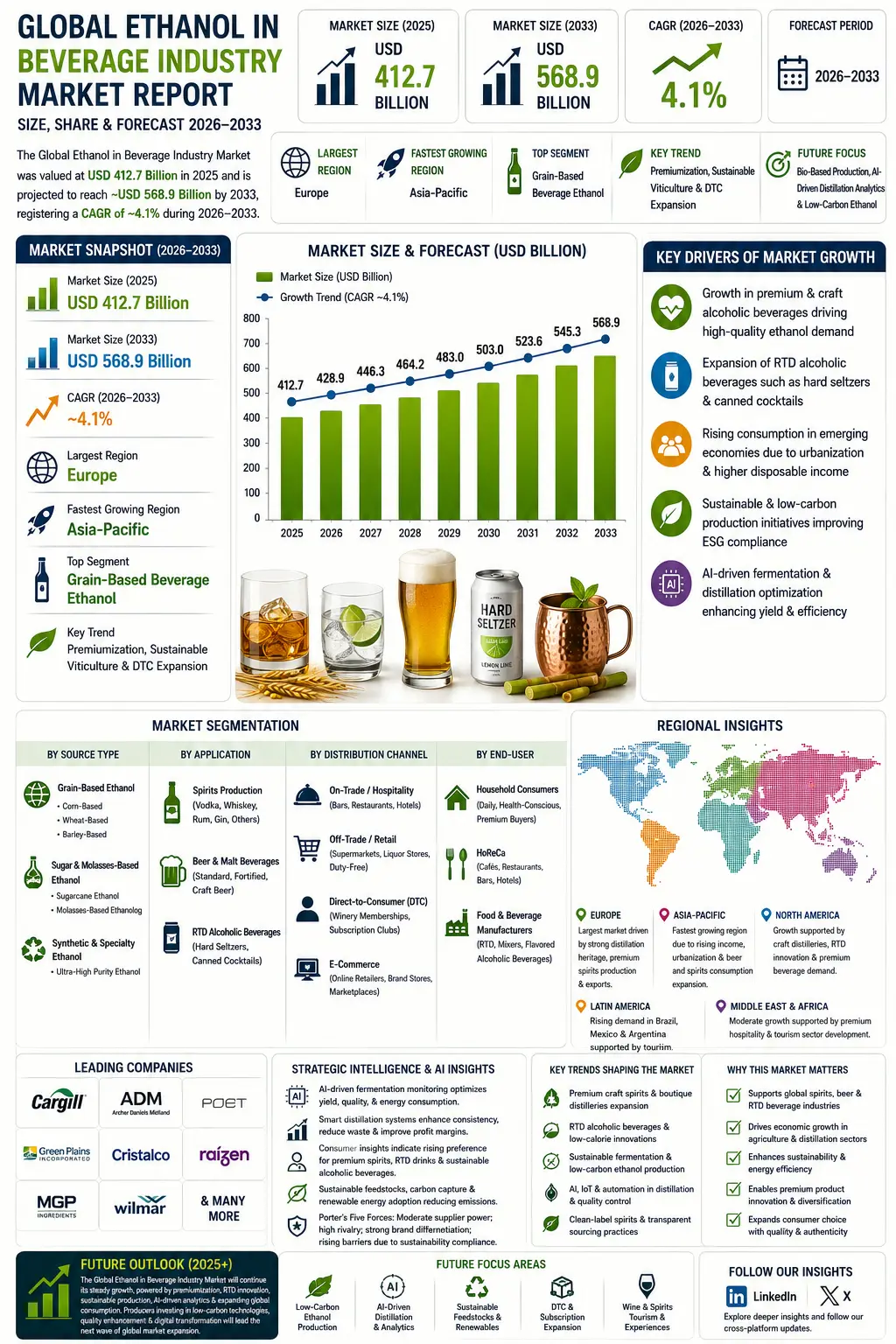
Key Drivers of Global Ethanol in Beverage Industry Market Growth
-
Growth in Premium & Craft Alcoholic Beverages
-
Expansion of Ready-to-Drink (RTD) Alcoholic Beverages
-
Rising Consumption in Emerging Economies
-
AI-Driven Fermentation & Quality Optimization
Global Ethanol in Beverage Industry Market Segmentation
-
By Source Type
2.By Application
2.1 Spirits Production 2.1.1 Vodka 2.1.1.1 Premium Vodka 2.1.1.2 Flavored Vodka 2.1.1.3 Craft Vodka 2.1.1.4 Luxury Small-Batch Vodka 2.1.2 Whiskey 2.1.2.1 Bourbon 2.1.2.2 Scotch 2.1.2.3 Rye Whiskey 2.1.2.4 Premium Aged Whiskey 2.1.3 Rum 2.1.3.1 White Rum 2.1.3.2 Dark Rum 2.1.3.3 Spiced Rum 2.1.3.4 Aged Reserve Rum 2.1.4 Gin & Specialty Spirits 2.1.4.1 London Dry Gin 2.1.4.2 Botanical Infused Spirits 2.1.4.3 Craft Small-Batch Gin 2.1.4.4 Limited-Edition Releases 2.2 Beer & Malt Beverages 2.2.1 Standard Beer Production 2.2.1.1 Lager 2.2.1.2 Ale 2.2.1.3 Craft Beer 2.2.1.4 Premium Imported Beer 2.2.2 Fortified & Specialty Beer 2.2.2.1 High-ABV Craft Variants 2.2.2.2 Seasonal Specialty Brews 2.2.2.3 Limited-Edition Releases 2.2.2.4 Barrel-Aged Variants 2.3 Ready-to-Drink (RTD) Alcoholic Beverages 2.3.1 Hard Seltzers 2.3.1.1 Fruit-Infused Variants 2.3.1.2 Low-Calorie Formulations 2.3.1.3 Premium Craft Seltzers 2.3.1.4 Organic RTD Options 2.3.2 Canned Cocktails 2.3.2.1 Classic Cocktail Variants 2.3.2.2 Premium Mixology Blends 2.3.2.3 Low-Sugar Options 2.3.2.4 Limited Seasonal Editions-
By Distribution Channel
-
By Region
Regional Insights of the Global Ethanol in Beverage Industry Market
Europe-Largest Market
Europe maintains its leading position in the global beverage ethanol market, supported by a long-standing distillation legacy, globally recognized spirits brands, and well-established export networks. Countries such as Germany, France, the UK, and Poland play a significant role in vodka, whiskey, and gin production. Strong premiumization trends and consistent demand for high-quality neutral grain spirits continue to sustain regional ethanol consumption.Asia-Pacific- Fastest Growing Market
Asia-Pacific is the fastest-growing regional market, driven by rapid urbanization, expanding middle-class populations, and increasing alcohol consumption across China, India, Japan, South Korea, and Southeast Asia. Rising disposable incomes, evolving lifestyle preferences, and growing popularity of beer, whiskey, and RTD alcoholic beverages are significantly boosting demand for beverage-grade ethanol in the region.North America
North America demonstrates steady and resilient growth, led by the United States and Canada. Expansion of craft distilleries, premium bourbon and whiskey production, and strong penetration of hard seltzers and canned cocktails are key contributors to ethanol demand. Advanced production technologies and integrated supply chains further strengthen regional market stability.Latin America
Latin America remains a strategically important region, particularly Brazil and Mexico, where sugarcane-based ethanol production supports both domestic consumption and export supply. Growth is reinforced by rising rum and spirits consumption, expanding urban populations, and improving distribution infrastructure.Middle East & Africa
Market expansion in the Middle East & Africa is primarily concentrated in tourism-driven hospitality centers and regulated alcohol markets such as the UAE and South Africa. Demand is supported by premium hotels, expatriate populations, and upscale dining establishments, with gradual growth expected alongside hospitality and retail sector development.Leading Companies in the Global Ethanol in Beverage Industry Market
- Cargill Inc.
- Archer Daniels Midland (ADM)
- POET LLC
- Green Plains Inc.
- Cristalco
- Ra??zen
- MGP Ingredients
- Wilmar International
Strategic Intelligence & AI-Driven Insights
Pheonix Demand Forecast Engine - Identifies stable long-term revenue growth driven by RTD innovation, premium spirits expansion, and emerging market consumption trends. Consumer Behavior Analyzer -Detects rising preference for premium, craft, and low-calorie alcoholic beverages, supporting higher-margin ethanol demand. Innovation Tracker-Highlights AI-powered fermentation monitoring, carbon capture integration, renewable feedstock sourcing, and smart distillation systems improving yield efficiency. Porter's Five Forces Analysis - Reflects moderate supplier power (feedstock dependency), high competitive rivalry among distillers, and increasing differentiation through sustainability and premium branding.Why the Global Ethanol in Beverage Industry Market Remains Critical
Strong foundational role in global alcoholic beverage production Expanding premium and craft spirits ecosystem RTD alcoholic beverage growth driving new demand streams Sustainability initiatives enhancing production efficiency AI-driven fermentation improving operational optimizationFinal Takeaway of the Global Ethanol in Beverage Industry Market
The Global Ethanol in Beverage Industry Market is evolving into a premium-oriented, sustainability-driven, and technology-integrated ecosystem. The projected CAGR of ~4.1% (2026-2033) reflects stable yet resilient growth supported by premium spirits expansion, RTD innovation, and emerging market consumption. Future leadership will be defined by producers that integrate AI-powered fermentation analytics, low-carbon production methods, diversified feedstock sourcing, and omnichannel beverage partnerships. At Pheonix Research, our advanced forecasting frameworks deliver comprehensive Ethanol in Beverage Industry revenue projections, competitive intelligence, and AI-backed strategic insights - empowering stakeholders to navigate the Post-2025 landscape with data-driven precision and long-term value creation.Social Mentions & Publication Channels
Explore deeper insights and follow our cross-platform updates on LinkedIn, and X for continuous intelligence and market coverage.
LinkedIn : https://www.linkedin.com/feed/update/urn:li:activity:7430870229393514496 X : https://x.com/Pheonix_Insight/status/2025109197730545914?s=20Table of Contents
1. Executive Summary
1.1 Market Snapshot (2026-2033)
1.2 Key Financial Highlights
1.3 Growth Outlook & CAGR Analysis
1.4 Largest & Fastest Growing Regions
1.5 Key Trends & Strategic Focus
1.6 Analyst Recommendations
2. Market Overview
2.1 Introduction to Beverage-Grade Ethanol
2.2 Industry Value Chain Analysis
2.3 Production Process Overview
2.4 Feedstock Landscape
2.5 Regulatory Framework & Compliance
2.6 Sustainability & ESG Landscape
2.7 Post-2025 Industry Outlook
3. Global Market Forecast Snapshot (USD Billion), 2026-2033
3.1 2025 Market Size
3.2 2033 Projected Market Size
3.3 CAGR Analysis (2026-2033)
3.4 Revenue Trend Analysis
3.5 Demand-Supply Outlook
4. Market Dynamics
4.1 Market Drivers
4.1.1 Premium & Craft Beverage Growth
4.1.2 RTD Alcohol Expansion
4.1.3 Emerging Market Consumption
4.1.4 Sustainable Production Adoption
4.1.5 AI-Driven Fermentation Optimization
4.2 Market Restraints
4.2.1 Feedstock Price Volatility
4.2.2 Regulatory & Taxation Constraints
4.2.3 Environmental Compliance Costs
4.3 Market Opportunities
4.3.1 Organic & Clean-Label Ethanol
4.3.2 Low-Carbon Production Technologies
4.3.3 Premium Export Markets
4.3.4 Advanced Distillation Automation
4.4 Porter’s Five Forces Analysis
5. Market Segmentation by Source Type (USD Billion), 2026-2033
5.1 Grain-Based Ethanol
5.1.1 Corn-Based Ethanol
5.1.1.1 Industrial Distillation Grade
5.1.1.2 Premium Beverage-Grade
5.1.1.3 Organic Corn Ethanol
5.1.1.4 Non-GMO Certified Ethanol
5.1.2 Wheat-Based Ethanol
5.1.2.1 Neutral Grain Spirit (NGS)
5.1.2.2 High-Purity Distilled Spirit
5.1.2.3 Craft Distillery Grade
5.1.2.4 Premium Export Grade
5.1.3 Barley-Based Ethanol
5.1.3.1 Malt-Derived Ethanol
5.1.3.2 Beer Fortification Grade
5.1.3.3 Specialty Distillation Grade
5.1.3.4 Organic Barley Ethanol
5.2 Sugar & Molasses-Based Ethanol
5.2.1 Sugarcane Ethanol
5.2.1.1 Caribbean Rum Grade
5.2.1.2 Premium Cane Spirit
5.2.1.3 Organic Cane Ethanol
5.2.1.4 Export Distillation Grade
5.2.2 Molasses-Based Ethanol
5.2.2.1 Industrial Beverage Grade
5.2.2.2 Bulk Distillery Supply
5.2.2.3 Blending & Fortification Grade
5.2.2.4 High-Proof Distillation Grade
5.3 Synthetic & Specialty Ethanol
5.3.1 Ultra-High Purity Ethanol
5.3.1.1 Neutral Spirit for Vodka
5.3.1.2 RTD Alcohol Base
5.3.1.3 Flavor-Infusion Base
5.3.1.4 Premium Blending Applications
6. Market Segmentation by Application (USD Billion), 2026-2033
6.1 Spirits Production
6.1.1 Vodka
6.1.1.1 Premium Vodka
6.1.1.2 Flavored Vodka
6.1.1.3 Craft Vodka
6.1.1.4 Luxury Small-Batch Vodka
6.1.2 Whiskey
6.1.2.1 Bourbon
6.1.2.2 Scotch
6.1.2.3 Rye Whiskey
6.1.2.4 Premium Aged Whiskey
6.1.3 Rum
6.1.3.1 White Rum
6.1.3.2 Dark Rum
6.1.3.3 Spiced Rum
6.1.3.4 Aged Reserve Rum
6.1.4 Gin & Specialty Spirits
6.1.4.1 London Dry Gin
6.1.4.2 Botanical Infused Spirits
6.1.4.3 Craft Small-Batch Gin
6.1.4.4 Limited-Edition Releases
6.2 Beer & Malt Beverages
6.2.1 Standard Beer Production
6.2.1.1 Lager
6.2.1.2 Ale
6.2.1.3 Craft Beer
6.2.1.4 Premium Imported Beer
6.2.2 Fortified & Specialty Beer
6.2.2.1 High-ABV Craft Variants
6.2.2.2 Seasonal Specialty Brews
6.2.2.3 Limited-Edition Releases
6.2.2.4 Barrel-Aged Variants
6.3 Ready-to-Drink (RTD) Alcoholic Beverages
6.3.1 Hard Seltzers
6.3.1.1 Fruit-Infused Variants
6.3.1.2 Low-Calorie Formulations
6.3.1.3 Premium Craft Seltzers
6.3.1.4 Organic RTD Options
6.3.2 Canned Cocktails
6.3.2.1 Classic Cocktail Variants
6.3.2.2 Premium Mixology Blends
6.3.2.3 Low-Sugar Options
6.3.2.4 Limited Seasonal Editions
7. Market Segmentation by Distribution Channel (USD Billion), 2026-2033
7.1 On-Trade / Hospitality
7.1.1 Bars & Nightclubs
7.1.1.1 Premium Cocktail Bars
7.1.1.2 Luxury Lounges
7.1.1.3 Resort Entertainment Venues
7.1.1.4 Event & Festival Catering
7.1.2 Hotels & Resorts
7.1.2.1 Luxury Hotels
7.1.2.2 Business Hotels
7.1.2.3 Boutique Hotels
7.1.2.4 All-Inclusive Resorts
7.2 Off-Trade / Retail
7.2.1 Supermarkets & Liquor Stores
7.2.1.1 Private Label Spirits
7.2.1.2 Premium Imports
7.2.1.3 Bulk Retail Supply
7.2.1.4 Promotional Packs
7.2.2 Specialty Retailers
7.2.2.1 Premium Wine & Spirits Stores
7.2.2.2 Craft Beverage Retailers
7.2.2.3 Organic & Specialty Stores
7.2.2.4 Duty-Free Shops
7.3 Direct-to-Consumer (DTC) & E-Commerce
7.3.1 Online Liquor Platforms
7.3.1.1 National E-Commerce Retailers
7.3.1.2 Subscription Alcohol Clubs
7.3.1.3 Limited Digital Releases
7.3.1.4 Cross-Border Online Platforms
7.3.2 Distillery-Owned Platforms
7.3.2.1 Brand-Owned Online Stores
7.3.2.2 Membership & Loyalty Programs
7.3.2.3 Direct Subscription Models
7.3.2.4 Exclusive Online Product Launches
8. Market Segmentation by Region (USD Billion), 2026-2033
8.1 Europe
8.2 Asia-Pacific
8.3 North America
8.4 Latin America
8.5 Middle East & Africa
9. Competitive Landscape
9.1 Market Share Analysis
9.2 Company Benchmarking
9.3 Strategic Initiatives
9.4 Mergers & Acquisitions
9.5 Capacity Expansion Analysis
10. Company Profiles
10.1 Cargill Inc.
10.2 Archer Daniels Midland (ADM)
10.3 POET LLC
10.4 Green Plains Inc.
10.5 Cristalco
10.6 Ra??zen
10.7 MGP Ingredients
10.8 Wilmar International
11. Strategic Intelligence & AI Insights
11.1 Demand Forecast Engine Analysis
11.2 Consumer Behavior Insights
11.3 Innovation & Technology Tracker
11.4 ESG & Sustainability Scorecard
12. Future Outlook & Strategic Recommendations
12.1 Market Outlook 2033
12.2 Technology Evolution Roadmap
12.3 Investment Opportunities
12.4 Strategic Risk Assessment
13. Appendix
14. About Us
15. Disclaimer
Competitive Landscape
Competitive Landscape of the Global Ethanol in Beverage Industry Market
Executive Framing
The Global Ethanol in Beverage Industry Market is characterized by high competitive intensity and a semi-consolidated market structure, where large-scale agribusiness corporations, integrated ethanol producers, and regional distilleries compete across supply chains. The market operates at the intersection of agriculture, industrial processing, and beverage manufacturing, making scale, feedstock access, and technological efficiency critical competitive differentiators. As demand for premium alcoholic beverages and sustainable production rises, competitive dynamics are increasingly shaped by low-carbon ethanol production, AI-driven fermentation optimization, and global supply chain integration.
Current Market Reality
The market is led by major global players such as Archer Daniels Midland (ADM), Cargill Inc., POET LLC, and Green Plains Inc., which benefit from vertically integrated operations and large-scale production capabilities. These companies dominate bulk ethanol supply, while regional producers and specialty distilleries cater to premium and craft beverage segments.
Europe remains the largest market due to its established distillation infrastructure and premium spirits heritage, while Asia-Pacific is the fastest-growing region driven by rising alcohol consumption and RTD beverage adoption. Increasing demand for grain-based and sugarcane-based ethanol is reshaping supply chains, while sustainability initiatives and regulatory compliance are becoming key competitive factors. Companies are investing in carbon reduction technologies, renewable feedstocks, and process optimization to strengthen long-term positioning.
Key Signals and Evidence
Several key signals highlight the evolving competitive dynamics in this market:
- Strong growth in premium spirits, craft distilleries, and high-quality beverage ethanol demand.
- Rapid expansion of ready-to-drink (RTD) alcoholic beverages, increasing ethanol consumption.
- Rising investment in sustainable and low-carbon ethanol production technologies.
- Integration of AI-driven fermentation monitoring and distillation efficiency systems.
- Strategic partnerships between ethanol producers and beverage companies to secure long-term supply.
Strategic Implications
Market participants must focus on scale, efficiency, and sustainability to maintain competitive advantage:
- Supply Chain Integration: Securing feedstock sources and optimizing production efficiency through vertical integration.
- Sustainability Leadership: Investing in low-carbon production, renewable energy, and waste reduction technologies.
- Premium Segment Alignment: Supporting craft distilleries and premium beverage manufacturers with high-quality ethanol.
- Technology Adoption: Leveraging AI for fermentation optimization, quality control, and cost efficiency.
- Global Expansion: Strengthening presence in emerging markets through partnerships and export networks.
Forward Outlook
By 2033, the Global Ethanol in Beverage Industry Market is projected to reach approximately USD 568.9 billion, growing at a CAGR of ~4.1%. Europe will continue to lead due to its strong spirits industry, while Asia-Pacific will remain the fastest-growing region driven by rising consumption and urbanization.
The market will evolve through a dual-structure model, combining large-scale industrial ethanol production with high-value premium and craft beverage applications. Companies that integrate sustainability, AI-driven production technologies, and strong global supply chains will be best positioned to capture long-term growth in this evolving and strategically critical market.
Value Chain
Global Ethanol in Beverage Industry Market: Value Chain & Market Dynamics
Executive Framing
In the evolving global ethanol in beverage industry market, the value chain is becoming increasingly complex and strategically critical, driven by rising alcohol consumption, premiumization of spirits, and advancements in sustainable fermentation technologies. As beverage ethanol serves as a foundational input across spirits, beer, and ready-to-drink (RTD) alcoholic beverages, the underlying supply chain must support large-scale production, consistent purity standards, and multi-channel distribution systems.
The market operates through a predominantly integrated value chain, where major producers control feedstock sourcing, fermentation, distillation, and bulk distribution. While large agribusiness and distillation companies leverage economies of scale and advanced processing infrastructure, craft distilleries and niche players focus on small-batch production, premium quality, and differentiation through unique feedstock selection.
However, challenges persist in feedstock availability and price volatility, particularly for grains and sugarcane, alongside increasing regulatory scrutiny on alcohol production, environmental impact, and carbon emissions. These factors directly influence production efficiency, cost structures, and long-term sustainability strategies.
Current Market Reality
The current value chain of the ethanol in beverage industry market is characterized by high complexity, reflecting the interplay between large-scale industrial production and growing demand for premium and craft alcoholic beverages. Leading players such as Archer Daniels Midland (ADM), Cargill Inc., and MGP Ingredients dominate upstream and midstream operations through vertically integrated supply chains.
At the upstream level, sourcing strategies depend heavily on agricultural feedstocks such as corn, wheat, barley, and sugarcane. Variability in crop yield, climate conditions, and commodity pricing introduces supply-side uncertainties, impacting production costs and margins.
Midstream operations involve fermentation, distillation, purification, and blending processes that require high precision and technological sophistication. Increasing demand for high-purity ethanol for premium spirits and RTD applications has intensified investment in advanced distillation technologies and AI-driven process optimization.
Downstream, the market exhibits a diversified and hybrid distribution network, including direct supply to distilleries and beverage manufacturers, as well as indirect channels through wholesalers, exporters, and e-commerce-enabled procurement platforms. Strategic partnerships between ethanol producers and beverage brands are also strengthening supply chain integration.
Despite operational advancements, regulatory compliance, sustainability pressures, and logistics complexities remain key bottlenecks, particularly in cross-border trade and carbon-intensive production processes.
Key Signals and Evidence
Several critical signals highlight the evolving dynamics of the ethanol value chain in the beverage industry:
- The market’s projected growth from USD 412.7 billion (2025) to ~USD 568.9 billion (2033) at a CAGR of ~4.1% reflects stable expansion driven by premium spirits and RTD innovation.
- A strong shift toward premium and craft alcoholic beverages is increasing demand for high-quality, specialized ethanol variants.
- The rapid growth of RTD alcoholic beverages and hard seltzers is creating new demand streams for neutral and flavor-ready ethanol bases.
- Asia-Pacific’s expansion highlights the importance of localized production and cost-efficient supply chains to meet rising consumption.
- Increasing adoption of sustainable and low-carbon ethanol production technologies is reshaping upstream sourcing and midstream processing strategies.
Additionally, the rise of digital procurement platforms and long-term supply contracts is strengthening buyer power among large beverage manufacturers while improving supply chain visibility.
However, supplier power remains moderate to high due to dependency on agricultural feedstocks, while buyer power is significant among large-scale beverage producers with strong negotiation capabilities.
Strategic Implications
The evolving value chain presents both opportunities and structural challenges for stakeholders. Companies must strategically balance production scale with product differentiation to remain competitive.
Large ethanol producers are expected to continue leveraging vertical integration, feedstock control, and technological capabilities, while investing in sustainable production methods and premium-grade ethanol offerings to align with evolving market demands.
For smaller and craft-focused players, operational agility and niche positioning serve as key competitive advantages. The ability to source specialty feedstocks, produce high-quality small-batch ethanol, and establish direct partnerships with premium beverage brands enables differentiation without requiring large-scale infrastructure.
Technology integration will play a crucial role in optimizing the value chain. AI-driven fermentation monitoring, predictive maintenance, and process automation, along with carbon capture and energy-efficient distillation systems, are expected to enhance efficiency, reduce costs, and ensure regulatory compliance.
Furthermore, sustainable sourcing and circular production models will become increasingly important, addressing both environmental regulations and growing consumer demand for eco-conscious alcoholic beverages.
Forward Outlook
Looking ahead, the ethanol in beverage industry market value chain is poised for significant transformation, driven by sustainability, digitalization, and evolving consumption patterns.
The near-to-medium term will likely witness:
- Expansion of low-carbon and bio-based ethanol production technologies to meet sustainability targets
- Increased adoption of AI-driven distillation and fermentation optimization for improved yield and consistency
- Growth in RTD alcoholic beverages and premium craft spirits, driving demand for specialized ethanol variants
- Strengthening of regional production hubs to reduce logistics costs and improve supply chain resilience
As the market evolves, companies that can ensure feedstock security, optimize production efficiency, and build resilient global distribution networks will be best positioned to capture long-term value.
In conclusion, the ethanol in beverage industry market is transitioning into a technology-enabled, sustainability-driven, and premium-focused ecosystem, where value chain efficiency, innovation, and regulatory alignment collectively define competitive success.
Investment Activity
Investment & Funding Dynamics : Global Ethanol in Beverage Industry Market
Executive Framing
Current Market Reality
Valued at USD 412.7 billion in 2025 and projected to reach ~USD 568.9 billion by 2033 (CAGR ~4.1%), the market demonstrates stable yet substantial investment flows. Europe remains the dominant investment hub due to established distillation ecosystems, while Asia-Pacific is attracting new capital driven by rising alcohol consumption and RTD beverage growth. Major players such as Archer Daniels Midland (ADM), Cargill, and Wilmar International are investing in capacity expansion, feedstock diversification, and supply chain optimization to maintain global competitiveness.
Key Signals and Evidence
- High Capital Infrastructure: Large-scale distillation plants, storage facilities, and logistics networks require significant upfront investment.
- Premium Spirits Growth: Rising demand for craft and premium alcoholic beverages is driving higher-quality ethanol production.
- RTD Beverage Expansion: Growth of hard seltzers and canned cocktails is increasing ethanol demand.
- Sustainable Production: Investments in low-carbon ethanol, renewable feedstocks, and carbon capture technologies are accelerating.
- AI & Process Optimization: AI-driven fermentation monitoring and distillation analytics are improving yield efficiency and cost optimization.
- Global Supply Chain Integration: Vertical integration from feedstock sourcing to distribution enhances operational efficiency.
- M&A Activity: Consolidation among large ethanol producers and strategic acquisitions of distillation assets are ongoing.
Strategic Implications
Companies with strong capital capabilities, integrated supply chains, and advanced production technologies are best positioned to maintain competitive advantage. Investors are prioritizing large-scale, efficient producers with sustainability-focused operations and diversified feedstock strategies. Strategic partnerships with beverage companies and expansion into high-growth regions are critical for long-term scalability and margin optimization.
Forward Outlook
From 2026 to 2033, investment in the Global Ethanol in Beverage Industry Market will remain strong and capital-intensive. Funding will increasingly focus on sustainable production technologies, AI-enabled process optimization, and expansion of production capacity to meet rising global demand. M&A activity is expected to continue as companies consolidate market share and strengthen supply chain resilience. Players investing in low-carbon ethanol and advanced fermentation systems will gain long-term strategic advantage.
Technology & Innovation
Global Ethanol in Beverage Industry Market: Technology & Innovation
Executive Framing
Technology and innovation are becoming central to the evolution of the global ethanol in beverage industry market, driven by the need for efficiency, sustainability, and premium product quality. As ethanol serves as a core input across spirits, beer, and RTD alcoholic beverages, advancements in fermentation science, distillation technologies, and AI-driven analytics are transforming production processes. The focus is increasingly on optimizing yield, reducing environmental impact, and supporting the premiumization of alcoholic beverages.
Current Market Reality
The current market reflects a technologically advancing yet industrially mature ecosystem. Producers are adopting AI-powered fermentation monitoring systems, automated distillation controls, and real-time quality analytics to improve consistency and efficiency. Sustainable production practices, including renewable feedstock sourcing, carbon capture integration, and energy-efficient distillation, are gaining traction. Additionally, digital supply chain systems and predictive demand analytics are helping producers align production with evolving beverage consumption trends, particularly in premium spirits and RTD categories.
Key Signals and Evidence
- AI-Driven Fermentation Optimization: Advanced analytics improve yield efficiency, reduce waste, and ensure consistent ethanol quality.
- Low-Carbon & Sustainable Production: Adoption of renewable feedstocks, carbon capture, and energy-efficient distillation technologies supports ESG goals.
- Advanced Distillation Systems: Automation and smart controls enhance purity, scalability, and cost efficiency in beverage-grade ethanol production.
- Digital Supply Chain Integration: Predictive analytics and real-time monitoring improve inventory management and demand forecasting.
- RTD & Premium Beverage Alignment: Technological innovation supports the development of high-quality ethanol for premium spirits and ready-to-drink beverages.
Strategic Implications
For ethanol producers, technology adoption enhances operational efficiency, cost optimization, and product consistency. Integration of AI and automation enables scalable production while maintaining high-quality standards required for premium beverages. Sustainability innovations strengthen regulatory compliance and brand positioning, particularly in markets emphasizing low-carbon production. Companies that align technological capabilities with premium beverage trends and RTD growth will gain competitive advantage in both mature and emerging markets.
Forward Outlook
The global ethanol in beverage industry market is expected to see continued innovation focused on bio-based production efficiency, low-carbon ethanol solutions, and AI-driven distillation optimization. Future developments will include advanced fermentation modeling, circular production systems, and deeper integration of digital supply chain platforms. As premium alcoholic beverages and RTD formats expand, technological innovation will remain a critical enabler of scalability, sustainability, and long-term market competitiveness.
Market Risk
Global Ethanol in Beverage Industry Market : Structural Constraints & Market Impacts
Executive Framing
The Global Ethanol in Beverage Industry Market is a foundational and large-scale segment supporting global alcoholic beverage production. With a projected CAGR of ~4.1% from 2026-2033, the market demonstrates stable growth but faces structural constraints related to feedstock dependency, regulatory pressures on alcohol consumption, and sustainability requirements in production processes.
Current Market Reality
Europe leads the market with established distillation infrastructure, while Asia-Pacific drives future growth. However, the industry is highly dependent on agricultural feedstocks such as corn, wheat, and sugarcane, making it vulnerable to price volatility, climate conditions, and supply chain disruptions. Additionally, strict alcohol regulations, taxation policies, and shifting consumer preferences toward low-alcohol and non-alcoholic beverages are influencing demand patterns.
Key Signals and Evidence
Key signals include rising demand for premium spirits, growth in RTD alcoholic beverages, and increasing adoption of sustainable and low-carbon ethanol production. At the same time, volatility in raw material prices, regulatory tightening on alcohol consumption, and competition from non-alcoholic and alternative beverages are emerging as critical risk factors. Technological advancements in AI-driven fermentation and distillation are improving efficiency but require high capital investment.
Strategic Implications
Producers must diversify feedstock sourcing, invest in sustainable and low-carbon production technologies, and enhance supply chain resilience to mitigate volatility risks. Leveraging AI-driven fermentation optimization and expanding partnerships with premium beverage brands will be key for value creation. Companies must also navigate complex global regulatory frameworks while adapting to evolving consumer preferences toward healthier alcohol consumption.
Forward Outlook
The Global Ethanol in Beverage Industry Market is expected to maintain steady growth, supported by premiumization and RTD expansion. However, long-term success will depend on managing feedstock volatility, regulatory pressures, and evolving consumption trends across global markets.
Regulatory Landscape
Regulatory & Policy Landscape: Global Ethanol in Beverage Industry Market
Executive Framing
The Global Ethanol in Beverage Industry Market operates within one of the most stringent regulatory environments, as it intersects alcohol production, food safety, agricultural sourcing, taxation, and environmental compliance. Beverage-grade ethanol is subject to strict oversight across production, distribution, blending, and final consumption stages.
Key regulatory bodies include the U.S. Alcohol and Tobacco Tax and Trade Bureau (TTB), European Commission (EU alcohol regulations), Food Safety and Standards Authority of India (FSSAI), and various national excise and customs authorities. These agencies govern ethanol purity standards, alcohol content, licensing, taxation, labeling, and cross-border trade compliance.
Additionally, increasing global emphasis on sustainability, carbon emissions, and renewable feedstock sourcing is expanding the regulatory scope beyond traditional alcohol laws into environmental and ESG compliance frameworks.
Current Market Reality
In Europe, strict excise duty structures, geographical indication (GI) protections, and alcohol production standards govern ethanol usage in spirits and beverages. The region also enforces sustainability regulations related to emissions, waste management, and energy efficiency in distillation processes.
North America maintains comprehensive regulatory systems covering ethanol production, blending standards, labeling, and distribution through structured alcohol control frameworks. The U.S. three-tier distribution system and federal/state-level taxation add layers of complexity to market operations.
Asia-Pacific markets are highly fragmented, with varying licensing requirements, import/export duties, and alcohol consumption regulations across China, India, Japan, and Southeast Asia. Feedstock sourcing regulations and government policies on agricultural inputs also influence ethanol production economics.
Globally, governments are tightening environmental policies related to carbon emissions, water usage, and renewable energy integration in ethanol production facilities.
Key Signals and Evidence
- Strict licensing and excise duty regulations for alcohol production and distribution.
- Mandatory purity, quality, and alcohol content standards for beverage-grade ethanol.
- High taxation and tariff structures impacting pricing and cross-border trade.
- Regulation of labeling, traceability, and product origin disclosure.
- Environmental compliance requirements including carbon emissions and water usage.
- Increasing adoption of renewable feedstock and sustainable production mandates.
Strategic Implications
Regulatory compliance is a critical barrier to entry and operational factor in the ethanol market. Large, integrated producers benefit from established compliance infrastructure, economies of scale, and the ability to navigate complex tax and licensing systems. Smaller players face higher entry barriers due to capital-intensive regulatory requirements.
Taxation policies significantly influence pricing strategies and profitability, particularly in premium and export-oriented segments. Companies must also align with evolving sustainability regulations, investing in low-carbon technologies, renewable feedstocks, and efficient water management systems.
Global expansion requires localized regulatory strategies, including partnerships with licensed distributors, adherence to regional alcohol laws, and compliance with import/export frameworks.
Forward Outlook
The regulatory landscape is expected to become increasingly stringent, particularly regarding environmental sustainability, carbon footprint reduction, and renewable energy integration. Governments may introduce stricter controls on alcohol consumption, advertising, and taxation, impacting overall demand dynamics.
Advancements in digital compliance systems, AI-driven monitoring, and traceability technologies will enhance regulatory enforcement and operational transparency. Cross-border trade policies and geopolitical factors will continue to influence ethanol supply chains and pricing structures.
Producers that proactively invest in compliance infrastructure, sustainable production methods, and advanced analytics will be best positioned to maintain competitiveness and capture long-term growth opportunities in the global ethanol in beverage industry market.