
Global Plant-Based Egg Market size and share Analysis 2026-2033
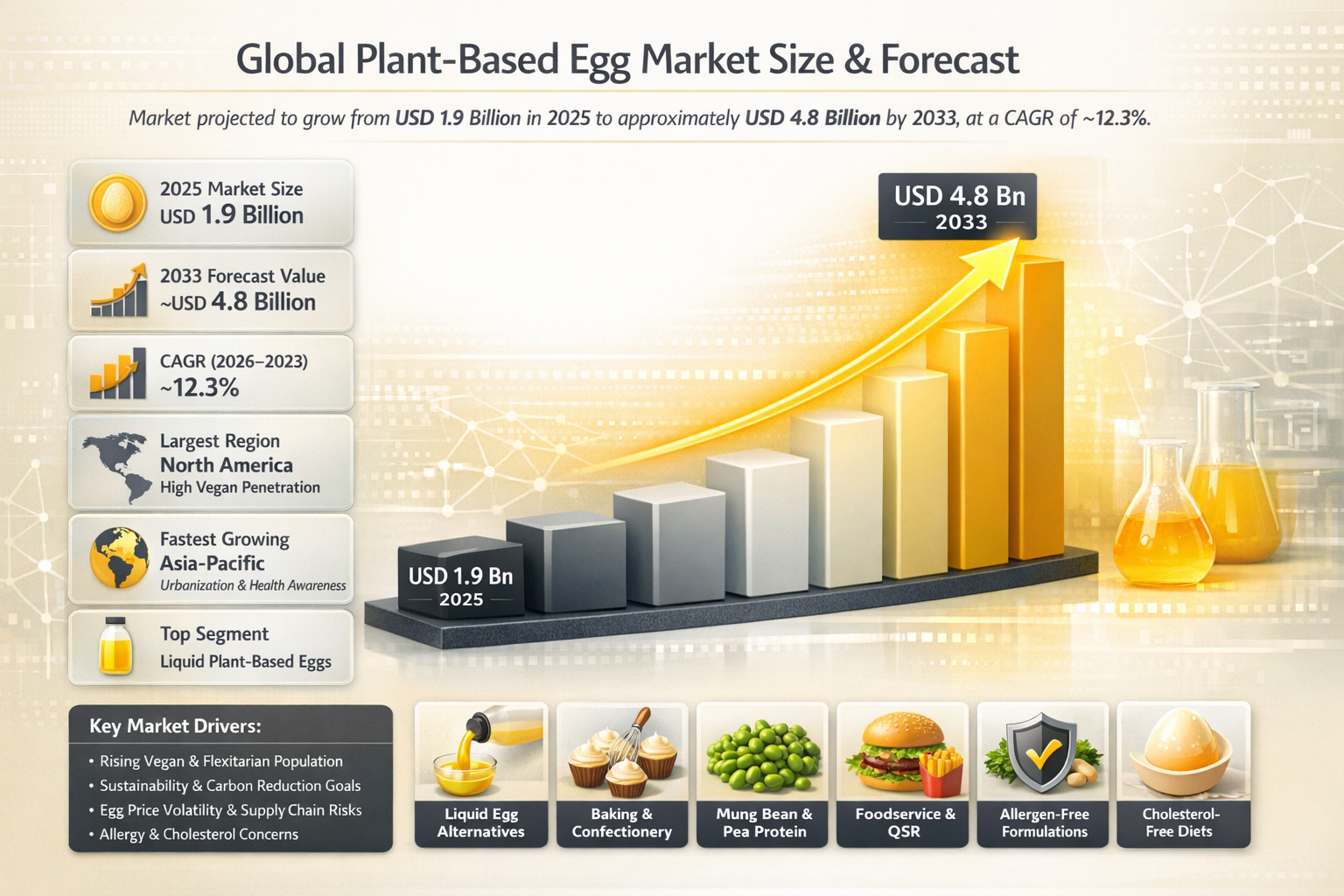
Global Plant-Based Egg Market Forecast Snapshot: 2026–2033
| Metric | Value |
| 2025 Market Size | USD 1.9 Billion |
| 2033 Market Size | ~USD 4.8 Billion |
| CAGR (2026–2033) | ~12.3% |
| Largest Region | North America |
| Fastest Growing Region | Asia-Pacific |
| Top Segment | Liquid Plant-Based Eggs |
| Key Trend | Clean-Label & Allergen-Free Egg Alternatives |
| Future Focus | Foodservice Integration & Functional Formulations |
Global Plant-Based Egg Market Overview
The Global Plant-Based Egg Market is booming. Plant-based eggs are the new scramble, driven by vegan trends, egg allergies, and eco-conscious consumers. With poultry supply chains getting unpredictable, food companies and retailers are jumping on plant-based egg alternatives.
According to Pheonix Research, the Global Plant-Based Egg Market is valued at USD 1.9 billion in 2025 and is projected to reach approximately USD 4.8 billion by 2033, expanding at a CAGR of ~12.3% during 2026–2033.
North America leads the market due to high vegan penetration, strong retail distribution, and advanced food innovation ecosystems. Asia-Pacific is the fastest-growing region, driven by urbanization, health awareness, and increasing plant-based product adoption.
Post-2025, the market is expected to transition toward functional, clean-label, protein-enhanced, and allergen-free egg solutions, with strong penetration in bakery, quick-service restaurants, and ready-to-eat meal applications.
Key Drivers of Global Plant-Based Egg Market Growth
1. Rising Vegan & Flexitarian Population
Growing ethical, environmental, and health-driven dietary shifts are increasing demand for egg alternatives.
2. Sustainability & Carbon Reduction Goals
Plant-based eggs offer significantly lower greenhouse gas emissions and water usage compared to poultry farming.
3. Egg Price Volatility & Supply Chain Risks
Avian influenza outbreaks and feed cost inflation are strengthening the appeal of stable plant-based alternatives.
4. Food Allergy & Cholesterol Concerns
Egg allergies and cholesterol-related health issues are driving adoption of allergen-free and cholesterol-free egg substitutes.
5. Innovation in Texture & Functional Performance
Advancements in emulsification, foaming, and binding technologies are improving product performance in baking and cooking.
Global Plant-Based Egg Market Segmentation
1. By Product Type
1.1 Liquid Plant-Based Eggs
1.1.1 Refrigerated Liquid Eggs
1.1.1.1 Soy-Based Liquid Eggs
1.1.1.2 Mung Bean-Based Liquid Eggs
1.1.1.3 Pea Protein-Based Liquid Eggs
1.1.1.4 Chickpea-Based Liquid Eggs
1.1.2 Shelf-Stable Liquid Eggs
1.1.2.1 UHT-Treated Variants
1.1.2.2 Long-Life Aseptic Packaging
1.2 Powdered Plant-Based Eggs
1.2.1 Baking-Specific Egg Replacers
1.2.1.1 Binding Agents
1.2.1.2 Leavening Agents
1.2.2 Cooking & Scramble Powders
1.2.2.1 High-Protein Formulations
1.2.2.2 Clean-Label Blends
1.2.3 Industrial Bulk Powder
1.2.3.1 B2B Bakery Applications
1.2.3.2 Ready Meal Manufacturing
1.3 Frozen Plant-Based Eggs
1.3.1 Frozen Scramble Portions
1.3.2 Pre-Formed Omelets
1.3.3 Breakfast Patties
1.4 Ready-to-Cook / Ready-to-Eat Products
1.4.1 Scramble Kits
1.4.2 Breakfast Wrap Fillings
1.4.3 Eggless Omelet Mixes
2. By Source
2.1 Soy-Based
2.1.1 Isolated Soy Protein
2.1.1.1 High-Protein Soy Isolate
2.1.1.2 Non-GMO Soy Isolate
2.1.1.3 Organic Certified Soy Protein
2.1.1.4 Functional Emulsifying Soy Protein
2.1.2 Fermented Soy Blends
2.1.2.1 Fermented Soy Protein Concentrates
2.1.2.2 Enzyme-Treated Soy Blends
2.1.2.3 Clean-Label Fermented Formulations
2.1.2.4 Flavor-Optimized Soy Systems
2.2 Mung Bean-Based
2.2.1 Protein Isolates
2.2.1.1 High-Purity Mung Bean Protein
2.2.1.2 Functional Binding Isolates
2.2.1.3 Heat-Stable Mung Bean Protein
2.2.1.4 Industrial Grade Protein Systems
2.2.2 Functional Mung Bean Extracts
2.2.2.1 Emulsification-Optimized Extracts
2.2.2.2 Foaming & Aeration Extracts
2.2.2.3 Scramble-Texture Extract Blends
2.2.2.4 Ready-to-Cook Functional Systems
2.3 Pea Protein-Based
2.3.1 Yellow Pea Protein
2.3.1.1 Pea Protein Concentrate
2.3.1.2 Texturized Pea Protein
2.3.1.3 Non-GMO Pea Protein
2.3.1.4 Clean-Label Pea Systems
2.3.2 Pea Protein Isolate Blends
2.3.2.1 Pea-Soy Blends
2.3.2.2 Pea-Mung Functional Blends
2.3.2.3 High-Protein Performance Blends
2.3.2.4 Bakery-Specific Blends
2.4 Chickpea-Based
2.4.1 Chickpea Flour
2.4.1.1 Fine-Milled Chickpea Flour
2.4.1.2 Organic Chickpea Flour
2.4.1.3 High-Protein Chickpea Base
2.4.1.4 Bakery-Optimized Chickpea Systems
2.4.2 Aquafaba-Based Formulations
2.4.2.1 Liquid Aquafaba Foaming Agents
2.4.2.2 Powdered Aquafaba
2.4.2.3 Confectionery Aeration Systems
2.4.2.4 Vegan Meringue Solutions
2.5 Others
2.5.1 Lentil Protein
2.5.1.1 Red Lentil Isolate
2.5.1.2 Functional Lentil Protein Blends
2.5.1.3 High-Fiber Lentil Systems
2.5.2 Algae-Based Protein
3. By Application
3.1 Bakery & Confectionery
3.1.1 Cakes & Muffins
3.1.1.1 Commercial Bakery Production
3.1.1.2 Home Baking Mixes
3.1.1.3 Gluten-Free Cake Systems
3.1.2 Cookies & Biscuits
3.1.2.1 Vegan Cookie Production
3.1.2.2 High-Protein Biscuits
3.1.2.3 Functional Snack Cookies
3.1.3 Pastries & Breads
3.1.3.1 Egg-Free Bread Formulations
3.1.3.2 Croissants & Laminated Dough
3.1.3.3 Artisan Vegan Pastries
3.1.4 Confectionery Applications
3.1.4.1 Meringues & Aerated Desserts
3.1.4.2 Egg-Free Custards & Fillings
3.1.4.3 Chocolate & Cream-Based Products
3.2 Breakfast & Household Cooking
3.2.1 Scrambled Eggs
.3.2.1.1 Liquid Scramble Alternatives
3.2.1.2 Frozen Scramble Portions
3.2.1.3 High-Protein Scramble Mixes
3.2.2 Omelets
3.2.2.1 Ready-to-Cook Omelet Base
3.2.2.2 Foodservice Bulk Omelet Mix
3.2.2.3 Folded Breakfast Patties
3.2.3 Pancakes & Waffles
3.2.3.1 Egg-Free Pancake Mix
3.2.3.2 High-Protein Waffle Systems
3.2.3.3 Instant Breakfast Mixes
3.2.4 Household Cooking & Recipes
3.2.4.1 Egg-Free Sauces & Dressings
3.2.4.2 Vegan Mayonnaise & Emulsions
3.2.4.3 Home-Based Protein Fortification
3.3 Processed & Packaged Foods
3.3.1 Ready-to-Eat Meals
3.3.1.1 Breakfast Bowls
3.3.1.2 Vegan Sandwich Fillings
3.3.1.3 Meal Kits
3.3.2 Frozen Breakfast Products
3.3.2.1 Frozen Burritos
3.3.2.2 Breakfast Sandwiches
3.3.2.3 Omelet Cups
3.3.3 Instant Mixes
3.3.3.1 Eggless Baking Mixes
3.3.3.2 Ready Batter Systems
3.3.3.3 Industrial Pre-Mixes
3.3.4 Protein-Enriched & Functional Foods
3.3.4.1 High-Protein Snacks
3.3.4.2 Low-Cholesterol Formulations
3.3.4.3 Clean-Label Reformulated Products
3.4 Foodservice & QSR
3.4.1 Quick-Service Restaurants (QSR)
3.4.1.1 Breakfast Menu Integration
3.4.1.2 Vegan Sandwich Applications
3.4.1.3 Limited-Time Promotional Items
3.4.2 Cafés & Bakeries
3.4.2.1 Egg-Free Pastry Production
3.4.2.2 Specialty Vegan Menu Items
3.4.2.3 Seasonal Innovation Launches
3.4.3 Institutional Catering
3.4.3.1 School Cafeterias
3.4.3.2 Corporate Meal Services
3.4.3.3 Healthcare Institutions
4. By Distribution Channel
4.1 Retail
4.1.1 Supermarkets & Hypermarkets
4.1.1.1 National Retail Chains
4.1.1.2 Private Label Products
4.1.1.3 Refrigerated Sections
4.1.2 Health & Organic Stores
4.1.2.1 Natural Food Chains
4.1.2.2 Specialty Health Retailers
4.1.3 Specialty Vegan Stores
4.1.3.1 Plant-Based Focused Retail
4.1.3.2 Independent Vegan Boutiques
4.2 Online
4.2.1 E-commerce Platforms
4.2.1.1 Marketplace Platforms
4.2.1.2 Grocery Delivery Apps
4.2.2 Brand-Owned Websites
4.2.2.1 Direct-to-Consumer Sales
4.2.2.2 Membership Programs
4.2.3 Subscription Models
4.2.3.1 Monthly Breakfast Kits
4.2.3.2 Bulk Replenishment Plans
4.3 Foodservice & Horeca
4.3.1 Restaurant Supply Chains
4.3.1.1 National Distributors
4.3.1.2 Regional Wholesalers
4.3.2 Institutional Suppliers
4.3.2.1 School & University Contracts
4.3.2.2 Hospital Supply Agreements
5. By End-User
5.1 Individual Consumers
5.1.1 Vegans
5.1.1.1 Ethical Vegans
5.1.1.2 Environmental Vegans
5.1.2 Flexitarians
5.1.2.1 Occasional Plant-Based Consumers
5.1.2.2 Health-Driven Flexitarians
5.1.3 Health-Conscious Consumers
5.1.3.1 Cholesterol-Aware Consumers
5.1.3.2 Fitness-Oriented Consumers
5.1.4 Egg-Allergic Consumers
5.1.4.1 Pediatric Allergy Segment
5.1.4.2 Adult Allergy Segment
5.2 Food Manufacturers
5.2.1 Bakery Manufacturers
5.2.1.1 Large Industrial Bakeries
5.2.1.2 Artisan Bakeries
5.2.2 Ready Meal Producers
5.2.2.1 Frozen Meal Companies
5.2.2.2 Refrigerated Meal Brands
5.2.3 Snack Manufacturers
5.2.3.1 Protein Snack Producers
5.2.3.2 Functional Food Brands
5.3 Foodservice Operators
5.3.1 QSR Chains
5.3.1.1 Global Chains
5.3.1.2 Regional Chains
5.3.2 Hotels
5.3.2.1 Premium Hotels
5.3.2.2 Budget Hotels
5.3.3 Institutional Kitchens
5.3.3.1 Educational Institutions
5.3.3.2 Corporate Campuses
5.3.3.3 Healthcare Facilities
6. By Region
6.1 North America
6.2 Europe
6.3 Asia-Pacific
6.4 Latin America
6.5 Middle East & Africa
Regional Insights of Global Plant-Based Egg Market
North America – Largest Market
North America holds the dominant share of the Global Plant-Based Egg Market, supported by high consumer awareness, strong vegan and flexitarian adoption, and well-established retail distribution networks. The presence of leading alternative protein companies, advanced food innovation ecosystems, and expanding foodservice partnerships further reinforce regional leadership.
Asia-Pacific – Fastest Growing Region
Asia-Pacific represents the fastest-growing market, driven by rapid urbanization, rising disposable incomes, and increasing awareness of alternative protein solutions. Growing health consciousness, expansion of modern retail formats, and evolving dietary preferences are accelerating plant-based egg adoption across key economies.
Europe – High-Growth Sustainability-Driven Market
Europe continues to demonstrate strong growth momentum, supported by progressive sustainability regulations, carbon reduction targets, and an expanding vegan and plant-forward consumer base. Retail expansion, private-label innovation, and increasing foodservice integration are strengthening regional market penetration.
Leading Companies
-
Bob’s Red Mill
-
Orgran
-
Zero Egg
-
Nestlé (Plant-Based Division)
-
Simply Eggless
Eat Just, Inc. Market leader in liquid mung bean-based egg alternatives, widely recognized for its flagship JUST Egg product. The company maintains strong retail and foodservice penetration across North America and is expanding internationally through strategic partnerships and continuous product innovation.
Strategic Intelligence and AI-Backed Insights of Global Plant-Based Egg Market
The Pheonix Demand Forecast Engine signals accelerating global adoption of plant-based egg alternatives, driven by rising consumer preference for protein-rich, cholesterol-free, and environmentally sustainable food solutions. Strong growth momentum is projected across bakery applications, breakfast formats, ready-to-eat meals, and foodservice integration.
The Consumer Behavior Analyzer identifies vegans, flexitarians, health-conscious consumers, and allergy-sensitive populations as the primary demand accelerators, reflecting a broader dietary transition toward clean-label, plant-forward, and functional nutrition choices.
The Innovation Tracker highlights increasing investment in texture optimization technologies, emulsification advancements, protein isolation techniques, and scalable manufacturing infrastructure. Continuous R&D in taste parity and functional performance is strengthening product competitiveness against conventional eggs.
Porter’s Five Forces Analysis indicates moderate supplier bargaining power and rising competitive intensity, alongside relatively high entry barriers related to R&D, branding, and distribution scale. However, substantial long-term growth opportunities remain for companies that differentiate through sustainability positioning, functional superiority, and strategic foodservice partnerships in the evolving Post-2025 landscape
Final Takeaway of Global Plant-Based Egg Market
The Global Plant-Based Egg Market is evolving into a high-growth, innovation-led segment within the alternative protein industry. With a projected CAGR of ~12.3% during 2026–2033, the market reflects accelerating consumer shift toward sustainable, allergen-free, and cholesterol-free food solutions.
Companies that combine functional performance innovation, scalable production, clean-label positioning, and strong foodservice partnerships will secure long-term competitive advantage. Strategic expansion into emerging markets and QSR collaborations will further strengthen growth trajectories in the Post-2025 landscape.
At Pheonix Research, our advanced forecasting models deliver comprehensive plant-based egg revenue analysis, competitive benchmarking, and strategic intelligence insights — enabling stakeholders to capitalize on emerging alternative protein opportunities with data-driven confidence.
📢 Social Mentions & Publication Channels
Explore deeper insights and follow our cross-platform updates on LinkedIn and X for continuous intelligence and market coverage.
LinkedIn : https://www.linkedin.com/feed/update/urn:li:activity:7432758555151130625
X : https://x.com/Pheonix_Insight/status/2026996745327292861?s=20
Table of Contents
1. Market Forecast Snapshot (2026–2033)
1.1 2025 Market Size – USD 1.9 Billion
1.2 2033 Market Size – ~USD 4.8 Billion
1.3 CAGR (2026–2033) – ~12.3%
1.4 Largest Market – North America
1.5 Fastest Growing Region – Asia-Pacific
1.6 Dominant Product Segment – Liquid Plant-Based Eggs
1.7 Key Trend – Clean-Label & Allergen-Free Egg Alternatives
1.8 Future Focus – Foodservice Integration & Functional Formulations
2. Global Plant-Based Egg Market Overview
2.1 Market Definition & Scope
2.2 Evolution of Egg Alternatives Industry
2.3 Rise of Vegan & Flexitarian Diets
2.4 Functional Innovation & Texture Optimization
2.5 Regulatory & Labeling Landscape
2.6 Post-2025 Market Outlook
3. Key Drivers of Global Plant-Based Egg Market Growth
3.1 Rising Vegan & Flexitarian Population
3.2 Sustainability & Carbon Reduction Goals
3.3 Egg Price Volatility & Supply Chain Risks
3.4 Food Allergy & Cholesterol Concerns
3.5 Innovation in Texture & Functional Performance
3.6 Retail & Foodservice Expansion
4. Market Segmentation by Product Type
4.1 Liquid Plant-Based Eggs
4.1.1 Refrigerated Liquid Eggs
4.1.1.1 Soy-Based Liquid Eggs
4.1.1.2 Mung Bean-Based Liquid Eggs
4.1.1.3 Pea Protein-Based Liquid Eggs
4.1.1.4 Chickpea-Based Liquid Eggs
4.1.2 Shelf-Stable Liquid Eggs
4.1.2.1 UHT-Treated Variants
4.1.2.2 Long-Life Aseptic Packaging
4.2 Powdered Plant-Based Eggs
4.2.1 Baking-Specific Egg Replacers
4.2.1.1 Binding Agents
4.2.1.2 Leavening Agents
4.2.2 Cooking & Scramble Powders
4.2.2.1 High-Protein Formulations
4.2.2.2 Clean-Label Blends
4.2.3 Industrial Bulk Powder
4.2.3.1 B2B Bakery Applications
4.2.3.2 Ready Meal Manufacturing
4.3 Frozen Plant-Based Eggs
4.3.1 Frozen Scramble Portions
4.3.2 Pre-Formed Omelets
4.3.3 Breakfast Patties
4.4 Ready-to-Cook / Ready-to-Eat Products
4.4.1 Scramble Kits
4.4.2 Breakfast Wrap Fillings
4.4.3 Eggless Omelet Mixes
5. Market Segmentation by Source
5.1 Soy-Based
5.1.1 Isolated Soy Protein
5.1.1.1 High-Protein Soy Isolate
5.1.1.2 Non-GMO Soy Isolate
5.1.1.3 Organic Certified Soy Protein
5.1.1.4 Functional Emulsifying Soy Protein
5.1.2 Fermented Soy Blends
5.1.2.1 Fermented Soy Protein Concentrates
5.1.2.2 Enzyme-Treated Soy Blends
5.1.2.3 Clean-Label Fermented Formulations
5.1.2.4 Flavor-Optimized Soy Systems
5.2 Mung Bean-Based
5.2.1 Protein Isolates
5.2.1.1 High-Purity Mung Bean Protein
5.2.1.2 Functional Binding Isolates
5.2.1.3 Heat-Stable Mung Bean Protein
5.2.1.4 Industrial Grade Protein Systems
5.2.2 Functional Mung Bean Extracts
5.2.2.1 Emulsification-Optimized Extracts
5.2.2.2 Foaming & Aeration Extracts
5.2.2.3 Scramble-Texture Extract Blends
5.2.2.4 Ready-to-Cook Functional Systems
5.3 Pea Protein-Based
5.3.1 Yellow Pea Protein
5.3.1.1 Pea Protein Concentrate
5.3.1.2 Texturized Pea Protein
5.3.1.3 Non-GMO Pea Protein
5.3.1.4 Clean-Label Pea Systems
5.3.2 Pea Protein Isolate Blends
5.3.2.1 Pea-Soy Blends
5.3.2.2 Pea-Mung Functional Blends
5.3.2.3 High-Protein Performance Blends
5.3.2.4 Bakery-Specific Blends
5.4 Chickpea-Based
5.4.1 Chickpea Flour
5.4.1.1 Fine-Milled Chickpea Flour
5.4.1.2 Organic Chickpea Flour
5.4.1.3 High-Protein Chickpea Base
5.4.1.4 Bakery-Optimized Chickpea Systems
5.4.2 Aquafaba-Based Formulations
5.4.2.1 Liquid Aquafaba Foaming Agents
5.4.2.2 Powdered Aquafaba
5.4.2.3 Confectionery Aeration Systems
5.4.2.4 Vegan Meringue Solutions
5.5 Others
5.5.1 Lentil Protein
5.5.1.1 Red Lentil Isolate
5.5.1.2 Functional Lentil Protein Blends
5.5.1.3 High-Fiber Lentil Systems
5.5.2 Algae-Based Protein
5.5.2.1 Microalgae Protein Extracts
5.5.2.2 Spirulina-Based Functional Blends
5.5.2.3 Omega-Enriched Algae Systems
5.5.3 Potato & Starch-Based Blends
5.5.3.1 Modified Potato Starch Systems
5.5.3.2 Clean-Label Binding Starches
5.5.3.3 Hybrid Plant Protein-Starch Blends
6. Market Segmentation by Application
6.1 Bakery & Confectionery
6.1.1 Cakes & Muffins
6.1.1.1 Commercial Bakery Production
6.1.1.2 Home Baking Mixes
6.1.1.3 Gluten-Free Cake Systems
6.1.2 Cookies & Biscuits
6.1.2.1 Vegan Cookie Production
6.1.2.2 High-Protein Biscuits
6.1.2.3 Functional Snack Cookies
6.1.3 Pastries & Breads
6.1.3.1 Egg-Free Bread Formulations
6.1.3.2 Croissants & Laminated Dough
6.1.3.3 Artisan Vegan Pastries
6.1.4 Confectionery Applications
6.1.4.1 Meringues & Aerated Desserts
6.1.4.2 Egg-Free Custards & Fillings
6.1.4.3 Chocolate & Cream-Based Products
6.2 Breakfast & Household Cooking
6.2.1 Scrambled Eggs
6.2.1.1 Liquid Scramble Alternatives
6.2.1.2 Frozen Scramble Portions
6.2.1.3 High-Protein Scramble Mixes
6.2.2 Omelets
6.2.2.1 Ready-to-Cook Omelet Base
6.2.2.2 Foodservice Bulk Omelet Mix
6.2.2.3 Folded Breakfast Patties
6.2.3 Pancakes & Waffles
6.2.3.1 Egg-Free Pancake Mix
6.2.3.2 High-Protein Waffle Systems
6.2.3.3 Instant Breakfast Mixes
6.2.4 Household Cooking & Recipes
6.2.4.1 Egg-Free Sauces & Dressings
6.2.4.2 Vegan Mayonnaise & Emulsions
6.2.4.3 Home-Based Protein Fortification
6.3 Processed & Packaged Foods
6.3.1 Ready-to-Eat Meals
6.3.1.1 Breakfast Bowls
6.3.1.2 Vegan Sandwich Fillings
6.3.1.3 Meal Kits
6.3.2 Frozen Breakfast Products
6.3.2.1 Frozen Burritos
6.3.2.2 Breakfast Sandwiches
6.3.2.3 Omelet Cups
6.3.3 Instant Mixes
6.3.3.1 Eggless Baking Mixes
6.3.3.2 Ready Batter Systems
6.3.3.3 Industrial Pre-Mixes
6.3.4 Protein-Enriched & Functional Foods
6.3.4.1 High-Protein Snacks
6.3.4.2 Low-Cholesterol Formulations
6.3.4.3 Clean-Label Reformulated Products
6.4 Foodservice & QSR
6.4.1 Quick-Service Restaurants (QSR)
6.4.1.1 Breakfast Menu Integration
6.4.1.2 Vegan Sandwich Applications
6.4.1.3 Limited-Time Promotional Items
6.4.2 Cafés & Bakeries
6.4.2.1 Egg-Free Pastry Production
6.4.2.2 Specialty Vegan Menu Items
6.4.2.3 Seasonal Innovation Launches
6.4.3 Institutional Catering
6.4.3.1 School Cafeterias
6.4.3.2 Corporate Meal Services
6.4.3.3 Healthcare Institutions
7. Market Segmentation by Distribution Channel
7.1 Retail
7.1.1 Supermarkets & Hypermarkets
7.1.1.1 National Retail Chains
7.1.1.2 Private Label Products
7.1.1.3 Refrigerated Sections
7.1.2 Health & Organic Stores
7.1.2.1 Natural Food Chains
7.1.2.2 Specialty Health Retailers
7.1.2.3 Clean-Label Focused Shelves
7.1.3 Specialty Vegan Stores
7.1.3.1 Plant-Based Focused Retail
7.1.3.2 Independent Vegan Boutiques
7.1.3.3 Premium & Functional Brands
7.2 Online
7.2.1 E-Commerce Platforms
7.2.1.1 Marketplace Platforms
7.2.1.2 Grocery Delivery Apps
7.2.1.3 Cross-Border E-Commerce
7.2.2 Brand-Owned Websites
7.2.2.1 Direct-to-Consumer Sales
7.2.2.2 Membership Programs
7.2.2.3 Exclusive Online SKUs
7.2.3 Subscription Models
7.2.3.1 Monthly Breakfast Kits
7.2.3.2 Bulk Replenishment Plans
7.2.3.3 Customized Nutrition Bundles
7.3 Foodservice & Horeca
7.3.1 Restaurant Supply Chains
7.3.1.1 National Distributors
7.3.1.2 Regional Wholesalers
7.3.1.3 Cold Chain Logistics
7.3.2 Institutional Suppliers
7.3.2.1 School & University Contracts
7.3.2.2 Hospital Supply Agreements
7.3.2.3 Corporate Procurement Systems
8. Market Segmentation by End-User
8.1 Individual Consumers
8.1.1 Vegans
8.1.1.1 Ethical Vegans
8.1.1.2 Environmental Vegans
8.1.2 Flexitarians
8.1.2.1 Occasional Plant-Based Consumers
8.1.2.2 Health-Driven Flexitarians
8.1.3 Health-Conscious Consumers
8.1.3.1 Cholesterol-Aware Consumers
8.1.3.2 Fitness-Oriented Consumers
8.1.3.3 High-Protein Diet Followers
8.1.4 Egg-Allergic Consumers
8.1.4.1 Pediatric Allergy Segment
8.1.4.2 Adult Allergy Segment
8.2 Food Manufacturers
8.2.1 Bakery Manufacturers
8.2.1.1 Large Industrial Bakeries
8.2.1.2 Artisan Bakeries
8.2.1.3 Gluten-Free Producers
8.2.2 Ready Meal Producers
8.2.2.1 Frozen Meal Companies
8.2.2.2 Refrigerated Meal Brands
8.2.2.3 Meal Kit Companies
8.2.3 Snack Manufacturers
8.2.3.1 Protein Snack Producers
8.2.3.2 Functional Food Brands
8.2.3.3 Clean-Label Reformulators
8.3 Foodservice Operators
8.3.1 QSR Chains
8.3.1.1 Global Chains
8.3.1.2 Regional Chains
8.3.1.3 Plant-Based Focused QSR
8.3.2 Hotels
8.3.2.1 Premium Hotels
8.3.2.2 Budget Hotels
8.3.2.3 Resort Chains
8.3.3 Institutional Kitchens
8.3.3.1 Educational Institutions
8.3.3.2 Corporate Campuses
8.3.3.3 Healthcare Facilities
9. Market Segmentation by Region
9.1 North America
9.2 Europe
9.3 Asia-Pacific
9.4 Latin America
9.5 Middle East & Africa
10. Regional Insights
10.1 North America – Market Leader
10.2 Asia-Pacific – Fastest Growing Region
10.3 Europe – Sustainability-Driven Expansion
10.4 Latin America – Emerging Alternative Protein Hub
10.5 Middle East & Africa – Institutional Adoption Growth
11. Competitive Landscape
11.1 Market Share Analysis
11.2 Competitive Positioning Matrix
11.3 Mergers & Acquisitions
11.4 Product Innovation & Functional Differentiation
11.5 Pricing & Clean-Label Strategies
12. Leading Companies
12.1 Eat Just, Inc. (Market Leader)
12.2 Follow Your Heart
12.3 Bob’s Red Mill
12.4 Orgran
12.5 Zero Egg
12.6 Nestlé (Plant-Based Division)
12.7 Simply Eggless
13. Strategic Intelligence & AI-Backed Insights
13.1 Pheonix Demand Forecast Modeling
13.2 Consumer Behavior Analytics
13.3 Innovation & Texture Optimization Tracker
13.4 Porter’s Five Forces Analysis
14. Sustainability & Regulatory Landscape
14.1 Environmental Impact & Carbon Reduction
14.2 Clean-Label & Allergen-Free Regulations
14.3 Food Labeling & Plant-Based Standards
14.4 Responsible Sourcing & Supply Chain Transparency
15. Market Significance
15.1 Food Security & Supply Stability
15.2 Contribution to Alternative Protein Ecosystem
15.3 Public Health & Nutrition Impact
15.4 Industrial Reformulation & Innovation
15.5 Long-Term Consumer Loyalty & Recurring Demand
16. Final Takeaway
16.1 Growth Outlook (2026–2033)
16.2 High-Growth Innovation Model
16.3 Functional Performance vs. Price Strategy
16.4 Foodservice & QSR Expansion Strategy
16.5 Strategic Recommendations
17. Appendix
18. About Us
19. Disclaimer
Competitive Landscape
Competitive Landscape of the Global Plant-Based Egg Market
Executive Framing
The Global Plant-Based Egg Market is moderately consolidated, led by key innovators such as Eat Just, Follow Your Heart, Nestlé, and Zero Egg. These companies dominate through strong product innovation, proprietary formulations, and early mover advantage, while a growing base of startups and private-label brands intensifies competition.
Current Market Reality
The market is highly innovation-driven, with liquid plant-based eggs—particularly mung bean-based formulations—leading adoption across retail and foodservice channels. Companies are focusing on replicating egg functionality such as binding, emulsification, and foaming, especially for bakery and QSR applications.
While North America leads in brand presence and commercialization, Asia-Pacific is witnessing rapid entry of regional players. Competitive dynamics are shaped by product performance, clean-label positioning, allergen-free claims, and scalability of production.
Key Signals and Evidence
- Strong dominance of Eat Just in the liquid egg segment with global retail and foodservice expansion.
- Increasing R&D investments in texture, taste, and functional performance optimization.
- Growing penetration of plant-based eggs in QSR breakfast menus and bakery reformulation.
- Rising competition from private-label and regional clean-label brands.
- Expansion of distribution through e-commerce, retail chains, and institutional supply networks.
Strategic Implications
- Functional Superiority: Focus on improving emulsification, binding, and foaming capabilities for industrial applications.
- Foodservice Partnerships: Expand collaborations with QSRs, bakeries, and institutional catering providers.
- Scale & Cost Efficiency: Invest in large-scale production to reduce pricing gaps with conventional eggs.
- Clean-Label Positioning: Emphasize allergen-free, non-GMO, and cholesterol-free formulations.
- Geographic Expansion: Target high-growth regions such as Asia-Pacific with localized product strategies.
Forward Outlook
The Global Plant-Based Egg Market is projected to grow from USD 1.9 billion in 2025 to approximately USD 4.8 billion by 2033, at a CAGR of ~12.3%. North America will continue to dominate, while Asia-Pacific emerges as a key growth engine driven by urbanization and evolving dietary preferences.
Future competition will be defined by technological innovation, functional product performance, brand positioning, and integration into mainstream foodservice and packaged food ecosystems, positioning plant-based eggs as a core segment within the alternative protein landscape.
Value Chain
Global Plant-Based Egg Market: Value Chain & Market Dynamics
Executive Framing
The Global Plant-Based Egg Market is emerging as a sustainability-driven, innovation-led, and consumer-focused segment, fueled by vegan trends, allergy concerns, and climate-conscious diets. The market is transitioning from niche egg alternatives to mainstream protein solutions, with strong adoption in bakery, breakfast, and ready-to-eat meal applications.
A hybrid operational model combines large-scale production by established players with direct-to-consumer engagement and foodservice partnerships, while startups focus on functional and clean-label product innovation.
Current Market Reality
The plant-based egg market exhibits moderate-to-high supply chain complexity due to multi-ingredient sourcing, protein isolation technologies, and cold-chain distribution requirements. Companies leverage refrigerated logistics, e-commerce platforms, and omnichannel retail networks to ensure accessibility and product quality.
Distribution spans retail, online, and foodservice channels, supporting both mass-market reach and premium product positioning.
Key Signals and Evidence
- Market growth from USD 1.9 billion (2025) to ~USD 4.8 billion (2033) at a CAGR of ~12.3%.
- Rising adoption among vegans, flexitarians, and health-conscious consumers.
- Increased penetration in bakery, breakfast, and ready-to-eat meal applications.
- Innovation in liquid, powdered, and functional plant-based egg formulations.
- Expansion of foodservice integration, retail, and e-commerce channels.
Strategic Implications
Market leaders are focusing on functional formulation innovation, supply chain scaling, and international expansion. Investments in texture optimization, emulsification technologies, and scalable manufacturing infrastructure are enhancing product performance and consumer acceptance.
Emerging players differentiate through clean-label claims, allergen-free solutions, and QSR partnerships, targeting niche consumer segments and establishing strong brand loyalty.
Forward Outlook
The market is expected to evolve into a core pillar of the global alternative protein ecosystem, driven by sustainability mandates, health trends, and technological innovation.
- Expansion of functional, protein-enriched, and allergen-free plant-based egg products.
- Growth in foodservice, QSR, and ready-to-eat applications.
- Adoption of AI-enabled supply chain optimization and production efficiency technologies.
- Increased focus on sustainable sourcing, clean-label formulations, and product personalization.
Companies integrating innovation, operational scalability, and omnichannel distribution are best positioned to capture long-term market share and value in the Post-2025 landscape.
Investment Activity
Investment & Funding Dynamics – Global Plant-Based Egg Market
Executive Framing
Current Market Reality
Valued at USD 1.9 billion in 2025 and projected to reach ~USD 4.8 billion by 2033 (CAGR ~12.3%), the market is led by North America, while Asia-Pacific is emerging as the fastest-growing region. Key players such as Eat Just, Zero Egg, and Nestlé are investing in liquid egg alternatives, mung bean-based formulations, and foodservice expansion to strengthen their global footprint.
Key Signals and Evidence
- R&D and Functional Innovation: Investments in emulsification, foaming, and binding technologies to improve product performance.
- Liquid Egg Segment Expansion: Capital allocation toward refrigerated and shelf-stable liquid plant-based egg products.
- Foodservice & QSR Partnerships: Strategic collaborations to integrate plant-based eggs into breakfast menus and ready-to-eat formats.
- Manufacturing Scale-Up: Expansion of production facilities and supply chain capabilities to meet growing demand.
- Clean-Label & Allergen-Free Positioning: Focus on natural ingredients and free-from formulations to attract health-conscious consumers.
- M&A & Venture Funding: Increasing investments in startups and alternative protein companies developing egg substitutes.
- Technology Integration: Adoption of AI-driven formulation, protein extraction, and process optimization technologies.
Strategic Implications
Companies focusing on functional performance, scalable liquid egg production, and strong foodservice integration are best positioned for long-term success. Investors are prioritizing brands with differentiated formulations, strong intellectual property, and the ability to replicate conventional egg functionality across diverse applications.
Forward Outlook
Between 2026 and 2033, investment activity is expected to accelerate, particularly in liquid egg alternatives, functional ingredient innovation, and foodservice expansion. Growth opportunities will be driven by rising consumer awareness, increasing allergy concerns, and broader integration into packaged food and QSR ecosystems.
Technology & Innovation
Global Plant-Based Egg Market: Technology & Innovation
Executive Framing
The Global Plant-Based Egg Market is rapidly evolving as an innovation-driven segment within the alternative protein industry. Driven by vegan trends, egg allergies, sustainability goals, and functional food demand, plant-based eggs are transitioning from niche products to mainstream protein solutions. Advancements in emulsification, foaming, binding, and protein isolation technologies are enabling applications across bakery, breakfast, ready-to-eat meals, and foodservice.
Current Market Reality
Valued at USD 1.9 billion in 2025 and projected to reach ~USD 4.8 billion by 2033, the market is expanding at a CAGR of ~12.3%. North America leads adoption due to strong vegan and flexitarian populations, advanced retail distribution, and innovation ecosystems. Asia-Pacific is the fastest-growing region, driven by urbanization, rising health awareness, and increasing acceptance of plant-based proteins.
Key Signals and Evidence
- Protein Source Innovation: Soy, mung bean, pea, chickpea, lentil, and algae proteins are optimized for functional performance in cooking, baking, and ready-to-eat applications.
- Functional Performance Enhancements: Advanced emulsification, foaming, and binding technologies improve texture, mouthfeel, and versatility across applications.
- Clean-Label & Allergen-Free Formulations: Rising consumer preference for allergen-friendly, cholesterol-free, and protein-enriched solutions drives product development.
- Foodservice & QSR Integration: Plant-based eggs are increasingly adopted in breakfast menus, bakery items, and ready-to-eat meal formats in quick-service and institutional channels.
- Scalable Manufacturing & Supply Chain Optimization: Companies are investing in automated production, R&D, and distribution networks to meet growing demand and ensure consistent quality.
Strategic Implications
Firms that integrate functional performance, clean-label positioning, and scalable manufacturing will gain competitive advantage. Strategic partnerships with QSRs, bakeries, and retail chains enhance market penetration. Investment in texture optimization, protein isolation technologies, and flavor parity R&D is critical to maintain product differentiation against conventional eggs.
Forward Outlook
The market is expected to continue robust growth through 2033, with innovation focused on functional, protein-enhanced, allergen-free, and clean-label formulations. Expansion into emerging markets, deeper integration into foodservice, and technological advances in texture, emulsification, and protein performance will strengthen plant-based eggs as a mainstream, sustainable protein source.
Market Risk
Risk Factors and Disruption Threats in the Global Plant-Based Egg Market
Executive Framing
The Global Plant-Based Egg Market is booming, driven by vegan trends, egg allergies, and eco-conscious consumers. Supply chain unpredictability in poultry is increasing adoption of plant-based egg alternatives. The market is valued at USD 1.9 billion in 2025 and is projected to reach ~USD 4.8 billion by 2033, expanding at a CAGR of ~12.3%.
Current Market Reality
North America leads due to high vegan penetration, strong retail distribution, and advanced food innovation ecosystems. Asia-Pacific is the fastest-growing region, fueled by urbanization, health awareness, and rising adoption of plant-based products. The market is shifting toward functional, clean-label, protein-enhanced, and allergen-free solutions with strong presence in bakery, QSR, and ready-to-eat meals.
Key Signals and Evidence
- Rising vegan and flexitarian population driving demand.
- Focus on sustainability and carbon reduction goals.
- Volatility in egg prices and supply chain risks enhancing appeal of alternatives.
- Food allergy and cholesterol concerns boosting allergen-free adoption.
- Innovation in texture, emulsification, foaming, and functional performance improving product quality.
Strategic Implications
- Prioritize functional innovation, protein enrichment, and product diversification.
- Invest in cold-chain logistics, sustainable packaging, and digital retail channels.
- Leverage regional growth opportunities in North America and Asia-Pacific.
- Strengthen foodservice partnerships and ready-meal integration.
- Focus on R&D for taste parity and functional performance to compete with conventional eggs.
Forward Outlook
The market is evolving into a high-growth, innovation-led segment of the alternative protein industry. Growth will continue across bakery, breakfast formats, ready-to-eat meals, and QSR applications. Companies combining functional innovation, scalable production, clean-label positioning, and strong foodservice partnerships will secure competitive advantage. Expansion into emerging markets and strategic collaborations will strengthen growth trajectories post-2025.
Regulatory Landscape
Regulatory & Policy Landscape: Global Plant-Based Egg Market
Executive Framing
The Global Plant-Based Egg Market operates under evolving food safety, labeling, and alternative protein regulations. Key authorities include the U.S. Food and Drug Administration (FDA), European Food Safety Authority (EFSA), Food Safety and Standards Authority of India (FSSAI), and other regional bodies. Plant-based egg products—including liquid, powdered, frozen, and ready-to-cook formats—must comply with hygiene, nutritional labeling, allergen disclosure, and packaging requirements.
Emerging innovations such as functional, high-protein, clean-label, and allergen-free formulations are subject to additional regulatory scrutiny. Claims like “vegan,” “cholesterol-free,” “non-GMO,” or “high-protein” require verification and certification to ensure consumer safety and compliance.
Current Market Reality
North America currently leads the market, supported by strong vegan adoption, advanced retail infrastructure, and well-established food innovation ecosystems. Regulatory frameworks are strict regarding labeling, allergen disclosure, and functional claims.
Asia-Pacific is the fastest-growing region, but regulatory landscapes are diverse, requiring companies to adapt labeling, ingredient approval, and food safety practices for each market. Foodservice integration and bakery applications introduce additional compliance considerations for multi-region operations.
Key Signals and Evidence
- Mandatory hygiene and food safety compliance for all plant-based egg products.
- Labeling requirements including ingredient, allergen, and nutritional information.
- Certification requirements for vegan, non-GMO, clean-label, and allergen-free claims.
- Regulations on functional, high-protein, and cholesterol-free product claims.
- Increasing focus on sustainable sourcing, packaging, and carbon reduction strategies.
- Foodservice and bakery integration requiring compliance with multi-region regulations.
Strategic Implications
Compliance with global regulatory frameworks is critical for market entry, product launch, and brand credibility. Companies must invest in quality control, documentation, and certification processes to ensure adherence to local and international standards.
Brands that align product innovation with labeling, allergen, and functional claim regulations will strengthen consumer trust. Adoption of scalable production, sustainable sourcing, and digital traceability supports both regulatory compliance and competitive advantage.
Forward Outlook
Regulatory oversight is expected to increase, particularly for functional formulations, high-protein and allergen-free products, and bakery-ready applications. Harmonization of global labeling and certification standards may reduce entry barriers while enabling cross-border scale.
Digital compliance tools, blockchain-enabled traceability, and AI-driven quality monitoring are anticipated to play an increasing role in ensuring adherence. Companies that proactively align with regulations, innovate responsibly, and maintain transparency will capture long-term growth opportunities.