
Global Plant-Based Food Market size and share Analysis 2026-2033
Global Plant-Based Food Market Forecast Snapshot: 2026???2033
| Metric | Value |
| 2025 Market Size | USD 82.4 Billion |
| 2033 Market Size | USD 162.7 Billion |
| CAGR (2026???2033) | 8.9% |
| Largest Region | North America |
| Fastest Growing Region | Asia-Pacific |
| Top Segment | Plant-Based Dairy Alternatives |
| Key Trend | Clean-Label & High-Protein Innovation |
| Future Focus | Functional Nutrition, Sustainable Sourcing & Retail Expansion |
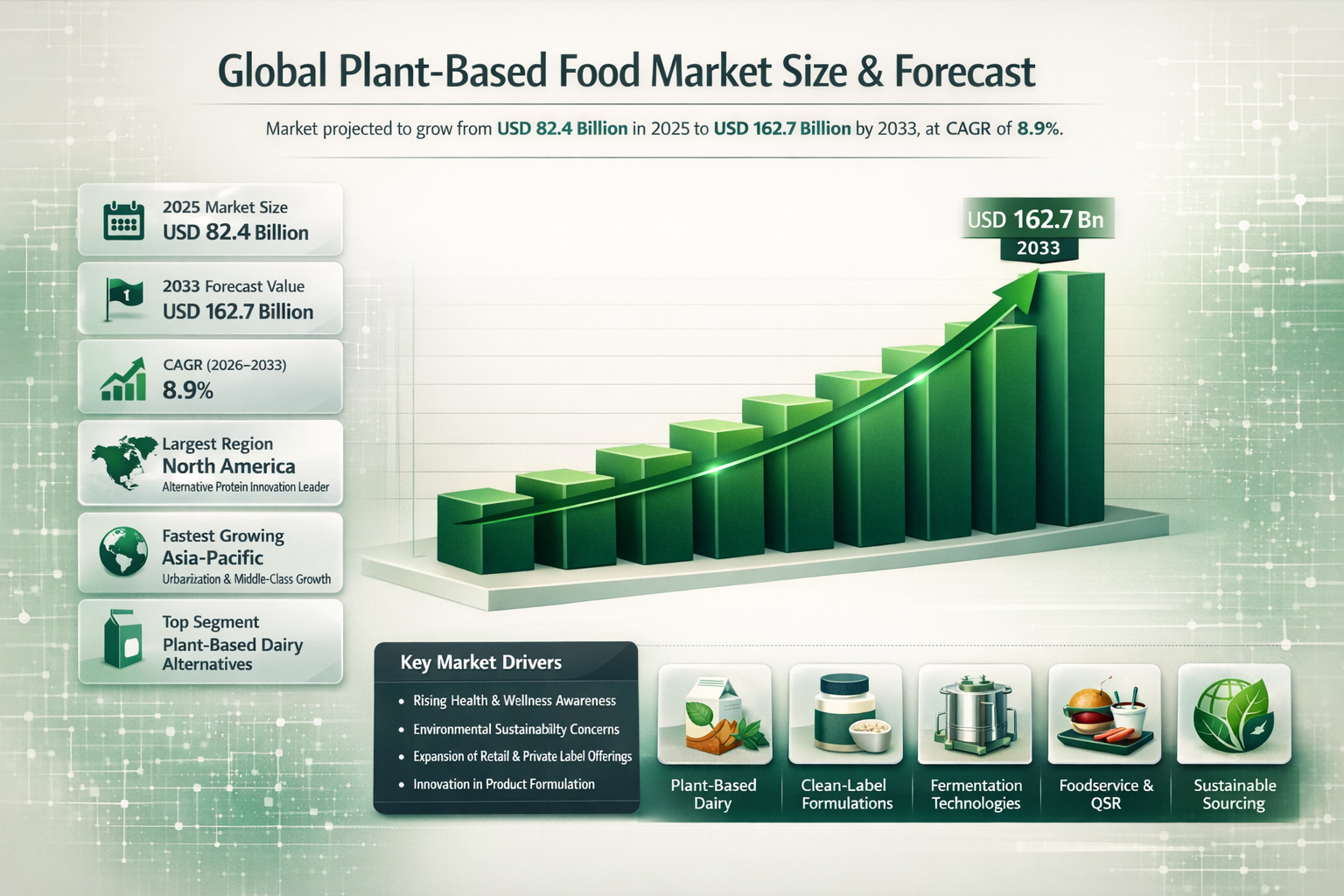
Global Plant-Based Food Market Overview
The Global Plant-Based Food Market is booming. Plant-based foods are on the rise, driven by health-conscious consumers, eco-friendly choices, and changing tastes. From dairy-free milks to meat substitutes, plant-based eggs, and ready-to-eat meals, the options are endless. It's fueled by health perks, being eco-friendly, and food innovation ??? new products popping up everywhere, catering to flexitarian and vegan lifestyles.
According to Pheonix Research, the Global Plant-Based Food Market is valued at USD 82.4 billion in 2025 and is projected to reach USD 162.7 billion by 2033, registering a CAGR of 8.9% during 2026???2033. This revenue forecast reflects increasing consumer adoption, product innovation, and strong retail penetration across both developed and emerging economies.
North America holds the largest share of the Global Plant-Based Food Market, supported by advanced alternative protein innovation, strong brand presence, and widespread retail distribution. Meanwhile, Asia-Pacific is emerging as the fastest-growing region, fueled by urbanization, rising disposable income, and increasing awareness of plant-based nutrition among younger demographics.
The Post-2025 outlook indicates deeper integration of functional ingredients, AI-driven product personalization, sustainable sourcing strategies, and expanded foodservice adoption, positioning plant-based foods as a long-term structural growth category rather than a niche trend.
Key Drivers of Global Plant-Based Food Market Growth
??Rising Health & Wellness Awareness
Consumers are increasingly seeking cholesterol-free, lactose-free, and clean-label food options. Plant-based foods align with preventive healthcare trends, weight management goals, and protein diversification strategies.
??Environmental & Sustainability Concerns
Lower carbon emissions, reduced water consumption, and ethical sourcing advantages are strengthening the sustainability appeal of plant-based food products. Climate-conscious consumption is becoming a mainstream purchasing driver.
??Expansion of Retail & Private Label Offerings
Supermarkets and hypermarkets are expanding plant-based SKUs, while private-label brands are increasing affordability and accessibility across mass-market consumers.
??Innovation in Product Formulation
Advancements in plant protein extraction, texture engineering, fermentation, and flavor enhancement are improving taste parity and functional performance versus conventional animal-based foods.
??Foodservice & QSR Integration
Major restaurant chains and foodservice operators are incorporating plant-based options into core menus, expanding consumer exposure and accelerating mainstream adoption.
Global Plant-Based Food Market segmentation
?? ?? 1. By Product Type
1.1 Plant-Based Dairy Alternatives
1.1.1 Plant-Based Milk
1.1.1.1 Almond Milk
1.1.1.2 Soy Milk
1.1.1.3 Oat Milk
1.1.1.4 Coconut Milk
1.1.1.5 Rice Milk
1.1.1.6 Cashew Milk
1.1.1.7 Blended Plant Milks
1.1.2 Plant-Based Yogurt
1.1.2.1 Almond-Based Yogurt
1.1.2.2 Coconut-Based Yogurt
1.1.2.3 Soy-Based Yogurt
1.1.2.4 Oat-Based Yogurt
1.1.2.5 Probiotic-Fortified Yogurt
1.1.3 Plant-Based Cheese
1.1.3.1 Sliced & Block Cheese
1.1.3.2 Shredded Cheese
1.1.3.3 Cream Cheese Alternatives
1.1.3.4 Mozzarella Alternatives
1.1.3.5 Aged & Artisan Vegan Cheese
1.1.4 Plant-Based Butter & Creamers
1.1.4.1 Spreadable Vegan Butter
1.1.4.2 Baking Margarine Alternatives
1.1.4.3 Coffee Creamers
1.1.4.4 Cooking Cream Alternatives
1.1.4.5 Whipping Cream Substitutes
1.2 Plant-Based Meat Alternatives
1.2.1 Burger Patties
1.2.1.1 Soy-Based Patties
1.2.1.2 Pea-Protein Patties
1.2.1.3 Wheat-Protein (Seitan) Patties
1.2.1.4 Blended Protein Patties
1.2.1.5 Premium Gourmet Patties
1.2.2 Sausages & Hot Dogs
1.2.2.1 Breakfast Sausages
1.2.2.2 Smoked Sausages
1.2.2.3 Spicy & Regional Variants
1.2.2.4 Ready-to-Grill Hot Dogs
1.2.3 Nuggets & Strips
1.2.3.1 Breaded Nuggets
1.2.3.2 Grilled Strips
1.2.3.3 Frozen Ready-to-Cook Formats
1.2.3.4 High-Protein Snack Bites
1.2.4 Minced & Ground Meat Alternatives
1.2.4.1 Plant-Based Ground Beef
1.2.4.2 Plant-Based Minced Chicken
1.2.4.3 Plant-Based Meat Crumbles
1.2.4.4 Ready Meal Integration Formats
1.3 Plant-Based Egg Alternatives
1.3.1 Liquid Egg Substitutes
1.3.1.1 Mung Bean-Based Liquid Eggs
1.3.1.2 Soy-Based Liquid Eggs
1.3.1.3 Pea-Protein Liquid Eggs
1.3.1.4 Foodservice Bulk Formats
1.3.2 Powdered Egg Replacers
1.3.2.1 Baking-Specific Egg Replacers
1.3.2.2 Allergen-Free Egg Powders
1.3.2.3 High-Protein Egg Replacement Blends
1.3.2.4 Industrial Bakery Pre-Mixes
1.3.3 Ready-to-Cook Egg Formats
1.3.3.1 Scramble Mixes
1.3.3.2 Omelet Bases
1.3.3.3 Folded Egg Patties
1.3.3.4 Frozen Breakfast Egg Alternatives
1.4 Plant-Based Ready Meals & Snacks
1.4.1 Frozen Meals
1.4.1.1 Frozen Bowls
1.4.1.2 Frozen Pasta Meals
1.4.1.3 Frozen Asian Cuisine
1.4.1.4 Microwaveable Meals
1.4.2 Protein Snacks
1.4.2.1 Protein Bars
1.4.2.2 Savory Protein Chips
1.4.2.3 Roasted Legume Snacks
1.4.2.4 Functional On-the-Go Packs
1.4.3 Instant & Convenience Foods
1.4.3.1 Instant Noodles with Plant Protein
1.4.3.2 Ready Soup Mixes
1.4.3.3 Meal Kits
1.4.3.4 Ready Sandwich Fillings
1.5 Functional & Fortified Plant Foods
1.5.1 High-Protein Formulations
1.5.1.1 Sports Nutrition-Oriented Products
1.5.1.2 Muscle Recovery Formulations
1.5.1.3 Protein-Enriched Staples
1.5.1.4 Senior Nutrition Products
1.5.2 Vitamin & Mineral Fortified Products
1.5.2.1 Calcium-Fortified Products
1.5.2.2 Vitamin B12-Enriched Foods
1.5.2.3 Iron-Fortified Products
1.5.2.4 Omega-3 Enriched Variants
1.5.3 Clean-Label & Organic Variants
1.5.3.1 Non-GMO Certified
1.5.3.2 Organic Certified
1.5.3.3 Preservative-Free Products
1.5.3.4 Allergen-Free Formulations
?? ?? 2. By Distribution Channel
2.1 Retail
2.1.1 Supermarkets & Hypermarkets
2.1.1.1 National Chains
2.1.1.2 Private Label Products
2.1.1.3 Refrigerated Sections
2.1.2 Convenience Stores
2.1.2.1 Urban Mini Markets
2.1.2.2 Transit Hub Retail
2.1.3 Health & Organic Stores
2.1.3.1 Specialty Health Retailers
2.1.3.2 Vegan Specialty Stores
2.2 Online
2.2.1 E-commerce Platforms
2.2.1.1 Marketplace Platforms
2.2.1.2 Grocery Delivery Apps
2.2.2 Brand-Owned Websites
2.2.2.1 Direct-to-Consumer (DTC)
2.2.2.2 Membership Programs
2.2.3 Subscription-Based Models
2.2.3.1 Monthly Meal Boxes
2.2.3.2 Auto-Replenishment Plans
2.3 Foodservice
2.3.1 Quick-Service Restaurants
2.3.1.1 Global QSR Chains
2.3.1.2 Regional QSR Brands
2.3.2 Full-Service Restaurants
2.3.2.1 Casual Dining
2.3.2.2 Premium Dining
2.3.3 Institutional Catering
2.3.3.1 Schools & Universities
2.3.3.2 Hospitals
2.3.3.3 Corporate Offices
?? ??3. By End-User
3.1 Individual Consumers
3.1.1 Vegans
3.1.1.1 Ethical Vegans
3.1.1.2 Environmental Vegans
3.1.2 Flexitarians
3.1.2.1 Occasional Plant-Based Consumers
3.1.2.2 Health-Driven Flexitarians
3.1.3 Health-Conscious Consumers
3.1.3.1 Weight Management Segment
3.1.3.2 Fitness-Oriented Consumers
3.1.4 Lactose-Intolerant & Allergy-Sensitive Consumers
3.1.4.1 Dairy-Intolerant Consumers
3.1.4.2 Egg-Allergic Consumers
3.2 Food Manufacturers
3.2.1 Bakery Producers
3.2.1.1 Industrial Bakeries
3.2.1.2 Artisan Producers
3.2.2 Ready Meal Manufacturers
3.2.2.1 Frozen Meal Producers
3.2.2.2 Refrigerated Meal Brands
3.2.3 Snack Companies
3.2.3.1 Protein Snack Producers
3.2.3.2 Functional Snack Brands
3.3 Foodservice Operators
3.3.1 QSR Chains
3.3.1.1 International Chains
3.3.1.2 Regional Chains
3.3.2 Hotels & Caf??s
3.3.2.1 Premium Hotels
3.3.2.2 Caf?? Chains
3.3.3 Institutional Kitchens
3.3.3.1 Educational Institutions
3.3.3.2 Healthcare Facilities
3.3.3.3 Corporate Campuses
?? ?? ?? ?? 4.by Region
4.1 North America4.2 Europe
4.3 Asia-Pacific
4.4 South America
4.5 Middle East & Africa
Regional Insights of Global Plant-Based Food Market
North America ??? Largest Market
North America accounts for the largest share of the Global Plant-Based Food Market, supported by high consumer awareness, strong purchasing power, and well-developed retail ecosystems. The United States remains the dominant revenue generator, driven by advanced alternative protein innovation, strong brand penetration, and widespread availability across supermarkets, specialty stores, and foodservice channels.
Asia-Pacific ??? Fastest Growing Region
Asia-Pacific is emerging as the fastest-growing regional market, fueled by rapid urbanization, rising disposable incomes, and evolving dietary preferences. Expanding middle-class populations across China, India, Japan, and Southeast Asia, combined with increasing modern retail penetration and digital grocery platforms, are accelerating plant-based food adoption.
Europe
Europe continues to exhibit strong growth momentum, underpinned by progressive sustainability policies, carbon reduction initiatives, and a rapidly expanding vegan and flexitarian consumer base. Regulatory support for sustainable food systems and strong private-label innovation further reinforce regional market expansion.
Middle East & Africa
The Middle East & Africa region is witnessing steady development, driven by increasing health awareness, diversification of food imports, and expansion of premium retail infrastructure. Growing exposure to global plant-based brands and rising demand for functional nutrition are strengthening long-term market potential.
South America
South America is gradually expanding within the plant-based ecosystem, supported by growing health consciousness, demand for affordable protein alternatives, and improving retail distribution networks. Regional flavor adaptation and price-competitive offerings are further enhancing consumer acceptance across key economies.
Leading Companies in the Global Plant-Based Food Market
Prominent players include:
-
Beyond Meat, Inc.
-
Impossible Foods Inc.
-
Oatly Group AB
-
The Hain Celestial Group
-
Eat Just, Inc.
-
Unilever PLC (Plant-Based Portfolio)
-
Tyson Foods (Alternative Protein Division)
-
Maple Leaf Foods (Greenleaf Foods)
Nestl?? is the world???s largest food & beverage company.
Strategic Intelligence and AI-Backed Insights
The Pheonix Demand Forecast Engine signals sustained high-growth momentum across plant-based dairy alternatives and protein-enriched snack categories, supported by expanding retail penetration and mainstream consumer adoption.The Consumer Behavior Analyzer identifies flexitarian consumers as the primary demand catalyst, reflecting a broad dietary shift toward balanced, plant-forward eating rather than strict veganism.
The Innovation Tracker highlights accelerating investment in fermentation-enabled protein technologies, clean-label reformulation strategies, and AI-powered supply chain optimization to enhance scalability, taste parity, and cost efficiency.
Porter???s Five Forces Analysis suggests moderate supplier bargaining power, intensifying competitive rivalry, and significant long-term opportunities for brands that differentiate through premium positioning, functional nutrition, and sustainability-driven value propositions.
Why the Global Plant-Based Food Market Remains Critical
-
Supports global sustainability and carbon reduction goals
-
Addresses rising lifestyle diseases through healthier alternatives
-
Enables protein diversification amid supply chain volatility
-
Strengthens food security through alternative sourcing
-
Aligns with ESG-focused investment strategies
Final Takeaway of Global Plant-Based Food Market
The Global Plant-Based Food Market is transitioning from a trend-driven niche to a structurally embedded pillar of the global food industry. With a projected CAGR of 8.9% during 2026???2033, the market reflects strong long-term growth fundamentals supported by sustainability priorities, product innovation, and expanding mainstream acceptance.
Companies that successfully integrate advanced protein technologies, scale production efficiently, strengthen retail partnerships, and align with sustainability commitments will be best positioned to capture long-term value creation in the Post-2025 landscape.
At Pheonix Research, our advanced forecasting frameworks provide in-depth Plant-Based Food revenue analysis, competitive benchmarking, and strategic intelligence ??? enabling stakeholders to capitalize on emerging opportunities with data-backed confidence and sustainable growth strategies.
???? Social Mentions & Publication Channels
??Explore deeper insights and follow our cross-platform updates on??LinkedIn??and??X??for continuous intelligence and market coverage.
LinkedIn : https://www.linkedin.com/feed/update/urn:li:activity:7432804646416498688
X : https://x.com/Pheonix_Insight/status/2027042319804101011?s=20
Table of Contents
1. Executive Summary
1.1 Market Snapshot (2026???2033)
1.1.1 2025 Market Size ??? USD 82.4 Billion
1.1.2 2033 Market Size ??? USD 162.7 Billion
1.1.3 CAGR (2026???2033) ??? 8.9%
1.2 Key Highlights
1.2.1 Largest Region ??? North America
1.2.2 Fastest Growing Region ??? Asia-Pacific
1.2.3 Dominant Segment ??? Plant-Based Dairy Alternatives
1.2.4 Key Trend ??? Clean-Label & High-Protein Innovation
1.2.5 Future Focus ??? Functional Nutrition, Sustainable Sourcing & Retail Expansion
1.3 Strategic Insights
1.3.1 Structural Shift Toward Plant-Forward Diets
1.3.2 Innovation-Led Competitive Landscape
1.3.3 Retail & Foodservice Acceleration
1.3.4 Long-Term Investment Attractiveness
2. Global Plant-Based Food Market Overview
2.1 Market Definition & Scope
2.2 Evolution of the Plant-Based Food Industry
2.3 From Niche Trend to Mainstream Category
2.4 Innovation in Alternative Proteins & Fermentation
2.5 Regulatory & Labeling Landscape
2.6 Post-2025 Market Outlook
3. Key Drivers of Market Growth
3.1 Rising Health & Wellness Awareness
3.2 Environmental & Sustainability Concerns
3.3 Retail & Private Label Expansion
3.4 Product Innovation & Taste Parity
3.5 Foodservice & QSR Integration
3.6 ESG & Investment Momentum
4. Market Segmentation by Product Type
4.1 Plant-Based Dairy Alternatives
4.1.1 Plant-Based Milk
4.1.1.1 Almond Milk
4.1.1.2 Soy Milk
4.1.1.3 Oat Milk
4.1.1.4 Coconut Milk
4.1.1.5 Rice Milk
4.1.1.6 Cashew Milk
4.1.1.7 Blended Plant Milks
4.1.2 Plant-Based Yogurt
4.1.2.1 Almond-Based Yogurt
4.1.2.2 Coconut-Based Yogurt
4.1.2.3 Soy-Based Yogurt
4.1.2.4 Oat-Based Yogurt
4.1.2.5 Probiotic-Fortified Yogurt
4.1.3 Plant-Based Cheese
4.1.3.1 Sliced & Block Cheese
4.1.3.2 Shredded Cheese
4.1.3.3 Cream Cheese Alternatives
4.1.3.4 Mozzarella Alternatives
4.1.3.5 Aged & Artisan Vegan Cheese
4.1.4 Plant-Based Butter & Creamers
4.1.4.1 Spreadable Vegan Butter
4.1.4.2 Baking Margarine Alternatives
4.1.4.3 Coffee Creamers
4.1.4.4 Cooking Cream Alternatives
4.1.4.5 Whipping Cream Substitutes
4.2 Plant-Based Meat Alternatives
4.2.1 Burger Patties
4.2.1.1 Soy-Based Patties
4.2.1.2 Pea-Protein Patties
4.2.1.3 Wheat-Protein (Seitan) Patties
4.2.1.4 Blended Protein Patties
4.2.1.5 Premium Gourmet Patties
4.2.2 Sausages & Hot Dogs
4.2.2.1 Breakfast Sausages
4.2.2.2 Smoked Sausages
4.2.2.3 Spicy & Regional Variants
4.2.2.4 Ready-to-Grill Hot Dogs
4.2.3 Nuggets & Strips
4.2.3.1 Breaded Nuggets
4.2.3.2 Grilled Strips
4.2.3.3 Frozen Ready-to-Cook Formats
4.2.3.4 High-Protein Snack Bites
4.2.4 Minced & Ground Alternatives
4.2.4.1 Plant-Based Ground Beef
4.2.4.2 Plant-Based Minced Chicken
4.2.4.3 Plant-Based Meat Crumbles
4.2.4.4 Ready-Meal Integration Formats
4.3 Plant-Based Egg Alternatives
4.3.1 Liquid Egg Substitutes
4.3.1.1 Mung Bean-Based Liquid Eggs
4.3.1.2 Soy-Based Liquid Eggs
4.3.1.3 Pea-Protein Liquid Eggs
4.3.1.4 Foodservice Bulk Formats
4.3.2 Powdered Egg Replacers
4.3.2.1 Baking-Specific Egg Replacers
4.3.2.2 Allergen-Free Egg Powders
4.3.2.3 High-Protein Replacement Blends
4.3.2.4 Industrial Bakery Pre-Mixes
4.3.3 Ready-to-Cook Formats
4.3.3.1 Scramble Mixes
4.3.3.2 Omelet Bases
4.3.3.3 Folded Egg Patties
4.3.3.4 Frozen Breakfast Alternatives
4.4 Plant-Based Ready Meals & Snacks
4.4.1 Frozen Meals
4.4.1.1 Frozen Bowls
4.4.1.2 Frozen Pasta Meals
4.4.1.3 Frozen Asian Cuisine
4.4.1.4 Microwaveable Meals
4.4.2 Protein Snacks
4.4.2.1 Protein Bars
4.4.2.2 Savory Protein Chips
4.4.2.3 Roasted Legume Snacks
4.4.2.4 Functional On-the-Go Packs
4.4.3 Instant & Convenience Foods
4.4.3.1 Instant Noodles with Plant Protein
4.4.3.2 Ready Soup Mixes
4.4.3.3 Meal Kits
4.4.3.4 Ready Sandwich Fillings
4.5 Functional & Fortified Plant Foods
4.5.1 High-Protein Formulations
4.5.1.1 Sports Nutrition-Oriented Products
4.5.1.2 Muscle Recovery Formulations
4.5.1.3 Protein-Enriched Staples
4.5.1.4 Senior Nutrition Products
4.5.2 Vitamin & Mineral Fortified Products
4.5.2.1 Calcium-Fortified Products
4.5.2.2 Vitamin B12-Enriched Foods
4.5.2.3 Iron-Fortified Products
4.5.2.4 Omega-3 Enriched Variants
4.5.3 Clean-Label & Organic Variants
4.5.3.1 Non-GMO Certified
4.5.3.2 Organic Certified
4.5.3.3 Preservative-Free Products
4.5.3.4 Allergen-Free Formulations
5. Market Segmentation by Distribution Channel
5.1 Retail
5.1.1 Supermarkets & Hypermarkets
5.1.1.1 National Chains
5.1.1.2 Private Label Products
5.1.1.3 Refrigerated & Frozen Sections
5.1.2 Convenience Stores
5.1.2.1 Urban Mini Markets
5.1.2.2 Transit Hub Retail
5.1.3 Health & Organic Stores
5.1.3.1 Specialty Health Retailers
5.1.3.2 Vegan Specialty Stores
5.2 Online
5.2.1 E-Commerce Platforms
5.2.1.1 Marketplace Platforms
5.2.1.2 Grocery Delivery Apps
5.2.2 Brand-Owned Websites
5.2.2.1 Direct-to-Consumer (DTC)
5.2.2.2 Membership Programs
5.2.3 Subscription-Based Models
5.2.3.1 Monthly Meal Boxes
5.2.3.2 Auto-Replenishment Plans
5.3 Foodservice
5.3.1 Quick-Service Restaurants
5.3.1.1 Global QSR Chains
5.3.1.2 Regional QSR Brands
5.3.2 Full-Service Restaurants
5.3.2.1 Casual Dining
5.3.2.2 Premium Dining
5.3.3 Institutional Catering
5.3.3.1 Schools & Universities
5.3.3.2 Hospitals
5.3.3.3 Corporate Offices
6. Market Segmentation by End-User
6.1 Individual Consumers
6.1.1 Vegans
6.1.1.1 Ethical Vegans
6.1.1.2 Environmental Vegans
6.1.2 Flexitarians
6.1.2.1 Occasional Consumers
6.1.2.2 Health-Driven Flexitarians
6.1.3 Health-Conscious Consumers
6.1.3.1 Weight Management Segment
6.1.3.2 Fitness-Oriented Consumers
6.1.4 Lactose-Intolerant & Allergy-Sensitive
6.1.4.1 Dairy-Intolerant Consumers
6.1.4.2 Egg-Allergic Consumers
6.2 Food Manufacturers
6.2.1 Bakery Producers
6.2.1.1 Industrial Bakeries
6.2.1.2 Artisan Producers
6.2.2 Ready Meal Manufacturers
6.2.2.1 Frozen Meal Producers
6.2.2.2 Refrigerated Meal Brands
6.2.3 Snack Companies
6.2.3.1 Protein Snack Producers
6.2.3.2 Functional Snack Brands
6.3 Foodservice Operators
6.3.1 QSR Chains
6.3.1.1 International Chains
6.3.1.2 Regional Chains
6.3.2 Hotels & Caf??s
6.3.2.1 Premium Hotels
6.3.2.2 Caf?? Chains
6.3.3 Institutional Kitchens
6.3.3.1 Educational Institutions
6.3.3.2 Healthcare Facilities
6.3.3.3 Corporate Campuses
7. Market Segmentation by Region
7.1 North America
7.2 Europe
7.3 Asia-Pacific
7.4 South America
7.5 Middle East & Africa
8. Regional Insights
8.1 North America ??? Market Leader
8.2 Asia-Pacific ??? Fastest Growing Region
8.3 Europe ??? Sustainability-Driven Expansion
8.4 South America ??? Emerging Growth Hub
8.5 Middle East & Africa ??? Premium & Functional Growth
9. Competitive Landscape
9.1 Market Share Analysis
9.2 Competitive Positioning Matrix
9.3 Mergers & Acquisitions
9.4 Innovation & R&D Investments
9.5 Pricing & Premiumization Strategies
10. Leading Companies
10.1 Beyond Meat, Inc.
10.2 Impossible Foods Inc.
10.3 Danone S.A.
10.4 Nestl?? S.A.
10.5 Oatly Group AB
10.6 The Hain Celestial Group
10.7 Eat Just, Inc.
10.8 Unilever PLC (Plant-Based Portfolio)
10.9 Tyson Foods (Alternative Protein Division)
10.10 Maple Leaf Foods (Greenleaf Foods)
11. Strategic Intelligence & AI-Backed Insights
11.1 Pheonix Demand Forecast Modeling
11.2 Consumer Behavior Analytics
11.3 Innovation & Fermentation Technology Tracker
11.4 Porter???s Five Forces Analysis
12. Sustainability & Regulatory Landscape
12.1 Carbon Reduction & ESG Commitments
12.2 Sustainable Sourcing & Supply Chain Transparency
12.3 Labeling & Regulatory Framework
12.4 Responsible Production & Waste Reduction
13. Market Significance
13.1 Role in Global Food Security
13.2 Public Health & Nutrition Impact
13.3 Climate & Sustainability Contribution
13.4 Retail & Foodservice Transformation
13.5 Investment & Economic Impact
14. Final Takeaway
14.1 Growth Outlook (2026???2033)
14.2 Structural Growth Thesis
14.3 Premium & Functional Strategy Roadmap
14.4 Retail & QSR Expansion Strategy
14.5 Strategic Recommendations
15. Appendix
16. About Us
17. Disclaimer
Competitive Landscape
Competitive Landscape of the Global Plant-Based Food Market
Executive Framing
The Global Plant-Based Food Market is experiencing robust growth, driven by increasing consumer adoption, innovation in plant-based products, and mainstream retail penetration. Leading companies such as Beyond Meat, Impossible Foods, Danone, Nestl??, and Oatly are shaping the market through advanced protein technologies, sustainability initiatives, and global distribution networks. Functional ingredients, AI-driven personalization, and foodservice integration are positioning plant-based foods as a structural growth category rather than a niche trend.
Current Market Reality
The market spans industrial (B2B) and retail segments, with the majority of demand coming from supermarkets, restaurants, bakeries, and beverage companies. Large corporations leverage scale, global sourcing, and processing efficiencies, while smaller players compete through premium offerings, clean-label products, and ethical sourcing certifications. Supply chain dynamics???traceability, sustainability certifications, and digital sourcing???are increasingly critical. Functional foods, including high-protein and fortified products, are gaining traction, enhancing market differentiation and consumer adoption.
Key Signals and Evidence
- Dominance of vertically integrated global players with extensive sourcing networks.
- Growing consumer demand for premium, organic, and single-origin plant-based products.
- Expansion of sustainability certification programs (Fairtrade, Non-GMO, Organic).
- Rising interest in functional foods driven by protein enrichment and antioxidant benefits.
- Rapid growth in Asia-Pacific supported by urbanization and increasing processed food consumption.
Strategic Implications
- Vertical Integration: Strengthen sourcing, processing, and distribution to ensure supply stability and cost efficiency.
- Premium & Functional Innovation: Expand high-protein, fortified, organic, and specialty product lines.
- Omnichannel Expansion: Enhance industrial partnerships and retail presence through e-commerce and specialty stores.
- Sustainability Leadership: Invest in ethical sourcing, traceability, and farmer partnerships.
- Supply Chain Digitization: Implement AI and blockchain for demand forecasting, pricing optimization, and transparency.
Forward Outlook
By 2033, the Global Plant-Based Food Market is projected to reach USD 162.7 billion, growing at a CAGR of 8.9%. North America will remain the largest market due to strong consumer awareness, brand presence, and retail infrastructure, while Asia-Pacific will be the fastest-growing region, driven by urbanization, rising incomes, and expanding middle-class populations. The market will continue to evolve through sustainability-led sourcing, functional product innovation, and digital supply chain transformation. Companies integrating traceability, premium product development, and scalable production will secure long-term leadership.
Value Chain
Global Plant-Based Food Market: Value Chain & Market Dynamics
Executive Framing
The Global Plant-Based Food Market is evolving into a sustainability-driven, innovation-led, and consumer-centric sector. Rising health consciousness, eco-friendly consumption patterns, and changing dietary preferences are driving demand across plant-based dairy, meat, egg alternatives, and ready-to-eat meals. North America leads in market share, while Asia-Pacific represents the fastest-growing region.
Post-2025, the market is expected to integrate functional ingredients, AI-driven product personalization, sustainable sourcing strategies, and expanded foodservice adoption, positioning plant-based foods as a long-term structural growth category rather than a niche trend.
Current Market Reality
The market exhibits complex supply chains due to multi-source plant proteins, cold-chain logistics, and large-scale production requirements. Distribution spans retail, online, and foodservice channels, enabling both mass-market penetration and premium product offerings.
North America dominates due to strong retail infrastructure, brand presence, and high consumer awareness, while Asia-Pacific is the fastest-growing region supported by urbanization, disposable income growth, and modern retail expansion.
Key Signals and Evidence
- Market growth from USD 82.4 billion (2025) to USD 162.7 billion (2033) at a CAGR of 8.9%.
- High adoption across plant-based dairy, meat, eggs, and ready-to-eat meals.
- Increased consumer preference for clean-label, high-protein, and allergen-free formulations.
- Rapid innovation in functional nutrition, taste parity, and protein enrichment.
- Strong expansion in retail, e-commerce, and foodservice channels accelerating mainstream adoption.
Strategic Implications
Market leaders focus on product innovation, fermentation-based protein technologies, supply chain scalability, and international expansion. Emerging players differentiate through clean-label claims, functional formulations, and niche product positioning. Companies investing in AI-driven supply chain optimization and retail partnerships are best positioned for competitive advantage.
Sustainability, ESG alignment, and functional nutrition are key drivers for investor and consumer confidence, providing a strategic edge in the post-2025 landscape.
Forward Outlook
The Global Plant-Based Food Market is expected to become a core pillar of the alternative protein ecosystem. Future growth is anticipated in:
- Functional and fortified plant-based products targeting protein, vitamins, and minerals.
- Expanded retail, e-commerce, and foodservice penetration across developed and emerging markets.
- Technological innovation in plant protein extraction, taste enhancement, and AI-driven production efficiency.
- Sustainable sourcing, clean-label, and ESG-aligned strategies driving long-term adoption.
Companies successfully integrating innovation, scalable production, and omnichannel distribution will capture significant long-term market share and value.
Investment Activity
Investment & Funding Dynamics ??? Global Plant-Based Food Market
Executive Framing
Current Market Reality
Valued at USD 82.4 billion in 2025 and projected to reach USD 162.7 billion by 2033 (CAGR ~8.9%), North America currently dominates the market, while Asia-Pacific represents the fastest-growing region. Key players, including Beyond Meat, Nestl??, Oatly, and Eat Just, are investing heavily in product diversification, sustainable sourcing, and retail expansion to strengthen global presence.
Key Signals and Evidence
- Functional & Fortified Product Development: Investments in high-protein, vitamin-enriched, and clean-label plant-based foods.
- Dairy & Meat Alternative Innovation: Capital allocation toward next-generation plant-based milks, yogurts, cheeses, and meat substitutes.
- Retail & E-Commerce Expansion: Funding directed to supermarket shelf presence, private-label offerings, and online grocery platforms.
- Foodservice Integration: Strategic partnerships with QSRs, restaurants, and institutional caterers.
- Fermentation-Enabled Protein Technologies: Investments in scalable, taste-optimized, and cost-efficient protein production.
- Supply Chain Optimization: AI-driven ingredient sourcing, production, and distribution to reduce cost and ensure reliability.
- M&A and Venture Funding Activity: Increasing consolidation and startup investment within emerging plant-based categories.
Strategic Implications
Brands focusing on functional nutrition, scalable production, clean-label innovation, and strong retail & foodservice partnerships are best positioned for long-term market leadership. Investors are prioritizing companies that can differentiate through sustainability, advanced protein technology, and broad category diversification.
Forward Outlook
Between 2026 and 2033, investment activity is expected to accelerate across dairy alternatives, meat substitutes, plant-based eggs, and functional foods. Opportunities will be driven by rising consumer health awareness, sustainability goals, private-label growth, and deeper integration into mainstream retail and QSR menus.
Technology & Innovation
Global Plant-Based Food Market: Technology & Innovation
Executive Framing
The Global Plant-Based Food Market is rapidly transitioning from a niche trend to a mainstream pillar in the global food ecosystem. Driven by health-conscious consumers, environmental sustainability, and expanding product innovation, plant-based foods now span dairy alternatives, meat substitutes, eggs, snacks, and ready-to-eat meals. The sector is characterized by continuous innovation in protein technologies, functional ingredients, and AI-enabled product personalization.
Current Market Reality
Valued at USD 82.4 billion in 2025 and projected to reach USD 162.7 billion by 2033, the market is expanding at a CAGR of 8.9%. North America holds the largest market share, fueled by advanced alternative protein ecosystems, strong retail penetration, and high consumer awareness. Asia-Pacific is the fastest-growing region, supported by urbanization, rising disposable income, and growing adoption of plant-based diets among younger demographics.
Key Signals and Evidence
- Product Innovation: Expansion across dairy alternatives, meat substitutes, egg alternatives, functional snacks, and fortified nutrition products.
- Functional Nutrition & Clean-Label Trends: Increased consumer preference for high-protein, allergen-free, and clean-label formulations.
- Retail & Foodservice Integration: Supermarkets, specialty stores, e-commerce platforms, and QSR chains are expanding plant-based offerings, improving accessibility.
- Technology & Process Advancements: Fermentation-based proteins, texture engineering, flavor optimization, and AI-powered supply chain innovations enhance scalability and taste parity.
- Environmental & Sustainability Impact: Reduced carbon footprint, water usage, and ethical sourcing drive adoption aligned with ESG goals.
Strategic Implications
Companies that leverage advanced protein technologies, scalable manufacturing, and sustainability-driven product positioning are better equipped for long-term growth. Strategic partnerships with retailers, QSRs, and foodservice operators accelerate market penetration. Investment in clean-label, fortified, and functional formulations ensures differentiation in a highly competitive market.
Forward Outlook
The post-2025 landscape points to sustained growth with deeper integration of functional ingredients, AI-driven personalization, and sustainable sourcing. Emerging markets in Asia-Pacific and Latin America present high adoption potential. Companies focusing on innovation, retail expansion, and ESG alignment will capture structural value in the global plant-based food ecosystem.
Market Risk
Risk Factors and Disruption Threats in the Global Plant-Based Food Market
Executive Framing
The Global Plant-Based Food Market is evolving from a niche trend to a mainstream growth category. Increasing health consciousness, environmental concerns, and rising consumer flexibility in dietary choices are driving rapid adoption. Key players are leveraging advanced protein technologies, sustainability initiatives, and retail expansion to capture long-term value.
Current Market Reality
As of 2025, the market is valued at USD 82.4 billion with North America holding the largest share, driven by advanced innovation and brand penetration. Asia-Pacific is the fastest-growing region due to urbanization, rising disposable income, and growing dietary awareness. Product categories like plant-based dairy, meat, eggs, and functional snacks are seeing strong mainstream adoption. Retail and foodservice integration are expanding consumer accessibility.
Key Signals & Evidence
- Rising health and wellness awareness is fueling demand for cholesterol-free, lactose-free, and clean-label foods.
- Environmental and sustainability concerns are shaping consumer preference for plant-based alternatives.
- Retail expansion, private-label offerings, and online channels are increasing product accessibility and affordability.
- Technological innovation in protein extraction, fermentation, and flavor engineering is enhancing product quality.
- Foodservice adoption by QSRs and restaurants signals mainstream acceptance and long-term growth potential.
Strategic Implications
- Companies must integrate functional and high-protein innovations to differentiate in a competitive market.
- Strong retail partnerships and foodservice collaborations are critical to scale and visibility.
- Sustainability and ESG-aligned sourcing strategies will strengthen brand positioning and investor confidence.
- AI-driven product personalization and supply chain optimization can enhance operational efficiency and consumer engagement.
- Monitoring emerging flexitarian consumer trends is essential for targeted product development.
Forward Outlook
The market is projected to reach USD 162.7 billion by 2033, registering a CAGR of 8.9%. Post-2025, growth will be shaped by integration of functional ingredients, expansion into foodservice, AI-enabled personalization, and sustainable sourcing. Companies successfully aligning with health, sustainability, and technological innovation will capture long-term value in the global plant-based ecosystem.
Regulatory Landscape
Regulatory & Policy Landscape: Global Plant-Based Food Market
Executive Framing
The Global Plant-Based Food Market operates under diverse food safety, labeling, and alternative protein regulations. Key authorities include the U.S. Food and Drug Administration (FDA), European Food Safety Authority (EFSA), Food Safety and Standards Authority of India (FSSAI), and other regional regulatory bodies. Products such as plant-based dairy alternatives, meat substitutes, eggs, and ready-to-eat meals must comply with hygiene, nutritional labeling, allergen declaration, and packaging standards.
Emerging trends such as high-protein formulations, clean-label products, functional nutrition, and fortified foods are subject to additional scrutiny. Claims like ???vegan,??? ???organic,??? ???cholesterol-free,??? or ???high-protein??? require verification and certification to ensure compliance and consumer trust.
Current Market Reality
North America holds the largest share, supported by advanced alternative protein innovation, strong retail presence, and widespread foodservice adoption. Regulatory oversight emphasizes labeling accuracy, allergen disclosure, and functional claim verification.
Asia-Pacific is the fastest-growing region, with urbanization, rising disposable income, and increasing awareness of plant-based nutrition driving adoption. Diverse regional regulations require companies to adapt product formulations, labeling, and certifications for market entry and expansion.
Key Signals and Evidence
- Mandatory hygiene, nutrition labeling, and allergen compliance for plant-based foods.
- Certification requirements for vegan, organic, clean-label, and high-protein claims.
- Functional and fortified product regulations impacting protein and nutrient claims.
- Growing emphasis on sustainability, eco-friendly packaging, and carbon footprint transparency.
- Foodservice integration and modern retail channels requiring multi-region regulatory adherence.
- Innovation in plant-based dairy, meat, egg, and ready-to-eat alternatives attracting regulatory attention.
Strategic Implications
Compliance with global and regional regulatory frameworks is essential for market entry, brand credibility, and product launch. Companies must invest in quality assurance, certification, and documentation to meet multi-country regulatory standards.
Brands that align product innovation with functional nutrition, allergen-free formulations, and sustainability practices will strengthen consumer trust. Adoption of scalable production, retail partnerships, and digital traceability tools supports both compliance and long-term competitive advantage.
Forward Outlook
Regulatory oversight is expected to increase for high-protein, functional, fortified, and clean-label plant-based products. Harmonization of labeling and certification standards across regions may reduce market entry barriers while enabling global scale.
Digital compliance monitoring, blockchain-enabled supply chains, and AI-driven quality assurance are likely to become critical for manufacturers. Companies that proactively innovate, align with sustainability mandates, and maintain transparent operations will capture long-term growth in the Global Plant-Based Food Market.