
Global Candy Market Report, Size & Forecast 2026-2033
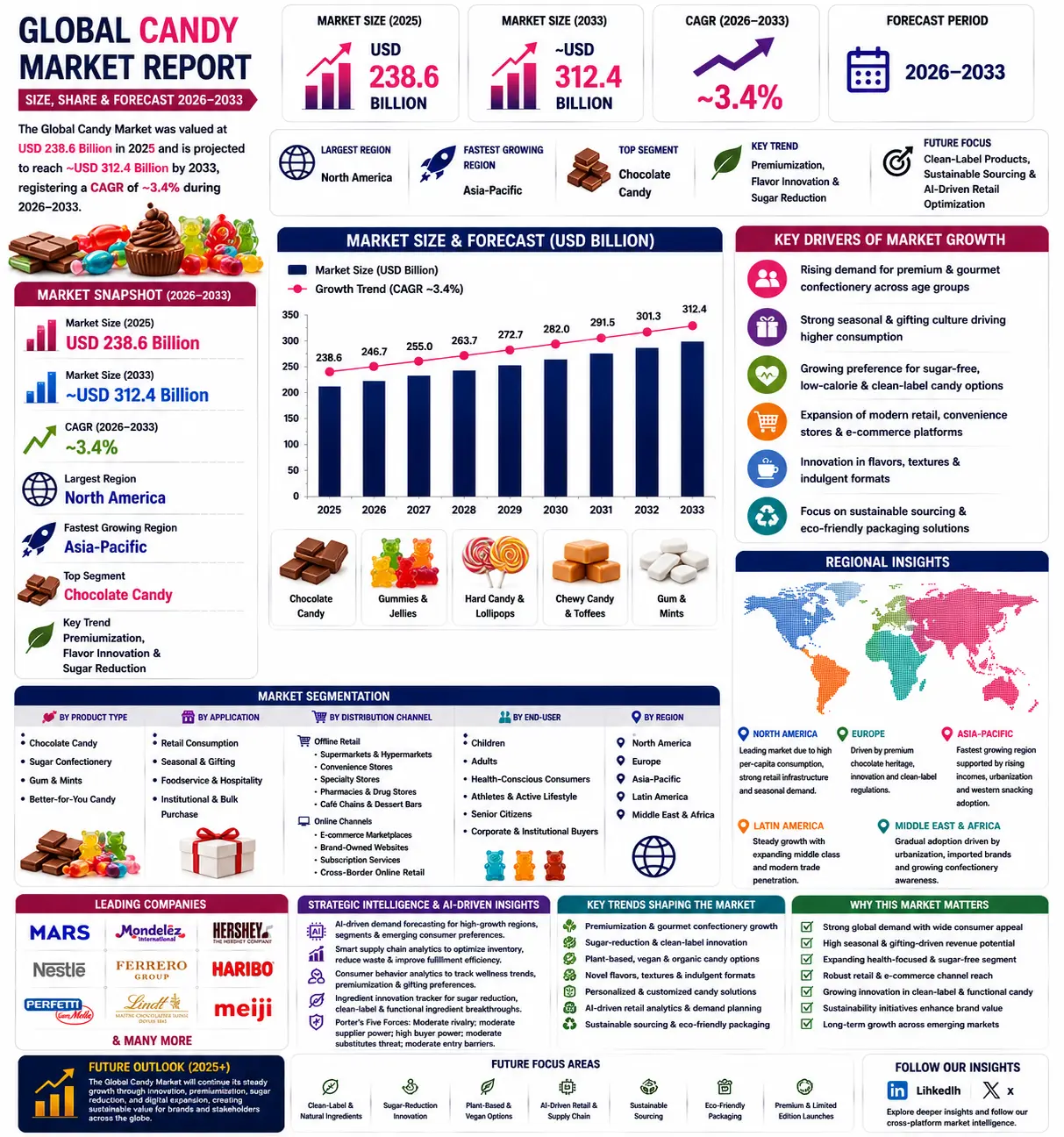
Global Candy Market Forecast Snapshot: 2026???2033
| Metric | Value |
|---|---|
| 2025 Market Size | ?? ?? ?? ?? ?? ?? ?? ?? ?? ?? ?? ?? ?? ?? ?? ?? ?? ?? ?? ?? ?? ?? ?? ?? ?? ?? ??USD 238.6 Billion |
| 2033 Market Size | ?? ?? ?? ?? ?? ?? ?? ?? ?? ?? ?? ?? ?? ?? ?? ?? ?? ?? ?? ?? ?? ?? ?? ?? ?? ?? ~USD 312.4 Billion |
| CAGR (2026???2033) | ?? ?? ?? ?? ?? ?? ?? ?? ?? ?? ?? ?? ?? ?? ?? ?? ?? ?? ?? ?? ?? ?? ?? ?? ?? ?? ~3.4% |
| Largest Region | ?? ?? ?? ?? ?? ?? ?? ?? ?? ?? ?? ?? ?? ?? ?? ?? ?? ?? ?? ?? ?? ?? ?? ?? ?? ?? North America |
| Fastest Growing Region | ?? ?? ?? ?? ?? ?? ?? ?? ?? ?? ?? ?? ?? ?? ?? ?? ?? ?? ?? ?? ?? ?? ?? ?? ?? ?? Asia-Pacific |
| Top Segment | ?? ?? ?? ?? ?? ?? ?? ?? ?? ?? ?? ?? ?? ?? ?? ?? ?? ?? ?? ?? ?? ?? ?? ?? ?? ?? Chocolate Candy |
| Key Trend | ?? ?? ?? ?? ?? ?? ?? ?? ?? ?? ?? ?? ??Premiumization, Flavor Innovation & Sugar Reduction |
| Future Focus | ?? ?? ?? Clean-Label Products, Sustainable Sourcing & AI-Driven Retail Optimization |
Global Candy Market Overview
The Global Candy Market continues to expand steadily as consumers seek indulgent treats, gifting options, and innovative flavor experiences. While traditional candy consumption remains strong, evolving consumer preferences are reshaping the market. Demand for premium chocolates, exotic flavors, sugar-free variants, and clean-label ingredients is accelerating.
According to Pheonix Research, the Global Candy Market is valued at USD 238.6 billion in 2025 and is projected to reach approximately USD 312.4 billion by 2033, reflecting a CAGR of ~3.4% (2026???2033).
North America remains the largest market due to high per-capita confectionery consumption, strong seasonal demand, and well-established retail infrastructure. Asia-Pacific is the fastest-growing region, driven by rising disposable incomes, urbanization, western snacking adoption, and rapid retail expansion.
Post-2025 market dynamics indicate increasing premiumization, sustainable cocoa sourcing initiatives, sugar-reduction strategies, plant-based alternatives, AI-driven demand forecasting, and eco-friendly packaging innovations.
Key Drivers of Global Candy Market Growth
Rising Demand for Premium & Gourmet Confectionery
Consumers are increasingly opting for artisan chocolates, limited-edition flavors, and high-quality ingredient formulations, enhancing value realization.
Seasonal & Gifting Culture
Festivals, holidays, and special occasions such as Halloween, Christmas, Valentine???s Day, and regional celebrations significantly boost candy sales.
Sugar Reduction & Better-for-You Innovation
Growing health awareness is driving demand for sugar-free, low-calorie, organic, and clean-label candy options.
Retail & E-Commerce Expansion
Strong presence across supermarkets, hypermarkets, convenience stores, and online platforms improves accessibility and impulse purchases.
Emerging Market Consumption Growth
Expanding middle-class populations in Asia-Pacific and Latin America are supporting long-term category expansion.
Global Candy Market Segmentation
?? ?? ?? ?? ??1. By Product Type
1.1 Chocolate Candy
1.1.1 Milk Chocolate
1.1.1.1 Plain Milk Chocolate Bars
1.1.1.2 Caramel-Filled Variants
1.1.1.3 Nut-Embedded Bars
1.1.1.4 Wafer & Biscuit Chocolate
1.1.2 Dark Chocolate
1.1.2.1 High Cocoa Content (70%+)
1.1.2.2 Sugar-Free Dark Chocolate
1.1.2.3 Organic Dark Chocolate
1.1.2.4 Antioxidant-Enriched Chocolate
1.1.3 White Chocolate
1.1.3.1 Classic White Bars
1.1.3.2 Fruit-Infused White Chocolate
1.1.3.3 Cookies & Cream Variants
1.1.3.4 Premium Artisan White Chocolate
1.1.4 Filled & Premium Chocolates
1.1.4.1 Truffles
1.1.4.2 Pralines
1.1.4.3 Liqueur-Filled Chocolates
1.1.4.4 Assorted Gift Boxes
1.2 Sugar Confectionery
1.2.1 Hard Candy
1.2.1.1 Fruit-Flavored Hard Candy
1.2.1.2 Mint & Menthol Candy
1.2.1.3 Herbal Lozenges
1.2.1.4 Sugar-Free Hard Candy
1.2.2 Gummies & Jellies
1.2.2.1 Fruit Gummies
1.2.2.2 Sour Gummies
1.2.2.3 Gelatin-Free Gummies
1.2.2.4 Novelty-Shaped Gummies
1.2.3 Chewy Candy
1.2.3.1 Caramel
1.2.3.2 Toffee
1.2.3.3 Taffy
1.2.3.4 Nougat
1.2.4 Lollipops
1.2.4.1 Classic Round
1.2.4.2 Filled Center
1.2.4.3 Novelty Designs
1.2.4.4 Sugar-Free Lollipops
1.3 Gum & Mints
1.3.1 Chewing Gum
1.3.1.1 Sugar-Free Gum
1.3.1.2 Bubble Gum
1.3.1.3 Long-Lasting Flavor Gum
1.3.1.4 Functional Gum
1.3.2 Breath Mints
1.3.2.1 Mint Tablets
1.3.2.2 Herbal Breath Fresheners
1.3.2.3 Sugar-Free Mints
1.3.2.4 Mint Strips
1.4 Better-for-You Candy
1.4.1 Sugar-Free Candy
1.4.2 Organic & Clean Label Candy
1.4.3 Low-Calorie & Keto Candy
1.4.4 Plant-Based & Vegan Candy
?? ?? ?? ?? 2. By Application
2.1 Retail Consumption
2.1.1 Supermarkets & Hypermarkets
2.1.1.1 Premium Shelf Placement
2.1.1.2 Promotional Multipacks
2.1.1.3 Private Label Candy
2.1.1.4 Seasonal Displays
2.1.2 Convenience Stores
2.1.2.1 Impulse Purchase Racks
2.1.2.2 Single-Serve Packs
2.1.2.3 Travel Retail Candy
2.1.2.4 Checkout Counter Placement
2.1.3 Specialty Candy Stores
2.1.3.1 Artisan Chocolates
2.1.3.2 Imported Premium Candy
2.1.3.3 Bulk Pick-and-Mix
2.1.3.4 Gourmet Gift Boxes
2.1.4 Online Direct-to-Consumer Platforms
2.1.4.1 Brand-Owned Websites
2.1.4.2 E-Commerce Marketplaces
2.1.4.3 Subscription Candy Boxes
2.1.4.4 Influencer & Social Promotions
2.2 Seasonal & Gifting Demand
2.2.1 Holiday Sales
2.2.2 Corporate Gifting
2.2.3 Wedding & Event Favors
2.2.4 Festive Limited Editions
2.3 Institutional & Bulk Purchase
2.3.1 Hospitality Sector
2.3.2 Travel & Duty-Free
2.3.3 Corporate Offices
2.3.4 Educational Institutions
?? ?? ?? ?? 3. By Distribution Channel
3.1 Offline Retail
3.1.1 Supermarkets & Hypermarkets
3.1.1.1 Organized Retail Chains
3.1.1.1.1 National Chains
3.1.1.1.2 Regional Chains
3.1.1.1.3 International Retailers
3.1.1.1.4 Premium / Gourmet Supermarkets
3.1.1.2 Merchandising Strategy
3.1.1.2.1 End-Cap Displays
3.1.1.2.2 Checkout Counter Placement
3.1.1.2.3 Seasonal Themed Displays
3.1.1.2.4 Private Label Shelf Placement
3.1.1.3 Product Format Availability
3.1.1.3.1 Family Packs
3.1.1.3.2 Single-Serve Bars
3.1.1.3.3 Multipacks
3.1.1.3.4 Gift Boxes & Assortments
3.1.1.4 Consumer Targeting
3.1.1.4.1 Premium Chocolate Buyers
3.1.1.4.2 Value-Oriented Consumers
3.1.1.4.3 Seasonal Shoppers
3.1.1.4.4 Health-Conscious Buyers
3.1.2 Convenience Stores
3.1.2.1 Urban Convenience Chains
3.1.2.1.1 High-Traffic Locations
3.1.2.1.2 Transit & Travel Hubs
3.1.2.1.3 Gas Station Stores
3.1.2.1.4 Campus & Office Locations
3.1.2.2 Product Format
3.1.2.2.1 Single-Serve Packs
3.1.2.2.2 Pocket-Size Candy
3.1.2.2.3 Gum & Mints
3.1.2.2.4 Impulse Mini Packs
3.1.2.3 Pricing Strategy
3.1.2.3.1 Premium Single Units
3.1.2.3.2 Combo Offers
3.1.2.3.3 Limited-Time Promotions
3.1.2.3.4 Impulse Pricing
3.1.2.4 Cross-Category Placement
3.1.2.4.1 Near Checkout
3.1.2.4.2 Beverage Section
3.1.2.4.3 Snack Aisle
3.1.2.4.4 Travel Essentials Rack
3.1.3 Specialty Candy Stores
3.1.3.1 Artisan & Gourmet Stores
3.1.3.1.1 Handcrafted Chocolates
3.1.3.1.2 Imported Premium Candy
3.1.3.1.3 Limited-Edition Collections
3.1.3.1.4 Seasonal Exclusives
3.1.3.2 Bulk & Customization
3.1.3.2.1 Pick-and-Mix Candy
3.1.3.2.2 Personalized Gift Boxes
3.1.3.2.3 Corporate Gifting Packs
3.1.3.2.4 Wedding & Event Favors
3.1.3.3 Premium Positioning
3.1.3.3.1 High Cocoa Content Chocolates
3.1.3.3.2 Organic & Clean Label Candy
3.1.3.3.3 Sustainable Sourcing Claims
3.1.3.3.4 Luxury Packaging
3.1.3.4 Consumer Engagement
3.1.3.4.1 In-Store Tastings
3.1.3.4.2 Seasonal Launch Events
3.1.3.4.3 Loyalty Programs
3.1.3.4.4 Experiential Retail Concepts
3.1.4 Pharmacies & Drug Stores
3.1.4.1 Chain Pharmacies
3.1.4.1.1 National Pharmacy Chains
3.1.4.1.2 Regional Pharmacy Networks
3.1.4.1.3 Hospital-Affiliated Stores
3.1.4.1.4 24/7 Urban Pharmacies
3.1.4.2 Functional & Sugar-Free Candy
3.1.4.2.1 Sugar-Free Chocolate
3.1.4.2.2 Herbal Lozenges
3.1.4.2.3 Breath Mints
3.1.4.2.4 Functional Gum
3.1.4.3 Seasonal & Gifting Placement
3.1.4.3.1 Holiday Displays
3.1.4.3.2 Countertop Assortments
3.1.4.3.3 Travel Packs
3.1.4.3.4 Small Gift Boxes
3.1.4.4 Consumer Targeting
3.1.4.4.1 Health-Conscious Buyers
3.1.4.4.2 Diabetic Consumers
3.1.4.4.3 Senior Consumers
3.1.4.4.4 OTC Adjacent Placement
3.2 Online Channels
3.2.1 E-Commerce Marketplaces
3.2.1.1 Domestic Platforms
3.2.1.1.1 Amazon
3.2.1.1.2 Walmart Online
3.2.1.1.3 Regional Grocery Apps
3.2.1.1.4 Health & Specialty Marketplaces
3.2.1.2 Cross-Border Platforms
3.2.1.2.1 Alibaba / Tmall
3.2.1.2.2 Lazada / Shopee
3.2.1.2.3 Global Confectionery Portals
3.2.1.2.4 International Direct Shipping
3.2.1.3 Sales Model
3.2.1.3.1 One-Time Purchase
3.2.1.3.2 Subscription Purchase
3.2.1.3.3 Bulk Purchase Discounts
3.2.1.3.4 Flash Sales
3.2.1.4 Consumer Influence
3.2.1.4.1 Reviews & Ratings
3.2.1.4.2 Influencer Partnerships
3.2.1.4.3 Sponsored Listings
3.2.1.4.4 AI-Based Recommendations
3.2.2 Brand-Owned Websites
3.2.2.1 Direct-to-Consumer (D2C) Sales
3.2.2.1.1 Full Product Portfolio
3.2.2.1.2 Exclusive Launches
3.2.2.1.3 Limited Editions
3.2.2.1.4 Custom Gift Bundles
3.2.2.2 Subscription & Loyalty Programs
3.2.2.2.1 Monthly Candy Boxes
3.2.2.2.2 Seasonal Subscriptions
3.2.2.2.3 Auto-Replenishment
3.2.2.2.4 Reward Points
3.2.2.3 Personalization Tools
3.2.2.3.1 Flavor Customization
3.2.2.3.2 Personalized Packaging
3.2.2.3.3 Corporate Branding Options
3.2.2.3.4 Occasion-Based Bundles
3.2.2.4 Digital Engagement
3.2.2.4.1 Recipe & Pairing Content
3.2.2.4.2 Virtual Tastings
3.2.2.4.3 Social Media Integration
3.2.2.4.4 Community Campaigns
3.2.3 Subscription-Based Candy Boxes
3.2.3.1 Monthly Themed Boxes
3.2.3.2 International Candy Boxes
3.2.3.3 Premium Chocolate Subscriptions
3.2.3.4 Corporate & Gifting Subscriptions
3.2.4 Cross-Border Online Retail
3.2.4.1 Imported Premium Brands
3.2.4.2 Regional Specialty Candy
3.2.4.3 Global Gifting Solutions
3.2.4.4 International Fulfillment & Logistics Networks
?? ?? ?? ?? 4. By Region
4.1 North America
4.2 Europe
4.3 Asia-Pacific
4.4 Latin America
4.5 Middle East & Africa
Leading Companies in the Global Candy Market
- Mars Incorporated
- Mondelez International
- The Hershey Company
- Nestl?? S.A.
- Ferrero Group
- Haribo GmbH
- Perfetti Van Melle
- Lindt & Spr??ngli
- Meiji Holdings
Mars and Mondelez lead the market in scale and global distribution reach, supported by diversified product portfolios and strong brand equity. Premium players such as Ferrero and Lindt drive high-margin growth through innovation and gifting-focused strategies.
Regional Insights of the Global Candy Market
North America ??? Leading Market
North America maintains market leadership due to high per-capita confectionery consumption, strong seasonal sales cycles (Halloween, Christmas, Valentine???s Day), and a highly developed supermarket and convenience retail ecosystem. Premium chocolate and gifting segments further strengthen revenue generation.
Asia-Pacific ??? Fastest-Growing Region
Asia-Pacific is experiencing the most rapid expansion, supported by rising disposable incomes, increasing western snacking adoption, urbanization, and rapid growth of modern retail and e-commerce platforms.
Europe
Europe???s market is shaped by a strong premium chocolate heritage, strict clean-label and sustainability regulations, and continuous innovation in artisan and high-cocoa-content products.
Latin America
Steady growth in Latin America is driven by expanding middle-class populations, rising demand for affordable indulgence, and improving retail infrastructure across urban centers.
Middle East & Africa
The region is witnessing gradual growth fueled by urban development, increasing penetration of modern retail formats, and rising demand for imported and premium confectionery brands.
Strategic Intelligence & AI-Backed Insights ??? Global Candy Market
Pheonix Demand Forecast Engine indicates stable long-term growth supported by premium chocolate expansion, seasonal demand cycles, sugar-reduction reformulation, and increasing penetration across emerging Asia-Pacific markets. Consumer Behavior Analyzer highlights rising preference for premium indulgence, clean-label ingredients, portion-controlled treats, and plant-based alternatives, with growing influence from social media trends and online gifting platforms. Innovation Tracker underscores flavor diversification, limited-edition launches, sustainable cocoa sourcing, recyclable packaging adoption, and AI-driven retail analytics as key competitive differentiators. Porter???s Five Forces Analysis reveals:-
High competitive rivalry
-
Moderate supplier power (cocoa & sugar volatility influence margins)
-
Moderate-to-high buyer power due to brand switching
-
Moderate substitution threat from healthier snack alternatives
-
Moderate entry barriers driven by brand equity and distribution scale
Why the Global Candy Market Remains Critical
-
High-frequency FMCG category with strong emotional appeal
-
Significant seasonal and gifting-driven revenue contribution
-
Strong scalability across mass-market and premium segments
-
Expanding innovation in sugar reduction and sustainable sourcing
-
Powerful global brand portfolios with strong distribution networks
Final Takeaway of the Global Candy Market
The Global Candy Market continues to evolve toward a premium, innovation-driven, and sustainability-focused ecosystem. While indulgence remains the core demand driver, growth opportunities are increasingly shaped by clean-label reformulation, sugar reduction, ethical sourcing, and omnichannel retail expansion.
The projected CAGR of ~3.4% (2026???2033) reflects stable and resilient long-term growth across developed and emerging markets.
At Pheonix Research, our advanced forecasting frameworks deliver comprehensive Candy Market revenue projections, competitive benchmarking, and AI-backed strategic intelligence ??? enabling stakeholders to capitalize on the Post-2025 confectionery landscape with data-driven precision and scalable growth strategies.
?????? Social Mentions & Publication Channels
Explore deeper insights and follow our cross-platform updates on??LinkedIn,?? and??X??for continuous intelligence and market coverage. LinkedIn : https://www.linkedin.com/feed/update/urn:li:activity:7432061770933911552 X : https://x.com/Pheonix_Insight/status/2026298041591115803?s=20Table of Contents
1. Executive Summary
1.1 Market Forecast Snapshot (2026???2033)
1.2 Global Market Size & CAGR Analysis
1.3 Largest & Fastest-Growing Segments
1.4 Regional Leadership Trends
1.5 Key Market Drivers
1.6 Competitive Landscape Overview
1.7 Strategic Outlook Through 2033
2. Introduction & Market Overview
2.1 Definition of the Global Candy Market
2.2 Scope of the Study
2.3 Role of Candy in the Global Confectionery Industry
2.4 Evolution from Traditional Confectionery to Premium & Clean-Label Candy
2.5 Seasonal & Gifting Culture Influence
2.6 Digital Retail, AI & Demand Forecasting Integration
2.7 Sustainability & Ethical Cocoa Sourcing Trends
3. Research Methodology
3.1 Primary Research
3.2 Secondary Research
3.3 Market Size Estimation Model
3.4 Forecast Assumptions (2026???2033)
3.5 Data Validation & Triangulation
4. Market Dynamics
4.1 Drivers
4.1.1 Rising Demand for Premium & Gourmet Confectionery
4.1.2 Seasonal & Gifting Culture Expansion
4.1.3 Sugar Reduction & Better-for-You Innovation
4.1.4 Retail & E-Commerce Expansion
4.4.5 Emerging Market Consumption Growth
4.1.6 Flavor Innovation & Limited-Edition Launches
4.1.7 Sustainable Packaging & Ethical Sourcing Initiatives
4.2 Restraints
4.2.1 Raw Material Price Volatility (Cocoa & Sugar)
4.2.2 Health Concerns & Sugar Regulations
4.2.3 Intense Competitive Rivalry
4.2.4 Supply Chain & Logistics Disruptions
4.3 Opportunities
4.3.1 Premium Chocolate Expansion
4.3.2 Clean-Label & Organic Candy Growth
4.3.3 Plant-Based & Vegan Confectionery
4.3.4 AI-Driven Retail Optimization
4.3.5 Expansion Across Asia-Pacific & Emerging Markets
4.4 Challenges
4.4.1 Cocoa Supply Chain Sensitivity
4.4.2 Margin Pressure from Retail Promotions
4.4.3 Private Label Competition
4.4.4 Changing Consumer Health Preferences
5. Global Candy Market Analysis (USD Billion), 2026???2033
5.1 Market Size Overview
5.2 CAGR Analysis
5.3 Regional Revenue Split (North America, Europe, Asia-Pacific, Latin America, MEA)
5.4 Product-Wise Revenue Distribution
5.5 Pricing & Margin Trend Analysis
6. Market Segmentation by Product Type (USD Billion), 2026???2033
6.1 Chocolate Candy
6.1.1 Milk Chocolate
6.1.1.1 Plain Milk Chocolate Bars
6.1.1.2 Caramel-Filled Variants
6.1.1.3 Nut-Embedded Bars
6.1.1.4 Wafer & Biscuit Chocolate
6.1.2 Dark Chocolate
6.1.2.1 High Cocoa Content (70%+)
6.1.2.2 Sugar-Free Dark Chocolate
6.1.2.3 Organic Dark Chocolate
6.1.2.4 Antioxidant-Enriched Chocolate
6.1.3 White Chocolate
6.1.3.1 Classic White Bars
6.1.3.2 Fruit-Infused White Chocolate
6.1.3.3 Cookies & Cream Variants
6.1.3.4 Premium Artisan White Chocolate
6.1.4 Filled & Premium Chocolates
6.1.4.1 Truffles
6.1.4.2 Pralines
6.1.4.3 Liqueur-Filled Chocolates
6.1.4.4 Assorted Gift Boxes
6.2 Sugar Confectionery
6.2.1 Hard Candy
6.2.1.1 Fruit-Flavored Hard Candy
6.2.1.2 Mint & Menthol Candy
6.2.1.3 Herbal Lozenges
6.2.1.4 Sugar-Free Hard Candy
6.2.2 Gummies & Jellies
6.2.2.1 Fruit Gummies
6.2.2.2 Sour Gummies
6.2.2.3 Gelatin-Free Gummies
6.2.2.4 Novelty-Shaped Gummies
6.2.3 Chewy Candy
6.2.3.1 Caramel
6.2.3.2 Toffee
6.2.3.3 Taffy
6.2.3.4 Nougat
6.2.4 Lollipops
6.2.4.1 Classic Round
6.2.4.2 Filled Center
6.2.4.3 Novelty Designs
6.2.4.4 Sugar-Free Lollipops
6.3 Gum & Mints
6.3.1 Chewing Gum
6.3.1.1 Sugar-Free Gum
6.3.1.2 Bubble Gum
6.3.1.3 Long-Lasting Flavor Gum
6.3.1.4 Functional Gum
6.3.2 Breath Mints
6.3.2.1 Mint Tablets
6.3.2.2 Herbal Breath Fresheners
6.3.2.3 Sugar-Free Mints
6.3.2.4 Mint Strips
6.4 Better-for-You Candy
6.4.1 Sugar-Free Candy
6.4.2 Organic & Clean Label Candy
6.4.3 Low-Calorie & Keto Candy
6.4.4 Plant-Based & Vegan Candy
7. Market Segmentation by Application (USD Billion), 2026???2033
7.1 Retail Consumption
7.1.1 Supermarkets & Hypermarkets
7.1.1.1 Premium Shelf Placement
7.1.1.2 Promotional Multipacks
7.1.1.3 Private Label Candy
7.1.1.4 Seasonal Displays
7.1.2 Convenience Stores
7.1.2.1 Impulse Purchase Racks
7.1.2.2 Single-Serve Packs
7.1.2.3 Travel Retail Candy
7.1.2.4 Checkout Counter Placement
7.1.3 Specialty Candy Stores
7.1.3.1 Artisan Chocolates
7.1.3.2 Imported Premium Candy
7.1.3.3 Bulk Pick-and-Mix
7.1.3.4 Gourmet Gift Boxes
7.1.4 Online Direct-to-Consumer Platforms
7.1.4.1 Brand-Owned Websites
7.1.4.2 E-Commerce Marketplaces
7.1.4.3 Subscription Candy Boxes
7.1.4.4 Influencer & Social Promotions
7.2 Seasonal & Gifting Demand
7.2.1 Holiday Sales
7.2.2 Corporate Gifting
7.2.3 Wedding & Event Favors
7.2.4 Festive Limited Editions
7.3 Institutional & Bulk Purchase
7.3.1 Hospitality Sector
7.3.2 Travel & Duty-Free
7.3.3 Corporate Offices
7.3.4 Educational Institutions
8. Market Segmentation by Distribution Channel (USD Billion), 2026???2033
8.1 Offline Retail
8.1.1 Supermarkets & Hypermarkets
8.1.1.1 Organized Retail Chains
8.1.1.1.1 National Chains
8.1.1.1.2 Regional Chains
8.1.1.1.3 International Retailers
8.1.1.1.4 Premium / Gourmet Supermarkets
8.1.1.2 Merchandising Strategy
8.1.1.2.1 End-Cap Displays
8.1.1.2.2 Checkout Counter Placement
8.1.1.2.3 Seasonal Themed Displays
8.1.1.2.4 Private Label Shelf Placement
8.1.1.3 Product Format Availability
8.1.1.3.1 Family Packs
8.1.1.3.2 Single-Serve Bars
8.1.1.3.3 Multipacks
8.1.1.3.4 Gift Boxes & Assortments
8.1.1.4 Consumer Targeting
8.1.1.4.1 Premium Chocolate Buyers
8.1.1.4.2 Value-Oriented Consumers
8.1.1.4.3 Seasonal Shoppers
8.1.1.4.4 Health-Conscious Buyers
8.1.2 Convenience Stores
8.1.2.1 Urban Convenience Chains
8.1.2.1.1 High-Traffic Locations
8.1.2.1.2 Transit & Travel Hubs
8.1.2.1.3 Gas Station Stores
8.1.2.1.4 Campus & Office Locations
8.1.2.2 Product Format
8.1.2.2.1 Single-Serve Packs
8.1.2.2.2 Pocket-Size Candy
8.1.2.2.3 Gum & Mints
8.1.2.2.4 Impulse Mini Packs
8.1.2.3 Pricing Strategy
8.1.2.3.1 Premium Single Units
8.1.2.3.2 Combo Offers
8.1.2.3.3 Limited-Time Promotions
8.1.2.3.4 Impulse Pricing
8.1.2.4 Cross-Category Placement
8.1.2.4.1 Near Checkout
8.1.2.4.2 Beverage Section
8.1.2.4.3 Snack Aisle
8.1.2.4.4 Travel Essentials Rack
8.1.3 Specialty Candy Stores
8.1.3.1 Artisan & Gourmet Stores
8.1.3.1.1 Handcrafted Chocolates
8.1.3.1.2 Imported Premium Candy
8.1.3.1.3 Limited-Edition Collections
8.1.3.1.4 Seasonal Exclusives
8.1.3.2 Bulk & Customization
8.1.3.2.1 Pick-and-Mix Candy
8.1.3.2.2 Personalized Gift Boxes
8.1.3.2.3 Corporate Gifting Packs
8.1.3.2.4 Wedding & Event Favors
8.1.3.3 Premium Positioning
8.1.3.3.1 High Cocoa Content Chocolates
8.1.3.3.2 Organic & Clean Label Candy
8.1.3.3.3 Sustainable Sourcing Claims
8.1.3.3.4 Luxury Packaging
8.1.3.4 Consumer Engagement
8.1.3.4.1 In-Store Tastings
8.1.3.4.2 Seasonal Launch Events
8.1.3.4.3 Loyalty Programs
8.1.3.4.4 Experiential Retail Concepts
8.1.4 Pharmacies & Drug Stores
8.1.4.1 Chain Pharmacies
8.1.4.1.1 National Pharmacy Chains
8.1.4.1.2 Regional Pharmacy Networks
8.1.4.1.3 Hospital-Affiliated Stores
8.1.4.1.4 24/7 Urban Pharmacies
8.1.4.2 Functional & Sugar-Free Candy
8.1.4.2.1 Sugar-Free Chocolate
8.1.4.2.2 Herbal Lozenges
8.1.4.2.3 Breath Mints
8.1.4.2.4 Functional Gum
8.1.4.3 Seasonal & Gifting Placement
8.1.4.3.1 Holiday Displays
8.1.4.3.2 Countertop Assortments
8.1.4.3.3 Travel Packs
8.1.4.3.4 Small Gift Boxes
8.1.4.4 Consumer Targeting
8.1.4.4.1 Health-Conscious Buyers
8.1.4.4.2 Diabetic Consumers
8.1.4.4.3 Senior Consumers
8.1.4.4.4 OTC Adjacent Placement
8.2 Online Channels
8.2.1 E-Commerce Marketplaces
8.2.1.1 Domestic Platforms
8.2.1.1.1 Amazon
8.2.1.1.2 Walmart Online
8.2.1.1.3 Regional Grocery Apps
8.2.1.1.4 Health & Specialty Marketplaces
8.2.1.2 Cross-Border Platforms
8.2.1.2.1 Alibaba / Tmall
8.2.1.2.2 Lazada / Shopee
8.2.1.2.3 Global Confectionery Portals
8.2.1.2.4 International Direct Shipping
8.2.1.3 Sales Model
8.2.1.3.1 One-Time Purchase
8.2.1.3.2 Subscription Purchase
8.2.1.3.3 Bulk Purchase Discounts
8.2.1.3.4 Flash Sales
8.2.1.4 Consumer Influence
8.2.1.4.1 Reviews & Ratings
8.2.1.4.2 Influencer Partnerships
8.2.1.4.3 Sponsored Listings
8.2.1.4.4 AI-Based Recommendations
8.2.2 Brand-Owned Websites
8.2.2.1 Direct-to-Consumer (D2C) Sales
8.2.2.1.1 Full Product Portfolio
8.2.2.1.2 Exclusive Launches
8.2.2.1.3 Limited Editions
8.2.2.1.4 Custom Gift Bundles
8.2.2.2 Subscription & Loyalty Programs
8.2.2.2.1 Monthly Candy Boxes
8.2.2.2.2 Seasonal Subscriptions
8.2.2.2.3 Auto-Replenishment
8.2.2.2.4 Reward Points
8.2.2.3 Personalization Tools
8.2.2.3.1 Flavor Customization
8.2.2.3.2 Personalized Packaging
8.2.2.3.3 Corporate Branding Options
8.2.2.3.4 Occasion-Based Bundles
8.2.2.4 Digital Engagement
8.2.2.4.1 Recipe & Pairing Content
8.2.2.4.2 Virtual Tastings
8.2.2.4.3 Social Media Integration
8.2.2.4.4 Community Campaigns
8.2.3 Subscription-Based Candy Boxes
8.2.3.1 Monthly Themed Boxes
8.2.3.2 International Candy Boxes
8.2.3.3 Premium Chocolate Subscriptions
8.2.3.4 Corporate & Gifting Subscriptions
8.2.3.5 Limited-Edition Seasonal Boxes
8.2.4 Cross-Border Online Retail
8.2.4.1 Imported Premium Brands
8.2.4.2 Regional Specialty Candy
8.2.4.3 Global Gifting Solutions
8.2.4.4 International Fulfillment & Logistics Networks
8.2.4.5 Duty-Free & Travel Retail Online Platforms
9. Market Segmentation by Region
9.1 North America
9.2 Europe
9.3 Asia-Pacific
9.4 Latin America
9.5 Middle East & Africa
10. Competitive Landscape ??? Global
10.1 Market Share Analysis
10.2 Brand Positioning Matrix
10.3 Product Portfolio Benchmarking
10.4 Distribution Network Strength Analysis
10.5 AI & Digital Capability Comparison
10.6 Competitive Intensity Mapping
11. Company Profiles
11.1 Mars Incorporated
11.2 Mondelez International
11.3 The Hershey Company
11.4 Nestl?? S.A.
11.5 Ferrero Group
11.6 Haribo GmbH
11.7 Perfetti Van Melle
11.8 Lindt & Spr??ngli
11.9 Meiji Holdings
12. Regional Insights
12.1 North America ??? Leading Market
12.2 Asia-Pacific ??? Fastest Growing Region
12.3 Europe ??? Premium Chocolate Heritage
12.4 Latin America ??? Expanding Middle-Class Demand
12.5 Middle East & Africa ??? Emerging Retail Expansion
13. Strategic Intelligence & Pheonix AI-Backed Insights
13.1 Pheonix Demand Forecast Engine
13.2 Consumer Behavior Analyzer
13.3 Innovation & Product Development Tracker
13.4 AI-Driven Retail Analytics Model
13.5 Automated Porter???s Five Forces Analysis
14. Future Outlook & Strategic Recommendations
14.1 Premium & Gourmet Expansion Strategy
14.2 Sugar Reduction & Reformulation Roadmap
14.3 Sustainable Cocoa & Ethical Sourcing Strategy
14.4 Omnichannel & D2C Optimization
14.5 Long-Term Market Outlook (2033+)
15. Appendix
16. About Pheonix Research
17. Disclaimer
Competitive Landscape
Competitive Landscape of the Global Candy Market
Executive Framing
The Global Candy Market is moderately consolidated with high competitive intensity. Leading players including Mars Incorporated, Mondelez International, The Hershey Company, Nestl?? S.A., Ferrero Group, Haribo GmbH, Perfetti Van Melle, Lindt & Spr??ngli, and Meiji Holdings dominate market share through extensive global distribution, brand equity, and diverse product portfolios. Competition is increasingly shaped by premiumization, flavor innovation, and clean-label initiatives.
Current Market Reality
The market is evolving as consumers seek indulgent yet health-conscious options. Chocolate candy remains the largest segment, while sugar-free, plant-based, and artisan products are gaining traction. Seasonal gifting, festive celebrations, and online purchasing behavior are crucial revenue drivers.
Traditional FMCG candy giants leverage global scale, retail penetration, and established brand loyalty. Emerging players and premium brands focus on sustainable sourcing, limited-edition flavors, AI-enabled personalization, and experiential retail strategies.
Key Signals and Evidence
- Strong adoption of premium chocolates and exotic flavor innovations.
- Growth of sugar-free, low-calorie, and clean-label candy options.
- Expansion of e-commerce and direct-to-consumer sales channels.
- Increased seasonal and gifting-driven consumption patterns.
- Integration of sustainable sourcing and eco-friendly packaging initiatives.
Strategic Implications
- Innovation Focus: Emphasize premium, exotic, and functional flavors.
- Omnichannel Expansion: Strengthen offline retail, e-commerce, and D2C platforms.
- Clean-Label & Health Initiatives: Develop sugar-reduced, plant-based, and keto-friendly offerings.
- Seasonal & Gifting Strategies: Leverage holidays, events, and personalized packaging for engagement.
- Sustainable Sourcing: Invest in ethically sourced cocoa, recyclable packaging, and CSR-led initiatives.
Forward Outlook
By 2033, the Global Candy Market is expected to reach approximately USD 312.4 billion, growing at a CAGR of ~3.4%. North America will maintain leadership due to high per-capita consumption and seasonal demand cycles, while Asia-Pacific will continue as the fastest-growing region, driven by urbanization, rising disposable incomes, and expanding modern retail and e-commerce networks.
The competitive landscape will continue evolving through flavor innovation, sustainable practices, clean-label reformulation, and AI-driven retail optimization. Companies that balance indulgence, health-conscious formulations, omnichannel reach, and ethical sourcing will secure sustainable market leadership.
Value Chain
Global Candy Market: Value Chain & Market Dynamics
Executive Framing
The global candy market operates in a high-volume, innovation-driven, and convenience-oriented value chain, fueled by strong consumer demand for indulgence, gifting, and novel flavor experiences. Candy products include chocolate, sugar confectionery, gummies, hard candies, chewing gum, and mints, evolving toward premium, functional, and better-for-you formats.
The market follows a hybrid operational model, where multinational brands leverage large-scale production, global sourcing, and retail penetration, while emerging players focus on premiumization, clean-label innovation, and direct-to-consumer (DTC) channels. This enables broad reach and rapid product innovation simultaneously.
Challenges include raw material volatility (cocoa, sugar), regulatory pressures on sugar reduction, sustainability compliance, and packaging innovations.
Current Market Reality
The candy value chain exhibits moderate-to-high complexity, given diverse formulations, large-scale production, and global distribution networks. Major players such as Mars, Mondelez, and Hershey maintain integrated supply chains and extensive retail coverage.
Upstream sourcing involves cocoa, sugar, dairy, fats, nuts, flavorings, and functional ingredients, with pricing affected by commodity volatility. Midstream operations include mixing, molding, flavoring, coating, packaging, and gift-box assembly. Innovation focuses on premium chocolates, sugar-free candy, plant-based alternatives, and exotic flavors.
Downstream distribution spans supermarkets, convenience stores, specialty shops, pharmacies, e-commerce, and subscription boxes, supporting accessibility and impulse purchasing.
Key Signals and Evidence
- Market growth from USD 238.6 billion (2025) to ~USD 312.4 billion (2033) at a CAGR of ~3.4%.
- Rising demand for premium and gourmet confectionery.
- Seasonal and gifting occasions (Halloween, Christmas, Valentine???s) boosting sales.
- Increasing adoption of sugar-reduced, clean-label, and plant-based candy.
- Expansion of e-commerce, DTC, and subscription-based channels enhancing reach.
Buyer power is moderate-to-high due to brand choice and product variety, while supplier power is moderate, influenced by cocoa and sugar volatility.
Strategic Implications
Market leaders focus on portfolio diversification, premiumization, and global supply chain efficiency. Emerging players differentiate via clean-label, functional candy, artisanal positioning, and digital-first retail.
Technology adoption, such as AI-driven demand forecasting, consumer analytics, and retail optimization, will enhance responsiveness. Sustainability initiatives including eco-friendly packaging, responsible sourcing, and carbon footprint reduction are increasingly crucial.
Forward Outlook
The global candy market is transitioning to a premium, innovation-driven, and sustainability-focused ecosystem. Future trends include:
- Expansion of premium and functional candy segments
- Growth in gifting-focused, artisanal, and seasonal products
- Adoption of sustainable packaging and ethically sourced ingredients
- Integration of AI-driven analytics and personalized marketing
Companies integrating innovation, supply chain efficiency, and omnichannel distribution will secure long-term growth. The global candy market remains a high-frequency, indulgence-driven, and consumer-centric sector where premiumization, flavor innovation, and sustainability define success.
Investment Activity
Investment & Funding Dynamics ??? Global Candy Market
Executive Framing
Current Market Reality
Valued at USD 238.6 billion in 2025 and projected to reach ~USD 312.4 billion by 2033 (CAGR ~3.4%), the market is led by North America, with Asia-Pacific as the fastest-growing region. Leading players such as Mars, Mondelez, Hershey, Ferrero, and Lindt are investing heavily in premium chocolates, clean-label candy, and omnichannel retail capabilities to strengthen brand positioning and drive market expansion.
Key Signals and Evidence
- Premium & Flavor Innovation: Capital allocated to artisanal, limited-edition, and high-cocoa-content chocolates.
- Sugar Reduction & Better-for-You Reformulation: Investment in sugar-free, low-calorie, plant-based, and clean-label candy production technologies.
- Sustainable Sourcing Initiatives: Funding toward ethically sourced cocoa, recyclable packaging, and ESG-compliant supply chains.
- Manufacturing & Scale Expansion: Facility upgrades, automation, and modernization for high-volume chocolate and confectionery production.
- Omnichannel & E-Commerce Integration: Investment in AI-driven retail optimization, D2C platforms, subscription-based candy boxes, and global online fulfillment networks.
- M&A & Strategic Partnerships: Consolidation and cross-border acquisitions to strengthen brand portfolios and market reach.
- Digital Marketing & Consumer Engagement: Funding for influencer campaigns, social commerce, loyalty programs, and experiential retail activation.
Strategic Implications
Companies investing in flavor R&D, sugar-reduction technologies, and sustainable sourcing are positioned for premium segment growth. Brands leveraging digital, omnichannel, and AI-backed retail optimization will capture emerging market opportunities and reinforce recurring revenue from seasonal and gifting-driven demand.
Forward Outlook
Between 2026 and 2033, investment activity is expected to grow in premium chocolate innovation, clean-label confectionery, plant-based candy, and AI-powered retail analytics. Emerging markets, especially in Asia-Pacific and Latin America, will attract increasing capital for distribution expansion, local manufacturing, and online subscription models.
Technology & Innovation
Global Candy Market: Technology & Innovation
Executive Framing
Innovation in the Global Candy Market is increasingly driven by the convergence of food science, flavor engineering, and sustainable production technologies. Companies are investing in novel ingredients, processing techniques, and AI-powered retail solutions to meet evolving consumer expectations for taste, health, and ethical sourcing.
Current Market Reality
The candy industry is embracing flavor innovation, sugar-reduction strategies, plant-based formulations, and premium ingredient integration. Advanced confectionery processing technologies enable consistent texture, long shelf life, and stability of complex ingredients like probiotics, protein, and natural extracts. AI and data-driven solutions optimize demand forecasting, personalization, and retail merchandising.
Key Signals and Evidence
- Flavor & Texture Innovation: Limited-edition flavors, exotic combinations, and hybrid confectionery formats drive consumer engagement.
- Sugar-Reduction & Alternative Sweeteners: Stevia, monk fruit, erythritol, and sugar alcohols gain traction in response to health-conscious trends.
- Plant-Based & Clean-Label Solutions: Vegan chocolates, allergen-free candies, and GMO-free formulations are expanding globally.
- Sustainable Sourcing & Eco-Packaging: Traceable cocoa, recyclable packaging, and carbon-neutral production practices differentiate premium brands.
- AI-Enabled Retail & Consumer Insights: AI supports dynamic pricing, personalized promotions, assortment planning, and online recommendation engines.
- Functional Ingredient Integration: Growing interest in fortified chocolate, herbal candies, and nutraceutical-infused gums highlights cross-category innovation.
Strategic Implications
Companies that combine indulgence, health-conscious formulations, and sustainable sourcing will secure long-term competitive advantages. Investment in AI-powered merchandising, flavor R&D, and alternative sweetener technology is crucial for meeting consumer expectations while optimizing profitability.
Forward Outlook
Future innovation will focus on hybrid indulgence-health formats, personalized flavor experiences, and AI-driven demand forecasting. Sustainable ingredient sourcing, reduced sugar content, and plant-based alternatives will define the next wave of candy market differentiation, while technology adoption will improve supply chain efficiency and consumer targeting.
Market Risk
Risk Factors and Disruption Threats in the Global Candy Market
Executive Framing
The Global Candy Market is projected to grow from USD 238.6 billion in 2025 to ~USD 312.4 billion by 2033 at a CAGR of ~3.4%. While the market is largely stable and resilient due to strong indulgence and gifting demand, evolving consumer preferences, sustainability mandates, and sugar-reduction trends introduce moderate market risk. Companies must balance tradition with innovation to sustain growth.
Current Market Reality
North America remains the largest market due to high per-capita consumption, mature retail channels, and seasonal demand spikes. Asia-Pacific is the fastest-growing region, driven by rising incomes, urbanization, and modern retail expansion. Premium chocolate, sugar-free, and clean-label innovations are increasingly shaping the market landscape, alongside omnichannel retail penetration.
Key Signals and Evidence
Key risk signals include: fluctuating raw material prices (cocoa, sugar, and nuts), increasing regulatory scrutiny on sugar content and labeling, and intensifying competition from functional snacks, plant-based alternatives, and healthier indulgence options. Seasonal demand variability and consumer brand-switching behavior also contribute to market uncertainty.
Strategic Implications
Companies should prioritize sustainable sourcing, clean-label innovation, sugar-reduction formulations, and premium product differentiation. Leveraging AI-driven retail analytics, subscription-based gifting, and D2C channels can strengthen consumer engagement and maintain market share. Investments in supply chain resilience, traceability, and flavor innovation will mitigate operational and reputational risks.
Forward Outlook
The Global Candy Market remains a high-frequency FMCG category with enduring growth potential. Long-term success will rely on balancing indulgence with sustainability, health-conscious innovation, and omnichannel retail strategies to address evolving consumer expectations and competitive pressures.
Regulatory Landscape
Regulatory & Policy Landscape: Global Candy Market
Executive Framing
The global candy market is primarily governed by food safety, labeling, and nutritional regulations, with oversight from authorities such as the U.S. FDA, European Food Safety Authority (EFSA), FSSAI (India), and other national food regulatory bodies. Candy products???including chocolate, gummies, sugar confectionery, chewing gum, and mints???must comply with ingredient standards, permissible additives, allergen labeling, and packaging requirements.
Emerging trends such as sugar reduction, clean-label formulations, plant-based alternatives, and functional fortification introduce additional regulatory considerations. Products claiming ???sugar-free,??? ???low-calorie,??? ???organic,??? or ???plant-based??? status must adhere to strict labeling criteria and substantiation rules to avoid misleading consumers.
Current Market Reality
Candy manufacturers are increasingly navigating multi-layered compliance requirements. For traditional confectionery, regulations focus on permissible sugar, cocoa, and additive usage, as well as allergen management. For better-for-you or functional variants, stricter scrutiny applies to ingredient claims (e.g., stevia, erythritol, probiotics) and health-related statements.
Product claims must align with regional regulations: ???organic,??? ???natural,??? ???sugar-free,??? or ???vegan??? designations require certification from recognized authorities. Cross-border sales introduce complexity, as definitions and thresholds vary by country. Mislabeling or unsubstantiated claims can result in fines, recalls, or brand reputation damage.
Key Signals and Evidence
- Food safety regulations covering sugar, cocoa, dairy, and additives.
- Allergen labeling mandates for nuts, milk, soy, gluten, and eggs.
- Strict oversight on sugar-reduction and ???better-for-you??? claims.
- Certification requirements for organic, plant-based, and clean-label claims.
- Regional differences in permissible ingredient thresholds and labeling.
- Enhanced scrutiny on imported and cross-border confectionery products.
Strategic Implications
Compliance planning is a critical factor in market entry and product positioning. Brands must invest in certified sourcing, ingredient traceability, and documentation to meet regional standards. Regulatory readiness enables smoother launches of sugar-free, plant-based, or functional candies while minimizing risk of recalls or fines.
Monitoring evolving policies???such as sugar taxes, allergen disclosures, and sustainability-linked labeling???is essential to maintain competitiveness. Companies aligning with verified certifications and evidence-backed claims can strengthen consumer trust, premium positioning, and cross-border market expansion.
Forward Outlook
Global candy regulations are expected to tighten around sugar content disclosure, plant-based claims, sustainable sourcing labels, and clean-label transparency. Authorities may enforce stricter monitoring on cross-border e-commerce channels and online D2C platforms.
Digital engagement and AI-driven personalization may also introduce emerging compliance considerations, particularly for subscription boxes and flavor customization.
Brands that proactively implement multi-regional regulatory compliance and certification strategies will gain competitive resilience, consumer credibility, and long-term growth advantages.