
Global Fruit and Vegetable Powders Market size and share Analysis 2026-2033
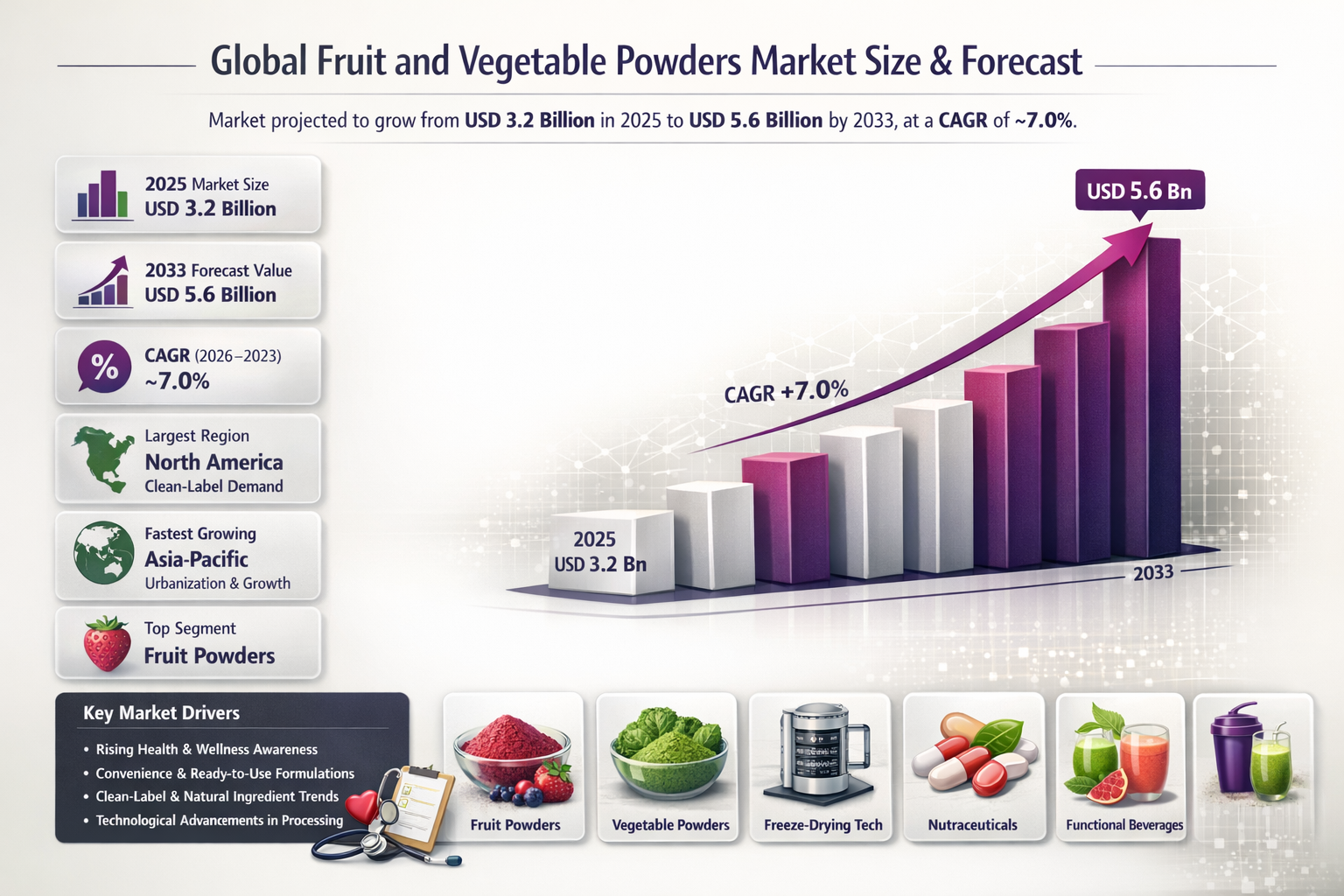
Global Fruit and Vegetable Powders Market Forecast Snapshot: 2026???2033
| Metric | Value |
| 2025 Market Size | USD 3.2 Billion |
| 2033 Market Size | USD 5.6 Billion |
| CAGR (2026???2033) | ~7.0% |
| Largest Region | North America |
| Fastest Growing Region | Asia-Pacific |
| Top Segment | Fruit Powders |
| Key Trend | Clean-Label, Functional & Nutrient-Dense Powders |
| Future Focus | Nutraceutical Integration, Functional Beverages, and Plant-Based Product Innovation |
Global Fruit and Vegetable Powders Market Overview
The Global Fruit and Vegetable Powders Market is experiencing robust growth, driven by rising consumer demand for convenience, clean-label foods, and nutrient-dense functional ingredients. Fruit and vegetable powders???including apple, berry, spinach, kale, and carrot powders???are increasingly incorporated into smoothies, bakery products, functional beverages, dietary supplements, and ready-to-eat foods.
According to Pheonix Research, the Global Fruit and Vegetable Powders Market is valued at USD 3.2 billion in 2025 and is projected to reach USD 5.6 billion by 2033, registering a CAGR of ~7.0% during 2026???2033. Market expansion is fueled by increasing health awareness, innovation in functional and fortified products, and wider penetration across retail, online, and foodservice channels.
North America currently dominates due to strong consumer preference for clean-label and functional ingredients, high disposable income, and advanced retail and distribution infrastructure. Asia-Pacific is the fastest-growing region, supported by urbanization, rising health consciousness, and expanding modern retail networks.
The post-2025 outlook indicates deeper integration into nutraceuticals, functional beverages, and plant-based product portfolios, positioning fruit and vegetable powders as a long-term growth category rather than a niche ingredient.
Key Drivers of Global Fruit and Vegetable Powders Market Growth
Rising Health & Wellness Awareness
Growing consumer focus on vitamins, minerals, and antioxidants is driving demand for fruit and vegetable powders in functional foods and beverages.
Convenience & Ready-to-Use Formulations
Powdered formats enable long shelf life, easy storage, and versatility, appealing to busy urban consumers and food manufacturers.
Clean-Label & Natural Ingredient Trend
The preference for natural, minimally processed, and preservative-free products supports the adoption of fruit and vegetable powders.
Expansion Across Foodservice & Retail Channels
Integration in smoothies, bakery products, snack bars, dietary supplements, and ready-to-eat meals is increasing market penetration.
Technological Advancements in Powder Processing
Freeze-drying, spray-drying, and encapsulation techniques improve nutrient retention, solubility, and flavor, supporting product innovation.
Global Fruit and Vegetable Powders Market Segmentation
?? ?? ??1. By Source
1.1 Fruit Powders 1.1.1 Apple Powder1.1.1.1 Pure Apple Powder
1.1.1.2 Apple Juice Concentrate Powder
1.1.1.3 Organic & Clean-Label Apple Powders
1.1.2 Berry Powder1.1.2.1 Strawberry Powder
1.1.2.1.1 Organic Strawberry Powder
1.1.2.1.2 Freeze-Dried Strawberry Powder
1.1.2.2 Blueberry Powder
1.1.2.2.1 Wild Blueberry Powder
1.1.2.2.2 Cultivated Blueberry Powder
1.1.2.3 Mixed Berry Blends
1.1.2.3.1 Functional Mixed Berry Powder
1.1.2.3.2 Antioxidant-Enriched Berry Blends
1.1.3 Tropical & Exotic Fruit Powders1.1.3.1 Mango Powder
1.1.3.1.1 Freeze-Dried Mango Powder
1.1.3.1.2 Spray-Dried Mango Powder
1.1.3.2 Pineapple Powder
1.1.3.3 Acai & Other Exotic Fruit Powders
1.1.3.3.1 Acai Powder
1.1.3.3.2 Dragon Fruit Powder
1.1.3.3.3 Guava & Papaya Powders
1.2 Vegetable Powders 1.2.1 Leafy Greens1.2.1.1 Spinach Powder
1.2.1.1.1 Organic Spinach Powder
1.2.1.1.2 Freeze-Dried Spinach Powder
1.2.1.2 Kale Powder
1.2.1.2.1 Regular Kale Powder
1.2.1.2.2 High-Protein Kale Powder
1.2.1.3 Chlorella & Algae-Based Powders
1.2.1.3.1 Chlorella Powder
1.2.1.3.2 Spirulina Powder
1.2.2 Root Vegetables1.2.2.1 Carrot Powder
1.2.2.1.1 Organic Carrot Powder
1.2.2.1.2 Spray-Dried Carrot Powder
1.2.2.2 Beetroot Powder
1.2.2.2.1 Freeze-Dried Beetroot Powder
1.2.2.2.2 Functional Beetroot Blends
1.2.2.3 Sweet Potato Powder
1.2.2.3.1 Orange-Fleshed Sweet Potato
1.2.2.3.2 Purple Sweet Potato
1.2.3 Other Vegetables1.2.3.1 Tomato Powder
1.2.3.1.1 Regular Tomato Powder
1.2.3.1.2 High-Lycopene Tomato Powder
1.2.3.2 Broccoli & Cauliflower Powder
1.2.3.2.1 Broccoli Powder
1.2.3.2.2 Cauliflower Powder
1.2.3.3 Mixed Vegetable Powders
1.2.3.3.1 Functional Mixed Vegetable Blends
1.2.3.3.2 High-Fiber Vegetable Powder
?? ?? ?? 2. By Application
2.1 Food & Beverages 2.1.1 Functional Beverages & Smoothies2.1.1.1 Smoothie Powders
2.1.1.2 Functional Drink Mixes
2.1.1.3 Plant-Based Protein Beverage Blends
2.1.2 Bakery & Confectionery2.1.2.1 Cakes & Muffins
2.1.2.1.1 Functional Cake Mixes
2.1.2.1.2 Gluten-Free Cake Powders
2.1.2.2 Cookies & Biscuits
2.1.2.2.1 High-Fiber Cookies
2.1.2.2.2 Antioxidant-Enriched Cookies
2.1.2.3 Pastries & Breads
2.1.2.3.1 Egg-Free Bread Formulations
2.1.2.3.2 Veggie-Enriched Pastries
2.1.3 Dairy & Non-Dairy Products2.1.3.1 Yogurt & Plant-Based Dairy
2.1.3.2 Ice Cream Powders
2.1.3.3 Nutritional Beverages
2.1.4 Ready-to-Eat Meals2.1.4.1 Soup Powders
2.1.4.2 Instant Noodle & Pasta Blends
2.1.4.3 Sauces & Condiment Powders
2.2 Nutraceuticals & Dietary Supplements2.2.1 Capsules & Tablets
2.2.2 Powder Mixes
2.2.3 Protein & Functional Ingredients
2.2.4 Vitamin & Mineral Fortified Powders
2.3 Foodservice & Culinary2.3.1 Restaurants & Caf??s
2.3.2 Hotels & Catering
2.3.3 Institutional Kitchens
2.3.4 Meal Kit Integrations
?? ?? ?? ??3. By Form
3.1 Powder / Fine Granules 3.1.1 Spray-Dried Powders3.1.1.1 Single-Fruit Powders (Apple, Mango, Berry)
3.1.1.2 Single-Vegetable Powders (Carrot, Beetroot, Spinach)
3.1.1.3 Mixed Fruit Powders
3.1.1.4 Mixed Vegetable Powders
3.1.1.5 Functional & Nutraceutical Blends
3.1.2 Freeze-Dried Powders3.1.2.1 Single-Fruit Freeze-Dried Powders
3.1.2.2 Single-Vegetable Freeze-Dried Powders
3.1.2.3 Organic / Clean-Label Freeze-Dried Powders
3.1.2.4 Antioxidant-Enriched Functional Powders
3.1.3 Encapsulated Powders3.1.3.1 Nutrient-Fortified Encapsulates (Vitamins, Minerals)
3.1.3.2 Protein-Enriched Encapsulates
3.1.3.3 Flavored Encapsulated Blends (Fruit, Vegetable, Herb Mixes)
3.1.3.4 Functional Ingredient Encapsulates (Prebiotic, Fiber, Antioxidants)
3.2 Freeze-Dried Chips / Flakes 3.2.1 Vegetable Chips
3.2.1.1 Leafy Vegetable Chips (Spinach, Kale, Chlorella)
3.2.1.2 Root Vegetable Chips (Carrot, Beetroot, Sweet Potato)
3.2.1.3 Mixed Vegetable Chips
3.2.1.4 Nutraceutical-Enriched Vegetable Chips
3.2.2 Fruit Chips3.2.2.1 Tropical Fruit Chips (Mango, Pineapple, Banana)
3.2.2.2 Berry Chips (Strawberry, Blueberry, Acai)
3.2.2.3 Mixed Fruit Chips
3.2.2.4 Functional Fruit Chips (Antioxidant-Enriched, High-Fiber)
3.2.3 Functional Snack Blends3.2.3.1 Fruit-Only Snack Blends
3.2.3.2 Vegetable-Only Snack Blends
3.2.3.3 Fruit & Vegetable Combined Blends
3.2.3.4 Protein & Fiber-Enriched Snack Blends
3.3 Encapsulated Powders (Specialty / Functional) 3.3.1 Nutrient-Fortified Powders
3.3.1.1 Vitamin-Fortified Powders (A, C, D, B-Complex)
3.3.1.2 Mineral-Enriched Powders (Iron, Zinc, Magnesium)
3.3.1.3 Antioxidant-Fortified Powders (Polyphenols, Flavonoids)
3.3.2 Flavored Encapsulated Blends3.3.2.1 Single-Fruit Flavored Powders
3.3.2.2 Mixed Fruit Flavored Powders
3.3.2.3 Vegetable-Flavored Powders
3.3.2.4 Functional Herb-Enhanced Blends
3.3.3 Protein & Fiber Encapsulates3.3.3.1 Plant-Protein Blends (Pea, Soy, Rice)
3.3.3.2 Fiber-Enriched Vegetable Powders
3.3.3.3 Prebiotic-Fortified Blends
3.3.3.4 Protein + Antioxidant Functional Mixes
3.4 Blended Functional Mixes 3.4.1 Fruit-Only Blends
3.4.1.1 Single-Fruit Functional Blends
3.4.1.2 Mixed Berry Functional Powders
3.4.1.3 Tropical Fruit Functional Blends
3.4.1.4 Antioxidant & Vitamin-Fortified Fruit Blends
3.4.2 Vegetable-Only Blends3.4.2.1 Leafy Greens Functional Blends (Spinach, Kale)
3.4.2.2 Root Vegetable Functional Blends (Carrot, Beetroot)
3.4.2.3 Mixed Vegetable Functional Powders
3.4.2.4 Fiber & Mineral-Enriched Vegetable Blends
3.4.3 Mixed Fruit & Vegetable Functional Powders3.4.3.1 Balanced Fruit + Vegetable Powders
3.4.3.2 Protein-Fortified Fruit & Veg Blends
3.4.3.3 Vitamin & Mineral-Enriched Blends
3.4.3.4 Clean-Label Organic Functional Mixes
?? ?? ?? 4. By Distribution Channel
4.1 Retail4.1.1 Supermarkets & Hypermarkets
4.1.2 Specialty Health Stores
4.1.3 Organic & Natural Food Stores
4.2 Online4.2.1 E-Commerce Platforms
4.2.2 Brand-Owned Websites
4.2.3 Subscription-Based Delivery
4.3 Foodservice & Horeca4.3.1 Restaurants & Caf??s
4.3.2 Hotels & Catering
4.3.3 Institutional Suppliers
?? ?? ?? ??5. By End-User
5.1 Individual Consumers5.1.1 Health-Conscious Adults
5.1.2 Fitness Enthusiasts
5.1.3 Children & School-Aged Consumers
5.1.4 Elderly & Functional Nutrition Seekers
5.2 Food Manufacturers5.2.1 Bakery & Confectionery Producers
5.2.2 Functional Food Manufacturers
5.2.3 Beverage Companies
5.2.4 Nutraceutical & Supplement Producers
5.3 Foodservice Operators5.3.1 QSR Chains
5.3.2 Hotels & Resorts
5.3.3 Institutional Kitchens
5.3.4 Catering Services
?? ?? 6. By Region
6.1 North America6.2 Europe
6.3 Asia-Pacific
6.4 Middle East & Africa
6.5 South America
Regional Insights of Global Fruit & Vegetable Powders Market
North America ??? Largest Market
??The region leads due to strong consumer preference for functional and clean-label products, advanced retail and distribution infrastructure, and a health-conscious population driving consistent demand.
Asia-Pacific ??? Fastest Growing Market
??Rapid urbanization, expanding middle-class populations, heightened awareness of functional ingredients, and growing penetration of modern retail channels are fueling accelerated market growth.
Europe
??Market expansion is supported by sustainability initiatives, rising plant-based and functional food trends, and favorable regulatory approvals that enable commercial scaling of fruit and vegetable powders.
Middle East & Africa
Growth is driven by increasing health awareness, the rise of premium retail formats, and growing imports of functional fruit and vegetable powders from global brands.
South America
??Adoption is strengthened by increasing health consciousness, integration into foodservice and quick-service channels, and expansion of urban retail networks.
Leading Companies of Global Fruit and Vegetable Powders Market
-
Ingredion Incorporated
-
Cargill, Inc.
-
Givaudan SA
-
SunOpta Inc.
-
FutureCeuticals, Inc.
-
Doehler Group
-
DSM Nutritional Products AG
-
Corbion N.V.
Leading companies focus on product innovation, functional blends, clean-label powders, and expansion into emerging markets.
Strategic Intelligence & AI-Backed Insights
Pheonix Demand Forecast Engine: Projects robust double-digit growth in fruit and vegetable powders across functional foods, beverages, dietary supplements, and fortified formulations.
Consumer Behavior Analyzer: Identifies health-conscious adults, fitness enthusiasts, and parents of children as the key adopters driving market demand.
Innovation Tracker: Highlights advancements in clean-label formulations, freeze-drying and encapsulation technologies, and development of functional ingredient blends for enhanced nutritional and sensory benefits.
Porter???s Five Forces Analysis: Indicates moderate supplier bargaining power, intense competitive rivalry, and significant growth opportunities for brands differentiating through premium quality, innovation, and functional benefits.
Why the Global Fruit & Vegetable Powders Market is Critical
Rising Health & Nutrition Awareness
Consumers are increasingly prioritizing nutrient-dense, functional, and plant-based ingredients, driving sustained demand for fruit and vegetable powders.
Functional Food & Beverage Integration
Powders are versatile ingredients used in smoothies, supplements, bakery products, and ready-to-eat meals, enabling manufacturers to enhance nutritional profiles and meet evolving dietary trends.
Clean-Label & Natural Ingredient Trends
??Growing preference for minimally processed, organic, and clean-label formulations positions the market as essential for manufacturers seeking consumer trust and regulatory compliance.
Convenience & Shelf-Life Advantages
??Fruit and vegetable powders offer extended shelf-life, easy storage, and simplified formulation, supporting product innovation in retail, foodservice, and nutraceutical segments.
Sustainability & Resource Efficiency
??By reducing spoilage, transportation weight, and wastage of perishable produce, powders contribute to sustainable production practices, aligning with corporate and regulatory sustainability goals.
Final Takeaway of Global Fruit and Vegetable Powders Market
The Global Fruit and Vegetable Powders Market is evolving from a niche ingredient segment into a key functional and nutritional solutions pillar within the broader food and beverage ecosystem. With a projected CAGR of ~7.0% during 2026???2033, growth is driven by increasing health awareness, rising demand for clean-label products, technological innovations, and wider adoption across retail and foodservice channels.
Companies that prioritize functional blends, freeze-drying and encapsulation technologies, and optimized supply chain strategies are best positioned to capture long-term value. Strategic collaborations, sustained R&D investment, and alignment with consumer health and wellness trends will remain critical competitive differentiators in the post-2025 landscape.
At Pheonix Research, our advanced forecasting models deliver comprehensive revenue analysis, competitive benchmarking, and actionable market intelligence ??? enabling stakeholders to capitalize on emerging opportunities with data-backed confidence and sustainable growth strategies.
???? Social Mentions & Publication Channels
??Explore deeper insights and follow our cross-platform updates on LinkedIn and??X??for continuous intelligence and market coverage.
LinkedIn : https://www.linkedin.com/feed/update/urn:li:activity:7433070085143052288
X : https://x.com/Pheonix_Insight/status/2027307959521587435?s=20
Table of Contents
1. Executive Summary
1.1 Market Forecast Snapshot (2026???2033)
1.1.1 2025 Market Size ??? USD 3.2 Billion
1.1.2 2033 Market Size ??? USD 5.6 Billion
1.1.3 CAGR (2026???2033) ??? ~7.0%
1.2 Key Highlights
1.2.1 Largest Region ??? North America
1.2.2 Fastest Growing Region ??? Asia-Pacific
1.2.3 Dominant Segment ??? Fruit Powders
1.2.4 Key Trend ??? Clean-Label, Functional & Nutrient-Dense Powders
1.2.5 Future Focus ??? Nutraceutical Integration, Functional Beverages & Plant-Based Innovation
1.3 Strategic Insights
1.3.1 Shift Toward Functional & Fortified Ingredients
1.3.2 Clean-Label & Natural Product Acceleration
1.3.3 Retail & Foodservice Penetration Expansion
1.3.4 Long-Term Investment Attractiveness
2. Global Fruit and Vegetable Powders Market Overview
2.1 Market Definition & Scope
2.2 Evolution from Ingredient Additive to Functional Solution
2.3 Value Chain & Processing Technologies
2.4 Raw Material Sourcing & Supply Chain Dynamics
2.5 Regulatory & Labeling Framework
2.6 Post-2025 Market Outlook
3. Key Drivers of Market Growth
3.1 Rising Health & Wellness Awareness
3.2 Convenience & Shelf-Life Advantages
3.3 Clean-Label & Natural Ingredient Demand
3.4 Expansion Across Retail & Foodservice Channels
3.5 Technological Advancements (Freeze-Drying, Spray-Drying, Encapsulation)
3.6 Sustainability & Food Waste Reduction
4. Market Segmentation by Source
4.1 Fruit Powders
4.1.1 Apple Powder
4.1.1.1 Pure Apple Powder
4.1.1.2 Apple Juice Concentrate Powder
4.1.1.3 Organic & Clean-Label Apple Powder
4.1.2 Berry Powders
4.1.2.1 Strawberry Powder
4.1.2.1.1 Organic Strawberry Powder
4.1.2.1.2 Freeze-Dried Strawberry Powder
4.1.2.2 Blueberry Powder
4.1.2.2.1 Wild Blueberry Powder
4.1.2.2.2 Cultivated Blueberry Powder
4.1.2.3 Mixed Berry Blends
4.1.2.3.1 Functional Mixed Berry Powder
4.1.2.3.2 Antioxidant-Enriched Berry Blends
4.1.3 Tropical & Exotic Fruit Powders
4.1.3.1 Mango Powder (Freeze-Dried / Spray-Dried)
4.1.3.2 Pineapple Powder
4.1.3.3 Acai Powder
4.1.3.4 Dragon Fruit Powder
4.1.3.5 Guava & Papaya Powders
4.2 Vegetable Powders
4.2.1 Leafy Greens
4.2.1.1 Spinach Powder
4.2.1.2 Kale Powder
4.2.1.3 Chlorella Powder
4.2.1.4 Spirulina Powder
4.2.2 Root Vegetables
4.2.2.1 Carrot Powder
4.2.2.2 Beetroot Powder
4.2.2.3 Sweet Potato Powder (Orange / Purple Variants)
4.2.3 Other Vegetables
4.2.3.1 Tomato Powder
4.2.3.2 Broccoli Powder
4.2.3.3 Cauliflower Powder
4.2.3.4 Mixed Vegetable Functional Blends
5. Market Segmentation by Application
5.1 Food & Beverages
5.1.1 Functional Beverages & Smoothies
5.1.1.1 Smoothie Powders
5.1.1.2 Functional Drink Mixes
5.1.1.3 Plant-Based Beverage Blends
5.1.2 Bakery & Confectionery
5.1.2.1 Cakes & Muffins
5.1.2.2 Cookies & Biscuits
5.1.2.3 Breads & Pastries
5.1.3 Dairy & Non-Dairy Products
5.1.3.1 Yogurt & Plant-Based Dairy
5.1.3.2 Ice Cream & Frozen Desserts
5.1.3.3 Nutritional Beverage Powders
5.1.4 Ready-to-Eat & Processed Foods
5.1.4.1 Soup Powders
5.1.4.2 Instant Noodles & Pasta Blends
5.1.4.3 Sauces & Condiment Mixes
5.2 Nutraceuticals & Dietary Supplements
5.2.1 Capsules & Tablets
5.2.2 Functional Powder Mixes
5.2.3 Protein & Antioxidant Blends
5.2.4 Vitamin & Mineral Fortified Powders
5.3 Foodservice & Culinary
5.3.1 Restaurants & Caf??s
5.3.2 Hotels & Catering
5.3.3 Institutional Kitchens
5.3.4 Meal Kit Integrations
6. Market Segmentation by Form
6.1 Powder / Fine Granules
6.1.1 Spray-Dried Powders
6.1.2 Freeze-Dried Powders
6.1.3 Encapsulated Powders
6.1.4 Functional & Nutraceutical Blends
6.2 Freeze-Dried Chips / Flakes
6.2.1 Vegetable Chips
6.2.2 Fruit Chips
6.2.3 Functional Snack Blends
6.3 Blended Functional Mixes
6.3.1 Fruit-Only Functional Blends
6.3.2 Vegetable-Only Functional Blends
6.3.3 Mixed Fruit & Vegetable Powders
6.3.4 Protein & Fiber-Enriched Functional Mixes
7. Market Segmentation by Distribution Channel
7.1 Retail
7.1.1 Supermarkets & Hypermarkets
7.1.2 Specialty Health Stores
7.1.3 Organic & Natural Food Stores
7.2 Online
7.2.1 E-Commerce Platforms
7.2.2 Brand-Owned Websites
7.2.3 Subscription-Based Delivery
7.3 Foodservice & HoReCa
7.3.1 Restaurants & Caf??s
7.3.2 Hotels & Catering
7.3.3 Institutional Suppliers
8. Market Segmentation by End-User
8.1 Individual Consumers
8.1.1 Health-Conscious Adults
8.1.2 Fitness Enthusiasts
8.1.3 Children & School-Aged Consumers
8.1.4 Elderly & Functional Nutrition Seekers
8.2 Food Manufacturers
8.2.1 Bakery & Confectionery Producers
8.2.2 Functional Food Manufacturers
8.2.3 Beverage Companies
8.2.4 Nutraceutical & Supplement Producers
8.3 Foodservice Operators
8.3.1 QSR Chains
8.3.2 Hotels & Resorts
8.3.3 Institutional Kitchens
8.3.4 Catering Services
9. Market Segmentation by Region
9.1 North America ??? Largest Market
9.2 Europe
9.3 Asia-Pacific ??? Fastest Growing Region
9.4 Middle East & Africa
9.5 South America
10. Regional Insights
10.1 North America ??? Functional & Clean-Label Leadership
10.2 Asia-Pacific ??? Urbanization & Retail Expansion
10.3 Europe ??? Sustainability & Regulatory Support
10.4 Middle East & Africa ??? Premium & Import-Driven Growth
10.5 South America ??? Health-Driven Adoption
11. Competitive Landscape
11.1 Market Share Analysis
11.2 Competitive Positioning Matrix
11.3 Mergers & Acquisitions
11.4 Innovation & R&D Strategies
11.5 Pricing & Premiumization Trends
12. Leading Companies
12.1 Archer Daniels Midland Company (ADM)
12.2 Kerry Group plc
12.3 Ingredion Incorporated
12.4 Cargill, Inc.
12.5 Givaudan SA
12.6 SunOpta Inc.
12.7 FutureCeuticals, Inc.
12.8 Doehler Group
12.9 DSM Nutritional Products AG
12.10 Corbion N.V.
13. Strategic Intelligence & AI-Backed Insights
13.1 Pheonix Demand Forecast Engine
13.2 Consumer Behavior Analyzer
13.3 Innovation & Technology Tracker
13.4 Porter???s Five Forces Analysis
14. Market Significance
14.1 Role in Functional Food Ecosystem
14.2 Nutraceutical & Supplement Integration
14.3 Clean-Label & Sustainability Contribution
14.4 Retail & Foodservice Transformation
14.5 Long-Term Investment Potential
15. Final Takeaway
15.1 Market Outlook (2026???2033)
15.2 Structural Growth Drivers
15.3 Innovation & Functional Strategy Roadmap
15.4 Competitive Differentiation Strategy
15.5 Strategic Recommendations
16. Appendix
17. About Pheonix Research
18. Disclaimer
Competitive Landscape
Competitive Landscape of the Global Fruit and Vegetable Powders Market
Executive Framing
The Global Fruit and Vegetable Powders Market is witnessing strong growth momentum, driven by increasing demand for clean-label, nutrient-dense, and functional food ingredients. Leading companies such as ADM, Kerry Group, Ingredion, Cargill, and Givaudan are shaping the competitive landscape through product innovation, global sourcing capabilities, and expansion into nutraceutical and functional food segments. The market is transitioning from a niche ingredient category to a mainstream functional nutrition solution.
Current Market Reality
The market operates across food & beverages, nutraceuticals, and foodservice sectors, with demand driven by manufacturers seeking convenient, shelf-stable, and versatile ingredients. Large players leverage advanced processing technologies such as freeze-drying and spray-drying, while smaller companies focus on organic, clean-label, and specialty blends. Supply chain efficiency, quality consistency, and sourcing of raw materials remain critical factors influencing market competitiveness.
Key Signals and Evidence
- Rising demand for functional and nutrient-rich ingredients across food and beverage applications.
- Increasing adoption of clean-label, organic, and minimally processed powder formulations.
- Technological advancements in drying and encapsulation improving product quality and shelf life.
- Growing integration into nutraceuticals, dietary supplements, and functional beverages.
- Rapid expansion in Asia-Pacific driven by urbanization and health awareness.
Strategic Implications
- Technology Investment: Focus on freeze-drying, spray-drying, and encapsulation to enhance nutrient retention and product performance.
- Functional Innovation: Develop antioxidant-rich, protein-enriched, and fortified powder blends.
- Clean-Label Positioning: Expand organic, non-GMO, and preservative-free product portfolios.
- Market Expansion: Strengthen presence in emerging markets, especially Asia-Pacific.
- Supply Chain Optimization: Improve sourcing efficiency and reduce raw material volatility risks.
Forward Outlook
By 2033, the Global Fruit and Vegetable Powders Market is projected to reach USD 5.6 billion, growing at a CAGR of ~7.0%. North America will remain the largest market due to strong demand for functional and clean-label products, while Asia-Pacific will emerge as the fastest-growing region driven by urbanization and expanding consumer awareness.
The market will continue evolving through integration into nutraceuticals, functional beverages, and plant-based innovations. Companies that invest in advanced processing technologies, functional product development, and scalable supply chains will be well-positioned to achieve long-term growth and competitive advantage.
Value Chain
Global Fruit & Vegetable Powders Market: Value Chain & Market Dynamics
Executive Framing
The Global Fruit & Vegetable Powders Market operates within a nutrition-driven, convenience-focused, and ingredient innovation-led ecosystem. Rising consumer demand for clean-label, functional, and nutrient-dense products is accelerating adoption across food, beverage, and nutraceutical industries.
The market follows an ingredient-centric operational model, where manufacturers focus on raw material sourcing, advanced processing technologies, and functional formulation development. This enables scalability while maintaining nutritional integrity and product versatility.
Current Market Reality
The market demonstrates moderate supply chain complexity, driven by dependence on agricultural raw materials and processing technologies such as freeze-drying, spray-drying, and encapsulation. However, extended shelf life of powders reduces logistical challenges compared to fresh produce.
Distribution is omnichannel, spanning B2B ingredient supply, retail, e-commerce, and foodservice, ensuring strong market penetration across multiple end-use industries.
Key Signals and Evidence
- Market growth from USD 3.2 billion (2025) to USD 5.6 billion (2033) at ~7.0% CAGR.
- Rising demand for functional foods, nutraceuticals, and clean-label ingredients.
- Increased adoption in smoothies, bakery, dietary supplements, and ready-to-eat products.
- Technological advancements in freeze-drying, spray-drying, and nutrient encapsulation.
- Expansion across retail, online platforms, and foodservice channels.
Strategic Implications
Companies are focusing on functional ingredient innovation, clean-label positioning, and product diversification to strengthen market presence. Investments in processing technologies and supply chain optimization are improving efficiency and product quality.
Emerging players are leveraging organic certification, premium blends, and nutraceutical integration to differentiate, while established players expand through global sourcing networks and B2B partnerships.
Forward Outlook
The market is expected to evolve into a core functional ingredient segment within the global food and nutraceutical ecosystem, supported by health trends and innovation.
- Growth in functional beverages, supplements, and plant-based product applications
- Expansion of clean-label, organic, and fortified powder formulations
- Adoption of advanced processing technologies for nutrient retention and taste enhancement
- Increasing focus on sustainable sourcing and waste reduction strategies
Companies that integrate innovation, scalable processing, and omnichannel distribution will be best positioned for long-term growth.
Investment Activity
Investment & Funding Dynamics ??? Global Fruit and Vegetable Powders Market
Executive Framing
Current Market Reality
Valued at USD 3.2 billion in 2025 and projected to reach USD 5.6 billion by 2033 (CAGR ~7.0%), the market is expanding across food, beverage, and nutraceutical sectors. North America leads in consumption and innovation, while Asia-Pacific is emerging as a high-growth investment destination. Leading players such as ADM, Kerry Group, and Ingredion are strengthening capabilities through product innovation and global distribution expansion.
Key Signals and Evidence
- Functional Ingredient Innovation: Increased funding toward antioxidant-rich, vitamin-fortified, and functional powder blends.
- Advanced Processing Technologies: Investments in freeze-drying, spray-drying, and encapsulation to enhance nutrient retention and shelf life.
- Nutraceutical Integration: Growing capital allocation toward dietary supplements and functional nutrition applications.
- Clean-Label Product Development: Focus on organic, non-GMO, and minimally processed powders.
- Supply Chain Optimization: Investments in sourcing, storage, and logistics to ensure consistent quality and reduce wastage.
- Retail & E-Commerce Expansion: Growth in direct-to-consumer channels and online health product platforms.
- M&A Activity: Selective acquisitions and partnerships to expand product portfolios and geographic reach.
Strategic Implications
Companies investing in functional innovation, advanced processing capabilities, and clean-label positioning are likely to gain competitive advantage. Investors are prioritizing scalable business models with strong integration across food, beverage, and nutraceutical ecosystems.
Forward Outlook
Between 2026 and 2033, investment activity is expected to remain steady, with increasing focus on functional beverages, plant-based product integration, and nutraceutical applications. Emerging markets and digital distribution channels will play a critical role in shaping future capital allocation strategies.
Technology & Innovation
Global Fruit and Vegetable Powders Market: Technology & Innovation
Executive Framing
The Global Fruit and Vegetable Powders Market is evolving as a critical component of the functional food and nutraceutical ecosystem, driven by increasing demand for clean-label, nutrient-dense, and convenient food ingredients. Technological advancements in drying, encapsulation, and formulation are enabling manufacturers to retain nutritional value while enhancing shelf life, taste, and versatility across applications such as beverages, bakery, supplements, and ready-to-eat meals.
Current Market Reality
Valued at USD 3.2 billion in 2025 and projected to reach USD 5.6 billion by 2033 at a CAGR of ~7.0%, the market is witnessing steady expansion. North America leads due to strong demand for functional and clean-label ingredients, while Asia-Pacific is the fastest-growing region driven by urbanization, rising health awareness, and expanding retail infrastructure. Fruit powders dominate the segment, particularly in smoothies, functional beverages, and nutraceutical applications.
Key Signals and Evidence
- Advanced Drying Technologies: Freeze-drying and spray-drying techniques enhance nutrient retention, color, and flavor stability.
- Encapsulation & Functional Blends: Microencapsulation enables targeted nutrient delivery, improved solubility, and integration into functional foods and supplements.
- Clean-Label & Organic Innovation: Rising demand for minimally processed, preservative-free, and organic powders supports product development.
- Expansion into Functional Foods & Nutraceuticals: Increasing use in dietary supplements, protein blends, and fortified food products.
- Convenience & Shelf-Life Advantages: Powder formats provide extended shelf life, easy storage, and formulation flexibility across industries.
Strategic Implications
Companies focusing on advanced processing technologies, clean-label positioning, and functional product innovation will gain competitive advantage. Strategic expansion into nutraceuticals, plant-based foods, and functional beverages enhances revenue opportunities. Investment in supply chain optimization and sustainable sourcing is essential to ensure quality consistency and scalability.
Forward Outlook
The market is expected to see continued growth through 2033, driven by increasing integration into functional nutrition, plant-based product innovation, and personalized health solutions. Technological advancements in encapsulation, nutrient preservation, and AI-driven formulation will further enhance product performance and expand application scope across global markets.
Market Risk
Risk Factors and Disruption Threats in the Global Fruit and Vegetable Powders Market
Executive Framing
The Global Fruit and Vegetable Powders Market is emerging as a high-potential functional ingredient segment within the broader food and nutraceutical ecosystem. Valued at USD 3.2 billion in 2025 and projected to reach USD 5.6 billion by 2033 at a CAGR of ~7.0%, the market is driven by increasing demand for clean-label, nutrient-dense, and convenient food solutions. Its expanding role across functional foods, beverages, and dietary supplements positions it as a long-term structural growth category.
Current Market Reality
North America leads the global market, supported by strong consumer demand for clean-label and functional products, high disposable income, and advanced retail infrastructure. Asia-Pacific is the fastest-growing region, driven by rapid urbanization, rising health awareness, and expanding modern retail networks. Fruit powders dominate the segment due to their widespread application across food, beverage, and nutraceutical industries.
Key Signals and Evidence
- Increasing consumer focus on vitamins, minerals, and antioxidant-rich ingredients.
- Growing demand for convenient, long shelf-life, and ready-to-use powder formats.
- Strong shift toward clean-label, natural, and minimally processed food products.
- Rapid expansion across foodservice, retail, and nutraceutical applications.
- Advancements in freeze-drying, spray-drying, and encapsulation technologies enhancing product quality.
Strategic Implications
- Invest in advanced processing technologies to improve nutrient retention and functional performance.
- Develop clean-label, fortified, and functional blends to enhance product differentiation.
- Expand into high-growth markets such as Asia-Pacific through strong distribution partnerships.
- Capitalize on opportunities in nutraceuticals, functional beverages, and plant-based innovation.
- Strengthen sustainable sourcing and supply chain efficiency to align with ESG and regulatory trends.
Forward Outlook
The market is expected to witness sustained growth, driven by increasing integration into functional foods, dietary supplements, and ready-to-eat products. Post-2025, innovation in encapsulation, personalized nutrition, and sustainable production will define competitive advantage. Companies focusing on premium quality, scalability, and functional innovation will be best positioned to capture long-term growth opportunities in the evolving global food landscape.
Regulatory Landscape
Regulatory & Policy Landscape: Global Fruit & Vegetable Powders Market
Executive Framing
The Global Fruit & Vegetable Powders Market operates under stringent global food safety, processing, and labeling regulations. Key regulatory bodies include the U.S. Food and Drug Administration (FDA), European Food Safety Authority (EFSA), Food Safety and Standards Authority of India (FSSAI), and Codex Alimentarius. Products such as fruit powders, vegetable powders, functional blends, and nutraceutical ingredients must comply with standards related to hygiene, pesticide residues, additives, and nutritional labeling.
Advanced product categories such as organic powders, clean-label ingredients, and nutrient-fortified blends are subject to additional certifications. Claims such as ???natural,??? ???organic,??? ???no additives,??? ???high in vitamins,??? or ???antioxidant-rich??? require scientific validation and regulatory approval to ensure transparency and consumer safety.
Current Market Reality
North America dominates the market with strict regulatory enforcement on food safety, traceability, and labeling standards, particularly for clean-label and functional food ingredients. Regulatory compliance is critical for retail and nutraceutical distribution.
Asia-Pacific is the fastest-growing region, but regulatory frameworks vary significantly across countries. Manufacturers must navigate different standards related to food additives, labeling requirements, and import/export regulations, increasing compliance complexity for global players.
Key Signals and Evidence
- Strict limits on pesticide residues, contaminants, and heavy metals in fruit and vegetable powders.
- Mandatory labeling requirements including nutritional values, ingredient sourcing, and allergen disclosure.
- Certification requirements for organic, non-GMO, and clean-label products.
- Regulations governing functional and nutraceutical claims such as vitamins, minerals, and antioxidants.
- Quality and safety standards for drying technologies including freeze-drying and spray-drying processes.
- Increasing focus on sustainable sourcing, traceability, and environmentally responsible production practices.
Strategic Implications
Compliance with global regulatory standards is essential for market entry, particularly in high-value regions such as North America and Europe. Companies must invest in quality assurance systems, supply chain traceability, and certification processes to maintain regulatory alignment.
Manufacturers focusing on clean-label, organic, and functional powders must ensure accurate labeling and validated claims. Adoption of advanced processing technologies, sustainable sourcing, and transparent supply chains enhances both regulatory compliance and competitive positioning.
Forward Outlook
Regulatory frameworks are expected to become more stringent, especially for functional, fortified, and nutraceutical applications of fruit and vegetable powders. Harmonization of global standards may improve cross-border trade but will require higher compliance investments.
Emerging technologies such as blockchain-enabled traceability, AI-driven quality monitoring, and digital compliance systems will play a key role in ensuring regulatory adherence. Companies that proactively align with evolving standards and sustainability mandates will secure long-term growth opportunities.