
Global Mango Market size and share Analysis 2026-2033
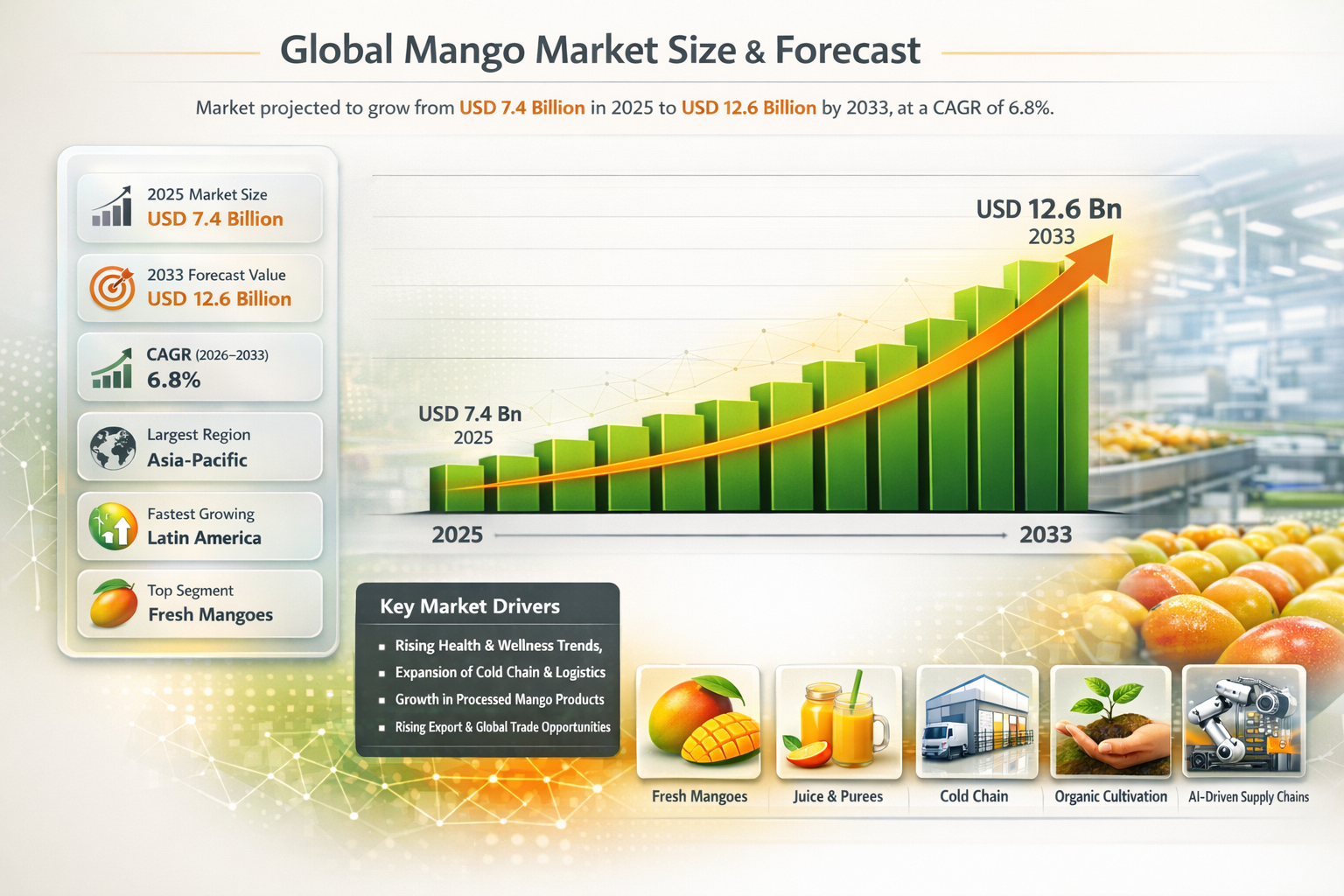
Global Mango Market Forecast Snapshot: 2026???2033
| Metric | Value |
|---|---|
| 2025 Market Size | USD 7.4 Billion |
| 2033 Market Size | USD 12.6 Billion |
| CAGR (2026???2033) | 6.8% |
| Largest Region | Asia-Pacific |
| Fastest Growing Region | Latin America |
| Top Segment | Fresh Mangoes |
| Key Trend | Organic Cultivation & Cold Chain Optimization |
| Future Focus | Value-Added Mango Products, Sustainable Farming, AI-Driven Supply Chain Management |
Global Mango Market Overview
Global Mango Market Mangoes are rich in vitamins, minerals, and antioxidants, making them a staple fruit in both fresh and processed forms. In the Global Mango Market, increasing consumer awareness of health benefits and rising demand for tropical fruit-based products are significantly driving consumption. Additionally, expanding applications in beverages, desserts, and packaged food products continue to strengthen the market???s growth trajectory.
According to Pheonix Research, the Global Mango Market is valued at USD 7.4 billion in 2025 and is projected to reach USD 12.6 billion by 2033, registering a CAGR of 6.8% during 2026???2033. This growth is underpinned by increasing global consumption, rising awareness of health benefits, expansion of cold chain infrastructure, and innovation in mango-based product lines.
Asia-Pacific leads the market due to large-scale production in India, China, Thailand, and the Philippines. Meanwhile, Latin America is the fastest-growing region, fueled by Brazil, Mexico, and Peru, driven by export growth, favorable climate, and rising international demand.
Post-2025, the market is evolving toward organic and sustainable farming practices, AI-driven supply chain optimization, and value-added mango products, creating opportunities for enhanced shelf life, quality, and profitability.
Key Drivers of Global Mango Market Growth
-
Rising Health & Wellness Trends
Increasing consumer awareness about the nutritional benefits of mangoes, including vitamins, antioxidants, and immunity-boosting properties, is driving higher demand for both fresh and processed mango products globally. -
Expansion of Cold Chain & Logistics Infrastructure
Improvements in cold storage facilities, refrigerated transportation, and advanced packaging solutions are extending product shelf life and enabling wider domestic and international distribution. -
Growth in Processed Mango Products
Rising consumption of mango-based juices, purees, dried mango, jams, desserts, and snack products is significantly contributing to the expansion of the processed mango segment. -
Favorable Climate & Improved Cultivation Practices
Tropical and subtropical countries are increasing production capacity through advanced farming techniques, high-yield crop varieties, irrigation improvements, and mechanized harvesting systems. -
Rising Export & Global Trade Opportunities
Strong international demand, particularly from North America, Europe, and the Middle East, is accelerating export volumes and supporting overall market revenue growth.
Global Mango Market Segmentation
1. By Product Type
1.1 Fresh Mangoes
1.1.1 Whole Mangoes
1.1.1.1 Domestic Consumption
1.1.1.2 Export Markets
1.2 Processed Mango Products
1.2.1 Mango Juice & Nectar
1.2.1.1 Retail Beverages
1.2.1.2 Food Service Industry
1.2.2 Mango Puree & Concentrates
1.2.2.1 Bakery & Confectionery
1.2.2.2 Frozen Dessert Applications
1.2.3 Dried Mango & Snacks
1.2.3.1 Packaged Consumer Snacks
1.2.3.2 Functional Food Ingredients
2. By Distribution Channel
2.1 Supermarkets & Hypermarkets
2.1.1 Fresh Produce Sections
2.1.1.1 Seasonal Mango Displays
2.1.1.1.1 Local Varieties
2.1.1.1.2 Imported Varieties
2.1.2 Packaged & Branded Products
2.1.2.1 Pre-Sliced Mangoes
2.1.2.1.1 Convenience Packs
2.1.2.1.2 Premium Imported Packs
2.2 Online Retail & E-Commerce
2.2.1 Direct-to-Consumer Delivery
2.2.1.1 Single Orders
2.2.1.1.1 Domestic Shipping
2.2.1.1.2 International Shipping
2.2.2 Subscription Boxes & Specialty Fruit Services
2.2.2.1 Seasonal Mango Boxes
2.2.2.1.1 Organic Varieties
2.2.2.1.2 Exotic & Rare Varieties
2.3 Traditional Retail
2.3.1 Local Markets & Fruit Stalls
2.3.1.1 Street Vendors
2.3.1.1.1 Urban Markets
2.3.1.1.2 Rural Markets
2.3.2 Wholesale Distributors
2.3.2.1 Aggregation & Sorting Centers
2.3.2.1.1 Domestic Distribution
2.3.2.1.2 Export Supply Chains
2.4 Food Service & Institutional
2.4.1 Hotels & Restaurants
2.4.1.1 Gourmet Dishes
2.4.1.1.1 Desserts & Platters
2.4.1.1.2 Smoothies & Beverages
2.4.2 Juice Bars & Cafes
2.4.2.1 Ready-to-Drink Mango Beverages
2.4.2.1.1 Cold-Pressed Juices
2.4.2.1.2 Mango Smoothies & Shakes
3. By Cultivation Type
3.1 Conventional Mango Farming
3.1.1 High-Yield Varieties
3.1.1.1 Local Cultivation
3.1.1.2 Export-Oriented Production
3.2 Organic Mango Farming
3.2.1 Certified Organic Farms
3.2.1.1 Domestic Organic Markets
3.2.1.2 International Export Markets
3.3 Sustainable & Integrated Farming
3.3.1 Water-Efficient Irrigation Systems
3.3.1.1 Drip Irrigation Practices
3.3.1.2 Rainwater Harvesting Integration
3.3.2 Soil Health & Biodiversity
3.3.2.1 Crop Rotation & Intercropping
3.3.2.2 Reduced Chemical Fertilizers & Pesticides
4. By Region
4.1 Asia-Pacific
4.2 Latin America
4.3 North America
4.4 Europe
4.5 Middle East & Africa
Regional Insights of Global Mango Market
Asia-Pacific ??? Largest Market
Asia-Pacific dominates due to major production hubs in India, China, Thailand, and the Philippines, coupled with high domestic consumption and established export networks. These factors maintain the region???s leadership in both volume and revenue.
Latin America ??? Fastest Growing Market
Brazil, Mexico, and Peru are rapidly expanding export capabilities to North America and Europe, supported by favorable climate conditions, mechanized farming practices, and government trade incentives, driving accelerated market growth.
North America
Rising imports of fresh and processed mango products, along with growing health-conscious consumer demand and diverse culinary trends, are strengthening the market in the United States and Canada.
Europe
Increasing preference for organic mangoes and processed mango products, combined with stringent food safety regulations and quality standards, is driving steady market growth across the region.
Middle East & Africa
Urbanization, rising disposable incomes, and increasing fruit imports are supporting consistent demand for fresh and processed mango products in key markets such as the UAE, Saudi Arabia, South Africa, and Kenya.
Leading Companies in the Global Mango Market
-
KP Foods Pvt Ltd.
-
Godrej Agrovet Ltd.
-
Vedant Agro Limited
-
Del Monte Fresh Produce
-
ITC Limited (Mango Products)
-
Fresh Del Monte Produce Inc.
-
National Mango Board
These companies lead through integrated farming, processing capabilities, cold chain management, and global distribution networks.
Strategic Intelligence & Market Insights
Pheonix Demand Forecast Engine identifies growing international mango trade, rising adoption of organic cultivation, and increasing consumer preference for processed mango products as primary long-term growth catalysts.
Supply Chain & Infrastructure Analyzer indicates significant investment in cold storage, AI-driven logistics, and sustainable packaging as critical factors for improving profitability and minimizing post-harvest losses.
Innovation Tracker highlights frozen mango products, ready-to-drink mango beverages, functional mango snacks, and value-added mango derivatives as major competitive differentiators.
Porter???s Five Forces Analysis reveals moderate supplier power, high capital and operational intensity barriers, strong competitive rivalry among global mango producers, and increasing differentiation driven by product innovation and organic certification.
Why the Global Mango Market Remains Critical
-
Provides essential nutrients and health benefits to consumers worldwide
-
Supports rural economies and employment in producing countries
-
Drives innovation in processed fruit products and beverages
-
Enhances international trade and export revenue
-
Encourages sustainable and organic agriculture practices
Final Takeaway of Global Mango Market
The Global Mango Market is projected to grow steadily at a CAGR of 6.8% during 2026???2033, fueled by rising demand for fresh and processed mango products, expanding export opportunities, and adoption of sustainable and organic farming practices.
Companies focusing on organic cultivation, value-added mango products, cold chain optimization, and AI-enabled supply chain management are well-positioned to secure long-term competitive advantage in this evolving market landscape.
At Pheonix Research, our comprehensive market intelligence framework provides in-depth revenue forecasts, regional insights, supply chain analysis, and innovation benchmarking, empowering stakeholders to capitalize on next-generation mango market opportunities with data-driven confidence.
???? Social Mentions & Publication Channels
??Explore deeper insights and follow our cross-platform updates on LinkedIn??and??X??for continuous intelligence and market coverage.
LinkedIn : https://www.linkedin.com/feed/update/urn:li:activity:7434268640688119808
X :https://x.com/Pheonix_Insight/status/2028508177650921964?s=20
Table of Contents
1. Executive Summary
1.1 Market Forecast Snapshot (2026???2033)
1.2 Global Market Size & CAGR Analysis
1.3 Largest & Fastest-Growing Segments
1.4 Region-Level Leadership & Growth Trends
1.5 Key Market Drivers
1.6 Competitive Landscape Overview
1.7 Strategic Outlook Through 2033
2. Introduction & Market Overview
2.1 Definition of the Global Mango Market
2.2 Scope of the Study
2.3 Evolution from Fresh Consumption to Processed Products
2.4 Role of Cold Chain Infrastructure & Supply Optimization
2.5 Impact of Health & Wellness Trends
2.6 Integration of Sustainable & Organic Farming Practices
2.7 AI-Driven Supply Chain Management & Value-Added Products
3. Research Methodology
3.1 Primary Research
3.2 Secondary Research
3.3 Market Size Estimation Model
3.4 Forecast Assumptions (2026???2033)
3.5 Data Validation & Triangulation
4. Market Dynamics
4.1 Drivers
4.1.1 Rising Health & Wellness Trends
4.1.2 Expansion of Cold Chain & Logistics Infrastructure
4.1.3 Growth in Processed Mango Products (Juices, Purees, Snacks)
4.1.4 Favorable Climate & Cultivation Practices
4.1.5 Rising Export & Trade Opportunities
4.2 Restraints
4.2.1 Vulnerability to Climate Change & Extreme Weather
4.2.2 Limited Shelf Life of Fresh Mangoes
4.2.3 Price Volatility in International Trade
4.2.4 Regulatory Compliance & Organic Certification Costs
4.3 Opportunities
4.3.1 Organic Mango Farming Expansion
4.3.2 Value-Added Mango Products (Frozen, Snacks, Beverages)
4.3.3 AI-Driven Supply Chain & Cold Storage Optimization
4.3.4 Export Market Expansion in Emerging Economies
4.4 Challenges
4.4.1 Pest & Disease Management
4.4.2 High Capital Requirements for Cold Chain Infrastructure
4.4.3 Maintaining Quality Across Long Supply Chains
4.4.4 Competition from Alternative Fruits & Tropical Products
5. Global Mango Market Analysis (USD Billion), 2026???2033
5.1 Market Size Overview
5.2 CAGR Analysis
5.3 Region-Wise Revenue Distribution
5.4 Product Type Revenue Split
5.5 Distribution Channel Revenue Trends
5.6 Cultivation Type Impact Analysis
6. Market Segmentation by Product Type (USD Billion), 2026???2033
6.1 Fresh Mangoes
6.1.1 Whole Mangoes
6.1.1.1 Domestic Consumption
6.1.1.2 Export Markets
6.2 Processed Mango Products
6.2.1 Mango Juice & Nectar
6.2.1.1 Retail Beverages
6.2.1.2 Food Service Industry
6.2.2 Mango Puree & Concentrates
6.2.2.1 Bakery & Confectionery Applications
6.2.2.2 Frozen Dessert Applications
6.2.3 Dried Mango & Snacks
6.2.3.1 Packaged Consumer Snacks
6.2.3.2 Functional Food Ingredients
7. Market Segmentation by Distribution Channel (USD Billion), 2026???2033
7.1 Supermarkets & Hypermarkets
7.1.1 Fresh Produce Sections
7.1.1.1 Seasonal Mango Displays
7.1.1.1.1 Local Varieties
7.1.1.1.2 Imported Varieties
7.1.2 Packaged & Branded Products
7.1.2.1 Pre-Sliced Mangoes
7.1.2.1.1 Convenience Packs
7.1.2.1.2 Premium Imported Packs
7.2 Online Retail & E-Commerce
7.2.1 Direct-to-Consumer Delivery
7.2.1.1 Domestic Shipping
7.2.1.2 International Shipping
7.2.2 Subscription Boxes & Specialty Fruit Services
7.2.2.1 Seasonal Mango Boxes
7.2.2.1.1 Organic Varieties
7.2.2.1.2 Exotic & Rare Varieties
7.3 Traditional Retail
7.3.1 Local Markets & Fruit Stalls
7.3.1.1 Urban Markets
7.3.1.2 Rural Markets
7.3.2 Wholesale Distributors
7.3.2.1 Domestic Distribution
7.3.2.2 Export Supply Chains
7.4 Food Service & Institutional
7.4.1 Hotels & Restaurants
7.4.1.1 Desserts & Platters
7.4.1.2 Smoothies & Beverages
7.4.2 Juice Bars & Caf??s
7.4.2.1 Cold-Pressed Juices
7.4.2.2 Mango Smoothies & Shakes
8. Market Segmentation by Cultivation Type (USD Billion), 2026???2033
8.1 Conventional Mango Farming
8.1.1 High-Yield Varieties
8.1.1.1 Local Cultivation
8.1.1.2 Export-Oriented Production
8.2 Organic Mango Farming
8.2.1 Certified Organic Farms
8.2.1.1 Domestic Organic Markets
8.2.1.2 International Export Markets
8.3 Sustainable & Integrated Farming
8.3.1 Water-Efficient Irrigation Systems
8.3.1.1 Drip Irrigation Practices
8.3.1.2 Rainwater Harvesting Integration
8.3.2 Soil Health & Biodiversity
8.3.2.1 Crop Rotation & Intercropping
8.3.2.2 Reduced Chemical Fertilizers & Pesticides
9. Market Segmentation by Geography
9.1 Asia-Pacific ??? Largest Market
9.2 Latin America ??? Fastest Growing Market
9.3 North America
9.4 Europe
9.5 Middle East & Africa
10. Competitive Landscape ??? Global
10.1 Market Share Analysis
10.2 Product Portfolio Benchmarking
10.3 Organic vs. Conventional Cultivation Mapping
10.4 Supply Chain & Cold Chain Partnerships
10.5 Competitive Intensity & Differentiation Strategies
11. Company Profiles
11.1 Alphonso Agro Exports
11.2 Chitale Agro Industries
11.3 KP Foods Pvt Ltd.
11.4 Godrej Agrovet Ltd.
11.5 Vedant Agro Limited
11.6 Dole Food Company
11.7 Del Monte Fresh Produce
11.8 ITC Limited (Mango Products)
11.9 Fresh Del Monte Produce Inc.
11.10 National Mango Board
12. Strategic Intelligence & Pheonix AI-Backed Insights
12.1 Pheonix Demand Forecast Engine
12.2 Supply Chain & Infrastructure Analyzer
12.3 AI-Driven Logistics Optimization Tracker
12.4 Value-Added Product Innovation Insights
12.5 Automated Porter???s Five Forces Analysis
13. Future Outlook & Strategic Recommendations
13.1 Organic Cultivation Expansion
13.2 Cold Chain Optimization & AI Integration
13.3 Value-Added Mango Product Development
13.4 Export Market Growth Strategies
13.5 Long-Term Market Outlook (2033+)
14. Appendix
15. About Pheonix Research
16. Disclaimer
Competitive Landscape
Competitive Landscape of the Global Mango Market
Executive Framing
The Global Mango Market is characterized by a fragmented yet consolidating structure, led by major producers such as Dole Food Company, Del Monte Fresh Produce, ITC Limited, and Alphonso Agro Exports. Alongside these players, numerous regional growers and processors compete across fresh and processed segments, focusing on domestic consumption, export markets, and value-added mango products.
Current Market Reality
Asia-Pacific dominates production with India, China, Thailand, and the Philippines as key hubs. Fresh mangoes account for the largest share, while processed products like juice, puree, dried mango, and snacks are rapidly growing. Latin America is emerging as the fastest-growing region, driven by export growth and expanding international demand.
Leading companies are leveraging cold chain infrastructure, AI-driven supply chain management, and sustainable farming practices to maintain competitiveness. Consumer preference for organic and value-added mango products is reshaping cultivation and production strategies globally.
Key Signals and Evidence
- Rising global demand for fresh and processed mango products.
- Expansion of cold chain and logistics infrastructure enabling wider distribution.
- Increasing adoption of organic and sustainable farming practices.
- Innovation in value-added mango products such as juices, purees, and snacks.
- Growing export volumes from Latin America to North America and Europe.
Strategic Implications
- Value-Added Product Development: Invest in mango-based beverages, frozen desserts, and snack innovations.
- Export Growth: Strengthen global trade networks and market reach.
- Organic & Sustainable Farming: Expand certified organic and environmentally friendly cultivation.
- Supply Chain Optimization: Leverage AI-enabled logistics and cold storage solutions.
- Consumer Engagement: Educate and promote health benefits of mango products.
Forward Outlook
The Global Mango Market is projected to grow from USD 7.4 billion in 2025 to USD 12.6 billion by 2033, at a CAGR of 6.8%. Asia-Pacific will continue to lead production, while Latin America will be the fastest-growing region due to favorable climate, advanced farming, and export expansion.
Future competition will be driven by innovations in processed mango products, AI-driven supply chain management, and sustainable agricultural practices. Companies focusing on organic cultivation, value-added product portfolios, and efficient logistics will secure long-term market leadership.
Value Chain
Global Mango Market: Value Chain & Market Dynamics
Executive Framing
The Global Mango Market operates within an agriculture-driven and export-oriented ecosystem, supported by strong demand for tropical fruits, natural nutrition, and functional food ingredients. Mangoes are increasingly positioned as both a fresh consumption staple and a value-added ingredient across beverages, desserts, and packaged food segments.
The market follows an agricultural production model with integrated processing and export networks, enabling scalability across domestic consumption and international trade.
Current Market Reality
The market exhibits moderate supply chain complexity, driven by seasonal production cycles, perishability, and reliance on cold chain logistics and export infrastructure. However, advancements in storage, packaging, and transportation are improving shelf life and reducing post-harvest losses.
Distribution is omnichannel, spanning traditional markets, supermarkets, e-commerce platforms, and foodservice channels, ensuring broad accessibility across global markets.
Key Signals and Evidence
- Market growth from USD 7.4 billion (2025) to USD 12.6 billion (2033) at a CAGR of 6.8%.
- Rising demand for fresh and processed mango products including juices, purees, and dried snacks.
- Expansion of global export markets driven by Latin America and Asia-Pacific production hubs.
- Increasing adoption of organic and sustainable farming practices.
- Growth in cold chain infrastructure and AI-driven supply chain optimization.
Strategic Implications
Market players are focusing on value-added product innovation, export expansion, and supply chain modernization to strengthen competitiveness. Investments in cold storage, logistics, and processing facilities are critical for minimizing losses and improving product quality.
Companies are also leveraging organic certification, premium product positioning, and branded exports to capture higher-margin segments and meet evolving consumer preferences.
Forward Outlook
The Global Mango Market is expected to evolve into a high-value agricultural and processed fruit segment, supported by increasing global demand and technological advancements.
- Expansion of processed mango products such as beverages, snacks, and functional ingredients
- Growth in organic and sustainable cultivation practices
- Increasing investment in cold chain and AI-driven logistics systems
- Strengthening of global trade networks and export-oriented supply chains
Companies that integrate efficient farming, advanced logistics, and product innovation will be best positioned to capture long-term growth opportunities.
Investment Activity
Investment & Funding Dynamics ??? Global Mango Market
Executive Framing
Current Market Reality
Valued at USD 7.4 billion in 2025 and projected to reach USD 12.6 billion by 2033 (CAGR 6.8%), the market is led by Asia-Pacific, with Latin America emerging as the fastest-growing export hub. Key players such as Dole, Del Monte, and regional producers are investing in value-added product development, export expansion, and supply chain optimization.
Key Signals and Evidence
- Cold Chain Expansion: Increased investment in storage, refrigeration, and logistics to reduce post-harvest losses.
- Processed Product Growth: Capital allocation toward mango juices, purees, dried snacks, and ready-to-eat products.
- Export Infrastructure Development: Strengthening global trade networks and compliance with international quality standards.
- Organic & Sustainable Farming: Rising investments in eco-friendly cultivation and certified organic mango production.
- AI-Driven Supply Chain: Adoption of digital tools for demand forecasting, inventory management, and logistics optimization.
- Retail & Foodservice Integration: Expansion through supermarkets, online platforms, and HoReCa channels.
- M&A Activity: Selective partnerships and regional consolidation to strengthen supply chain and distribution reach.
Strategic Implications
Companies focusing on export scalability, processed product innovation, and supply chain efficiency are best positioned for long-term growth. Investors are prioritizing integrated operations, sustainable farming practices, and technology-driven logistics to enhance profitability and competitiveness.
Forward Outlook
Between 2026 and 2033, investment activity is expected to rise steadily, supported by growing international demand, advancements in cold chain infrastructure, and increasing adoption of AI-driven supply chain management. Value-added mango products and organic farming will remain key investment areas.
Technology & Innovation
Global Mango Market: Technology & Innovation
Executive Framing
Technology and innovation in the Global Mango Market are increasingly focused on enhancing agricultural productivity, improving post-harvest management, and expanding value-added product development. With rising global demand for fresh and processed mango products, stakeholders are adopting advanced farming techniques, cold chain optimization, and AI-driven supply chain solutions to improve quality, reduce waste, and maximize profitability.
Current Market Reality
Valued at USD 7.4 billion in 2025 and projected to reach USD 12.6 billion by 2033 at a CAGR of 6.8%, the market is experiencing steady innovation across cultivation, logistics, and processing. Asia-Pacific leads production through large-scale farming, while Latin America is rapidly advancing export-oriented innovations supported by improved infrastructure and mechanization.
Key Signals and Evidence
- Advanced Cultivation Techniques: Adoption of high-yield varieties, precision irrigation, and integrated pest management to improve crop output and quality.
- Cold Chain & Post-Harvest Innovation: Expansion of refrigerated storage, controlled atmosphere systems, and advanced packaging to extend shelf life.
- Processed Product Development: Growth in mango-based juices, purees, dried snacks, and ready-to-eat products.
- AI-Driven Supply Chain Optimization: Use of data analytics and AI for demand forecasting, inventory management, and logistics efficiency.
- Sustainable & Organic Farming: Increasing focus on eco-friendly cultivation practices and certified organic mango production.
Strategic Implications
Companies investing in cold chain infrastructure, advanced farming technologies, and value-added processing capabilities will gain competitive advantage. Expanding into global export markets and diversifying product portfolios into functional and convenience-based offerings can significantly enhance revenue streams. Sustainability and traceability will also become key differentiators in premium markets.
Forward Outlook
The market is expected to evolve toward AI-enabled supply chains, sustainable farming practices, and increased production of value-added mango products. Future innovation will focus on improving shelf life, enhancing product quality, and expanding global distribution networks, positioning mangoes as a key fruit category within the global food and beverage ecosystem.
Market Risk
Risk Factors and Disruption Threats in the Global Mango Market
Executive Framing
The Global Mango Market is positioned as a high-growth tropical fruit segment driven by increasing global consumption, expanding export opportunities, and rising demand for nutrient-rich food products. Valued at USD 7.4 billion in 2025 and projected to reach USD 12.6 billion by 2033 at a CAGR of 6.8%, the market is benefiting from improvements in cold chain infrastructure, product innovation, and sustainable farming practices.
Current Market Reality
Asia-Pacific dominates the global mango market due to large-scale production and consumption in countries such as India, China, Thailand, and the Philippines. Latin America is the fastest-growing region, supported by strong export growth from Brazil, Mexico, and Peru. Fresh mangoes remain the leading segment, while processed mango products are rapidly gaining traction across retail and foodservice channels.
Key Signals and Evidence
- Rising consumer demand for vitamin-rich and antioxidant-packed tropical fruits.
- Expansion of cold chain and logistics infrastructure improving product shelf life and global distribution.
- Growing consumption of processed mango products such as juices, purees, dried snacks, and desserts.
- Advancements in cultivation techniques and high-yield farming practices increasing production capacity.
- Increasing global trade and export demand across North America, Europe, and the Middle East.
Strategic Implications
- Invest in cold chain optimization and logistics to reduce post-harvest losses and improve quality.
- Focus on value-added mango products such as beverages, snacks, and functional food ingredients.
- Expand organic and sustainable farming practices to meet evolving consumer and regulatory demands.
- Leverage AI-driven supply chain management to enhance efficiency and traceability.
- Strengthen export strategies and global distribution networks to capture international demand.
Forward Outlook
The market is expected to witness strong growth driven by rising health awareness, increasing demand for tropical fruits, and expansion of processed food applications. Post-2025, innovation in product development, sustainable agriculture, and advanced logistics will shape market competitiveness. Companies focusing on quality, scalability, and global market expansion will be well-positioned to capture long-term growth opportunities.
Regulatory Landscape
Regulatory & Policy Landscape: Global Mango Market
Executive Framing
The Global Mango Market operates under agricultural production, food safety, and international trade regulations governed by authorities such as the U.S. Department of Agriculture (USDA), European Food Safety Authority (EFSA), Food Safety and Standards Authority of India (FSSAI), and Codex Alimentarius. Fresh and processed mango products must comply with standards related to pesticide residues, quality grading, hygiene, packaging, and export-import requirements.
Value-added mango products???including juices, purees, dried mango, and functional food ingredients???are subject to additional regulatory scrutiny around additives, preservatives, labeling, and nutritional claims. Certifications such as ???organic,??? ???non-GMO,??? and ???sustainably sourced??? require strict compliance and verification across global markets.
Current Market Reality
Asia-Pacific dominates the market due to large-scale mango production and strong domestic consumption, supported by government-backed agricultural policies and export frameworks. Regulatory oversight primarily focuses on crop quality, pesticide control, and export compliance.
Latin America is the fastest-growing region, driven by increasing exports to North America and Europe. Countries like Mexico, Brazil, and Peru must comply with strict international standards related to food safety, traceability, and quality certification to access premium markets.
Key Signals and Evidence
- Strict limits on pesticide residues and contaminants in fresh mango exports.
- Mandatory grading, sorting, and quality standards for domestic and international trade.
- Labeling requirements for processed mango products including ingredient and nutritional disclosure.
- Certification requirements for organic, fair-trade, and sustainably sourced mangoes.
- Cold chain compliance and phytosanitary regulations for international shipments.
- Increasing focus on traceability, packaging standards, and post-harvest handling practices.
Strategic Implications
Compliance with global agricultural and food safety regulations is essential for exporters and producers seeking access to high-value international markets. Investment in cold chain infrastructure, quality control systems, and certification processes is critical for maintaining product quality and regulatory alignment.
Companies focusing on processed mango products must ensure adherence to food processing standards and labeling regulations. Adoption of sustainable farming practices, digital traceability systems, and AI-driven supply chain optimization enhances both compliance and competitive advantage.
Forward Outlook
Regulatory frameworks are expected to become more stringent, particularly around pesticide usage, sustainability, and food safety standards. Increasing global demand for organic and clean-label products will further drive certification requirements and compliance complexity.
Technologies such as blockchain-enabled traceability, AI-driven logistics, and smart cold chain systems will play a key role in ensuring compliance and reducing post-harvest losses. Companies that proactively align with evolving regulations and sustainability mandates will be best positioned for long-term growth.